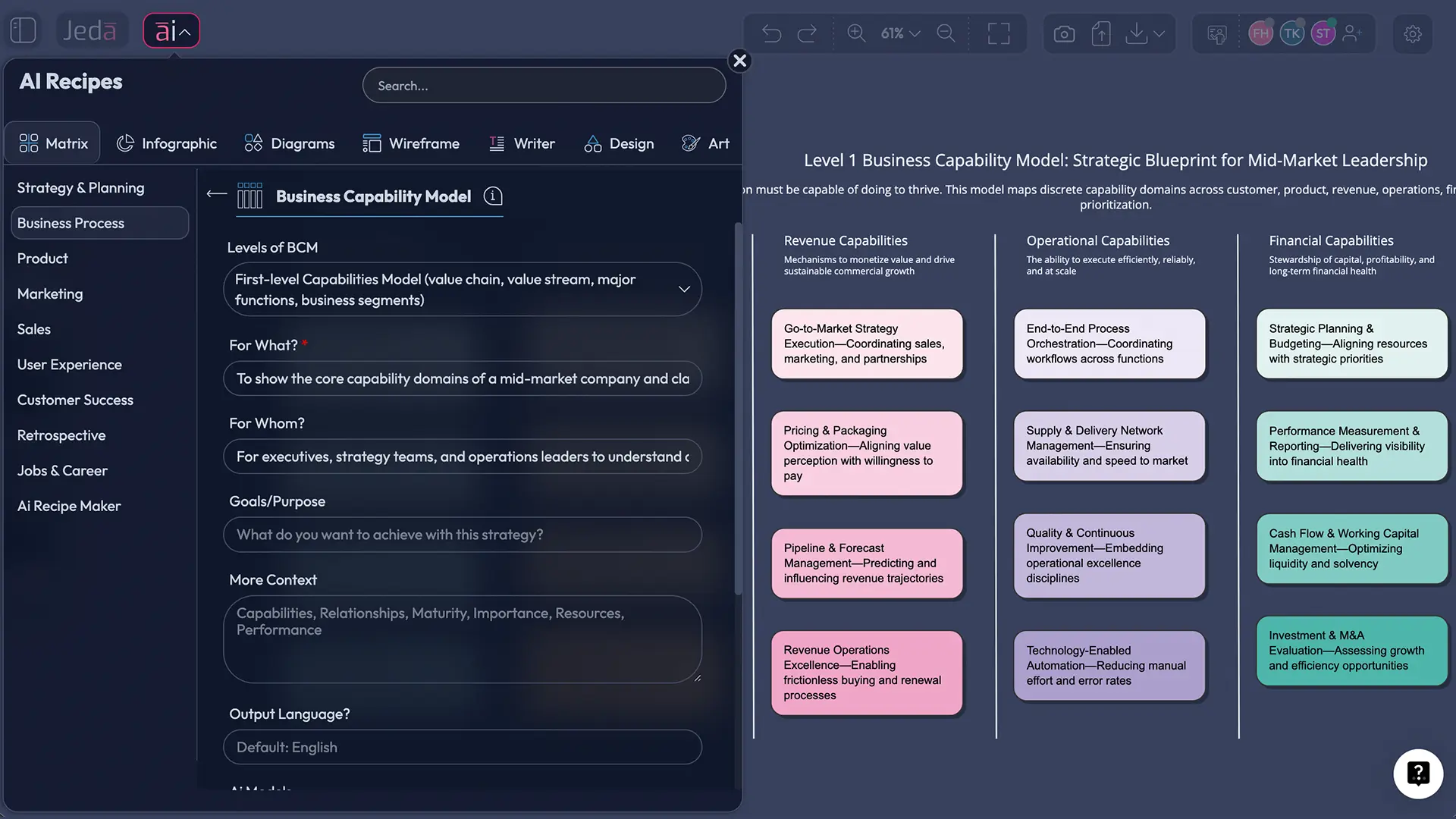
A first-level business capabilities model with AI gives you the one thing most strategy teams never quite pin down: the top layer of what the business must be able to do. Not the org chart. Not the process manual. The actual capability backbone. This is where a level 1 business capability map earns its keep. In Jeda.ai, you can generate that top-layer view inside an AI Workspace, refine it in an AI Whiteboard, and keep the output editable instead of trapping it in a dead slide. That matters when 150,000+ users are already building working strategy visuals, not just admired diagrams.
What Is a First-level Business Capabilities Model?
A first-level business capabilities model is the top layer of a capability hierarchy. It shows the broad capability domains a business depends on to operate and compete. Think of these as the major “chapters” of the enterprise, not the paragraphs.
SAP LeanIX describes Level-1 capabilities as baseline capabilities the business needs in order to function, and recommends that organizations begin with a manageable top set before expanding into deeper layers. William Ulrich’s work on capability maps makes a similar point from a business architecture angle: the map becomes a stable language for planning, alignment, and change.
So what belongs here? Broad, durable areas such as Customer Management, Product Management, Revenue Management, Operations, Finance, Governance, or Human Resources. These are not workflow steps. They are not team names. They are not one-quarter initiatives dressed up as strategy.
That’s the trick. Keep Level 1 broad enough to stay stable, but specific enough to mean something.
How Level 1 Capabilities Relate to Value Chain, Value Stream, Major Functions, and Business Segments
This is where teams get tangled.
A value chain explains how a firm creates value across linked activities. Porter’s 1985 work is still the reference point here. A value stream shows the end-to-end flow of value from a customer or stakeholder perspective. Lean Enterprise Institute and Ardoq both frame value streams as the actions that deliver value from trigger to outcome.
A level 1 business capability map is different. It doesn’t show flow. It shows enduring business abilities.
That means these concepts connect, but they are not interchangeable:
- Value chain: the broad logic of value creation
- Value stream: the flow of value delivery
- Major functions: a useful reality check for broad business scope
- Business segments: a lens for where capabilities vary by market, product line, or operating model
- Level 1 capabilities: the stable top-layer abilities that enable all of the above
Look, this matters because many first drafts go wrong right here. Teams paste value-stream stages into a capability map and end up with verbs everywhere. Or they copy departments and call it architecture. Same mess, nicer typography.
A better move is to use value chain and value stream thinking as input, then build Level 1 capability domains that remain stable across process changes, system changes, and even some operating-model changes.
Why Use AI for Level 1 Capability Mapping?
Because the top layer is deceptively hard.
Anyone can throw seven boxes on a slide. The problem is deciding which seven belong there, which ones overlap, and which ones are really just departments pretending to be capabilities. AI helps because it can synthesize strategy notes, product mix, market structure, and existing operating-model language into a usable first draft.
But AI shouldn’t be the judge. It should be the accelerator.
That’s where Jeda.ai has an edge. You can start with a matrix recipe, shape the output visually in an AI Whiteboard, cross-check the map with stakeholders, and then use AI+ to deepen one selected area at a time. That last point is important. AI+ is best for extending an already generated section. It is not the place to dump a giant custom instruction set and expect architecture magic.
- Top-layer clarity
Generate broad capability domains before the team disappears into low-level detail.
- Context from real inputs
Use strategy notes, operating-model summaries, or uploaded documents to ground the first draft in reality.
- Faster stakeholder alignment
Review the top-level map live with leaders, analysts, and transformation owners in one workspace.
- Selective deep dive
Use AI+ on one chosen capability cell or branch when you want more detail after the base map exists.
- Cross-view thinking
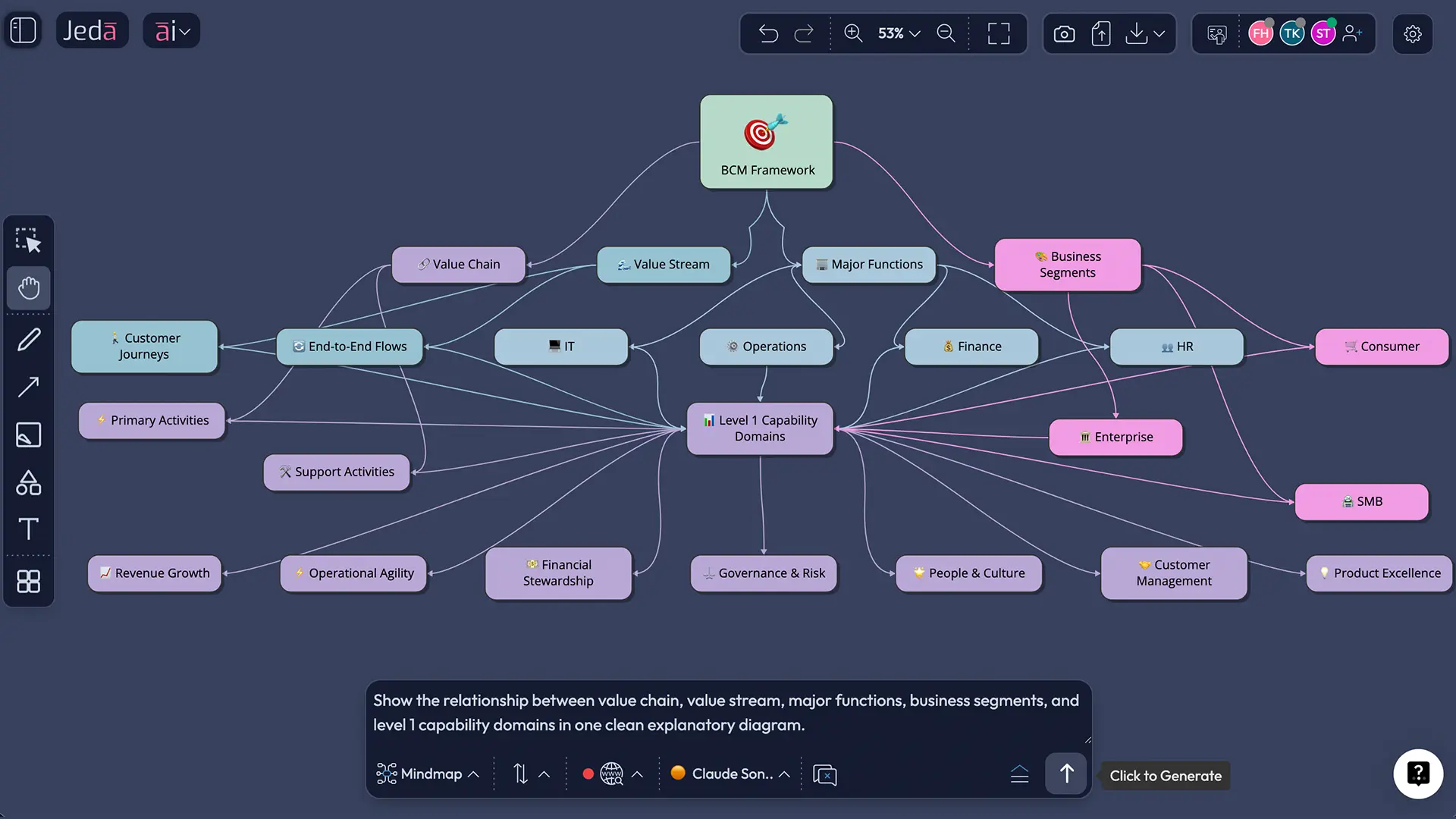
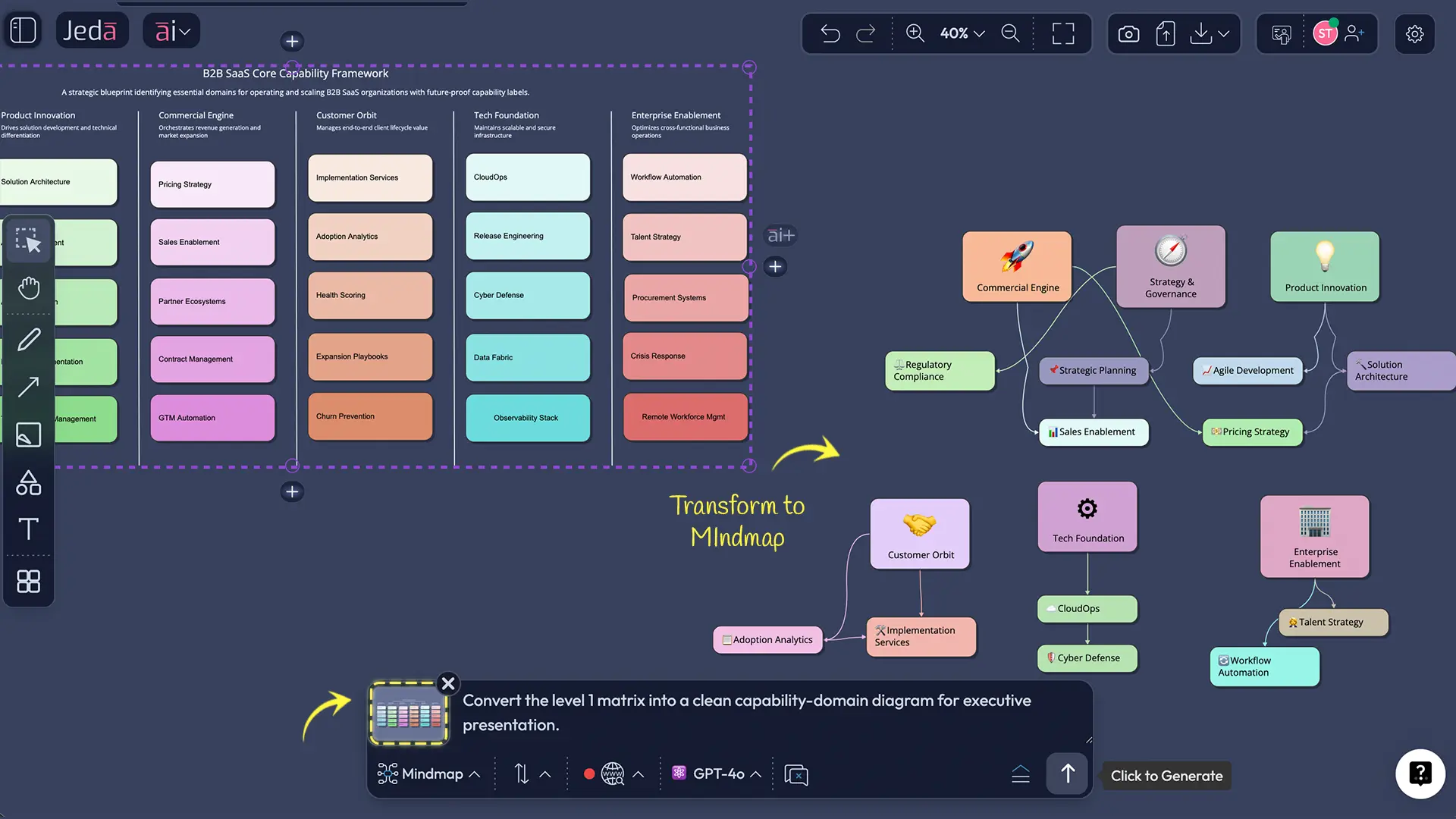
Generate the matrix first, then transform the output into a diagram if the team needs another angle.
- Strategy-first structure
Keep the map centered on enduring business abilities instead of temporary initiatives or departments.
How to Create a Level 1 Business Capability Map in Jeda.ai
You asked for two methods. So here they are.
Method 1: Recipe Matrix
This is the recommended route when you want a single matrix output for top-layer capability domains.
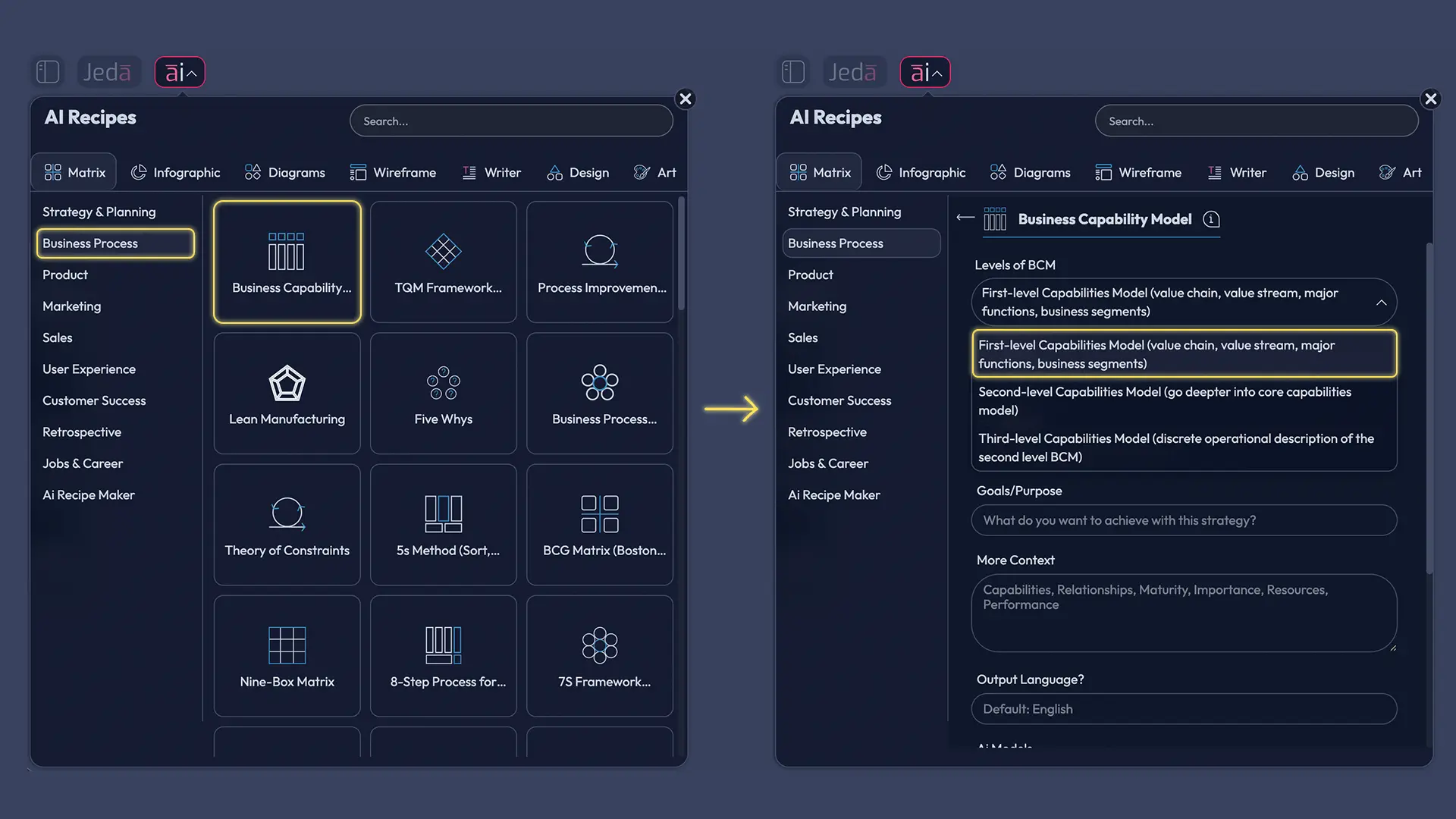
- Open the AI Menu in Jeda.ai.
- Choose the First-level Business Capabilities Model recipe flow available in your workspace.
- Enter the business context: industry, business model, main value streams, major segments, and any strategic priorities.
- Generate the matrix.
- Review the output and remove anything that looks like a department, workflow step, or initiative label.
- Select any weak cell and tap the AI+ button to extend it with more depth or alternative naming.
- If the team wants a different lens, use Vision Transform to convert the matrix into a diagram.
Method 2: Prompt Bar
Use this when you want more control over the wording.
- Open the Prompt Bar at the bottom of the canvas.
- Select the Matrix command.
- Enter a prompt that asks for a first-level business capability map only.
- Press Enter to generate.
- Refine names, merge overlaps, and validate the top layer with stakeholders.
- Use AI+ to deepen one selected area after the model exists.
- Open the Matrix recipe flow
Start in the AI Menu and choose the Matrix recipe available in your workspace so the output begins as a single structured matrix.
- Add business scope and context
Include the company type, strategic goals, value streams, and segments so the matrix reflects the real business instead of a generic template.
- Generate Level 1 domains only
Tell Jeda.ai to create top-layer capability domains and stop before level-2 or process detail.
- Cross-check against value logic
Review the matrix against the company’s value chain, value streams, major functions, and business segments to catch gaps or overlap.
- Refine the naming
Rename vague boxes, remove departments and workflow verbs, and keep the structure stable, broad, and outcome-focused.
- Use AI+ for selective deepening
Select one generated area and use AI+ to extend it. AI+ works best for a focused deep dive after the base matrix already exists.
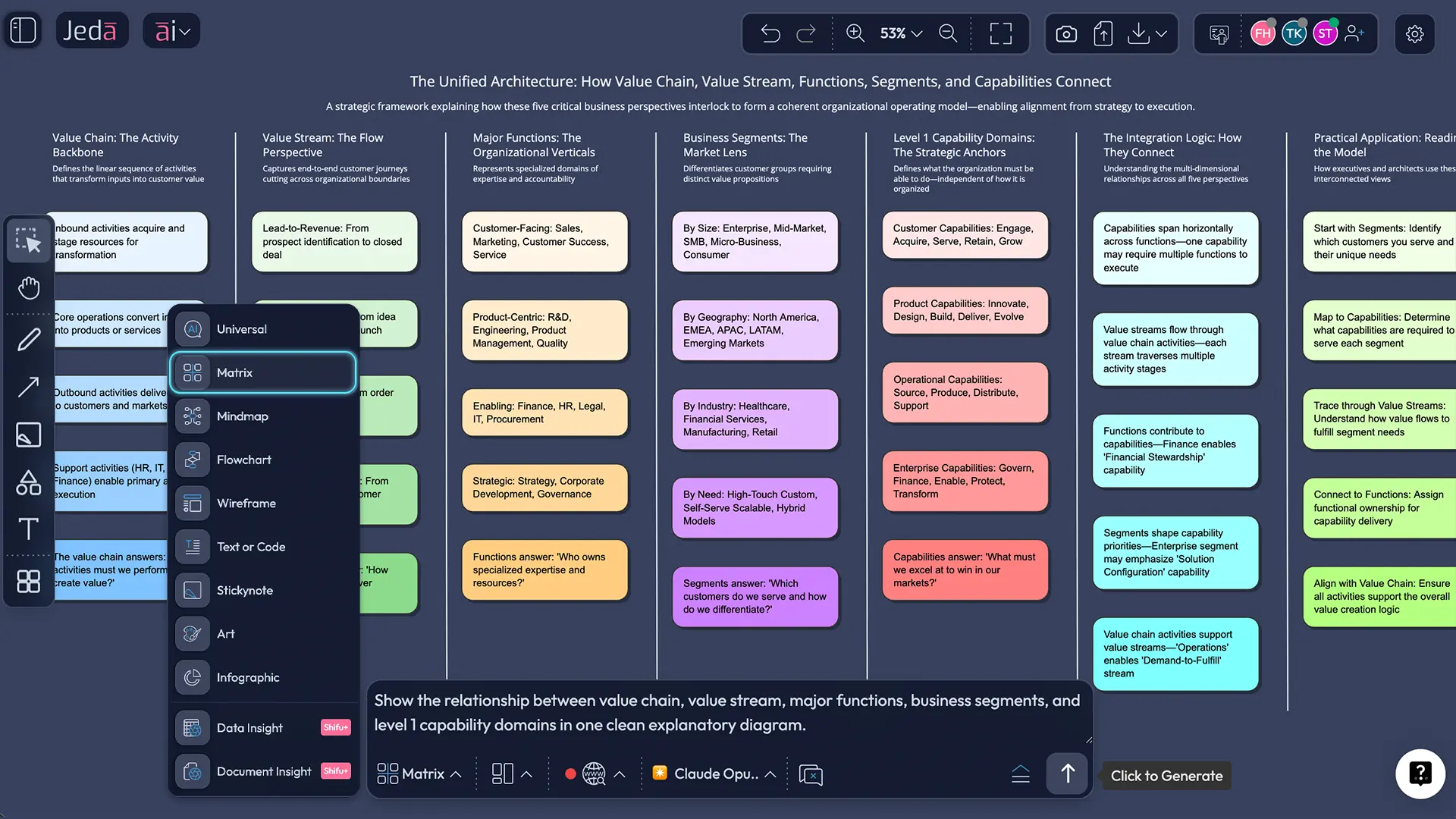
A prompt that usually works well:
First-level Business Capability Map Example
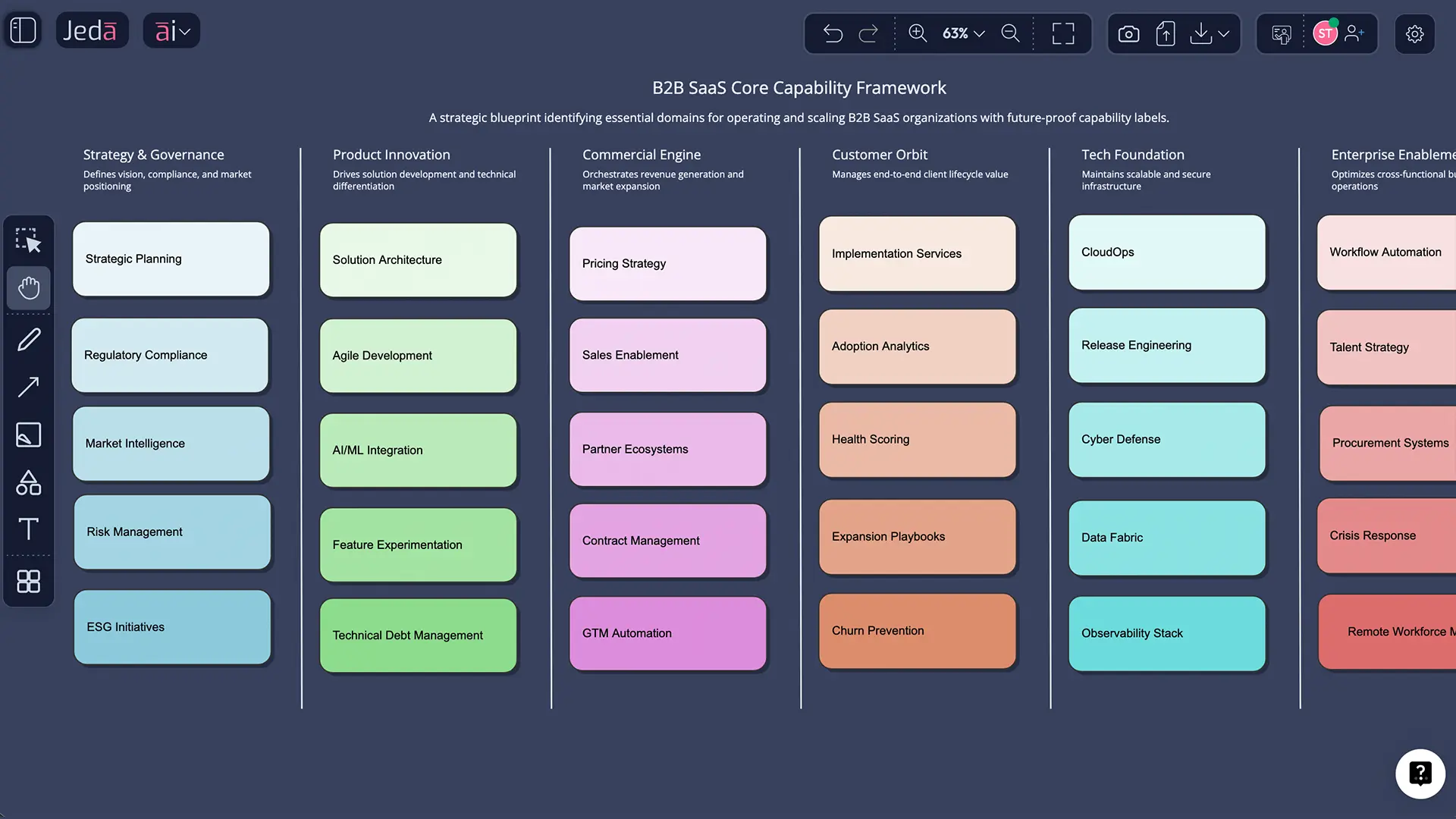
Let’s use a simple example: a B2B SaaS company selling to mid-market teams.
A weak first draft usually starts with Sales, Marketing, Product, Support, Finance, and HR. That feels familiar. It also smuggles in departments.
A stronger first-level model might look more like this:
- Strategy and Planning
- Customer and Market Management
- Revenue Management
- Product and Service Management
- Service Delivery and Operations
- Enterprise Support and Governance
Why is that better? Because it reflects what the business must be able to do, not how the current org chart happens to divide labor this year. Under that top layer, you can later build Level 2 and Level 3 without rewriting the whole map every time the company reorganizes.
And this is where the topical cluster helps. Once you lock the top layer, the natural next step is to decompose it into the Second-level Business Capabilities Model with AI, then into the Third-level Business Capabilities Model with AI. Start broad. Then go deeper where it actually matters.
Best Practices for a Clean Top-layer Map
One more opinionated take: don’t over-polish the first workshop output. The first job of a Level 1 map is clarity, not decoration.
Common Mistakes to Avoid
The first mistake is copying departments straight into the map. That gives you politics, not architecture.
The second is confusing value streams with capabilities. A value stream flows. A capability endures.
Third, teams go too deep too soon. They start breaking boxes apart before they agree on the top layer. That burns time and creates fake precision.
And the fourth one is subtle. They ask AI for “a business capability model” with no context, then act surprised when the result looks like a generic MBA poster. AI needs real business scope. Otherwise it hallucinates with confidence. A dangerous hobby.
Frequently Asked Questions
- What is a level 1 business capability map?
- A level 1 business capability map is the top layer of a capability hierarchy. It shows the broad business domains an organization must be able to perform, without dropping into detailed sub-capabilities, processes, or team structures.
- What belongs in level 1 capabilities?
- Level 1 should include broad, stable capability domains such as customer management, product management, revenue management, operations, finance, governance, or people management. The exact labels vary, but they should stay outcome-focused and enterprise-wide.
- How many level 1 capabilities should a company have?
- Many teams begin with roughly 7 to 10 top-level capabilities because that range keeps the map readable and useful. You can add detail later, but the first layer should stay clear enough for leaders to understand quickly.
- Is a level 1 capability map the same as a value chain?
- No. A value chain explains how value is created across linked activities. A level 1 capability map shows the enduring business abilities that support value creation. They relate to each other, but they are not the same structure.
- How do value streams relate to level 1 capabilities?
- Value streams show the end-to-end flow of value from a stakeholder perspective. Level 1 capabilities show the top-layer business abilities that enable those streams. Value streams are a useful input when you validate the capability domains.
- Can AI generate level 1 business capabilities?
- Yes, AI can generate a strong first draft when you provide real business context. But stakeholders still need to validate naming, scope, and overlap so the final top layer reflects the enterprise rather than a generic template.
- Should I use AI+ to create the whole map from scratch?
- Usually no. AI+ works best after the base matrix exists. Use it to deepen one selected generated area, propose alternative labels, or extend a chosen section. It is better at focused extension than full first-pass specification.
- What comes after a level 1 business capability map?
- After Level 1 is validated, teams usually move into Level 2 decomposition for core capabilities and then Level 3 for discrete operational sub-capabilities. That sequence keeps the model organized and easier to govern.
- Can I export the result from Jeda.ai?
- Yes. Jeda.ai exports PNG, SVG, and PDF. The platform reference does not confirm native PowerPoint or Word export, so teams typically place the exported visual into decks or strategy documents afterward.
Sources & Further Reading
- [1]
Porter, Michael E. (1985) . “Competitive Advantage: Creating and Sustaining Superior Performance” Free Press / Harvard Business School listing.
View Source ↗ - [2]
SAP LeanIX (2026) . “SAP LeanIX Business Capability Map” SAP LeanIX.
View Source ↗ - [3]
SAP LeanIX (2026) . “How to Create a Business Capability Map?” SAP LeanIX Wiki.
View Source ↗ - [4]
SAP LeanIX (2026) . “What is Business Capability: Definition & Mapping” SAP LeanIX Wiki.
View Source ↗ - [5]
Ardoq (2024) . “Differences Between Business Capabilities, Processes, & Value Streams” Ardoq Knowledge Hub.
View Source ↗ - [6]
Lean Enterprise Institute (2026) . “Value Stream Mapping Overview” Lean Lexicon.
View Source ↗ - [7]
Ulrich, William (2011) . “The Business Capability Map: The 'Rosetta Stone' of Business/IT Alignment” Cutter Consortium / Business Architecture Associates.
View Source ↗
Create Your First-level Capability Map in Jeda.ai
Join 150,000+ users building strategy visuals in Jeda.ai’s AI Workspace and AI Whiteboard with 300+ strategic frameworks and editable matrix workflows.
Try Free Template