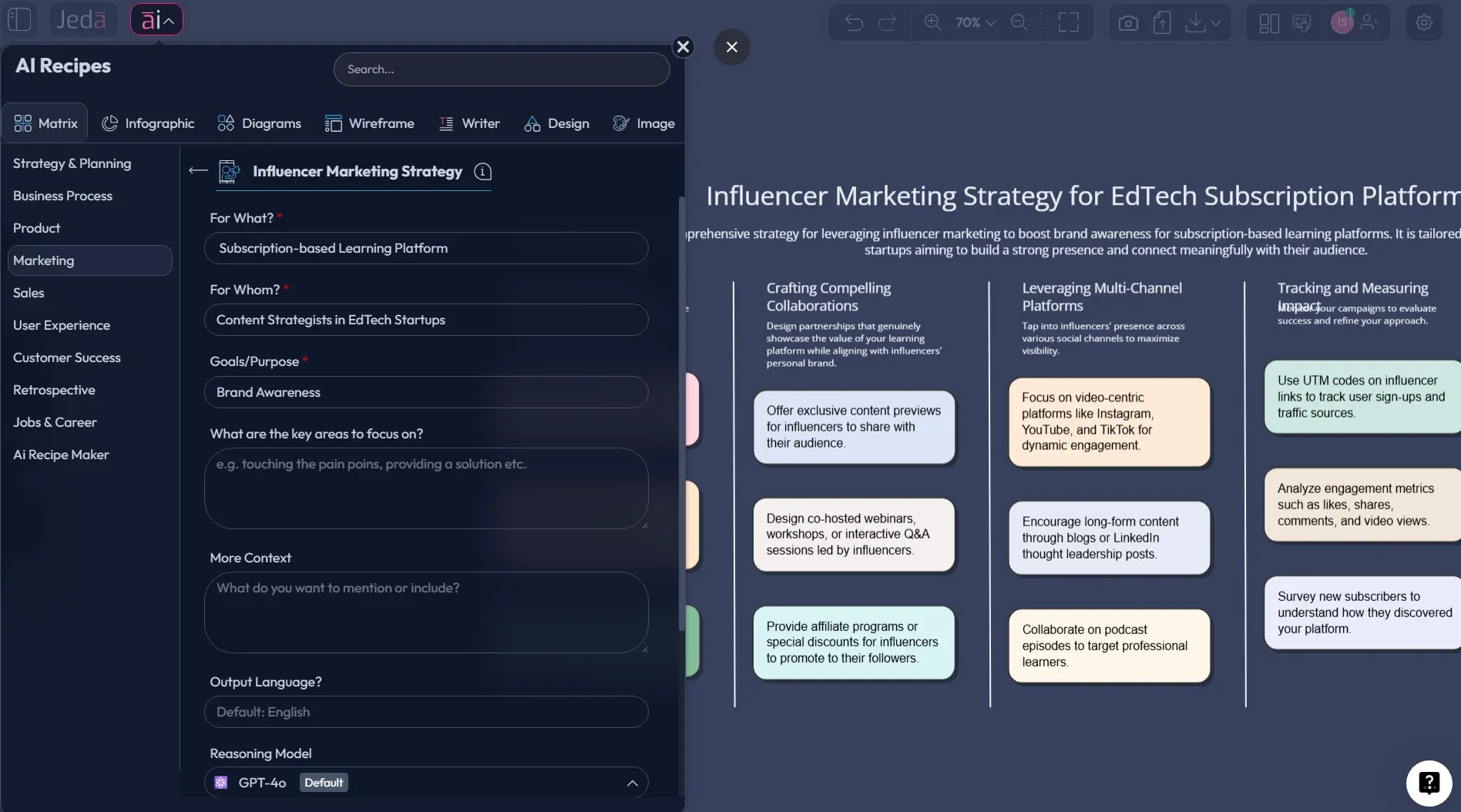
If your influencer program still lives in six tabs, three DMs, one half-finished deck, and a spreadsheet nobody trusts, you do not have a strategy. You have activity. Influencer Marketing Strategy with AI gives you a cleaner way to plan the whole system inside one AI Workspace: goals, creator fit, content direction, compliance, measurement, and next-step decisions. In Jeda.ai, that strategy becomes an editable matrix on an AI Whiteboard, not a static memo that dies after the kickoff.
And that difference matters. The strongest influencer programs are not built on follower envy. They are built on fit, credibility, creative freedom, disclosure discipline, and measurement. Recent meta-analyses show influencers can materially improve engagement and purchase intention, but the lift depends on credibility, platform context, content value, and influencer-brand fit rather than raw popularity alone.
What is Influencer Marketing Strategy with AI?
Influencer Marketing Strategy with AI is a structured planning approach that uses AI to turn a vague creator-marketing idea into an operating model. Instead of asking, “Which influencer should we hire?” the strategy asks better questions first: What business outcome matters, which audience segment matters most, what kind of creator can shift behavior, what proof will count as success, and what could go sideways?
That’s why a matrix format works so well. It forces trade-offs into the open.
In Jeda.ai, the matrix usually includes columns such as business goal, audience segment, creator profile, platform, content angle, offer or CTA, measurement plan, compliance checks, and optimization actions. You can then extend any weak section with the AI+ button, convert the matrix into a supporting diagram with Vision Transform, and collaborate on the board live inside the AI Workspace. This is far more useful than a one-page brief because the thinking stays editable.
Academic work backs the need for that structure. Recent evidence shows influencer outcomes are shaped by credibility, authenticity cues, relationship dynamics, and product-platform fit, while over-endorsement can weaken purchase intention by hurting perceived authenticity and trust.
Why use influencer marketing with AI instead of managing it manually?
Manual influencer planning breaks in the same predictable places: bad creator fit, fuzzy briefs, vanity metrics, weak attribution, and legal sloppiness. AI helps most when it reduces those planning errors before money leaves the building.
- Goal-first planning
Map each campaign to awareness, consideration, conversion, retention, or UGC capture instead of blending everything into one vague brief.
- Creator-fit logic
Match creators to audience, category, voice, and buying stage so selection is based on relevance and resonance, not only reach.
- Measurable ROI
Build tracking into the strategy from the start with UTMs, codes, landing pages, attributed revenue, assisted conversions, and brand-lift indicators.
- Compliance discipline
Keep disclosure rules, claim controls, and review steps visible so campaigns do not wander into avoidable legal trouble.
- Always-on optimization
Compare creator cohorts, content formats, and platform performance each cycle, then revise the plan instead of repeating weak bets.
- From matrix to action
Use the matrix for strategic framing, then convert it into a diagram, flow, or campaign board inside the same Visual AI workflow.
Here’s the blunt version: AI will not rescue a sloppy strategy. But it will help a serious team move faster, ask sharper questions, and make the planning visible. That is the useful part.
The matrix we recommend for Influencer Marketing Strategy with AI
The recipe works best when the matrix answers one row-level question: what creator move are we making, for whom, and why should it work?
A strong version includes these columns:
That structure also reflects the current research. Micro and meso influencers often look attractive because they can produce stronger engagement than larger accounts in the right context, while creator credibility and authenticity remain central drivers of performance. At the same time, research on over-endorsement and virtual endorsers shows trust can erode fast when the match feels forced or overly commercial.
How to create Influencer Marketing Strategy with AI in Jeda.ai
Because this sits under the Marketing matrix-recipe lane, the cleanest approach is to use the AI Menu first, then use the Prompt Bar when you want tighter control. After that, use AI+ for deeper analysis. Jeda.ai supports both workflows in one AI Workspace, and the final board stays editable on the AI Whiteboard. The platform guidance for recipes, command selection, AI+, Vision Transform, exports, pricing, and collaboration comes from the workflow and Jeda.ai user-guide documents.
- Open a workspace in Jeda.ai
Create or open a board in Jeda.ai. Use the canvas as the shared planning surface for your campaign strategy.
- Method 1: Use the AI Menu recipe
Open the AI Menu at the top-left, go to Matrix Recipes, choose the Marketing category, select the Influencer Marketing Strategy recipe, fill in the guided fields, and click Generate.
- Method 2: Use the Prompt Bar
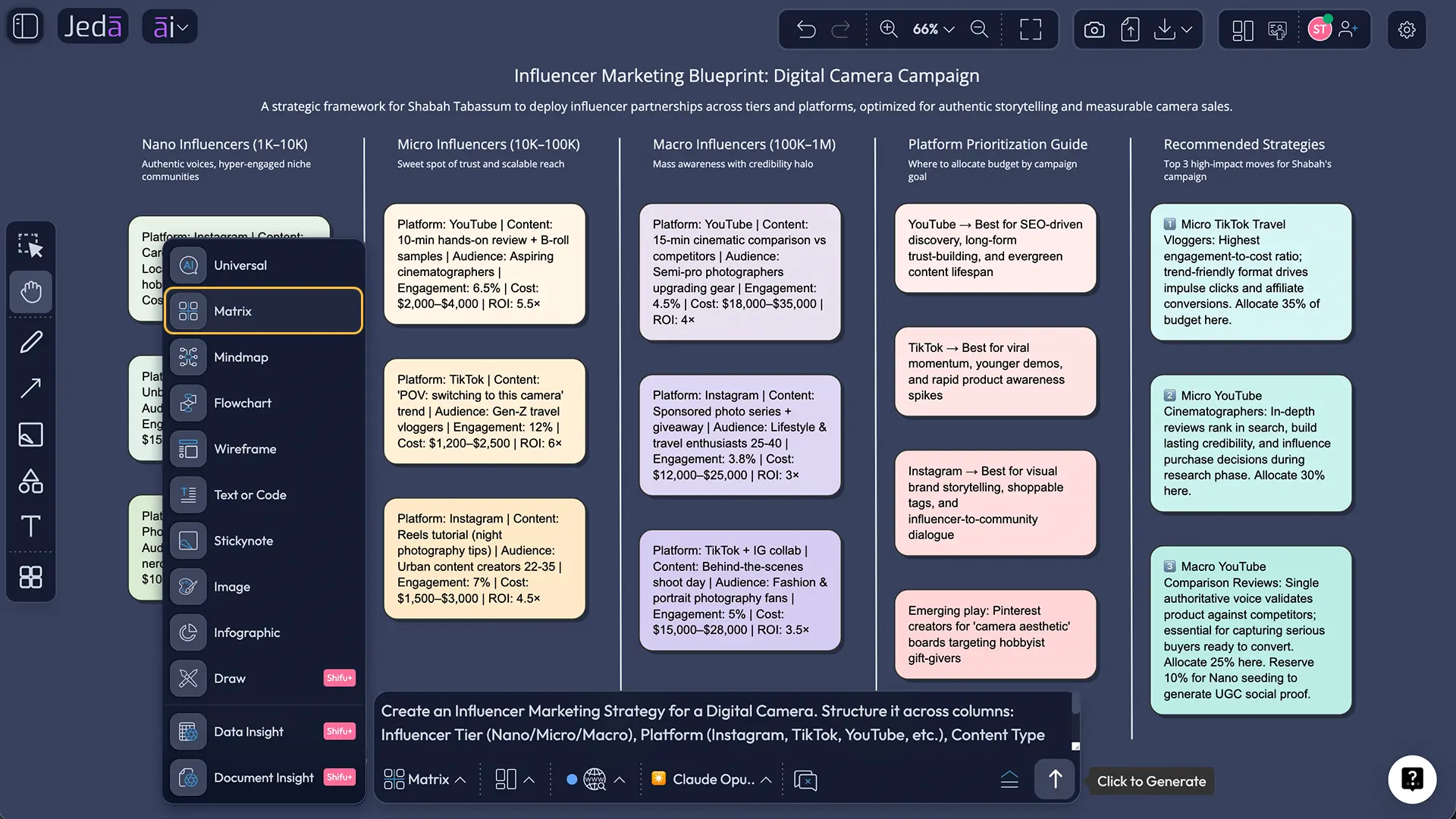
Open the Prompt Bar at the bottom, choose the Matrix command, paste the strategy prompt, and generate the board. This is the better option when you want custom columns or a tighter scoring model.
- Add proof and context
Attach campaign briefs, social screenshots, creator examples, sales notes, audience insights, or performance exports. Use Document Insight or Data Insight when you need supporting material summarized into the board.
- Use AI+ for the deep dive
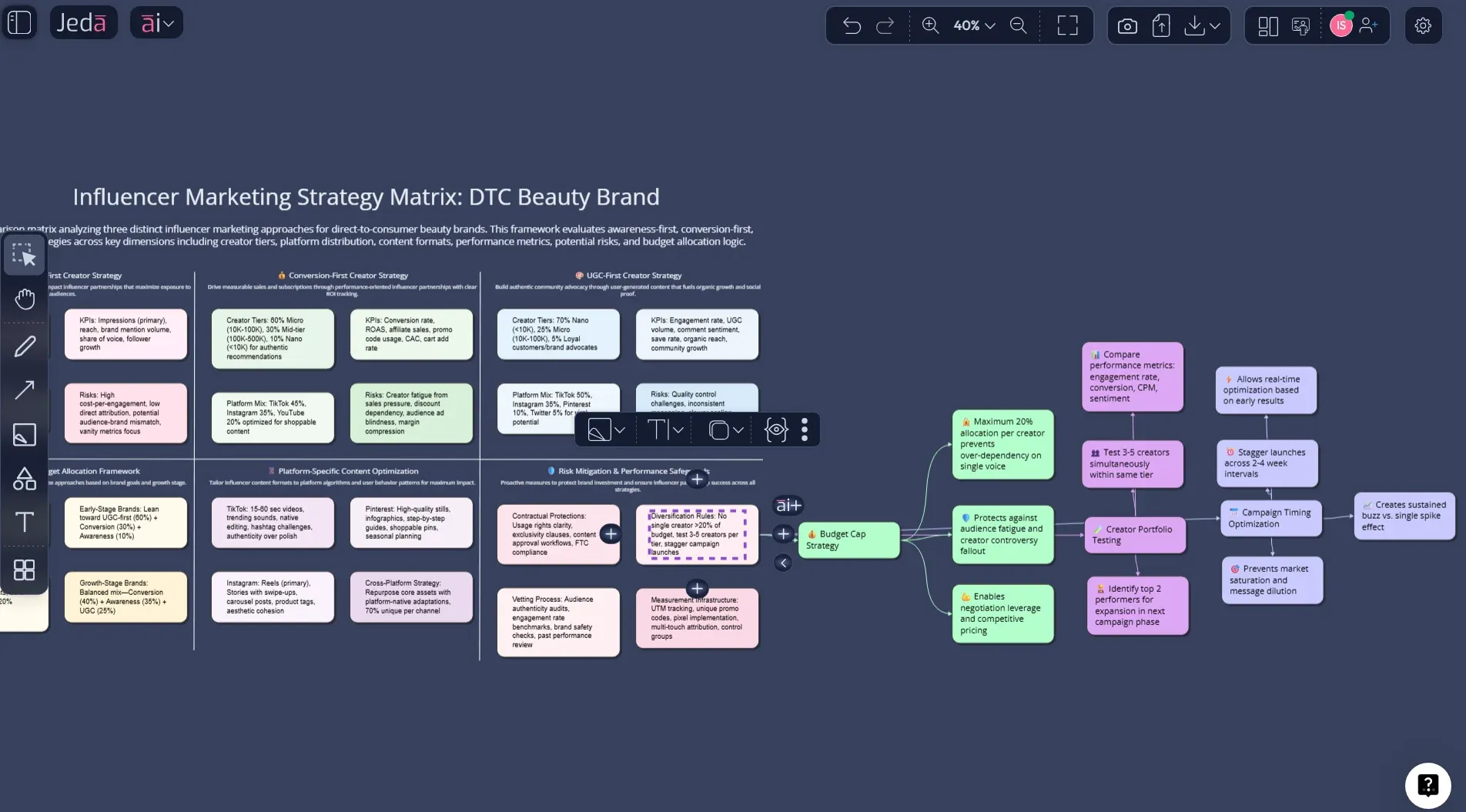
Select a weak area such as creator selection, compliance, or KPI design, then tap AI+ to extend it. This is the right move when the team needs a deeper breakdown but does not want to rebuild the whole matrix.
- Convert and share
Use Vision Transform to convert the matrix into a supporting diagram or workflow, collaborate with the team, and export the result as PNG, SVG, or PDF.

Copy-paste prompt for Method 2 — Prompt Bar → Matrix
Prompt:
Create an Influencer Marketing Strategy matrix for [brand / product].
Target audience: [audience]. Primary business goal: [awareness / leads / sales / retention / UGC].
Include columns for: Objective, Audience segment, Creator tier, Platform, Content angle, Offer / CTA, Tracking plan, Compliance checks, Risks, and Optimization actions.
Recommend the best creator mix across nano, micro, macro, and flagship options.
Keep it specific, measurable, and decision-ready. End with 5 questions the team must answer before launch.
A practical example: how the strategy changes by business goal
This is where most teams get caught. They treat influencer marketing like one channel with one playbook. It is not.
1) Awareness-first launch
Use this when people do not know the category, the product, or the problem. Prioritize creators with strong relevance and storytelling ability. Your matrix should weight message clarity, audience overlap, earned reach, save/share behavior, and search lift more heavily than immediate sales.
2) Conversion-first push
Use this when demand exists but trust or urgency is missing. Now your matrix should prioritize proof style, offer integration, click quality, landing-page continuity, promo code use, and affiliate or attributed revenue.
3) UGC and paid-creative engine
Use this when the main win is not just the post itself, but the creative asset stream. Here the matrix should score creators on brief adherence, hook strength, editing quality, usage rights, repurposability, and brand-safety consistency.
That is why the board matters. One visual lets your marketing team, product team, and leadership team see the same trade-offs inside the AI Workspace. No side arguments about what “good” means.

Use AI+ for the deep dive: what should you extend?
The user note for this page is dead right: AI+ should drive the deeper analysis, not a hyper-specific command request. In practice, that means you first generate the main strategy matrix, then extend the uncertain parts.
Good AI+ extension targets include:
- Creator fit analysis — why a creator matches the audience, category, and purchase stage
- Risk review — where disclosure, claim language, or brand safety could fail
- Content angle expansion — how one creator idea can become three platform-native variations
- Measurement model — what should count as leading indicators versus revenue outcomes
- Optimization logic — which underperforming rows to cut, fix, or double down on
Then convert the strongest branch into a supporting diagram.
Best practices that separate serious influencer programs from expensive chaos
A few rules keep showing up in both research and actual operator playbooks.
Choose resonance over vanity reach
The right audience, message fit, and engagement quality usually matter more than a giant audience blob. That is why micro and meso creators keep earning attention from smart operators.
Give creators real constraints, then leave room
Clear briefs help. Over-scripted briefs hurt. The best campaigns define outcome, guardrails, disclosures, claims, and CTA path, then give the creator space to sound like themselves.
Track the full funnel, not one shiny number
Reach, video views, clicks, add-to-cart, affiliate sales, assisted conversions, and branded-search lift all matter in different situations. One KPI is a toy.
Keep disclosure visible and boringly compliant
The FTC’s current guidance is plain: material connections need to be clear and conspicuous. That belongs inside the strategy board, not as a last-minute legal footnote.
Build a program, not a string of one-offs
One post can create noise. A repeatable creator system creates learning.
Common mistakes to avoid
- Choosing creators because leadership recognizes the name. That usually means status-chasing, not audience logic.
- Using follower count as the main scoring variable. Easy way to overpay.
- Briefing for brand voice so hard that the content stops sounding human. Then the post feels like an ad wearing a hoodie.
- Treating compliance as cleanup. Disclosure, claims, and usage rights should be planned up front.
- Calling the campaign successful because engagement looked nice. Nice is not a business metric.
- Running single-post tests with no learning loop. If there is no structured review, you are buying anecdotes.
Frequently asked questions
- What is an influencer marketing strategy?
- An influencer marketing strategy is a structured plan for using creators to move a specific business outcome such as awareness, leads, sales, or UGC production. It defines audience, creator fit, platform, content rules, KPIs, attribution, risks, and review logic before launch.
- How is influencer marketing strategy different from a campaign brief?
- A strategy decides the system: who you target, which creator types matter, what success looks like, and how you will measure it. A campaign brief is narrower. It tells a specific creator what to produce within that larger plan.
- Should we use micro or macro influencers?
- Choose based on the job. Micro and meso creators often work well for niche trust, stronger engagement, and lower-risk testing. Macro or flagship creators can help when broad awareness or fast cultural reach matters. The strategy should score both options against the same KPI logic.
- What metrics should we track in influencer marketing?
- Track metrics that match the business objective. For awareness, use reach, views, saves, shares, and branded-search lift. For conversion, track clicks, landing-page conversion, code use, affiliate revenue, assisted conversions, and customer acquisition cost.
- How do we measure influencer ROI accurately?
- Start by defining the revenue or value event you care about, then connect each creator to trackable assets such as UTMs, promo codes, custom landing pages, affiliate links, or post-purchase surveys. Combine direct revenue with assisted outcomes so you do not under-credit upper-funnel creators.
- Why does authenticity matter so much?
- Authenticity matters because consumers use it as a shortcut for trust. When the partnership feels forced, over-commercial, or mismatched, credibility drops. Research consistently links trustworthiness, authenticity cues, and creator-brand fit to stronger engagement and purchase outcomes.
- What legal checks should be part of the strategy?
- Build in disclosure rules, claim approval, usage rights, prohibited language, and review ownership before launch. In the United States, the FTC expects material connections to be disclosed clearly and conspicuously, not buried where users can miss them.
- How does Jeda.ai help with influencer marketing planning?
- Jeda.ai lets teams generate an editable strategy matrix inside one AI Workspace, attach documents or data, collaborate live on an AI Whiteboard, extend weak sections with AI+, and convert the plan into supporting diagrams or workflows without leaving the board.
- Can Jeda.ai export the final strategy board?
- Yes. Export your board from Jeda.ai as PNG, SVG, or PDF. Those formats work well for reviews, handoffs, and archived campaign planning.
- Is Jeda.ai suitable for small teams or only enterprise users?
- It works for both. Whitebelt starts free, Blackbelt adds more usage and collaboration, and Shifu adds Multi-LLM intelligence with an Aggregator. So a lean team can start small, while a larger team can run deeper planning workflows in the same platform.
Sources and further reading
- [1]
Pan, M., Blut, M., Ghiassaleh, A., & Lee, Z. W. Y. (2025) . “Influencer marketing effectiveness: A meta-analytic review” Journal of the Academy of Marketing Science.
View Source ↗ - [2]
Barari, M. M. et al. (2025) . “A meta-analysis of the effectiveness of social media influencers” Journal of the Academy of Marketing Science.
View Source ↗ - [3]
Joshi, Y. et al. (2025) . “Social media influencer marketing: foundations, trends, and directions” Electronic Commerce Research.
View Source ↗ - [4]
van der Harst, J. P. & Angelopoulos, S. (2024) . “Less is more: Engagement with the content of social media influencers” Journal of Business Research.
View Source ↗ - [5]
Cheah, C. W. et al. (2024) . “Social media influencer over-endorsement: Implications for consumer purchase intentions” Journal of Retailing and Consumer Services.
View Source ↗ - [6]
Federal Trade Commission (2023–2026 guidance page) . “Endorsements, Influencers, and Reviews” FTC.
View Source ↗
Build Your Influencer Strategy on a Real Board
Join over 150,000+ users who use Jeda.ai’s AI Workspace to turn messy campaign planning into editable, decision-ready visuals.
Try Free Template