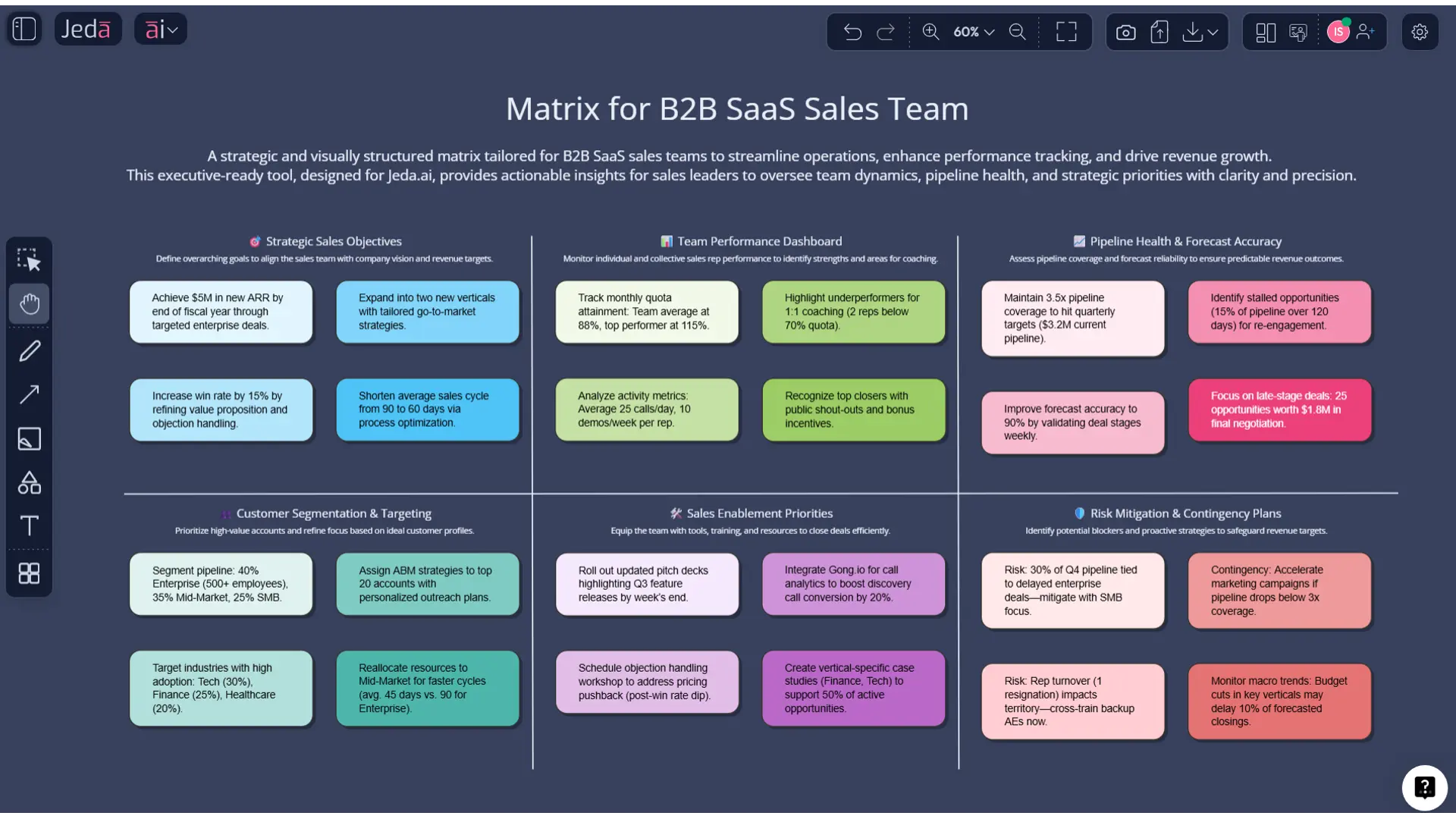
A sales follow up strategy usually breaks down for a simple reason: teams confuse activity with design. They send a few emails, maybe leave a voicemail, maybe nudge someone on LinkedIn, then call it a process. It isn’t. It’s improvisation dressed up as discipline. In Jeda.ai, you can turn that mess into a living system inside an AI Workspace and AI Whiteboard—one that maps timing, channels, message themes, buyer signals, objections, and next-best actions in a format your team can actually edit, share, and reuse.
And yes, that matters. Recent sales guidance still points to persistence, smart spacing, and multichannel touches as the basics of a working cadence, but most ranking pages stop at static templates and generic advice. Outreach recommends starting with tighter spacing, then widening intervals over time; one of its 2026 cadence guides suggests two to three business days for the first follow-up, then four to seven days later in the sequence, often across more than one channel. HubSpot’s 2026 sales statistics page also continues to cite the familiar gap: many reps give up too early, while successful sales often require at least five follow-ups.
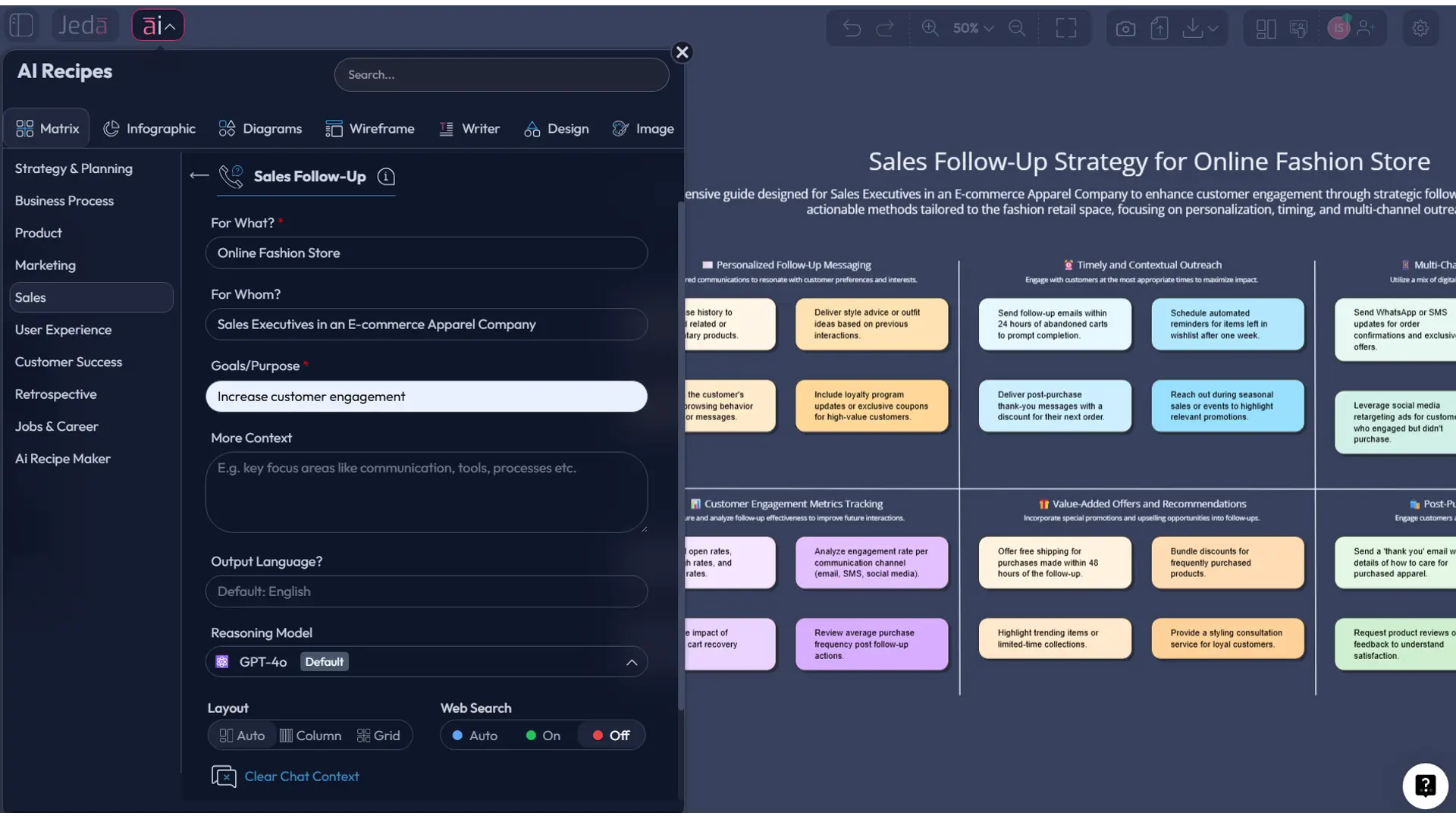
That’s where Jeda.ai is different. The point is not just to write a better email. The point is to generate an editable, collaborative follow-up framework that helps your reps decide what to send, when to send it, why this touch exists, and what outcome to push toward next. The uploaded workflow file requires a structured resource-page format with both Method 1: Recipe Matrix and Method 2: Prompt Bar, plus an AI+ extension path. The Jeda.ai platform docs also confirm the right constraints: Matrix outputs are editable, AI Recipes live in the AI Menu, web search is a platform feature, and AI+ expands an existing visual rather than generating a narrowly predefined deep dive from scratch.
What is a sales follow up strategy?
A sales follow up strategy is a structured plan for re-engaging prospects after an initial touchpoint. It defines who gets followed up, when they get contacted, which channel is used, what value is delivered in each step, and what signal determines the next move. Good strategies don’t rely on memory. They rely on decision rules.
That sounds obvious. Yet the live SERP tells a different story. Most current pages ranking for this topic are really email-template collections, blog-style best-practice posts, or cadence explainers from vendors such as Zendesk, Cognism, Highspot, Outreach, Atlassian, and HubSpot. They do a decent job on timing, templates, and persistence. What they rarely do is turn follow-up into a visual operating system your team can adapt by segment, funnel stage, and deal context. A practical sales follow up strategy usually covers seven elements:
- Trigger event
- Buyer stage
- Channel mix
- Message objective
- Value asset or proof point
- CTA for that touch
- Exit or escalation rule
That last one gets ignored a lot. But it matters. Atlassian’s Loom sales follow-up guide explicitly recommends knowing when to step back, and notes that after roughly six or seven unsuccessful attempts, it may be time to pause or close the loop politely.
Why use Sales Follow Up Strategy with AI?
Because most teams don’t have a messaging problem first. They have a system problem.
An AI-assisted follow-up workflow helps you move from scattered outreach to a repeatable strategy board. Instead of storing next steps across CRM notes, inbox drafts, Slack messages, and rep memory, you create one editable source of truth. In Jeda.ai, that can live inside a Visual AI board where the logic is visible, collaborative, and easy to optimize.
The strongest current guidance on cadence leans toward three ideas: persistence, multichannel sequencing, and clear timing intervals. Outreach recommends gradually expanding touch spacing; its 2026 email-cadence guidance also says multichannel outreach tends to outperform single-channel campaigns, often combining LinkedIn and email first, then calls later. Highspot’s 2026 sales cadence guide adds another layer: follow-ups work better when the asset shared is tailored to the prospect’s role, pain point, or industry.
Jeda.ai lets you operationalize those ideas visually instead of treating them as loose tips.
- Map the full cadence
Build a Matrix that shows timing, channel, message angle, proof point, and CTA for every touch.
- Generate smarter variants
Use Jeda.ai to create multiple follow-up paths for warm leads, demo no-shows, stalled deals, or post-trial users.
- Refine with AI+
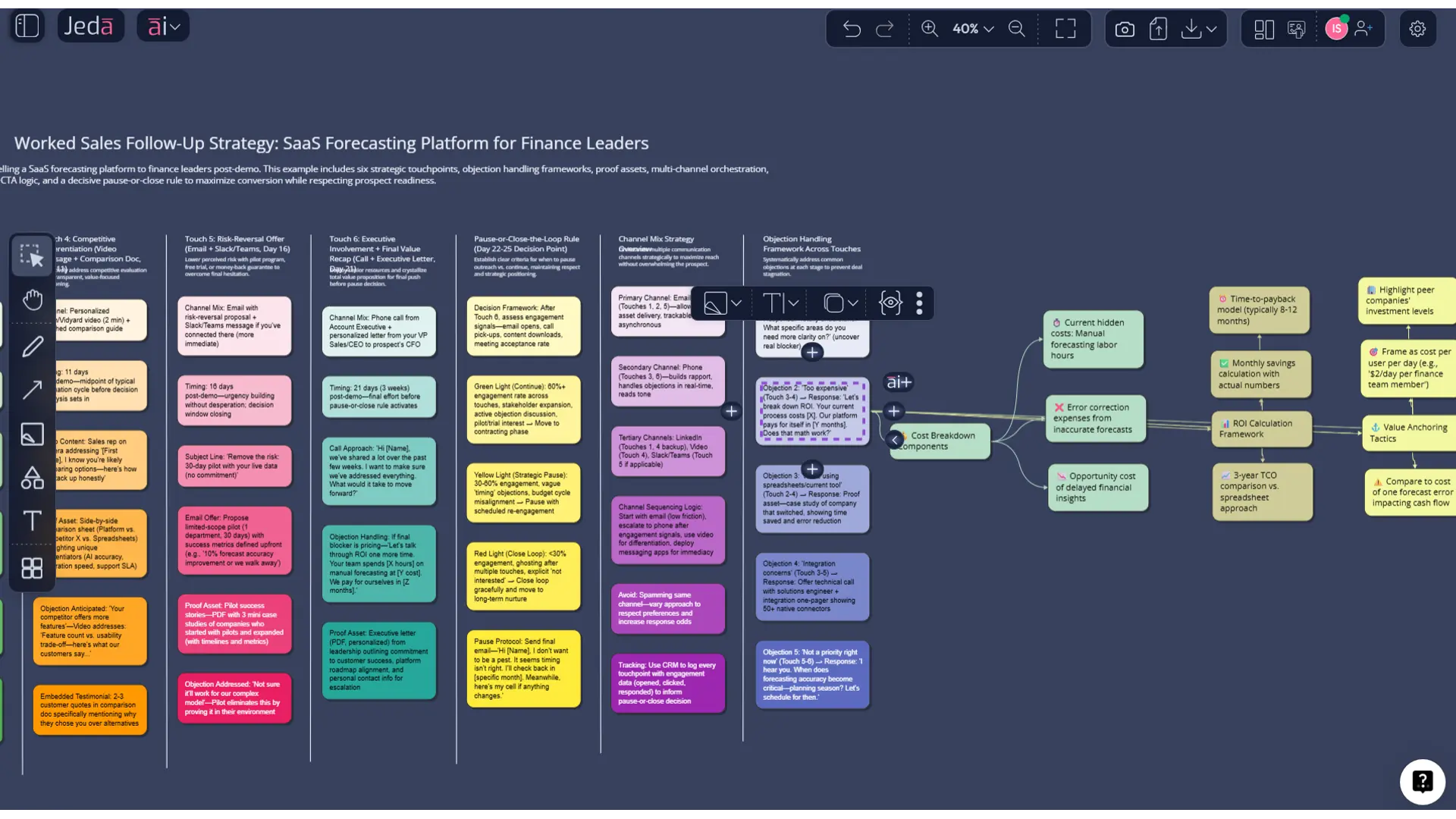
Tap the AI+ button on any section to extend a branch, add objections, or generate alternative messaging logic.
- Ground with web context
Because web search is a platform capability, you can enrich a board with current market context and examples when needed.
- Collaborate on one board
Sales, RevOps, founders, and consultants can review the same system inside an AI Whiteboard instead of trading screenshots.
- Convert and reuse
Use Vision Transform to turn your matrix into a flowchart, mind map, or diagram for training, onboarding, or deal reviews.
Look at the competitive gap and it becomes pretty clear. The market gives you templates. Jeda.ai gives you a working model. That difference is the whole game.
How to create a Sales Follow Up Strategy in Jeda.ai
Because this topic is a Matrix Recipe under the Sales category, the best setup is to use the AI Menu first, then use the Prompt Bar when you want more freedom or want to build a custom variant. That structure aligns with the uploaded workflow and with Jeda.ai’s documented recipe system and prompt-bar behavior. Matrix outputs are editable, AI Recipes are accessed from the AI Menu, and AI+ extends what is already on the canvas.
Method 1: Recipe Matrix
This is the cleaner way to start when you want a structured board fast.
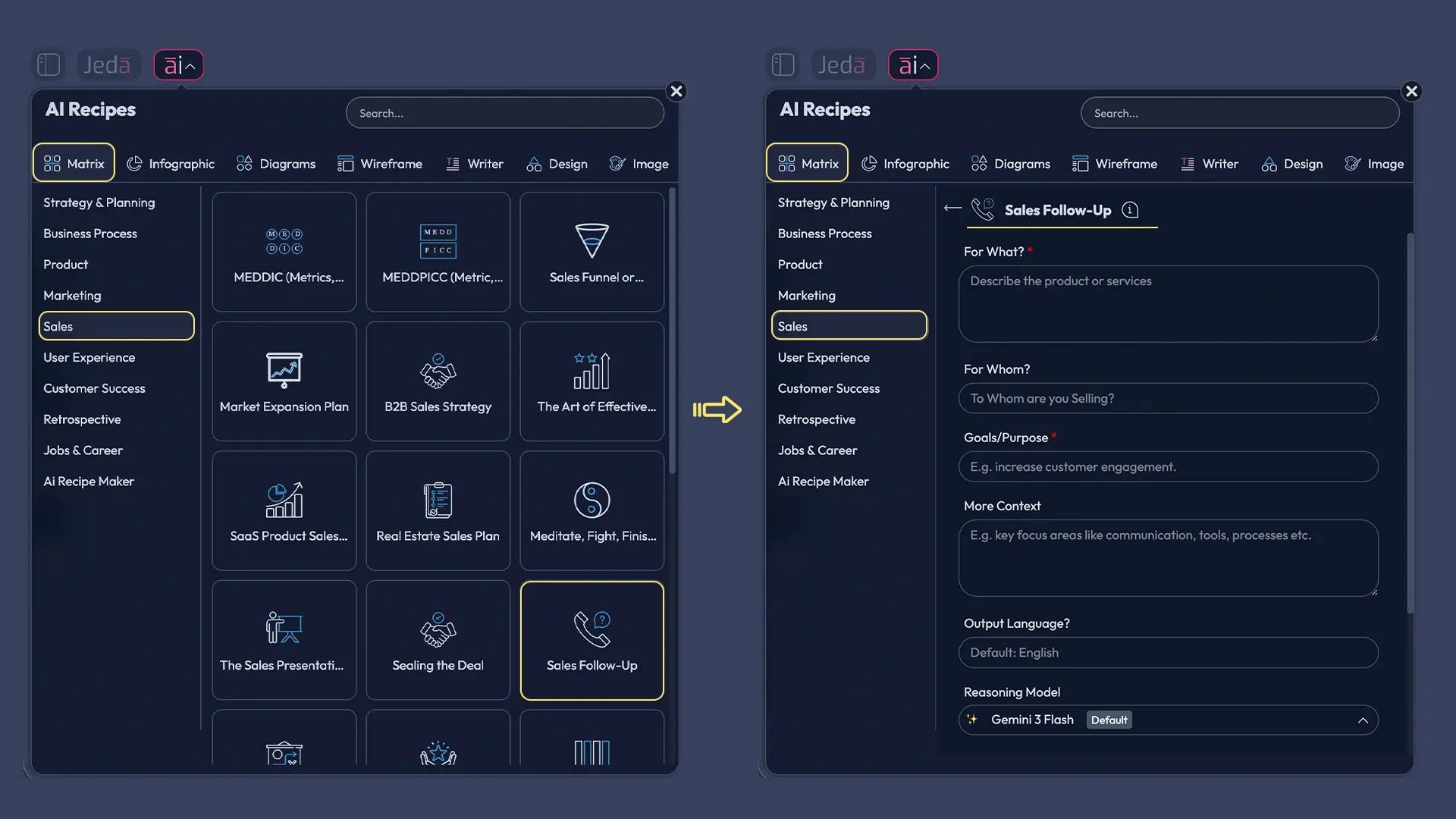
- Open the AI Menu
Click the AI Menu in the top-left of the Jeda.ai canvas, then choose Matrix Recipes under the Sales category.
- Select the Sales Follow Up Strategy recipe
Pick the Sales Follow Up Strategy matrix recipe and fill in buyer type, sales context, goal, objections, trigger event, and desired CTA.
- Generate the matrix
Let Jeda.ai build an editable matrix showing follow-up stages, channel choices, timing windows, message themes, value assets, and next actions.
- Customize for your motion
Edit rows or columns for inbound leads, cold outbound, demo follow-up, free-trial conversion, stalled deals, or reactivation plays.
- Extend with AI+
Select any matrix section and use AI+ to expand the strategy with extra objection handling, alternate sequence ideas, or industry-specific follow-up branches.
- Transform for enablement
Use Vision Transform to convert the matrix into a flowchart or mind map for rep onboarding, leadership review, or sales-playbook documentation.
Method 2: Prompt Bar
This is better when you want a custom version, a narrower audience, or a board built around a specific scenario.
Start with the Matrix command in the Prompt Bar. Then enter a prompt that includes the audience, sales motion, trigger, channel mix, cadence logic, and CTA goals.
A strong example prompt:
Build a sales follow up strategy matrix for a B2B SaaS company selling to CFOs. Include touchpoint number, timing, channel, message objective, proof asset, objection addressed, CTA, and stop-or-escalate rule. Keep the sequence professional, concise, and multichannel.
You can also generate a scenario-specific board:
Create a sales follow up strategy for demo no-shows in mid-market SaaS. Use seven touches across email, LinkedIn, and phone. Include subject-line direction, value hook, and next-step CTA for each touch.
Why this works: it makes the AI specify logic, not just copy.
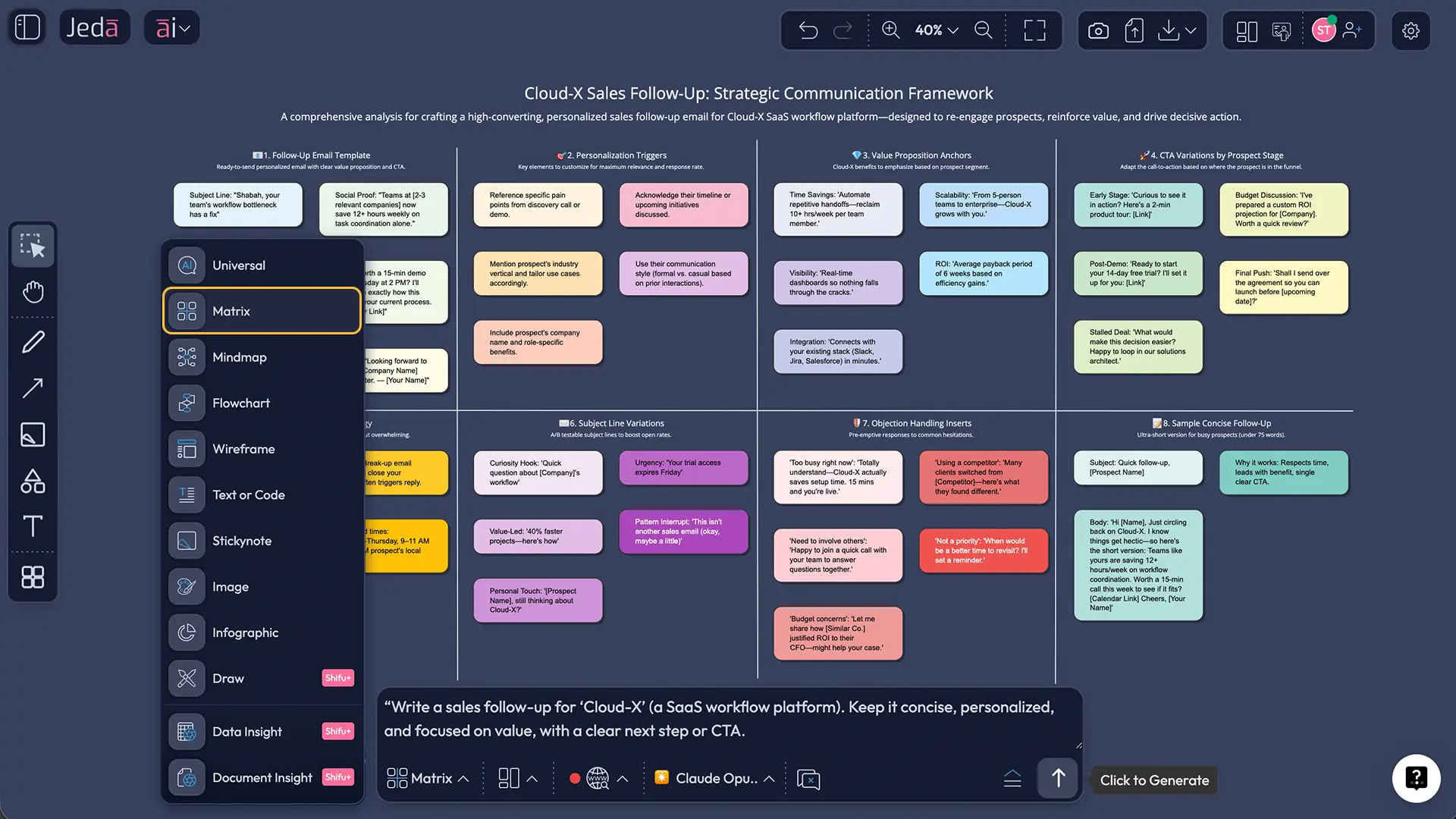
AI+ button generated deep dive
Here’s the right way to handle the AI+ extension for this page. The workflow note says nothing overly specific should be asked of AI+; that’s consistent with how the product works. AI+ extends what is already there. It is not a magic microscope for tiny one-off instructions. So the move is to generate the main strategy board first, select the most useful section, then use AI+ to deepen it in-context.
Good AI+ use cases:
- Extend the “stalled opportunity” row into a longer nurture path
- Expand “objections” into more nuanced resistance patterns
- Add role-based variants for CFO, COO, or VP Sales
- Add extra value assets by funnel stage
- Extend a reactivation path for cold leads
Bad AI+ use case:
- “Write exactly one perfect email for a prospect named Sarah at a healthcare startup with three objections and a Tuesday timeline.”
That’s too narrow. Wrong tool.
Sales Follow Up Strategy template and example
Let’s make this concrete.
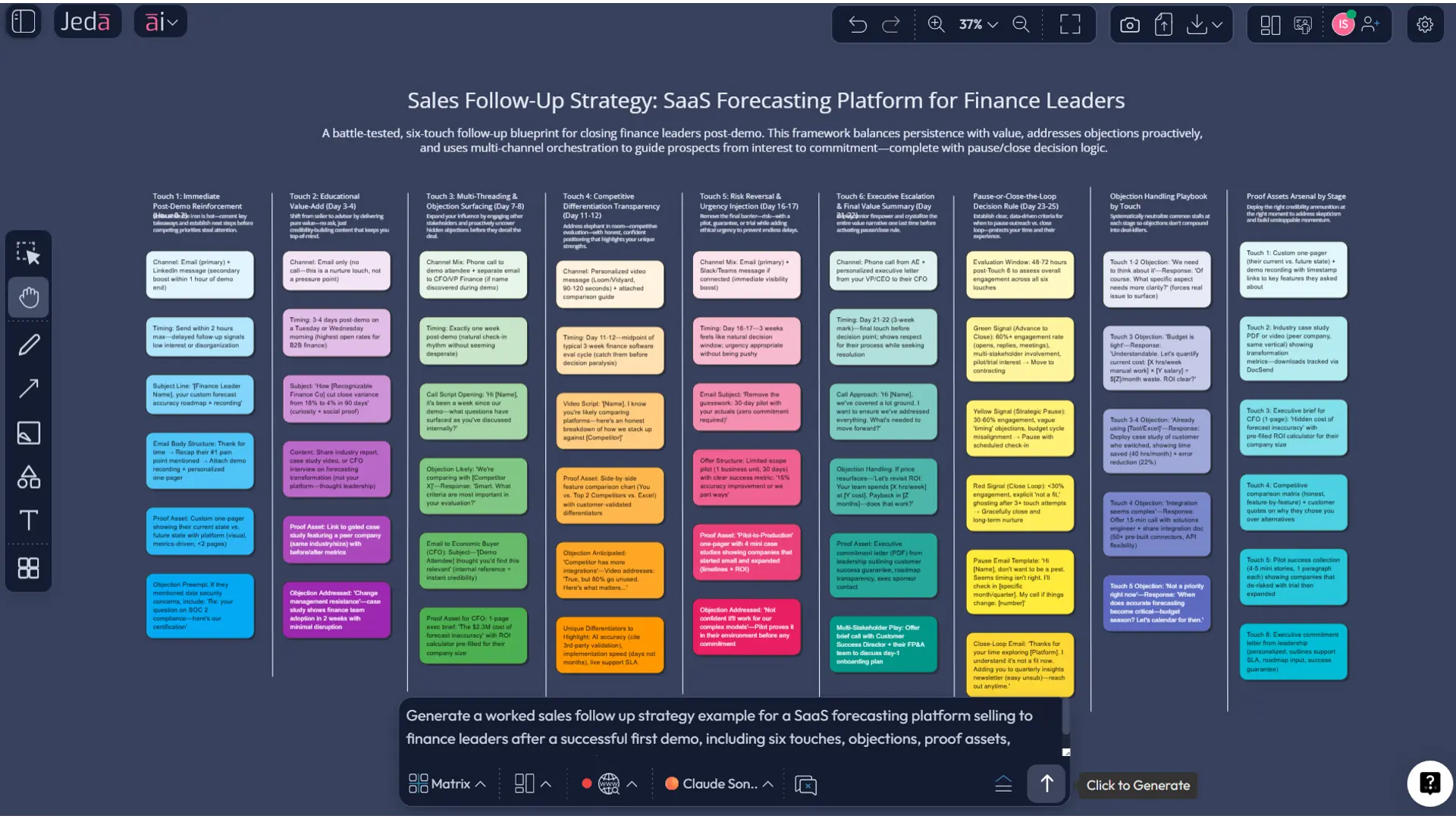
Imagine a mid-market SaaS team selling forecasting software to finance leaders. The first demo goes well, but the buyer goes quiet after asking for “a bit of time.” That is not a dead lead. It’s a decision stall. Your board should reflect that.
A useful matrix could include columns like:
- Trigger
- Touch window
- Channel
- Message angle
- Supporting asset
- Risk or objection
- CTA
- Owner
And then the row logic might look like this:
- Touch 1, within 24 hours: recap conversation, confirm the business problem, send a short next-step CTA
- Touch 2, 2-3 business days later: share a relevant case study tailored to finance leaders
- Touch 3, 4-5 days later: quick LinkedIn nudge referencing the original issue
- Touch 4, 6-7 days later: call + voicemail + concise email with one clear question
- Touch 5, 7+ days later: objection-focused follow-up with ROI framing
- Touch 6: breakup-style message or pause signal with easy re-entry option
That isn’t random. It matches the broad patterns current sales sources keep repeating: quick first follow-up, polite persistence, mixed channels, useful assets, and clear next steps. Cognism summarizes this pretty well with “respond quickly, stay politely persistent, and make the next step crystal clear,” while Outreach recommends a gradually widening sequence instead of a frantic barrage.
Best practices for a stronger sales follow up strategy
This is the part most teams skip because it feels less exciting than templates. It’s also the part that separates adults from chaos.
First, build around buyer stage, not rep anxiety. A prospect who just signed up for a trial should not get the same sequence as someone who ghosted after legal review.
Second, make each touch do one job. One email should not try to recap the meeting, handle objections, pitch the roadmap, share a case study, and ask for a meeting. That’s not persuasion. That’s a junk drawer.
Third, vary the proof. Highspot explicitly emphasizes using role- and industry-relevant assets in follow-up. That means one touch might use a case study, another a short comparison, another a customer quote, another a one-minute explainer. Fourth, use multiple channels with intent. Outreach’s 2026 email-cadence guidance recommends using two to three channels rather than relying on email alone. In B2B, that usually means email plus LinkedIn, then calls for the right prospects.
Common mistakes to avoid
The first mistake is treating follow-up like a copywriting exercise only. It’s a systems problem first.
The second is over-emailing because email is easy. Current cadence advice keeps leaning toward multichannel for a reason: one channel rarely captures real buying behavior well enough on its own. The third is using vague “just checking in” language. Nobody asked for that masterpiece.
The fourth is forgetting organizational design. One academic paper that still matters here—The Sales Lead Black Hole—showed that lead follow-up behavior depends not just on rep effort, but on lead prequalification quality, managerial tracking, rep experience, and process design across the organization. In plain English: if your system is sloppy, your follow-up will be sloppy too.
The fifth is never defining when to stop. Atlassian’s Loom guidance says balance matters, and after repeated failed attempts it can be smarter to close the loop cleanly than keep hammering the same contact forever.
Frequently asked questions
- What is the best sales follow up strategy?
- The best sales follow up strategy is a structured, multichannel sequence tied to buyer stage, value delivery, and a single CTA per touch. It should define timing, channel, proof asset, next step, and when to pause or escalate.
- How many follow-ups should a sales rep send?
- A practical starting point is five to eight touches, then adjust by deal size, intent, and engagement. HubSpot's 2026 sales statistics still cite the common benchmark that many successful sales require five or more follow-ups.
- How long should a sales follow up cadence last?
- For many B2B sequences, a cadence runs across several weeks rather than a few random days. Outreach's 2026 guidance recommends tighter spacing at the start, then wider intervals later; it also notes enterprise sequences often span one to two months.
- When should the first follow-up happen?
- The first follow-up should usually happen quickly after a meaningful trigger such as a meeting, demo, or trial signup. Several current sales guides treat the first 24 hours as the highest-leverage window for relevance and recall.
- Should follow-up be email only?
- No. Current best-practice guidance increasingly favors multichannel follow-up. Outreach says multichannel outreach tends to outperform single-channel outreach, often mixing LinkedIn, email, and phone based on context and engagement level.
- What should each follow-up include?
- Each follow-up should include one clear purpose, one useful value hook, and one obvious next step. Atlassian also emphasizes making the next action easy, while Highspot stresses sharing relevant, role-specific assets rather than generic content.
- How can AI improve a sales follow up strategy?
- AI can help design the cadence, generate variant messaging by persona or deal stage, surface objection patterns, and turn unstructured follow-up logic into a reusable board. In Jeda.ai, you can do that inside an editable AI Workspace rather than a static document.
- Can Jeda.ai create a sales follow up strategy visually?
- Yes. Jeda.ai can generate an editable Matrix for a sales follow up strategy through the AI Menu recipe or the Prompt Bar. You can then expand sections with AI+, convert the board with Vision Transform, and collaborate on the same AI Whiteboard.
- What is the difference between a sales cadence and a sales follow up strategy?
- A sales cadence is usually the scheduled sequence of touches. A sales follow up strategy is broader: it includes cadence, channel logic, value assets, CTA design, objection handling, ownership, and exit criteria. The cadence is one piece of the strategy.
- When should you stop following up?
- Stop or pause when the prospect is clearly unqualified, asks not to be contacted, or remains unresponsive after a defined sequence. Atlassian's Loom guide suggests that after roughly six or seven unsuccessful attempts, it may be time to close the loop respectfully.
Sources & Further Reading
- [1]
Andzulis, James M.; Panagopoulos, Nikolaos G.; Rapp, Adam A. (2012) . “The Sales Lead Black Hole: On Sales Follow-Up of Marketing Leads” Journal of Personal Selling & Sales Management.
View Source ↗ - [2]
HubSpot (2026) . “97 Key Sales Statistics to Help You Sell Smarter in 2025” HubSpot Blog.
View Source ↗ - [3]
Outreach (2026) . “How to Build a Sales Cadence That Generates Consistent Results” Outreach Blog.
View Source ↗ - [4]
Outreach (2026) . “Email Cadence Best Practices That Actually Boost Engagement” Outreach Blog.
View Source ↗ - [5]
Zendesk (2025) . “18 Sales Follow-Up Email Templates That Convert” Zendesk Blog.
View Source ↗ - [6]
Cognism (2025) . “Sales Follow Up: Timing, Templates & 7 Proven Tactics” Cognism Blog.
View Source ↗ - [7]
Atlassian / Loom (2024) . “Sales Follow Up Strategies to Boost Your Conversion Rates” Atlassian Blog.
View Source ↗ - [8]
Highspot (2026) . “The 10-Step Sales Cadence High-Performing Reps Use” Highspot Blog.
View Source ↗
Turn your sales follow up strategy into an editable board
Join over 150,000+ users who use Jeda.ai to turn messy sales logic into clear, collaborative decision systems inside one AI Workspace.
Try Jeda.ai Free