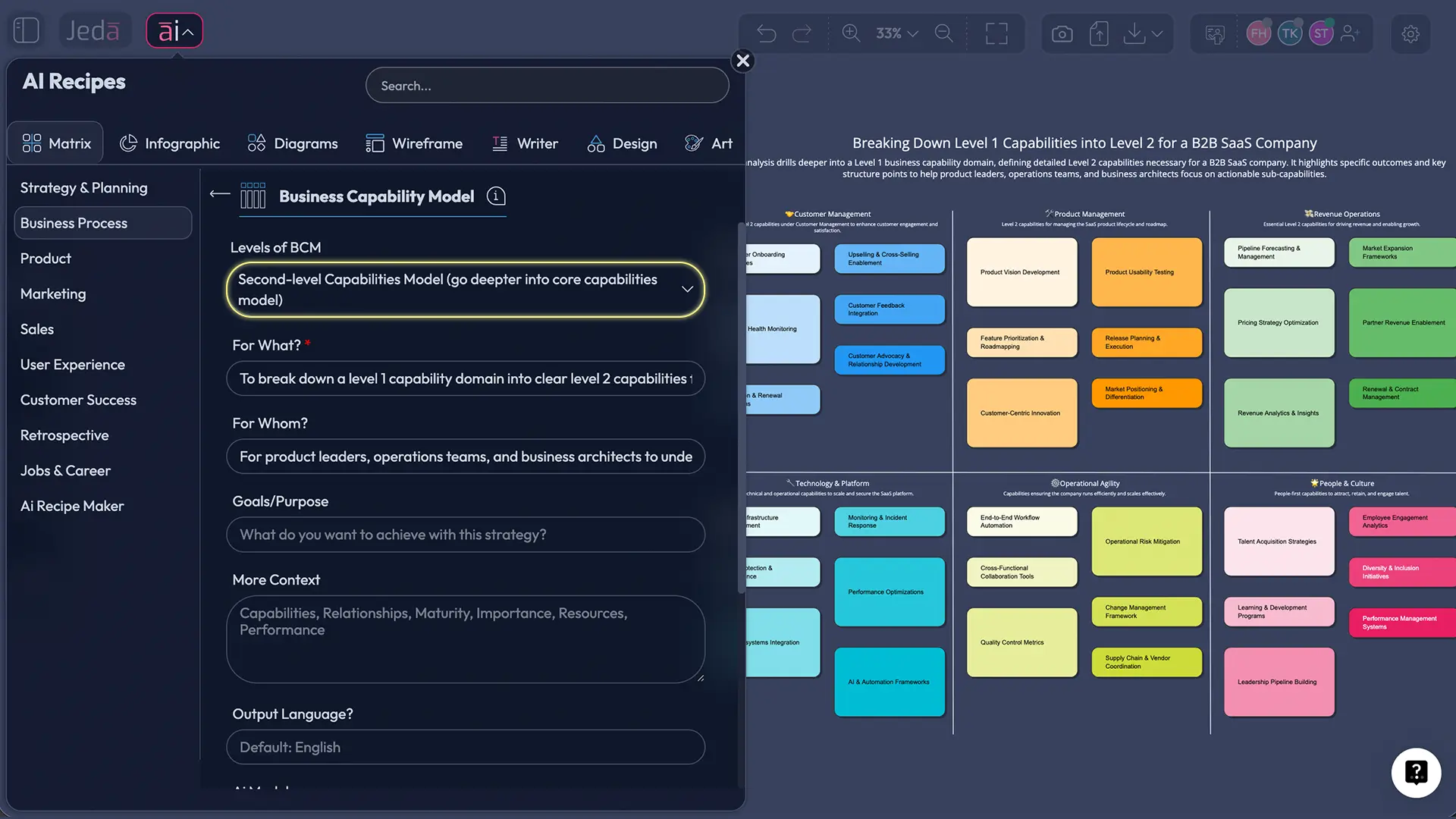
A second-level business capabilities model with AI is where a capability map starts becoming useful for real planning. The top layer tells you the broad domains. A level 2 business capability map tells you what sits inside those domains and which core capabilities actually deserve attention, ownership, and investment. That’s the difference between a decorative strategy diagram and something your team can use. In Jeda.ai, you can build that structure in an AI Workspace, refine it on an AI Whiteboard, and keep the whole thing editable as you learn more. Useful. Finally.
What Is a Second-level Business Capabilities Model?
A second-level business capabilities model is the layer that decomposes each Level 1 domain into more specific core capabilities. SAP LeanIX describes Level 2 capabilities as narrower in scope and supportive of Level 1 capabilities. That framing is clean and practical. Level 1 is the big chapter. Level 2 is the set of major subheadings.
This matters because a Level 1 map is rarely enough for planning. It gives direction, but not enough structure for prioritization, maturity scoring, ownership, or application mapping. Level 2 is where the model becomes specific enough to be useful while still staying above process detail.
A good Level 2 capability is still stable. It should express a distinct responsibility or business outcome that contributes to the parent domain. If your label starts reading like a workflow step or a ticket queue, you’ve gone too far.
How Level 2 Capabilities Support Level 1 Domains
Level 2 capabilities exist to give the top layer shape.
Take a Level 1 domain like Customer Management. It sounds useful, but it’s still broad. At Level 2, you can break that down into capabilities such as Customer Segmentation and Targeting, Customer Acquisition, Customer Service and Retention, and Account Growth. LeanIX uses very similar examples to show how Level 2 becomes the working structure beneath the top layer.
What does that buy you? Clarity.
You can now ask better questions:
- Which Level 2 capabilities are strategically critical?
- Which ones are mature?
- Which ones are under-supported by systems?
- Which ones are overloaded by manual work?
- Which ones need ownership clarification?
And here’s the important part: not every Level 1 domain needs the same decomposition depth right away. Decompose where strategy, risk, or investment pressure is highest. Leave the rest lighter until there’s a reason to go deeper.
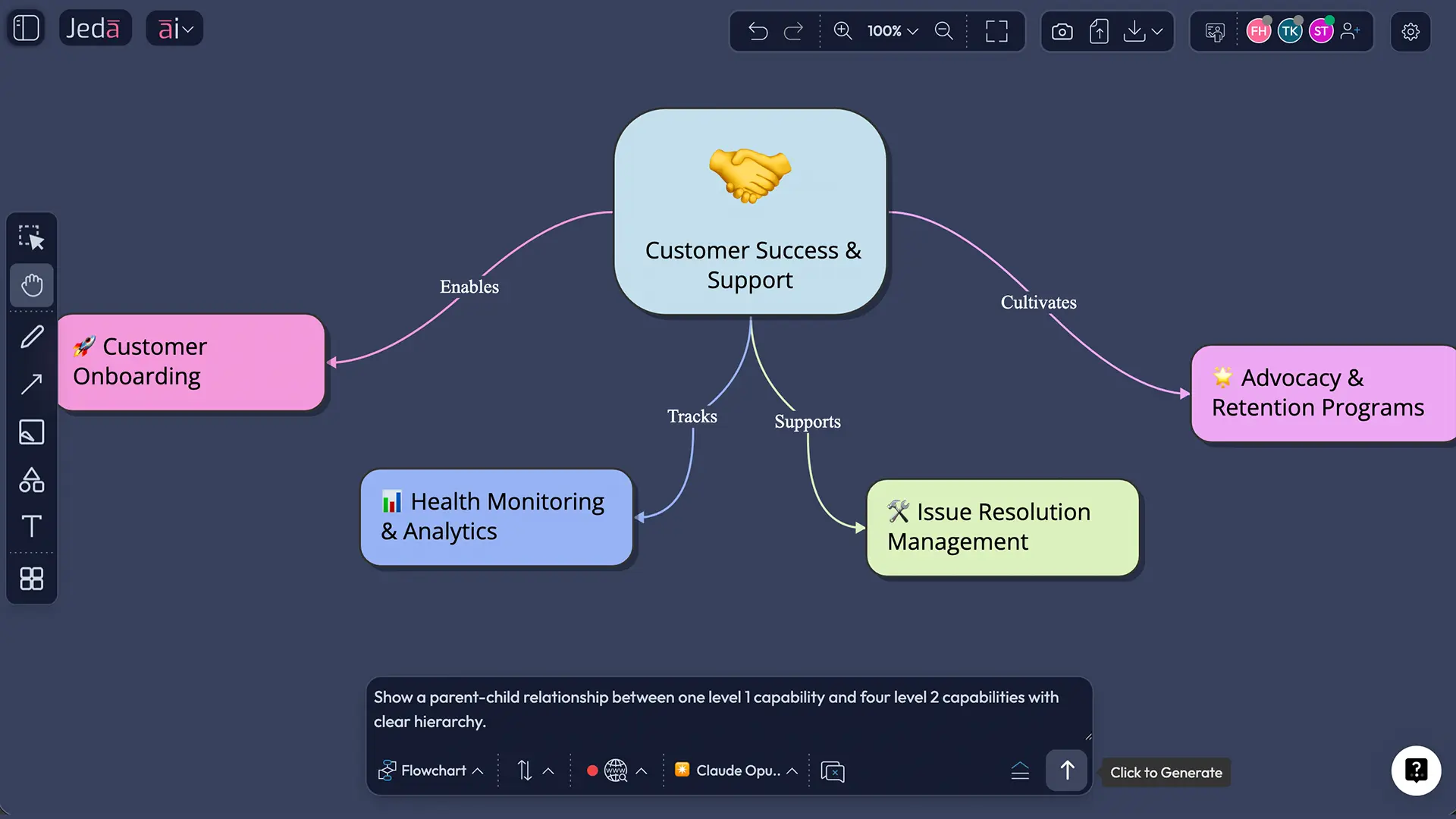
Why Use AI for Level 2 Capability Decomposition?
Because decomposition is where teams start losing time.
At Level 2, people overthink names, duplicate concepts, and drift into process language. They argue about what belongs under what. They pull in half the operating model. Then they wonder why the map feels messy. AI helps because it can propose clean decompositions quickly, surface likely overlaps, and give you a strong first pass that stakeholders can react to.
But reaction is still the point. AI drafts. Humans decide.
Jeda.ai makes that cycle faster because you’re not bouncing between chat, slides, and whiteboards. You can generate a Level 2 matrix, edit it visually, bring in collaborators, then use AI+ on one selected capability when you want deeper sub-structure or naming alternatives. That focused extension model matters. AI+ is very good at deepening an existing branch. It is much less useful when you treat it like a giant blank wish machine.
- Cleaner decomposition
Generate distinct Level 2 capabilities under one parent domain without starting from a blank board.
- Overlap detection
Spot duplicate ideas, fuzzy naming, and parent-child confusion earlier in the workshop.
- Review with the right people
Bring business owners, analysts, and transformation leads into the same editable canvas.
- Selective AI+ deepening
Use AI+ after generation to deepen one selected capability or propose alternate decomposition paths.
- Matrix-first clarity
Keep the output as a clean capability matrix before transforming it into another visual view.
- Planning readiness
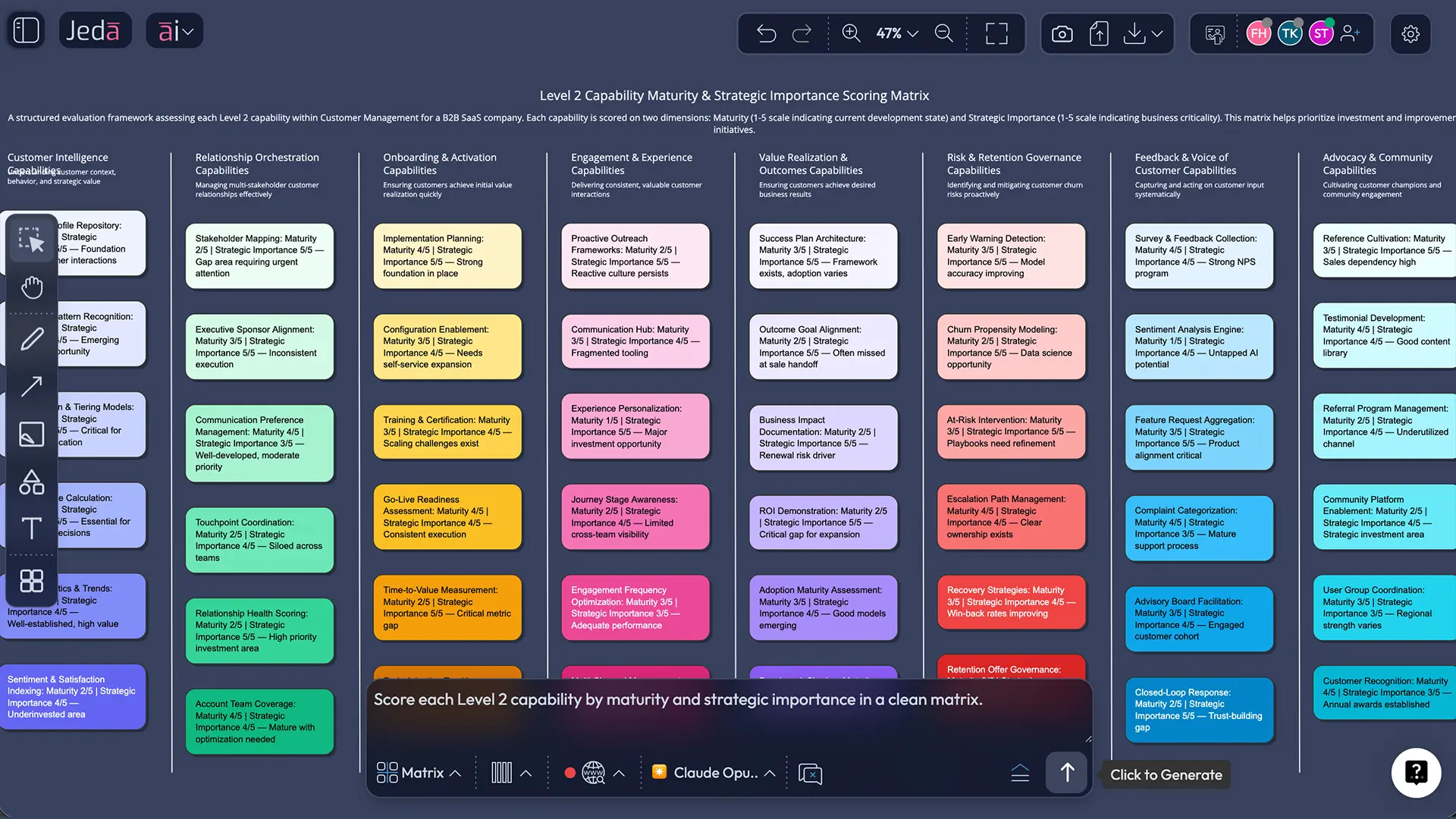
Level 2 is the layer where maturity, ownership, and prioritization finally become practical.
How to Create a Level 2 Business Capability Map in Jeda.ai
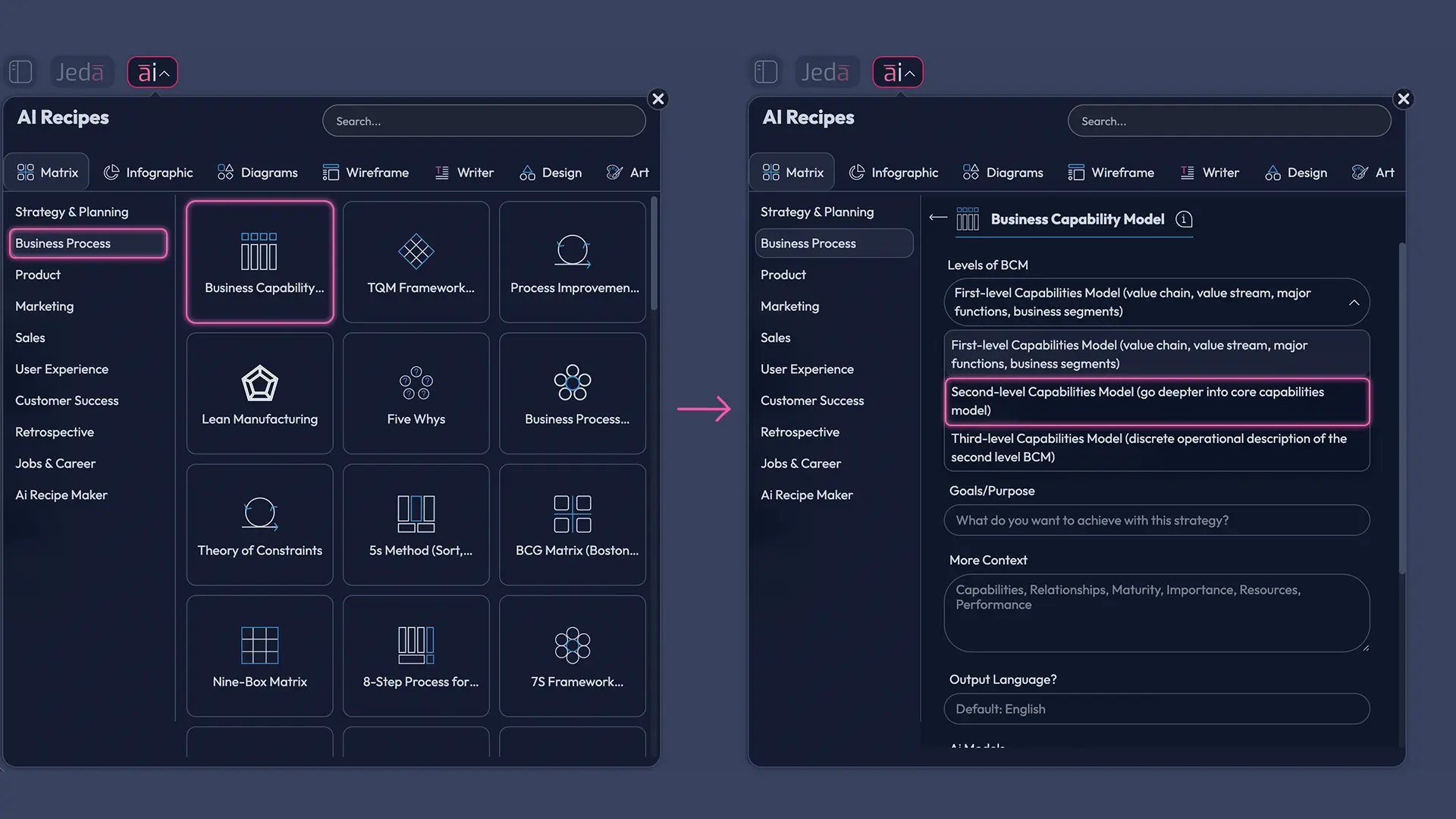
Method 1: Recipe Matrix
- Open the AI Menu in Jeda.ai.
- Choose the Matrix recipe flow in your workspace.
- Start from one validated Level 1 domain.
- Ask Jeda.ai to generate Second-level Capabilities Model for that domain.
- Review whether every proposed capability clearly contributes to the parent domain.
- Remove duplicates, rename fuzzy labels, and keep the output above process detail.
- Select one cell and use the AI+ button if you want deeper explanation or a better alternative structure.
- Use Vision Transform if you want to convert the matrix into a diagram for stakeholder review.
Method 2: Prompt Bar
- Open the Prompt Bar at the bottom of the canvas.
- Select the Matrix command.
- Enter a prompt that starts from one parent capability and requests Level 2 only.
- Press Enter to generate.
- Review scope, naming, and overlap with stakeholders.
- Use AI+ for focused deep dives, not as the first-pass prompt engine.
- Choose one parent domain
Start from a validated Level 1 capability such as Customer Management, Revenue Management, or Product Management.
- Open the Matrix recipe flow
Use the AI Menu and select the Matrix recipe available in your workspace so the output stays structured as a single matrix.
- Generate Level 2 capabilities only
Tell Jeda.ai to create distinct core capabilities under the parent domain and avoid process steps, department names, or Level 3 detail.
- Review for contribution and overlap
Check whether each proposed capability clearly supports the parent domain and whether any cells repeat the same idea in different words.
- Add planning signals
Note likely owners, maturity concerns, or strategic importance while the team reviews the matrix together.
- Use AI+ for one selected branch
Tap AI+ on one generated cell or group only after the base matrix exists. Use it to deepen or sharpen a specific area, not to replace the first-pass build.
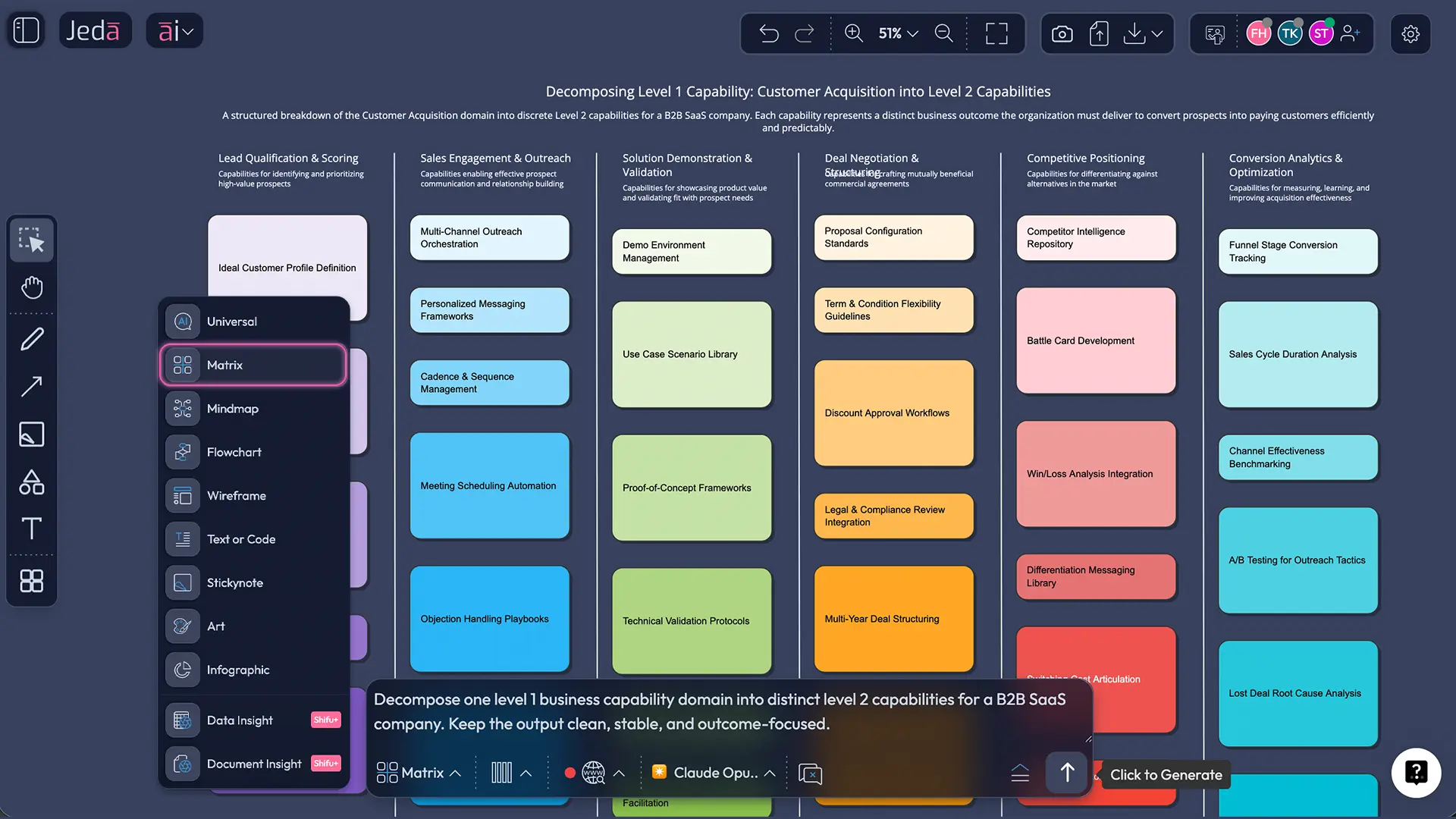
A prompt that usually gives a usable first pass:
Level 2 Business Capability Map Example
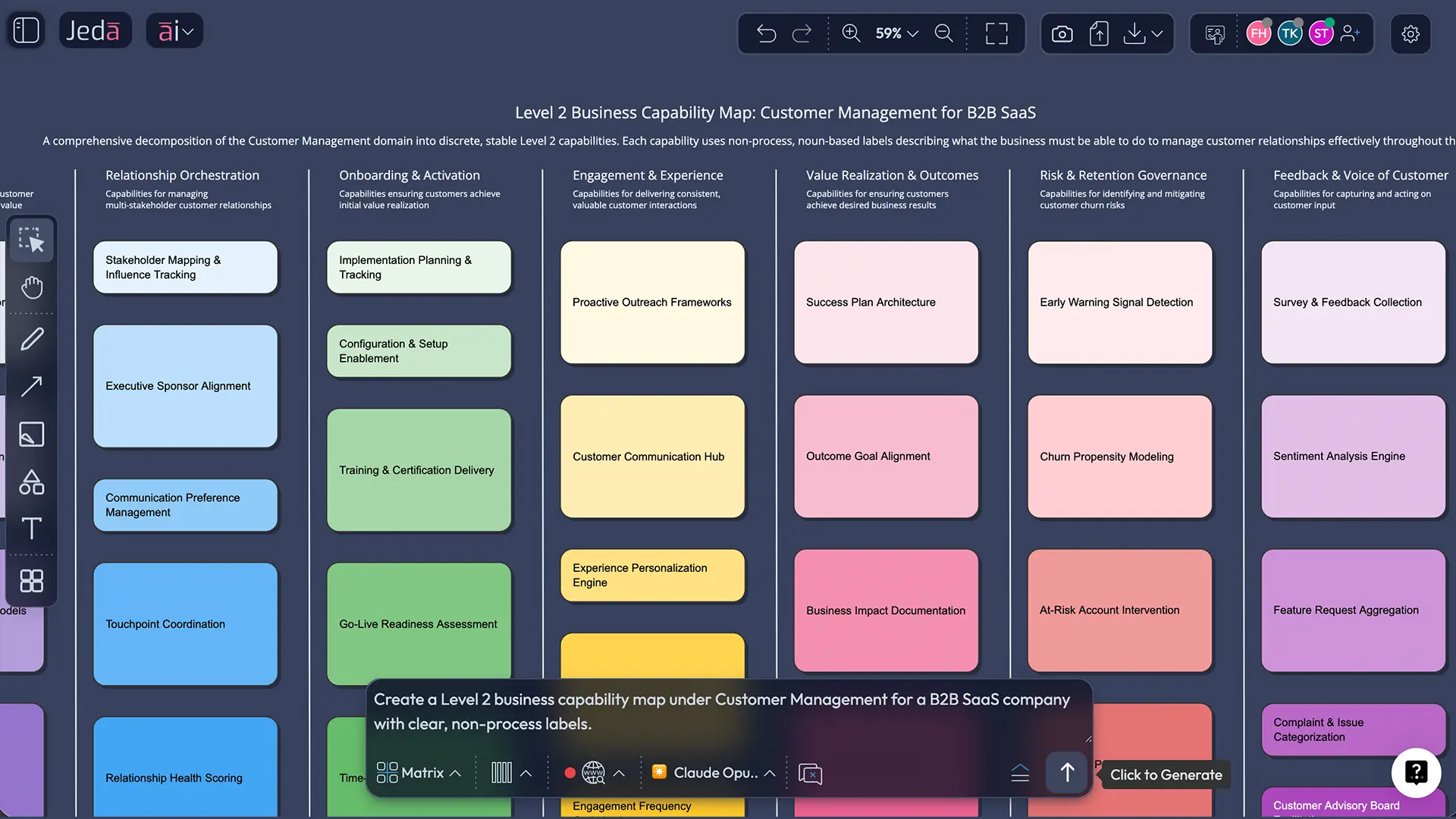
Let’s keep using Customer Management.
A sloppy decomposition might list Lead Routing, CRM Cleanup, Support Ticket Escalation, and Quarterly Account Review. Those are tasks or workflows. They don’t belong at Level 2.
A stronger Level 2 structure might include:
- Customer Segmentation and Targeting
- Customer Acquisition
- Customer Service and Retention
- Account Development
- Customer Insight Management
Now the model starts to support decisions. You can identify which of those capabilities are strategic differentiators, which are mature, and which are dragging behind. You can also decide where it makes sense to continue into Third-level Business Capability Model with AI for more operational detail.
That’s the real value of Level 2. It becomes the bridge between the broad enterprise view and the more discrete operational sub-capabilities that follow.
Best Practices for Clean Capability Decomposition
A small but important point: Level 2 should still be readable by leaders. If only the operating team can understand the labels, the model is already getting too tactical.
Common Mistakes to Avoid
The first mistake is dropping straight into tasks. Teams start with good intentions, then suddenly half the matrix is workflow steps.
The second is forcing symmetry. Not every Level 1 capability needs five neat Level 2 children. Reality doesn’t care about visual perfection.
Third, people duplicate concepts with slightly different wording. “Customer success” and “customer retention support” may look different, but they may be doing the same job in the model.
And the fourth mistake is forgetting the use case. Level 2 exists so you can plan, assess, prioritize, and assign. If the output can’t support that, the decomposition is probably off.
Frequently Asked Questions
- What is a level 2 business capability map?
- A level 2 business capability map is the layer that breaks a Level 1 business domain into core supporting capabilities. It is more detailed than the top layer, but it still stays above process steps and day-to-day workflow detail.
- What are Level 2 capabilities in business architecture?
- Level 2 capabilities are narrower capabilities that support a broader Level 1 domain. They usually represent major responsibilities or outcomes under that parent domain and are detailed enough to support planning, ownership, and assessment.
- How do you decompose Level 1 into Level 2 capabilities?
- Start with one validated parent domain, then identify the distinct core capabilities required to fulfill it. Keep the labels stable and outcome-focused, and remove anything that looks like a task, process step, or temporary initiative.
- What is the difference between Level 1 and Level 2 capabilities?
- Level 1 shows broad enterprise capability domains. Level 2 breaks one of those domains into core supporting capabilities. Level 1 is the high-level structure; Level 2 is where the map starts becoming useful for prioritization and governance.
- How detailed should Level 2 capabilities be?
- They should be specific enough to be distinct and useful, but not so detailed that they become process fragments. A good test is whether the label still describes an enduring business ability rather than a workflow step.
- Should every Level 1 capability be decomposed into Level 2 immediately?
- No. Many teams decompose the most strategic or problematic Level 1 domains first. That keeps the effort focused and avoids wasting time building deep detail where it is not yet needed.
- Can AI help decompose core business capabilities?
- Yes. AI can generate a strong first draft of Level 2 capabilities when you provide the parent domain and enough business context. Stakeholders still need to validate the final structure, naming, and overlap.
- When should you move to Level 3 capabilities?
- Move to Level 3 when the team needs discrete operational detail under a Level 2 capability for planning, ownership, maturity assessment, or application mapping. If Level 2 already supports the decision, you may not need deeper decomposition yet.
- Can I export the result from Jeda.ai?
- Yes. Jeda.ai exports PNG, SVG, and PDF. The platform reference does not confirm native PowerPoint or Word export, so teams usually place the exported visual into decks or reports afterward.
Sources & Further Reading
- [1]
SAP LeanIX (2026) . “SAP LeanIX Business Capability Map” SAP LeanIX.
View Source ↗ - [2]
SAP LeanIX (2026) . “How to Create a Business Capability Map?” SAP LeanIX Wiki.
View Source ↗ - [3]
Orbus Software (2025) . “The Ultimate Guide to Business Capability Maps” Orbus Software.
View Source ↗ - [4]
Avolution (2026) . “How to Create a Business Capability Map, Examples & Guide” Avolution.
View Source ↗ - [5]
Ulrich, William (2011) . “The Business Capability Map: The 'Rosetta Stone' of Business/IT Alignment” Cutter Consortium / Business Architecture Associates.
View Source ↗ - [6]
Khosroshahi, Pouya Aleatrati; Hauder, Matheus; Volkert, Stefan; Matthes, Florian; Gernegross, Martin (2018) . “Business Capability Maps: Current Practices and Use Cases for Enterprise Architecture Management” HICSS 2018.
View Source ↗
Build Your Level 2 Capability Map in Jeda.ai
Join 150,000+ users using Jeda.ai’s AI Workspace and AI Whiteboard to turn top-level domains into core capability structures with 300+ strategic frameworks.
Try Free Template