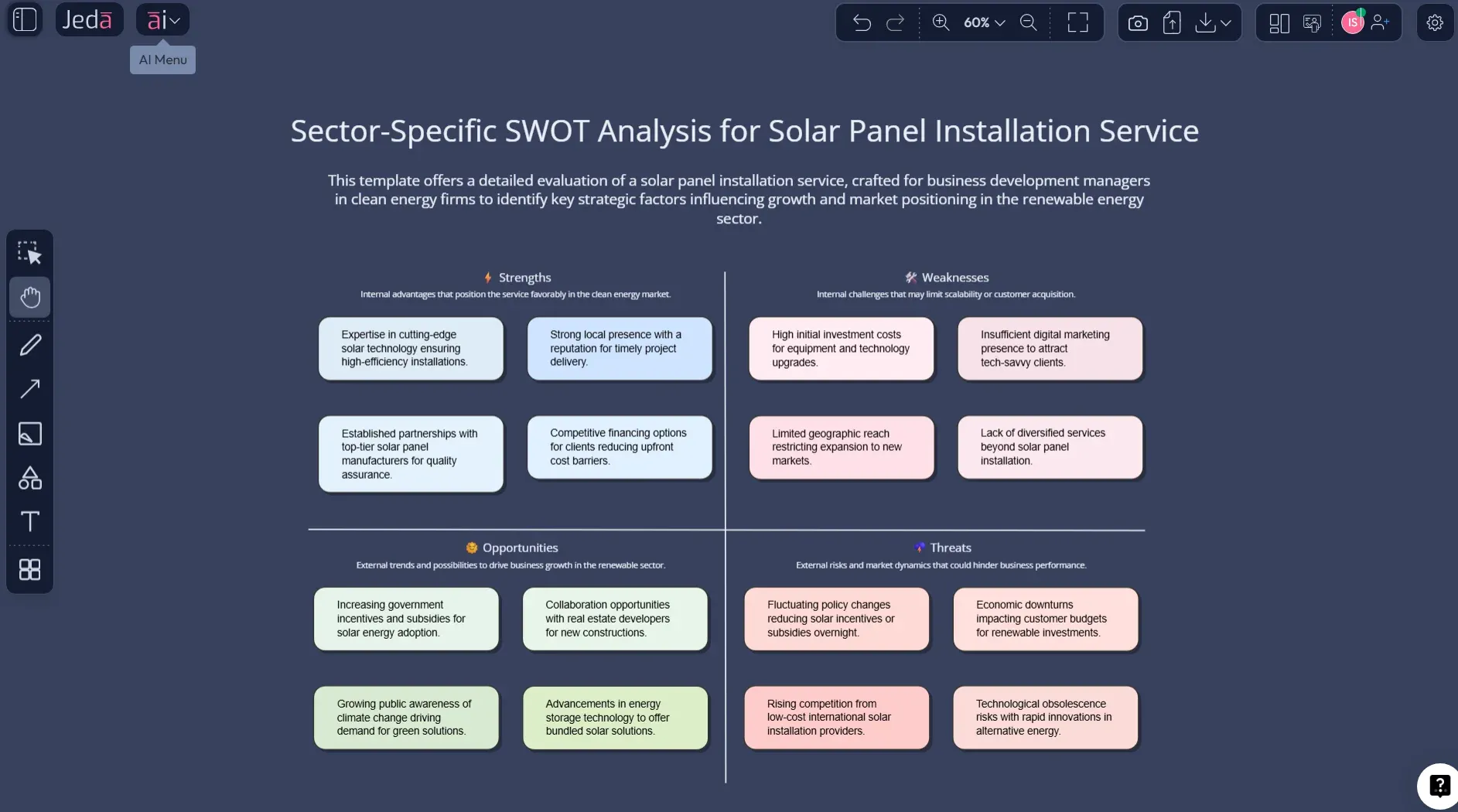
If your SWOT reads like it could describe any company, it’s describing no company.
That’s the quiet failure mode of strategy teams: they run a SWOT, feel productive, and still walk away with decisions that don’t survive the sector’s reality—regulation, unit economics, capex cycles, procurement politics, or platform dynamics.
Sector Specific SWOT Analysis with AI fixes that by forcing the SWOT to speak the language of the industry you’re actually in. In Jeda.ai—your AI Workspace and AI Whiteboard in one place—you can generate a sector-aware SWOT, attach evidence, pressure-test assumptions, and ship a visual output your stakeholders can challenge (and improve) instead of politely ignoring.
What is Sector Specific SWOT Analysis with AI?
A SWOT is a structured way to list Strengths, Weaknesses, Opportunities, and Threats. The original approach traces back to the “SOFT/SWOT” planning work associated with Robert Franklin Stewart, later reconstructed through archival research and interviews.
A sector-specific SWOT is not a different framework—it’s a stricter standard.
Instead of writing broad statements (“strong brand,” “competitive market”), you define factors using sector constraints:
- How money is actually made (margins, utilization, reimbursement, take rates)
- What can legally be done (licenses, compliance regimes, audits)
- What breaks delivery (supply chain chokepoints, capacity, lead times)
- Who controls demand (procurement, payers, gatekeepers, platforms)
- What changes the game (standards, regulation, technology adoption curves)
That’s the real purpose: make the quadrants sector-literate, so the output can drive decisions.
Because here’s the uncomfortable truth: classic SWOTs often become long lists that aren’t prioritized or validated—then they never get used.
Sector Specific SWOT Analysis with AI uses AI to get to a high-quality first draft quickly, then lets your team refine the parts that require judgment—on a canvas where the reasoning is visible.
Why Use Sector Specific SWOT Analysis with AI?
A SWOT is only as useful as its relevance to how the sector works. Different industries punish different mistakes.
Michael Porter’s core point is that industry structure shapes competition and profitability—so sector context isn’t “extra,” it’s the battlefield.
Using Sector Specific SWOT Analysis with AI inside Jeda.ai helps you:
- Avoid generic strategy theater by grounding factors in industry mechanics
- Generate sector lenses on demand (regulatory, capex, buyer power, supply risk)
- Separate signals from noise faster, so you can prioritize what matters
- Build stakeholder-ready outputs (ops view vs. investor view vs. compliance view)
- Keep the analysis editable on an AI Whiteboard instead of locked in a doc
And because you’re working inside an AI Workspace, you can collaborate, annotate, and iterate without tool-hopping—then export cleanly as PNG, SVG, or PDF.
- Sector lenses built-in
Generate SWOT factors through explicit industry lenses like regulation, unit economics, procurement, capex cycles, and supply constraints.
- Better prioritization
Use AI to cluster and score factors, then focus your team’s debate on the few items that change decisions.
- Board-to-deck clarity
Turn a messy sector landscape into a slide-ready visual you can defend in leadership reviews.
How to Create Sector Specific SWOT Analysis with AI in Jeda.ai
Jeda.ai includes 300+ frameworks and strategy recipes, so you can generate a sector-aware SWOT without building the structure from scratch—then refine it with your team inside the same AI Workspace.
Method 1: AI Menu (Recommended)
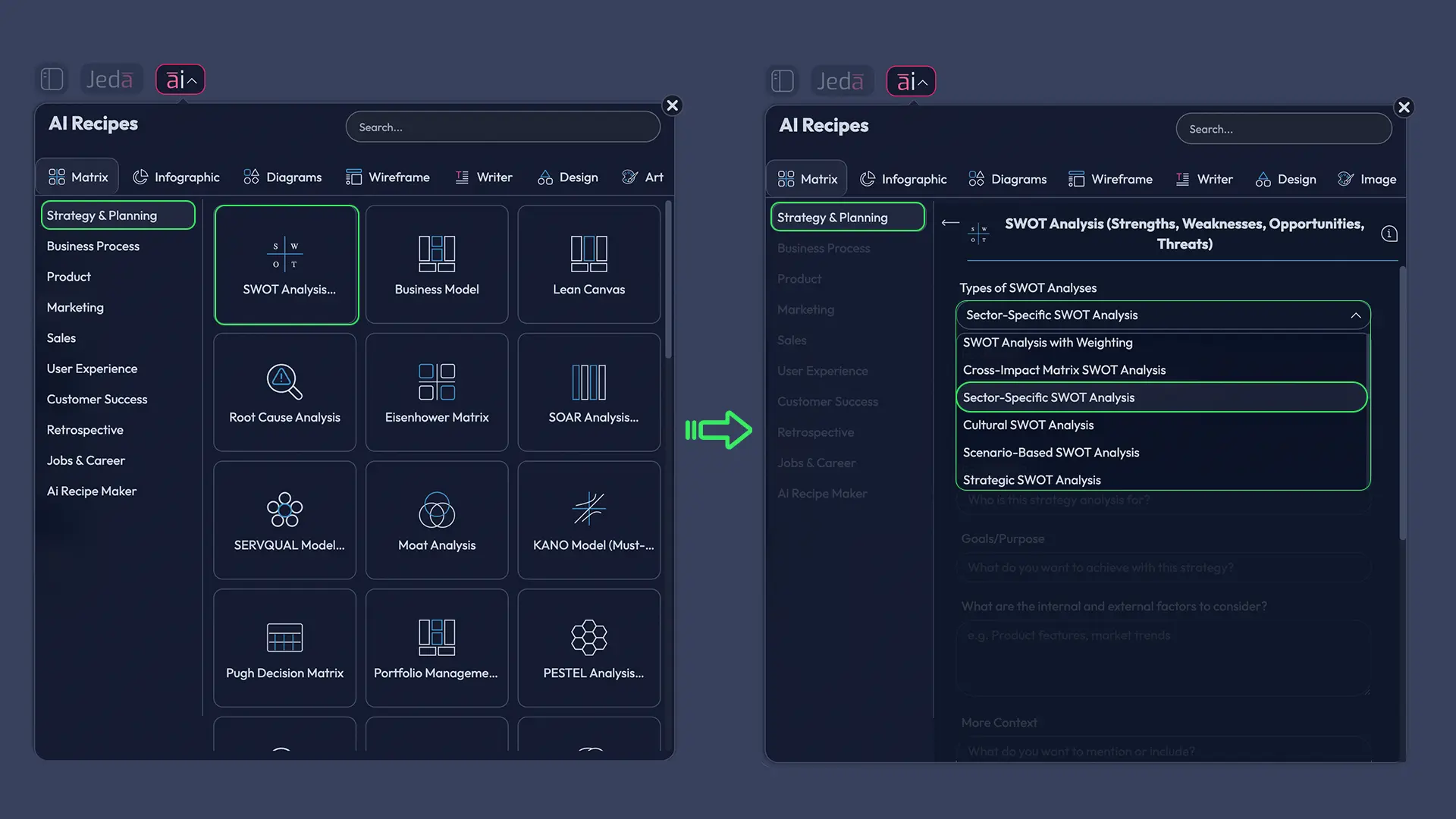
- Open the AI Menu on the canvas
Start inside your Jeda.ai AI Workspace so your output stays visual and editable.
- Choose the SWOT recipe category
Select the Sector Specific SWOT Analysis template (or a SWOT variant if you need one).
- Define the sector and boundary
Specify industry + geography + business model. Example: “Grid-scale battery storage developer, ERCOT, merchant + contracted revenues.”
- Add a sector lens checklist
Pick 3–5 lenses: regulation, unit economics, supply chain, capex/financing, procurement/buyers, safety/standards.
- Generate with 1–3 models
Run one model for speed, or multiple models for broader coverage. Use an Aggregator to reconcile the strongest reasoning.
- Refine and extend on-canvas
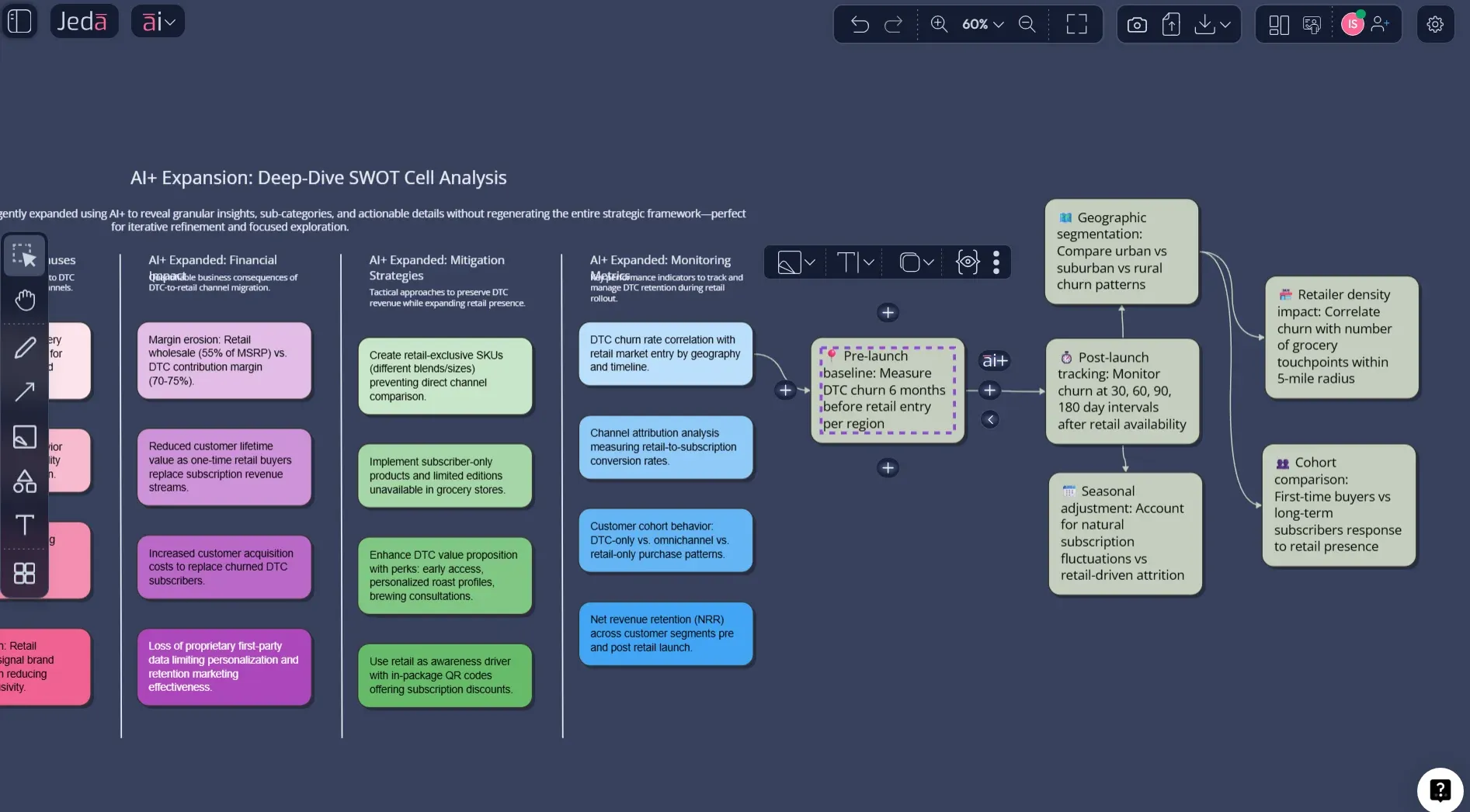
Edit factors, add evidence notes, then use AI+ to deepen weak sections and Vision Transform to convert into diagrams or maps.
Method 2: Prompt Bar (Flexible)
Use this when you want stricter rules for factor quality, formatting, or scoring.
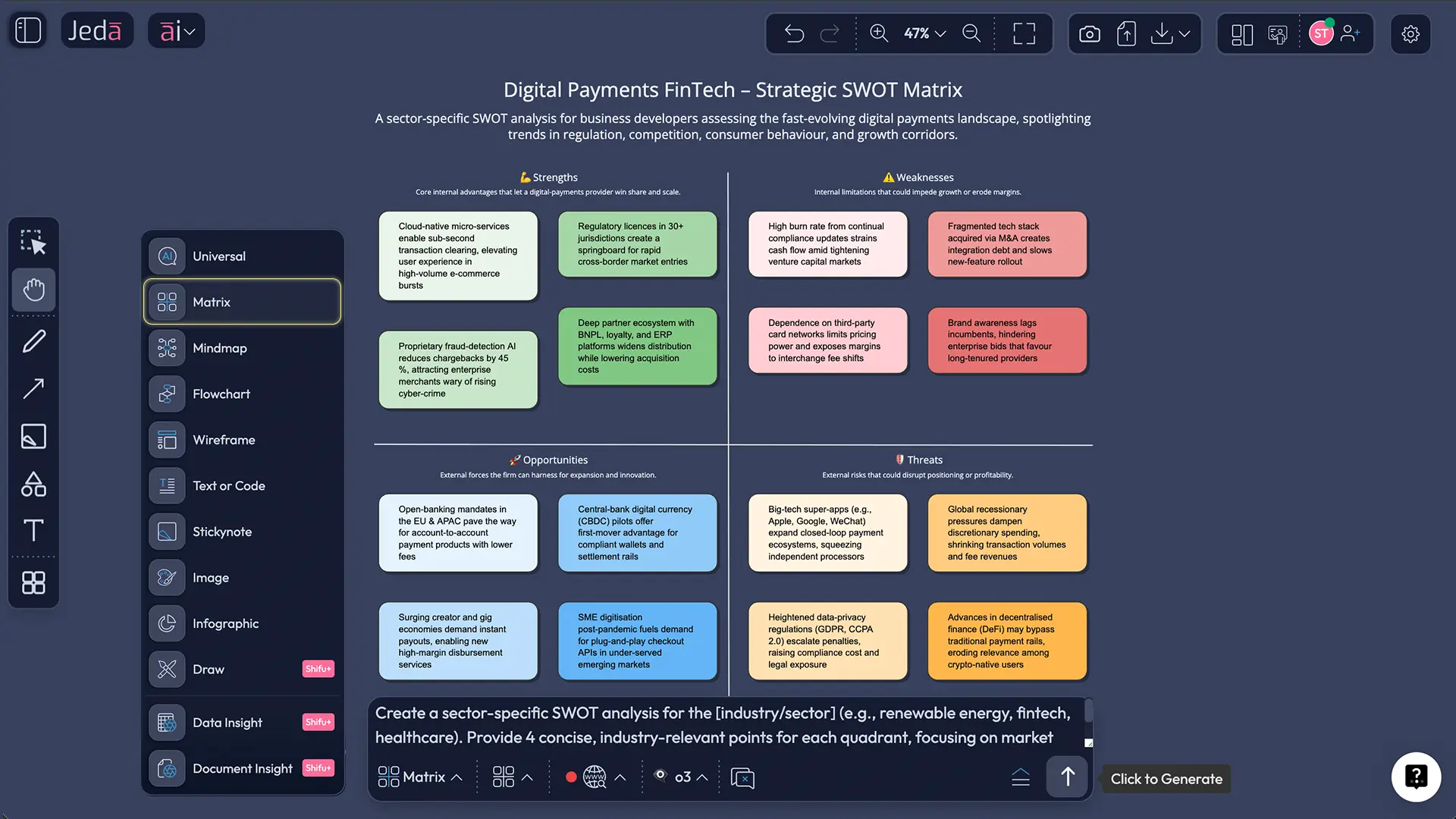
- Open the Prompt Bar at the bottom of the canvas
- Select the Matrix command
- Paste the prompt below
- Press Enter to generate
Reusable prompt (edit bracketed parts):
Create a Sector Specific SWOT Analysis for [company] in the [sector] sector, operating in [region], with business model [business model].
Use these lenses: [regulation], [unit economics], [procurement/buyers], [supply chain], [capex/financing].
Provide 6 items per quadrant. Each item must be sector-specific, measurable where possible, and written as a testable claim.
Then add: (1) top 3 decision drivers, (2) top 3 risks, (3) 5 “questions to validate” that would change the SWOT.
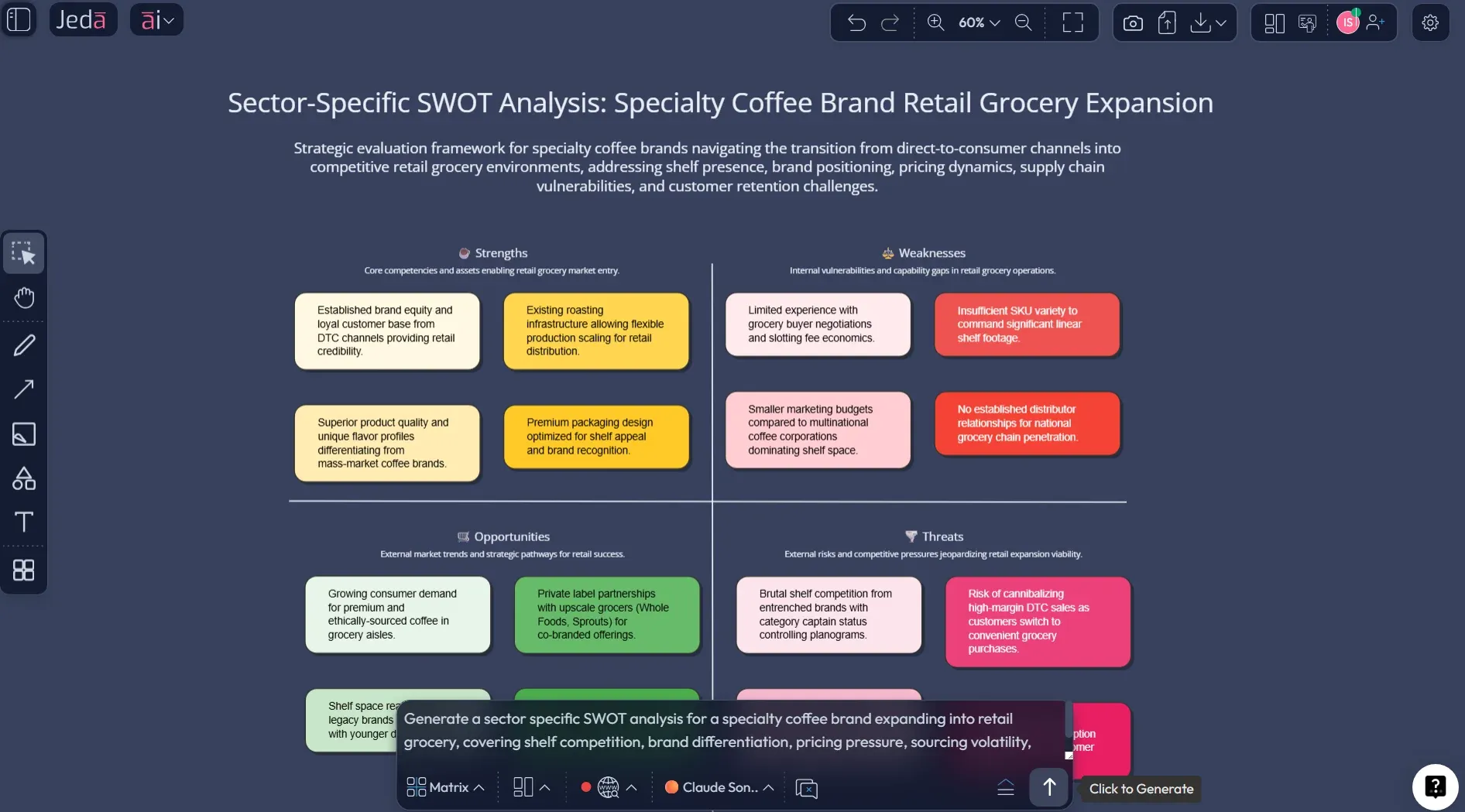
Sector Specific SWOT Analysis with AI Template & Examples
The fastest way to make this real is to see how the same SWOT categories produce totally different factors depending on the sector.
Sector lens library (use these as “filters”)
Regulation & compliance
- Licensing, audits, reporting, enforcement risk, policy volatility
Unit economics
- CAC payback, churn drivers, utilization, ARPU, reimbursement, claims cycles
Supply chain & capacity
- Lead times, concentration risk, quality systems, logistics constraints
Procurement & buyer power
- RFP cycles, gatekeepers, switching costs, bundling pressure
Capex & financing
- Debt covenants, interest-rate sensitivity, payback periods, asset life
Safety & standards
- Certifications, incident risk, liability, operational controls
Porter’s work is a reminder that competitive forces and buyer/supplier power look different by industry—so your SWOT must reflect the structure you’re in.
Worked example: Energy storage developer (sector-aware SWOT)
Context A grid-scale battery storage developer building projects in a deregulated market, mixing contracted revenues and merchant exposure.
Strengths (sector-aware)
- Interconnection team has a track record navigating queue reforms and technical studies
- Dispatch optimization capability improves capture of ancillary services revenue
- EPC partnerships reduce construction risk in constrained labor markets
Weaknesses (sector-aware)
- Balance sheet limits ability to self-fund long-duration projects
- Supplier concentration on cells and inverters increases schedule and price volatility
- Limited operating history raises lender scrutiny on performance guarantees
Opportunities (sector-aware)
- Policy incentives and grid reliability demand expand project economics
- Corporate offtake and utility procurement create long-term contracted revenue paths
- Congestion-driven price spreads increase arbitrage upside in specific nodes
Threats (sector-aware)
- Permitting and community opposition delays construction timelines
- Safety incidents anywhere in the sector tighten fire-code enforcement for everyone
- Merchant price compression reduces returns as more capacity enters the market
Mini examples (to show range)
Healthcare provider
- Buyer power = payers and reimbursement policies
- Threats often include coding changes, staffing shortages, and compliance exposure
- Strengths often include referral networks and outcomes data
B2B manufacturing
- Strengths and threats tend to be dominated by capacity, quality systems, and supplier concentration
- Opportunities often tie to reshoring, automation, and new standards adoption
Consumer fintech
- Regulatory compliance and fraud risk become first-class SWOT factors
- Distribution channels and platform dependence often determine bargaining power
Sector-specific SWOT isn’t theoretical—SWOT has been applied as a decision tool across very different domains (public systems, tourism, waste management), precisely because sector constraints shape feasible strategy.
Best Practices & Tips
Common Mistakes to Avoid
- Sector cosplay: using industry buzzwords without naming mechanisms (procurement cycles, payers, standards, capex).
- No boundary definition: mixing multiple industries or geographies and calling it “one SWOT.”
- Confusing trends with factors: “AI is big” isn’t a SWOT item; “AI-driven automation cuts claims processing costs by X%” is.
- Skipping buyer power: most strategy failures are demand-side failures wearing a product-side disguise.
- Treating AI output as final: AI gives a draft; your team supplies the judgment, evidence, and priorities. SWOT’s limitations show up hardest when lists aren’t verified or used.
Frequently Asked Questions
- What is Sector Specific SWOT Analysis with AI?
- Sector Specific SWOT Analysis with AI is a SWOT method that forces strengths, weaknesses, opportunities, and threats to be written through explicit industry lenses like regulation, unit economics, buyer power, supply constraints, and capex cycles. AI generates a strong first draft quickly, then you refine it with expert judgment.
- How is a sector-specific SWOT different from a standard SWOT?
- A standard SWOT often stays generic and becomes a long list. A sector-specific SWOT defines the sector boundary and requires each factor to reflect industry mechanics, such as procurement, compliance, utilization, or supply concentration. This produces fewer, sharper factors that are easier to prioritize and use.
- Which sectors benefit the most from a sector-specific SWOT?
- Regulated, capital-intensive, or gatekeeper-driven sectors benefit most—healthcare, finance, energy, transportation, telecom, and public-sector adjacent markets. These industries have constraints that dominate outcomes, so a generic SWOT misses the variables that decide what is feasible.
- What inputs should I give AI to get a good sector-specific SWOT?
- Provide the sector, geography, and business model first. Then add 3–5 lenses (regulation, unit economics, procurement, supply chain, capex/financing). Add a short context block: customer type, pricing model, growth goal, and the top constraints you already suspect.
- How do I prevent AI from producing vague SWOT items?
- Require “testable claims” and attach a validation question to each quadrant. In Jeda.ai, you can edit items directly on the AI Whiteboard, add evidence notes, and use AI+ to refine weak items with stricter rules rather than accepting the first draft.
- Can Jeda.ai generate different SWOT views for different stakeholders?
- Yes. You can generate one SWOT for leadership decisions, another for operations constraints, and another for compliance or risk review. Because it is an AI Workspace, you can keep all versions on one board and make differences explicit, instead of merging viewpoints into one diluted list.
- How often should a sector-specific SWOT be updated?
- Update it when sector conditions shift: regulation changes, input costs move, buyer behavior changes, or a new platform gatekeeper emerges. For fast-moving sectors, a quarterly refresh is common. For slower sectors, it may be semiannual—unless a policy or supply shock hits.
- Can I export the results for reports or presentations?
- Yes. Export your board as PNG, SVG, or PDF so the visuals stay crisp. This is useful when you need the analysis to travel into decks, board memos, or client deliverables without recreating the work from scratch.
- How does this relate to Porter’s Five Forces or PESTEL?
- Use PESTEL to map macro conditions and Porter’s Five Forces to understand industry structure, then translate what you learn into a sector-specific SWOT that is decision-ready. Porter’s work emphasizes that industry structure drives competition, which is exactly why sector context must shape SWOT factors.
Sources & Further Reading
- [1]
Puyt, R. W., Lie, F. B., & Wilderom, C. P. M. (2023) . “The origins of SWOT analysis” Long Range Planning.
View Source ↗ - [2]
Hill, T., & Westbrook, R. (1997) . “SWOT analysis: It's time for a product recall” Long Range Planning.
View Source ↗ - [3]
Helms, M. M., & Nixon, J. (2010) . “Exploring SWOT analysis – where are we now? A review of academic research from the last decade” Journal of Strategy and Management.
View Source ↗ - [4]
Porter, M. E. (2008) . “The Five Competitive Forces That Shape Strategy” Harvard Business Review.
View Source ↗ - [5]
Srivastava, P. K., Kulshreshtha, K., Mohanty, C. S., Pushpangadan, P., & Singh, A. (2005) . “Stakeholder-based SWOT analysis for successful municipal solid waste management in Lucknow, India” Waste Management.
View Source ↗
Generate a Sector Specific SWOT in One Visual Board
Join 150K+ builders who use Jeda.ai as an AI Workspace to create strategy outputs that are clear, editable, and ready for leadership review.
Try the SWOT TemplatesRelated frameworks
- SWOT Analysis with AI
- PESTEL Analysis with AI
- Porter’s Five Forces with AI
- TOWS Matrix with AI
- SWOT Analysis with Weighting
- AI Workspace
- AI Whiteboard
Closing thought
Sector strategy fails when you treat every industry like it plays by the same rules.
A sector-specific SWOT isn’t a better list. It’s a sharper argument. Use Sector Specific SWOT Analysis with AI to expose the sector constraints early, debate the real drivers faster, and earn the right to commit to a plan that actually fits the industry you’re in.