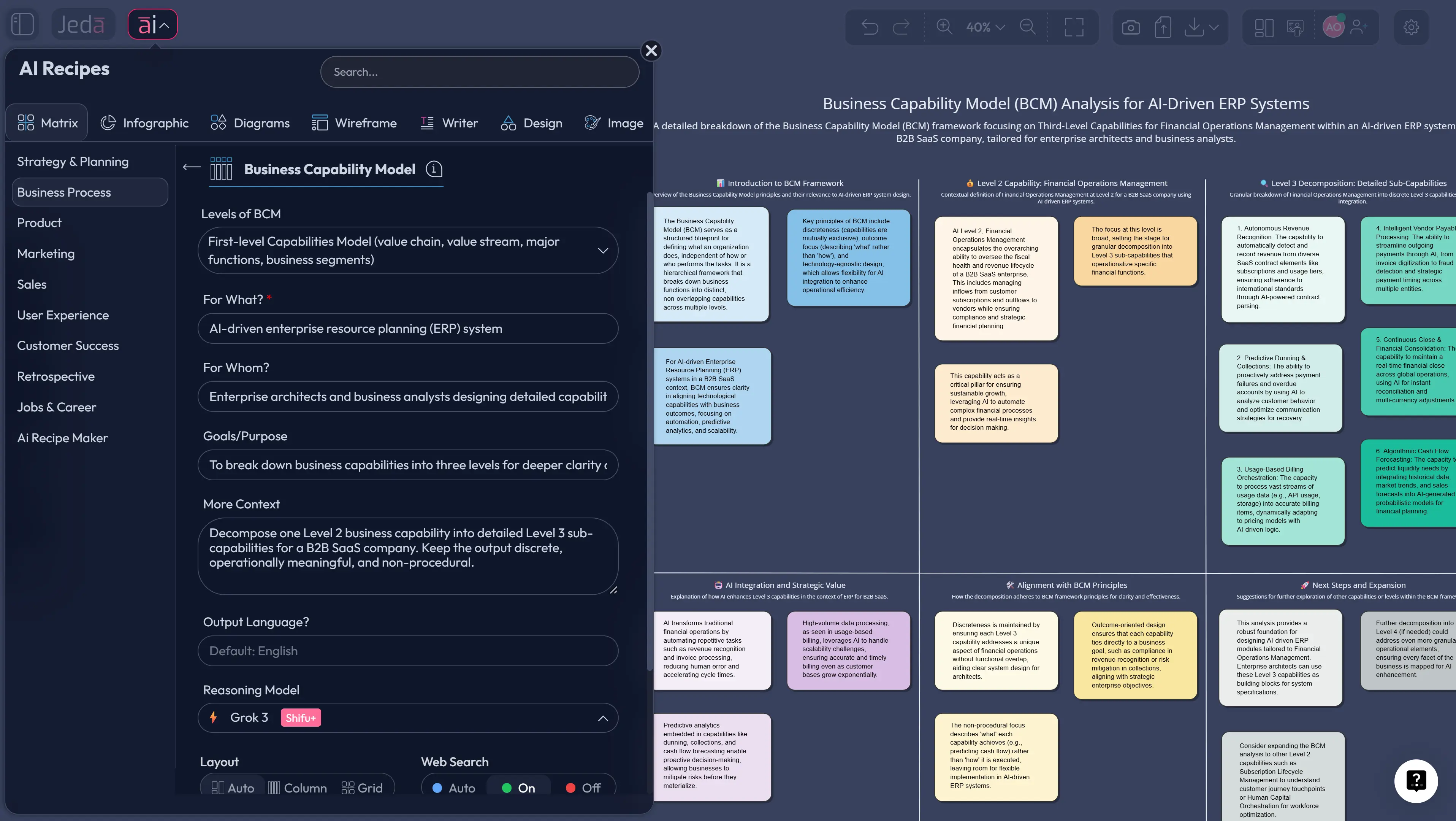
A third-level business capabilities model with AI is where your map stops being broad and starts getting operationally useful. Not operational as in “here are the task steps.” Operational as in “these are the discrete sub-capabilities that matter under a Level 2 capability.” That distinction is everything. A level 3 business capability map gives you enough detail for ownership, maturity discussion, and solution planning without collapsing into workflow spaghetti. In Jeda.ai, you can build that structure inside an AI Workspace, shape it on an AI Whiteboard, and keep it editable as the model improves. Which is nice, because strategy rarely stays still.
What Is a Third-level Business Capabilities Model?
A third-level business capabilities model decomposes a Level 2 capability into more granular sub-capabilities. SAP LeanIX describes Level 3 as more granular support beneath Level 2, and recommends keeping most maps to three levels for clarity. That advice is practical. Once you go deeper, you often drift into processes, tasks, and implementation details.
So Level 3 is not “everything the team does.” It is the last layer where capability language still has real architectural value for most planning situations.
A good Level 3 capability is discrete, specific, and still stable enough to survive workflow change. It should describe a distinct business ability, not a single activity in a sequence. That’s the line to protect.
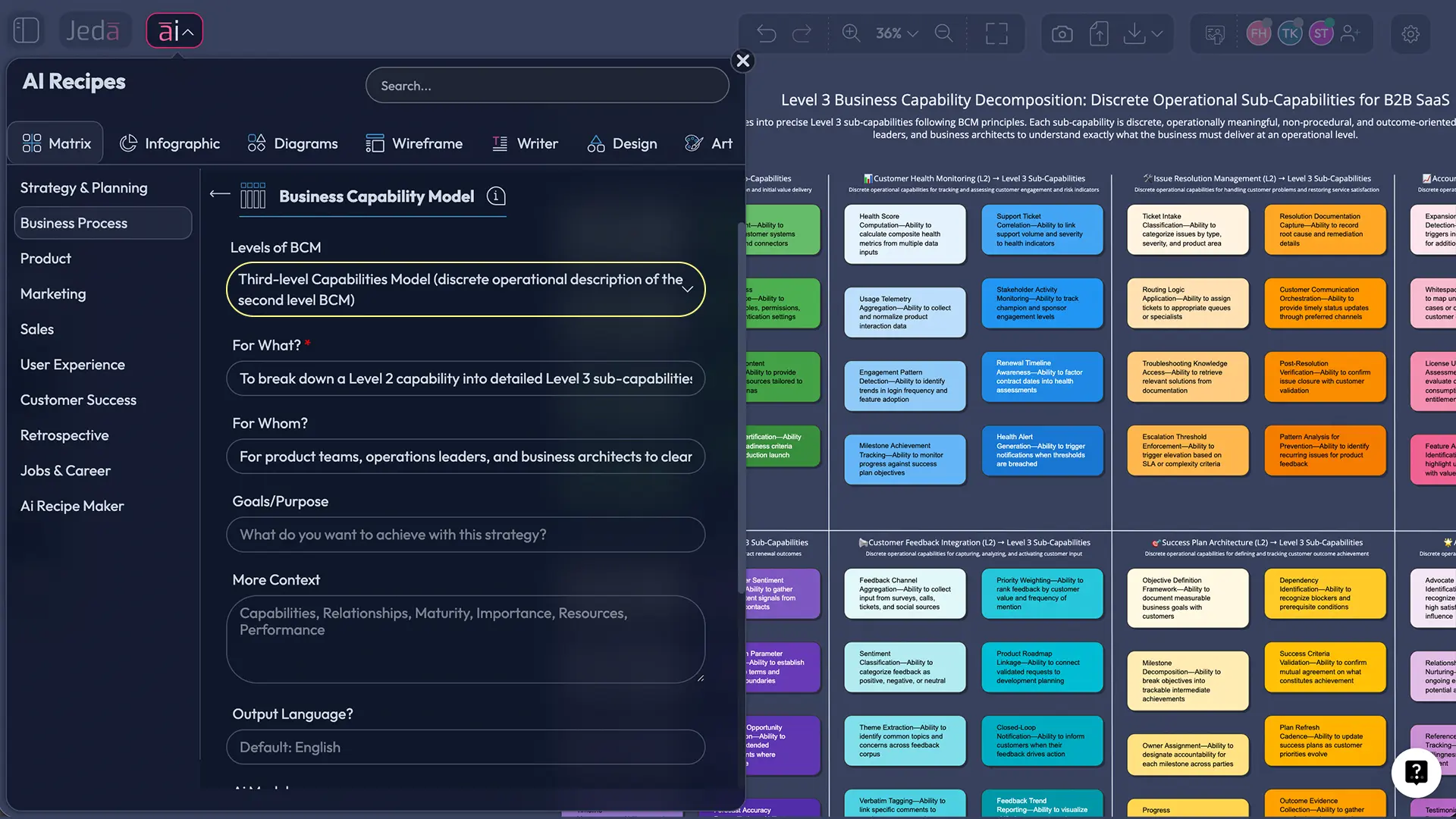
How Level 3 Capabilities Differ from Processes and Tasks
This is the make-or-break section.
Level 3 is where many teams accidentally abandon capability thinking and start writing a process map with prettier boxes. The difference is simple in theory and annoying in practice.
A Level 3 capability describes a discrete business ability.
A process describes how work flows.
A task describes a specific action within that flow.
Here’s a clean example. Suppose your Level 2 capability is Customer Acquisition.
Good Level 3 capability candidates might include:
- Campaign Strategy and Planning
- Channel Performance Management
- Lead Qualification Management
- Funnel Conversion Analysis
- Offer and Message Optimization
What doesn’t belong?
- Send follow-up email
- Route MQL to SDR
- Update CRM field
- Approve ad creative
- Run weekly pipeline call
Those are tasks or process steps.
That’s why Level 3 needs discipline. It should feel more specific than Level 2, but it still has to describe what the business must be able to do, not the exact sequence of clicks and approvals people carry out on Tuesday morning.
Why Use AI for Level 3 Capability Decomposition?
Because Level 3 gets crowded fast.
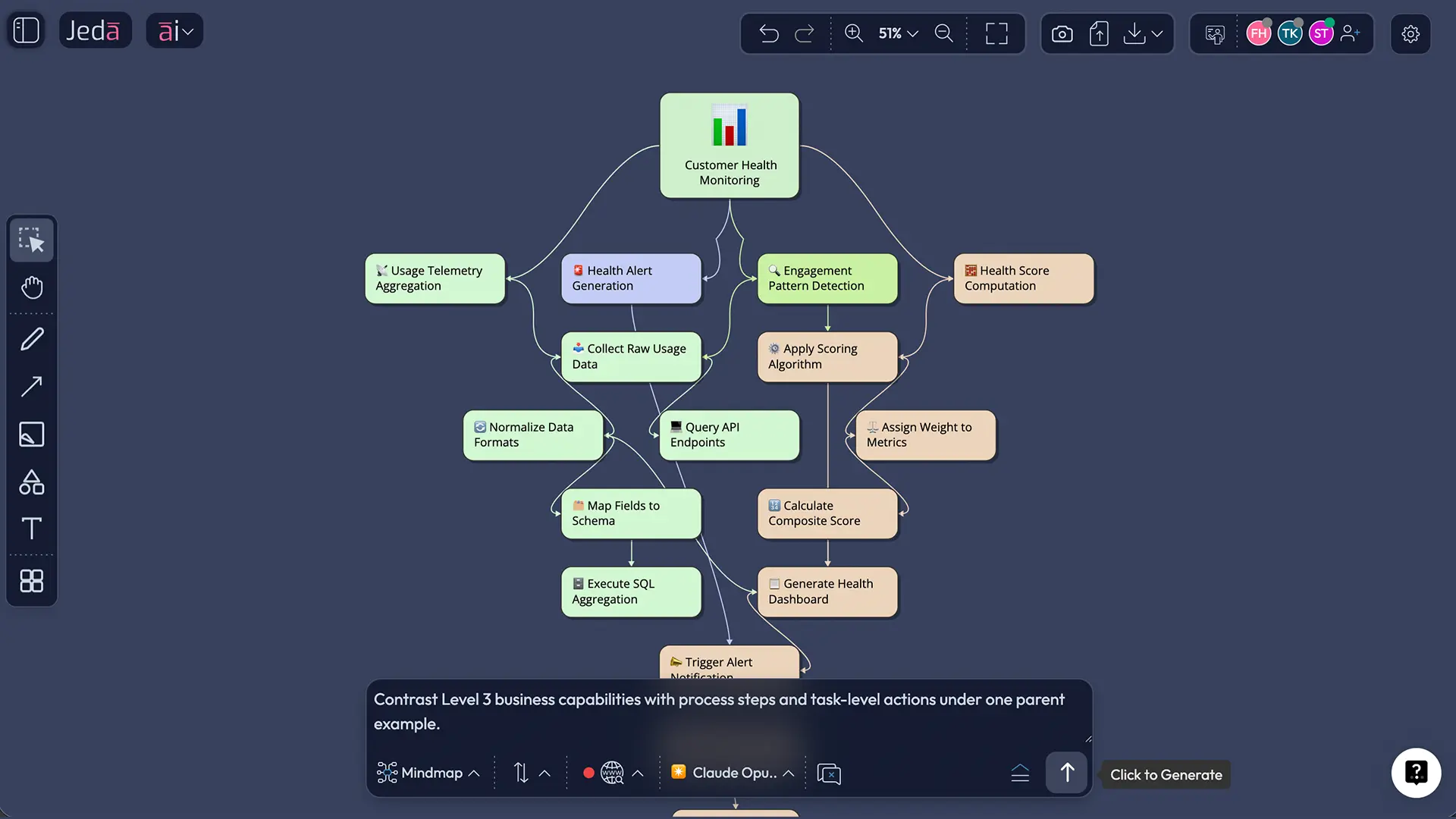
You’re close enough to operations that every stakeholder wants their favorite workflow represented. AI helps by clustering similar ideas, proposing discrete sub-capabilities, and surfacing cleaner wording than what usually appears in a live workshop. It can save a ridiculous amount of time. But only if you keep a tight boundary around what you’re asking for.
That’s where Jeda.ai helps. You can generate the structure as a matrix, keep it editable, bring reviewers into the same AI Whiteboard, and then use AI+ on a selected cell or branch when a sub-capability needs more depth. Again, that focused extension matters. AI+ is not where you should drop a giant “build the whole architecture from scratch” instruction. It shines when the branch already exists and you want a deeper, generated dive.
- Granular without chaos
Generate Level 3 sub-capabilities that are detailed enough for planning but still cleaner than a process map.
- Boundary control
Use AI to propose structure, then quickly remove task-level or workflow-level items that slipped in.
- Operational review
Review the sub-capabilities with business owners and operators in one collaborative workspace.
- AI+ branch extension
Select one generated sub-capability and use AI+ to extend it or propose alternate decomposition options.
- Single-matrix workflow
Keep the output structured as a matrix first, then convert it if the team needs another visual lens.
- Architectural integrity
Stay capability-oriented while still producing detail useful enough for ownership, maturity, and application discussion.
How to Create a Level 3 Business Capability Map in Jeda.ai
Two methods again. Same rule: keep it as a single matrix first.
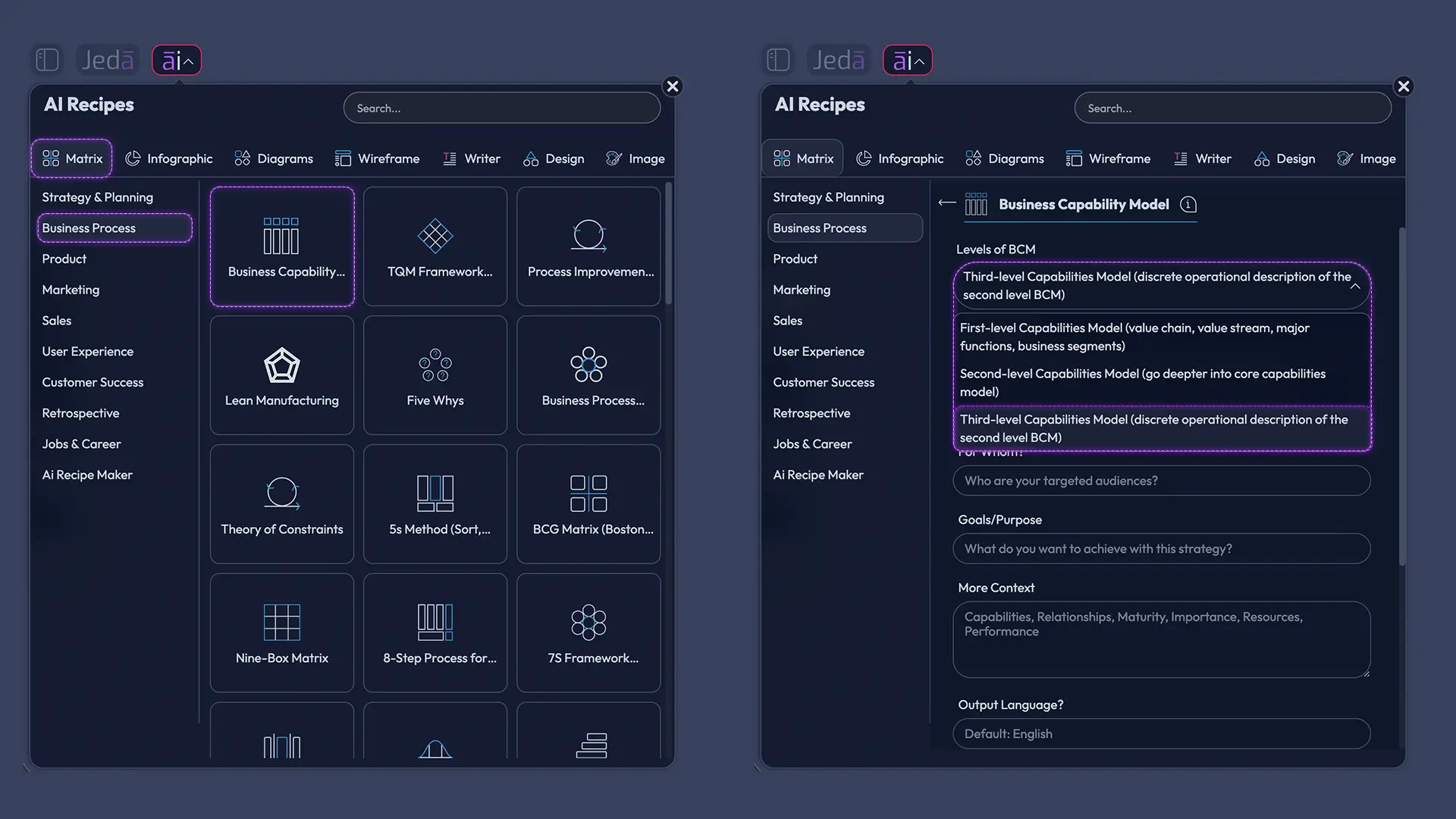
Method 1: Recipe Matrix
- Open the AI Menu in Jeda.ai.
- Choose the Matrix recipe flow available in your workspace.
- Start from one validated Level 2 capability.
- Ask Jeda.ai for Third-level Business Capabilities.
- Review each label against one test: is this still a capability, or has it turned into a process step?
- Remove workflow fragments, duplicates, and overly technical implementation labels.
- Select one promising cell and tap the AI+ button if you want a deeper generated dive or better alternative labels.
- Use Vision Transform if you want to show the same structure in diagram form.
Method 2: Prompt Bar
- Open the Prompt Bar at the bottom of the canvas.
- Select the Matrix command.
- Enter a prompt that starts from one Level 2 capability and asks for Level 3 sub-capabilities only.
- Press Enter to generate.
- Review granularity, naming, and scope with stakeholders.
- Use AI+ for one focused extension after the base matrix already exists.
- Choose one Level 2 capability
Start from a validated Level 2 capability such as Customer Acquisition, Talent Acquisition, Revenue Operations, or Product Discovery.
- Open the Matrix recipe flow
Use the AI Menu and select the Matrix recipe available in your workspace so the output stays structured and easy to review.
- Generate Level 3 only
Ask Jeda.ai for a Third-level Business Capabilities.
- Test the boundary
Review every label and remove anything that describes how work flows or what one person clicks, approves, or sends.
- Add practical signals
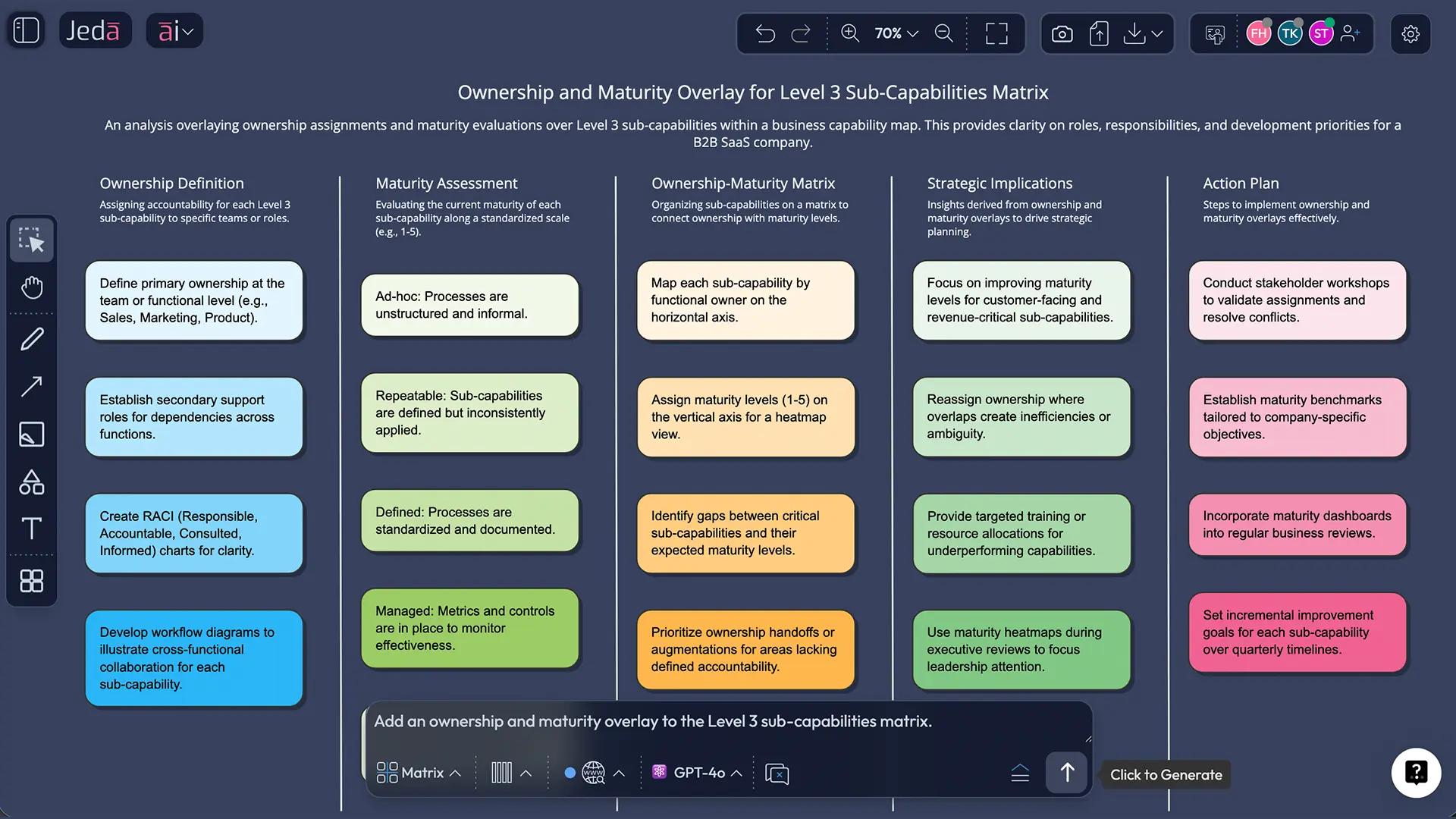
Discuss likely ownership, maturity, application support, and operational risk while the matrix is on the canvas.
- Use AI+ for one selected deep dive
Tap AI+ only after the matrix exists. It is best for extending one chosen sub-capability or branch, not for writing the whole architecture from scratch.
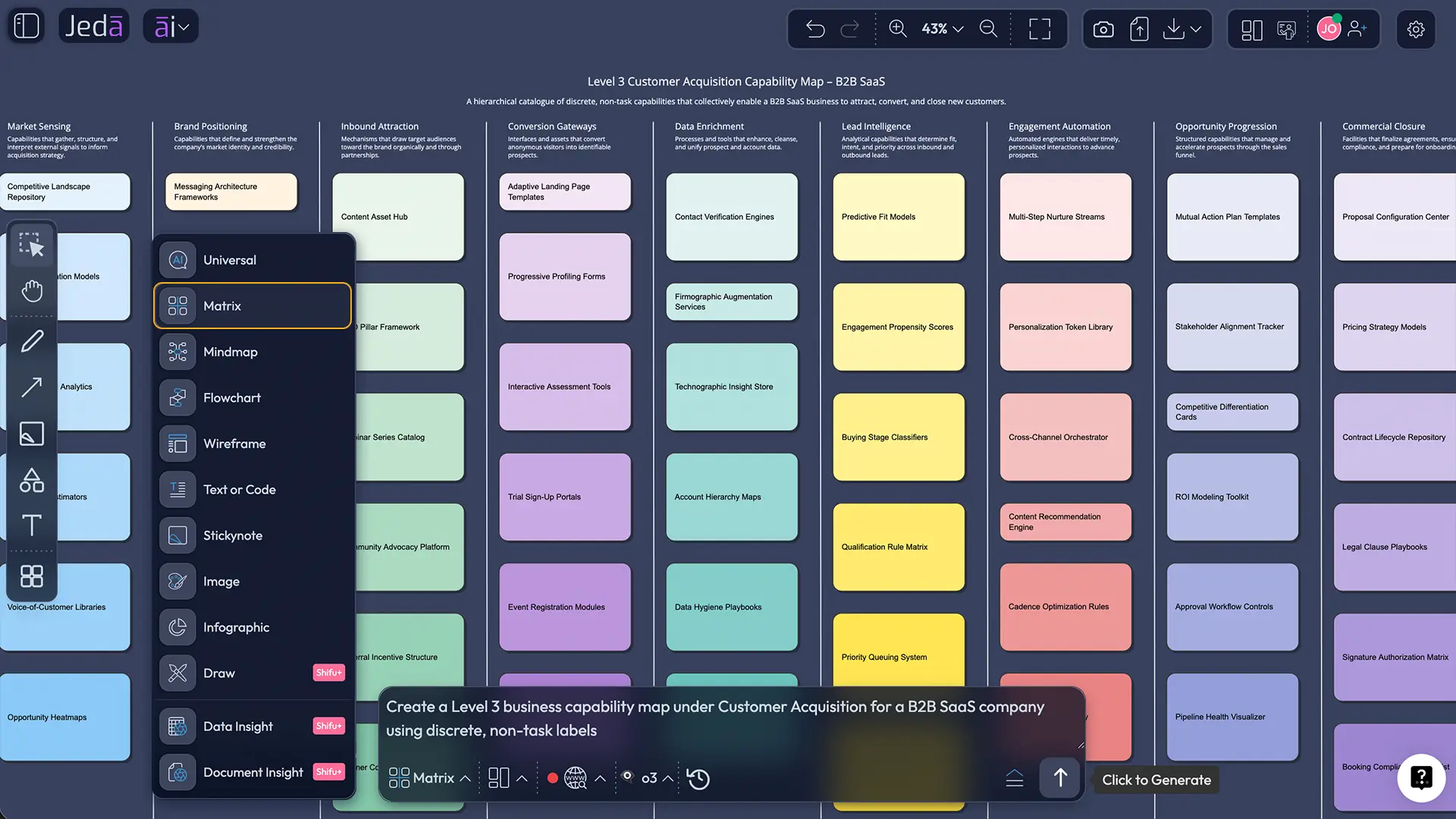
A prompt that usually produces a strong first draft:
Level 3 Business Capability Map Example
Let’s stay with Customer Acquisition.
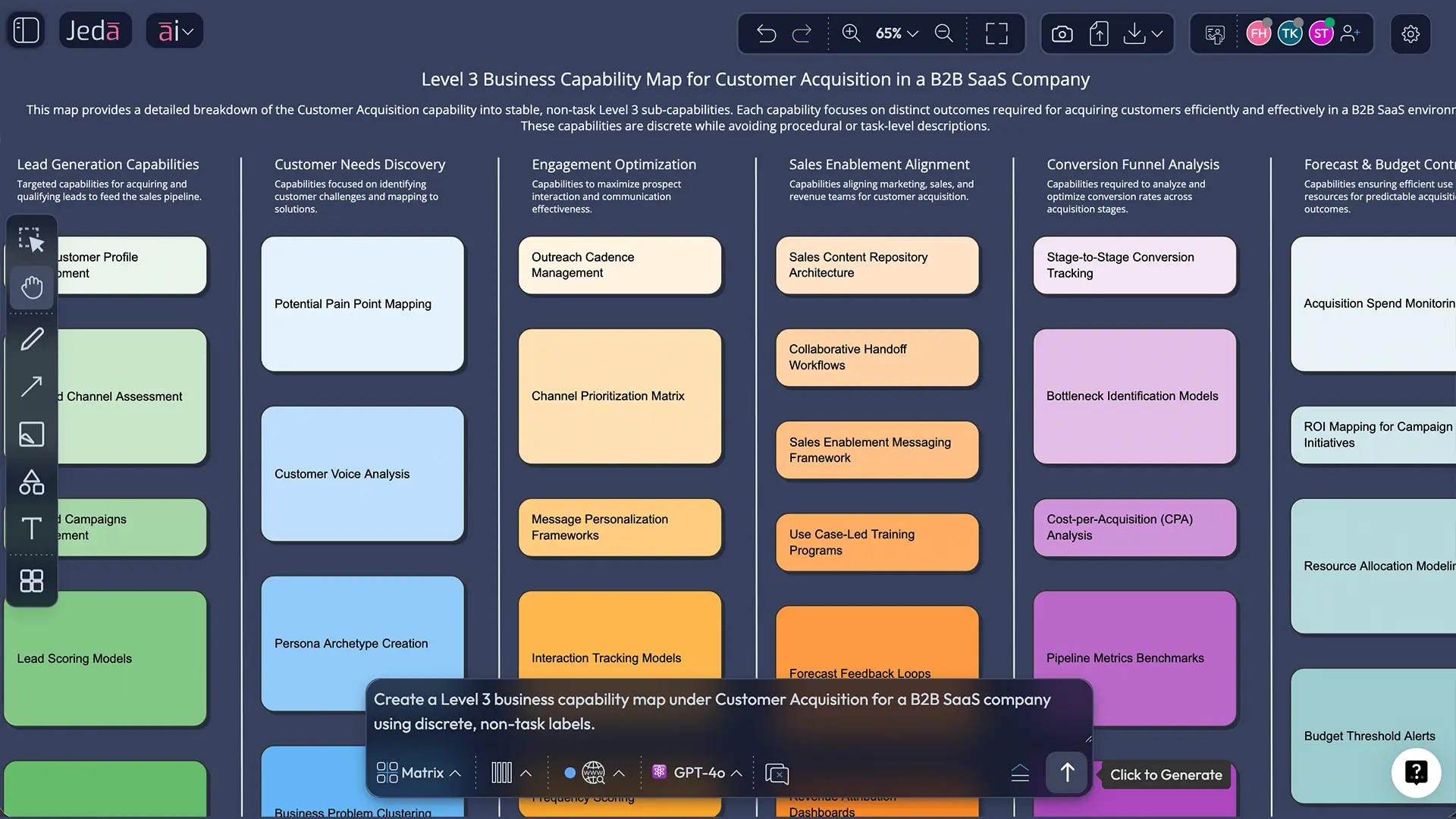
A useful Level 3 map could include:
- Campaign Strategy and Planning
- Audience and Segment Prioritization
- Channel Performance Management
- Lead Qualification Management
- Funnel Conversion Analysis
- Offer and Message Optimization
That set is specific enough to support ownership and maturity discussion. It is not so specific that it becomes a process map. You can now ask which sub-capabilities are underperforming, which rely on fragile tooling, and which deserve deeper investment.
And here’s the cluster logic. Once you reach Level 3, you can connect back upward to the First-level Business Capabilities Model with AI and the Second-level Business Capabilities Model with AI. That is how the topical authority stack works. Top layer for scope. Middle layer for structure. Third layer for discrete operational design.
Best Practices for Discrete Operational Capability Design
A blunt rule we’ve found useful: if the label requires a numbered sequence to make sense, it is probably not a capability.
Common Mistakes to Avoid
The first mistake is treating Level 3 as permission to list every operational activity anyone can think of. That turns the map into a junk drawer.
The second is hiding processes inside capability language. “Lead handoff execution” may sound strategic, but it’s still a flow step wearing a blazer.
Third, teams decompose everything equally. You don’t have to. Some Level 2 capabilities deserve more detail than others.
And the fourth mistake is forgetting why you built the map. Level 3 should support decisions around ownership, maturity, tooling, and transformation. If it can’t do that, you probably decomposed in the wrong direction.
Frequently Asked Questions
- What is a level 3 business capability map?
- A level 3 business capability map is the layer that breaks one Level 2 capability into more granular sub-capabilities. It gives operationally meaningful detail while still staying above process steps and task lists.
- What are Level 3 capabilities?
- Level 3 capabilities are discrete sub-capabilities beneath a Level 2 parent. They are more specific than Level 2, but they should still describe enduring business abilities rather than workflow steps or individual tasks.
- How is Level 3 different from a business process?
- Level 3 still describes what the business must be able to do. A business process describes how work flows from step to step. If the label reads like a sequence of actions, it likely belongs in process documentation instead.
- How granular should Level 3 capabilities be?
- They should be specific enough to support ownership, maturity, and planning discussions, but not so detailed that they become task fragments. For many teams, Level 3 is the deepest useful capability layer before process modeling begins.
- When should you stop decomposing capabilities?
- Stop when the map is detailed enough to support the decision you need. If going deeper only produces workflow steps, approval actions, or software tasks, you have likely crossed from capability mapping into process mapping.
- Can AI generate Level 3 sub-capabilities?
- Yes. AI can generate a strong first draft of Level 3 sub-capabilities when you provide the Level 2 parent and real business context. Stakeholders still need to validate which labels are useful and which ones drift into process detail.
- Should every Level 2 capability have Level 3 detail?
- No. Many organizations only decompose the Level 2 capabilities that matter most for strategy, risk, tooling, or transformation. Uneven depth is normal if the business need is uneven.
- Should I use AI+ to build the entire Level 3 map?
- Usually no. AI+ works best after the base matrix already exists. It is ideal for extending one selected sub-capability or branch rather than replacing the first-pass generation workflow.
- Can I export the result from Jeda.ai?
- Yes. Jeda.ai exports PNG, SVG, and PDF. The platform reference does not confirm native PowerPoint or Word export, so teams generally place the exported visual into reports or decks later.
Sources & Further Reading
- [1]
SAP LeanIX (2026) . “SAP LeanIX Business Capability Map” SAP LeanIX.
View Source ↗ - [2]
SAP LeanIX (2026) . “How to Create a Business Capability Map?” SAP LeanIX Wiki.
View Source ↗ - [3]
Orbus Software (2025) . “The Ultimate Guide to Business Capability Maps” Orbus Software.
View Source ↗ - [4]
Avolution (2026) . “How to Create a Business Capability Map, Examples & Guide” Avolution.
View Source ↗ - [5]
Ulrich, William (2011) . “The Business Capability Map: The 'Rosetta Stone' of Business/IT Alignment” Cutter Consortium / Business Architecture Associates.
View Source ↗ - [6]
Khosroshahi, Pouya Aleatrati; Hauder, Matheus; Volkert, Stefan; Matthes, Florian; Gernegross, Martin (2018) . “Business Capability Maps: Current Practices and Use Cases for Enterprise Architecture Management” HICSS 2018.
View Source ↗
Build Your Level 3 Capability Map in Jeda.ai
Join 150,000+ users using Jeda.ai’s AI Workspace and AI Whiteboard to create detailed, editable capability structures with 300+ strategic frameworks.
Try Free Template