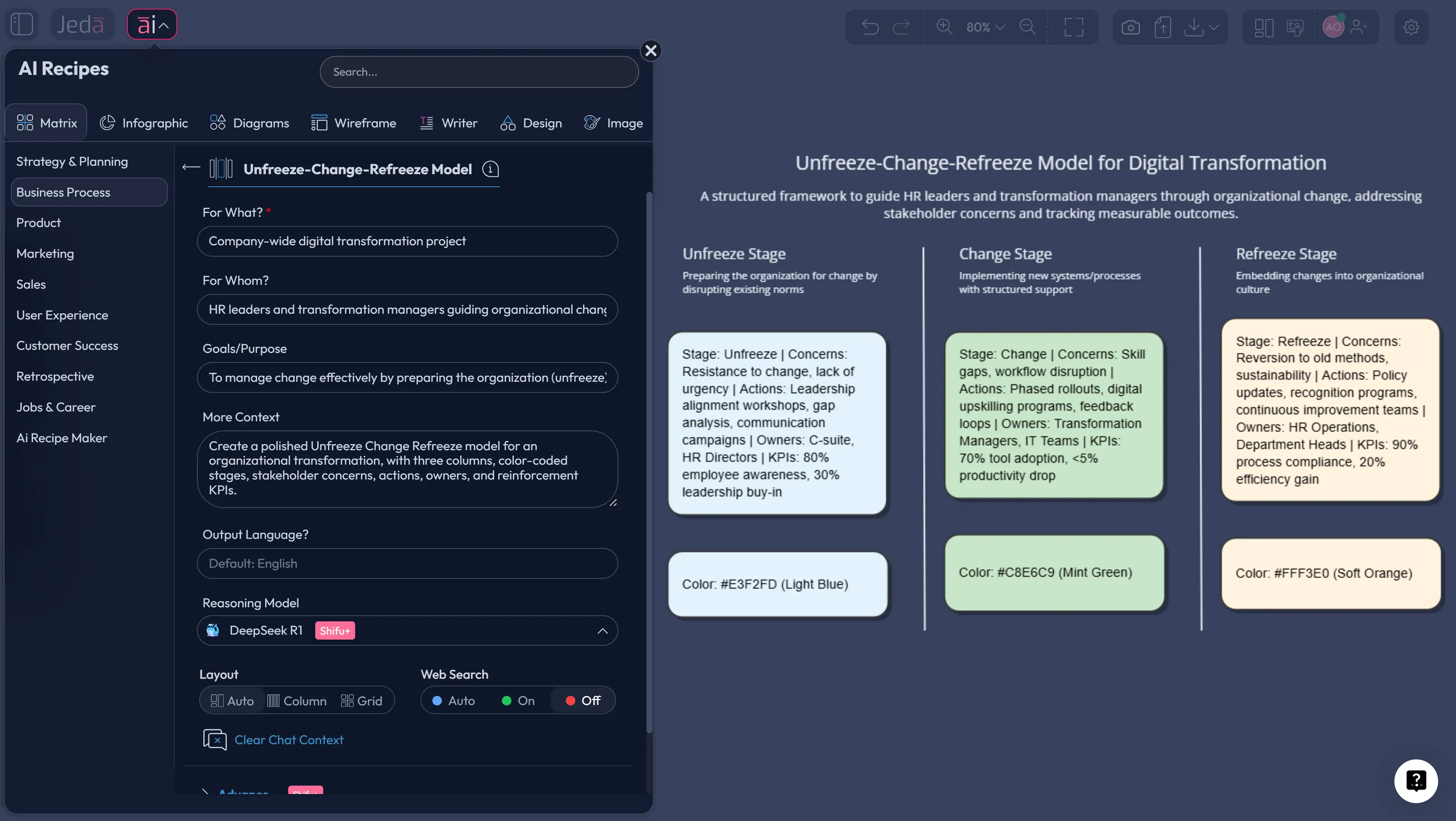
Unfreeze Change Refreeze model with AI gives teams a disciplined way to prepare for change, guide the messy middle, and stabilize new behaviors before old habits creep back in. Kurt Lewin’s classic three-stage model still matters because it forces one uncomfortable question: are you changing the system, or just announcing change and hoping people cope? In Jeda.ai, you can turn that question into an editable AI Workspace for diagnosis, stakeholder alignment, and follow-through. That matters when 150,000+ users want more than vague transformation talk. They want a visible method they can adapt, challenge, and execute inside an AI Whiteboard.
Lewin’s model is usually presented as unfreeze → change → refreeze, though some scholarly discussions use movement instead of change. The broad idea is simple. The application is not.
What is the Unfreeze Change Refreeze model?
The Unfreeze Change Refreeze model is a three-stage approach to planned organizational change associated with Kurt Lewin’s 1947 work on group dynamics and social change. In practical terms, unfreezing weakens attachment to the status quo, change introduces new behaviors or structures, and refreezing reinforces the new state so the organization does not slide backward. Lewin’s contribution was not merely a tidy slogan. It was a field-based way of thinking about equilibrium, opposing forces, and the social conditions required for durable change.
That last part gets lost all the time. The model is often treated as a cartoon of an ice cube. Burnes argues that much of the modern criticism oversimplifies Lewin’s original work, while Cummings and colleagues show that the popular three-step story has often been stripped from its deeper context. So yes, the model is simple. But it is not simplistic when used well.
For Jeda.ai readers, the appeal is obvious. The framework is naturally visual. You can lay out driving forces, restraining forces, stakeholder reactions, communication needs, pilot actions, and reinforcement loops inside one AI Workspace instead of scattering them across slides, chat threads, and spreadsheet tabs.
Why use the Unfreeze Change Refreeze model with AI?
The academic case for Lewin’s model is clarity. The operational case for pairing it with AI is speed, completeness, and pattern detection.
Without AI, teams often rush straight to execution. They skip readiness mapping, underestimate resistance, and treat adoption as a training issue rather than a systems issue. With Jeda.ai, you can use a Visual AI workflow to surface assumptions earlier, structure messy inputs faster, and turn unstructured thinking into a board that people can actually work from.
- Stage visibility
Separate unfreeze, change, and refreeze work so leaders can see where the initiative is actually failing instead of blaming adoption in general.
- Stakeholder alignment
Map sponsors, blockers, impacted teams, and communication gaps in one Jeda.ai board rather than across disconnected documents.
- AI-assisted synthesis
Use AI to cluster resistance themes, summarize documents, and suggest action paths from interviews, notes, and planning artifacts.
- Method discipline
The model forces teams to prepare, transition, and reinforce change in sequence, which reduces impulsive rollouts.
- Evidence-in planning
Bring PDFs, screenshots, spreadsheets, and web context into the AI Workspace so the framework reflects reality instead of executive wishful thinking.
- Durable adoption
Refreezing becomes measurable when you attach owners, incentives, routines, and review cadences to the board.
There is another benefit. AI makes the framework more useful in complex settings where the original model is sometimes criticized as too linear. You can still keep Lewin’s three stages as the macro-structure while running iterative pilots, gathering feedback, and updating the board in cycles. That is the grown-up version.
The three stages explained in academic but usable terms
1. Unfreeze
Unfreezing is the deliberate destabilization of the current equilibrium. Leaders create a credible case for change, expose the cost of staying still, and reduce attachment to old routines. This is where force-field logic matters: what is pushing the change forward, and what is holding it back?
In practice, unfreezing includes diagnosing performance gaps, naming external pressure, identifying cultural resistance, and building psychological readiness. It also includes something managers love to avoid: listening.
2. Change
The change stage is where the new process, structure, workflow, behavior, or mindset is introduced. Communication, coaching, experimentation, and visible leadership matter here. So do feedback loops. A rigid rollout usually breaks because the organization learns faster than the rollout plan.
Jeda.ai is especially useful in this stage because the AI Whiteboard can hold pilot designs, role changes, training plans, decision logic, process redesigns, and issue tracking in one shared space.
3. Refreeze
Refreezing stabilizes the new state through reinforcement, governance, incentives, norms, documentation, and repetition. This stage is the reason the model remains relevant. Change efforts often fail not because the solution was terrible, but because the organization quietly reverted.
Critics sometimes argue that “refreeze” sounds too static for turbulent environments. Fair. But the stronger interpretation is not permanent rigidity. It is temporary stabilization long enough for the desired behaviors to become normal operating practice.
How to create the Unfreeze Change Refreeze model in Jeda.ai
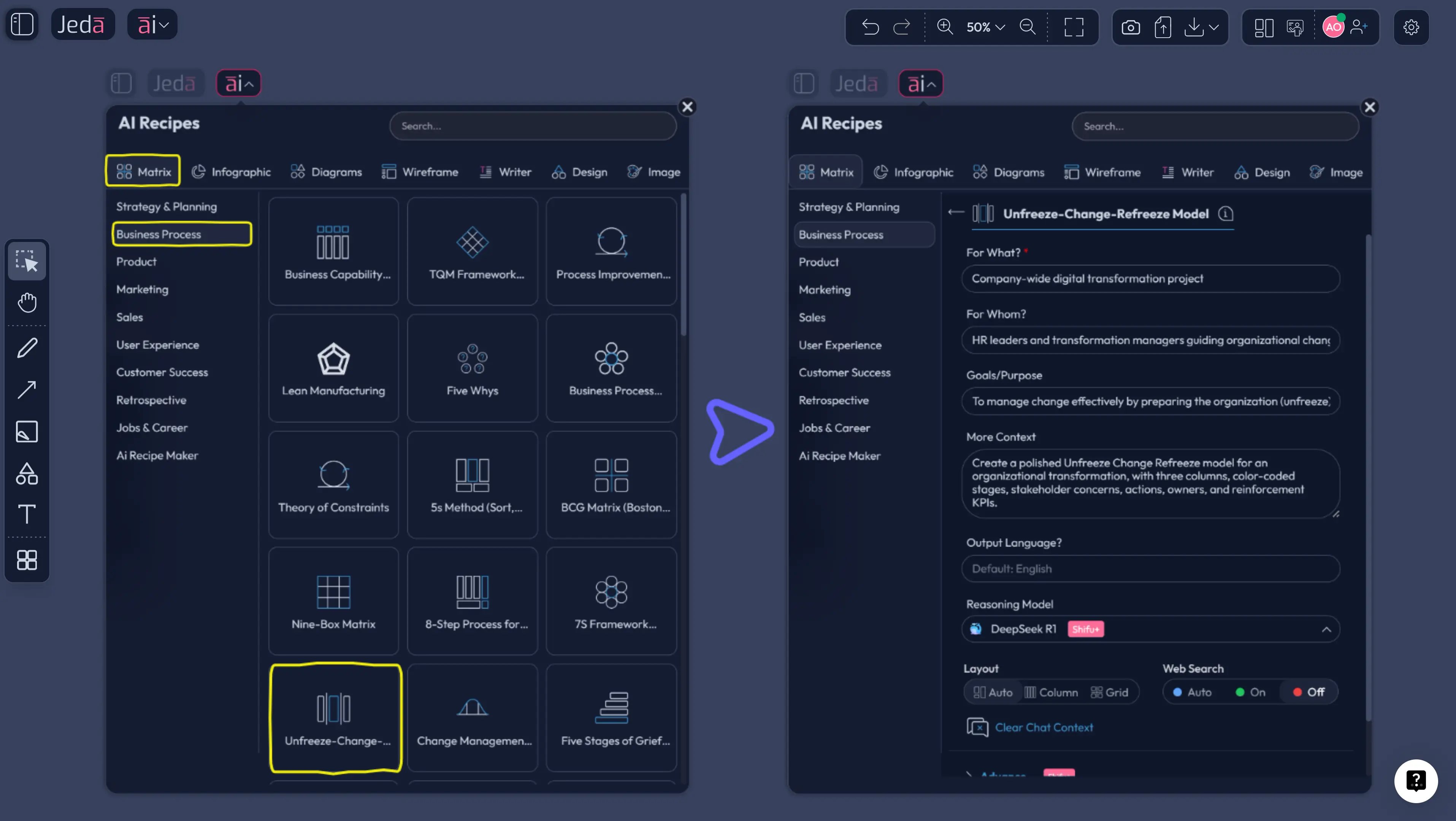
Method 1: Recipe Matrix
Use this method when your workspace exposes a matrix-style recipe or a closely related structured framework path in the AI Menu.
- Open the AI Menu from the top-left of the canvas.
- Choose "Unfreeze Change Refreeze model".
- Enter the change context: current state, target state, affected teams, risks, and timeline.
- Ask Jeda.ai to generate a three-column matrix for Unfreeze, Change, and Refreeze with actions, owners, dependencies, and likely resistance points.
- Review the first output and refine the board.
- Use the AI+ button to extend weak sections such as stakeholder analysis, communication planning, or reinforcement actions.
- If you want a different structure later, use Vision Transform to convert the matrix into a diagram or flowchart.
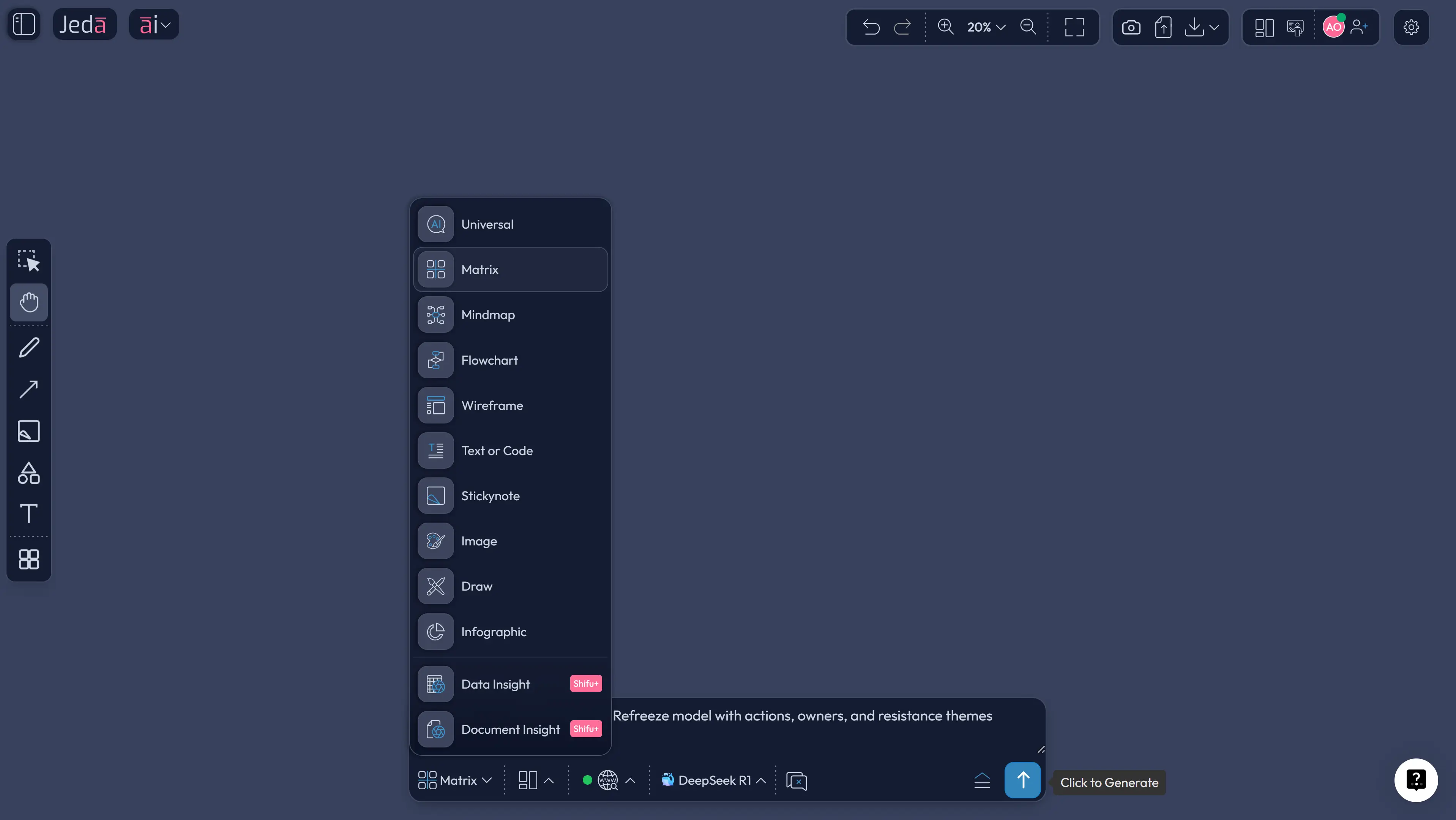
Method 2: Prompt Bar
This is the safest universal method because it is explicitly supported in the platform reference.
- Open the Prompt Bar at the bottom of the canvas.
- Select the Matrix command.
- Type a structured prompt such as:
Create an Unfreeze Change Refreeze model for rolling out a new performance management process. Include driving forces, restraining forces, stakeholder concerns, pilot actions, training needs, reinforcement mechanisms, KPIs, and owners. - Press Enter to generate the first board.
- Edit the sticky notes, labels, and structure directly in Jeda.ai.
- Tap the AI+ button on any section to deepen resistance analysis, communication planning, or success metrics.
- Use Vision Transform if you want to convert the matrix into a process diagram for executive communication.
- Define the change case
Name the current state, target state, and the organizational reason the status quo is no longer acceptable.
- Map unfreeze factors
List driving forces, restraining forces, stakeholders, fears, incentives, and readiness signals.
- Design the transition
Break the change stage into pilots, training, process updates, decision owners, and feedback loops.
- Plan reinforcement
Specify what will lock in the new behaviors: governance, KPIs, manager routines, incentives, and documentation.
- Generate the board in Jeda.ai
Use the Matrix command or a recipe-style matrix path to create the first visual draft.
- Deepen with AI+
Use the AI+ button to extend thin areas such as communication plans, risk controls, and adoption barriers.
- Convert and share
Transform the matrix into a diagram if needed, then collaborate, edit, and export as PNG, SVG, or PDF.
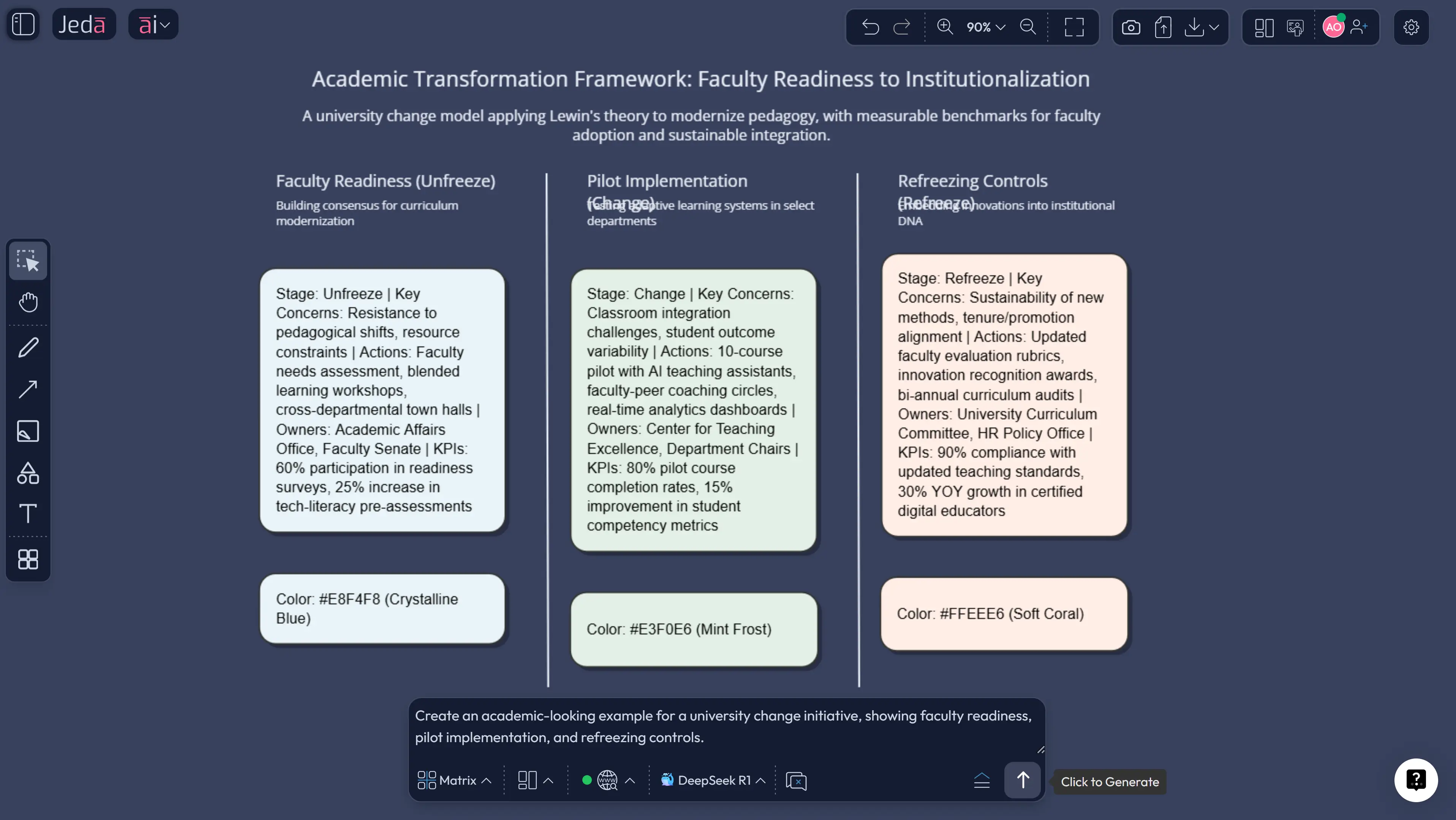
Unfreeze Change Refreeze model example
Imagine a university replacing fragmented course-planning practices with a shared AI-supported planning workflow.
- Unfreeze: faculty frustration is documented, duplicated work is measured, and the limits of the current system are made visible. The board captures stakeholder concerns, including training anxiety and tool fatigue.
- Change: the university pilots the new workflow with one department, adds peer champions, redesigns approval steps, and collects weekly feedback.
- Refreeze: the new planning standard is written into departmental routines, onboarding, review meetings, and semester planning templates.
That example shows why the model still earns a place in serious change work. It gives leaders a structure for separating readiness problems from implementation problems. Those are not the same thing. Treating them as the same thing is how transformation programs light money on fire.
Best practices when applying Lewin’s model with AI
Common mistakes to avoid
Treating unfreeze as a launch announcement
A kickoff meeting is not unfreezing. If people still believe the old way is safer, faster, or politically smarter, you have not unfreezed anything.
Confusing activity with adoption
Training sessions, workshops, and dashboard screenshots can create the illusion of progress. Refreezing asks a nastier question: what changed in normal behavior after the excitement faded?
Assuming resistance is irrational
Resistance often signals missing information, broken incentives, historical mistrust, or poorly designed workflows. AI can help cluster those reasons, but leaders still have to face them.
Using refreeze as permanent rigidity
The modern reading of refreezing is stabilization, not fossilization. Lock in what must become standard, but leave room for later learning.
Why Jeda.ai is a strong fit for this framework
Jeda.ai fits Lewin’s model because it is not just a note-taking surface. It is an AI Workspace built for structured thinking, collaborative editing, and evidence-backed visual planning. You can bring documents, process notes, screenshots, and spreadsheets into Jeda.ai, use the Matrix command to structure the model, and then keep the board alive as the initiative moves from readiness to rollout to reinforcement.
That matters for teams that dislike tool sprawl. The AI Whiteboard gives you one environment for stakeholder mapping, process redesign, meeting synthesis, and visual communication. Jeda.ai also supports 300+ strategic frameworks, so your Lewin board can connect with adjacent methods instead of living as a standalone artifact no one revisits.
| Framework-native structure | Editable visual output | Collaborative board | AI-assisted synthesis | |
|---|---|---|---|---|
| Jeda.ai | 300+ | ✓ | ✓ | ✓ |
| Blank whiteboard tool | Limited | ✓ | ✓ | ✗ |
| Text-only AI chat | Varies | ✗ | ✗ | ✓ |
And yes, the brand proof still matters. Jeda.ai serves 150,000+ users and positions itself as a framework-native AI Workspace and AI Whiteboard for decision-grade work, not just brainstorming.
Frequently asked questions
- What is the Unfreeze Change Refreeze model?
- The Unfreeze Change Refreeze model is Kurt Lewin’s three-stage approach to planned change: prepare people to leave the old state, implement the transition, and stabilize the new behavior so it becomes normal practice.
- Who created the Unfreeze Change Refreeze model?
- The model is associated with Kurt Lewin’s 1947 work on group dynamics and social change. Later scholars, especially Edgar Schein and Bernard Burnes, helped interpret and contextualize the model for organizational settings.
- Is Lewin’s change model still relevant today?
- Yes, but not as a rigid script. It remains useful as a macro-framework for readiness, transition, and reinforcement. Modern teams often combine it with iterative pilots, feedback loops, and continuous improvement.
- Why use AI for Lewin’s model?
- AI helps teams synthesize stakeholder feedback, cluster resistance themes, summarize documents, and generate structured boards faster. That improves diagnosis and planning, especially when change data is scattered across many sources.
- What happens in the unfreeze stage?
- Unfreezing creates readiness for change by challenging the status quo, surfacing risks of inaction, identifying resistance, and building stakeholder understanding. It is a preparation stage, not merely a communication campaign.
- What is the biggest weakness of the model?
- Its most common weakness is oversimplification. Critics argue the popular version sounds too linear and too static for fast-moving environments. Used carefully, though, it can still organize complex change without pretending reality is neat.
- How does Jeda.ai help with refreezing?
- Jeda.ai helps teams make refreezing concrete by keeping one visible board for KPIs, new routines, owners, reinforcement actions, documentation, and review checkpoints. That reduces the risk of quiet regression after launch.
- Can I build this model in Jeda.ai without a prebuilt recipe?
- Yes. The Prompt Bar method is fully workable. Select the Matrix command, describe the change initiative and the three stages, generate the board, then extend it with the AI+ button and refine it collaboratively.
- What industries can use the Unfreeze Change Refreeze model?
- The model is widely used across business, education, healthcare, operations, and public-sector settings. It is especially useful when the challenge involves behavior change, process redesign, or implementation of a new operating norm.
- What should I measure in a Lewin-based change plan?
- Track readiness indicators during unfreeze, execution and learning indicators during change, and behavior stability indicators during refreeze. Good measures include adoption, error rates, cycle time, compliance, engagement, and manager follow-through.
Sources & further reading
- [1]
Lewin, Kurt (1947) . “Frontiers in Group Dynamics: Concept, Method and Reality in Social Science; Social Equilibria and Social Change” Human Relations.
View Source ↗ - [2]
Schein, Edgar H. (1996) . “Kurt Lewin's Change Theory in the Field and in the Classroom: Notes Toward a Model of Managed Learning” Systems Practice.
View Source ↗ - [3]
Burnes, Bernard (2004) . “Kurt Lewin and the Planned Approach to Change: A Re-appraisal” Journal of Management Studies.
View Source ↗ - [4]
Cummings, Stephen; Bridgman, Todd; Brown, Kenneth G. (2016) . “Unfreezing Change as Three Steps: Rethinking Kurt Lewin's Legacy for Change Management” Human Relations.
View Source ↗ - [5]
Hussain, Syed Tamkin et al. (2018) . “Kurt Lewin's change model: A critical review of the role of leadership and employee involvement in organizational change” Journal of Innovation & Knowledge.
View Source ↗ - [6]
Stanz, Lauren et al. (2021) . “Leading Through Rapid Change Management” Hospital Pharmacy.
View Source ↗ - [7]
Vasel, Haneen (2025) . “Factors shaping the implementation of educational organizational change: An analysis of Lewin's model in the context of teaching innovations” Social Sciences & Humanities Open.
View Source ↗
Start your Unfreeze Change Refreeze model with AI
Use Jeda.ai to turn change logic into an editable AI Workspace. Join 150,000+ users building decision-ready boards with 300+ strategic frameworks.
Try Free Template