Brand positioning Strategy with AI is no longer a nice-to-have for busy marketing teams. It is the fastest way to turn scattered research, fuzzy differentiation, and too-many-opinions syndrome into a sharp market position you can actually use. In Jeda.ai, you can do that work inside one AI Workspace and AI Whiteboard instead of bouncing between docs, slides, chat tabs, and half-finished spreadsheets. That matters when your team needs a usable positioning map, not another meeting about why the message still feels “a bit generic.”
A strong position is the place your brand occupies in the buyer’s mind relative to alternatives. It is how people answer the quiet question behind every buying decision: “Why this brand, from this category, for this need, instead of the others?” Classic positioning thinking traces back to Al Ries and Jack Trout’s work on owning a distinct place in the mind, and modern brand strategy keeps circling the same core truth: clarity beats noise. What changed is the speed. AI can now compress the slowest parts of the work—research synthesis, competitor clustering, map drafting, statement generation, and scenario testing—without forcing you into a static text-only workflow.
If you want the shortest version, here it is. Brand positioning gets stronger when you combine customer needs, competitor signals, proof points, and a visual model that the whole team can challenge together. That is exactly where Jeda.ai fits.
What is brand positioning strategy?
Brand positioning strategy is the process of defining how you want your brand to be understood by a specific audience, in a specific market, against specific alternatives. Good positioning links four things: who you serve, what problem you solve, what makes you different, and why people should believe you. Amazon Ads frames it as the unique value a brand presents to customers, while Hinge emphasizes differentiation in the audience’s mind and the need for relevance, difference, and visibility. Map & Fire adds the missing practical layer: positioning is not just a statement template. It depends on customer insight, competitor context, and offering alignment.
That is why brand positioning work usually breaks into a few visual assets:
- a customer-needs snapshot
- a competitor comparison
- a positioning map or perceptual map
- a proof-backed differentiation list
- a concise positioning statement
- a messaging direction for campaigns, pricing, launch pages, and sales
And yes, this is where teams often get stuck. One person wants a premium position. Another wants “accessible.” The founder wants bold. Sales wants practical. Product wants technical precision. Nobody is wrong. But without a shared visual, everybody is arguing from a different map.
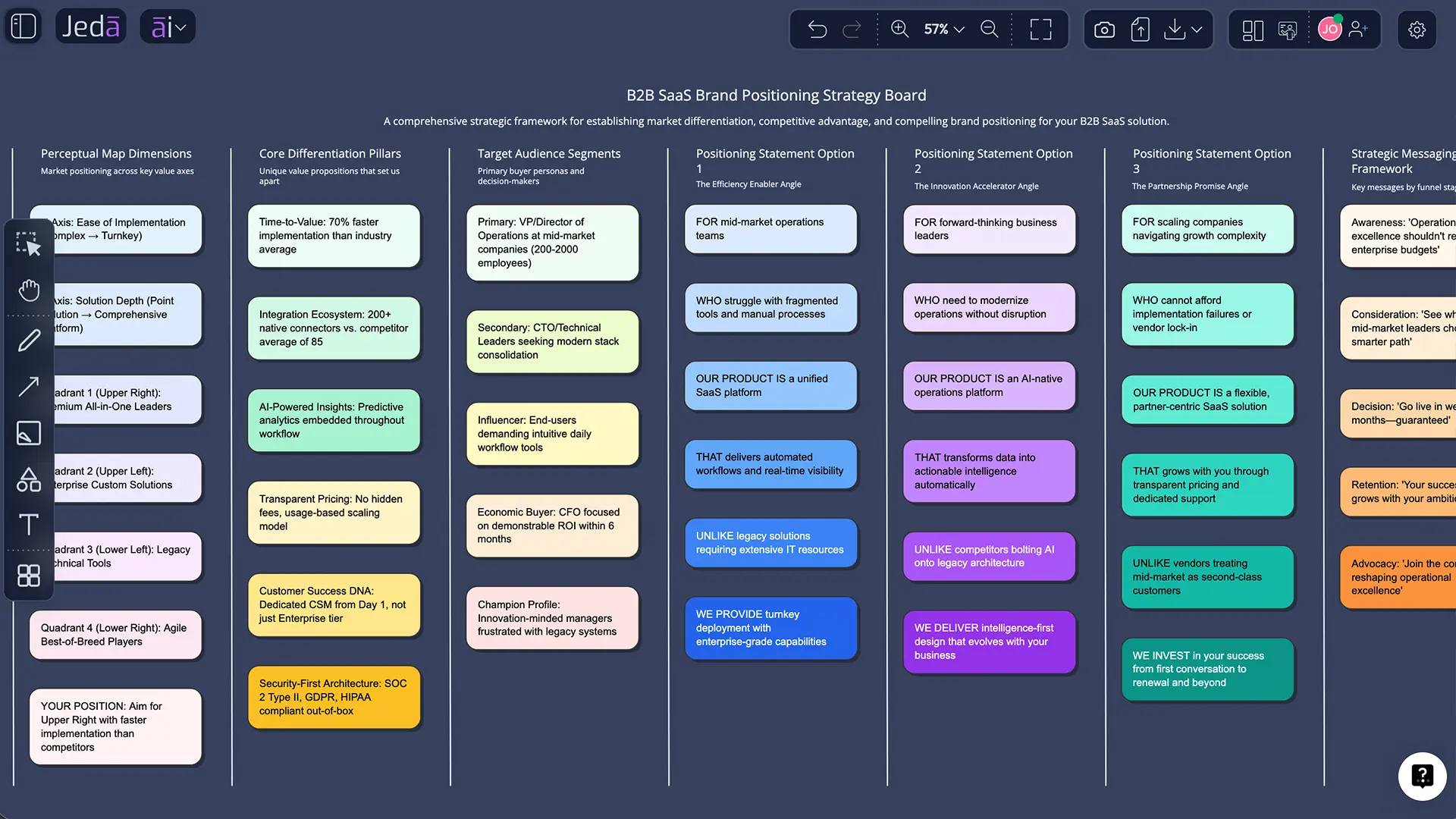
Why use brand positioning Strategy with AI?
Traditional positioning workshops are slow for a boring reason: most of the time disappears into organizing messy inputs. Interviews live in docs. Competitor claims live on websites. Voice-of-customer notes live in spreadsheets. Internal opinions live in Slack threads and somebody’s head. AI helps because it can cluster, summarize, compare, and draft fast. But speed alone is not enough. You still need a format that marketers, founders, product leaders, and consultants can challenge together. That is where a visual workflow wins.
Jeda.ai gives you that mix. The platform combines editable visual outputs, collaborative canvas work, web-grounded research support, and 300+ strategic frameworks inside one AI Workspace. So instead of generating a paragraph and pasting it into slides later, you can build the positioning model where the actual decision happens.
- Sharper differentiation
Compare competitors, audience needs, proof points, and white space in one visual so your position stops sounding like everybody else.
- Faster synthesis
Turn research notes, web findings, and internal inputs into a first-pass map and statement in minutes instead of days.
- Team alignment
Your marketing, product, and leadership teams can react to the same canvas rather than debating separate documents.
- Better evidence
Use Jeda.ai’s platform-level web search and document workflows to ground your positioning in market reality, not wishful thinking.
- Multiple visual paths
Start with a Matrix, then turn it into a Diagram or Mindmap with Vision Transform when the team needs a different lens.
- Deeper iteration
Use AI+ to extend a node, quadrant, or competitor cluster when you need more examples, risks, or messaging angles.
There is another, less glamorous benefit. AI makes it easier to test alternative positions before you commit. Premium vs accessible. Expert vs friendly. Category leader vs challenger. Feature-led vs outcome-led. Most teams should test two or three versions before locking the final statement. Jeda.ai makes that kind of branching normal, not painful.
How to create Brand positioning Strategy with AI in Jeda.ai
Jeda.ai already supports this topic as a live resource and related marketing/strategy workflows, and its broader AI Menu and Prompt Bar system are designed for structured visual generation. The cleanest path is to start with a matrix-style workflow, because positioning work naturally depends on side-by-side comparisons, trade-offs, and attribute mapping. Jeda.ai’s AI Workspace also supports Multi-LLM generation, Dynamic Prompt, Vision Transform, and the AI+ button for extending selected smart shapes.
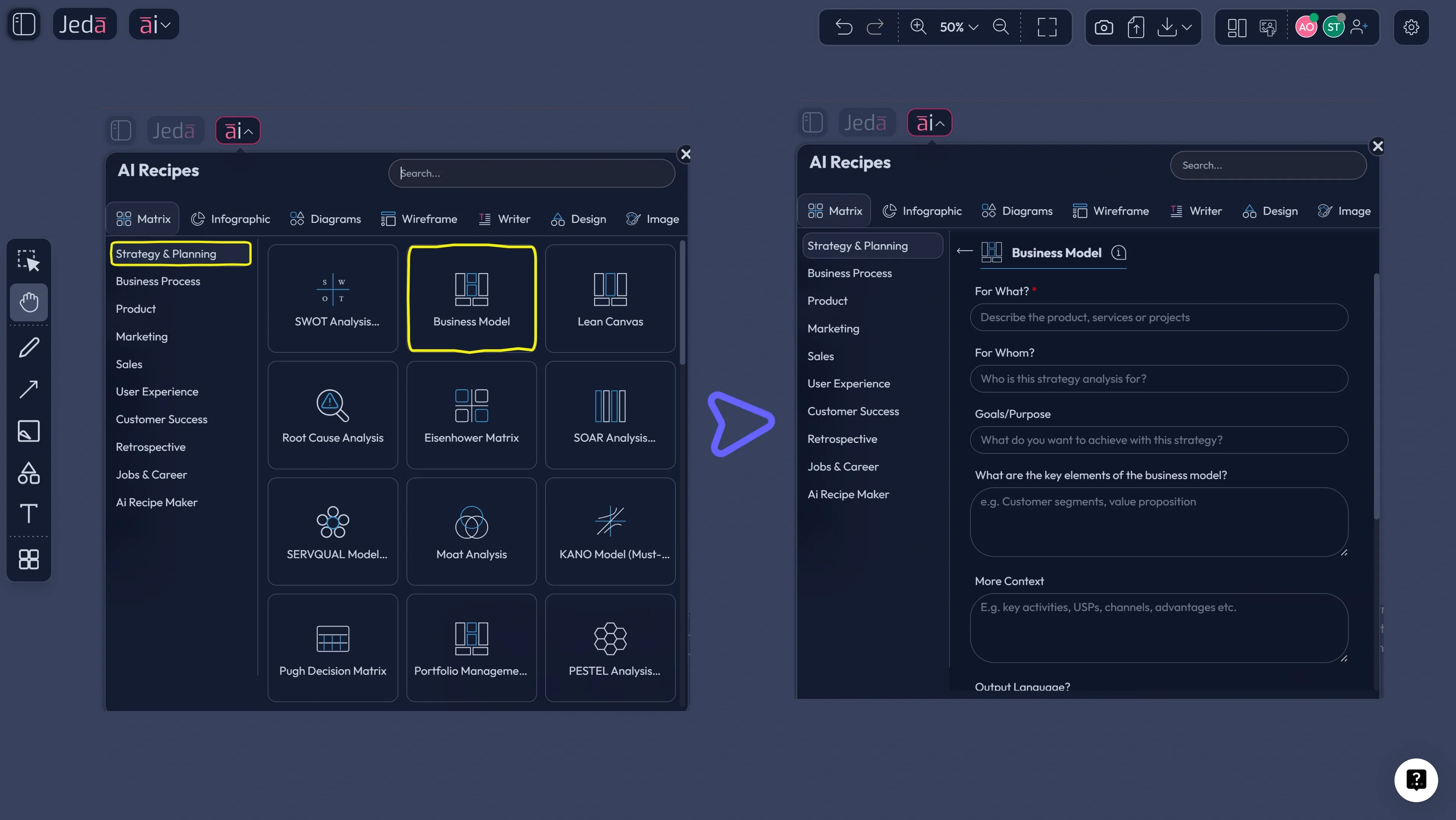
Method 1: Recipe Matrix
Use the AI Menu when you want a guided structure first. Open the AI Menu, go to the Matrix-oriented recipe path, and choose the closest positioning-style framework available in your workspace. Depending on your team’s angle, that may be a direct Brand Positioning Strategy workflow or a related matrix such as Strategy Canvas or Quality Differentiation. Guided inputs work well here because the hardest part of positioning is often framing the problem clearly.
Good inputs to include:
- target audience segment
- category and subcategory
- top 3–5 competitors
- buying criteria customers actually use
- current perception problems
- proof points you can defend
- desired market position
- tone or strategic direction
- Open the AI Menu
In the top-left of your Jeda.ai workspace, open the AI Menu and enter the Matrix recipe path for a positioning-oriented framework.
- Choose a positioning-friendly matrix
Select the closest Brand Positioning, Strategy Canvas, Quality Differentiation, or competitor-mapping style recipe available in your workspace.
- Fill the strategic inputs
Add the audience, category, main competitors, decision criteria, proof points, current perception issues, and the position you want to own.
- Generate the first model
Pick the preferred layout and AI model, then generate the initial brand positioning strategy visual on the canvas.
- Refine the weak areas
Edit sticky notes, rename axes, merge duplicate themes, and remove any claims that are not true, provable, or relevant.
- Extend with AI+
Select any quadrant, competitor cluster, or statement draft and extend it with AI using the AI+ button to deepen insights, examples, and messaging options.
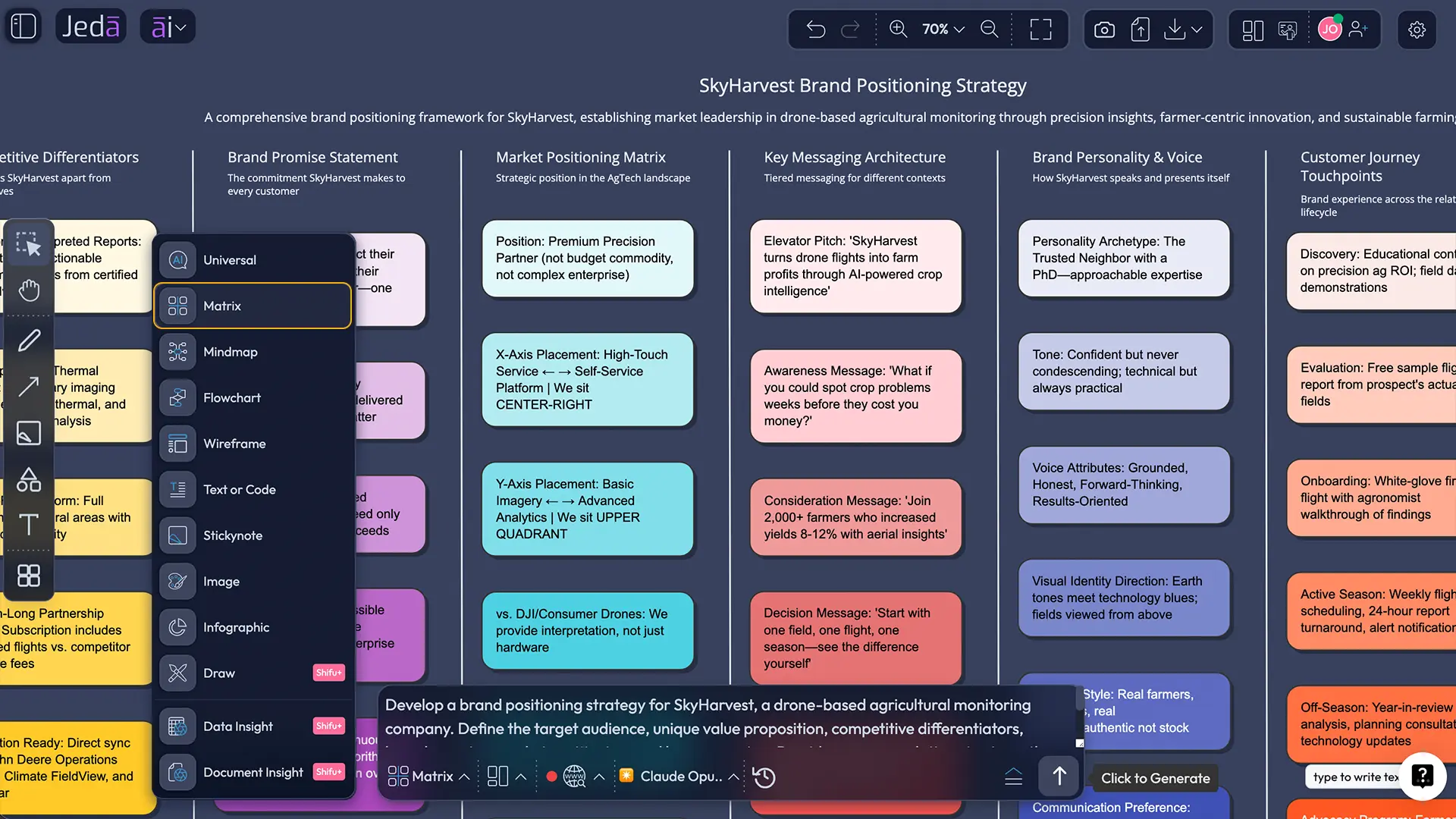
Method 2: Prompt Bar
Use the Prompt Bar when you want more control. Open the Prompt Bar at the bottom of the canvas, select the Matrix command, and write a direct prompt. You can also switch on web search, choose a single model, or use Multi-LLM if the decision matters enough to justify multiple perspectives.
Try a prompt like this:
“Create a brand positioning strategy for a B2B analytics platform serving mid-market operations teams. Compare us against Tableau, Power BI, and Looker on ease of use, strategic depth, implementation speed, proof points, and buyer trust. Output a positioning matrix, a white-space summary, and three positioning statement options.”
Then do the smart part. Edit the first output. AI is fast, but the winning version usually appears in round two or three.
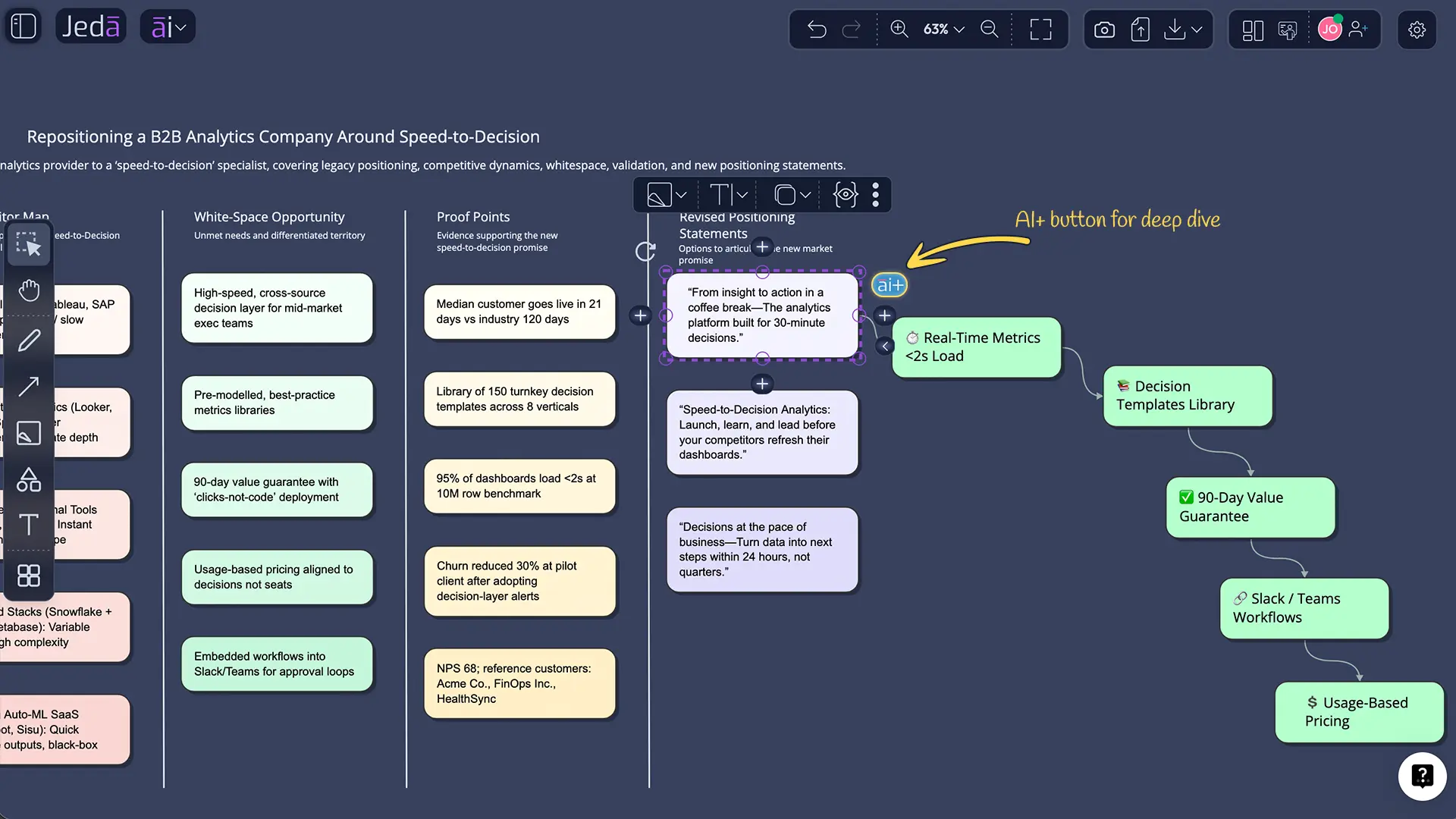
AI+ deep dive and Vision Transform
AI+ is best for extending what already exists. It can deepen a competitor cluster, add reasons-to-believe, expand a target segment, or explore alternate statements from a selected node. It is not the place to ask for an entirely unrelated framework out of nowhere. Start the framework first. Then use AI+ to push depth where the team wants to challenge assumptions.
Vision Transform is useful after that. Build the first model as a Matrix, then turn it into a Mindmap for workshop discussion or into a Diagram when the team wants clearer relationships between audience, proof, and differentiation.
The visuals that make positioning easier to defend
A lot of brand teams jump too early to the positioning statement. Bad move. The statement is the summary, not the discovery process. The stronger flow is:
- map the audience
- map the competitors
- map the buying criteria
- find the white space
- pressure-test your claims
- write the statement
That flow works especially well on an AI Whiteboard because each visual exposes a different kind of mistake.
A perceptual map shows whether your intended position is already crowded. A strategy canvas shows where your feature story is still too close to competitors. A mind map helps you expand customer language, objections, and reasons-to-believe. And a simple diagram can connect your target segment, value proposition, proof, and key message hierarchy into one board that non-marketers can actually understand.
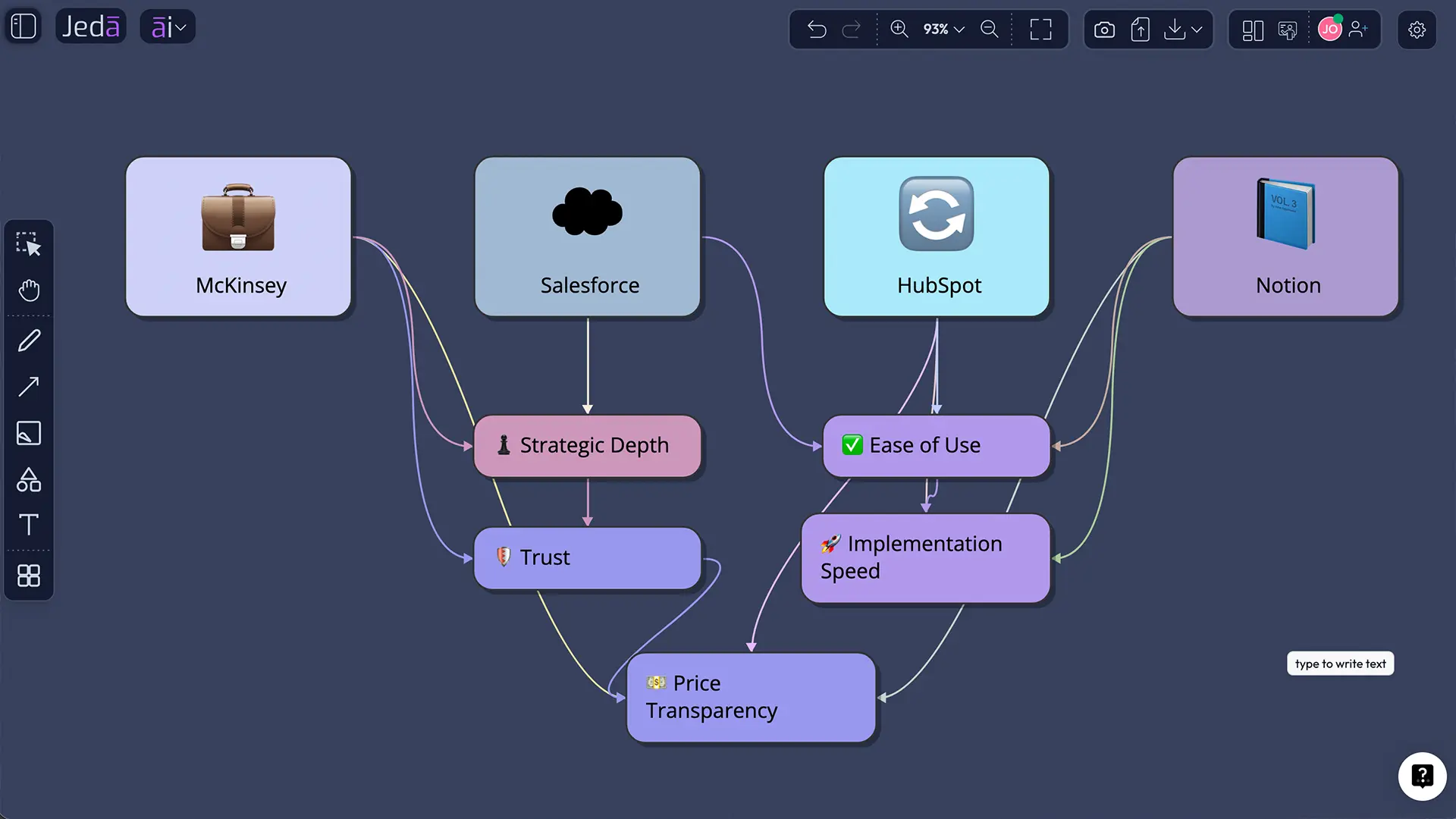
Example: repositioning a B2B SaaS analytics brand
Let’s make this real. Imagine a B2B SaaS analytics product that keeps losing deals to better-known enterprise tools. The team describes itself as “powerful, flexible, and innovative.” Which sounds impressive until you realize every competitor says almost the same thing.
Inside Jeda.ai, the team starts with a matrix prompt that compares the brand against three competitors across implementation speed, dashboard flexibility, executive readability, collaboration, and total cost of adoption. The first output shows something useful: the product is not winning on raw feature breadth, but it is meaningfully stronger on speed-to-value and decision clarity for non-technical operators.
That changes the game.
Instead of trying to position as “the most advanced analytics platform,” the team shifts toward “the fastest way for operations leaders to turn messy data into confident weekly decisions.” Suddenly the position is narrower, more believable, and more ownable. Then the team uses AI+ on the “proof points” node to generate evidence ideas: onboarding time, dashboard adoption, weekly usage cadence, and stakeholder alignment benefits.
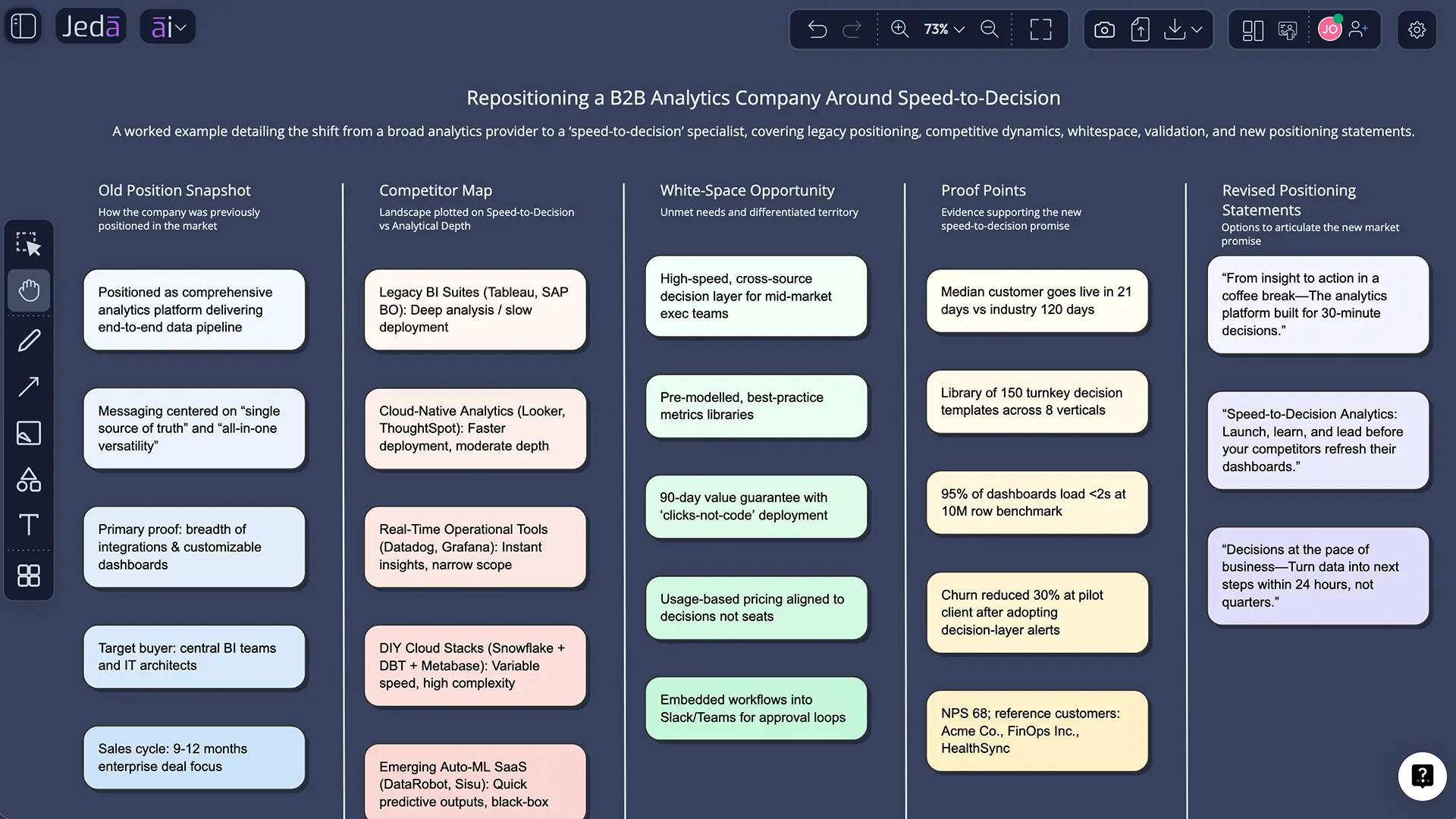
That board is far more useful than a polished paragraph alone because it shows the logic behind the position. Founders trust it more. Sales can use it. Product can align to it. Marketing can build from it.
Best practices and common mistakes
The most common mistakes are painfully consistent. Teams confuse messaging with positioning. They pick dimensions that matter to the company, not the buyer. They stuff too many promises into one statement. Or they skip competitor context and end up claiming a position that is already occupied.
Another frequent miss: treating the positioning statement as the first step. It should be the last compression pass. The map comes first. The statement comes after the map has earned it.
Frequently asked questions
- What is the difference between brand positioning and brand messaging?
- Brand positioning defines the space you want to own in the buyer’s mind relative to alternatives. Brand messaging is how you communicate that position across pages, campaigns, sales conversations, and launches. Positioning is the strategic core; messaging is the expression layer.
- Can AI really help with brand positioning strategy?
- Yes, especially in the messy middle. AI helps cluster audience needs, compare competitors, surface white space, draft statements, and test alternatives faster. It still needs human judgment, but it removes a huge amount of manual synthesis work and speeds up iteration.
- What inputs produce better results in Jeda.ai?
- The best outputs come from concrete inputs: target segment, category, named competitors, buying criteria, proof points, current perception issues, and the position you want to explore. Vague prompts produce generic positioning. Specific prompts create more defensible strategic options.
- Should I use Matrix, Mindmap, or Diagram first?
- Start with Matrix for most positioning work because it handles comparisons and trade-offs cleanly. Use Mindmap when you need more expansion around audience language or objections. Use Diagram when you want to show relationships between brand, audience, proof, and message architecture.
- What does the AI+ button do in this workflow?
- AI+ extends a selected visual element. In positioning work, that means deepening a competitor cluster, adding reasons-to-believe, expanding a buyer segment, or generating alternative statements from a chosen node. It works best after the main framework already exists on the canvas.
- Can Jeda.ai use documents or research files for positioning work?
- Yes. You can upload files and use Document Insight or Data Insight workflows when you want the platform to extract structure from research decks, interview notes, PDFs, or spreadsheets. That is useful when your positioning work starts from existing evidence rather than a blank board.
- How often should a brand revisit its positioning?
- Revisit positioning whenever the market changes meaningfully: new competitors, new target segment, pricing shifts, product expansion, or falling message resonance. For most teams, a formal review every six to twelve months is smart, with lighter checks each quarter.
- Does a positioning statement belong on the website exactly as written?
- Usually no. A positioning statement is mainly an internal alignment tool. Parts of it can shape homepage copy, sales messaging, and campaign language, but the raw statement itself is usually too compressed and too strategic to publish word-for-word.
Sources & further reading
A smart positioning workflow mixes classic strategy thinking with practical mapping methods and evidence-based research. The sources below are strong places to sharpen the method before you lock your final brand position.
- [1]
Al Ries; Jack Trout (2001) . “Positioning: The Battle for Your Mind” McGraw-Hill.
View Source ↗ - [2]
Niraj Dawar (2015) . “A Better Way to Map Brand Strategy” Harvard Business Review.
View Source ↗ - [3]
Amazon Ads (2025) . “What is brand positioning and why is it important?” Amazon Ads.
View Source ↗ - [4]
Map & Fire (2025) . “Brand Positioning Strategy: Framework, Exercises, Examples” Map & Fire.
View Source ↗ - [5]
Hinge Marketing (2025) . “Brand Positioning Strategy for the Professional Services Industry” Hinge Marketing.
View Source ↗ - [6]
Natia Kvirkvelia (2019) . “Perceptual Mapping as a Marketing Research Tool for Brand Positioning” ResearchGate / conference paper.
View Source ↗
You can also explore related Jeda.ai workflows through the AI Workspace, the AI Whiteboard, Porter’s Five Forces with AI, and PESTEL Analysis with AI. Those are especially useful when your positioning work depends on competitor pressure, category forces, or macro trends.
Start Your Brand Positioning Strategy in Jeda.ai
Join over 150,000 professionals who use Jeda.ai to turn strategy ideas, competitor insight, and market evidence into editable visual decisions.
Try Free Template