Business growth plan work gets messy fast. One meeting says “expand upmarket,” another says “launch a new offer,” finance wants proof, sales wants timeline, and suddenly your strategy is six tabs, three decks, and one cursed spreadsheet. A business growth plan should do the opposite. It should make growth choices visible, defensible, and executable. That is exactly where Jeda.ai starts to earn its keep as an AI Workspace and AI Whiteboard for teams that need more than another blank page.
If you are trying to grow revenue, enter a new market, increase retention, expand product lines, or simply stop guessing, Jeda.ai gives you a more useful way to work. You can turn goals, market signals, financial inputs, and strategic options into editable visual planning. Not static output. Not a one-shot answer. Real working strategy.
What Is a Business Growth Plan?
A business growth plan is a written roadmap for how a company will grow from its current state to a more ambitious one. Good ones define the target, the route, the resources, the risks, and the sequence. Business.com frames it as a strategy for where a company wants to go and how it will get there, while SBA guidance reinforces the need for market analysis, competitive research, and a grounded understanding of customer demand.
And here is the part many teams skip: a growth plan is not the same as a business plan. A business plan usually explains how the business works. A growth plan explains how the business will scale from here. That difference matters.
In practice, most serious growth plans end up circling a few classic strategic choices that trace back to Ansoff’s 1957 work: sell more of current offers into current markets, build new offers, enter new markets, or diversify. Simple on paper. Less simple when your team has to choose, prioritize, and commit.
That is why a visual format helps. You stop talking in abstractions and start seeing trade-offs.
Why Use a Business Growth Plan with AI?
Because planning is rarely blocked by a lack of ambition. It is blocked by synthesis.
Leaders have market notes, customer interviews, board decks, revenue data, competitor moves, and scattered opinions. AI helps compress that pile into working strategy. McKinsey argues that AI is reshaping strategy development itself, and Accenture’s research makes the commercial case even plainer: firms with AI-led processes outperform peers on revenue growth, productivity, and scaling success.
But raw AI text alone is not enough. You still need structure. You need something your team can challenge, edit, extend, and own together.
That is where Jeda.ai feels different:
- Strategy becomes visible
Turn growth goals, options, risks, and KPIs into an editable matrix instead of another vague strategy memo.
- Evidence goes in
Use Jeda.ai Web Search, upload source documents, or bring in spreadsheets so the plan is built on real inputs.
- One plan, many views
Start as a matrix, then use Vision Transform to turn the same plan into a mind map, flowchart, or infographic.
- AI+ deepens weak spots
Use the AI+ button on a section that feels thin and extend it with scenarios, tactics, or risk analysis.
- Built for real collaboration
Jeda.ai works like an AI Whiteboard, so your leadership team can review, edit, and align in the same shared canvas.
- Framework-native planning
You are not starting from scratch. Jeda.ai brings 300+ strategic frameworks into one Visual AI workflow.
There is another reason to use AI here. Growth planning is full of blind spots. Teams overrate familiar channels, underrate operational constraints, and confuse motion with progress. A strong AI Workspace helps you pressure-test the plan before the market does it for you. Much cheaper that way.
How to Create a Business Growth Plan in Jeda.ai
The best route is to treat the first output as a strategy draft, not holy scripture. Generate the structure, refine the weak parts, and convert it into the format your team needs next.
Method 1 — Matrix Recipes path
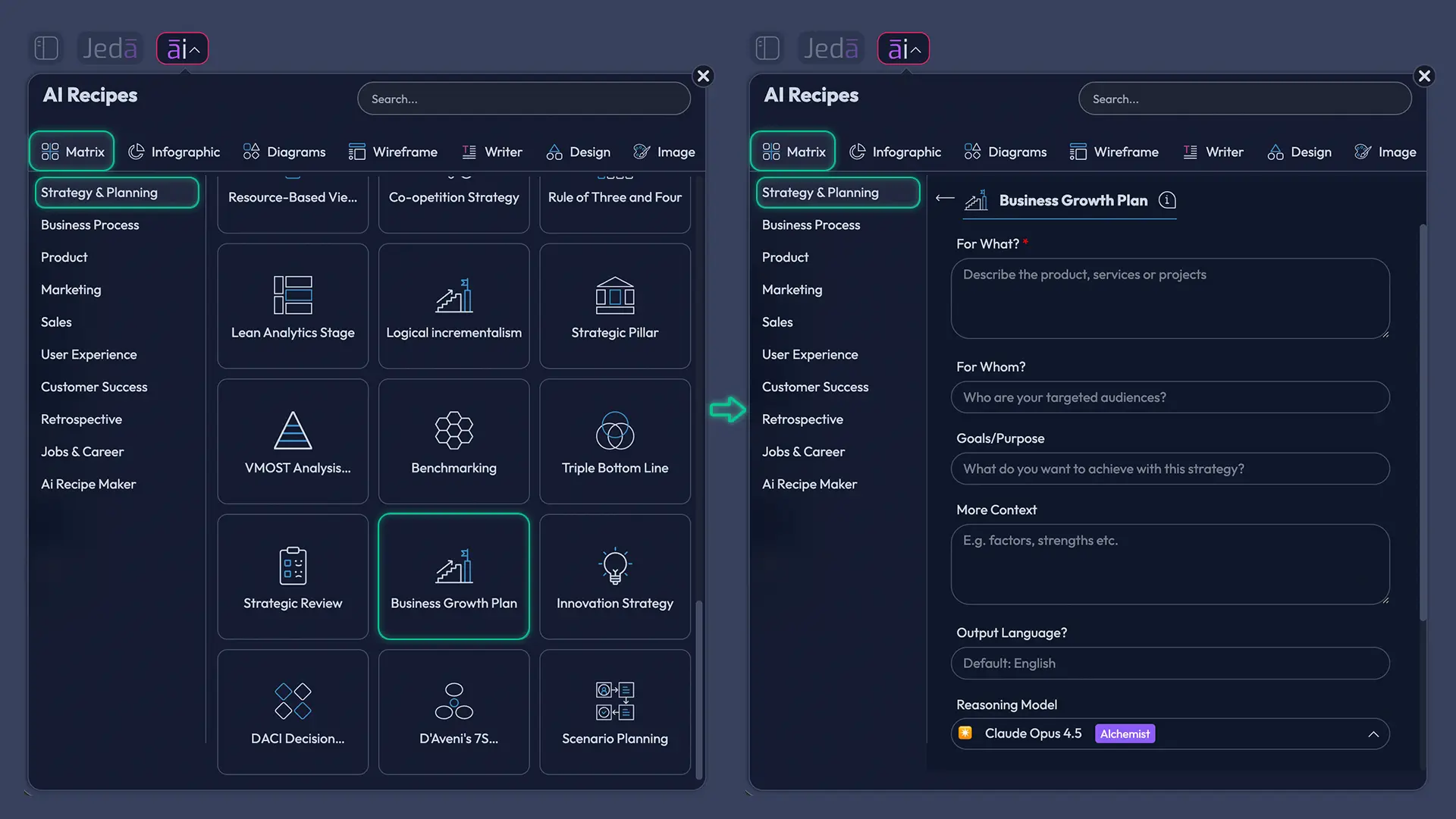
The uploaded Jeda.ai docs confirm Matrix Recipes such as Project Planning, Financial Planning, and Clear Path to Action, but they do not confirm a dedicated named “Business Growth Plan” recipe. So the cleanest honest approach is this: use the Matrix Recipes category as your structured starting point, then tailor the inputs to growth planning.
Open the AI Menu in the top-left area of the workspace. Go to Matrix Recipes. Choose the closest planning-oriented recipe. Then fill in the growth context: current revenue, target outcome, customer segment, market opportunity, product or channel plays, constraints, timeline, owners, and KPIs.
That gives you the skeleton.
Method 2 — Prompt Bar path
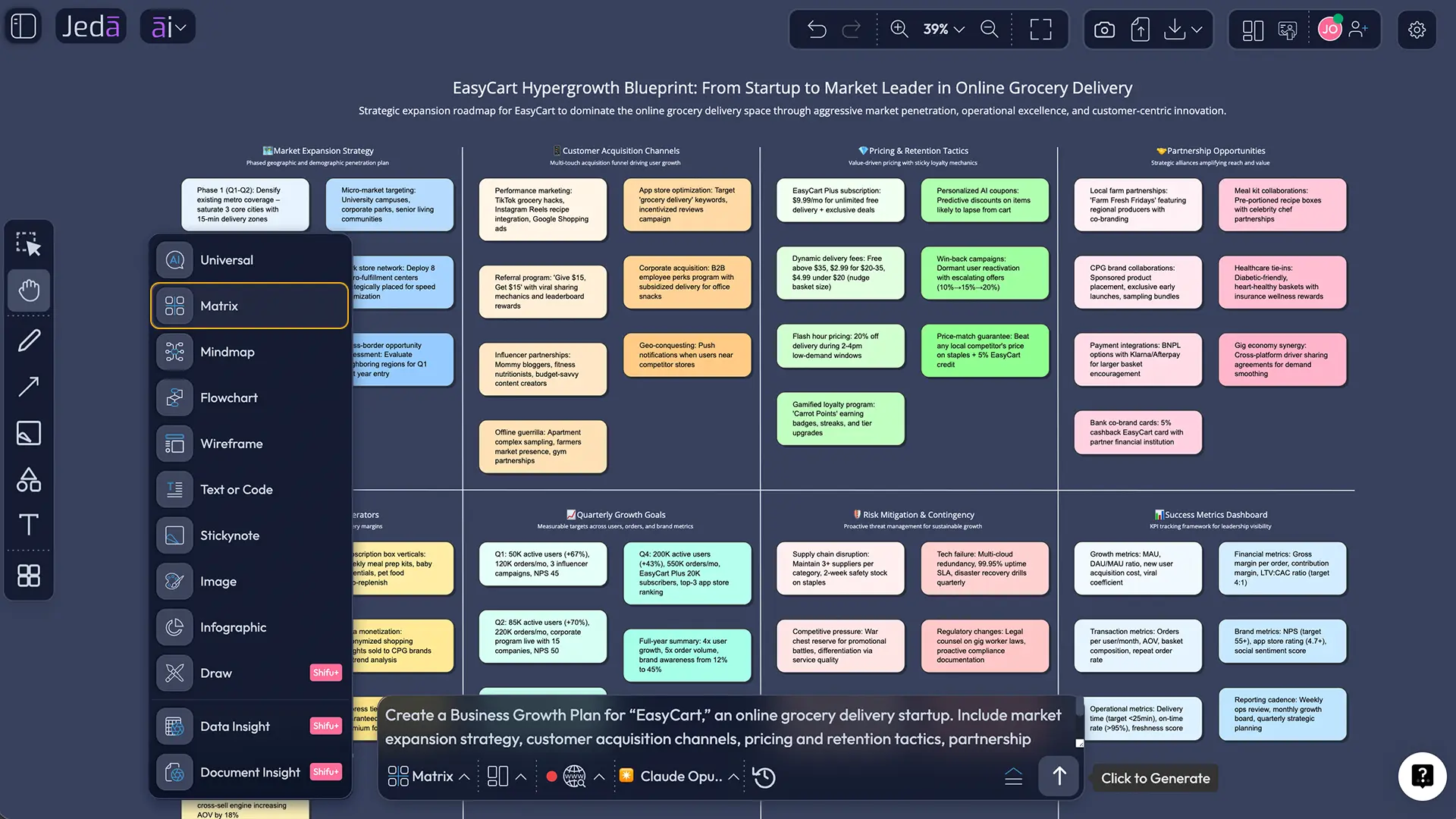
If you want more freedom, go straight to the Prompt Bar at the bottom of the workspace. Select the Matrix command. Then prompt the AI to generate a business growth plan that includes goals, current-state diagnosis, growth levers, priorities, dependencies, budget assumptions, risks, owners, and measures of success.
This route is better when the business case is more nuanced. Maybe you want one version for market expansion, one for upsell growth, and one for retention recovery. The Prompt Bar gives you that flexibility.
Use AI+ to deepen the plan
Once the matrix is on the board, click a cell or smart shape and use the AI+ button to expand it. This is where Jeda.ai becomes more than a generator.
Use AI+ on:
- a weak “market opportunity” section that needs segmentation,
- a vague “channel plan” that needs tactics,
- a thin “risk” box that needs mitigation,
- or a KPI area that needs better measures.
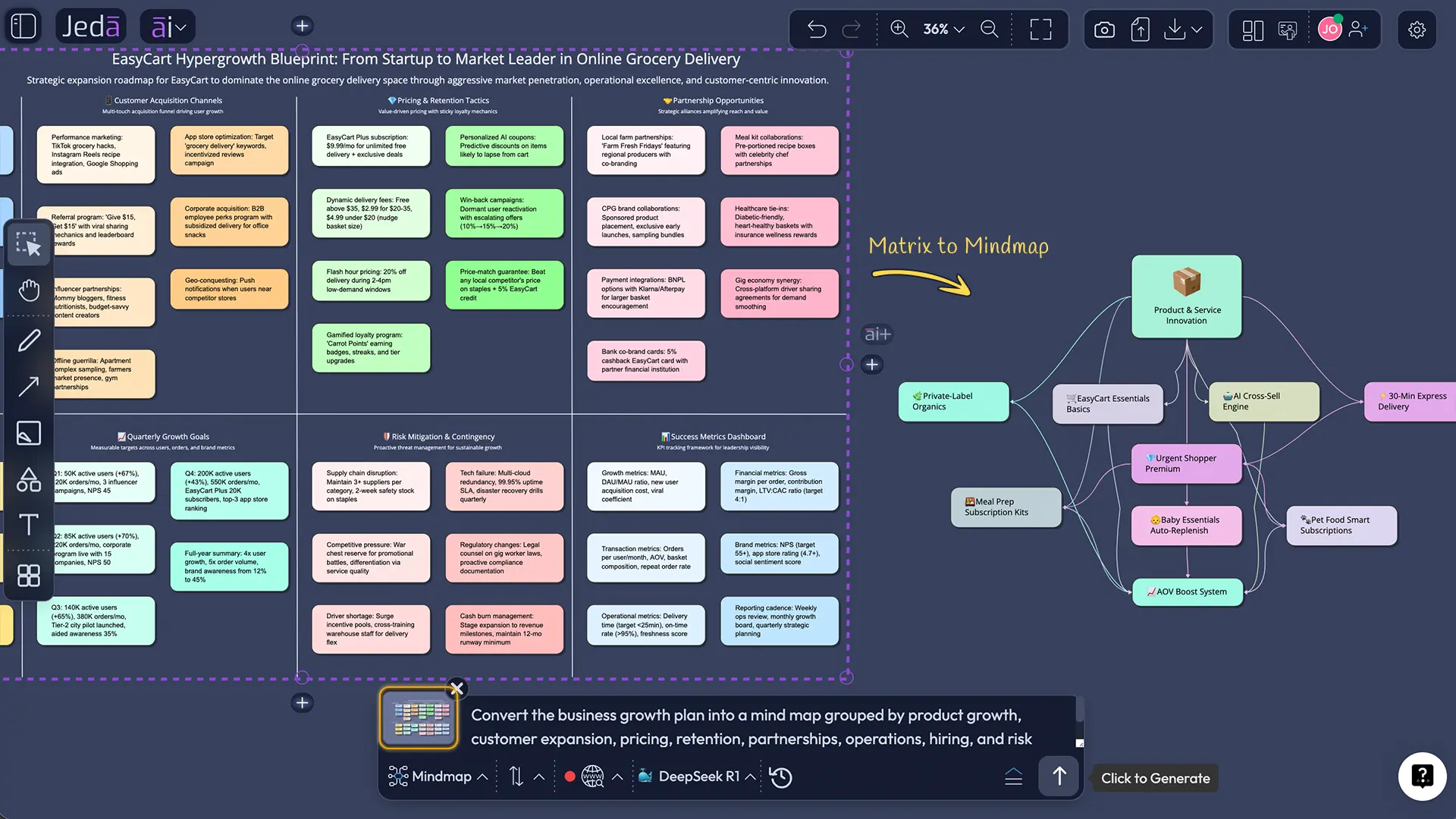
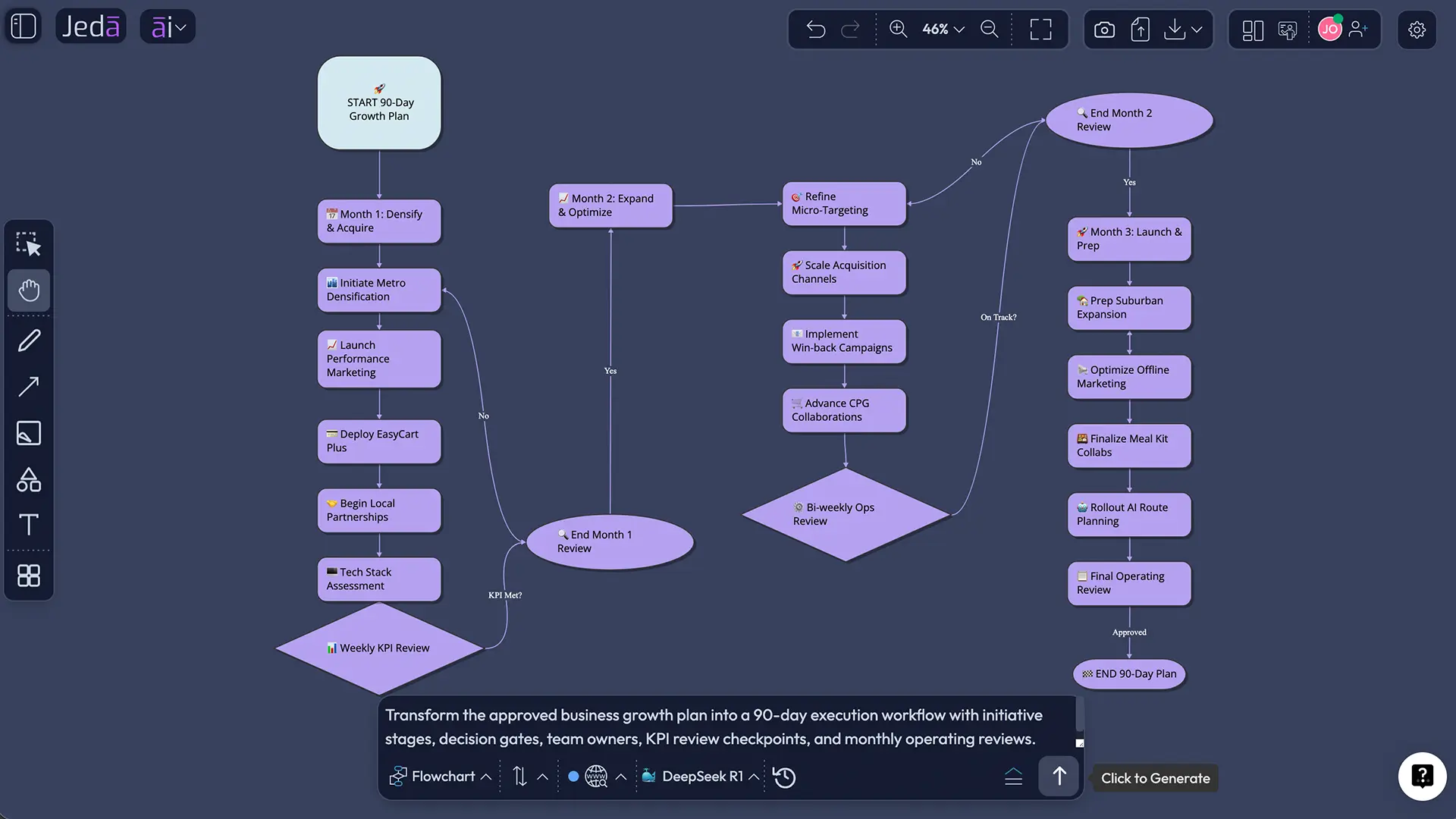
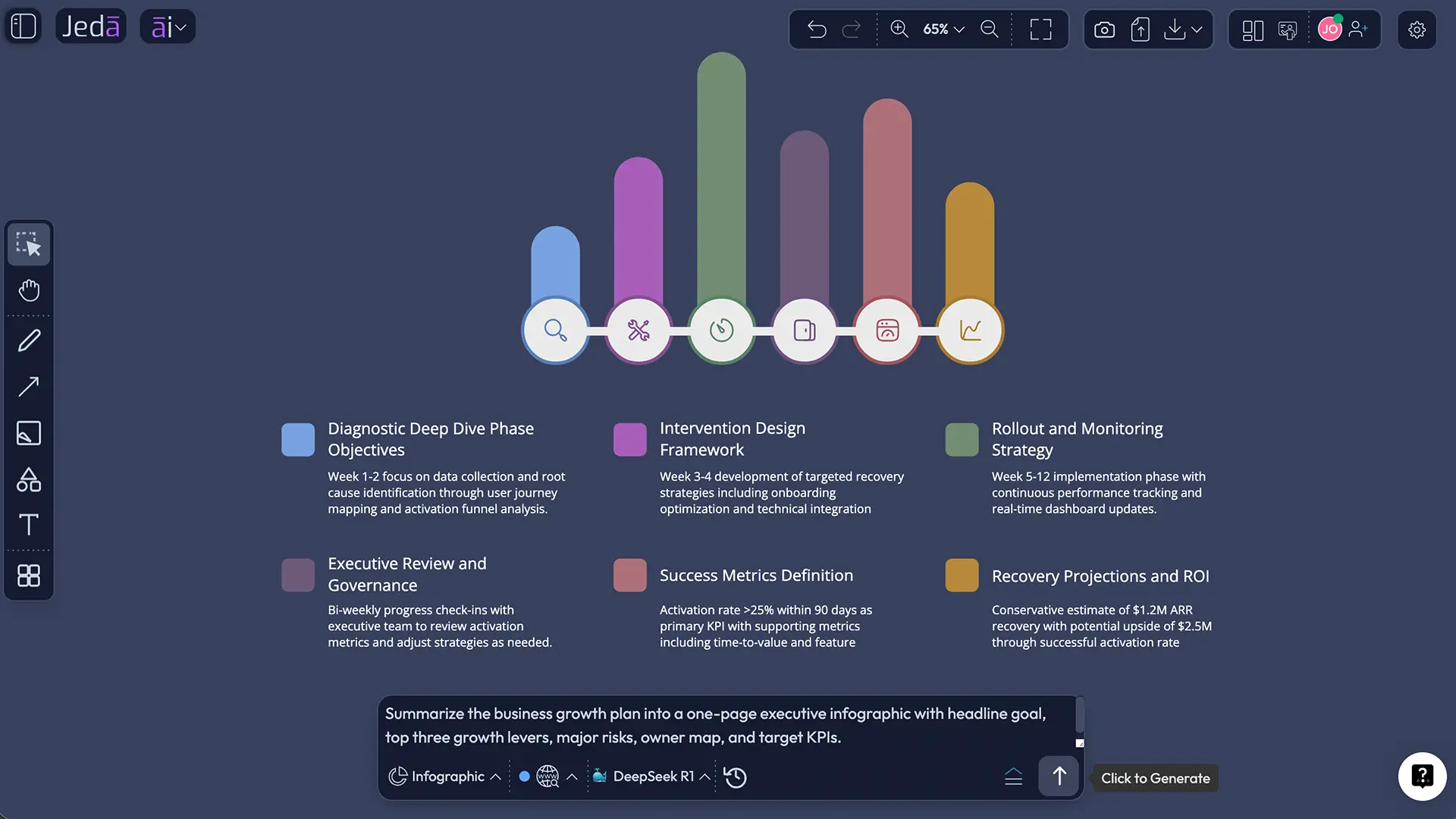
Then use Vision Transform to change the same plan into a Mindmap for initiative clustering, a Flowchart for 90-day execution, or an Infographic for leadership communication. Same thinking. Better format.
- Start with a Matrix structure
Open Jeda.ai, use the AI Menu for a Matrix Recipe or select the Matrix command in the Prompt Bar, and frame the growth problem clearly.
- Add real growth context
Enter your current state, target outcome, market shifts, product plans, constraints, owners, timeline, and KPIs so the plan is grounded.
- Generate the first business growth plan
Create an editable matrix that covers goals, growth levers, resource needs, dependencies, risks, and execution priorities.
- Deepen weak sections with AI+
Click a smart shape and use the AI+ button to expand thin sections such as market analysis, customer strategy, or operational readiness.
- Transform the plan into other views
Use Vision Transform to convert the matrix into a mind map for exploration, a flowchart for execution, or an infographic for summary.
- Align the team and ship the plan
Review collaboratively inside the AI Whiteboard, assign owners, finalize KPIs, and export the visual as PNG, SVG, or PDF.
Business Growth Plan Template and Example
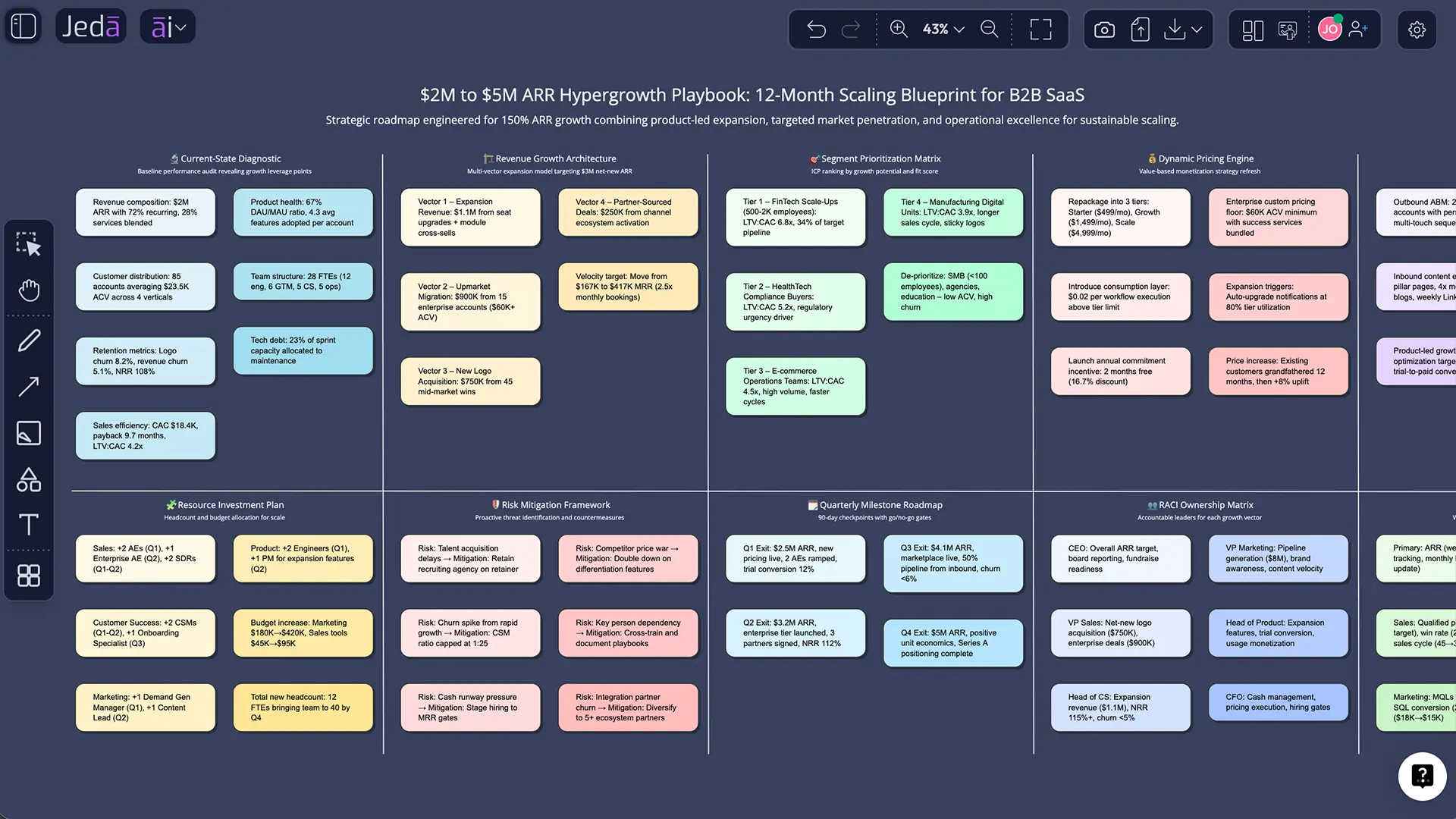
Say you run a B2B SaaS company doing $2M ARR and want to reach $5M in 12 months. You could ask Jeda.ai to generate a matrix with these columns:
- current-state diagnosis,
- best-fit growth routes,
- customer and segment opportunities,
- product and pricing moves,
- demand generation plays,
- operational requirements,
- risk factors,
- and KPI ownership.
Now the plan stops being fluffy.
A good output would likely show that the fastest path is not “do more marketing.” It might be:
- raise expansion revenue from existing accounts,
- tighten onboarding to lift retention,
- test one adjacent vertical,
- and hold off on a new product line until delivery capacity catches up.
That is a real plan because it includes sequencing, not just wishes.
After generation, transform that matrix into a Mindmap so each growth lever branches into initiatives, then into a Flowchart so the operating team can see what happens in week 1, month 1, and quarter 1. This is where Jeda.ai as an AI Workspace feels especially strong. Strategy does not die in a static artifact. It keeps moving.
Best Practices for Smarter Growth Planning
A few things separate useful growth plans from performative ones.
And one more. Important one. Do not confuse idea generation with decision-making. Brainstorm first if needed. Then narrow. A growth plan should end with choices.
Common Mistakes to Avoid
The first mistake is writing a growth plan that is really just a goal list. “Expand enterprise,” “grow pipeline,” “improve retention.” Fine. But how? In what order? With what people and trade-offs? If the answer is fuzzy, the plan is not done.
The second mistake is chasing growth that muddies the company’s position. HBR recently revisited the old warning about the growth trap: in the rush to expand, companies can dilute the very strategy that made them useful in the first place. That happens all the time. Especially when every new idea sounds exciting for fifteen minutes.
The third mistake is leaving finance and operations out of the room. A growth plan that ignores staffing, delivery, tooling, or cash constraints is basically fan fiction.
The fourth mistake is never revising the plan. Markets move. Competitors react. AI makes faster planning possible, but it does not eliminate the need to revisit assumptions.
And the fifth? Treating the first AI output as final. Don’t do that. Use it as a sharp first draft. Then challenge it.
Frequently Asked Questions
- What is a business growth plan?
- A business growth plan is a practical roadmap for how a company will expand from its current state. It usually defines growth goals, market opportunities, strategic choices, resource needs, execution priorities, risks, timelines, and KPIs so teams can move from ambition to action.
- How is a business growth plan different from a business plan?
- A business plan explains how a business works overall, often for launch or funding. A business growth plan focuses on the next phase of expansion. It is more execution-heavy, with clear growth routes, operational requirements, timelines, and accountability.
- Can AI create a complete business growth plan?
- AI can generate a strong first draft, synthesize research, suggest growth routes, and structure priorities. But the final plan still needs human judgment, especially around strategic trade-offs, internal constraints, and what the leadership team is actually willing to commit to.
- Which Jeda.ai command should I use first for a business growth plan?
- Start with the Matrix command if you want a structured plan with clear categories. Use the AI Menu’s Matrix Recipes path when you want more scaffolding. Then use Mindmap, Flowchart, or Infographic views to turn the same thinking into exploration, execution, or summary formats.
- Can I use spreadsheets and reports while building the plan?
- Yes. Jeda.ai supports Data Insight for CSV or Excel analysis and Document Insight for PDFs or Word files. That means you can bring revenue trends, market data, quarterly plans, or board notes into the same workflow before generating the final growth plan.
- How does AI+ help with growth planning?
- AI+ lets you extend a selected part of the visual rather than regenerating the whole thing. It is useful when one section needs more depth, such as customer segmentation, channel strategy, risk mitigation, KPI design, or execution detail.
- What should a strong business growth plan include?
- At minimum, include the target outcome, current-state diagnosis, market and customer analysis, growth routes, strategic priorities, resource needs, execution milestones, owners, risks, and KPIs. The plan should also show what not to do, not just what to pursue.
- How often should a business growth plan be updated?
- Most teams revisit the plan quarterly, but faster-moving businesses often review parts of it monthly during the first 90 days. If customer demand, competition, or delivery capacity changes quickly, the plan should be treated as a living document instead of a one-time exercise.
- Is web search built into Jeda.ai?
- Yes. In Jeda.ai, web search is a platform feature in the Prompt Bar rather than a single model feature. You can set it to Auto, On, or Off depending on whether your planning workflow needs current information and external context.
- Can multiple people work on the same plan?
- Yes. Jeda.ai works as an AI Whiteboard for collaborative planning, so teams can review, edit, and align around the same visual in one shared workspace. That is especially useful when growth planning cuts across leadership, finance, product, sales, and operations.
- Can I export the finished growth plan?
- Yes. Jeda.ai supports export to PNG, SVG, and PDF. That gives you a presentation-ready output without locking the strategy into one format too early.
Sources & Further Reading
- [1]
H. Igor Ansoff (1957) . “Strategies for Diversification” Harvard Business Review.
View Source ↗ - [2]
U.S. Small Business Administration (2025) . “Write your business plan” SBA.gov.
View Source ↗ - [3]
U.S. Small Business Administration (2025) . “Market research and competitive analysis” SBA.gov.
View Source ↗ - [4]
McKinsey & Company (2025) . “How AI is transforming strategy development” McKinsey.
View Source ↗ - [5]
McKinsey & Company (2025) . “The State of AI: Global Survey 2025” McKinsey.
View Source ↗ - [6]
Accenture (2024) . “AI-Enabled Business Growth Strategies” Accenture.
View Source ↗ - [7]
Accenture (2024) . “New Accenture Research Finds that Companies with AI-Led Processes Outperform Peers” Accenture Newsroom.
View Source ↗ - [8]
Constantinos C. Markides (2025) . “Don’t Let Growth Muddle Your Company’s Strategy” Harvard Business Review.
View Source ↗ - [9]
Business.com Editors (2026) . “How to Write a Business Growth Plan” Business.com.
View Source ↗ - [10]
HSBC UK (2025) . “How to create a business growth plan” HSBC UK.
View Source ↗
Start Your Business Growth Plan in Jeda.ai
Join over 150,000+ users who use Jeda.ai as an AI Workspace and AI Whiteboard for strategy, planning, and execution.
Try Free Template