Most startups don’t fail because founders “lack hustle.” They fail because they make five big decisions with half the context, then stick to them for too long. Pricing. Market focus. Channel. Competitive position. Execution cadence. You can be brilliant and still get wrecked by a bad sequence.
Business strategies for startups work when you can (1) make choices visible, (2) update them fast, and (3) keep your team aligned on the same “source of truth.” That’s the whole point of using an AI Workspace and AI Whiteboard like Jeda.ai: you’re not writing strategy in scattered docs—you’re building it as editable visuals you can reuse. And yes, there are 150,000+ users doing this already.
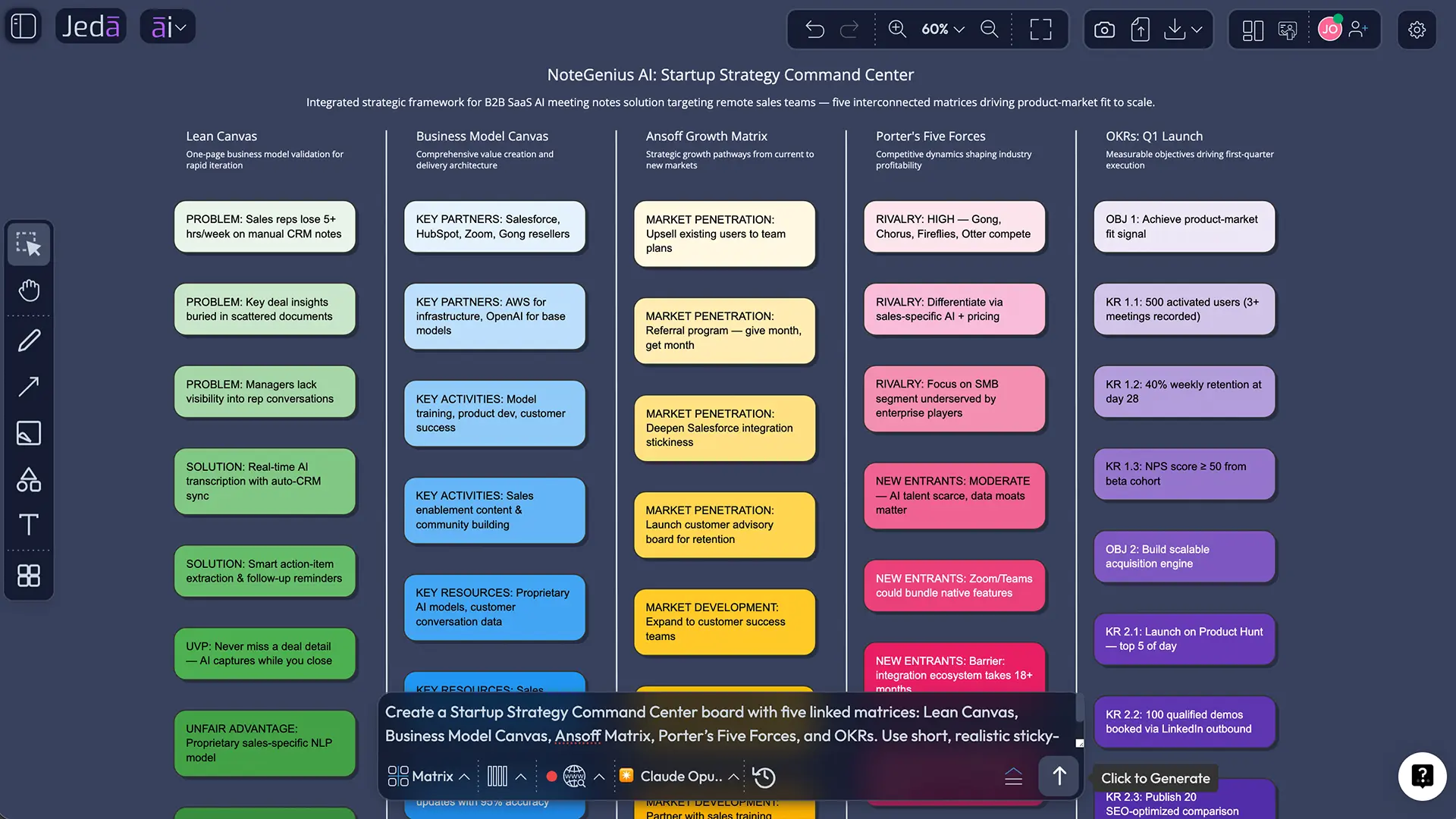
The 5 strategies (and the matrices that make them concrete)
This article is intentionally practical. Each “strategy” below maps to a strategy matrix you can generate and edit inside Jeda.ai. If you’ve got 60 minutes, you can build the whole stack and walk away with a board you’ll actually use next week.
1) Validate the business fast with Lean Canvas
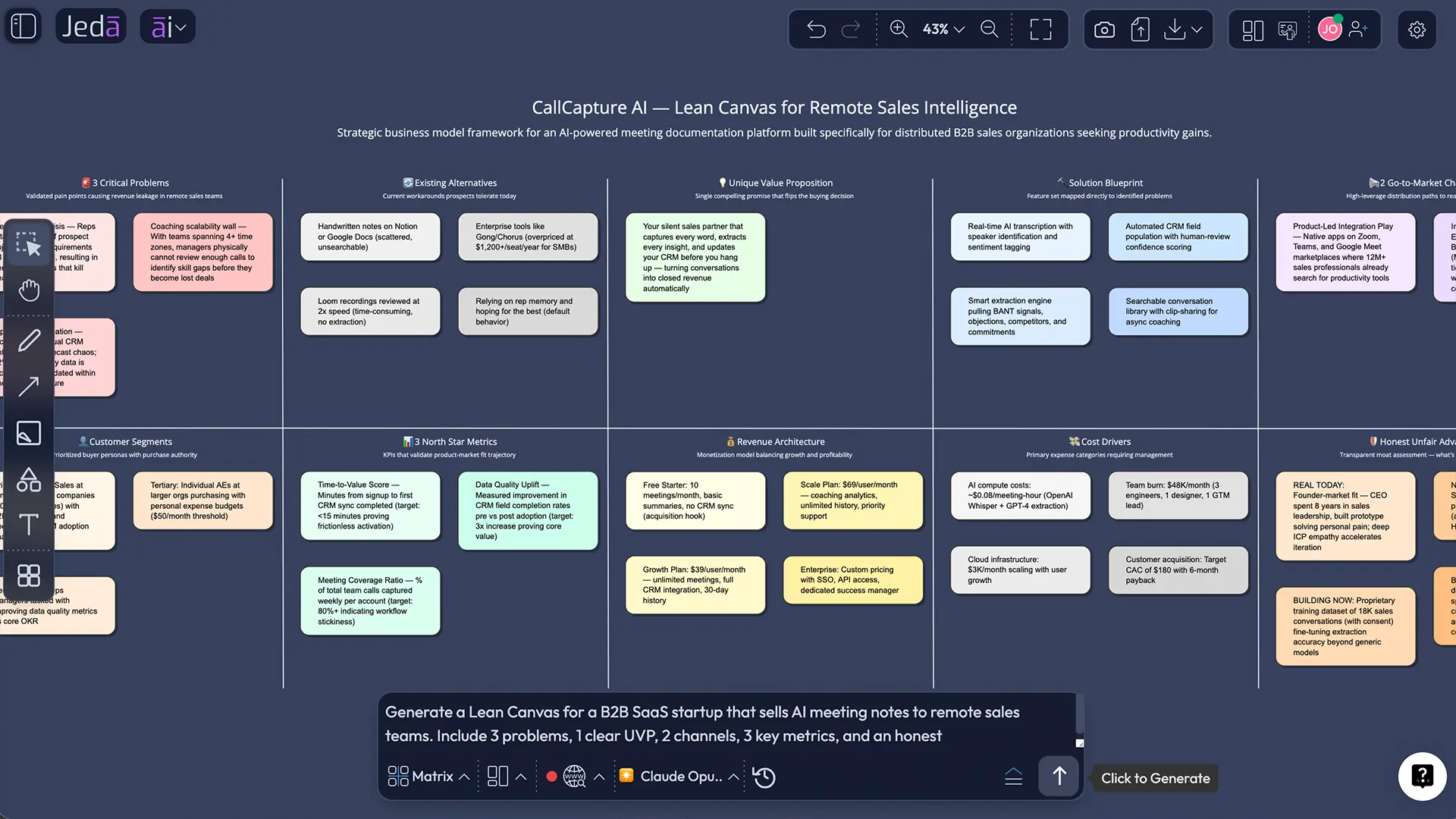
If you’re early-stage, your job isn’t to “write a plan.” It’s to test the riskiest assumptions before you invest a quarter of your runway.
Lean Canvas is built for that: one page, nine blocks, and brutally focused on problem/solution fit. (It’s commonly attributed to Ash Maurya.)
What to put on the canvas (the version that works):
- Problem: 1–3 painful problems (not “people want productivity”)
- Customer segments: who feels the pain most today
- Unique value proposition: why you, why now
- Channels: how you’ll reach them without praying for virality
- Key metrics: what you track weekly (not yearly)
- Unfair advantage: what can’t be copied quickly (if you don’t have one yet, write “TBD” and move on)
2) Design your business model with Business Model Canvas
Once your assumptions start holding up, the next move is getting your model coherent: customers, value, delivery, and money—together.
The Business Model Canvas (popularized by Alexander Osterwalder and Yves Pigneur) is the cleanest way to do this visually. Strategyzer describes it as a tool to “describe, design, challenge, invent, and pivot” business models. How startups use it well:
- Keep Customer Segments specific (one primary beachhead beats five “targets”)
- Treat Channels as experiments (each channel gets a test + metric)
- Tie Cost Structure to reality (people costs, compute, acquisition, compliance)
- Write Key Partnerships only if they change your odds (not “Stripe”)
- Clarity for the team
Everyone sees the same model. Less debating in Slack. More building.
- Fast pivots
Swap a channel or segment without rewriting a 40-page doc.
- Editable visuals
You can move blocks, add sticky notes, and keep the strategy living.
3) Choose a growth direction with the Ansoff Matrix
Growth is not one thing. It’s four different bets with four different risk profiles.
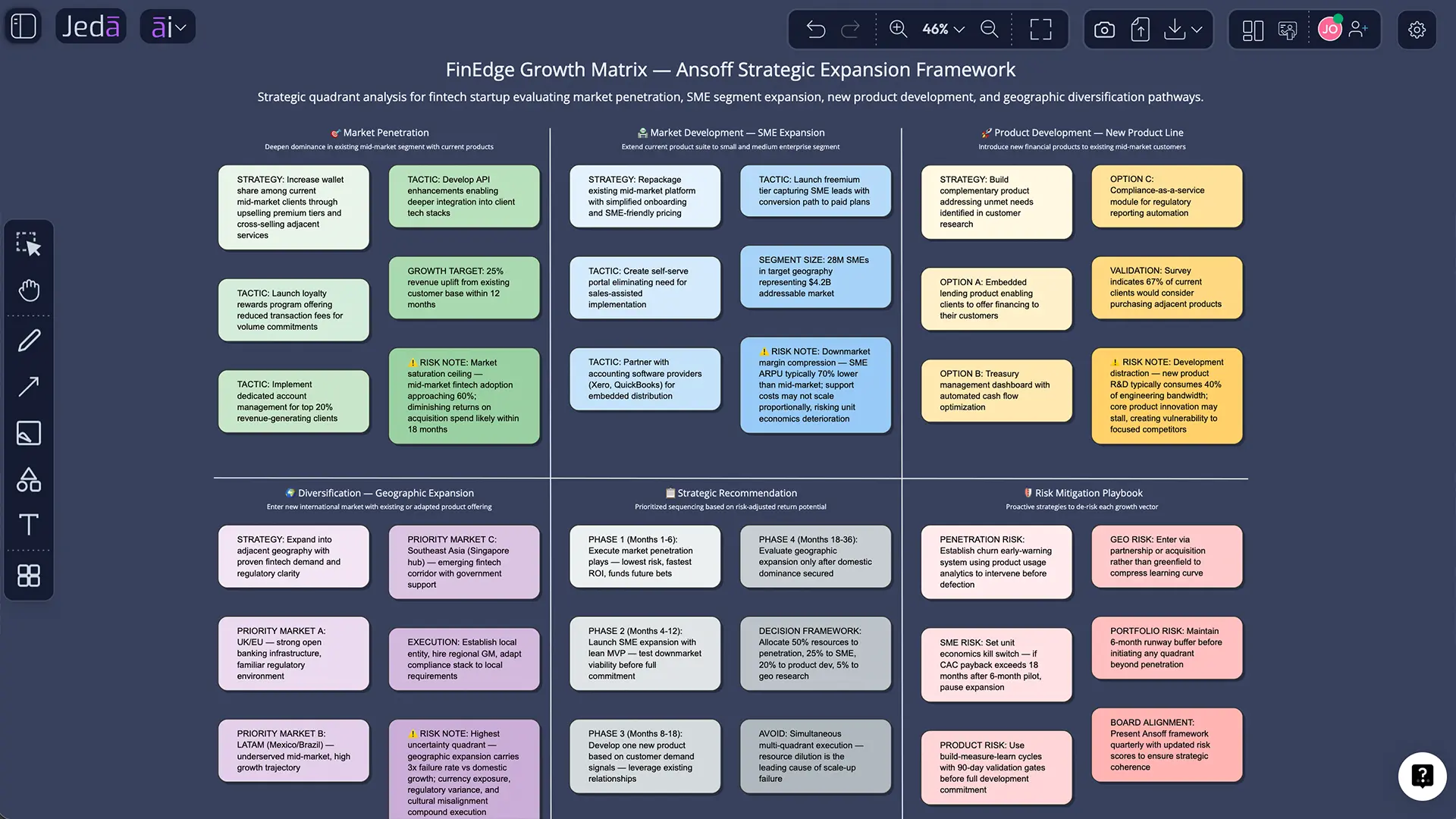
The Ansoff Matrix (often called the Product/Market Expansion Grid) lays out your options: Market Penetration, Market Development, Product Development, Diversification.
The startup-friendly version:
- Penetration: same product, same audience → improve conversion, retention, pricing
- Market development: same product, new audience → pick one new segment, not five
- Product development: new product, same audience → expand only if retention is solid
- Diversification: new product, new audience → treat as a separate startup
4) Win your competitive position with Porter’s Five Forces
Startups love to say “we have no competitors.” That’s only true if you’re selling something nobody wants.
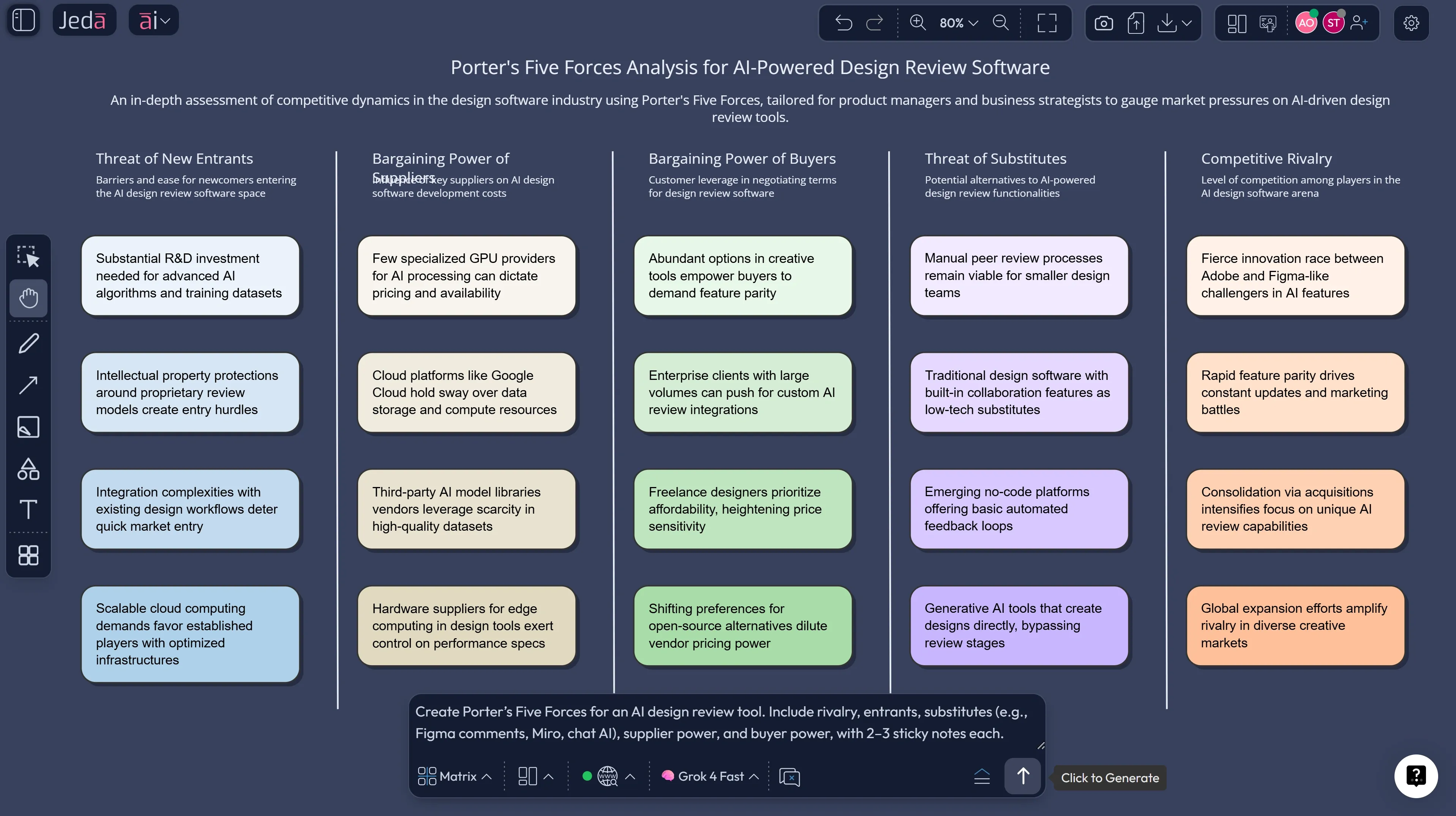
Porter’s Five Forces helps you judge competitive pressure: rivalry, new entrants, substitutes, supplier power, buyer power. It was first described by Michael Porter in his classic 1979 Harvard Business Review article. Why this matters for founders:
- It tells you whether your market is a goldmine or a knife fight
- It forces you to name substitutes (“Excel” is usually your biggest enemy)
- It pushes you toward a position that’s harder to copy
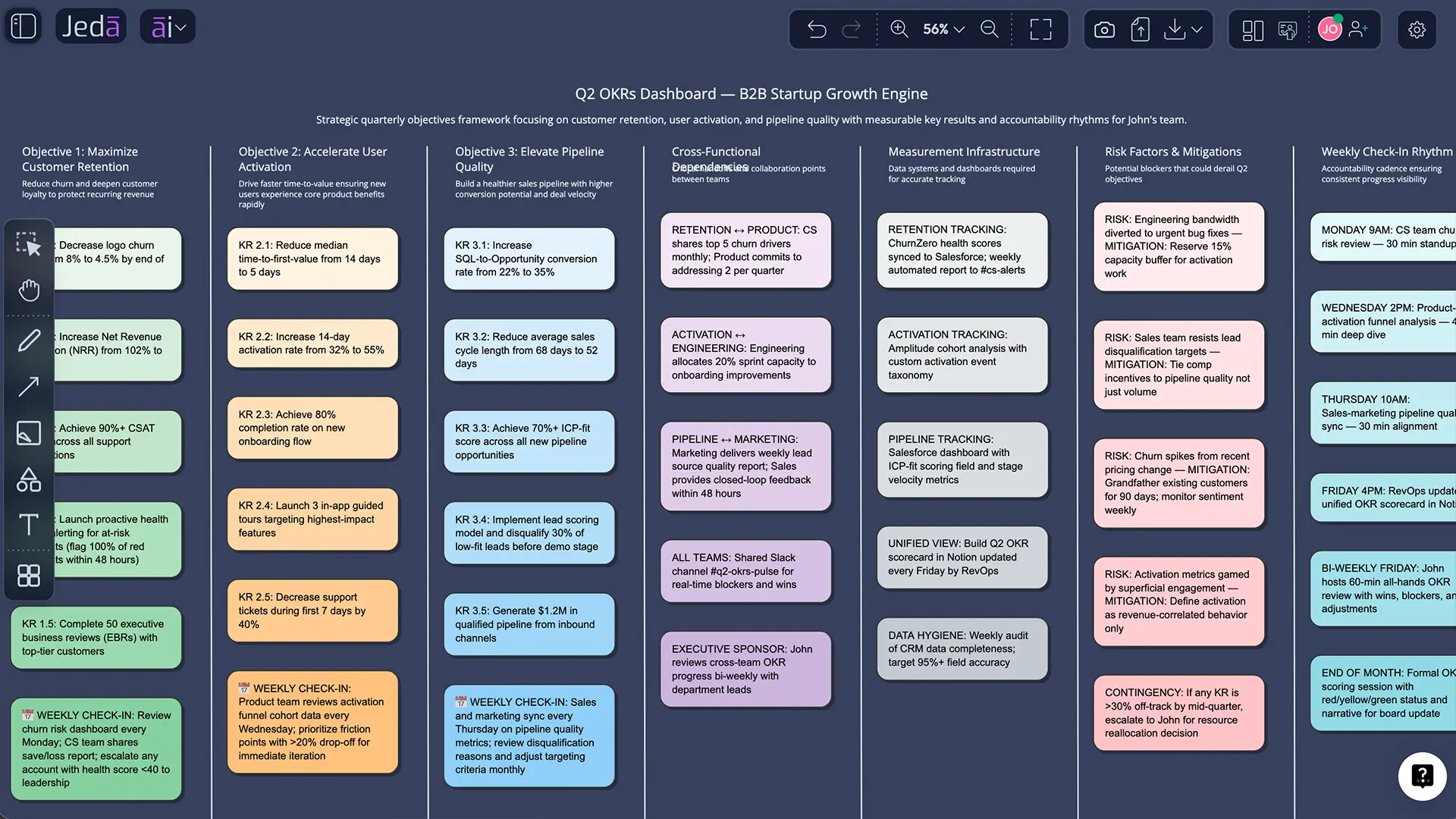
5) Execute with focus using OKRs
Strategy without execution is… vibes. Expensive vibes.
OKRs (Objectives and Key Results) are widely associated with Andy Grove’s Intel and later popularized in Silicon Valley (John Doerr brought them to Google). The startup way to do OKRs (and not hate them):
- 1–3 Objectives per quarter (max)
- 2–4 Key Results per objective
- Key Results must be measurable (“ship feature X” is usually a task, not a result)
- Weekly check-in: confidence score + what changed
How to build these 5 strategies in Jeda.ai
Jeda.ai is an AI Workspace and AI Whiteboard where strategy becomes editable visuals—not static docs. You can generate these matrices two ways: Recipe Matrix (AI Menu templates) or Prompt Bar (freeform).
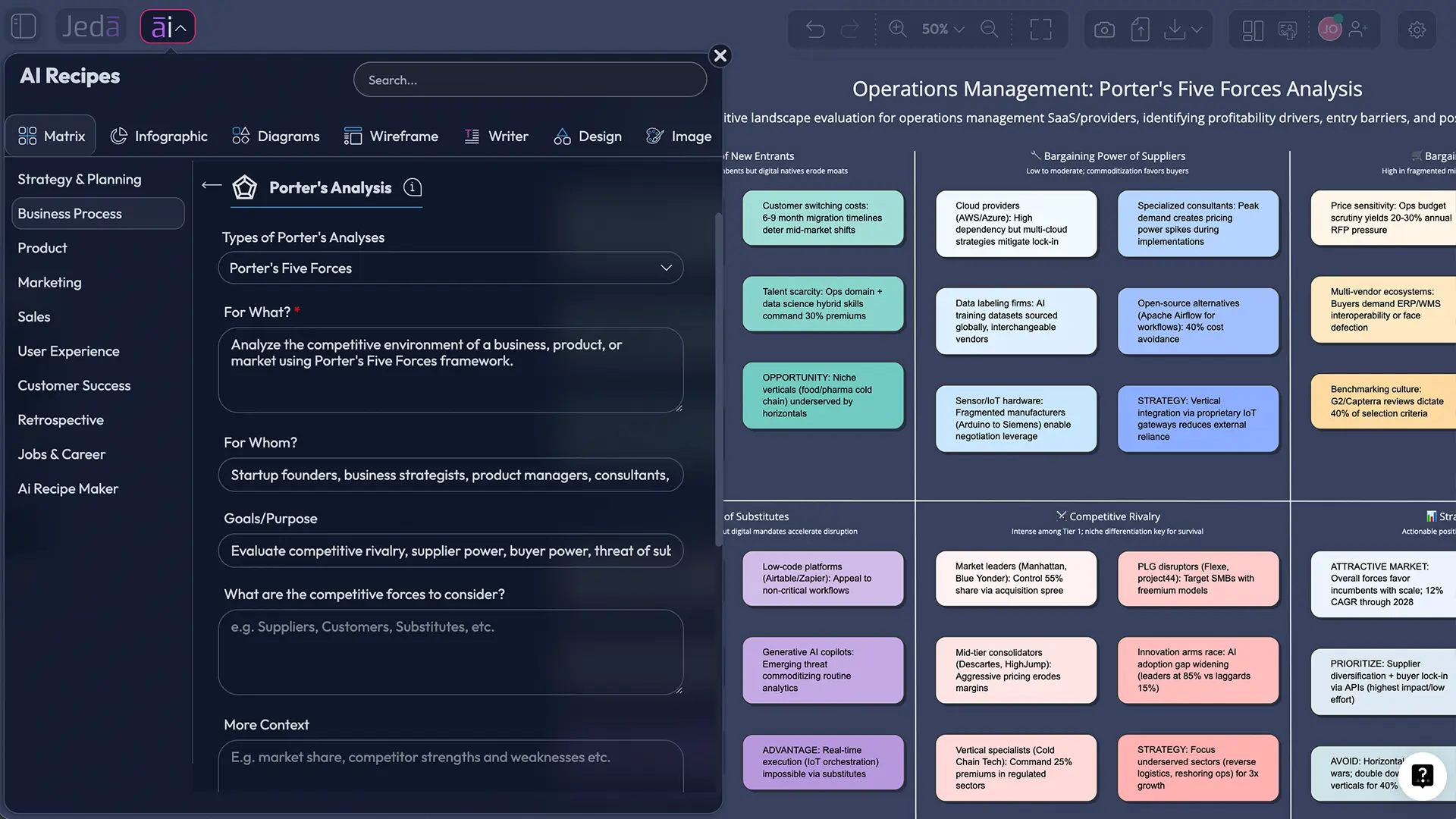
Method 1: Recipe Matrix (recommended for speed + structure)
- Open the AI Menu
In your workspace, open the AI Menu from the top-left area of the canvas.
- Choose Matrix Recipes
Select the Matrix Recipes category to access strategy templates.
- Pick a template
Choose the specific matrix you need (Lean Canvas, Business Model Canvas, Ansoff Matrix, Five Forces, OKRs, etc.).
- Fill the guided fields
Add your startup context: customer segment, product, market, constraints, and goals.
- Generate the matrix
Click Generate to create the visual directly on the canvas as editable smart shapes.
- Refine collaboratively
Edit the sticky notes, add evidence, and invite teammates to comment and iterate in real time.
Method 2: Prompt Bar (best when you want custom wording)
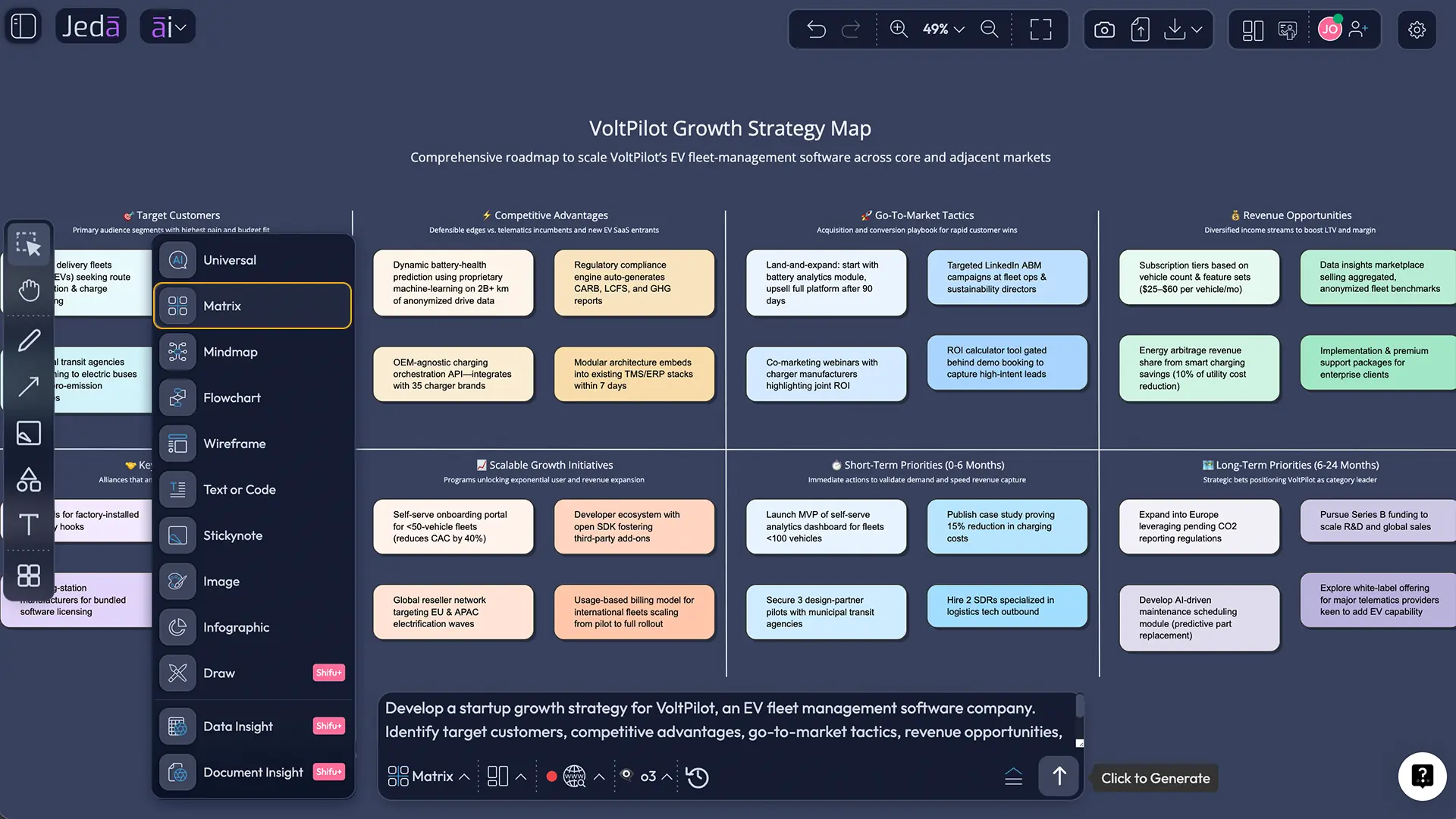
- Open the Prompt Bar
Use the Prompt Bar at the bottom of the workspace.
- Select the Matrix command
Choose Matrix so the output renders as a strategy framework grid.
- Describe your startup context
Write 3–6 lines: what you sell, who you sell to, what stage you’re in, and the decision you’re making.
- Ask for one matrix at a time
Generate Lean Canvas first, then Business Model Canvas, then Ansoff, Five Forces, and OKRs.
- Turn on Web Search when needed
If you want current market context, enable Web Search (it’s a platform feature, not a model feature).
- Generate and edit
Press Generate, then rewrite any cell directly on the canvas so the strategy fits your reality.
Deepen your strategy with AI+ (without turning it into a black box)
After you generate any matrix, you can tap the AI+ button on a selected area to extend it with more ideas, variations, or supporting detail. Keep it simple: extend, review, edit. Don’t outsource judgment.
A simple “Strategy Command Center” layout (copy this)
If you want one board that runs your next 90 days, build it like this:
- Lean Canvas (top-left) — assumptions
- Business Model Canvas (top-right) — model coherence
- Ansoff Matrix (middle-left) — growth bet
- Five Forces (middle-right) — competitive pressure
- OKRs (bottom) — execution + metrics
And yes, you can export the board as PNG, SVG, or PDF when you’re ready to share.
More strategy matrices you’ll want once the basics are done
You asked for the “top 5,” but founders rarely stop at five. Here are a few Matrix Recipes that pair well with the stack above:
- SWOT Analysis (helpful, but debated origin and often misused)
- PESTEL Analysis (macro forces that change your market story)
- Kano Model (feature prioritization that isn’t just “ship everything”)
- Moat Analysis (what makes you hard to copy over time)
- Risk Analysis (what can kill the plan, and how you’ll see it early)
Common mistakes startups make with strategy matrices
- They fill boxes with slogans. Strategy needs choices you can test.
- They generate everything in one prompt. One matrix per decision keeps the output sharp.
- They don’t attach evidence. Add links, metrics, customer quotes, or doc snippets.
- They never revisit the board. Update weekly for execution, monthly for strategy.
- They confuse “a framework” with “a decision.” Frameworks help you decide; they don’t decide for you.
Frequently Asked Questions
- What are business strategies for startups?
- Business strategies for startups are the set of choices a startup makes about who it serves, what it sells, how it competes, and how it grows. The goal is to reduce uncertainty by turning assumptions into testable decisions, then aligning execution around the best bets.
- Which strategy framework should a startup start with?
- A startup should start with Lean Canvas when it needs to validate the riskiest assumptions fast. Lean Canvas is designed for early-stage uncertainty and keeps the plan to one page so you can update it after every learning cycle.
- When should we use Business Model Canvas instead of Lean Canvas?
- You should use Business Model Canvas when your core assumptions are starting to hold and you need a fuller picture of customers, partners, operations, and economics. It helps you spot mismatches between delivery, costs, and revenue before scaling.
- How does the Ansoff Matrix help startup growth decisions?
- The Ansoff Matrix helps startups pick a growth direction by separating four types of bets: market penetration, market development, product development, and diversification. It makes risk visible so teams don’t accidentally choose a ‘new product + new market’ bet without meaning to.
- Is Porter’s Five Forces useful for startups?
- Yes—Porter’s Five Forces is useful for startups because it forces you to measure competitive pressure, substitutes, and buyer power. It helps you avoid markets where pricing collapses and guides you to positions where differentiation or switching costs can exist.
- How do OKRs fit into startup strategy?
- OKRs fit into startup strategy by translating priorities into measurable outcomes. A good OKR set makes the strategy operational: a small number of objectives, clear key results, and weekly check-ins so the team can adjust before the quarter is over.
- Can Jeda.ai generate these matrices automatically?
- Yes. Jeda.ai can generate strategy matrices using Matrix Recipes (guided templates) or the Prompt Bar (custom prompts). The output is editable on the canvas, so you can rewrite assumptions, add evidence, and iterate with your team in one AI Workspace.
- Do I need web search for startup strategy boards?
- Not always. Use Web Search when you need current market context, competitor signals, or industry stats. If you’re mapping internal assumptions or planning execution, you can keep Web Search off and focus on what your team already knows.
- How often should a startup update its strategy board?
- A startup should update its strategy board weekly for execution (metrics, blockers, next actions) and monthly for strategy (market shifts, new learnings, positioning changes). If you’re early-stage and learning fast, revisit the Lean Canvas after every major experiment.
Sources & Further Reading
- [1]
Michael E. Porter (1979) . “How Competitive Forces Shape Strategy” Harvard Business Review.
View Source ↗ - [2]
Institute for Strategy and Competitiveness, Harvard Business School (n.d.) . “The Five Forces” HBS.
View Source ↗ - [3]
Strategyzer (n.d.) . “The Business Model Canvas (library overview)” Strategyzer.
View Source ↗ - [4]
Harvard Business Review (2004) . “Blue Ocean Strategy” Harvard Business Review.
View Source ↗ - [5]
Blue Ocean Strategy (n.d.) . “What is Blue Ocean Strategy?” BlueOceanStrategy.com.
View Source ↗ - [6]
Google re:Work (n.d.) . “Set goals with OKRs” Google re:Work.
View Source ↗ - [7]
What Matters (John Doerr) (2025) . “The Origin Story of OKRs” WhatMatters.com.
View Source ↗ - [8]
Richard Willem Puyt et al. (2023) . “The origins of SWOT analysis” Long Range Planning (ScienceDirect).
View Source ↗ - [9]
Corporate Finance Institute (2022) . “Ansoff Matrix: Overview, Strategies and Practical Examples” CFI.
View Source ↗
Build Your Startup Strategy Board in Jeda.ai
Join over 150,000+ users who use Jeda.ai to turn ideas into editable strategy matrices and decision-ready visuals.
Try Jeda.ai Free