Generate Content Marketing Strategy with AI when you want alignment, speed, and measurable outcomes—not another strategy doc that gets ignored after the kickoff meeting. In Jeda.ai, you build the full system on one AI Workspace / AI Whiteboard: goals → audience → pillars → channels → workflow → KPIs, all editable and shareable.
Content marketing is “creating and distributing valuable, relevant, and consistent content to attract and retain a clearly defined audience—and drive profitable customer action.” That’s the definition. The missing part for most teams is the operating system that makes it happen consistently. (That’s where this page helps.)
(Source: Content Marketing Institute)
What is a content marketing strategy?
A content marketing strategy is a documented plan that links your business goals to an audience, a point of view, a set of content pillars, a distribution system, and measurable KPIs—so your content consistently drives outcomes.
Content Marketing Institute describes a content marketing strategy as an outline of key business and customer needs plus a plan for how content addresses those needs. This is why a strategy is not “a calendar.” A calendar is a schedule. Strategy is the logic behind what deserves a spot on that schedule.
(Source: Content Marketing Institute)
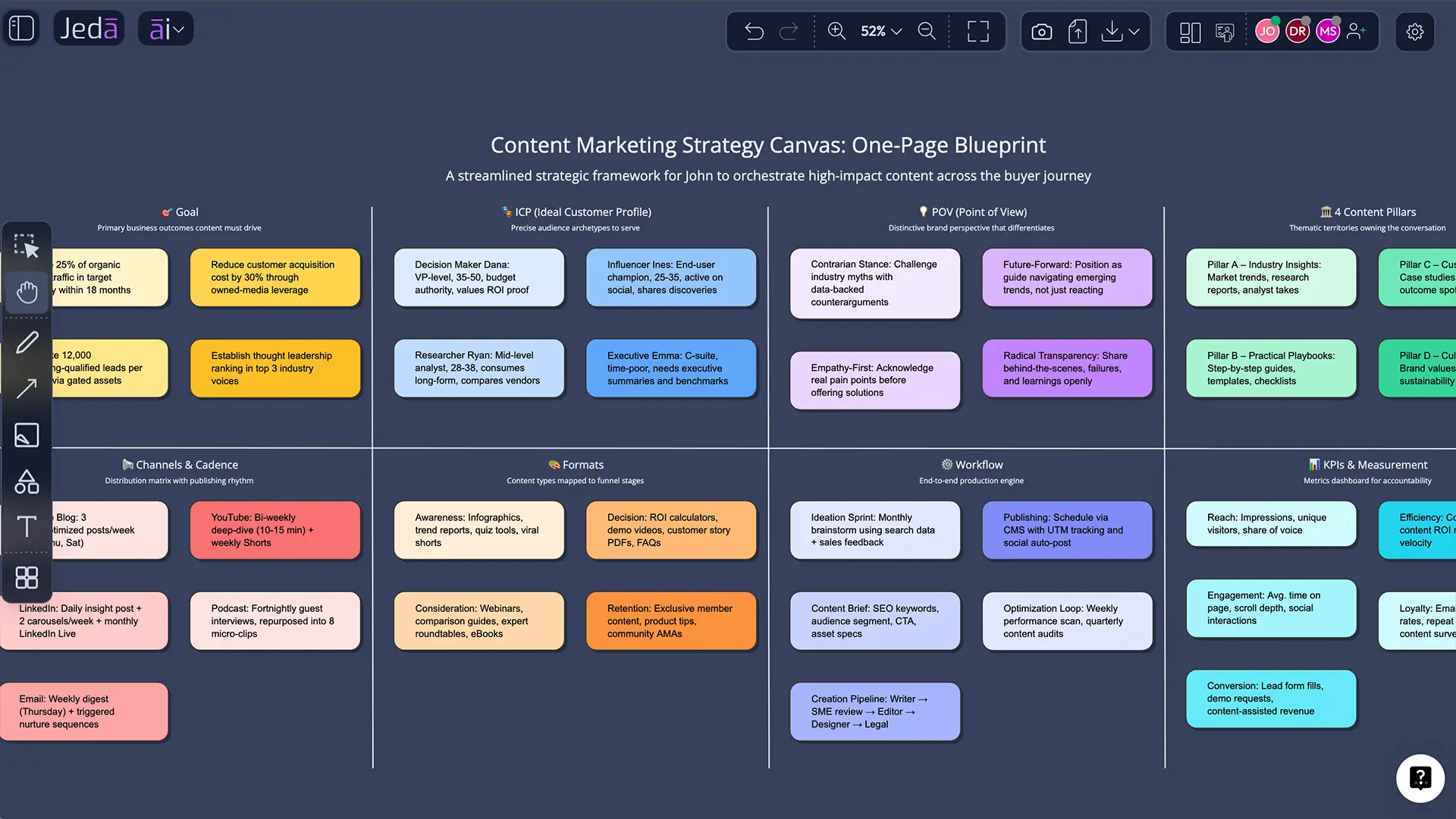
Why generate a content marketing strategy with AI?
AI helps you do three things faster: structure, ideate, and standardize. The win is not “AI writes posts.” The win is “AI turns messy inputs into a clear strategy you can run weekly.”
Use AI when you need:
- Faster alignment across stakeholders (goal + audience + POV)
- Faster topic planning (pillars → clusters → series)
- Faster execution design (workflow + roles + review gates)
- Faster measurement (dashboards tied to strategy KPIs)
Industry data also shows marketers are leaning into formats like video and thought leadership, which increases the need for a clear POV and a repeatable system.
(Source: Content Marketing Institute; HubSpot)
- Speed to a usable plan
Generate the first version of a strategy canvas in minutes, then refine it visually instead of rewriting docs.
- Pillars that stay consistent
AI helps you expand pillars into clusters and series so your content compounds instead of drifting weekly.
- A real workflow, not vibes
Turn strategy into an execution flow: brief → draft → edit → publish → distribute → repurpose → review.
- KPIs tied to goals
Track funnel KPIs that map back to the strategy canvas so reporting is clean and defensible.
- Collaboration on one canvas
Comment, edit, and align in real time. Strategy becomes a living system—not a PDF artifact.
- Slide-ready outputs
Export visuals as PNG/SVG/PDF and drop into decks without rebuilding everything in slides.
How to create a content marketing strategy in Jeda.ai
You can build this two ways:
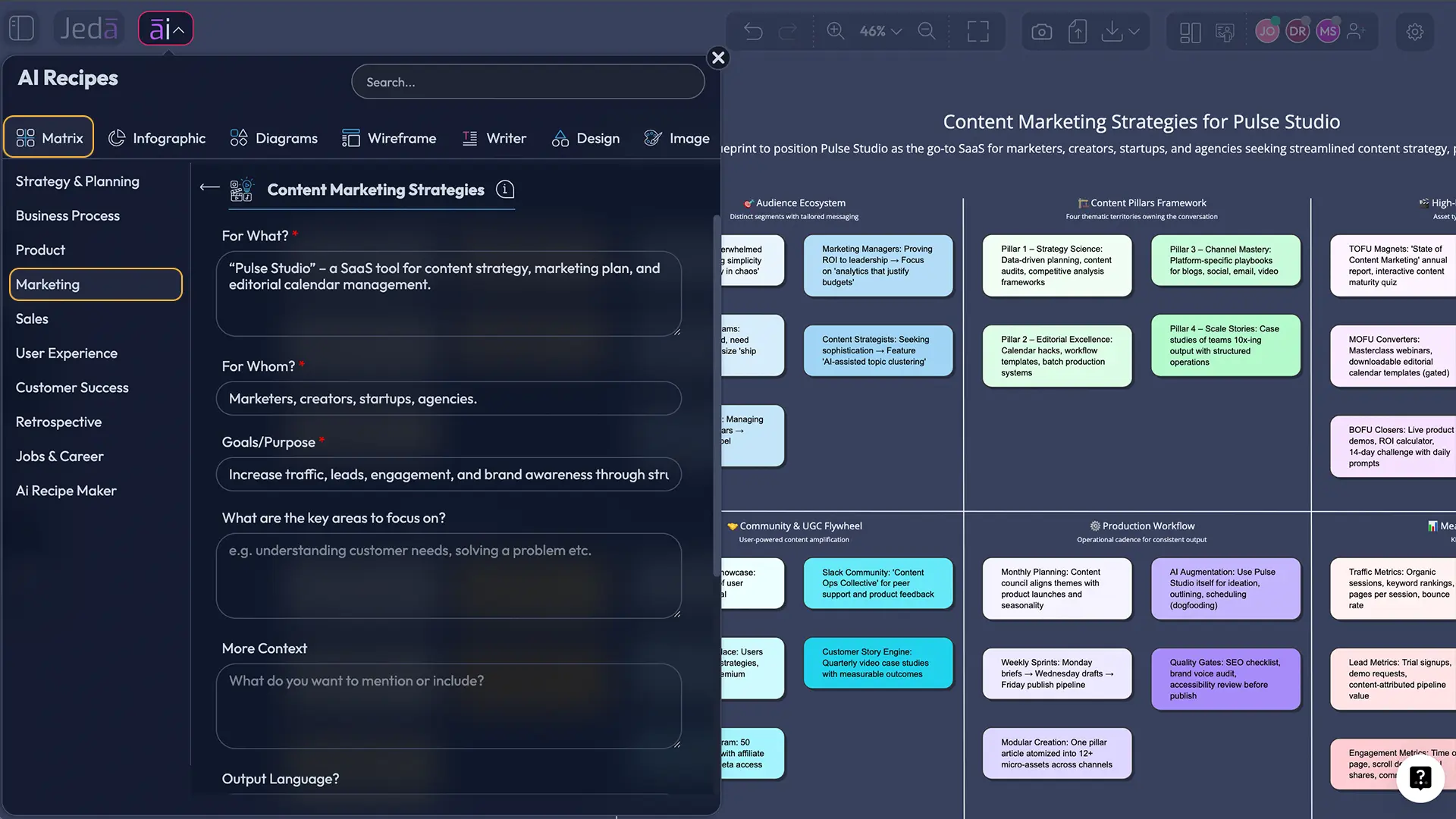
Method 1: AI Menu (Recipe Matrix) — best when you want guided structure fast
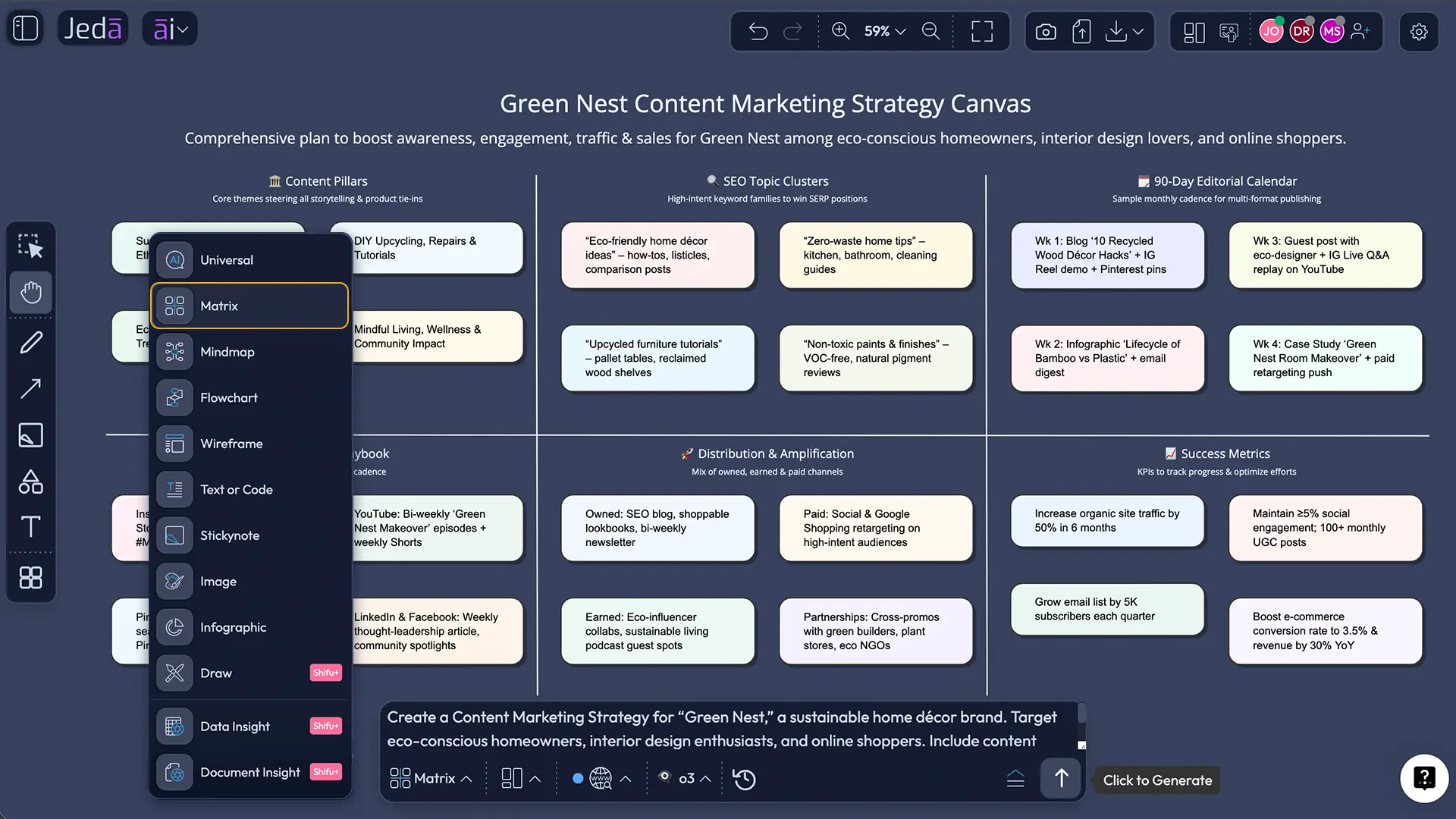
Method 2: Prompt Bar — best when you want maximum control
After generation, use AI+ to extend weak sections and Vision Transform to convert one visual into another format without starting over.
- Set the goal (one sentence)
Decide the single business outcome content should influence (pipeline, trials, retention, activation). Keep it measurable.
- Method 1 — AI Menu (Recipe Matrix)
Click AI Menu → Matrix Recipes → search for 'content strategy', 'marketing plan', or 'editorial calendar'. Choose the closest template and generate the first draft strategy canvas.
- Method 2 — Prompt Bar (Matrix)
Open the Prompt Bar, select Matrix, and generate a one-page strategy canvas including ICP, POV, pillars, channels, cadence, workflow, and KPIs.
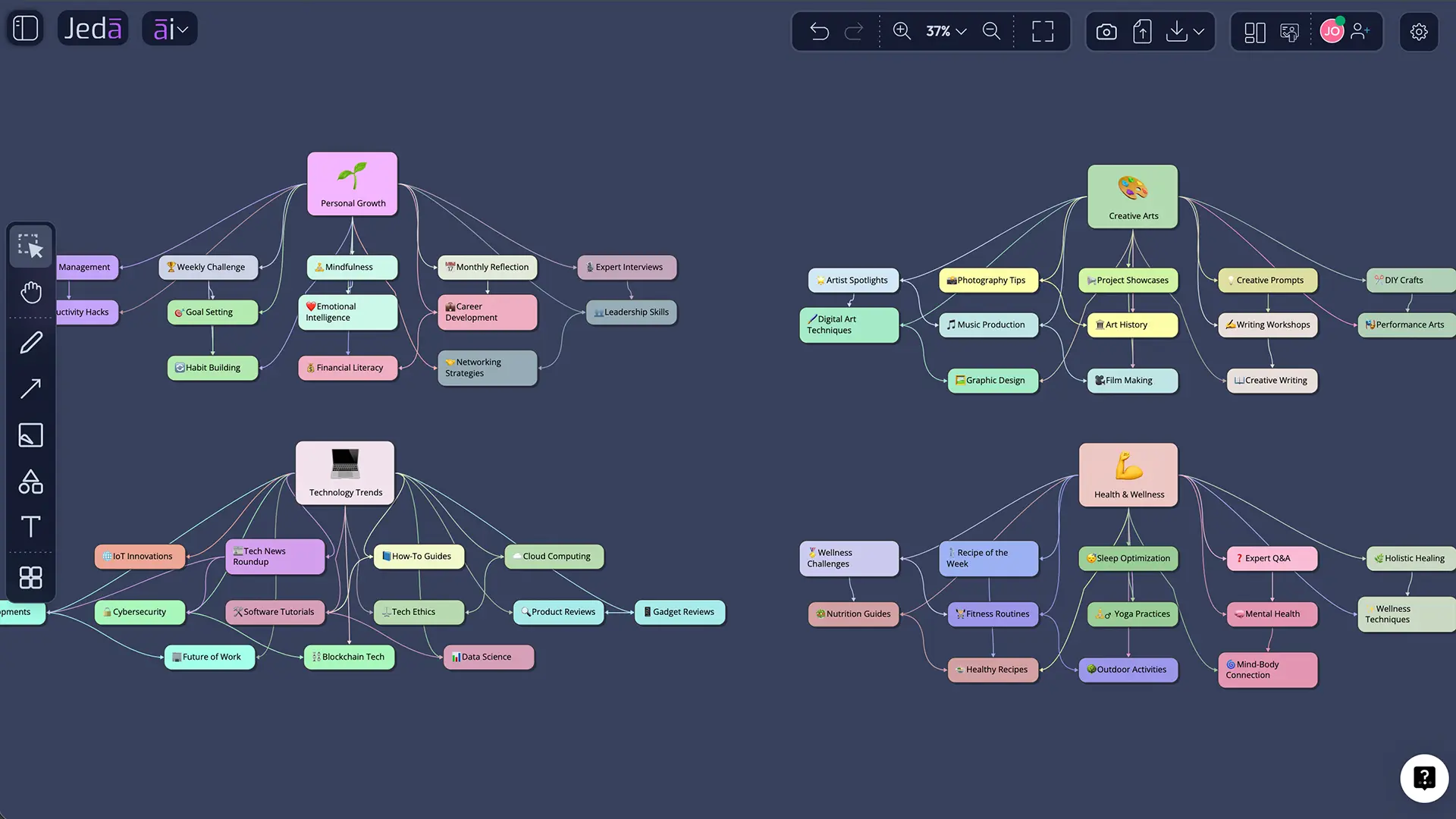
- Generate pillars + topic clusters (Mindmap)
Select Mindmap and generate a pillar map with clusters and recurring series ideas so you get a real backlog.
- Build the production system (Flowchart)
Select Flowchart and generate the workflow from brief to publish to repurpose to performance review, including owners.
- Lock measurement with Data Insight
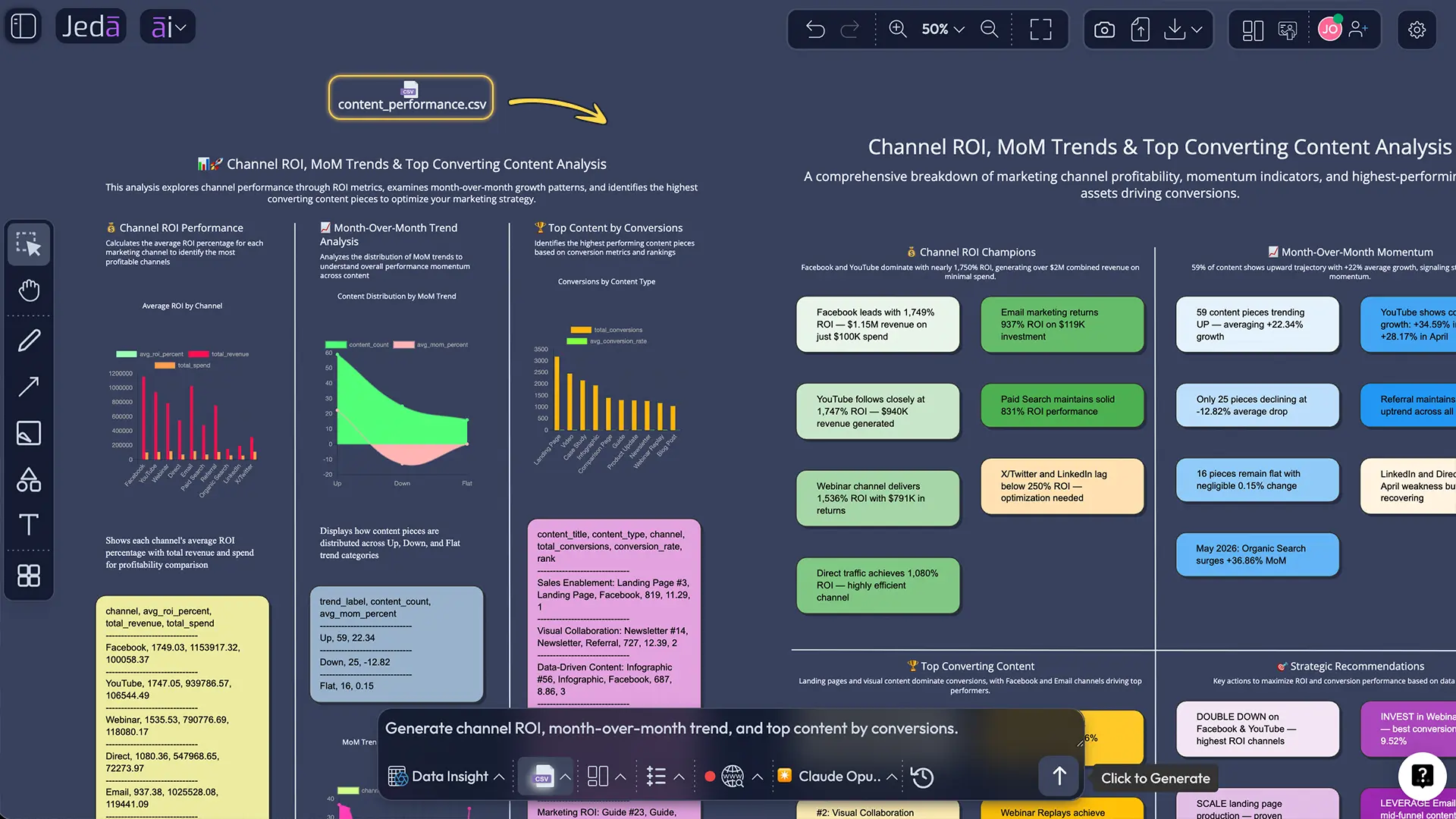
Upload a CSV of content performance metrics. Use Data Insight to generate a KPI dashboard aligned with your strategy goal.
- Use AI+ to extend weak parts
Select any box or node and tap AI+. Extend with angles, examples, risks, experiments, or next steps—then edit visually.
Copy/paste prompts (Prompt Bar)
Matrix prompt — one-page strategy canvas
“Generate a one-page content marketing strategy canvas for [company/product]. Include: business goal, ICP, point of view, 4 content pillars, flagship formats, channels + cadence, distribution + repurposing loop, production workflow, and KPIs by funnel stage. Keep each cell concise and execution-ready.”
Mindmap prompt — pillars → clusters → series
“Create a Mindmap for these pillars: [pillar list]. For each pillar, add 8–12 topic clusters and 3–5 recurring series concepts. Label series with the target audience intent.”
Flowchart prompt — production + repurposing workflow
“Create a Flowchart for content operations: Brief → Research → Draft → Edit → Design → SEO check → Publish → Distribute → Repurpose → Measure → Weekly review. Add roles at each step.”
Content marketing strategy template (example you can reuse)
Here’s a clean template structure you can generate and then customize:
Best practices (what high-performing teams do)
Common mistakes to avoid
Publishing without a POV
If your angle is unclear, your content becomes interchangeable.Choosing channels before the audience
Channels are distribution mechanics. Start with ICP intent first.Mistaking a calendar for a strategy
A calendar is “what happens.” Strategy is “why this earns attention.”Tracking vanity metrics only
If your KPI set can’t connect to the business goal, reporting becomes storytelling, not measurement.
Frequently Asked Questions
- What is a content marketing strategy?
- A content marketing strategy is a documented plan that defines your goal, audience, point of view, pillars, formats, channels, workflow, and KPIs so content consistently attracts, engages, and converts the right people. Content Marketing Institute frames strategy as business and customer needs plus a plan for how content addresses them.
- How do you create a content marketing strategy?
- Start with a measurable business goal, define the ICP and POV, choose 3–5 pillars, map channels and cadence, design a workflow, and set KPIs by funnel stage. In Jeda.ai, generate the plan as a Matrix first, then expand pillars as a Mindmap and workflow as a Flowchart.
- What should a content marketing strategy include?
- At minimum: goal, audience, POV, content pillars, flagship formats, distribution channels, cadence, production workflow, and measurement. A one-page strategy (Matrix) keeps it executable while details can live in linked visuals.
- How can AI help with content marketing strategy?
- AI accelerates the first draft of the plan, expands pillars into topic clusters, generates workflow structures, and supports measurement via dashboards from CSV data. The best use is a Visual AI workflow: AI proposes structure, humans refine and execute.
- What is the difference between content strategy and content marketing strategy?
- Content strategy is broader governance and management of content across an organization. Content marketing strategy focuses specifically on using content to attract, retain, and convert an audience to drive business outcomes.
- How do you create content pillars?
- Pick 3–5 themes that match ICP needs and your credibility. Expand each into clusters and recurring series. In Jeda.ai, use Mindmap to generate pillars → clusters → series, then validate against your POV and product strengths.
- How do you measure content marketing ROI?
- Tie content to a business goal and track leading indicators (traffic quality, engagement, email clicks) plus outcomes (leads, trials, pipeline influence). Use a weekly review cadence. In Jeda.ai, Data Insight can generate a KPI dashboard from your CSV metrics.
- What formats are marketers investing in right now?
- B2B benchmarks report increased investment expectations in video and thought leadership content, and HubSpot reports video-based formats as top ROI drivers. Your best format still depends on ICP intent and your distribution strengths.
Sources & Further Reading
- [1]
Content Marketing Institute (n.d.) . “What Is Content Marketing?” Content Marketing Institute.
View Source ↗ - [2]
Content Marketing Institute (n.d.) . “Developing a Content Marketing Strategy” Content Marketing Institute.
View Source ↗ - [3]
Content Marketing Institute (n.d.) . “How To Write a 1-Page Content Marketing Strategy” Content Marketing Institute.
View Source ↗ - [4]
Content Marketing Institute (2025) . “B2B Content Marketing: 2025 Benchmarks & Trends” Content Marketing Institute.
View Source ↗ - [5]
HubSpot (2026) . “2026 Marketing Statistics, Trends, & Data” HubSpot.
View Source ↗ - [6]
American Marketing Association (n.d.) . “The Definition of Marketing: What is Marketing?” AMA.
View Source ↗ - [7]
Ahrefs (2024) . “How to Create a Winning Content Marketing Strategy (+ Template)” Ahrefs Blog.
View Source ↗ - [8]
Holliman, G. & Rowley, J. (2014) . “Business to business digital content marketing: marketers’ perceptions of best practice” Journal of Research in Interactive Marketing.
View Source ↗ - [9]
Vinerean, S. (2017) . “Content Marketing Strategy. Definition, Objectives and Tactics” Expert Journal of Marketing.
View Source ↗
Generate your content marketing strategy in one canvas
Join over 150,000 professionals who use Jeda.ai to turn strategy into visual execution.
Try Free Template