Marketing Mix with AI gives you a faster way to think through product, price, place, and promotion without turning strategy into a pile of disconnected docs, slides, and sticky notes. The old problem is familiar: one person owns pricing, another owns channels, someone else owns campaign messaging, and the “strategy” ends up scattered across tabs. Jeda.ai fixes that by turning the marketing mix into a live, editable visual inside one AI Workspace and AI Whiteboard.
That matters more now than it did even a year ago. McKinsey’s 2025 global survey found that 78% of organizations already use AI in at least one business function, and respondents most often reported AI use in marketing and sales. HubSpot’s 2026 State of Marketing report goes even further: 80% of marketers use AI for content creation, and 75% use it for media production. AI is no longer the novelty. The real edge is how you apply it to planning, positioning, channel choices, and execution.
If you want the broader product context first, Jeda.ai already frames this clearly through its AI Workspace and AI Whiteboard experience. This page takes that same logic and applies it to one specific job: building a sharper marketing mix.
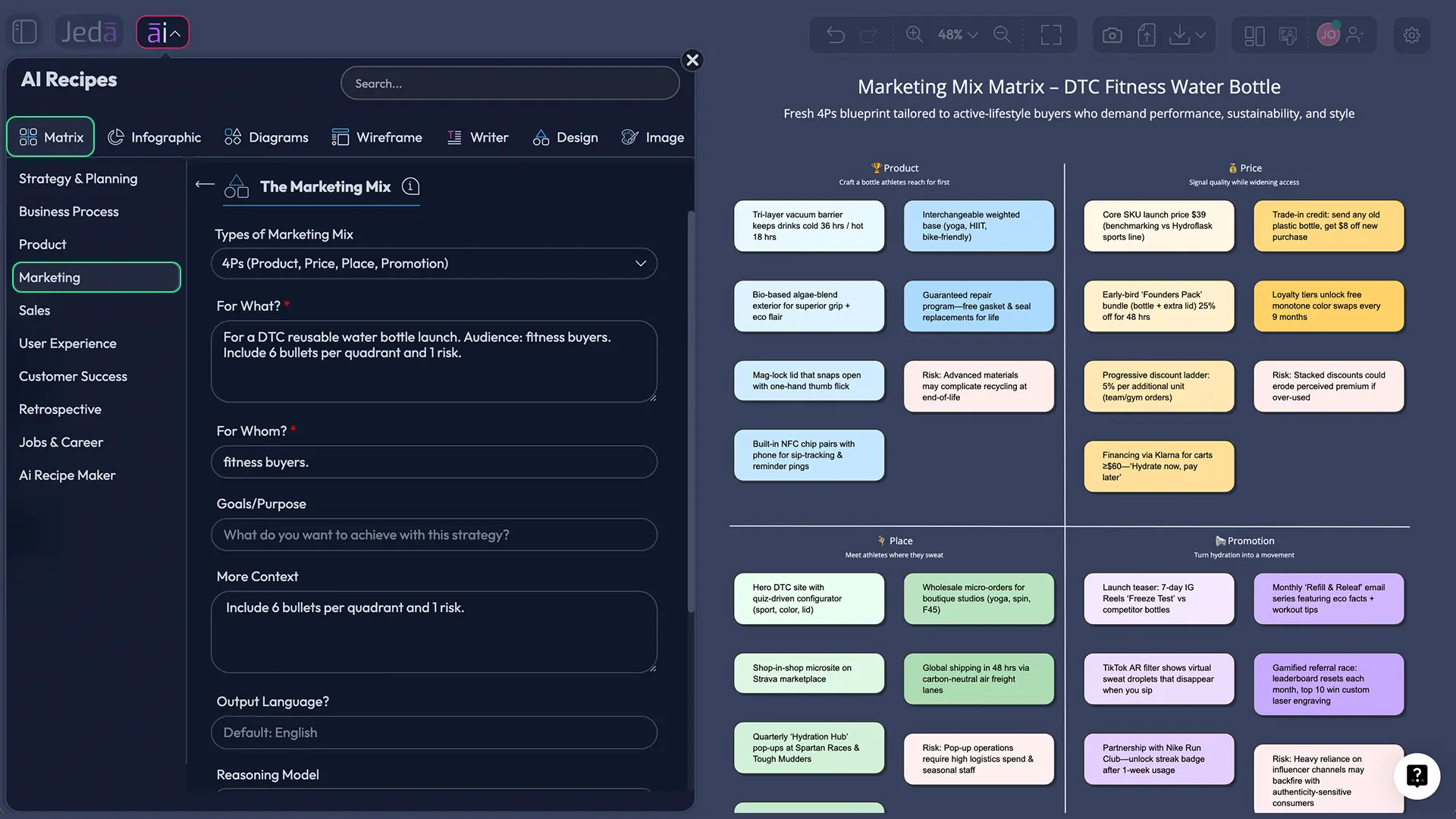
So here’s the smarter move: use AI to structure the marketing mix visually, test different assumptions faster, and then keep refining it with your team. That is where Jeda.ai stands out. You are not just getting text back. You are getting an editable visual plan in a Visual AI workspace that you can review, extend, and present.
What is the marketing mix?
The marketing mix is a practical framework for deciding how an offer reaches the market and why buyers should care. Neil Borden popularized the phrase “marketing mix” in the 1960s, E. Jerome McCarthy formalized the classic 4Ps model, and later services marketers expanded it into the 7Ps with People, Process, and Physical Evidence. A common business-friendly variation is the 5Ps, which adds People to the original four.
That history matters because the framework changed for a reason. The 4Ps are clean and sharp for product-market planning. The 5Ps are useful when the customer experience depends heavily on staff, service, or human touchpoints. The 7Ps become more helpful when you need to think like a service operator, not just a campaign planner.
In plain English:
- 4Ps help you define the core commercial offer.
- 5Ps bring the human layer into the plan.
- 7Ps help you operationalize the full customer experience.
What AI changes is the speed and quality of the thinking. Instead of drafting each P manually and revising them in separate files, you can generate the full structure, spot weak assumptions, compare alternatives, and keep improving the mix on one shared board.
Why use Marketing Mix with AI?
A marketing mix looks simple on paper. In real work, it rarely is.
You need customer insight, competitor context, positioning logic, pricing trade-offs, distribution choices, content angles, launch timing, and stakeholder alignment. That is exactly why teams lose speed. The framework is easy. The inputs are messy.
Jeda.ai helps because it brings structure without flattening the thinking. You can start from a Matrix Recipe, build from the Prompt Bar, pull in external context with web search, run multiple reasoning models for better judgment, and keep extending the result with the AI+ button. Then your team can edit the board together on the AI Whiteboard instead of translating the same idea three times. And because Jeda.ai gives you access to 300+ strategic frameworks, the marketing mix does not have to live alone. It can connect naturally to buyer personas, content strategy, positioning, GTM planning, and competitive analysis.
- Faster first draft
Generate a usable 4Ps, 5Ps, or 7Ps structure in minutes instead of starting from a blank board.
- Better evidence
Use web search, uploaded briefs, and research files to ground the mix in current market context.
- Shared alignment
Marketing, product, founders, and consultants can review the same live board instead of passing static docs around.
- Deeper thinking
Use AI+ to expand one weak cell into tactics, risks, examples, or next actions without rebuilding the whole framework.
- Easy comparison
Compare two positioning options, pricing models, or channel mixes visually in the same AI Workspace.
- Editable output
Unlike static AI answers, the final matrix stays editable inside Jeda.ai’s Visual AI canvas.
And there is a second advantage people miss: AI helps you challenge the lazy version of the framework. A weak marketing mix is usually generic. “Competitive price.” “Strong promotion.” “Use digital channels.” That is filler. AI becomes valuable when it forces sharper specifics: which segments, what offer logic, which channels, what proof, which operational constraints.
4Ps vs 5Ps vs 7Ps: which one should you use?
Most teams do not need a longer framework. They need the right one.
Use 4Ps when you need commercial clarity fast. This is the right choice for product launches, campaign planning, ecommerce offers, and quick strategic reviews.
Use 5Ps when customer-facing people directly affect results. This works well for retail, hospitality, consulting, agencies, SaaS onboarding, and any offer where service quality changes perception.
Use 7Ps when you are marketing a service, subscription, or complex experience. If fulfillment, onboarding, trust, and delivery mechanics shape the brand promise, the 7Ps usually give you the cleaner operating view.
A simple rule helps: start narrow, then expand. Begin with 4Ps. If the plan feels too abstract, move to 5Ps. If delivery, process, and trust clearly matter, step up to 7Ps.
How to create Marketing Mix with AI in Jeda.ai
Jeda.ai gives you three practical ways to build this framework: start with a Recipe Matrix, generate it from the Prompt Bar, and then deepen any section with the AI+ button.
Method 1: Recipe Matrix inside the AI Menu
This is the cleanest route when you want structure quickly. Since you already have Matrix recipes for 4Ps of marketing, 5Ps of marketing, and 7Ps of marketing, this is the recommended starting point.
- Open the AI Menu
Click the AI Menu in the top-left corner of the Jeda.ai canvas to access recipe categories.
- Choose Matrix Recipes
Select the Matrix recipe category so the output is structured as an editable framework instead of plain text.
- Pick 4Ps, 5Ps, or 7Ps of marketing
Choose the recipe that fits your planning depth: 4Ps for speed, 5Ps for human touchpoints, 7Ps for service and delivery detail.
- Add your business context
Fill in the form with product details, target audience, market situation, positioning goals, competitors, and campaign objectives.
- Generate the first board
Let Jeda.ai create the matrix on the canvas so each P becomes a visual planning area your team can edit.
- Refine and extend
Review the cells, edit weak points, and use the AI+ button on any selected shape to deepen analysis without rebuilding the entire framework.
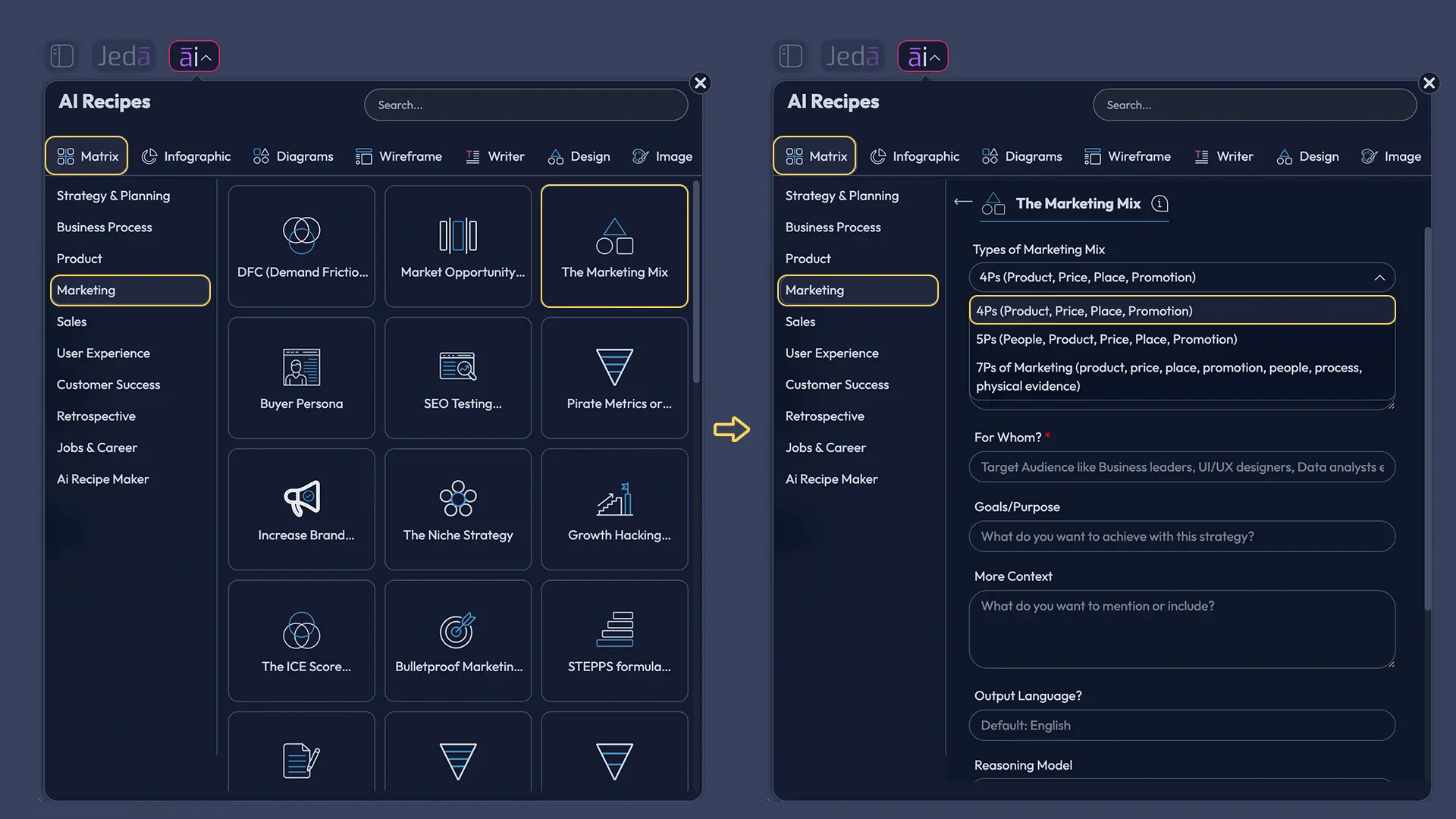
A good input here is not long. It is specific. Include the offer, audience, market, goal, and one hard constraint. For example: a new SaaS launch, mid-market target, premium positioning, two-channel acquisition focus, and a limited launch budget.
Method 2: Prompt Bar with the Matrix command
Sometimes you do not want a guided recipe. You already know the context and just want the framework generated now. That is where the Prompt Bar shines.
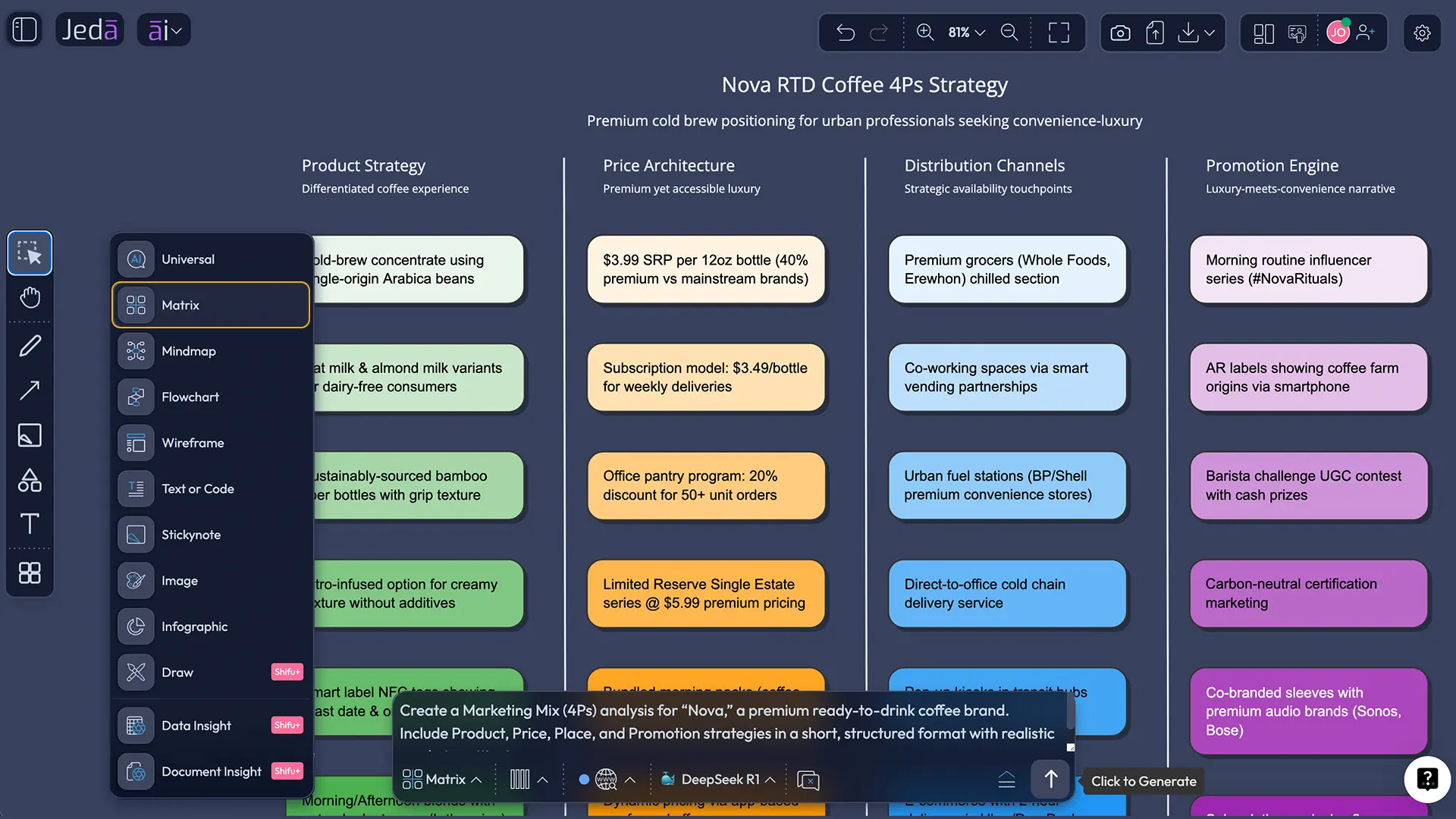
Open the Prompt Bar at the bottom of the AI Whiteboard, select the Matrix command, and type a direct instruction. Good prompts for this page look like this:
- “Create a 4Ps marketing mix for a DTC sparkling tea brand entering urban retail in Bangladesh.”
- “Build a 5Ps marketing mix for a B2B SaaS analytics tool targeting ecommerce growth teams.”
- “Generate a 7Ps marketing mix for a subscription-based design service expanding into the US market.”
This method is especially useful when you want to pair the matrix with web search, Multi-LLM Agent, or uploaded context from Document Insight or Data Insight. For example, you can upload a campaign brief, pricing sheet, or survey export first, then use those inputs to generate a sharper matrix.
Method 3: AI+ button for a deeper dive
This is where the board stops being “just a framework.”
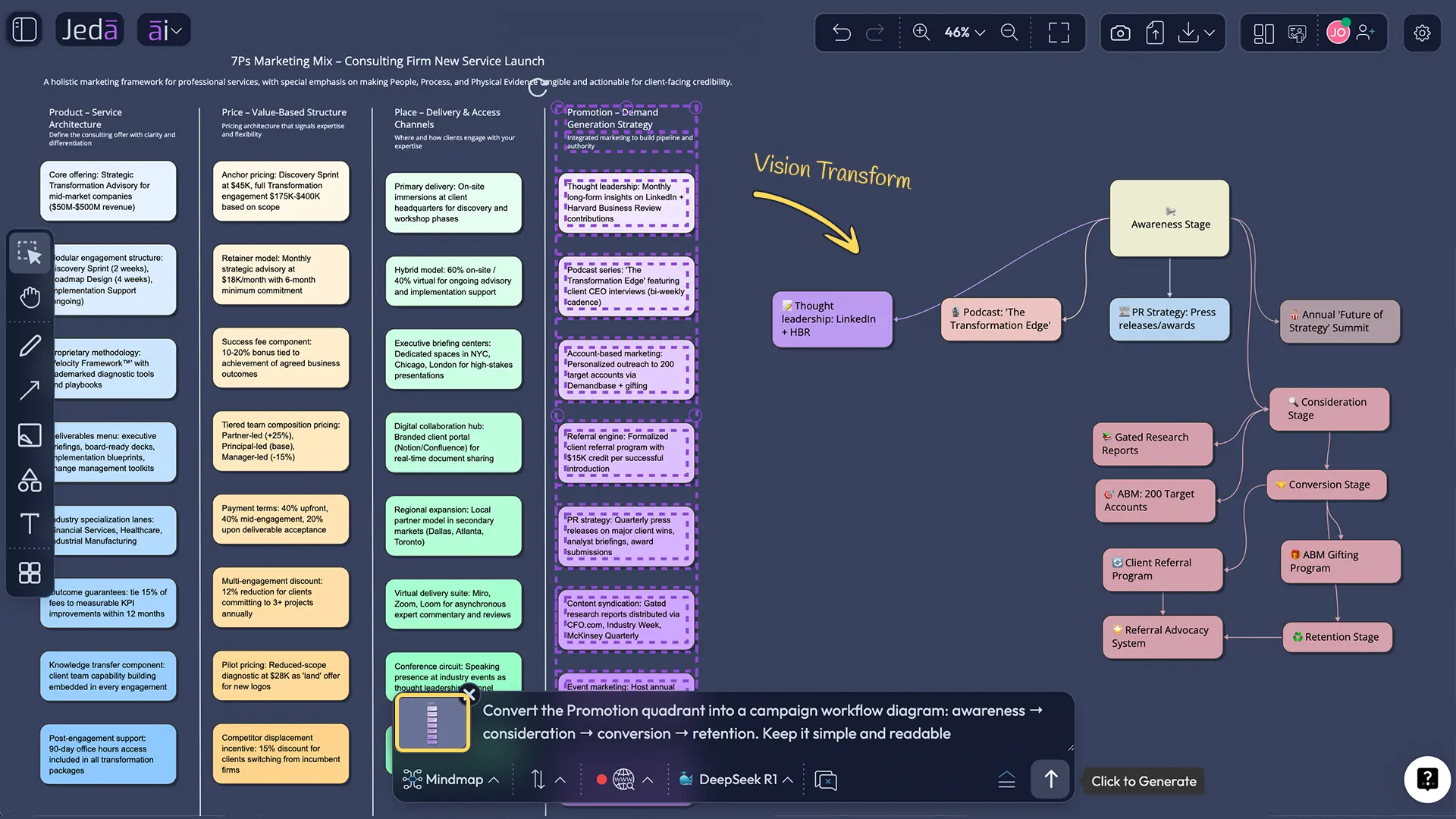
Select any cell in your generated matrix and tap the AI+ button. Jeda.ai will extend that part of the framework with more detail. Use it when one part feels thin. Maybe your pricing logic is vague. Maybe the promotion plan is too broad. Maybe the People or Process sections need more realistic execution detail.
The key here: you do not need to rebuild the full marketing mix. Just deepen the part that needs work.
That makes AI+ perfect for:
- expanding one promotion cell into campaign tactics,
- breaking one pricing cell into tiering logic,
- turning one place/distribution cell into channel priorities,
- adding onboarding or trust signals under Process or Physical Evidence.
And once the matrix is solid, you can use Vision Transform to convert it into a mind map, diagram, or flowchart if the team wants a different planning view.
Marketing Mix with AI examples
Here is where the framework gets practical.
Example 1: 4Ps for a DTC sparkling tea brand
A 4Ps board works well when the challenge is market fit and go-to-market clarity.
- Product: zero-sugar sparkling tea, three flavors, premium packaging, limited launch SKUs
- Price: slightly above mass-market soda, below imported premium beverages
- Place: modern trade, selected cafes, ecommerce bundles
- Promotion: creator-led sampling, short-form video, launch packs, referral code offers
What AI improves here is not just speed. It pushes better trade-offs. Should price support trial or premium signaling? Should place start with retail or direct bundles? Should promotion emphasize health, taste, or lifestyle? Those are real decisions. AI helps surface them faster.
Example 2: 5Ps for a B2B SaaS analytics tool
A 5Ps board becomes more useful when customer trust depends on people, not just messaging.
- Product: analytics dashboard for ecommerce growth teams
- Price: team-based subscription with annual discount
- Place: direct sales, product-led demo flow, partner referrals
- Promotion: webinars, comparison content, LinkedIn thought leadership, retargeting
- People: onboarding specialist, customer success manager, founder-led sales support for top accounts
Here, the extra P matters because the sales and onboarding experience shapes conversion. AI can expand the People section into handoff plans, service promises, FAQ themes, and team responsibilities.
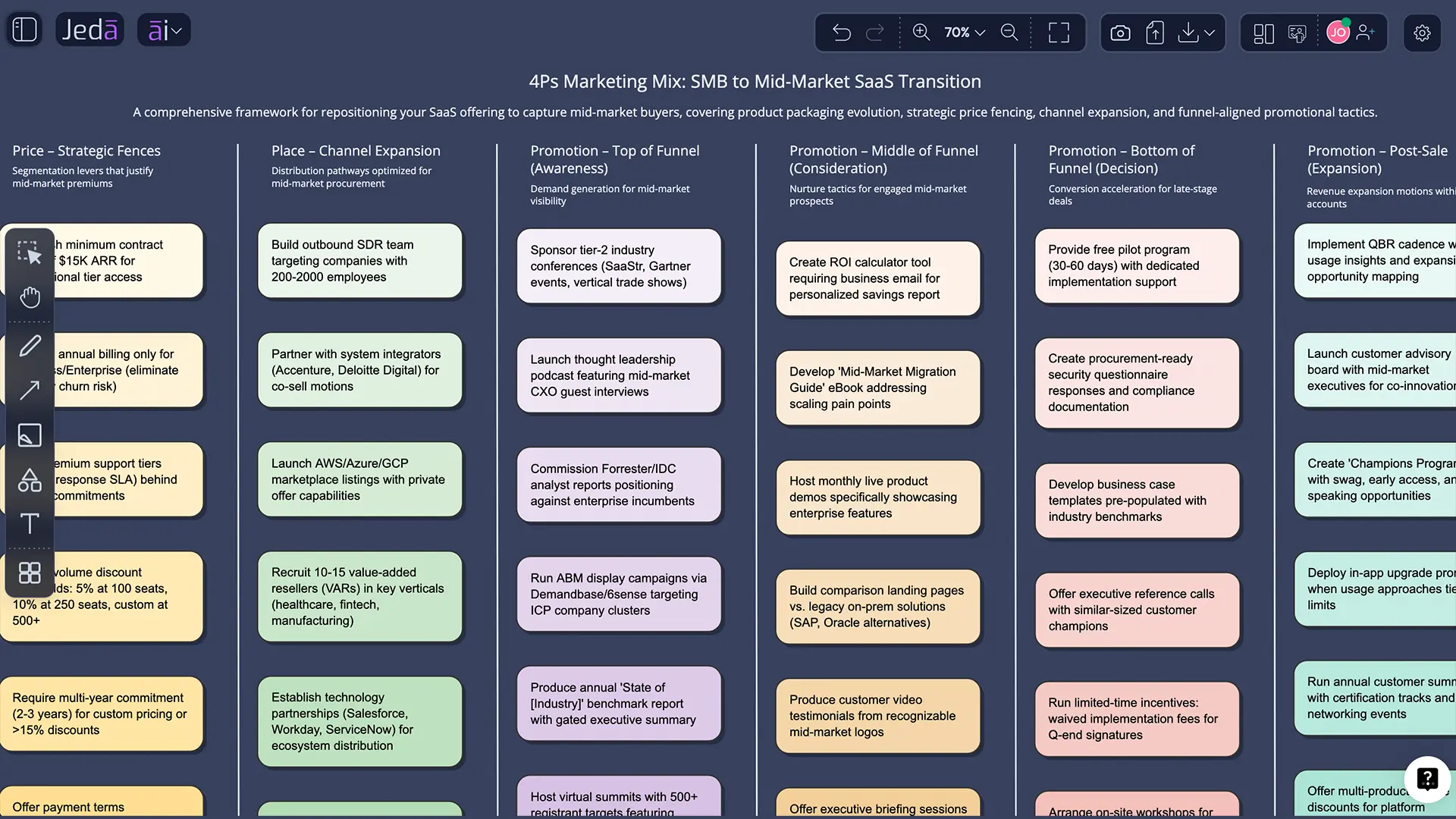
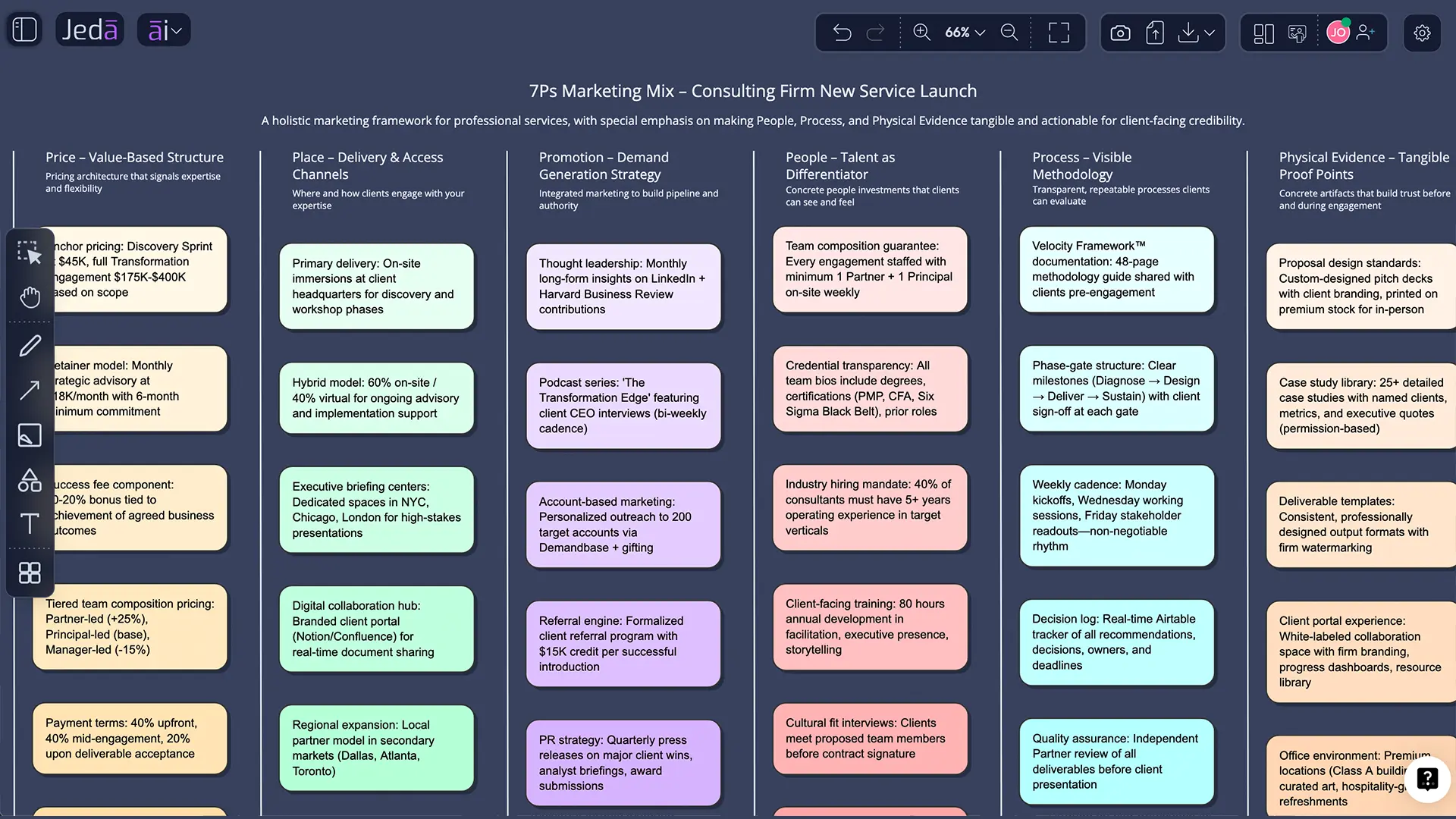
Example 3: 7Ps for a subscription-based creative service
This is where the full extended mix earns its keep.
- Product: monthly design-on-demand subscription
- Price: tiered plans by turnaround speed and revision scope
- Place: direct online acquisition with demo calls
- Promotion: case studies, before/after content, email nurture, retargeting
- People: design leads, account manager, customer support
- Process: briefing, queueing, approvals, revisions, delivery SLAs
- Physical Evidence: proposal deck, client portal, brand guidelines, polished deliverables, testimonial library
This is the version many service brands actually need. Without Process and Physical Evidence, the plan looks persuasive but incomplete. AI helps connect the promise to the delivery system.
Best practices for a better marketing mix
A strong board is specific, evidence-backed, and easy to act on. A weak board is full of soft words nobody can execute.
Common mistakes to avoid
The first mistake is forcing the 7Ps when you only need the 4Ps. More boxes do not make a smarter strategy.
The second mistake is treating every P as equal. In some launches, pricing is the hard part. In others, distribution kills the plan. Let the board show tension, not fake balance.
Third: using AI to create vague language. “Leverage digital channels” is not a strategy. Name the channels, the audience, and the reason.
And one more. Teams often separate planning from proof. Do not do that. If you have customer interviews, pricing feedback, survey exports, or campaign results, bring them into the same AI Workspace before you finalize the mix.
Frequently asked questions
- What is Marketing Mix with AI?
- Marketing Mix with AI means using AI to build, review, and improve a 4Ps, 5Ps, or 7Ps framework faster. Instead of drafting every section manually, you generate the structure, pressure-test assumptions, and refine the plan visually on one editable board.
- Should I use the 4Ps, 5Ps, or 7Ps model?
- Use 4Ps for faster offer strategy, 5Ps when people strongly affect the customer experience, and 7Ps when service delivery, trust, and operations shape the brand promise. Start with the simplest version that still reflects reality.
- Can Jeda.ai create a usable marketing mix from a short brief?
- Yes. Jeda.ai can generate a first-pass matrix from a focused prompt or a Matrix Recipe. The result gets better when you include product context, target audience, market situation, and one or two real constraints.
- What is the difference between Matrix Recipes and the Prompt Bar?
- Matrix Recipes are guided and better when you want structure fast. The Prompt Bar is more flexible and works well when you already know what you want to generate. Both produce editable visual outputs on the AI Whiteboard.
- How does the AI+ button help with marketing mix planning?
- AI+ lets you deepen one selected part of the board instead of rebuilding the entire framework. It is useful for expanding pricing logic, campaign tactics, delivery steps, trust signals, or next actions from a single cell.
- Can I use research files or campaign data to improve the framework?
- Yes. You can upload files and use Document Insight or Data Insight to extract useful context before generating the matrix. That helps the final board reflect actual evidence rather than generic marketing language.
- Is the marketing mix output editable in Jeda.ai?
- Yes. Matrix outputs in Jeda.ai are editable smart shapes on the canvas. You can update text, adjust structure, expand sections, and collaborate with teammates in real time inside the same AI Workspace.
- Can my team collaborate on the board?
- Yes. Jeda.ai supports real-time collaboration on its AI Whiteboard, so marketers, founders, consultants, and other stakeholders can review and edit the same board together instead of passing around separate versions.
- Can I try this workflow for free?
- Yes. Jeda.ai offers a Whitebelt free plan, while Blackbelt and Shifu plans expand usage and advanced capabilities. That makes it easy to test a marketing mix workflow before deciding whether you need more power features.
- Can I share or export the finished marketing mix?
- Yes. You can present the board collaboratively and export the final output from Jeda.ai. According to the platform workflow reference, export formats include PNG, SVG, and PDF.
Sources & further reading
The marketing mix has lasted because it is simple, not because it is shallow. Borden’s original work explains where the idea came from. McCarthy made the framework teachable. Booms and Bitner made it more realistic for service businesses. Recent AI research matters for a different reason: it shows that AI is already embedded in marketing work, which raises the bar for how strategy teams plan and differentiate.
- [1]
Borden, Neil H. (1964) . “The Concept of the Marketing Mix” Journal of Advertising Research.
View Source ↗ - [2]
McCarthy, E. Jerome (1960) . “Basic Marketing: A Managerial Approach” R.D. Irwin / Google Books.
View Source ↗ - [3]
Booms, Bernard H. and Bitner, Mary J. (1981) . “Marketing Strategies and Organization Structures for Service Firms” Marketing of Services, American Marketing Association.
View Source ↗ - [4]
Oxford College of Marketing (2020) . “Understanding the 7Ps of the Marketing Mix” Oxford College of Marketing.
View Source ↗ - [5]
Australian Government (n.d.) . “The 5 Ps of Marketing” business.gov.au.
View Source ↗ - [6]
HubSpot (2025) . “What Are the 4 Ps of Marketing? The Marketing Mix Explained” HubSpot Blog.
View Source ↗ - [7]
McKinsey & Company (2025) . “The State of AI: How Organizations Are Rewiring to Capture Value” McKinsey Global Survey on AI.
View Source ↗ - [8]
HubSpot (2026) . “The 2026 State of Marketing Report” HubSpot.
View Source ↗
Start Your Marketing Mix with AI Today
Join over 150,000 users who use Jeda.ai’s AI Workspace and AI Whiteboard to turn messy planning into editable visual strategy.
Try Free Template