Generative AI Agent - Jeda.ai reflects the ongoing evolution of AI technologies. The core idea still holds: AI systems are getting better at understanding context, generating new output, and helping people move faster from analysis to action. But the sharper way to describe Jeda.ai today is this: it is an AI-powered visual workspace for thinking, analysis, brainstorming, and strategic planning, built to turn ideas, documents, and data into editable, decision-ready visuals.
Generative AI Agent - Jeda.ai
In this emerging era, AI agents are becoming more useful in solving complex problems and surfacing insights that can reshape how teams work. They can automate routine processes, support analysis, and help generate new options when a problem is still messy. That is the real appeal. Not just speed. Better thinking under pressure.
Jeda.ai fits that direction by giving professionals a visual place to do the work. Instead of stopping at text output, Jeda.ai lets people generate and edit structured visuals on an infinite canvas. That changes the workflow from “ask and copy” to “generate, review, refine, extend, and collaborate.”
Exploring the Diversity of AI Agents
Defining AI Agents
AI agents are advanced systems designed to perform tasks autonomously by making decisions based on their programming, environment, available tools, and goals. Some are simple. Others reason, plan, adapt, and improve over time. The category is broad, which is exactly why the term gets overused so easily.
What matters in practice is what kind of work the agent can actually handle. Can it respond only to direct inputs? Can it track context? Can it pursue a goal over multiple steps? Can it improve from feedback? Those differences shape real business value.
Categories of AI Agents
The original blog described these categories correctly in spirit, and they still matter. They help explain why not every AI product should be treated the same way. Some systems are rule-driven helpers. Others are better described as adaptive decision systems.
AI Agents in Action
AI agents are already reshaping work across industries:
- Retail: recommendation systems personalize the customer experience and support sales.
- Manufacturing: predictive maintenance systems reduce downtime by anticipating equipment issues.
- Education: adaptive learning systems tailor experiences to the learner’s pace and progress.
- Business operations: AI agents support analysis, task handling, forecasting, and workflow optimization.
This is where Jeda.ai becomes relevant. The platform is not just about generating text or images. It helps teams turn ideas, data, and documents into visual working artifacts they can actually use.
The Impact of Generative AI Agents
Generative AI agents represent a more creative and adaptive class of AI systems. Traditional AI tends to work inside tighter boundaries. Generative AI agents can produce new output from existing inputs, which makes them more useful in ideation, content creation, early-stage planning, and strategy work where the answer is not already sitting in a dropdown.
What is a Generative AI Agent?
A generative AI agent can create new output from context. That may include text, images, structured analysis, code, or visual formats. The point is not novelty for its own sake. The point is useful synthesis.
That is why this category matters so much for business and creative work. Teams rarely need raw information alone. They need a way to transform information into options, structure, and next steps.
Key Differences Highlighted
Jeda.ai as a Visual Generative AI Workspace
Jeda.ai stands at the intersection of generative AI and visual work. That matters because ideas rarely become useful through text alone. Teams need to see relationships, compare alternatives, refine structures, and build shared understanding.
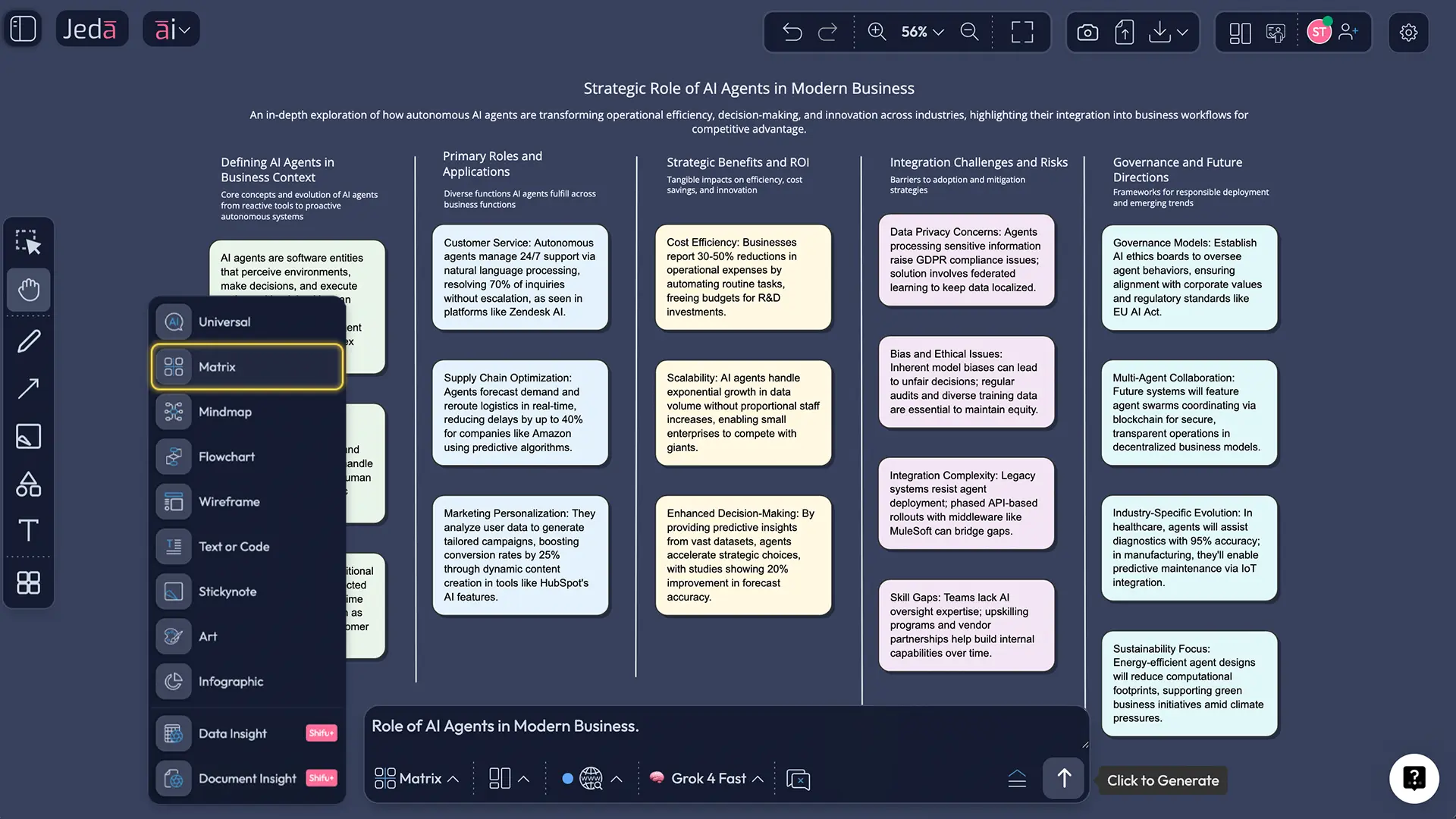
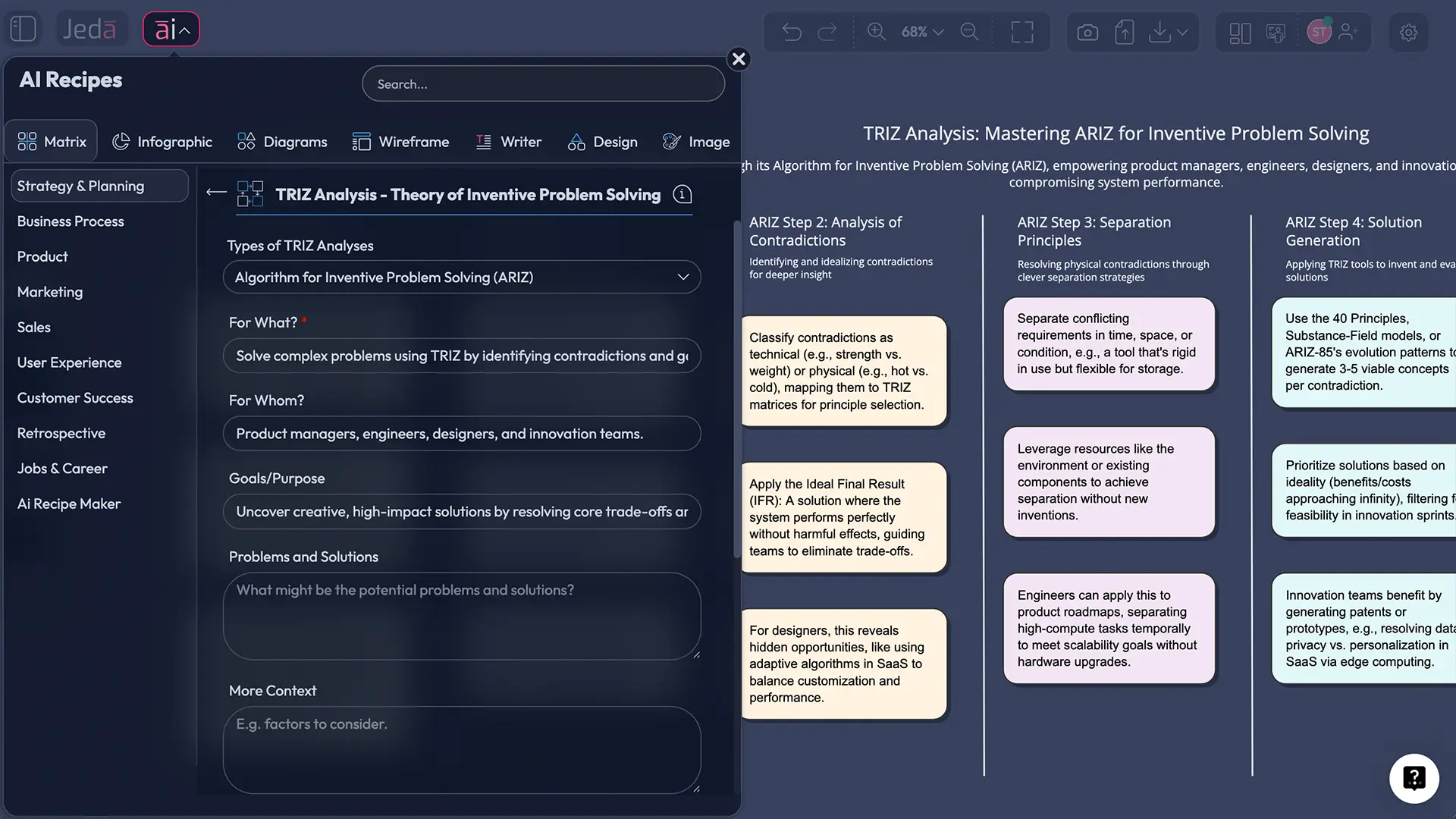
Today, Jeda.ai does that through a current workflow built around:
- the Prompt Bar for direct AI generation,
- the AI Menu for structured AI Recipes,
- Data Insight for CSV and Excel analysis,
- Document Insight for PDFs, Word files, PPTs, markdown, and more,
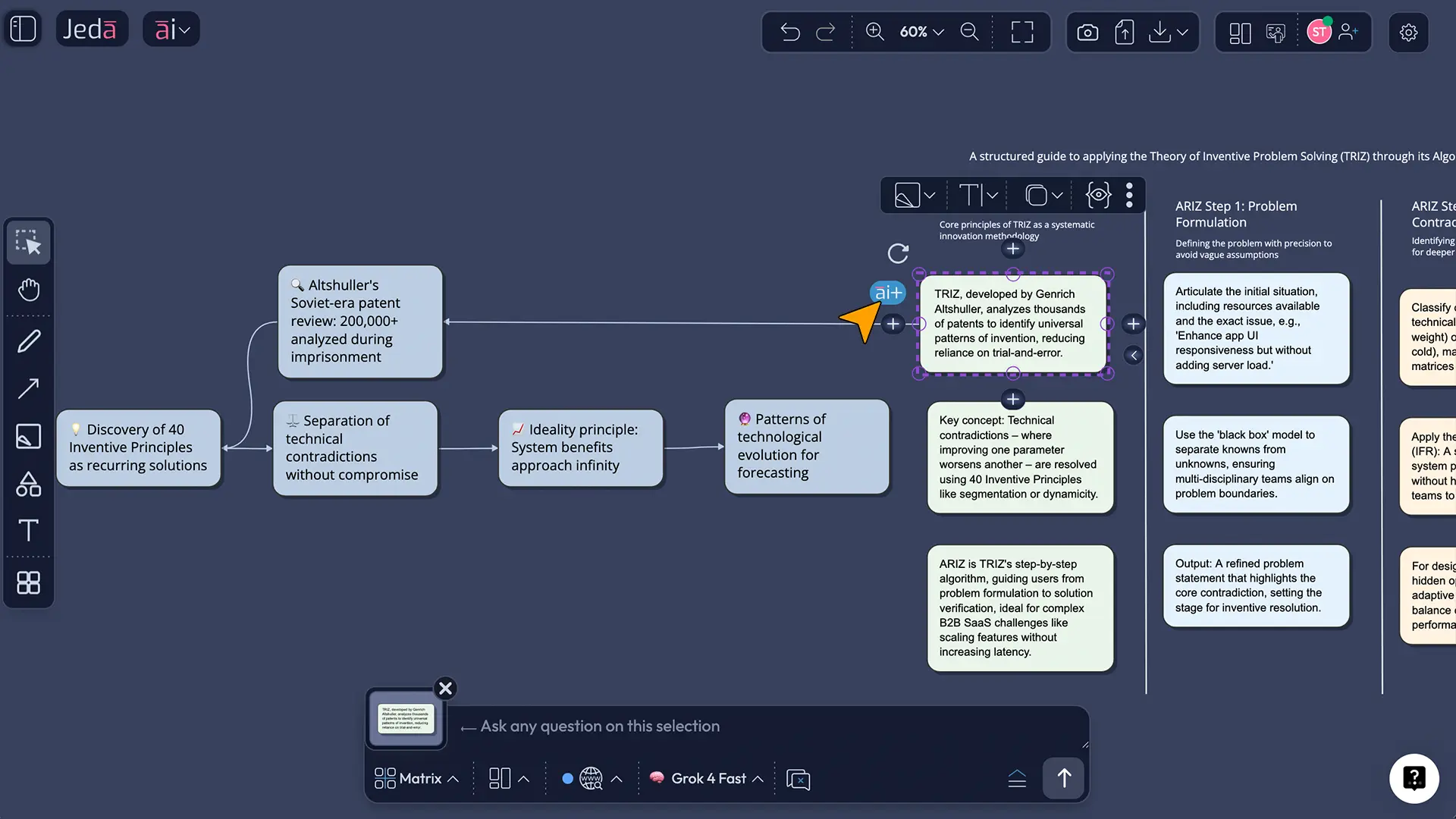
- AI+ for extending an existing visual,
- Vision Transform for converting one visual form into another,
- and an editable collaborative canvas where the output does not stop being useful after generation.
That is a far stronger product story than older language around “templates” or broad “AI magic.” Jeda.ai is useful because it turns generation into an editable visual workflow.
Unleashing Creativity with Generative AI Agents
The Power of Generative AI in Strategic Ideation
Jeda.ai supports strategic ideation by helping teams move from a rough prompt to a structured visual. That may be a matrix, mind map, flowchart, diagram, stickynote cluster, infographic, or written block. The practical effect is simple: it becomes easier to externalize messy thinking and shape it into something discussable.
Facilitating Strategic Planning
With the right context, generative AI can help teams move beyond blank-canvas paralysis. Jeda.ai supports planning work by making it easier to generate visual structures, review them, edit them, and expand them. In a real workflow, that means fewer disconnected tools and less friction between raw input and actionable output.
Enhancing Ideation Processes
Whether the task is product thinking, marketing strategy, problem solving, or early design direction, generative AI helps accelerate ideation. Jeda.ai adds a visual layer to that process. So the output is not just something you read. It becomes something you can rearrange, connect, extend, and share.
What Jeda.ai Can Generate Today
The original blog pointed to a wide range of outcomes. That remains true, but the current product language is clearer and more concrete.
Data-Driven Strategy Analysis with AI
What older copy called “Generative AI Templates” is better described today through AI Recipes, Matrix generation, and Data Insight. Jeda.ai can turn structured business inputs into visual analysis, charts, frameworks, and strategic views that are easier to work with than a static summary.
Mind Maps and Visual Idea Expansion
Jeda.ai can generate detailed Mindmap outputs for brainstorming, clustering ideas, and building topic trees. This is useful when a team needs to break down a concept, expand an opportunity area, or surface connections that are hard to see in plain text.
Flowcharts and Wireframes
From process visualization to early interface thinking, Jeda.ai supports Flowchart and Wireframe generation. That makes it easier to move from concept to visual structure without switching tools too early.
Written Content and Sticky Notes
For text-heavy work, Jeda.ai supports Text or Code generation and also Stickynote-style output for brainstorming and workshop flows. That makes written thinking more flexible on the canvas.
AI Images and Visual Exploration
For visual concept creation, Jeda.ai includes an Image command powered by current image models. These image outputs are static, while the workspace’s visual commands remain editable.
Data Insight
The earlier “Data Intelligence” framing should now be understood as Data Insight. It analyzes CSV and Excel files, generates visual analysis, and can help produce data-driven frameworks from real numbers.
Document Insight
The earlier “Document Intelligence” framing is now Document Insight. It analyzes uploaded files such as PDF, DOCX, PPTX, MD, RTF, TXT, and CSV, then turns that content into structured visuals such as mind maps, matrices, flowcharts, and other formats.
AI+ and Visual Transformation
The older blog described transformation in broad, almost mystical terms. The current version is more useful: AI+ extends an existing visual from the selected object, and Vision Transform converts an existing selection into a different output style.
Why This Matters for Modern Teams
Generative AI Agent - Jeda.ai matters because it closes a familiar gap. Teams often have ideas, documents, notes, screenshots, datasets, and prompts. What they lack is one place that can turn all of that into a structured visual workflow.
Jeda.ai helps bridge that gap. It brings AI reasoning into a visual environment where outputs can be edited, extended, compared, and shared. For strategy, design thinking, planning, ideation, and data-backed decision-making, that is a practical shift.
"At Jeda.ai, we believe that AI agents are key to unlocking the full potential of data-driven decision-making. By integrating AI agents into our platform, we empower your business to make smarter, faster, and more informed decisions. "
Let's hear more from TK, CEO at Jeda.ai, and Todd Watts, Innovation Center Lead at Beyondsoft.
Conclusion: The Future of Generative AI Agents
Generative AI Agent - Jeda.ai represents more than a generic promise about AI. It points to a more practical future where AI helps teams think, create, analyze, and decide inside the same visual environment.
The future of AI agents is promising because the technology keeps getting better at handling context, generating alternatives, and supporting more complex workflows. But the real win comes when that intelligence is usable. That is where Jeda.ai stands out. It takes AI output and turns it into something visible, editable, collaborative, and closer to action.
For professionals trying to streamline analysis, spark better ideation, or turn fragmented inputs into clear visual work, the appeal is obvious. The time to engage with this kind of AI workflow is now.
Frequently Asked Questions
- What is a generative AI agent?
- A generative AI agent is an AI system that can create new outputs from context instead of only following fixed rules. Depending on the workflow, that can include text, images, structured analysis, code, or visual outputs that help users move from raw input to usable decisions.
- How is Jeda.ai different from a standard chatbot?
- A standard chatbot usually returns text. Jeda.ai takes prompts, files, and visual selections and turns them into editable visual outputs on a collaborative canvas. That means the work can continue after generation instead of stopping at a chat response.
- Can Jeda.ai support strategy and planning work?
- Yes. Jeda.ai is well suited for strategy, analysis, brainstorming, and planning because it combines AI reasoning with visual structures such as matrices, mind maps, flowcharts, diagrams, sticky notes, and document-driven outputs.
- What are the most relevant Jeda.ai features for this use case?
- The most relevant current features are the Prompt Bar, AI Recipes, Data Insight, Document Insight, AI+, Vision Transform, and the editable infinite canvas. Together they make AI output easier to structure, refine, and share with a team.
- Can Jeda.ai work with files and existing materials?
- Yes. Jeda.ai supports file-based workflows through Data Insight and Document Insight. Users can upload structured files such as CSV and Excel or documents such as PDFs, Word files, PPTs, markdown files, and text files, then turn them into visual outputs.
- Are Jeda.ai visuals editable after generation?
- Most Jeda.ai visual outputs are editable on the canvas, which is one of the platform’s strongest advantages. Image-command outputs are static, but visual commands such as Matrix, Mindmap, Flowchart, Diagram, Stickynote, Wireframe, and Infographic remain editable.
- What plans unlock the more advanced AI workflows?
- White Belt covers basic use, while Black Belt expands limits and adds export and AI Extend. Shifu adds advanced models, Data Insight, Document Insight, Multi-LLM Agent, Dynamic Prompt, Vision Transform, Web Search, and broader AI workflows. Alchemist adds higher-tier models and higher caps.
- Why does a visual workspace matter for AI agents?
- Because ideas, trade-offs, and decisions are often easier to understand when they are visible. A visual workspace makes it easier to compare options, map relationships, organize complexity, and collaborate around AI-generated output instead of leaving it trapped inside a chat thread.
Citations
- [1]
Google Cloud (2025) . “What are AI agents? Definition, examples, and types” Google Cloud.
View Source ↗ - [2]
Cole Stryker (n.d.) . “Types of AI Agents” IBM.
View Source ↗ - [3]
IBM (n.d.) . “What Are AI Agents?” IBM.
View Source ↗ - [4]
Michael Chui, Eric Hazan, Roger Roberts, Alex Singla, Kate Smaje, Alex Sukharevsky, Lareina Yee, and Rodney Zemmel (2023) . “The economic potential of generative AI: The next productivity frontier” McKinsey & Company.
View Source ↗ - [5]
Todd Watts and Tawhid Khan (n.d.) . “AI Agents at Work: Practical Ways to Shape Your Business Future” Beyondsoft Consulting Inc..
View Source ↗
Explore Generative AI Workflows in Jeda.ai
Use Jeda.ai to turn prompts, data, documents, and early ideas into editable visual work for strategy, planning, and creative exploration.
Try Jeda.ai