Hybrid learning is no longer the backup plan for MBA programs. It is quickly becoming the operating model for modern business education. AACSB’s 2025 reporting shows program delivery is evolving alongside learner expectations, while leading business schools now market blended, hybrid, and flexible formats as a core advantage rather than a compromise. That shift matters because MBA candidates do not just want content. They want rigor, cohort energy, career relevance, and a format that does not wreck the rest of their lives.
That is exactly where Jeda.ai earns its keep. Instead of forcing lecturers, program directors, and cohort leaders to juggle slide decks, LMS threads, PDFs, chat tools, and disconnected whiteboards, Jeda.ai turns hybrid delivery into a single AI Workspace. It combines AI Whiteboard collaboration, visual frameworks, document analysis, data interpretation, real-time teamwork, and AI-assisted expansion on one canvas. Not someday. Now. And for business schools trying to deliver sharper classroom experiences with fewer prep hours, that changes the game.
What hybrid learning means for modern MBA education
Hybrid learning in MBA education is not simply “some students on Zoom, some in class.” The stronger model blends synchronous and asynchronous learning, structured collaboration, case analysis, cohort discussion, faculty guidance, and periodic in-person moments into one coherent experience. When it works, students get flexibility without losing the intellectual friction that makes business school valuable.
AACSB notes that business school delivery models continue to evolve to meet learner expectations, even as overall demand stays resilient and students become more selective about the value they buy. And AACSB’s coverage of online business education points in the same direction: the better programs are becoming more participatory, more social, and more collaborative rather than static content dumps. That should sound familiar to anyone who has suffered through a dead discussion board and a 92-slide lecture deck.
The problem is execution. Hybrid formats create orchestration load for faculty. Research on collaborative hybrid classrooms shows that teachers often struggle with live group management, collaborative documents, monitoring interactions, and maintaining attention across in-room and remote learners. So the real issue is not whether hybrid learning works. It is whether your delivery stack is built for it.
Why MBA programs are leaning into hybrid and blended formats
Look at what leading schools are signaling. The University of Colorado Boulder’s Hybrid MBA emphasizes asynchronous coursework, synchronous online sessions, and recurring in-person Saturdays. ESSEC’s Hybrid EMBA highlights flexibility, face-to-face networking, and reduced time away from work. Harvard Business School Executive Education openly positions virtual, in-person, and blended formats as learning on your terms. The market is not whispering here. It is using a megaphone.
Three forces are driving this:
- Flexibility without dilution
Working professionals want MBA-level rigor without pausing career momentum, travel, or family commitments.
- Cohort connection still matters
Business education still depends on live discussion, peer challenge, and collaborative problem-solving, not solo content consumption.
- Programs must prove value faster
Schools need stronger engagement, clearer outcomes, and more visible differentiation in a crowded MBA market.
And here is the uncomfortable truth: most schools still try to solve a hybrid delivery problem with a tool stack designed for file storage, not shared thinking. The LMS stores material. Zoom hosts class. Slides present. Docs capture notes. None of those tools, by themselves, create a live decision-making surface for MBA-level analysis.
That is why Visual AI matters. In management education, students learn faster when they can see relationships, trade-offs, priorities, and frameworks in motion. A paragraph can explain a market-entry problem. A board can make the room argue about it. That is a better class. If you want the broader product context, the natural companion pages are AI Workspace and AI Whiteboard.
Why Jeda.ai fits hybrid MBA delivery better than fragmented tools
Jeda.ai is not just another classroom app with AI sprinkled on top like parsley. It is built as an AI Workspace for thinking, structuring, and collaborating visually. The platform gives lecturers and students a shared canvas where they can generate, edit, extend, and present live outputs across frameworks, diagrams, mind maps, flowcharts, sticky-note clusters, wireframes, infographics, and structured text.
That matters in MBA settings because hybrid learning is usually messy in the same five places:
- Pre-class prep takes too long.
- In-class participation becomes uneven.
- Remote students fade into the wallpaper.
- Post-class synthesis gets buried across tools.
- Reusable teaching assets never become reusable.
Jeda.ai attacks all five.
Use it for:
And because Jeda.ai supports 300+ strategic frameworks, AI Whiteboard collaboration, AI+ extension, Vision Transform, and model-assisted generation inside one environment, it gives MBA programs a stronger delivery system without turning the class into a software tutorial. Related resources like visual strategic frameworks and AI Workspace also fit neatly into the same content ecosystem.
How to run hybrid MBA teaching in Jeda.ai
This is the practical part. No fluff. Just a smarter classroom workflow.
Method 1: Recipe Matrix
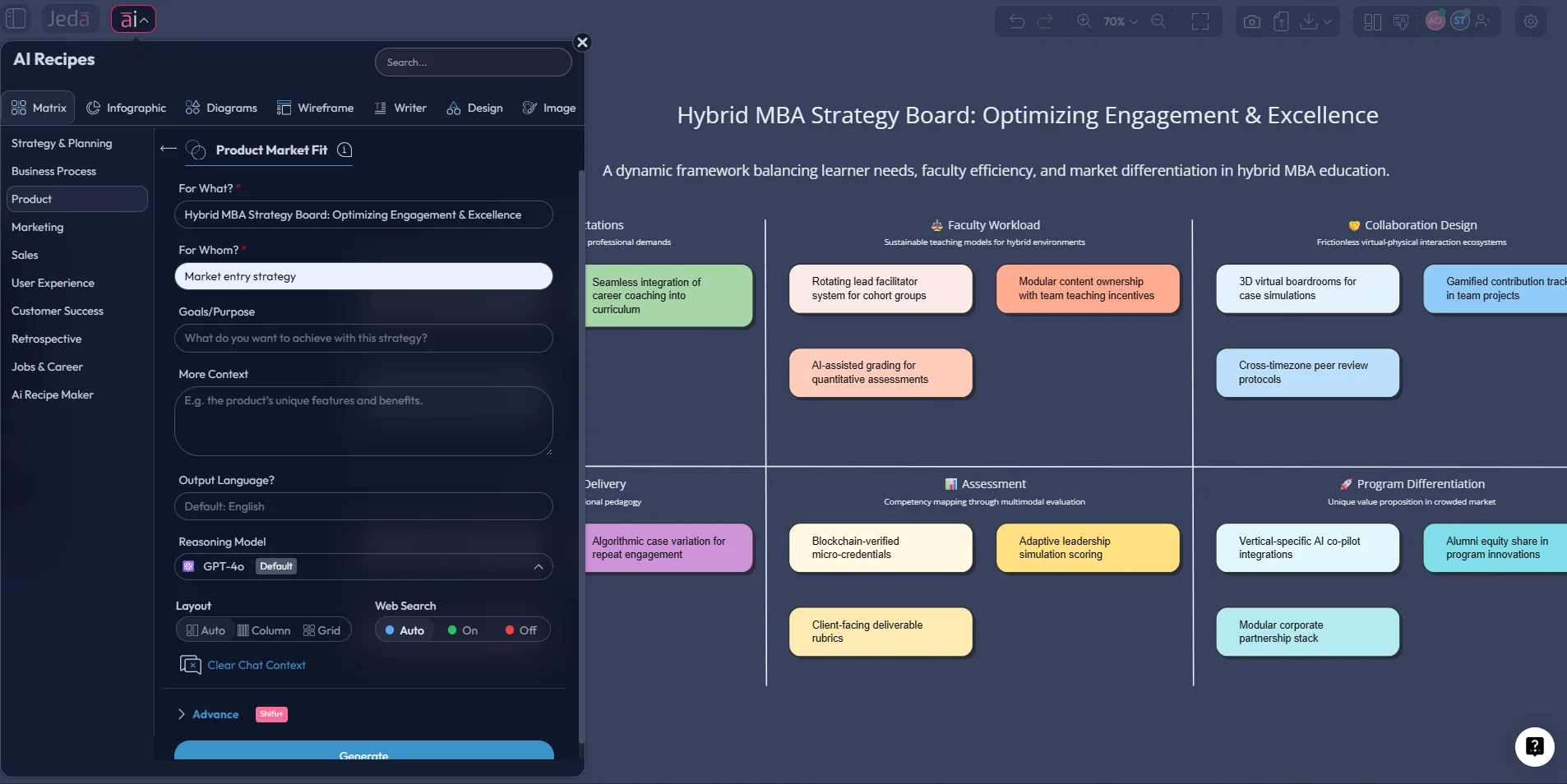
Use the AI Menu when you want a proven structure fast. This is the cleaner option for lecturers who want to run workshops around strategy, planning, prioritization, innovation, or reflection.
- Open the AI Menu
Click the AI Menu in the top-left corner of Jeda.ai and go to Matrix Recipes. Pick a framework that fits the lesson, such as SWOT Analysis, Risk Analysis, PESTEL, KANO Model, or Project Planning.
- Frame the MBA learning objective
Enter the course context, cohort level, industry case, learning outcomes, and the core decision students must make. Keep it concrete so the matrix does not come out generic.
- Generate the board for live class use
Let Jeda.ai build the matrix on the canvas. Use it as the anchor for synchronous discussion across in-room and remote participants.
- Facilitate contribution visually
Students can critique assumptions, move ideas, add evidence, annotate priorities, and work from the same visual structure instead of scattered chat threads.
- Extend with AI+
Select any smart shape and tap the AI+ button to deepen that section. Use AI+ to expand risks, alternatives, examples, counterarguments, or next-step recommendations already present on the board.
- Transform for follow-up
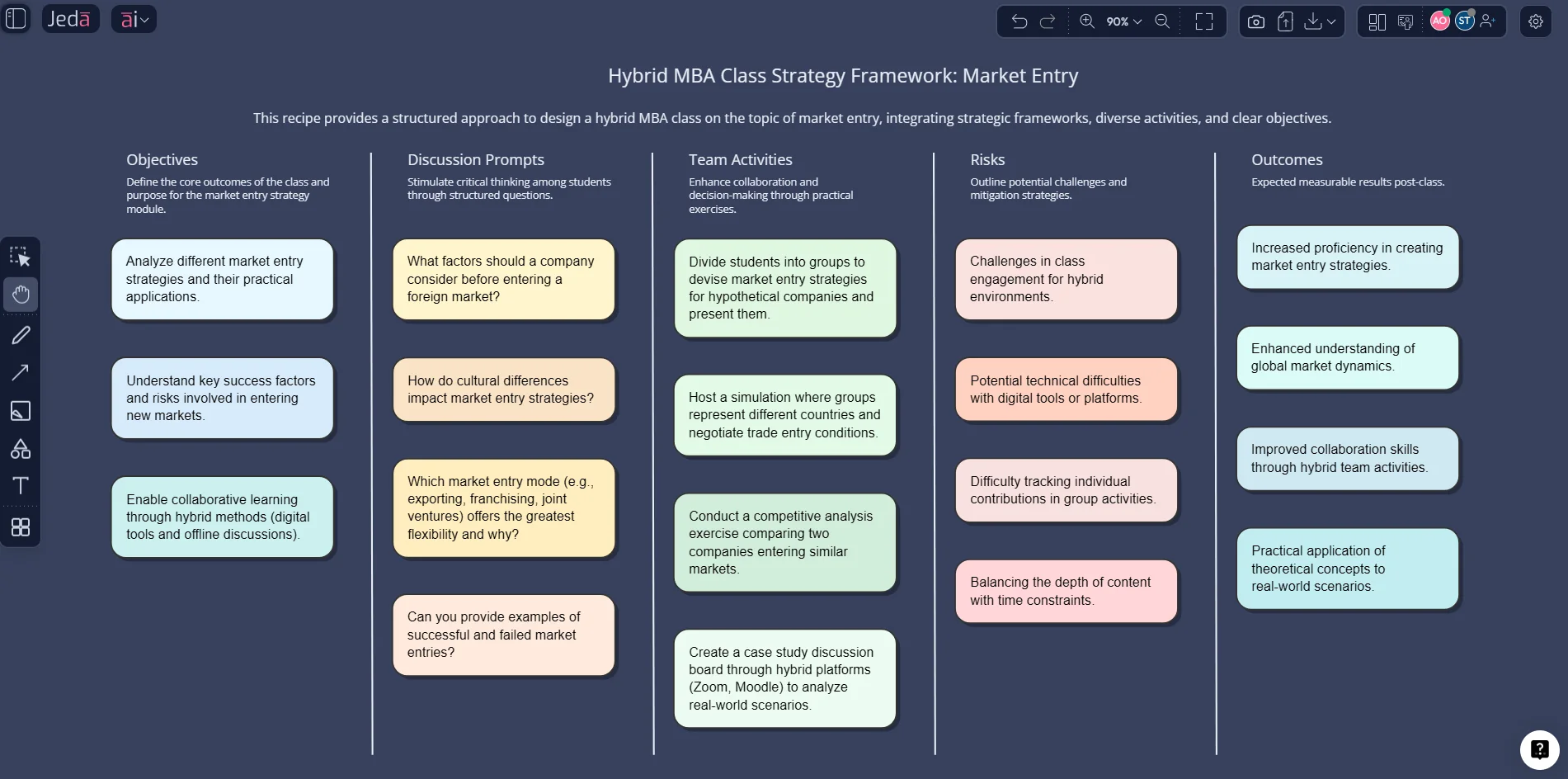
Use Vision Transform to convert the matrix into a flowchart, mind map, or diagram for recap, assignments, or presentation-ready outputs.
Method 2: Prompt Bar
Use the Prompt Bar when you want speed, freedom, or a more custom output. This works especially well for live seminar pivots.
Try prompts like:
- “Create a mind map of the leadership failures in this case and separate people, process, incentives, and culture.”
- “Generate a flowchart showing the decision path for entering the Southeast Asian EV market.”
- “Turn this uploaded annual report into a matrix of risks, growth bets, and operational constraints.”
- “Create an infographic summarizing the five most important lessons from today’s strategy discussion.”
The smart move in hybrid classes is to use the Prompt Bar as your live co-facilitator. Ask for structure, then let students interrogate it.
Method 3: AI+ button generated deep dive
This is where classes stop feeling passive. Once a board exists, faculty do not need to restart from scratch to go deeper. They can select a node, card, or cell and use AI+ to extend only that part of the visual. In practice, that means you can ask students to challenge one assumption, pick one risk, or expand one stakeholder view and build the board iteratively.
That is more useful than tossing a giant one-shot prompt at the machine and praying it reads your mind. AI+ is strongest when it deepens an existing line of reasoning already on the canvas.
A model workflow for hybrid MBA classes
Here is what a modern MBA session can look like inside Jeda.ai.
Before class
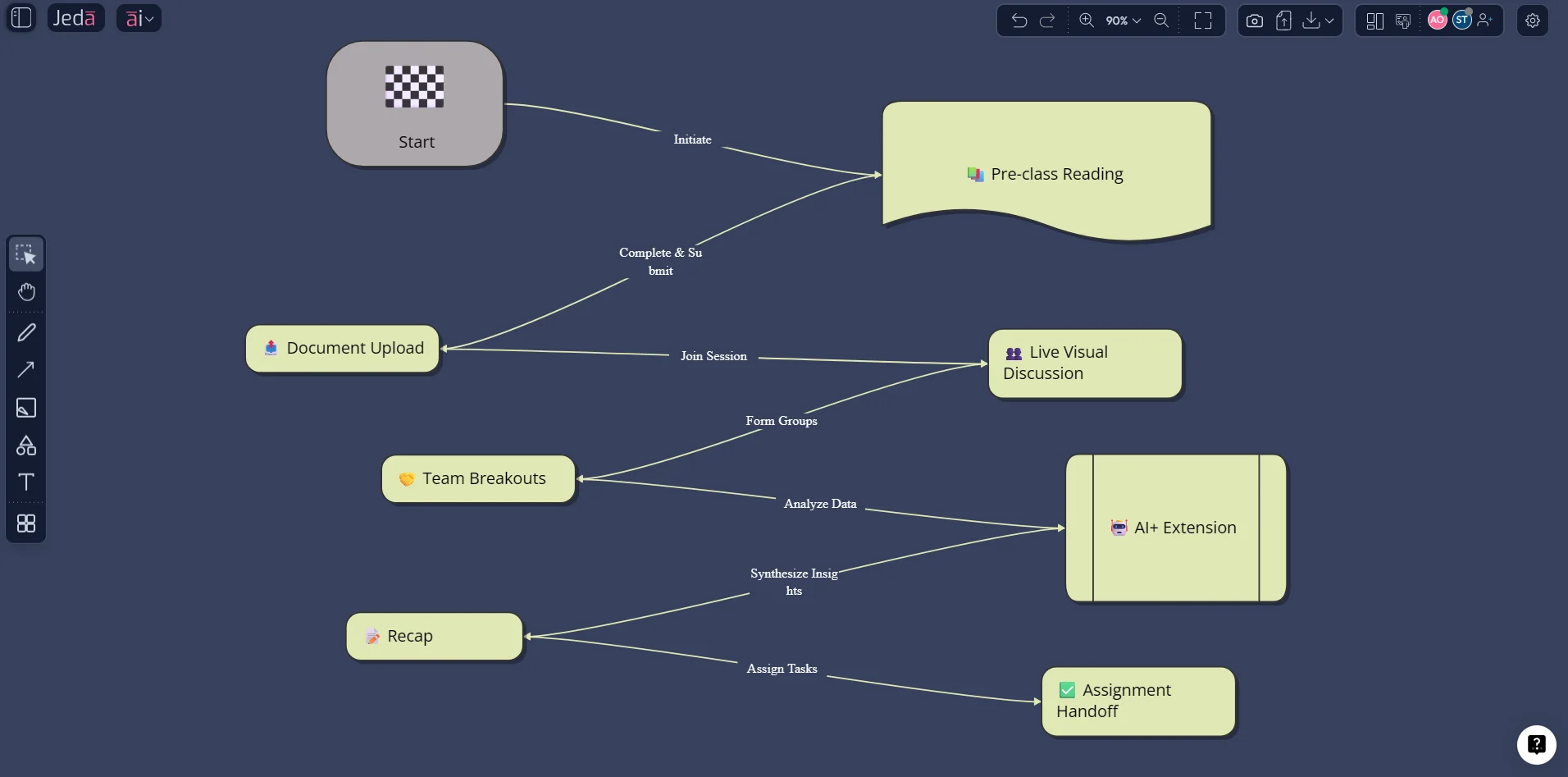
Upload the case PDF, market brief, article, or company deck into Document Insight. Generate a matrix or mind map that surfaces the central issues. Build a second board for breakout groups. Prepare one infographic or summary frame for the session close.
During class
Share the live AI Whiteboard. Use one framework board for plenary discussion. Let teams work on parallel sections. Remote students stay inside the same visual space, not in a side channel where they become polite ghosts.
After class
Turn the final board into a study asset. Export as PNG, SVG, or PDF. Reuse it for revision, asynchronous reflection, cohort discussion, project submissions, or executive-style briefings.
What MBA lecturers, program directors, and students actually gain
The obvious gain is time. But that is not the full story.
The deeper gain is instructional coherence.
Research on blended and hybrid higher education keeps returning to the same ingredients: strong technology integration, active engagement, thoughtful pedagogy, support for teachers, and assessment design that matches the format. Graduate business research also shows positive links between blended learning practices and student engagement when the model is designed well. So the challenge is not adding more digital tools. It is choosing a tool that helps the pedagogy stay visible.
Jeda.ai helps hybrid MBA programs do that by making the learning process legible.
- Better case teaching
Convert readings and reports into matrices, mind maps, and visual arguments that students can question in real time.
- Fairer hybrid participation
Remote and in-room learners work from the same living board, which reduces the usual two-classroom problem.
- Faster prep and reuse
Turn one class session into a reusable teaching asset for future cohorts, workshops, assessments, and marketing content.
And yes, there is a strategic upside for schools too. If every serious MBA program is promising flexibility, then flexibility alone stops being a differentiator. The real edge becomes this: can your program deliver sharper learning experiences, clearer collaboration, and more visible thinking than the school down the road?
That is where a strong AI Workspace becomes part of your product, not just your operations.
Common mistakes hybrid MBA programs should stop making
1. Treating hybrid as a delivery format, not a learning design problem
If the class still runs like a lecture with occasional chat comments, the issue is not the students. The issue is the format design.
2. Letting the LMS do all the heavy lifting
The LMS is useful for administration. It is usually terrible at live visual reasoning.
3. Running collaboration in too many places
Zoom for talking. Slides for presenting. Docs for notes. Whiteboard for brainstorming. Email for follow-up. That stack leaks attention like a busted pipe.
4. Ignoring post-class asset value
If the board disappears after class, the institution loses reusable intellectual capital.
5. Making AI outputs static
MBA classrooms need editable outputs. Students should challenge, rearrange, annotate, and extend what the AI generates. Otherwise it is just fancy wallpaper.
Frequently asked questions
- What is hybrid learning in an MBA context?
- Hybrid learning in MBA programs combines online and in-person teaching across live sessions, self-paced work, discussion, case analysis, and collaboration. The goal is to preserve academic rigor and cohort interaction while giving working professionals more flexibility.
- Why is hybrid learning growing in business education?
- Business schools are adapting to learner expectations for flexibility, professional continuity, and stronger digital delivery. At the same time, leading institutions are redesigning programs to be more participatory and collaborative rather than content-heavy and passive.
- How does Jeda.ai support hybrid MBA teaching?
- Jeda.ai gives faculty and students one shared AI Workspace for case analysis, frameworks, diagrams, data interpretation, document analysis, and collaborative whiteboarding. That reduces tool switching and keeps the class focused on visible thinking.
- Can Jeda.ai help with case-based teaching?
- Yes. Lecturers can upload reports, PDFs, market briefs, or case documents, analyze them with Document Insight, and convert them into matrices, mind maps, flowcharts, diagrams, or infographics for discussion and follow-up work.
- What is the best way to start a hybrid MBA lesson in Jeda.ai?
- The fastest route is often Matrix Recipes from the AI Menu because they provide structure immediately. For more open-ended seminars, the Prompt Bar works well when you want custom mind maps, flowcharts, or visual summaries generated live.
- What does the AI+ button do in classroom workflows?
- AI+ extends an existing visual by expanding a selected node, card, or section. In class, that is useful for deepening one argument, adding evidence, surfacing risks, or exploring alternatives without rebuilding the entire board.
- Is Jeda.ai only useful for strategy modules?
- No. It fits strategy, leadership, marketing, operations, entrepreneurship, innovation, product, and consulting-style courses. Any module that benefits from visible structure, trade-offs, or collaborative reasoning can use it.
- Can remote and in-person students work on the same board?
- Yes. Jeda.ai supports real-time collaboration on the same workspace, which helps reduce the split-attention problem common in hybrid classrooms where remote students often become observers instead of contributors.
- What can schools export from Jeda.ai after class?
- Jeda.ai supports PNG, SVG, and PDF exports. Schools can keep boards as teaching assets, revision materials, presentation visuals, and reusable templates for future cohorts.
- Why use an AI Whiteboard instead of slides alone?
- Slides present information well, but they are weak at live co-creation. An AI Whiteboard supports generation, debate, editing, restructuring, and extension on one surface, which better matches MBA-style discussion and problem solving.
Sources & Further Reading
- [1]
AACSB International (2025) . “Enrollment Trends at AACSB Business Schools: 2025” AACSB Insights.
View Source ↗ - [2]
AACSB International (2025) . “How Online Business Education Has Evolved” AACSB Insights.
View Source ↗ - [3]
Gudonienė, D. et al. (2025) . “Hybrid Teaching and Learning in Higher Education: A Systematic Literature Review” Sustainability.
View Source ↗ - [4]
Ortega-Arranz, A. et al. (2024) . “Collaborative activities in hybrid learning environments: Exploring teacher orchestration load and students’ perceptions” Computers & Education.
View Source ↗ - [5]
Casado García-Hirschfeld, E. et al. (2025) . “Teaching economics in blended learning higher education: Use of whiteboard videos to engage the students” The International Journal of Management Education.
View Source ↗ - [6]
Magnaye, R. P. (2025) . “Sustainable blended learning practices and graduate students’ engagement in higher education institution” International Journal of Research Studies in Education.
View Source ↗ - [7]
Leeds School of Business (2026) . “Hybrid MBA Program” University of Colorado Boulder.
View Source ↗ - [8]
ESSEC Business School (2026) . “Hybrid Executive MBA” ESSEC.
View Source ↗ - [9]
Harvard Business School Executive Education (2026) . “Executive Education” Harvard Business School.
View Source ↗
Start building hybrid MBA experiences that actually feel modern
Join 150,000+ users on Jeda.ai and turn case teaching, collaboration, and visual reasoning into one repeatable hybrid learning system.
Try Jeda.ai Free