Top Product management frameworks give teams a reusable way to move from loose ideas to shipped products. The problem is not a lack of frameworks. It is fragmentation. Discovery sits in one doc, prioritization in another tool, launch planning in a slide deck, and the roadmap somewhere else entirely. Jeda.ai fixes that by turning the process into one AI Workspace and AI Whiteboard where your product thinking stays visual, editable, and connected.
That is the real pitch here. Not “AI for AI’s sake.” Jeda.ai lets you create, compare, extend, and reshape frameworks inside a single Visual AI workflow. With 150,000+ users and 300+ strategic frameworks, Jeda.ai gives product teams a faster way to turn customer insight into product direction and product direction into execution. This guide shows which frameworks matter most, when to use them, and how to build them with AI.
What are product management frameworks?
Product management frameworks are structured ways to make product decisions. Product School describes them as practical structures that help teams stay focused. Mailchimp frames them as guidance that takes a product from idea to launch. Atlassian and Aha! push the same core idea: frameworks reduce bias, make trade-offs visible, and give teams a repeatable decision process.
A framework is not the answer. It is the container for better answers.
That is why product teams rarely rely on just one. Job To Be Done Framework helps uncover the customer struggle. Product Market Fit checks whether the market actually wants the thing. Opportunity Solution Tree Framework organizes discovery. Weighted Impact Scoring or ICE Prioritization (Reach, Impact, Confidence, Effort) helps rank bets. Product Roadmap, Sprint Planning, and Release Management turn those bets into delivery.
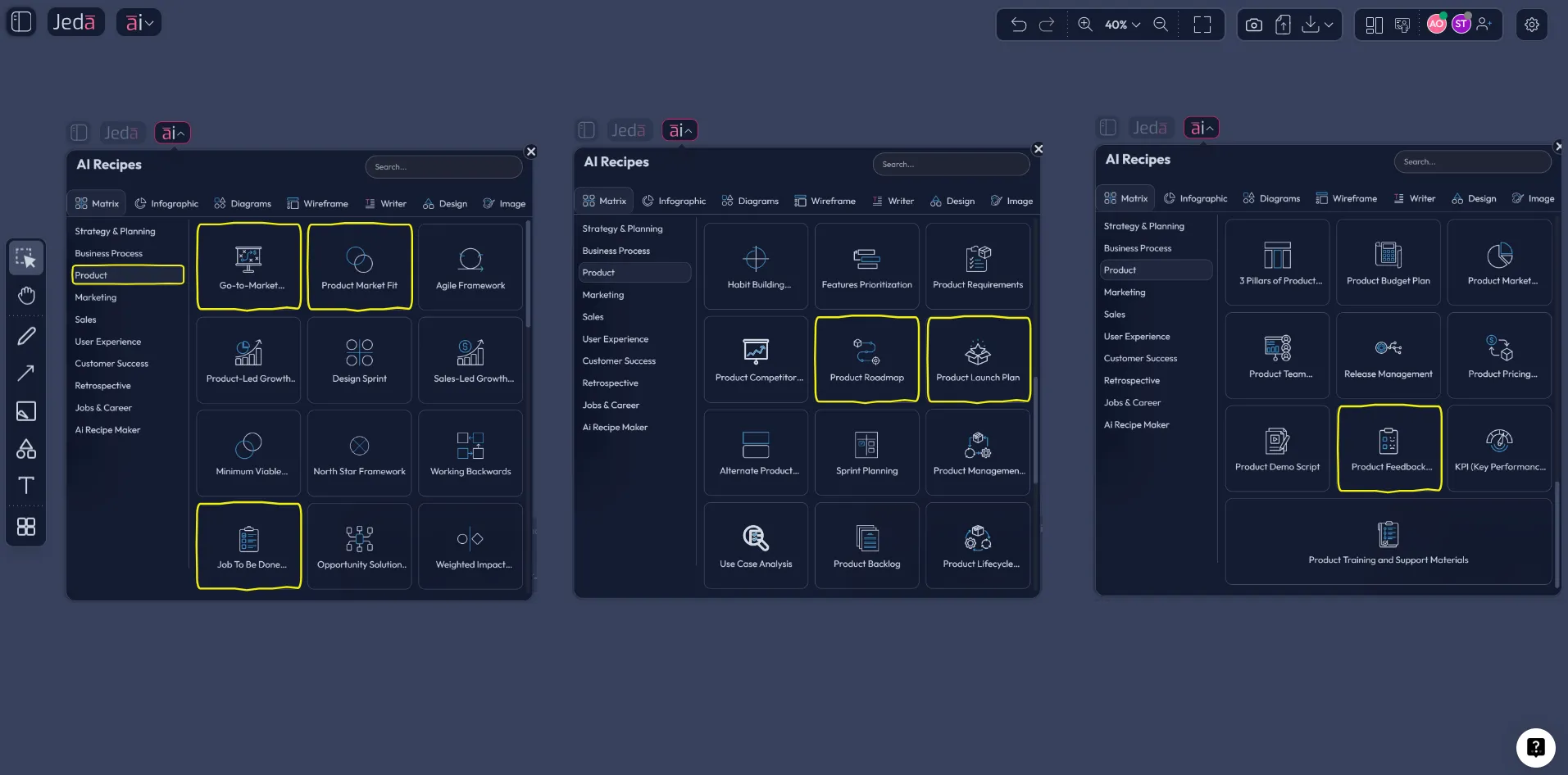
Top product management frameworks, grouped by the job they do
You do not need all of these on one initiative. You need the right one at the right moment.
Discovery and customer understanding
- Product Market Fit — test whether the market pulls the product forward.
- Job To Be Done Framework — understand the customer goal behind the request.
- Opportunity Solution Tree Framework — connect outcomes, opportunities, ideas, and tests.
- Design Sprint — answer a critical question quickly with a prototype and user feedback.
- Double Diamond Product Planning — move from discover to define to develop to deliver.
- Use Case Analysis — translate user situations into flows, needs, and edge cases.
- Product Feedback Form — capture cleaner feedback from users, sales, and support.
- Alternate Product Service Idea — explore adjacent concepts before overcommitting.
- CIRCLES Method — structure product thinking around users, needs, and trade-offs.
Strategy, market, and growth
- Go-to-Market Strategy — align audience, positioning, channels, and rollout.
- Product-Led Growth Strategy — let the product drive acquisition and expansion.
- Sales-Led Growth Strategy — shape the motion around demos, deals, and buying committees.
- Working Backwards — start with the customer experience and define backwards.
- North Star Framework — align the team around one value-linked metric.
- First Mover Advantage — decide whether speed to market is strategically worth it.
- 5 Cs of Pricing — balance customer, company objectives, cost, competition, and channels.
- Product Pricing Strategy — compare pricing models, tiers, and monetization logic.
- Product Market Segmentation — avoid treating all users as one vague audience.
- Product Competitor Analysis — map alternatives, gaps, and competitive pressure.
- 3 Pillars of Product Management — keep business, user, and technology in balance.
- Habit Building Framework — focus on repeated user behavior and retention loops.
Prioritization and decision making
- Weighted Impact Scoring — rank initiatives with weighted criteria.
- ICE Prioritization (Reach, Impact, Confidence, Effort) — triage quickly with a scoring model.
- Features Prioritization — rank candidate features against business and user value.
- Minimum Viable Product (MVP) Strategy — cut scope to what helps you learn fastest.
- Product Requirements — define what must be built and why.
- Product Budget Plan — force cost reality into planning.
- KPI (Key Performance Indicators) Dashboard — tie prioritization to outcomes, not opinions.
- Product Management Framework — use a broader operating model when teams need one system.
Planning, delivery, and launch
- Agile Framework — run iterative delivery with room to adapt.
- GIST Planning (goal, ideas, steps projects, tasks) — tie strategy to execution cleanly.
- Sprint Planning — convert goals into committed near-term work.
- Product Backlog — maintain an ordered queue instead of a mess of requests.
- Product Roadmap — communicate direction, sequence, and trade-offs.
- Release Management — coordinate shipping across functions.
- Product Launch Plan — align messaging, dependencies, rollout, and monitoring.
- Product Lifecycle Management — manage growth, maturity, and decline intentionally.
- Product Demo Script — keep launch and sales demos consistent.
- Product Training and Support Materials — prepare internal teams and customers after launch.
Team and operating rhythm
- Product Team Competencies — define skill expectations and hiring gaps.
- Product Requirements — keep engineering, design, and product aligned.
- Product Feedback Form — make incoming signal usable.
- KPI Dashboard — keep reviews grounded in evidence.
- Product Budget Plan — match ambition to team capacity.
Why use product management frameworks with AI?
Because frameworks help you think, but AI helps you move.
Inside Jeda.ai, a framework is not a dead template. It sits inside an AI Workspace, stays editable on an AI Whiteboard, and can be expanded with AI+ or reshaped with Vision Transform. That matters when one product problem needs more than one view. You might start with Product Market Fit, switch to Job To Be Done Framework, branch into Opportunity Solution Tree Framework, score options with Weighted Impact Scoring, and then turn the result into a Product Roadmap and Product Launch Plan.
That chain is where the time savings show up. You stop redrawing the same thinking in five different tools.
- Pick the right framework faster
Use guided Product recipes instead of starting from a blank board.
- Keep work connected
Move from discovery to roadmap and launch in one workspace.
- Extend with AI+
Select a card or branch and deepen what is already there.
- Compare paths visually
Map alternatives and trade-offs side by side.
- Switch formats fast
Turn one visual into another without rebuilding the logic.
- Collaborate live
Keep product, design, engineering, and GTM on one board.
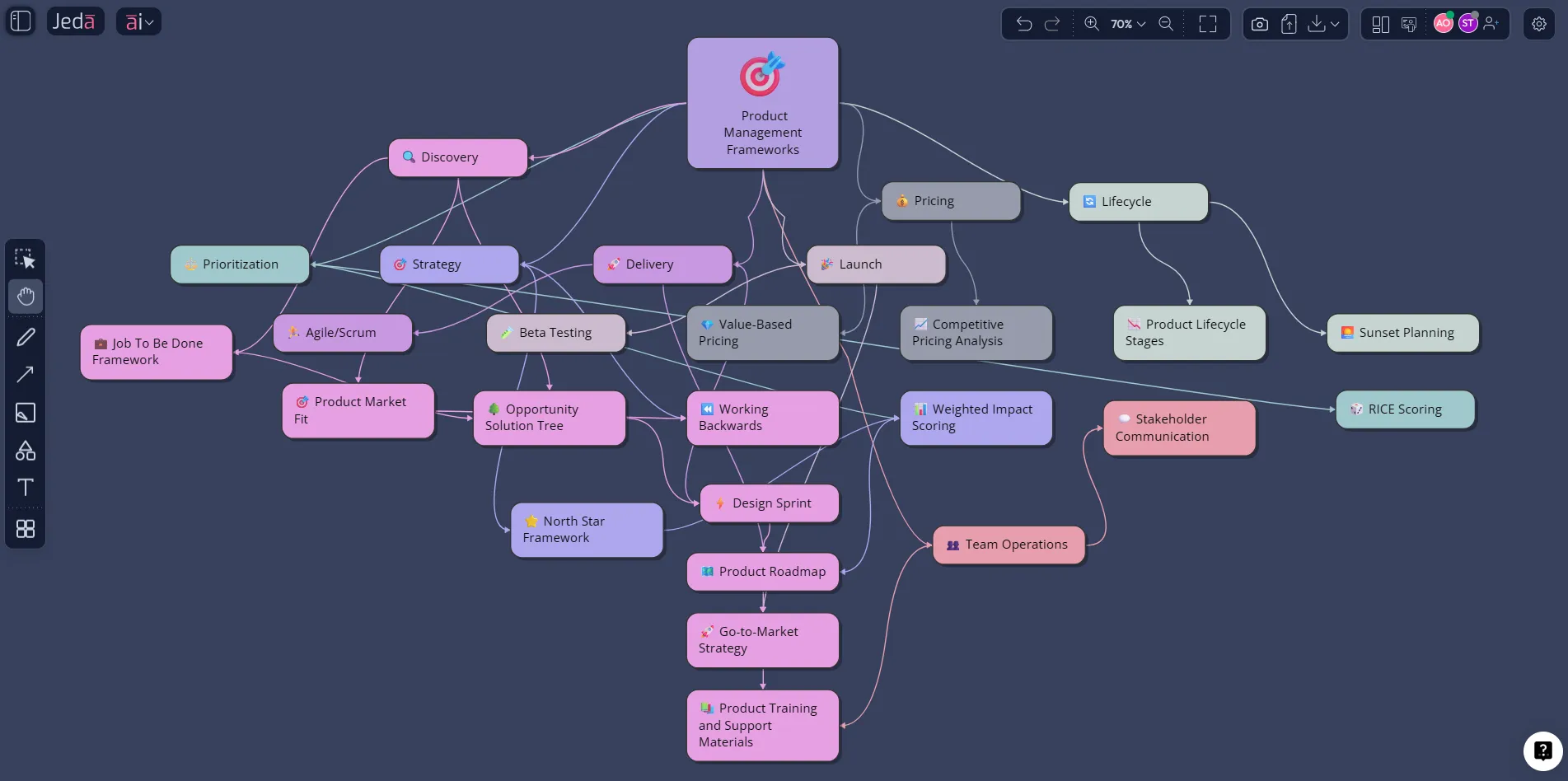
How to create product management frameworks in Jeda.ai
Method 1: Recipe Matrix inside AI Menu
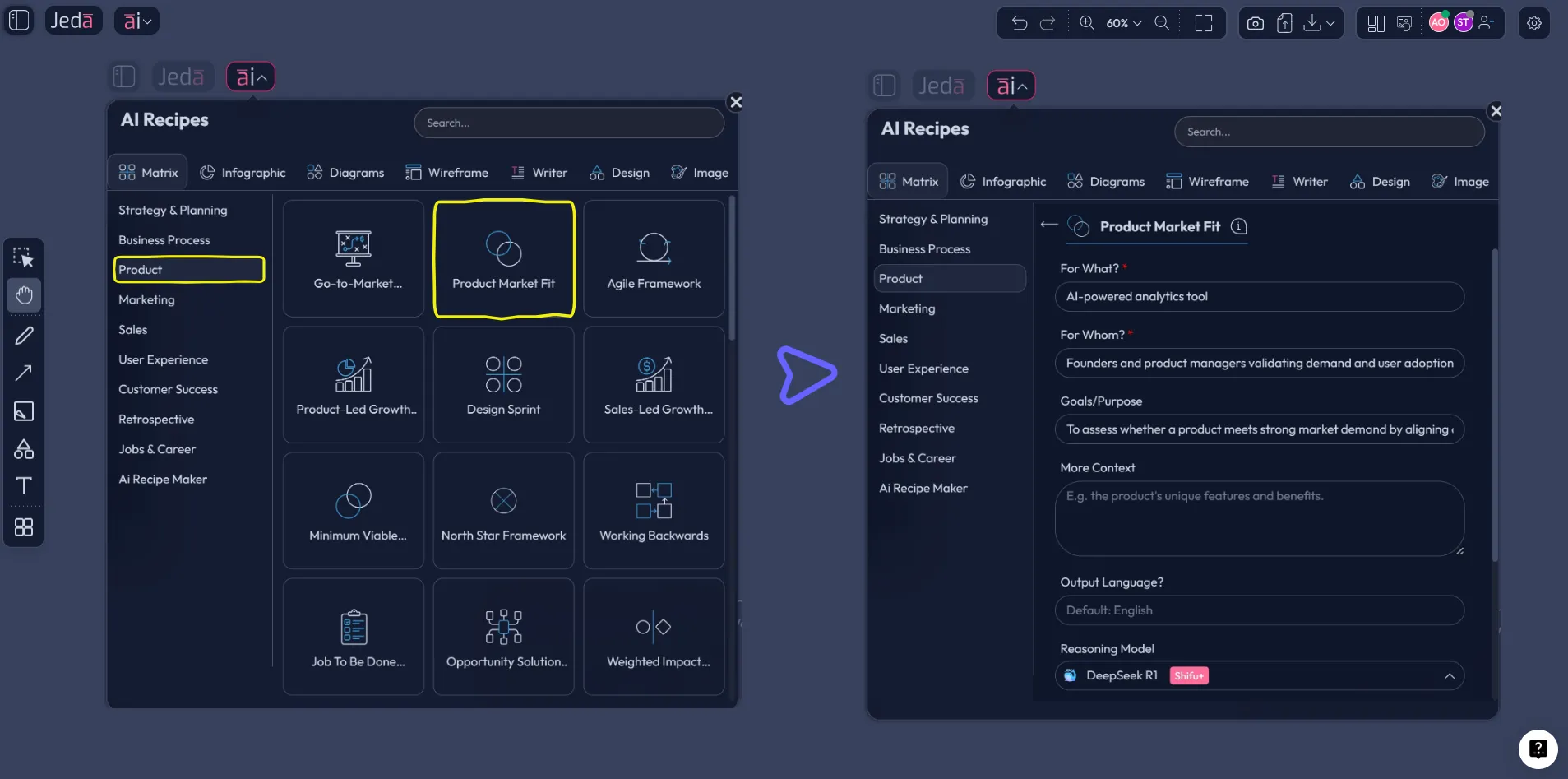
Open the AI Menu in the top-left corner, go to Matrix Recipes, switch to the Product subcategory, and choose a template such as Go-to-Market Strategy, Product Market Fit, North Star Framework, or Product Roadmap.
Across many of these Product recipes, the recurring fields are simple:
- For What? — treat this as the required anchor field wherever it appears.
- For Whom? — define the user, segment, buyer, or stakeholder.
- Goals/Purpose — state the outcome the framework should support.
- More Context — add constraints, product stage, market details, or assumptions.
Method 2: Prompt Bar for custom combinations
Use the Prompt Bar when you want to combine frameworks or create a second view.
- Select Matrix to compare Product-Led Growth Strategy, Sales-Led Growth Strategy, and Go-to-Market Strategy.
- Select Mindmap to expand Job To Be Done Framework into solution spaces.
- Select Flowchart to connect Sprint Planning, Product Backlog, Release Management, and Product Launch Plan.
Method 3: AI+ for deeper detail
After the first board is generated, select a node, card, or section and tap AI+. That is the best way to add a deeper layer without rebuilding the whole framework. AI+ works best when the structure is already good.
- Open AI Menu and choose Matrix Recipes
In Jeda.ai, click the AI Menu in the top-left corner, open Matrix Recipes, and switch to the Product category.
- Pick the product framework
Choose a template such as Go-to-Market Strategy, Product Market Fit, Job To Be Done Framework, North Star Framework, or Product Roadmap.
- Fill the recurring fields
Enter For What? first, then strengthen the output with For Whom?, Goals/Purpose, and More Context.
- Generate the first board
Create the framework and review the structure before editing.
- Use the Prompt Bar for a second view
Create a companion Matrix, Mindmap, or Flowchart from the same product problem.
- Extend with AI+
Select a branch or card and use AI+ to add detail without rebuilding the whole board.
- Transform or export
Use Vision Transform when you need another format, or export as PNG, SVG, or PDF when ready.
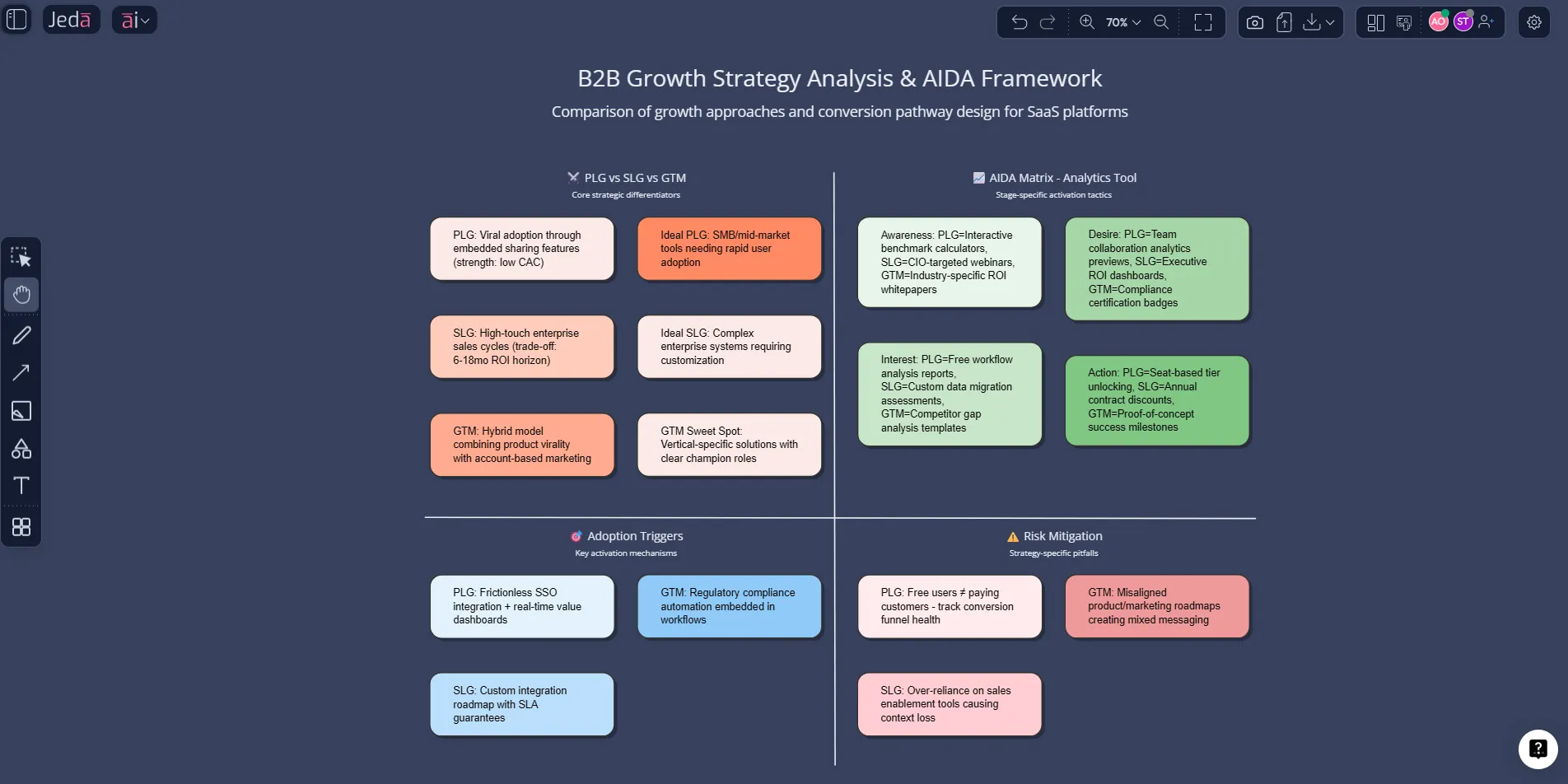
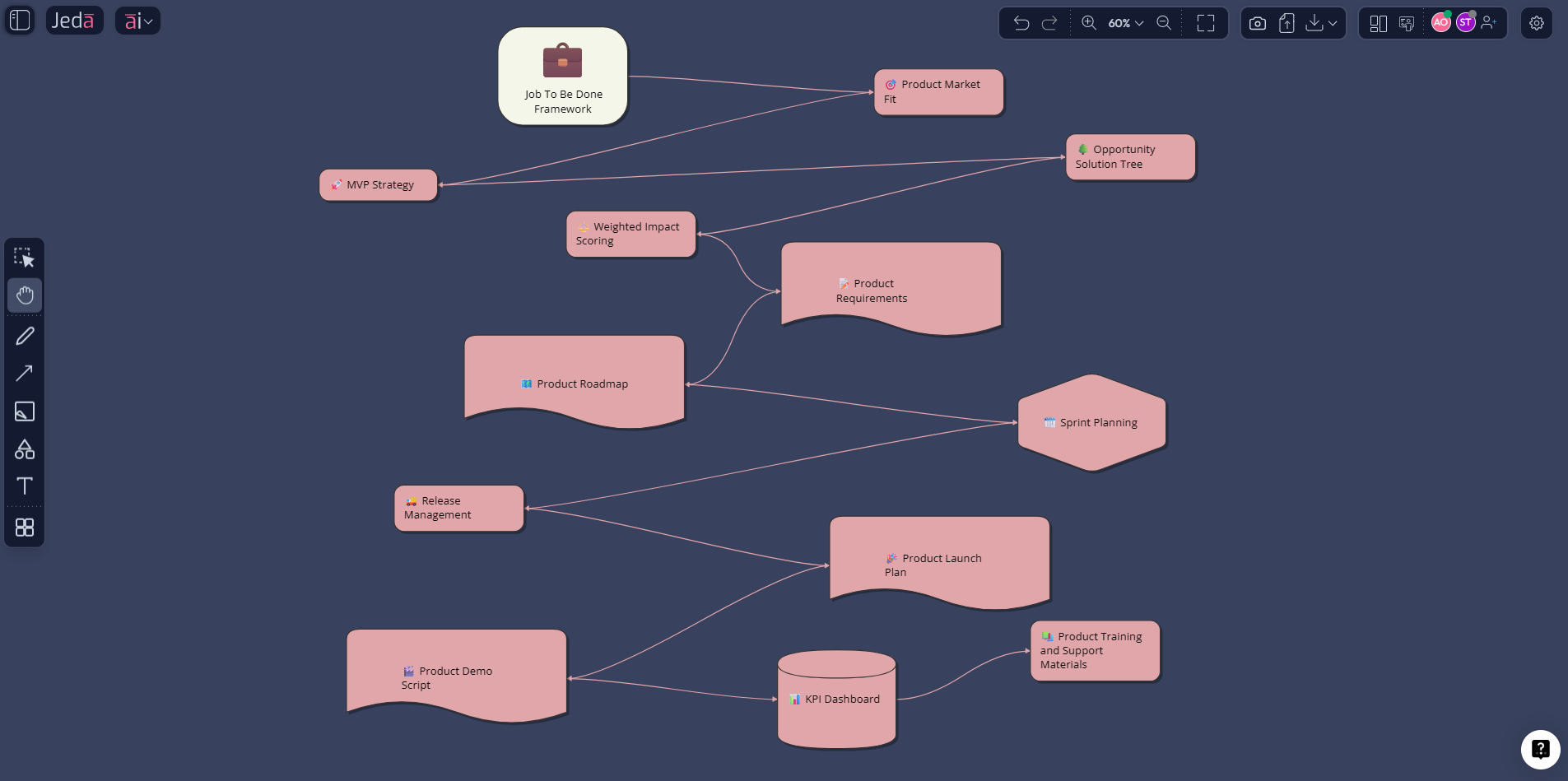
A practical workflow from idea to launch
That is why Jeda.ai works well as an AI Workspace for product teams. Discovery, prioritization, delivery, and launch stay connected instead of splintering into separate tools. And yes, that usually means fewer “wait, which version is final?” moments.
Best practices and common mistakes
The usual mistakes are familiar: starting with features instead of need, using one framework as a religion, treating a full whiteboard like proof of insight, and forgetting enablement materials after launch.
Frequently asked questions
- What are product management frameworks?
- They are structured methods for discovery, prioritization, planning, launch, and lifecycle work. Good frameworks replace vague discussion with clearer logic and more explicit trade-offs.
- Which framework should I start with?
- Start with the framework that matches the problem. Use Product Market Fit or JTBD for demand questions, Opportunity Solution Tree for discovery structure, and Product Roadmap or Sprint Planning when execution is already the issue.
- How many frameworks should one initiative use?
- Usually two to five. Most teams need one discovery framework, one prioritization framework, one planning framework, and sometimes one launch framework. Beyond that, process can start crowding out judgment.
- What is the difference between Product Market Fit and North Star Framework?
- Product Market Fit checks whether the market truly wants the product. North Star Framework defines the metric that best captures product value once the direction is clearer. One validates demand. The other aligns execution.
- Can AI help with product management frameworks?
- Yes. AI is especially useful for first drafts, visual organization, option comparison, and documentation speed. The strongest results still come from human review and strong product judgment.
- Can I use Jeda.ai without a recipe?
- Yes. Recipes are the fast lane, but the Prompt Bar lets you create custom product management frameworks with Matrix, Mindmap, or Flowchart views when you need a tailored approach.
- Are the outputs editable?
- Yes. Frameworks created through Jeda.ai’s smart-shape commands remain editable, so the team can revise text, structure, and logic directly on the board.
- Can I export product management frameworks from Jeda.ai?
- Yes. Jeda.ai supports export as PNG, SVG, and PDF, which makes sharing easier without forcing the team to recreate the visual somewhere else.
- Why use Jeda.ai instead of a blank whiteboard?
- A blank whiteboard gives freedom but not structure. Jeda.ai adds guided recipes, AI generation, AI+ extension, editable visuals, and one connected AI Whiteboard for the whole product workflow.
Sources & further reading
- [1]
Atlassian (2026) . “Six product prioritization frameworks and how to pick the right one” Atlassian.
View Source ↗ - [2]
Aha! (2026) . “Product Prioritization Frameworks: 12 Common Models” Aha!.
View Source ↗ - [3]
Clayton M. Christensen, Taddy Hall, Karen Dillon, and David S. Duncan (2016) . “Know Your Customers’ Jobs to Be Done” Harvard Business Review.
View Source ↗ - [4]
Design Council (2023) . “The Double Diamond” Design Council.
View Source ↗ - [5]
GV (2026) . “The Design Sprint” GV.
View Source ↗ - [6]
Working Backwards (2026) . “The Amazon Working Backwards PR/FAQ Process” Working Backwards.
View Source ↗ - [7]
Amplitude (2024) . “Every Product Needs a North Star Metric: Here’s How to Find Yours” Amplitude.
View Source ↗ - [8]
Marc Andreessen (2007) . “The only thing that matters” pmarchive.
View Source ↗ - [9]
Eric Ries (2026) . “The Lean Startup Methodology” The Lean Startup.
View Source ↗ - [10]
Teresa Torres (2023) . “Opportunity Solution Trees: Visualize Your Discovery to Stay Aligned and Drive Outcomes” Product Talk.
View Source ↗ - [11]
Lewis Lin / Product School (2024) . “A Guide to the CIRCLES Framework with Product Examples” Product School.
View Source ↗ - [12]
Nir Eyal (2011) . “The Hooked Model: How to Manufacture Desire in 4 Steps” Nir and Far.
View Source ↗ - [13]
Manifesto for Agile Software Development (2001) . “Manifesto for Agile Software Development” Agile Manifesto.
View Source ↗
Need the broader context first? Explore the AI Workspace page. Want the visual collaboration angle? Start with the AI Whiteboard page. For related reading, pair this guide with Business Model Strategy Templates with AI, Buyer Persona with AI, and Visual Document Analysis with AI.
Start building product management frameworks in Jeda.ai
Join over 150,000+ professionals who use Jeda.ai to turn discovery, prioritization, roadmapping, and launch planning into editable visual workflows.
Try Free Template