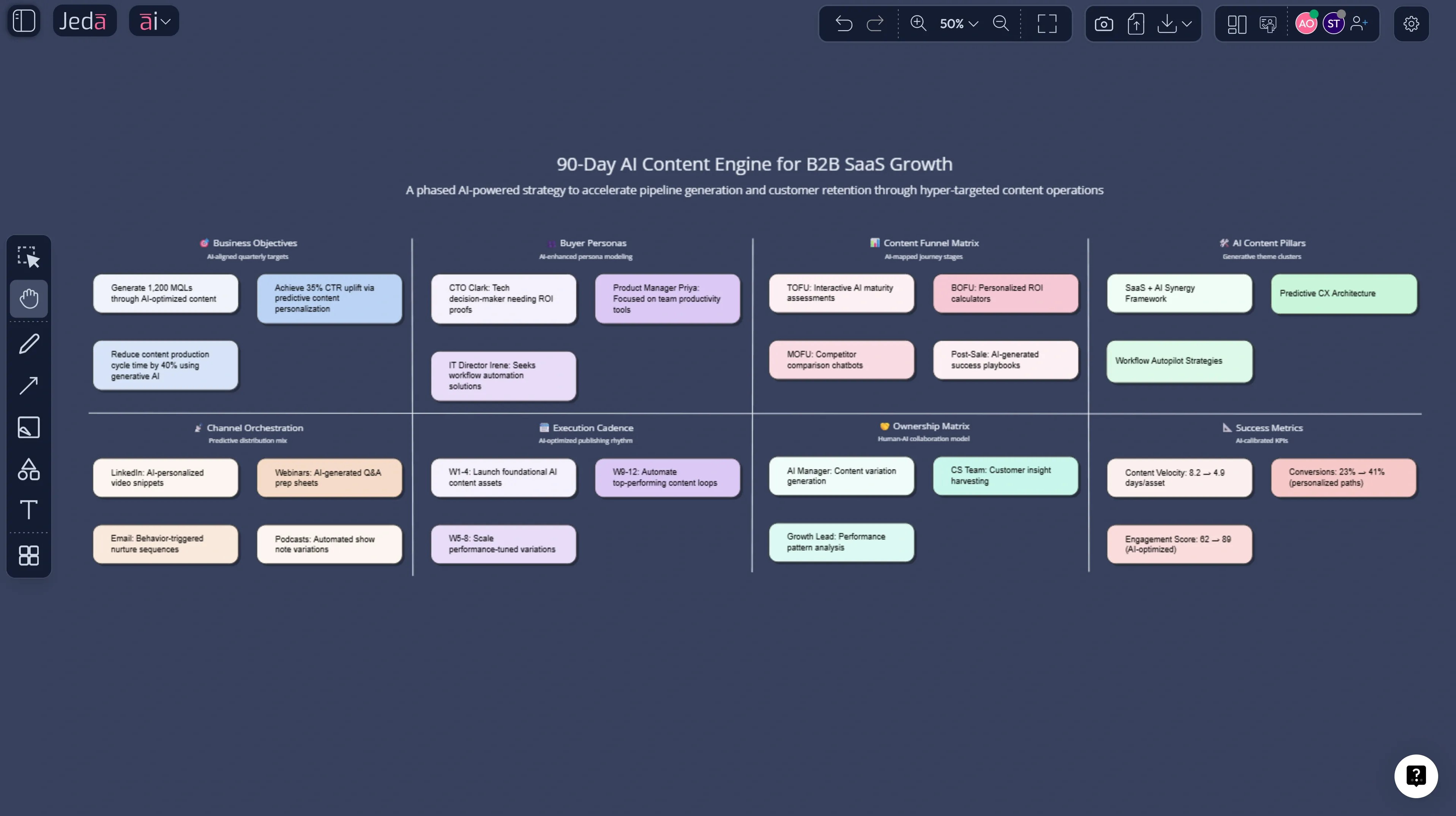
Most teams do not have a content shortage. They have a decision shortage. An AI content marketing strategy fixes that by turning random content requests into a visible system: who you want to reach, what problems you will solve, which formats you will publish, where you will distribute them, and how you will know the work actually moved the business. Inside a collaborative AI Workspace like Jeda.ai, that strategy becomes a live matrix instead of another forgotten slide or spreadsheet.
And that matters more now than it did two years ago. Content Marketing Institute’s 2025 B2B research found that top performers most often credit audience understanding, content quality, industry expertise, goal alignment, measurement, and documented strategy for their success. HubSpot’s 2025 AI data adds another uncomfortable truth: marketers are already using AI heavily for content creation and research, but only a small minority publish raw AI output without meaningful editing. In plain English, speed is easy. Quality control is the real moat.
If you want content marketing strategies with AI that do more than fill a calendar, build them as a matrix first. Then extend, pressure-test, and repurpose them inside Jeda.ai.
What Is an AI Content Marketing Strategy?
An AI content marketing strategy is a documented plan for creating, distributing, and improving content with AI assisting the work at the right points, not running the whole show. The strategic core stays the same: audience needs, business goals, editorial priorities, distribution logic, and measurement. AI simply makes the system faster, more searchable, and easier to update.
That definition lines up with both practitioner and research views. Content Marketing Institute defines content strategy as an outline of business and customer needs plus a detailed plan for how content will address them. Academic research goes further and shows that content marketing effectiveness rises when strategy is clear, content aligns with audience needs, performance is measured regularly, and enabling systems are in place. So no, a pile of prompts is not a strategy. It is just faster chaos.
For that reason, the best AI Whiteboard workflows do not start with “write me ten blogs.” They start with decisions:
- Which audience segment matters most right now?
- Which customer problem deserves repeated coverage?
- Which proof, offer, or insight will move buyers forward?
- Which channels deserve effort this quarter?
- Which metrics separate vanity from progress?
When you build those answers visually in Jeda.ai, the plan becomes editable, discussable, and reusable across the team.
Why Most Content Plans Break Before the Quarter Ends
Here is the blunt version: many content plans are really publishing plans wearing strategy makeup.
They list topics. They assign dates. They maybe toss in a channel column and a KPI nobody reviews after month one. Then real work starts, priorities shift, and the entire thing turns into a graveyard of half-shipped intent.
Research explains why. CMI reports that among teams with only moderate or worse results, 42% cite lack of clear goals, 39% say content is not tied to the customer journey, and 35% say it is not data-driven. Separate academic research shows the same pattern from another angle: strategic clarity, audience-fit, performance measurement, and enabling systems are associated with stronger results, while “more promotion” by itself is not a magic fix.
That is why the matrix matters.
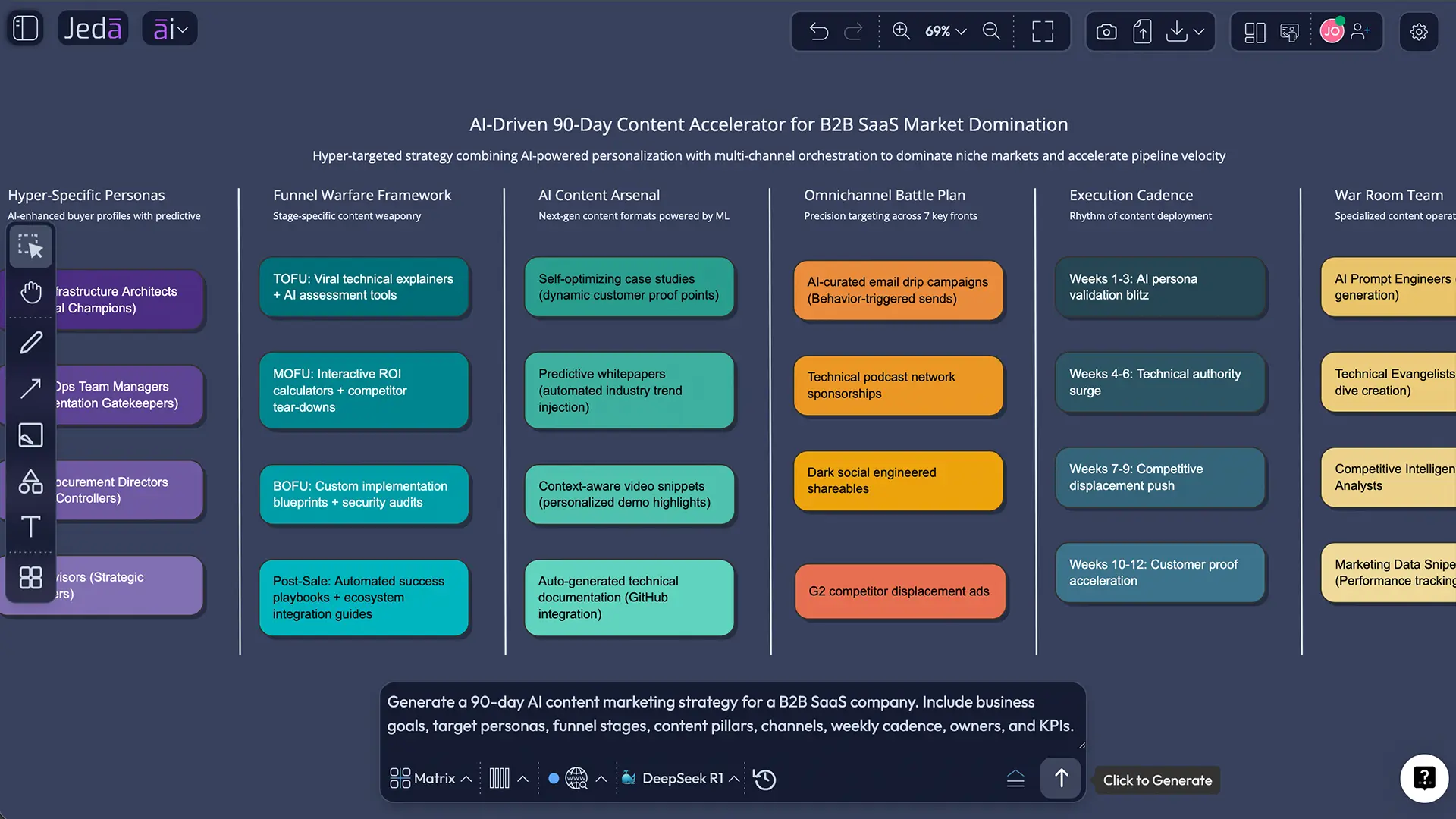
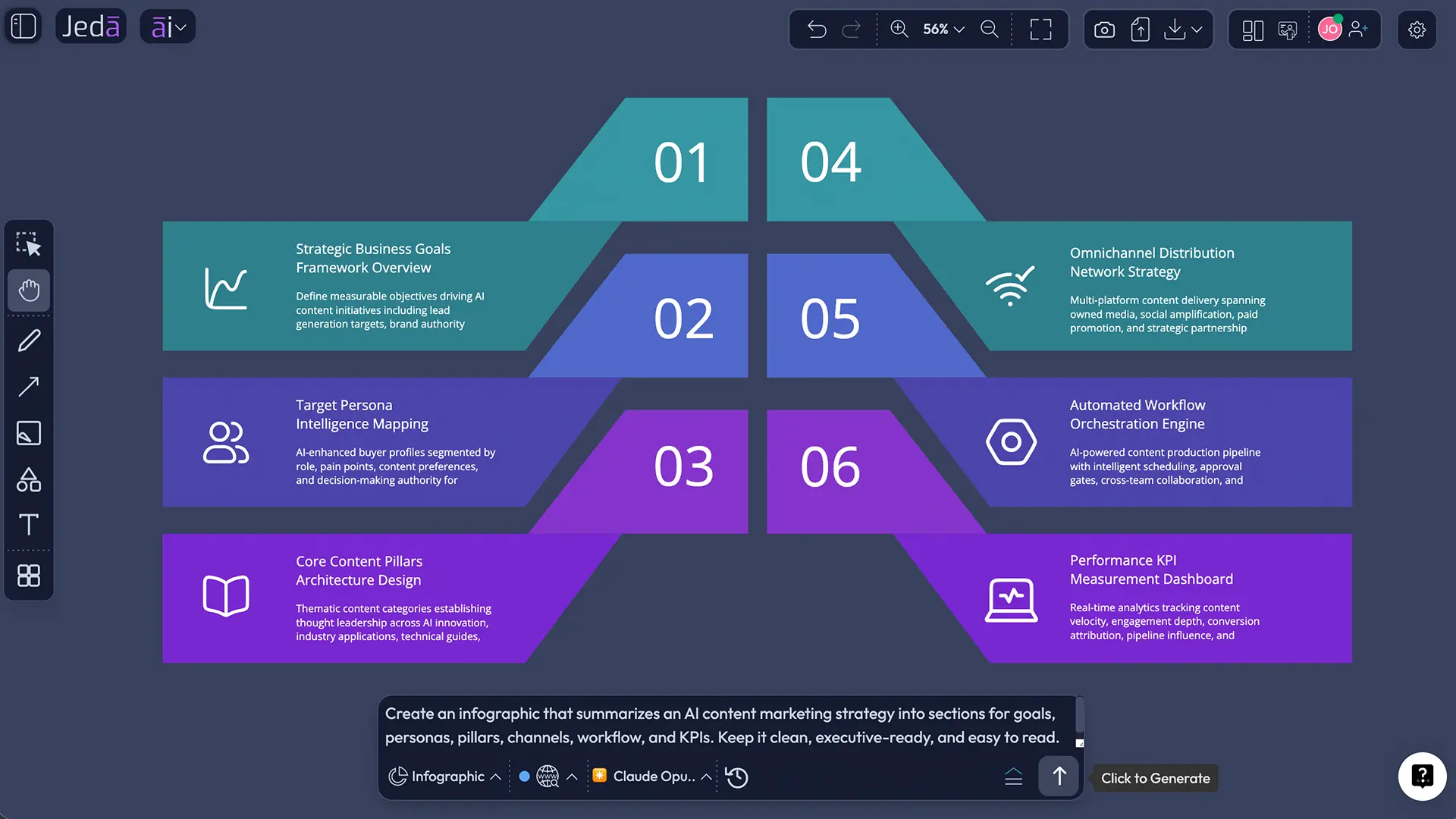
A good matrix forces eight decisions onto one board at the same time. It stops content teams from treating format, channel, and KPI as afterthoughts. It also gives leadership a cleaner way to review the plan. One glance. Fewer debates. Better trade-offs.
- Audience
Define the segment, pain point, and search or buying intent you want to win.
- Goal
Tie every content stream to a business outcome such as pipeline, signups, retention, or authority.
- Core Message
Clarify the claim, promise, or narrative your market should remember after reading.
- Content Pillars
Group content into repeatable themes so the team builds depth instead of random topical clutter.
- Formats
Map the right asset to the job: article, webinar, infographic, email, or case study.
- Channels
Choose where content earns attention, not just where the team already feels comfortable posting.
- Cadence & Owners
Assign publishing rhythm, review checkpoints, and who owns creation, approval, and repurposing.
- KPIs & Learning Loop
Track signal-rich metrics and decide how the next round improves based on evidence.
The Content Marketing Strategy Matrix You Actually Need
A useful content marketing matrix is not complicated. It is complete.
We recommend an eight-block structure:
- Audience — ICP, funnel stage, pain point, and trigger event.
- Goal — awareness, demand generation, sales enablement, customer education, or retention.
- Pillars — the three to five topics you want to be known for.
- Formats — what the audience will actually consume at each stage.
- Channels — where distribution happens and what “good reach” means there.
- Offer or CTA — what action should follow the content.
- Cadence and owners — who ships, who reviews, who repurposes.
- KPIs — what success looks like this month, this quarter, and after a full content cycle.
That structure also fits what recent studies say works. Timely content matched to the correct journey stage increases engagement in B2B settings. Top-performing B2B marketers still win on audience understanding and content quality before anything else. And AI usage seems to amplify output most effectively when humans still edit, review, and steer the system.
So the goal is not to make AI louder. The goal is to make strategy more explicit.
Why Use AI for Content Marketing Strategies?
Because the strategy work is not only creative. A big chunk of it is analytic, repetitive, and cross-functional. AI is good at those jobs.
Semrush recommends using AI to accelerate keyword research, audience refinement, content briefing, keyword clustering, and optimization. Ahrefs shows a similar pattern in practice: AI helps teams generate ideas faster and pressure-test weak angles before they waste production time. HubSpot’s 2025 data shows research is one of the most common AI use cases in content marketing, just behind content creation itself.
But here is the part too many teams miss: AI should tighten the loop between insight and execution. Not replace editorial judgment.
That is where Jeda.ai stands out. Instead of keeping your strategy trapped in a doc and your ideation trapped in chat, Jeda.ai turns the work into a live Visual AI system inside an AI Workspace and AI Whiteboard. You can build the matrix, discuss it in context, extend sections with AI+, and transform the matrix into another visual when the team needs a different view. And because Jeda.ai is built around 300+ strategic frameworks, the matrix can live beside the rest of your planning workflow instead of becoming another isolated marketing artifact.
- Faster research
Use AI to surface search patterns, audience questions, and competitive gaps before the brief is written.
- Smarter prioritization
Cluster ideas into pillars, funnel stages, and campaign themes instead of collecting disconnected topic lists.
- Cleaner repurposing
Turn one strategic theme into blog, social, webinar, email, and infographic variants without losing the message.
- Better measurement
Map metrics to business outcomes so you are not mistaking impressions for progress.
- Shared visibility
Give marketing, sales, and leadership one editable source of truth rather than five mismatched documents.
- Continuous improvement
Use AI+ to deepen weak blocks, add ideas, and stress-test channel or KPI choices on the same board.
How to Build an AI Content Marketing Strategy in Jeda.ai
If you are building content marketing strategies with AI in Jeda.ai, use the Matrix format. This topic is not just a list. It is a decision framework.
Method 1: Recipe Matrix
This is the better starting point when you want structure fast.
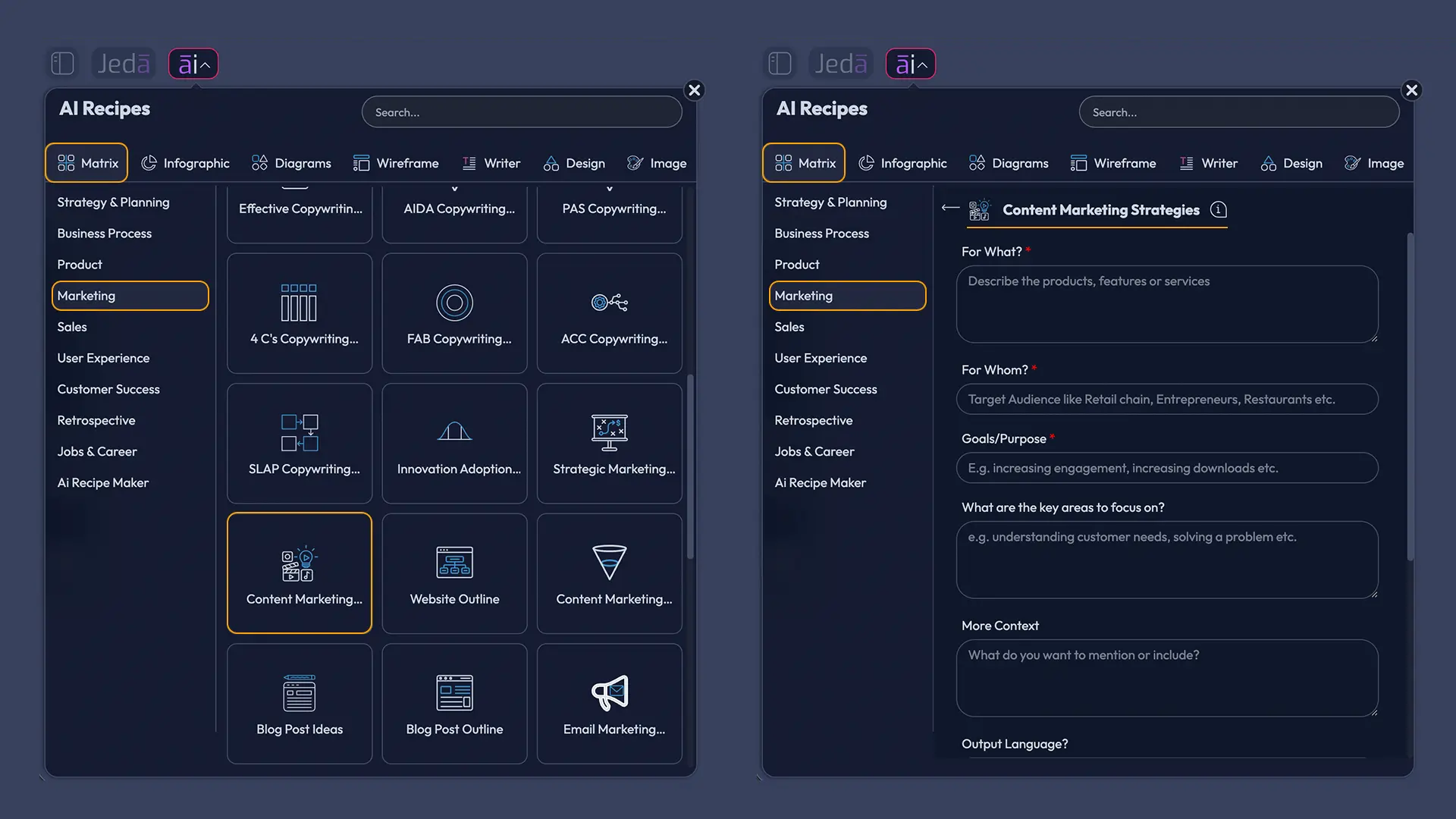
- Open the AI Menu
Enter your Jeda.ai AI Workspace, open the AI Menu from the top-left, and go to the Marketing recipe area.
- Choose Content Marketing Strategies
Select the Content Marketing Strategies recipe and set the layout to a matrix-style output so your plan becomes a visible decision board.
- Add business context
Enter the company type, offer, target audience, market, brand voice, and the business goal the strategy should support.
- Define the matrix fields
Make sure the recipe covers audience, goal, content pillars, formats, channels, cadence, CTA, and KPI blocks.
- Generate with your preferred model setup
Run one model for speed or multiple models for broader thinking if your plan allows it.
- Review the board like a strategist
Check whether each block aligns with the same audience and buying stage. Fix contradictions before you admire the design.
- Edit and collaborate on-canvas
Adjust wording, expand sticky notes, and assign owners so the matrix becomes operational instead of decorative.
- Extend with AI+
Select the finished matrix and use the AI+ button to deepen weak areas, add examples, expand pillar ideas, or suggest repurposing paths.
Method 2: Prompt Bar
Use this when you want more control over the first pass.
- Open the Prompt Bar
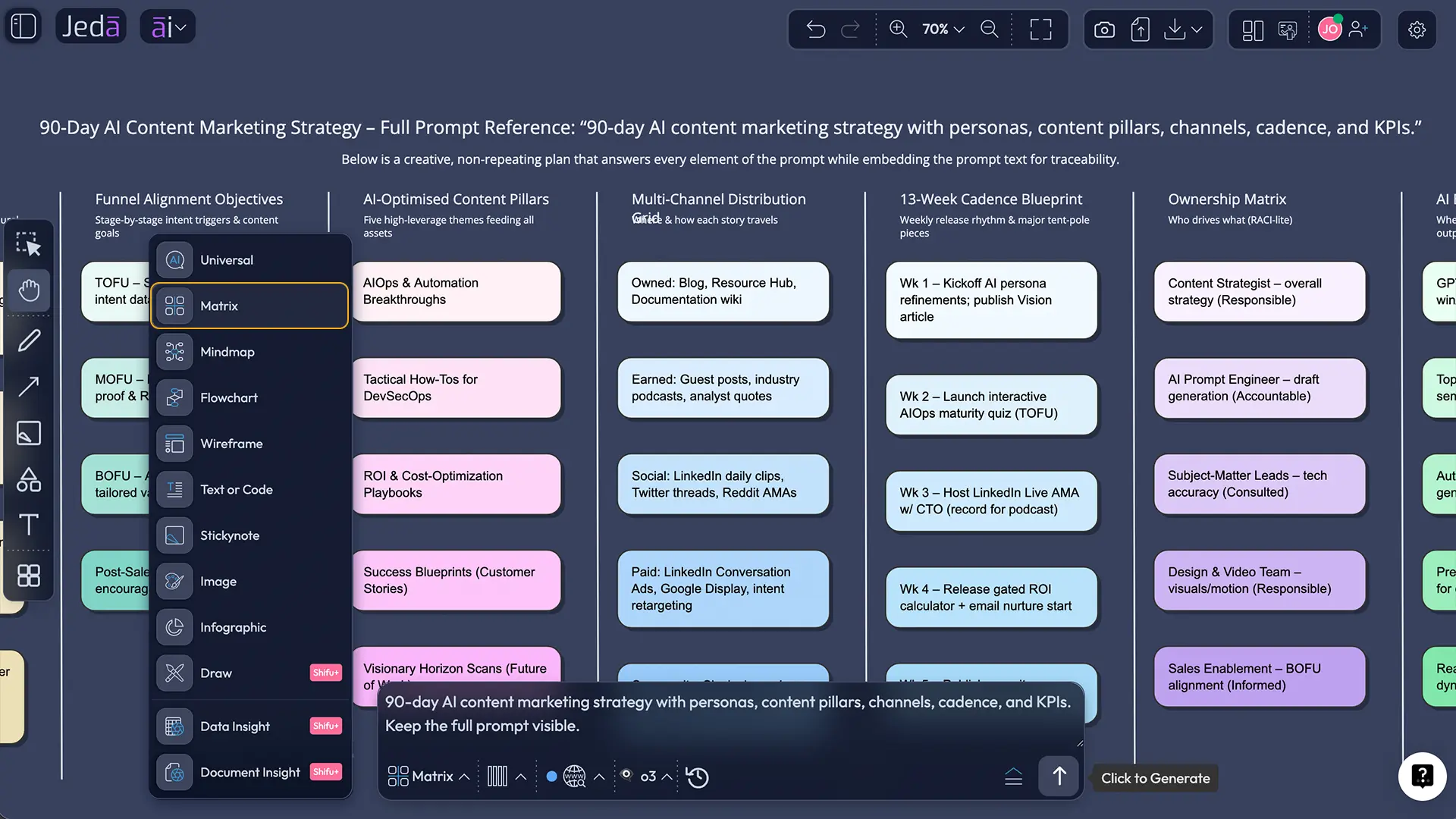
At the bottom of the canvas, open the Prompt Bar and select the Matrix command.
- Write a high-context prompt
Include audience, goals, funnel stages, content pillars, formats, distribution channels, publishing cadence, CTA, and KPIs in one clear request.
- Ask for a strategic matrix, not generic ideas
Tell Jeda.ai to organize the answer into a content marketing strategy matrix so every decision sits in a defined block.
- Generate and inspect the logic
Review whether the suggested channels, formats, and KPIs actually fit the audience and business objective.
- Refine on the board
Rewrite weak blocks, merge duplicates, and add real-world constraints such as budget, approval bandwidth, or sales alignment.
- Use Vision Transform when needed
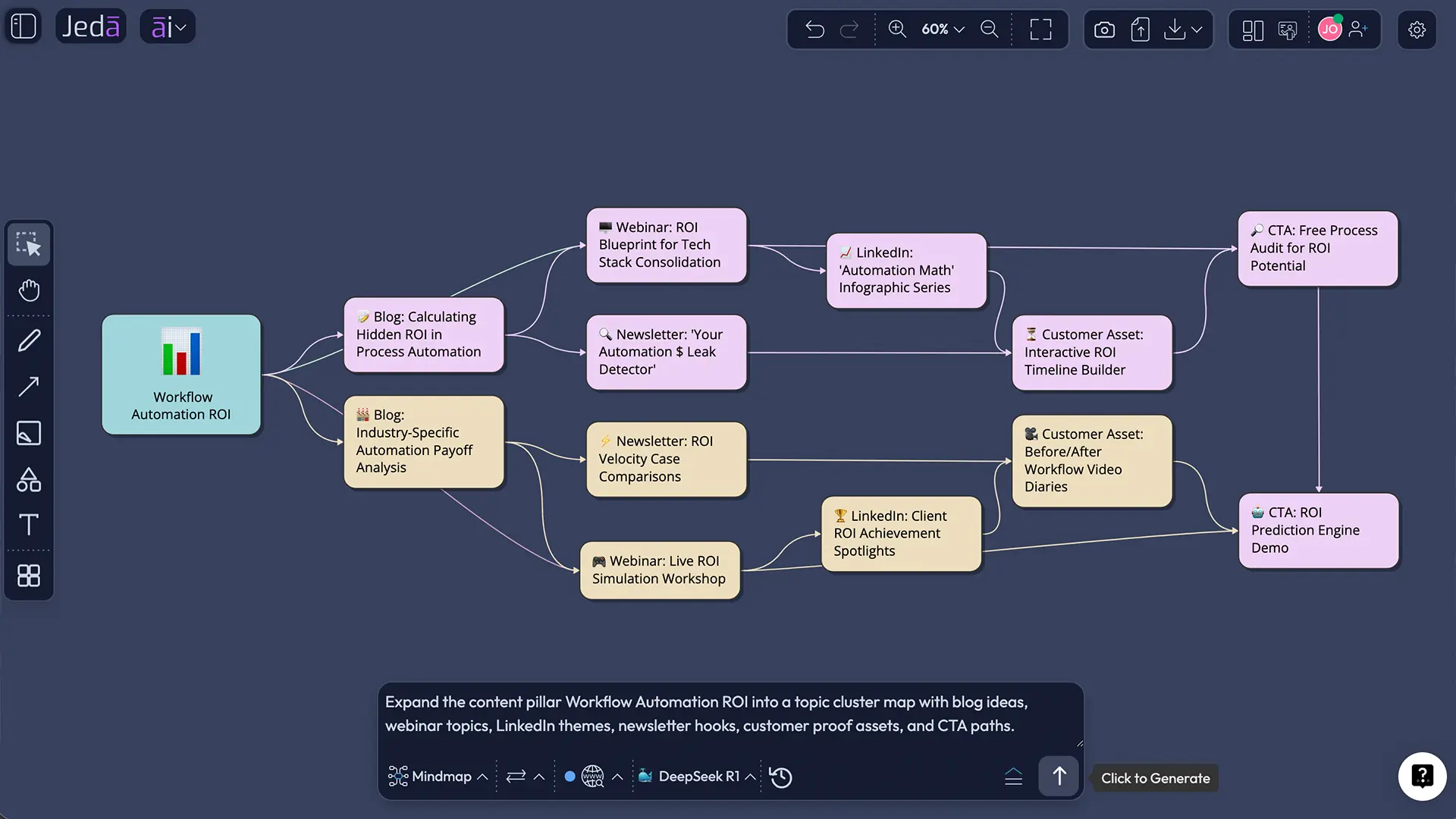
When the team wants a different view, use Vision Transform to convert the matrix into a mind map, diagram, or flowchart for campaign planning.
AI+ Button: Deep-Dive Expansion
The AI+ button is your second-pass strategist.
After the matrix is on the board, select it and tap AI+ to extend the work. Ask it to deepen an audience segment, turn one pillar into a 90-day mini-plan, generate quarterly campaign themes, surface missing KPIs, or add repurposing logic across channels. That is where AI+ shines.
One rule matters here: use AI+ as an extension tool. It works best when it builds on what is already visible in context. It is not the right place to start from zero or demand ultra-specific new instructions detached from the board.
For adjacent planning work, connect this page to the broader AI Workspace, AI Whiteboard, and AI content marketing strategies resources on Jeda.ai.
AI Content Marketing Strategy Template & Example
Let’s make this concrete.
Imagine a mid-market cybersecurity SaaS company that sells to IT managers and CISOs. The company wants to increase qualified pipeline without tripling headcount. Inside Jeda.ai, the matrix might look like this:
- Audience: IT managers researching security gaps, CISOs validating vendors, operations leaders comparing deployment complexity.
- Goal: Increase demo-qualified leads from organic and owned channels.
- Pillars: threat visibility, compliance readiness, incident response, vendor consolidation.
- Formats: blog explainers, comparison pages, webinar recaps, short LinkedIn posts, customer proof snippets.
- Channels: organic search, LinkedIn, email nurture, partner webinars.
- CTA: request a demo, download a buyer checklist, join a live walkthrough.
- Cadence: one flagship article, two supporting assets, three repurposed distribution pieces per week.
- KPIs: qualified organic sessions, assisted demo conversions, webinar attendance, email click-through rate, influenced pipeline.
Now the interesting part. The team selects the matrix and uses AI+ to expand the “incident response” pillar into a six-week campaign, then uses Vision Transform to turn the strategy into a campaign flow. Same strategy. New view. Less rework.
That is what a proper AI Workspace should do.
Best Practices for Content Marketing Strategies With AI
The strongest AI-assisted strategies still follow very human rules.
A few research-backed reminders help here. CMI found that top-performing B2B marketers most often win through audience understanding, content quality, industry expertise, goal alignment, and performance measurement. HubSpot found only a small share of marketers publish fully AI-written pieces without editing. Ahrefs found AI users publish more content and, on average, report faster growth — but quality perceptions still favor human-written content. The lesson is obvious. Use AI to reduce friction, not standards.
Common Mistakes to Avoid
The most expensive content mistake is not publishing too little. It is publishing at speed with no strategic spine.
Here are the usual offenders:
1. Treating AI like a replacement for editorial judgment
AI can suggest, cluster, summarize, and reframe. It cannot reliably protect your point of view, market conviction, or brand tension unless a human shapes the work.
2. Confusing a content calendar with a content strategy
A calendar tells you when. A strategy tells you why, for whom, where, and toward what result.
3. Publishing broad topics with no audience specificity
“Cybersecurity trends” is not a strategy. “Compliance content for healthcare IT buyers entering vendor evaluation” starts to sound like one.
4. Ignoring distribution design
Great content without a channel plan is a fancy file. B2B marketers still report strong results from webinars, email, blogs, and events when those channels are chosen deliberately.
5. Measuring volume instead of business movement
More articles, more impressions, more posts. Lovely. Did pipeline improve? Did retention improve? Did the sales team get better conversations? That is the scoreboard.
Frequently Asked Questions
- What is an AI content marketing strategy?
- An AI content marketing strategy is a documented plan for using AI to support content research, planning, creation, distribution, and optimization while humans still control judgment, brand voice, and final decisions. It is a strategy system, not a prompt collection.
- How is a content marketing strategy different from a content calendar?
- A content calendar shows what will be published and when. A content strategy explains why the content exists, who it serves, what business goal it supports, how it will be distributed, and which metrics determine success.
- Why should I build a content marketing strategy as a matrix?
- A matrix forces the team to see audience, goal, pillars, formats, channels, cadence, and KPIs together. That makes contradictions obvious early and helps leadership review the whole plan in one visual frame.
- What should go inside a content marketing strategy matrix?
- At minimum, include audience, business goal, core message, content pillars, formats, distribution channels, publishing cadence, CTA, and KPIs. Those blocks turn a topic list into an operating model.
- Can AI help without making the content sound robotic?
- Yes, if AI is used for research, clustering, outlining, repurposing, and analysis while humans rewrite, fact-check, and shape the final voice. The problem is not AI use. The problem is unedited AI use.
- How do I deepen the strategy after the first draft in Jeda.ai?
- Generate the first matrix, select it on the canvas, and use the AI+ button to extend weak sections, add examples, expand a pillar into a campaign, or surface missing channel and KPI ideas.
- Can I convert the matrix into another view in Jeda.ai?
- Yes. Use Vision Transform to turn the finished matrix into another visual such as a mind map, diagram, or flowchart when your team needs a different planning view for execution.
- Which metrics matter most for content marketing strategies with AI?
- Track metrics that connect content to business movement: qualified organic sessions, assisted conversions, demo requests, webinar signups, email engagement, influenced pipeline, retention signals, and content production efficiency.
- Is this workflow suitable for small teams?
- Yes. Small teams often benefit the most because the matrix reduces rework, clarifies priorities, and lets one core idea become many assets across channels without losing strategic consistency.
- What can I export from Jeda.ai after building the matrix?
- You can export the finished board from Jeda.ai as PNG, SVG, or PDF. That is useful for reviews, handoffs, and documentation when the team needs a snapshot of the current strategy.
Sources & Further Reading
- [1]
Content Marketing Institute (2026) . “Developing a Content Marketing Strategy” Content Marketing Institute.
View Source ↗ - [2]
Stephanie Stahl (2024) . “B2B Content Marketing Benchmarks, Budgets, and Trends: Outlook for 2025” Content Marketing Institute.
View Source ↗ - [3]
HubSpot (2025) . “How to Develop a Content Strategy in 7 Steps (From Start to Finish)” HubSpot Blog.
View Source ↗ - [4]
HubSpot (2025) . “AI in Content Marketing: How Creators and Marketers Are Using AI to Speed Up and Succeed” HubSpot Blog.
View Source ↗ - [5]
Semrush (2025) . “How to Use AI for a Content Strategy That Drives Results” Semrush Blog.
View Source ↗ - [6]
Ryan Law and Xibeijia Guan (2025) . “The State of AI in Content Marketing” Ahrefs.
View Source ↗ - [7]
Christiane Koob, et al. (2021) . “Determinants of Content Marketing Effectiveness: Conceptual Framework and Empirical Findings from a Managerial Perspective” PLOS ONE.
View Source ↗ - [8]
Ari Salonen, et al. (2024) . “Digital Content Marketing on Social Media Along the B2B Customer Journey: The Effect of Timely Content Delivery on Customer Engagement” Industrial Marketing Management.
View Source ↗ - [9]
Simona Vinerean (2017) . “Content Marketing Strategy. Definition, Objectives and Tactics” Expert Journal of Marketing.
View Source ↗ - [10]
Adobe (2025) . “2025 AI and Digital Trends in B2B Journeys Report” Adobe.
View Source ↗
Build Your AI Content Marketing Strategy in Jeda.ai
Join over 150,000+ users using Jeda.ai’s Visual AI workspace and AI Whiteboard to turn strategy into editable, collaborative decisions.
Try Free Template