AI has become part of the business course that is meant to explain it. Students can prompt, compare models, build simple agents, draft workflow plans, and demo plausible use cases before asking whether the use case should exist at all. Start with a basic management question: when is AI the right operating choice, and what needs to be true before a manager approves it?
What AI actually changes about managerial decision-making
The familiar classroom risk is tool fluency. Students learn the prompt, the model name, and the demo flow, then mistake that fluency for business readiness. The shortcut is seductive because a demo can look finished before its economics, risk, data, workflow, and approval logic are clear.
The course therefore needs use-case discipline. Managers do not have to become machine-learning engineers, but they need enough understanding to decide what AI is for, which model is good enough, where the workflow may fail, and who owns the outcome.
Use these lenses across assignments. Together they make a full rubric, rather than a prompt template:
| Course lens | What students should answer |
|---|---|
| Use-case value | What business decision, task, or workflow becomes better because AI is involved? |
| Model fit | What quality, cost, latency, data, and risk constraints shape the model choice? |
| Enterprise edge | Does the AI system build a durable advantage through data, workflow, evaluation, or learning? |
| Consulting logic | Can the team translate technical capability into an executive recommendation with tradeoffs? |
| Human approval | Where must a person review, override, or own the outcome? |
| Evaluation logic | How will the team know the AI output is good enough to use? |
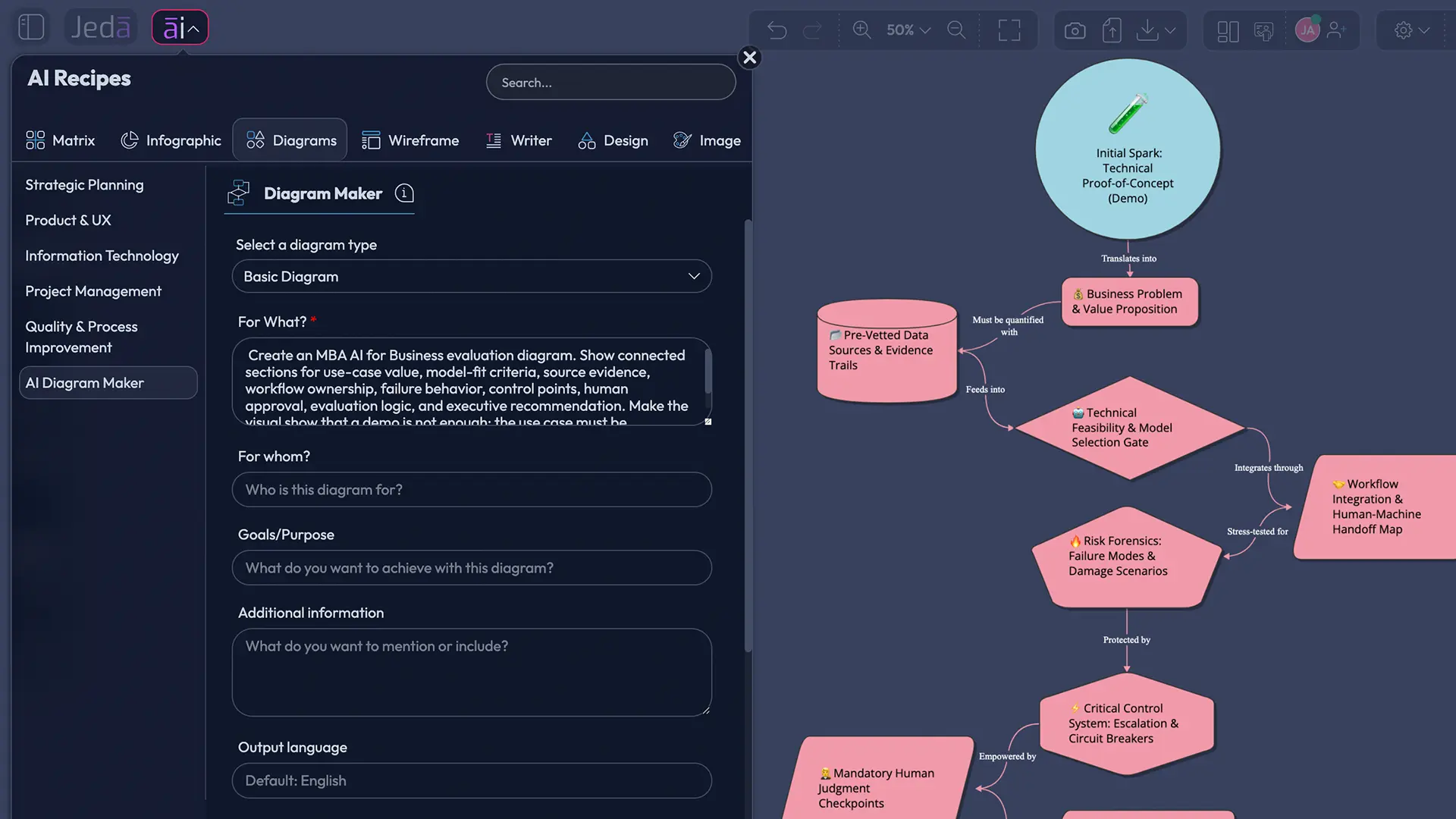
That provides the course foundation. From there, students need three habits:
| Teach this | Why it matters if you skip it |
|---|---|
| Durable principles: AI system limits, use-case economics, evaluation, workflow, and governance | Without them, students memorize today's tools and miss tomorrow's management problem |
| Judgment: the discipline to decide when AI output is not good enough to use | Without it, they graduate able to demo AI and unable to approve it responsibly |
| Practical tactics: using AI to test use cases, compare models, design workflows, and document controls | Without them, AI literacy stays theoretical and never reaches a managerial decision |
With all three in place, students can treat AI output as a business-system component: useful only when value, risk, workflow, and accountability are explicit.
What AI reasoning gets wrong in AI-for-business cases
Adoption is rising faster than evaluation maturity
Stanford HAI's 2026 AI Index economy chapter reports that global corporate AI investment more than doubled in 2025 and that organizational AI adoption rose to 88% of surveyed organizations, while AI agent deployment remained in the single digits across most business functions. Anthropic's Economic Index research studies real-world AI use through measures such as task complexity, skill level, purpose, autonomy, and success. OpenAI's State of Enterprise AI report reports that surveyed enterprise workers attribute 40 to 60 minutes saved per active day to AI use, while also showing that deeper workflow integration matters.
Students already know that AI is everywhere. The course should make clear that adoption without evaluation, governance, and workflow design creates expensive ambiguity.
Text-only AI exercises will not close that gap. Students need practice defending AI use cases when a demo looks good, the model comparison is incomplete, and workflow ownership is unclear. Build the course around value logic, model fit, failure behavior, human approval, and evaluation evidence.
They also need to demonstrate capability with AI without mistaking a demonstration for a business case.
Trade demonstration work for evaluation work
Put evaluation on one canvas
Jeda.ai is a visual AI workspace for AI-for-business work that needs model comparison and visible controls. It supports framework-based outputs, document and data analysis, a collaborative canvas, and multi-model comparison. Use the canvas to connect use cases, source documents, model tests, workflow roles, failure modes, control points, and the executive recommendation.
Start with the business goal, approved sources, and evaluation criteria. Then compare more than one model's output, and require students to trace every go, revise, or stop recommendation back to evidence. A second model can offer another opinion, but it is not an evaluation system by itself.
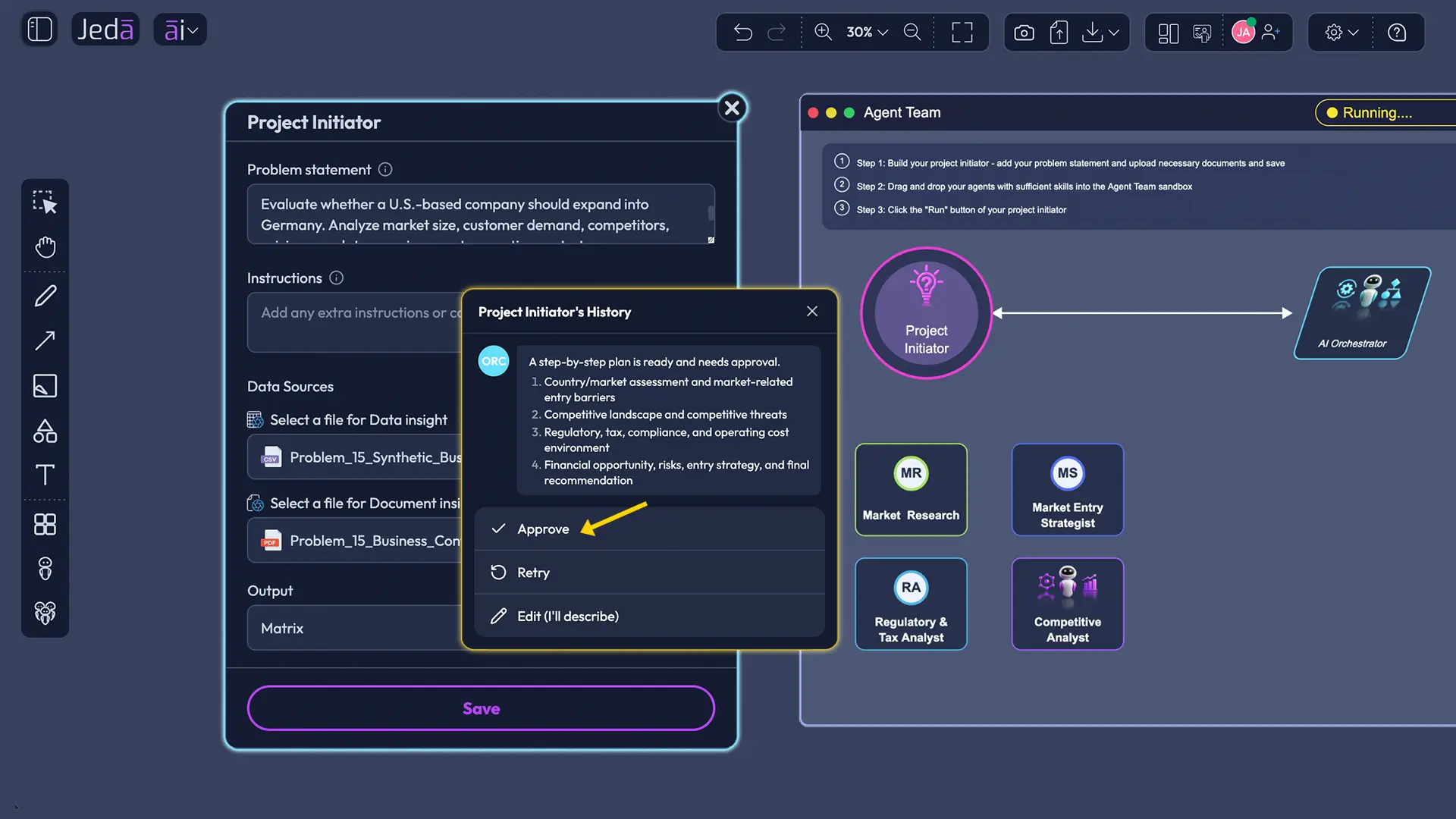
Jeda.ai also offers an agentic MBA case workspace. Students can create, upload, edit, or select a skill; assign it to a specialist agent; and build a small agent team in a sandbox. Before work begins, the team reviews the Orchestrator's plan, adds the case question and shared files, keeps agent-specific files with the right agent, and resolves any skill or team gaps. The useful moment is the review: what agents can access, what they are allowed to do, where escalation happens, and what humans approve.
The 45-minute use-case gate
Build the rest of the course
Extend this activity with the sample syllabus, exercises, quizzes, projects, and instructor guide.
A useful AI for Business assignment should end with a management decision that students can defend after the demo is over.
Explore Jeda.ai
Join over 150,000 professionals who trust Jeda.ai for their strategic analysis.
Explore Jeda.ai