Students can ask a model to explain a dataset, write code, summarize a chart, draft a forecast, and recommend an action before they have even decided which action the analysis is meant to inform. That changes the teaching challenge. Begin with a basic analytics question: when does the data support a decision, and when does it merely support a confident story?
What AI actually changes about analytics judgment
The familiar classroom risk is dashboard-first thinking. Students can produce visuals and summary statistics before they have clarified the decision. AI accelerates that tendency: it can infer column meanings, write transformations, explain correlations, and produce managerial-sounding recommendations even when the data is not fit for purpose.
The course therefore needs stronger decision discipline. The advantage comes from framing the decision, checking data quality, handling uncertainty, setting action thresholds, and keeping the recommendation traceable.
Use these lenses across cases. They form a complete rubric; they are not a reason to make every assignment bigger:
| Course lens | What students should answer |
|---|---|
| Decision frame | What decision will this analysis change? |
| Data quality | What is missing, biased, stale, duplicated, or poorly defined? |
| Enterprise edge | Does the analytics system improve a repeatable decision better than competitors can? |
| Consulting logic | Can the team turn messy data into a recommendation leadership can question and use? |
| Uncertainty | What range, sensitivity, or scenario matters more than the point estimate? |
| Action threshold | What result would be strong enough to act, pause, or collect more data? |
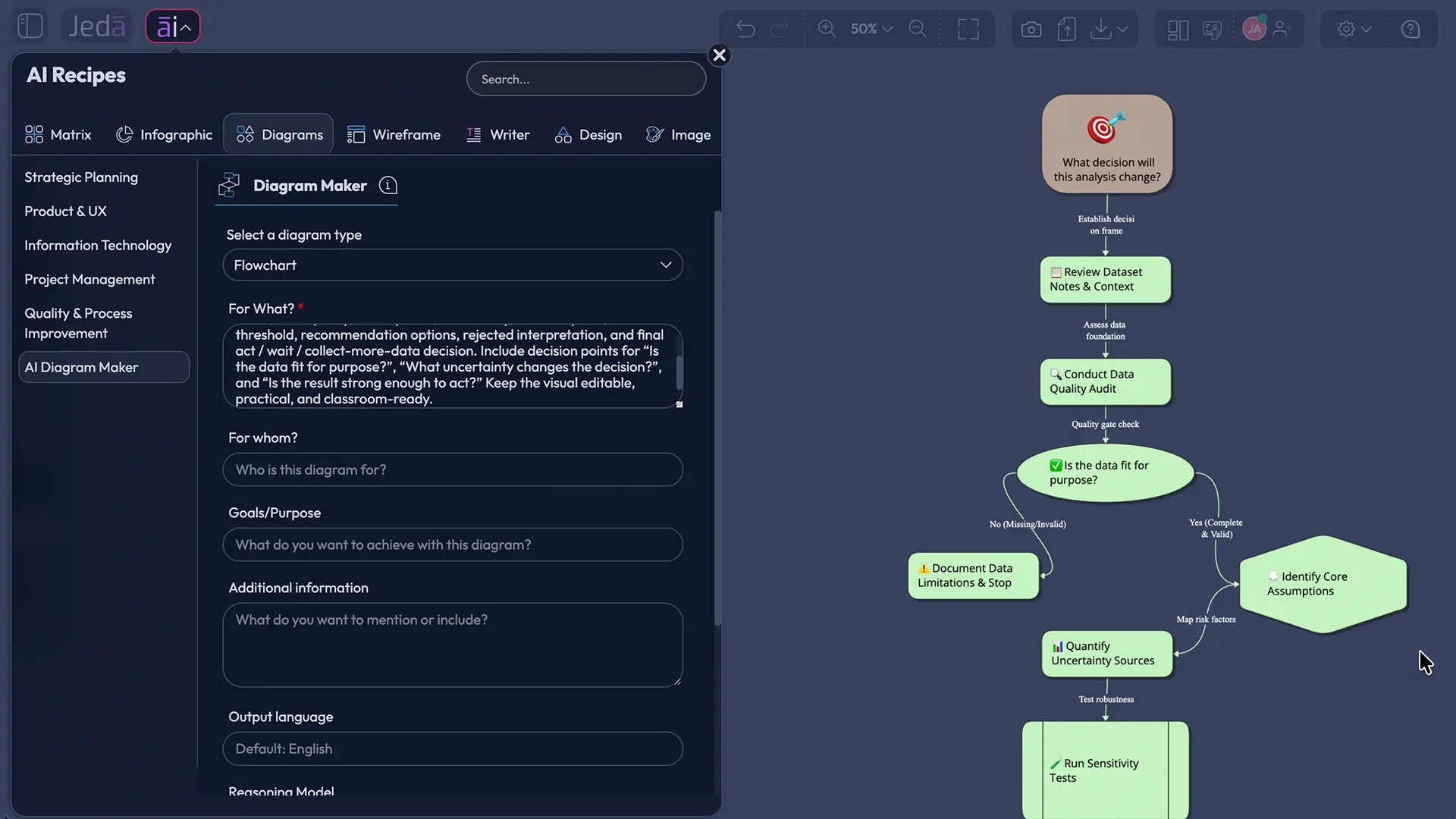
That is the course foundation. From there, students need three habits:
| Teach this | Why it matters if you skip it |
|---|---|
| Durable principles: decision framing, data quality, uncertainty, and action thresholds | Without them, students produce analysis that does not change a decision |
| Judgment: the discipline to know when the data is too weak to act | Without it, they graduate fluent in dashboards and dangerous around bad data |
| Practical tactics: using AI to prepare, explain, challenge, and document analytics work | Without them, students miss the real workflow change happening around analytics teams |
With all three in place, students can treat AI output like an analyst's draft: useful for speed, but untrusted until the data and decision logic are visible.
What AI reasoning gets wrong in analytics cases
Data readiness is now part of analytics
TDWI's reports on analytics practice show how closely modern analytics now sits with data strategy, governance, embedded analytics, generative AI, and agentic AI. Qlik's 2025 AI and data trends outlook names authenticity, applied value, and agents as themes shaping data-driven business, with source verification and practical ROI at the center.
AI is more than a reporting layer. It gives the course another reason to strengthen data definitions, governance, decision accountability, and discipline around uncertainty.
Text-only AI exercises will not close that gap. Students need practice defending analytics recommendations when the data dictionary is incomplete, the model output sounds confident, and the managerial decision carries a real cost of error. Build the course around decision framing, data quality, uncertainty, thresholds, and action ownership.
They also need to speed up analytics work with AI without turning weak data into an authoritative answer.
Trade preparation work for decision work
Put the decision path on one canvas
Jeda.ai is a visual AI workspace for analytics work that should remain inspectable. It supports framework-based outputs, document and data analysis, a collaborative canvas, and multi-model comparison. Use the canvas to keep the decision frame, data notes, assumptions, charts, model outputs, risks, and recommendation together.
Start with the dataset notes, definitions, and decision threshold. Then compare more than one model's interpretation, and require students to trace the recommendation back to data quality and uncertainty. A second model can challenge an interpretation, but it cannot repair missing data.
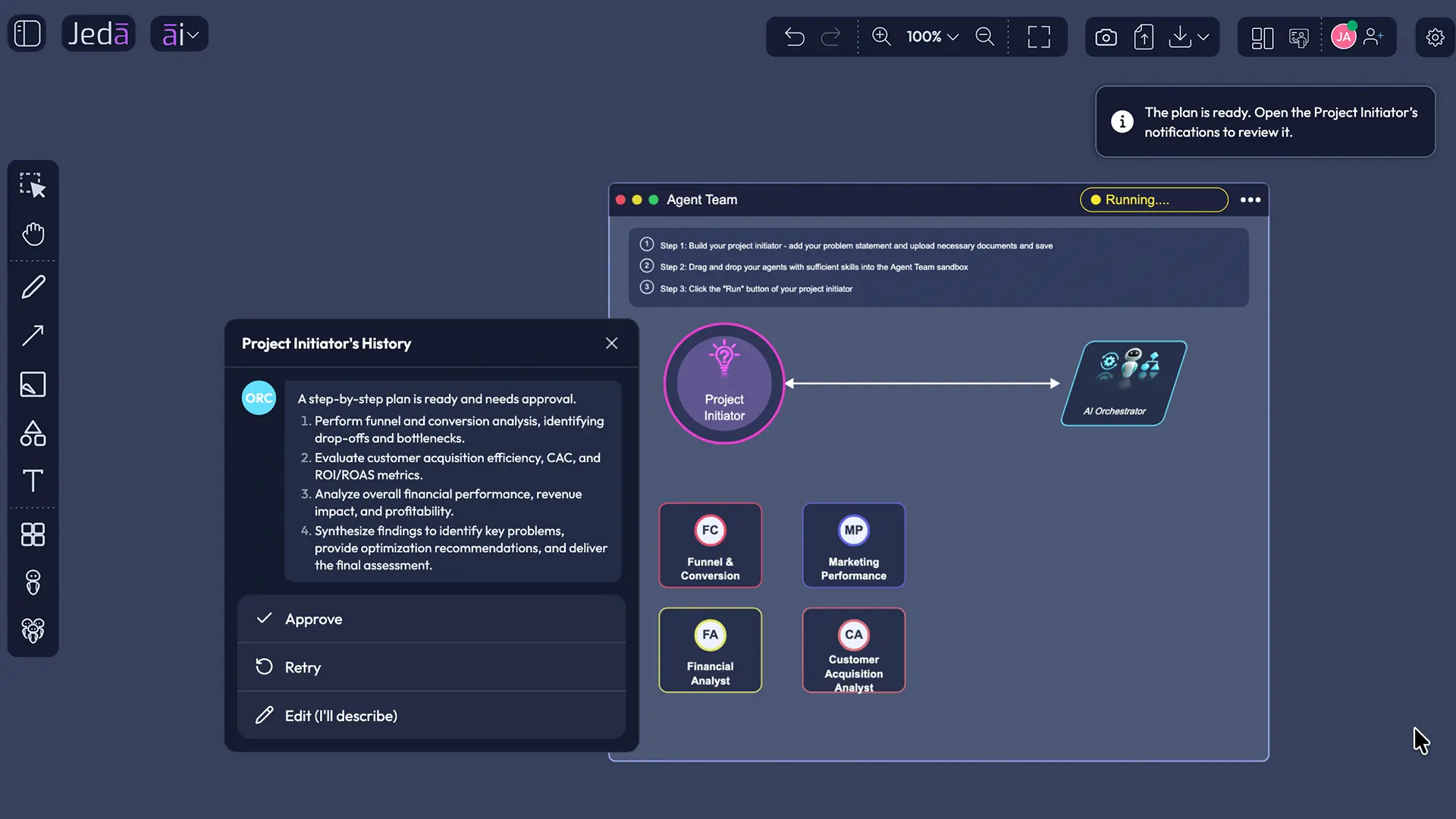
Jeda.ai also offers an agentic MBA case workspace. Students can create, upload, edit, or select a skill; assign it to a specialist agent; and build a small agent team in a sandbox. Before work begins, the team reviews the Orchestrator's plan, adds the case question and shared files, keeps agent-specific files with the right agent, and resolves any skill or team gaps. In this course, no agent should be allowed to turn weak data into an authoritative recommendation.
The 45-minute decision audit
Build the rest of the course
Extend this activity with the sample syllabus, exercises, quizzes, projects, and instructor guide.
A useful analytics assignment should end with a decision, an uncertainty statement, and a clear distinction between what the data says and what the manager chose.
Explore Jeda.ai
Join over 150,000 professionals who trust Jeda.ai for their strategic analysis.
Explore Jeda.ai