A capstone team can now draft a statement of work, issue tree, research plan, interview guide, analysis summary, risk log, and final deck before the project has been scoped. That makes the first question more important: what problem is this team actually responsible for solving?
What AI actually changes about capstone work
Capstone projects have always risked sprawl. Teams collect too much research, run too many frameworks, and arrive at a recommendation that sounds useful without answering a client decision. AI accelerates that pattern. It can fill a deck before students name the decision owner, usable evidence, or boundary of the work.
The course therefore needs stronger scoping discipline. The work starts with a defined decision, an honest account of what evidence can support, and a recommendation the client can act on.
Use these lenses at team checkpoints. Together they form a rubric; they are not a reason to make every project larger:
| Course lens | What students should answer |
|---|---|
| Problem definition | What decision is the client actually trying to make? |
| Enterprise edge | Would the recommendation strengthen a durable capability, or only produce a one-time fix? |
| Data access | What evidence is available, missing, confidential, or too weak to use? |
| Consulting logic | Can the team build a client-ready argument from evidence, assumptions, and clear tradeoffs? |
| Stakeholder usefulness | Who will use the recommendation, and what action should it change? |
| Implementation risk | What has to be true operationally for the recommendation to work? |
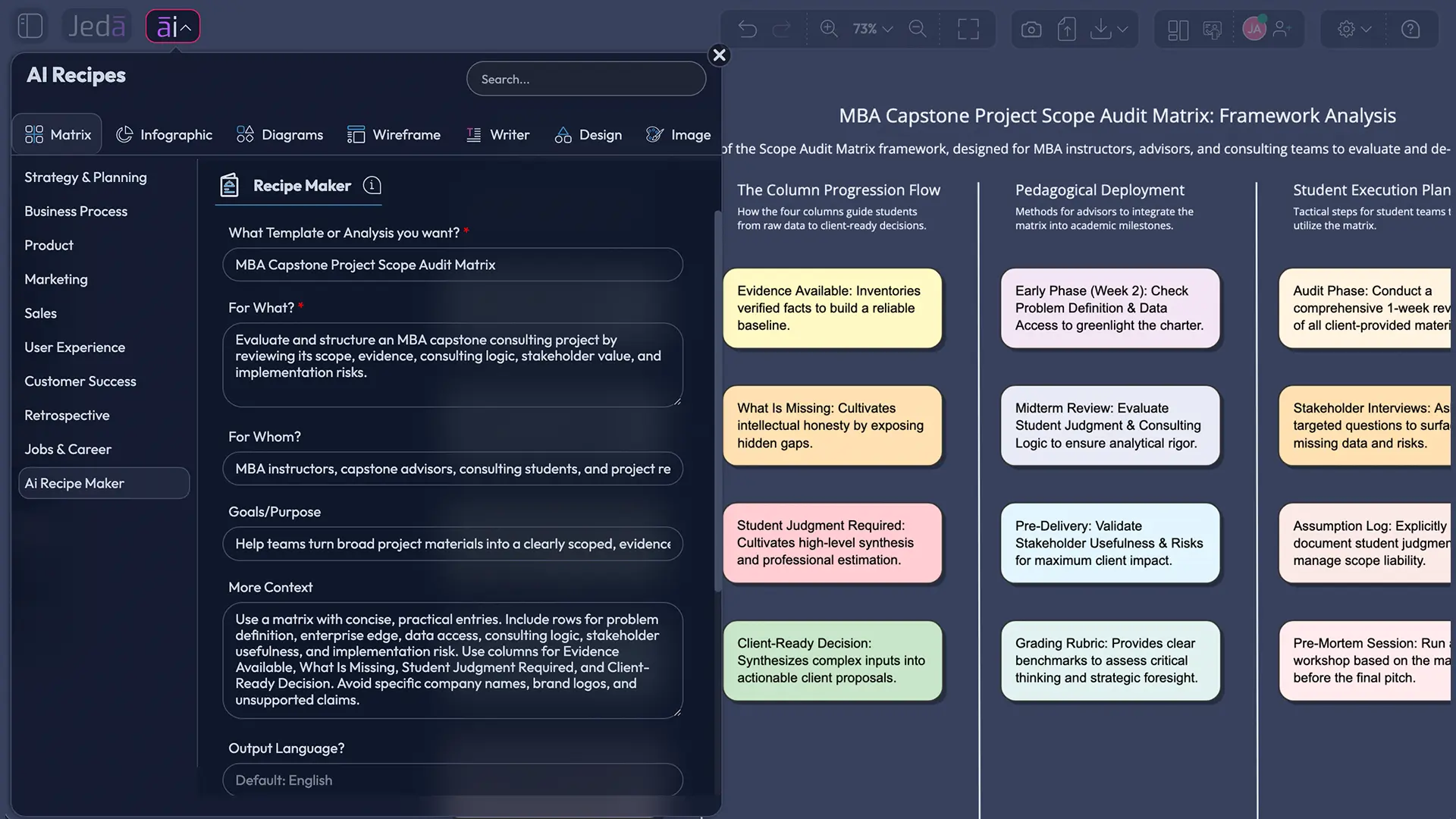
The framework gives the course its foundation. Students then need three working habits:
| Teach this | Why it matters if you skip it |
|---|---|
| Durable principles: scope, evidence, client value, implementation, and accountability | Without them, students produce project-shaped work that does not move a decision |
| Judgment: the discipline to reject broad briefs, weak data, and premature recommendations | Without it, they graduate with polished decks and no consulting spine |
| Practical tactics: using AI to synthesize, challenge, and document project work | Without them, the capstone stays slower than real client work and still fails to teach AI governance |
AI output should be treated as a project analyst's draft. It can save time, but it does not decide the scope.
What AI reasoning gets wrong in capstone projects
Employers do not need prettier projects
PMI's 2025 Pulse of the Profession report argues that business acumen moves project professionals from tactical troubleshooters to strategic value creators, and reports that only 18% of project professionals have high business-acumen proficiency. NACE's career readiness framework gives business schools another useful standard: communication, critical thinking, leadership, teamwork, professionalism, technology, and career development are how students prove readiness in real work.
AI can help students produce deliverables, but a capstone still has to demand judgment. A prettier project is not necessarily a better one. A client-ready project names the decision, evidence, tradeoff, owner, and implementation risk.
Text-only AI exercises will not close that gap. Students should defend a recommendation when the client brief is messy, evidence is incomplete, and the generated synthesis sounds more certain than the team should be. Build the capstone around scoping, evidence quality, stakeholder usefulness, implementation risk, and decision ownership.
They also need to use AI without solving the wrong problem more quickly.
Trade project-office work for client decision work
Put the argument on one canvas
Jeda.ai is a visual AI workspace with framework-based outputs, document and data analysis, a collaborative canvas, and multi-model comparison. It can keep the statement of work, client constraints, interview excerpts, issue tree, analysis plan, recommendation options, and implementation risks in one shared workspace.
Start with the client question and approved sources. Compare more than one model's synthesis, then check each recommendation against the evidence and scope. A second model can challenge a storyline, but it cannot confirm that the project was scoped correctly.
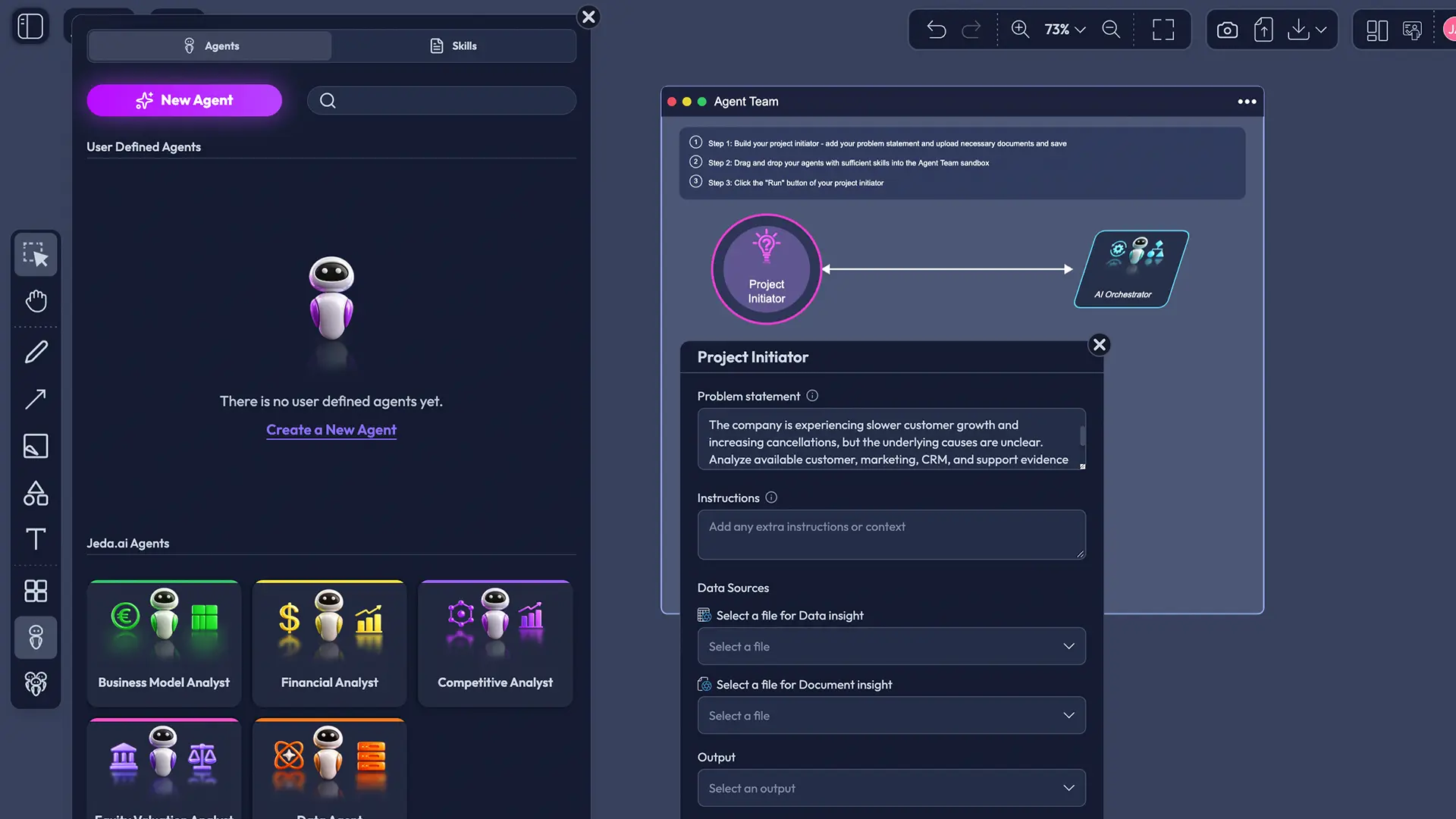
Jeda.ai also offers an agentic MBA case workspace. Students can create, upload, edit, or select a skill; assign it to a specialist agent; and build a small agent team in a sandbox. Before execution, the team reviews the Orchestrator's plan, adds the case question and shared files, keeps agent-specific files with the right agent, and resolves skill or team gaps. In a capstone course, this is where students protect role clarity and client accountability.
The 45-minute scope audit
Build the rest of the course
Extend the exercise with the sample syllabus, exercises, quizzes, projects, and instructor guide.
A strong capstone does not need every possible analysis. It needs the right question, honest evidence, a defensible recommendation, and a client who knows what happens next.
Explore Jeda.ai
Join over 150,000 professionals who trust Jeda.ai for their strategic analysis.
Explore Jeda.ai