Students can ask AI to read a 10-K, draft a valuation memo, explain a DCF, compare debt and equity financing, and write an investment recommendation before they have made a single finance judgment. That makes the output look more settled than the underlying decision. Start with one corporate-finance question: which assumptions would a finance leader be prepared to defend with capital on the line?
What AI actually changes about capital allocation
The familiar classroom risk is formula practice. Students can calculate value without taking ownership of the business judgment inside the assumptions. AI makes that risk more convincing. It can summarize filings, explain ratios, draft scenarios, and produce analyst-style prose before the revenue case, discount rate, peer set, or downside logic has been tested.
The course therefore needs assumption discipline. Corporate-finance advantage comes from deciding how capital should be allocated when forecasts are uncertain, incentives are imperfect, and the cost of being wrong is real.
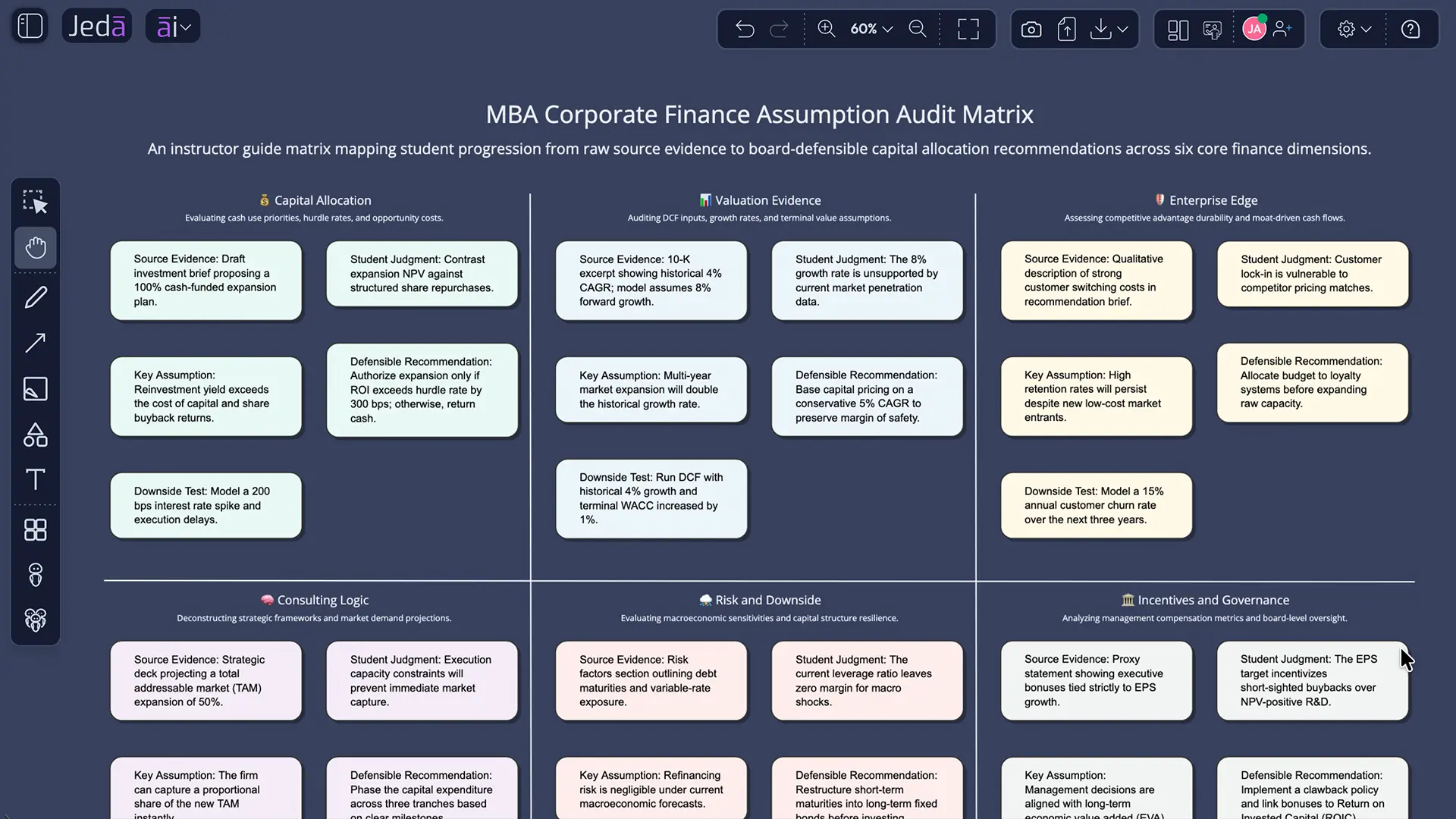
Use these lenses across cases. They form a full rubric, but they do not replace the finance model:
| Course lens | What students should answer |
|---|---|
| Capital allocation | Which use of capital creates the strongest risk-adjusted value? |
| Valuation evidence | Which assumptions come from filings, market data, management guidance, or operating evidence? |
| Enterprise edge | Does the financing or investment choice strengthen a durable source of advantage? |
| Consulting logic | Can the team turn financial analysis into a recommendation a CFO, board, or investor could challenge? |
| Risk and downside | What breaks the recommendation, and how bad is the downside? |
| Incentives and governance | Who benefits from the decision, who approves it, and what agency problem could distort it? |
That is the course foundation. From there, students need three habits:
| Teach this | Why it matters if you skip it |
|---|---|
| Durable principles: capital budgeting, valuation, capital structure, risk, and governance | Without them, students produce model-shaped answers without finance judgment |
| Judgment: the discipline to defend, revise, or reject assumptions under uncertainty | Without it, they graduate able to explain a DCF and unable to advise on capital |
| Practical tactics: using AI to collect evidence, challenge assumptions, and document model logic | Without them, the course misses how finance work is already being reorganized |
With all three in place, students can treat AI output like a junior analyst's memo: useful for collecting evidence and challenging assumptions, but never allowed to approve a capital decision.
What AI reasoning gets wrong in finance cases
Finance leaders are already under pressure to change the function
Deloitte's Q4 2025 CFO Signals survey reports that 50% of North American CFOs named digital transformation of finance as a top priority for 2026, 49% cited automation to free employees for higher value work, and 87% expected AI to be extremely or very important to finance department operations in 2026. CFA Institute's 2025 report on explainable AI in finance warns that opaque AI systems can undermine trust, regulatory compliance, and risk management in high-stakes financial decisions.
AI belongs in corporate finance when students can test valuation logic, inspect assumptions, explain uncertainty, and decide what a finance leader should approve. It cannot substitute for financial reasoning.
Text-only AI exercises will not close that gap. Students need practice defending capital decisions when an AI recommendation sounds like an analyst memo, the spreadsheet is fragile, and the downside case changes the decision. Build the course around valuation evidence, capital-structure tradeoffs, risk, incentives, governance, and explainability.
They also need to use AI to collect and challenge finance work without letting it launder assumptions.
Trade collection work for capital decision work
Put the valuation logic on one canvas
Jeda.ai is a visual AI workspace for finance work that should not stay buried in a private chat thread. It supports framework-based outputs, document and data analysis, a collaborative canvas, and multi-model comparison. For this course, use the canvas to keep source excerpts, assumption drivers, valuation outputs, sensitivity tables, financing tradeoffs, risk flags, and the final recommendation in an inspectable workspace.
Start with approved source documents and model constraints. Then compare more than one model's interpretation, and check each useful claim against the source evidence and finance logic. A second model can challenge an assumption, but it is not an independent source. Students need that distinction early.
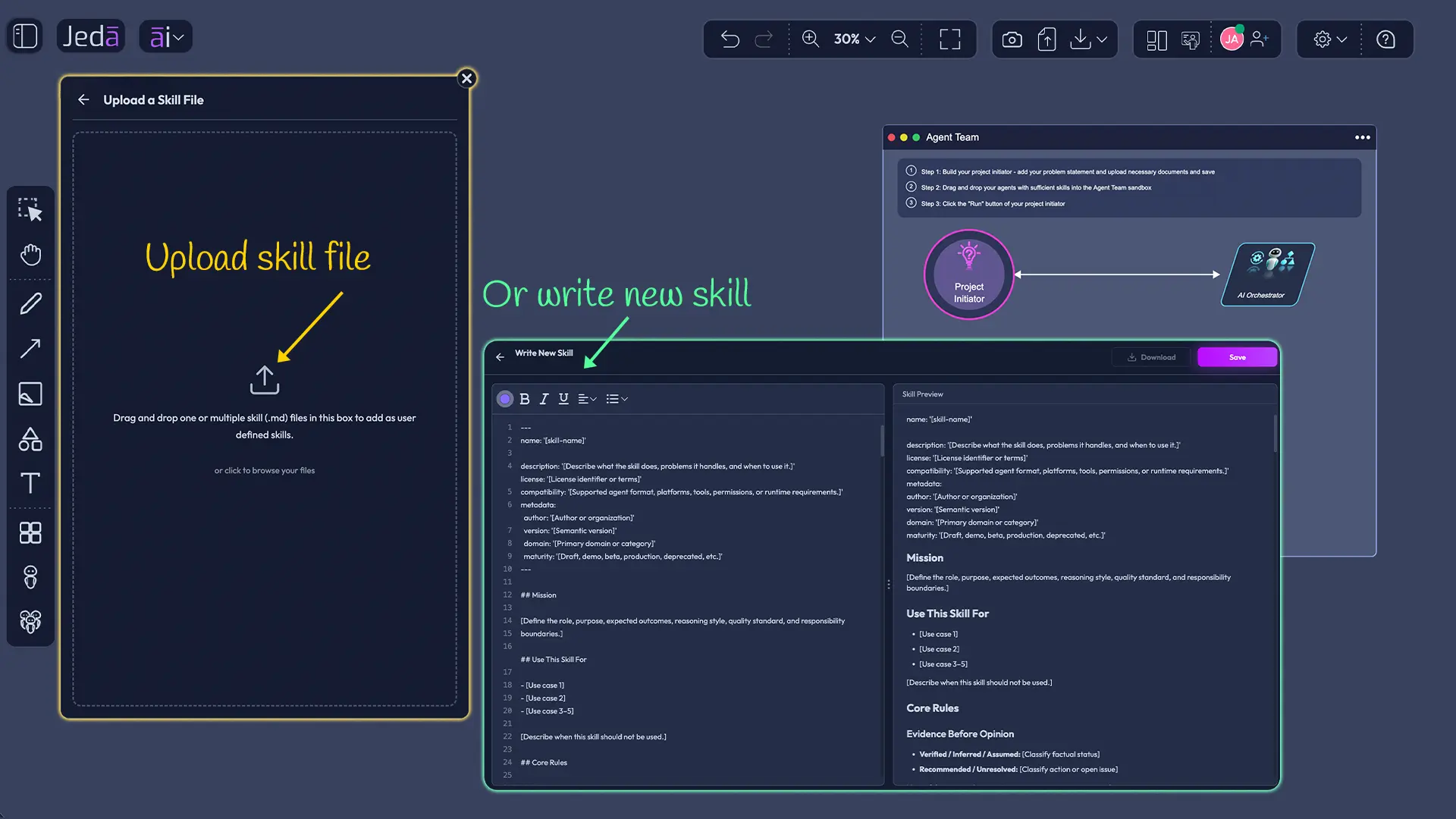
Jeda.ai also offers an agentic MBA case workspace. Students can create, upload, edit, or select a skill; assign it to a specialist agent; and build a small agent team in a sandbox. Before execution, the team reviews the Orchestrator's plan, adds the case question and shared files, keeps agent-specific files with the right agent, and resolves any skill or team gaps. One agent can review filings, another can challenge assumptions, and another can test downside cases. The student team still approves the recommendation.
The 45-minute assumption audit
Build the rest of the course
Extend this activity with the sample syllabus, exercises, quizzes, projects, and instructor guide.
A useful corporate-finance assignment should leave students with one habit: every valuation is only as good as the assumptions a finance leader is willing to defend.
Explore Jeda.ai
Join over 150,000 professionals who trust Jeda.ai for their strategic analysis.
Explore Jeda.ai