Students can ask a model for a cloud plan, customer-experience map, capability model, data roadmap, operating-model design, and change plan before they understand how the business actually works. That creates a convincing roadmap very early. Begin with the central transformation question: what work must change before the technology creates value?
What AI actually changes about digital transformation
The familiar classroom risk is technology-first transformation. Students may write about platforms before they have examined processes, data, governance, adoption, or value. AI makes the mistake faster and smoother. It can produce a roadmap that looks complete while assuming clean data, available talent, willing users, and clear ownership.
The course therefore needs operating-model discipline. Digital advantage comes from redesigning work, governing data, changing decision rights, measuring value, and building trust into the system.
Use these lenses across cases. They form a full rubric; they are not a reason to let every roadmap sprawl:
| Course lens | What students should answer |
|---|---|
| Workflow redesign | Which process, handoff, or decision actually changes? |
| Data readiness | What data must be accessible, governed, current, and fit for the use case? |
| Consulting logic | Can the team turn digital ambition into a sequenced transformation recommendation? |
| Enterprise edge | Does the transformation build a repeatable capability competitors cannot quickly copy? |
| Operating model | What roles, controls, incentives, and routines must change? |
| Value realization | What baseline and metric will prove that the transformation worked? |
That provides the course foundation. From there, students need three habits:
| Teach this | Why it matters if you skip it |
|---|---|
| Durable principles: process redesign, data readiness, operating model, governance, and value realization | Without them, students mistake a technology roadmap for transformation |
| Judgment: the discipline to sequence change around constraints and adoption risk | Without it, they graduate with ambitious roadmaps no organization can execute |
| Practical tactics: using AI to map workflows, compare target states, and pressure-test dependencies | Without them, the course stays abstract while enterprise transformation work changes around it |
With all three in place, students can treat AI output like a transformation-office draft: useful for mapping, but risky when it hides the work that still has to change.
What AI reasoning gets wrong in transformation cases
The investment is moving toward AI-enabled software
Accenture's Technology Vision 2025 argues that AI autonomy will reshape enterprise technology, customer experience, the physical world, and the workforce, while trust becomes a central limit on value. IDC's 2026 analysis of digital transformation software spend says global digital transformation software spending is on pace to hit $640 billion by 2029, with AI expected to account for about 40% of that software spend.
Every digital roadmap now needs a management case for data, workflow, trust, and measurable value. AI does not turn every roadmap into an AI roadmap, but it does raise the standard for explaining how technology changes work.
Text-only AI exercises will not close that gap. Students need practice defending a transformation recommendation when an AI roadmap looks coherent, the data dependencies are unresolved, and adoption has not been earned. Build the course around workflow redesign, data readiness, operating-model fit, governance, and value realization.
They also need to map transformation work with AI without allowing it to skip the hard parts.
Trade mapping work for operating-model work
Put the operating model on one canvas
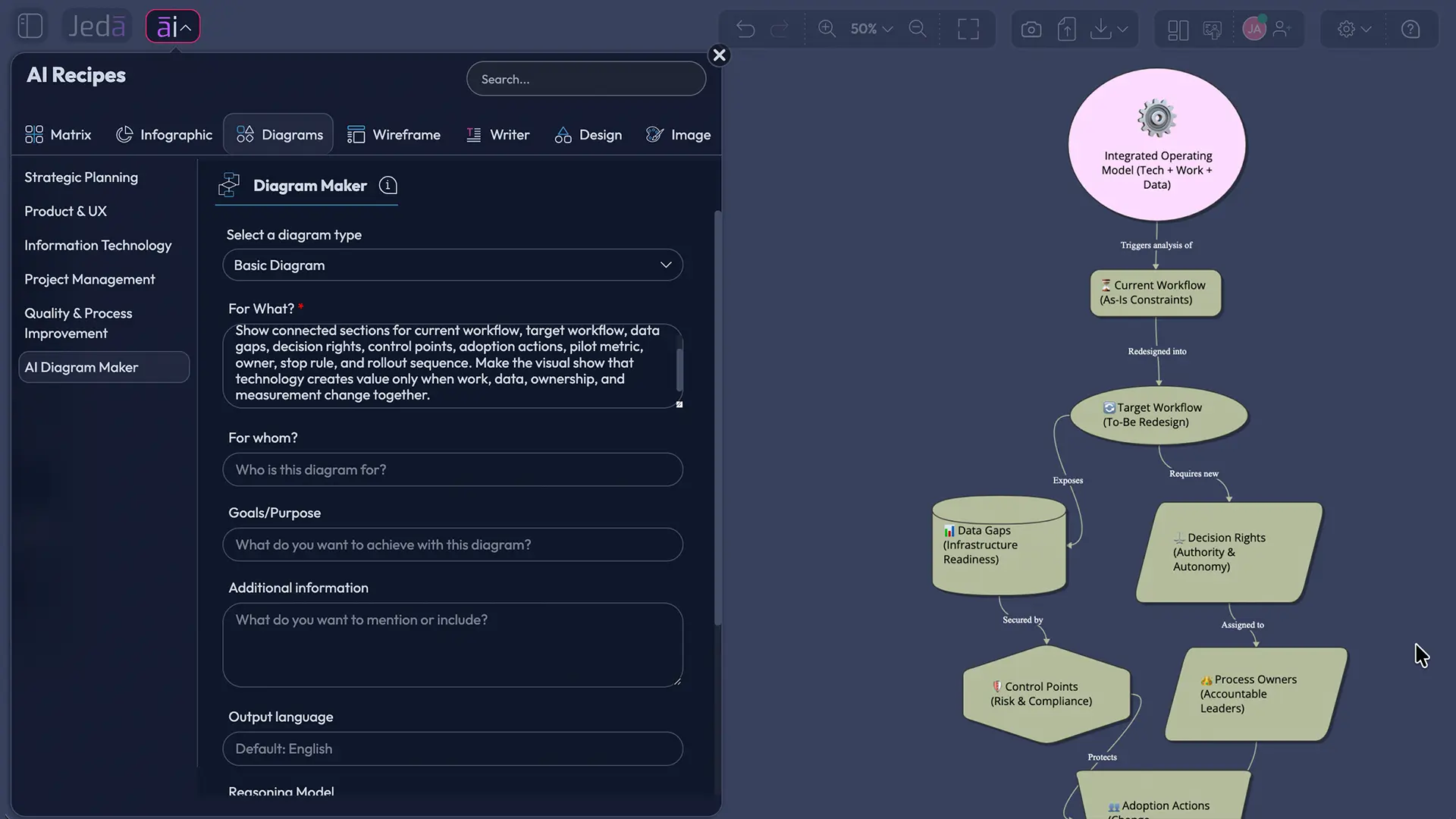
Jeda.ai is a visual AI workspace for transformation work that needs shared evidence and visible dependencies. It supports framework-based outputs, document and data analysis, a collaborative canvas, and multi-model comparison. Use the canvas to show the current workflow, target workflow, data gaps, control points, adoption actions, pilot metrics, and rollout sequence.
Start with the current-state facts and constraints. Then compare more than one model's roadmap, and require students to trace each recommendation back to workflow, data, owner, and value. A second model can find another dependency, but it cannot prove the organization can absorb the change.
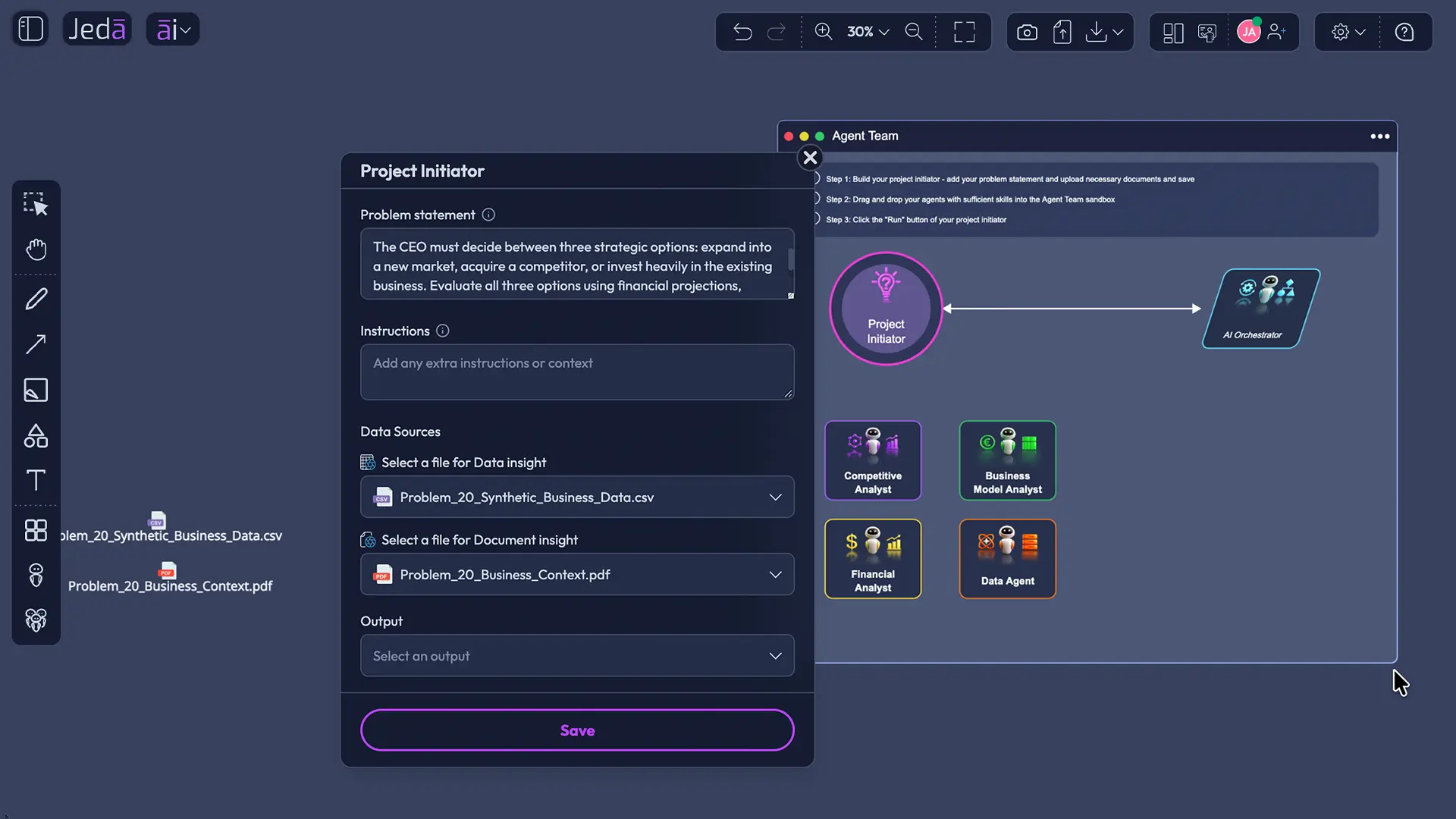
Jeda.ai also offers an agentic MBA case workspace. Students can create, upload, edit, or select a skill; assign it to a specialist agent; and build a small agent team in a sandbox. Before work begins, the team reviews the Orchestrator's plan, adds the case question and shared files, keeps agent-specific files with the right agent, and resolves any skill or team gaps. One agent can map customer impact, another can test data readiness, and another can pressure-test operating risk. Students still approve the roadmap.
The 45-minute workflow redesign test
Build the rest of the course
Extend this activity with the sample syllabus, exercises, quizzes, projects, and instructor guide.
A useful transformation assignment should name one process outcome, one data dependency, one owner, and one metric that shows whether the work mattered.
Explore Jeda.ai
Join over 150,000 professionals who trust Jeda.ai for their strategic analysis.
Explore Jeda.ai