Students can create a startup idea, market map, customer persona, landing-page copy, financial model, and investor script before they have spoken to a single customer. That makes an idea look more developed than it is. Begin with a basic entrepreneurship question: what evidence says this opportunity deserves scarce time and capital?
What AI actually changes about venture creation
The familiar classroom risk is pitch theater. Students can make an idea sound fundable before they have tested the pain point, market, channel, pricing, or business model. AI makes that easier: the idea arrives with a name, a story, a competitive scan, and revenue logic before reality has had a say.
The course therefore needs validation discipline. Venture advantage comes from customer evidence, ranked assumptions, resource restraint, and the ability to decide whether to persevere, pivot, or stop.
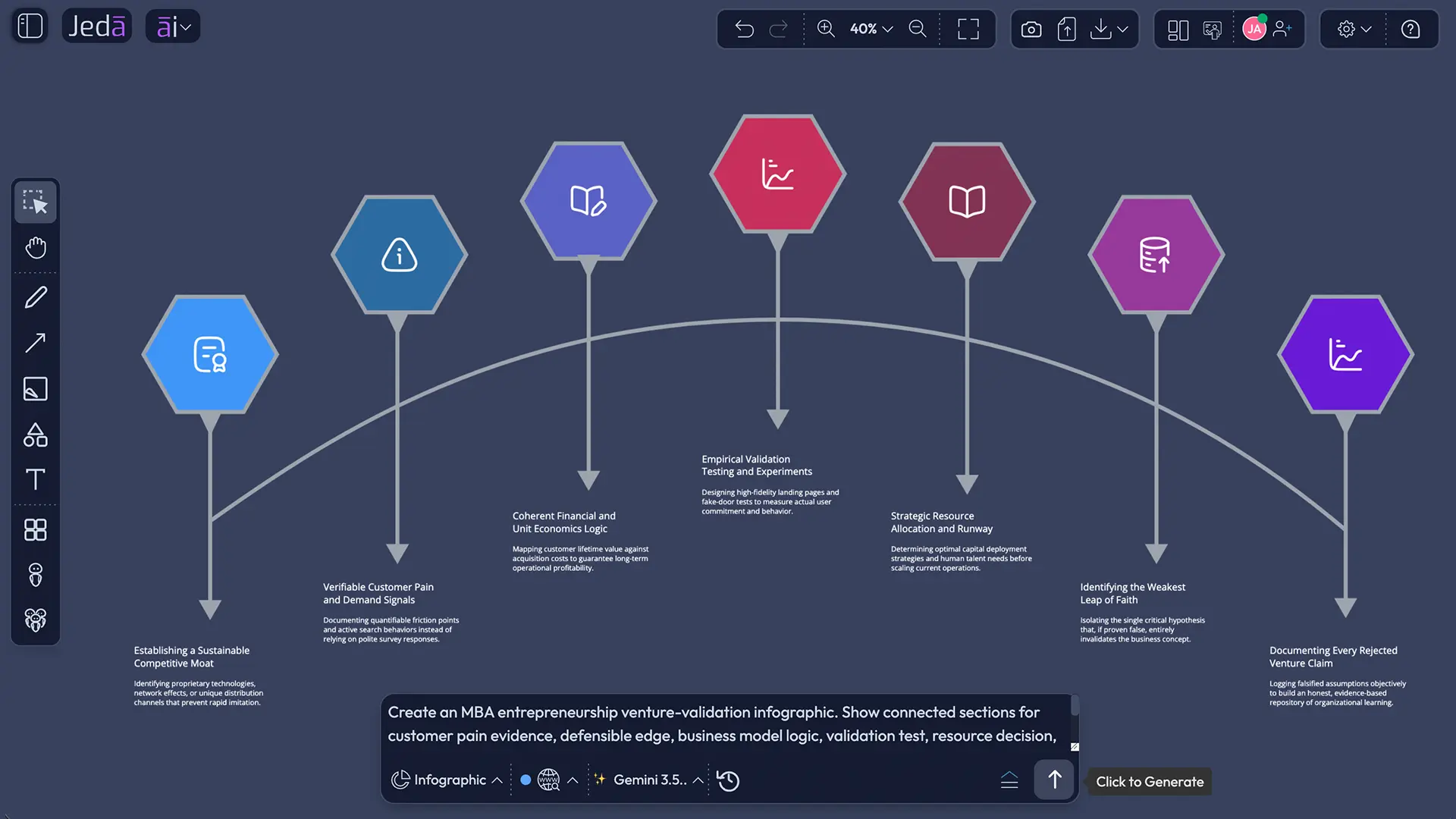
Use these lenses in venture reviews. Together they make a full rubric; they are not a reason to ask every team for a larger plan:
| Course lens | What students should answer |
|---|---|
| Customer pain | What evidence shows that the problem is real and urgent? |
| Enterprise edge | What could become defensible: data, distribution, workflow lock-in, trust, brand, or network effects? |
| Business model logic | How does the venture create, deliver, and capture value? |
| Consulting logic | Can the team explain the venture case in investor or advisor language without hiding assumptions? |
| Validation test | What is the smallest test that could disprove the opportunity? |
| Resource discipline | What should the team spend, delay, or refuse to build until evidence improves? |
That gives the course its footing. From there, students need three habits:
| Teach this | Why it matters if you skip it |
|---|---|
| Durable principles: customer discovery, business-model logic, validation, and resource discipline | Without them, students mistake a fluent pitch for a venture |
| Judgment: the discipline to reject attractive ideas when evidence is weak | Without it, they graduate able to generate startups and unable to build one responsibly |
| Practical tactics: using AI to create options, stress-test assumptions, and sharpen investor objections | Without them, the course ignores how fast founders can now fabricate plausibility |
When those habits are in place, students can treat AI output as venture raw material. It is useful for generating possibilities, but it has little value until customers and constraints push back.
What AI reasoning gets wrong in venture cases
Startup activity is not the same as venture quality
Startup Genome's 2026 ecosystem analysis argues that AI is concentrating startup value and reports that AI-native ecosystem value grew 140% in the year it studied. The Global Entrepreneurship Monitor 2025/2026 Global Report, based on more than 160,000 interviews across 53 economies, warns that strong startup activity can still leave a survival gap and an AI readiness gap.
Treat AI as an uneven opportunity. Access to tools helps, but venture quality still depends on validation, focus, timing, and execution.
Text-only AI exercises will not close that gap. Students need practice defending a venture decision when an AI pitch is compelling, the evidence is thin, and the market response is still unknown. Build the course around customer pain, assumption risk, business-model logic, resource discipline, and investor objections.
They also need to widen the venture search with AI without letting it manufacture certainty.
Trade option generation for validation work
Put the venture logic on one canvas
Jeda.ai is a visual AI workspace for venture work that needs fast options and visible evidence. It supports framework-based outputs, document and data analysis, a collaborative canvas, and multi-model comparison. Use the canvas to keep customer-pain evidence, value proposition, business model, tests, market assumptions, risks, and pitch logic in one place.
Start with customer evidence and constraints. Then compare more than one model's venture logic, and take every claim back to a test or assumption. A second model can sharpen a pitch, but it cannot replace the customer.
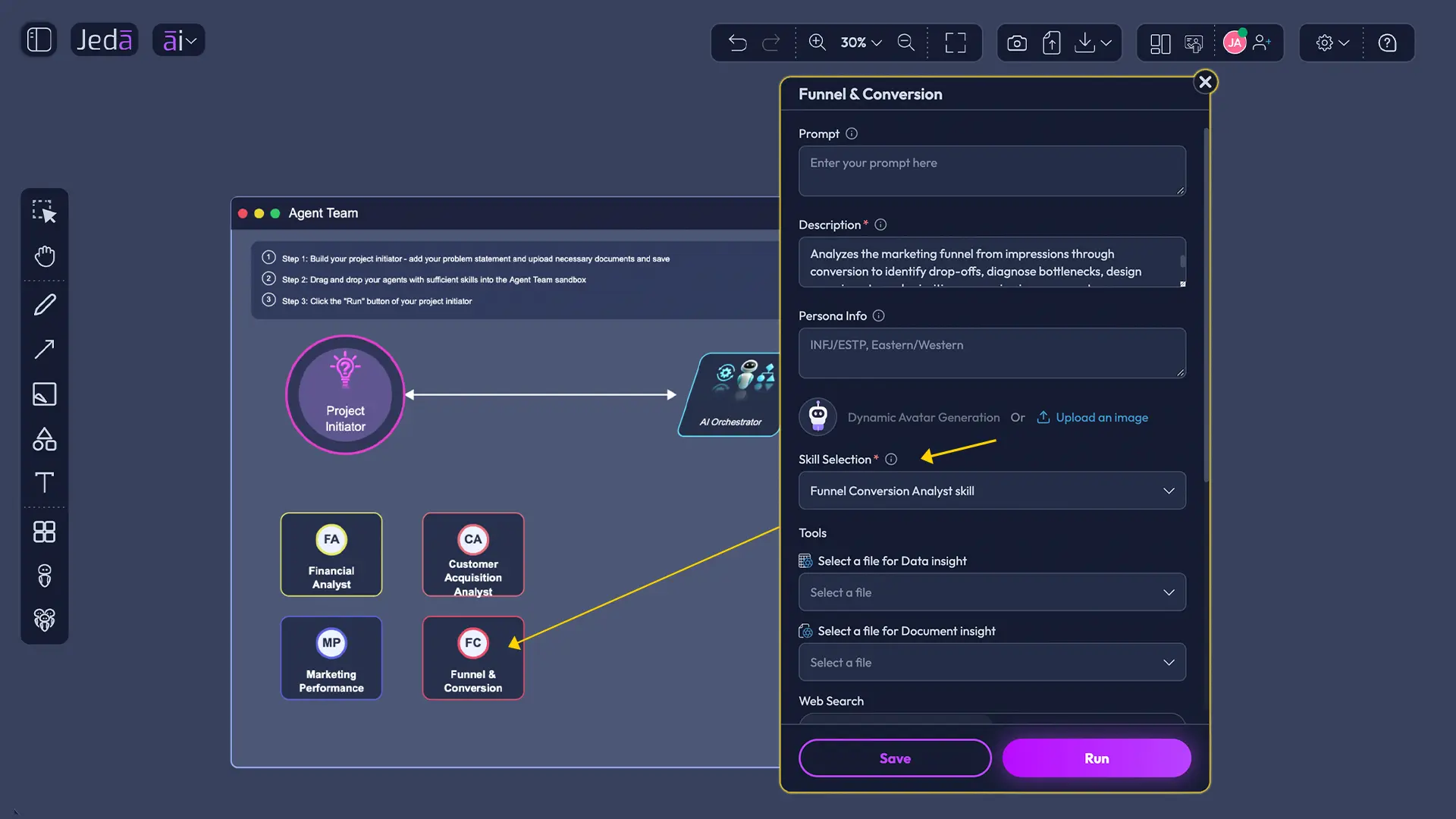
Jeda.ai also offers an agentic MBA case workspace. Students can create, upload, edit, or select a skill; assign it to a specialist agent; and build a small agent team in a sandbox. Before work begins, the team reviews the Orchestrator's plan, adds the case question and shared files, keeps agent-specific files with the right agent, and resolves any skill or team gaps. One agent can test competitors, another can challenge pricing, and another can draft investor objections. The founding team still owns the decision.
The 45-minute investor objection drill
Build the rest of the course
Extend this activity with the sample syllabus, exercises, quizzes, projects, and instructor guide.
A useful entrepreneurship assignment should not ask only whether the venture sounds exciting. It should ask what the team learned that a competitor would not know yet.
Explore Jeda.ai
Join over 150,000 professionals who trust Jeda.ai for their strategic analysis.
Explore Jeda.ai