A student can produce a stakeholder map, ESG memo, board briefing, AI policy, sustainability claim, or risk-control plan in minutes with a model. The difficult part has not gone away: they still have to work through the tradeoff. Start the course with a practical ethics question: when the recommendation is acted on, who lives with the consequence, whose view was heard, and who answers for the result?
What AI actually changes about responsible management
In this subject, polished values language is an old classroom trap. A student may call for transparency, inclusion, sustainability, accountability, and fairness without ever saying what the company must actually do. AI makes that easier, because it can produce convincing ethical language while skipping the cost, the control, the named owner, or the person who might be harmed.
That is why the emphasis belongs on operational judgment. In a responsible-management decision, materiality, stakeholder harm, governance ownership, disclosure, and stop rules should be visible rather than assumed.
Bring these lenses into case discussions. They give students a complete rubric, but a board memo does not have to march through all six every time:
| Course lens | What students should answer |
|---|---|
| Materiality | Which risks or opportunities could influence enterprise value, stakeholder trust, or management action? |
| Enterprise edge | Does responsible conduct strengthen trust, access, resilience, or license to operate in a durable way? |
| Stakeholder harm | Who could be harmed, excluded, misled, or forced to carry hidden costs? |
| Consulting logic | Can the team turn ethical and sustainability evidence into a board-ready recommendation? |
| Governance owner | Who has authority to approve, monitor, and stop the decision? |
| Disclosure discipline | What must be documented so outsiders can understand the basis for the claim? |
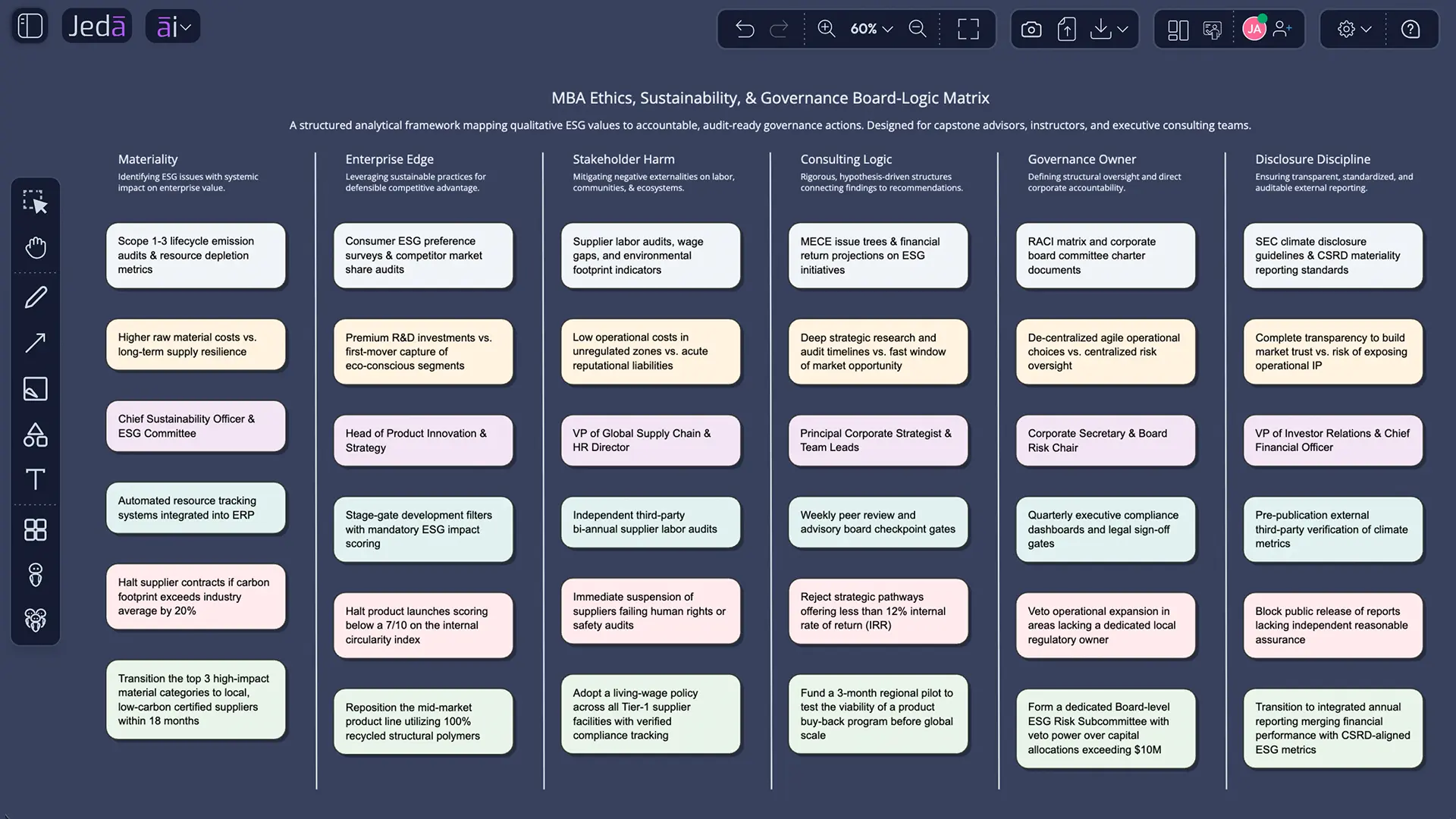
These ideas give the course its footing. Three habits then matter most:
| Teach this | Why it matters if you skip it |
|---|---|
| Durable principles: materiality, stakeholder duties, governance, disclosure, and control | Without them, students produce values language that cannot govern anything |
| Judgment: the discipline to choose under competing duties and name the cost | Without it, they graduate able to sound responsible while avoiding accountability |
| Practical tactics: using AI to compare standards, surface harms, and draft governance options | Without them, responsible AI stays abstract and never meets a board decision |
With those habits in place, an AI draft becomes the equivalent of a first board memo. It may be useful for comparison, but it is not trusted until the evidence, owner, and control can be identified.
What AI reasoning gets wrong in ethics and governance cases
Governance standards are becoming operating standards
ISO/IEC 42001 specifies requirements for establishing, implementing, maintaining, and continually improving an AI management system, and ISO describes it as the world's first AI management system standard. The IFRS Foundation's ISSB materials emphasize decision-useful sustainability information for investors, including governance, strategy, risk management, metrics, targets, and industry-specific disclosures.
Do not leave ethics and sustainability for a reflection paragraph after the case is done. Put them in the decision system itself, where the class tests evidence, names tradeoffs, assigns ownership, and sets controls.
Text-only AI exercises are too thin for this. Students should have to defend a responsible-management decision when an AI memo sounds principled, the evidence is incomplete, and it is tempting to minimize stakeholder harm. Materiality, stakeholder exposure, governance design, disclosure discipline, and human approval need to shape the work from the start.
They also need experience comparing options with AI without handing the responsibility over to it.
Trade comparison work for accountable judgment
Put the board logic on one canvas
Jeda.ai is a visual AI workspace suited to responsible-management work where the reasoning needs to stay visible. It supports framework-based outputs, document and data analysis, a collaborative canvas, and multi-model comparison. On the canvas, students can keep stakeholder evidence, materiality logic, standard references, governance options, control design, and the final board recommendation together.
Begin with the standards, case facts, and decision constraints. Compare more than one model's interpretation only after that, then check each claim against the evidence and the relevant governance owner. A second model may notice a risk that the first one missed. It still cannot decide what duty the organization owes.
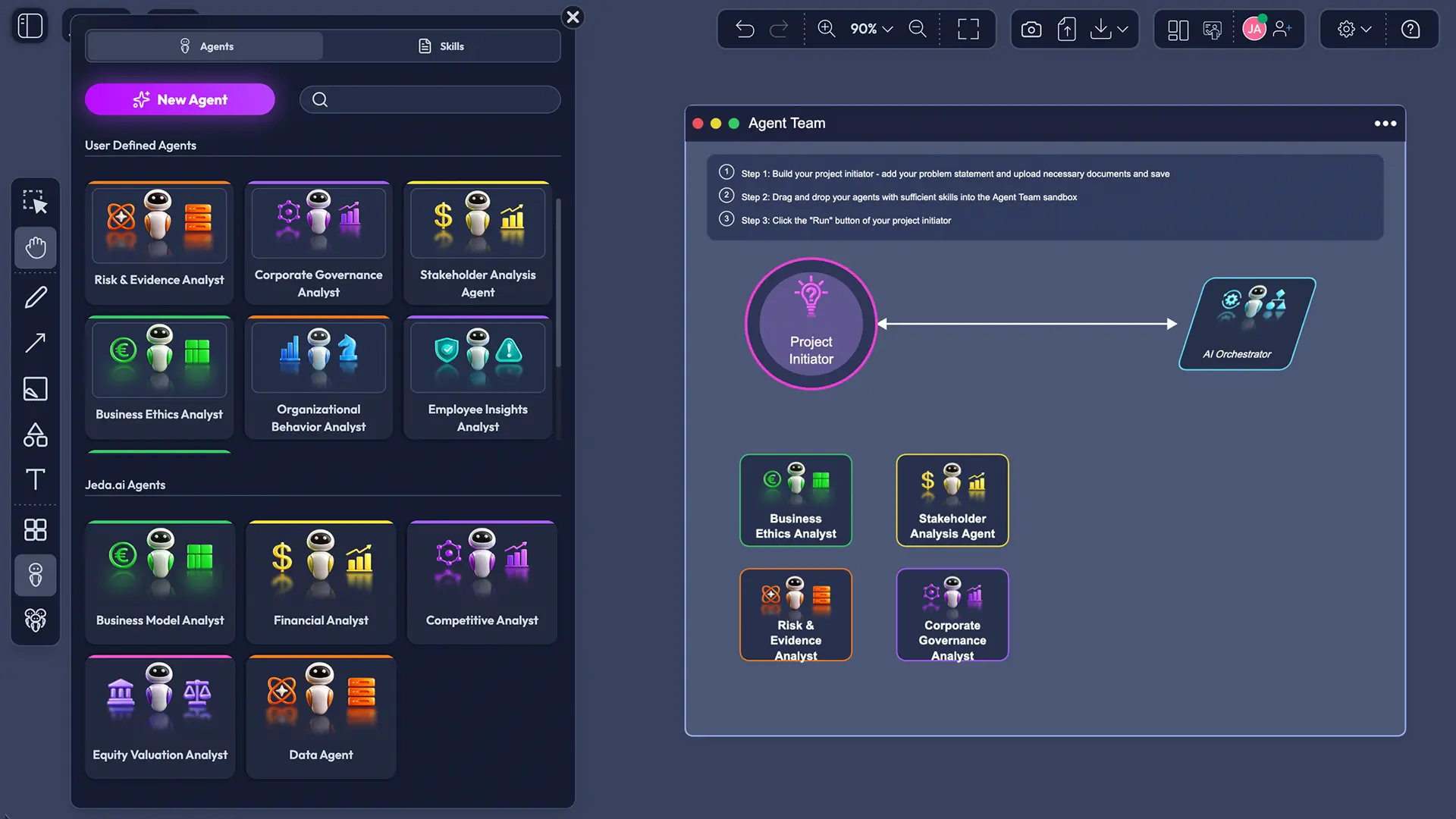
Jeda.ai also offers an agentic MBA case workspace. Students can create, upload, edit, or select a skill; assign it to a specialist agent; and build a small agent team in a sandbox. Before anything runs, the team reviews the Orchestrator's plan, adds the case question and shared files, keeps agent-specific files with the appropriate agent, and resolves any gaps in skills or team roles. In this course, recommendations with legal, reputational, or human consequences should always go through human approval.
The 45-minute board challenge
Build the rest of the course
Extend this activity with the sample syllabus, exercises, quizzes, projects, and instructor guide.
A useful governance assignment should leave students with a simple standard: no responsible claim stands without evidence, an owner, a control, and a consequence.
Fix:
Explore Jeda.ai
Join over 150,000 professionals who trust Jeda.ai for their strategic analysis.
Explore Jeda.ai