Students can now generate product concepts, feature bundles, personas, service blueprints, experiment plans, and launch stories before testing whether a problem is worth solving. The course needs to begin somewhere else: what is the team trying to learn, and which evidence would make it stop?
What AI actually changes about innovation management
Innovation classes have always faced a problem of concept abundance. Teams produce too many ideas and confuse novelty with progress. AI multiplies the supply. A thin problem can turn into twenty polished concepts, each with a name, user story, and pitch.
The course therefore needs learning discipline. Innovation advantage comes from problem framing, assumption testing, prototype learning, resource choices, and a willingness to stop ideas before they consume attention.
Use these lenses to ground case discussions. Together they form a rubric; they do not turn every project into a stage-gate memo:
| Course lens | What students should answer |
|---|---|
| Problem framing | What user, customer, or operating problem is actually worth solving? |
| Assumption risk | Which belief would break the concept if it turned out false? |
| Enterprise edge | Does the innovation build a capability, data loop, brand asset, or operating advantage that compounds? |
| Consulting logic | Can the team turn discovery evidence into a recommendation a sponsor can fund or reject? |
| Prototype learning | What does the prototype need to teach, not just show? |
| Portfolio fit | Why should this idea receive resources instead of other options? |
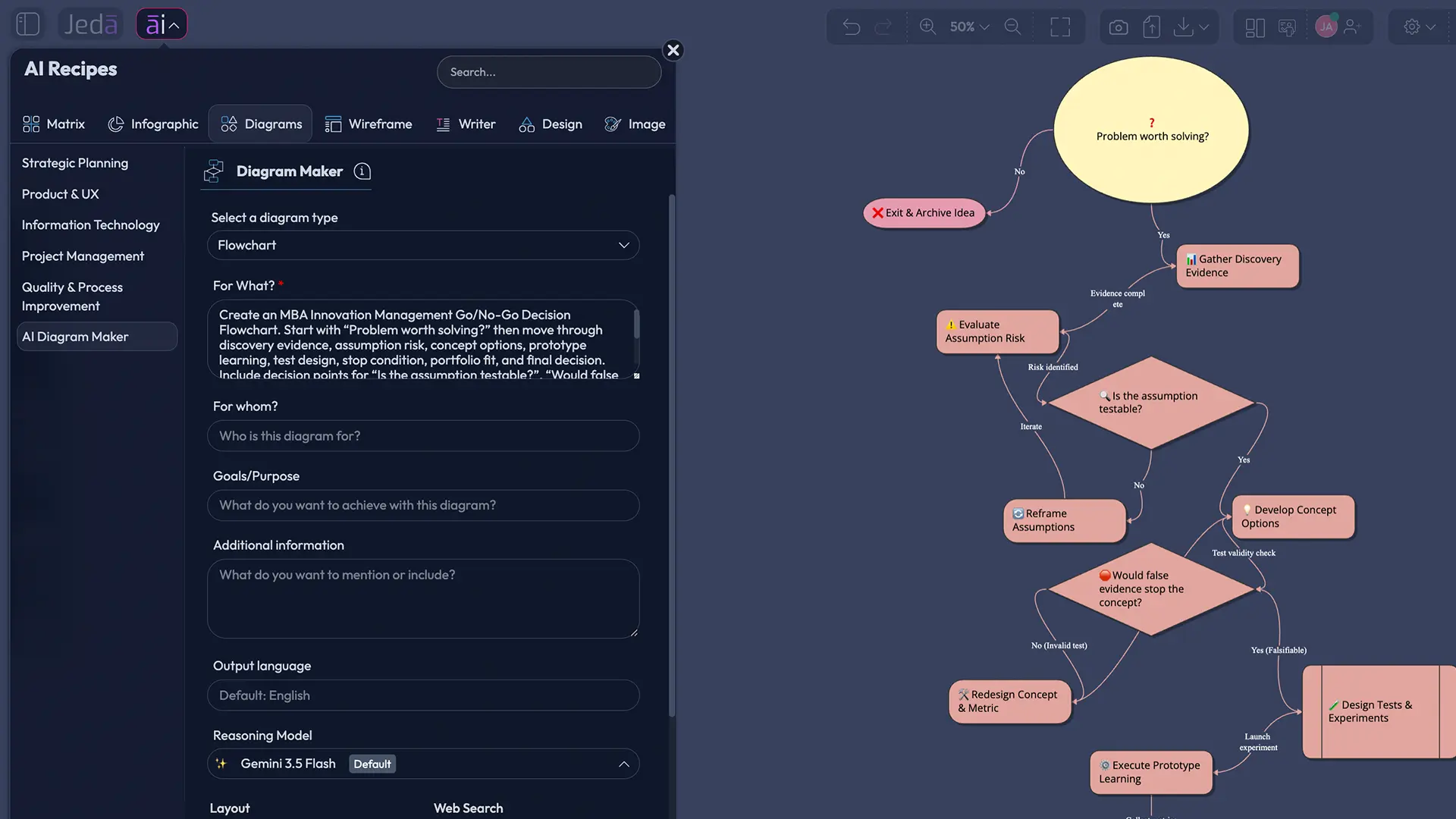
The framework gives the course its foundation. Students then need three habits:
| Teach this | Why it matters if you skip it |
|---|---|
| Durable principles: problem framing, design research, experimentation, and portfolio choice | Without them, students mistake idea volume for innovation capability |
| Judgment: the discipline to rank assumptions and reject attractive concepts | Without it, they graduate with better brainstorms and no learning logic |
| Practical tactics: using AI to generate variations, compare analogies, and design tests | Without them, innovation work stays slower than practice and less explicit about AI risk |
AI output should be treated as raw concept inventory. It is useful to search through, but it has no value until evidence gives it shape.
What AI reasoning gets wrong in innovation cases
Innovation speed is rising. Evidence still matters.
BCG's Most Innovative Companies 2025 report argues that innovation excellence is a moving target and that agentic AI is about to increase the competitive tempo. WIPO's Global Innovation Index 2025 describes innovation systems at a crossroads: AI and quantum technologies are advancing quickly while investment growth slows and collaboration models change.
Students should use AI to tighten the loop between evidence, concept, prototype, decision, and portfolio tradeoff. It cannot be taught as a creativity shortcut.
Text-only AI exercises will not close the gap. Students should defend an innovation decision when the generated concept is attractive, user evidence is thin, and the portfolio has competing demands. Build cases around problem framing, assumption risk, prototype learning, portfolio fit, and resource discipline.
They also need to create more options with AI without confusing them with progress.
Trade variation work for learning work
Put the learning loop on one canvas
Jeda.ai is a visual AI workspace with framework-based outputs, document and data analysis, a collaborative canvas, and multi-model comparison. The canvas can keep discovery notes, problem frames, assumptions, prototype options, experiment results, and portfolio choices in one inspectable space.
Start with discovery evidence and constraints. Compare more than one model's concepts or test designs, then take each promising idea back through the assumption list. A second model can widen the search, but it cannot tell students which problem is worth solving.
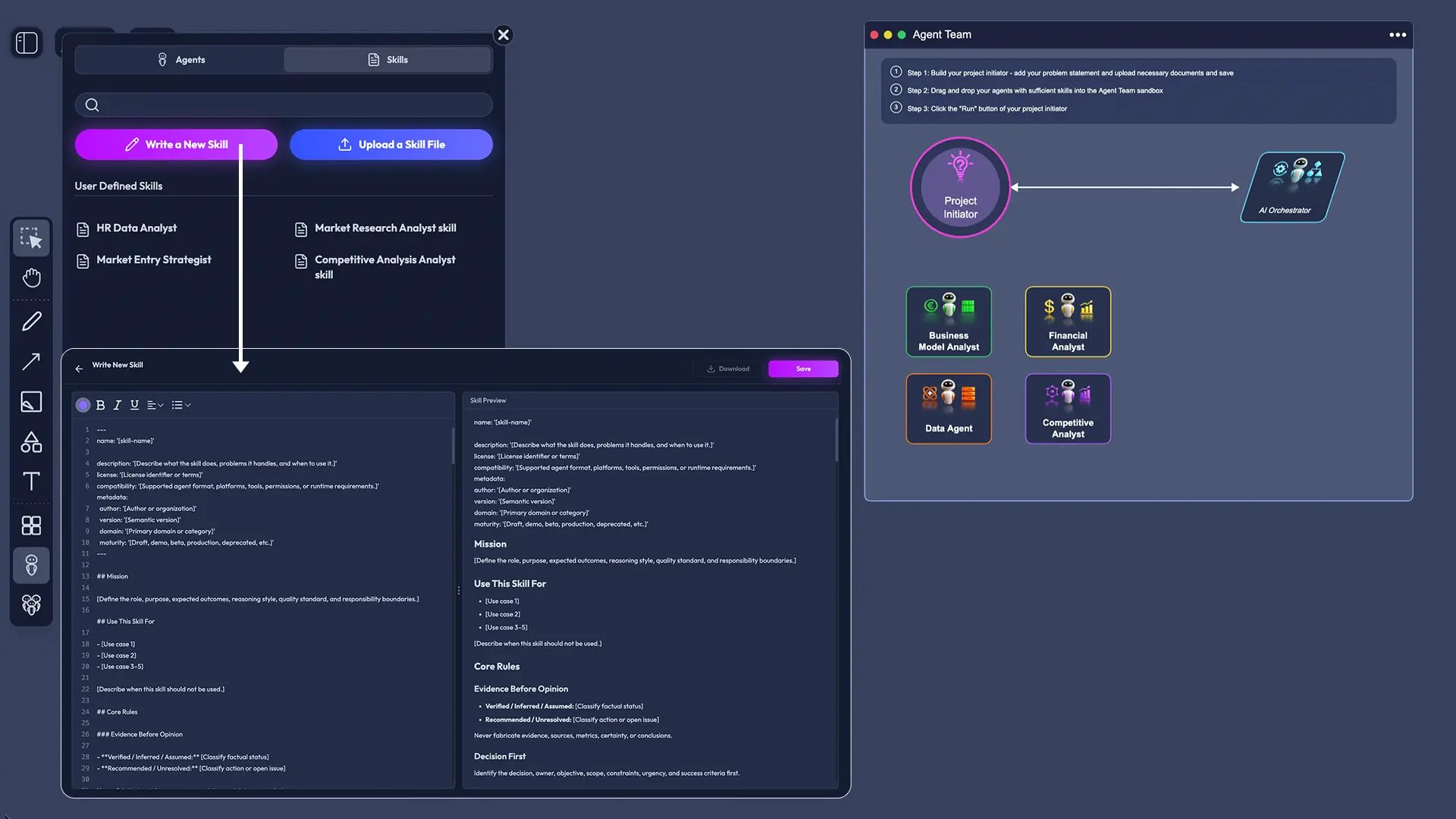
Jeda.ai also offers an agentic MBA case workspace. Students can create, upload, edit, or select a skill; assign it to a specialist agent; and build a small agent team in a sandbox. Before work begins, the team reviews the Orchestrator's plan, adds the case question and shared files, keeps agent-specific files with the right agent, and resolves skill or team gaps. One agent can scan competitors, another can challenge feasibility, and another can draft investor objections, but the team still decides what the evidence means.
The 45-minute kill test
Build the rest of the course
Extend the exercise with the sample syllabus, exercises, quizzes, projects, and instructor guide.
A good innovation project shows that students can learn under uncertainty and spend organizational attention responsibly.
Explore Jeda.ai
Join over 150,000 professionals who trust Jeda.ai for their strategic analysis.
Explore Jeda.ai