A student can now produce a change memo, stakeholder map, communication cadence, training plan, resistance analysis, and pulse-survey questions before they understand the organization behind them. That is useful only after the class has asked a harder leadership question: how do people move, resist, and commit when AI is part of the plan?
What AI actually changes about change leadership
In class, change is often reduced to communication. AI makes that reduction sound more persuasive. Conflict becomes "alignment gaps," fear becomes "stakeholder concerns," and power becomes "engagement needs." A plan can sound humane while offering very little diagnosis.
Bring the focus back to the organization as a social system. AI can widen the map, but leadership still means noticing who has power, who carries the work, who loses status, what behavior must change, and which evidence would show adoption.
Use these lenses as prompts for case discussion. They make a useful rubric, though no single case needs all of them:
| Course lens | What students should answer |
|---|---|
| Stakeholder power | Who can slow, sponsor, reinterpret, or quietly defeat the change? |
| Enterprise edge | Does the change build an organizational capability competitors cannot copy, or only install a tool? |
| Adoption evidence | What behavior, not sentiment, will show that the change is taking hold? |
| Change capacity | Is this group able to absorb one more initiative now? |
| Leadership behavior | What must leaders do in public that proves the change is serious? |
| Consulting logic | Can the team diagnose the adoption problem in a way an executive client would recognize as real? |
The framework covers the content. Students then need three working habits:
| Teach this | Why it matters if you skip it |
|---|---|
| Durable principles: power, incentives, identity, routines, and adoption | Without them, students treat change as messaging and miss the operating system underneath |
| Judgment: the discipline to test whether a plan fits the people who must live with it | Without it, they graduate with polished change decks and weak organizational diagnosis |
| Practical tactics: using AI to map stakeholders, pressure-test adoption risks, and compare interventions | Without them, leadership theory stays separate from the messy case work students will actually face |
An AI response belongs in the same category as a consultant's first draft. It may surface an option, but it cannot read the room for the team.
What AI reasoning gets wrong in change cases
AI change is still change
Prosci's AI adoption research separates implementation from adoption: putting a tool in place is technical work, while getting people to use it well is change work. Prosci reports that 63% of organizations cite human factors as a primary challenge in AI implementation. Microsoft's 2025 Work Trend Index makes the leadership pressure concrete: 82% of leaders said 2025 was a year to rethink strategy and operations, and 81% expected agents to be integrated into their AI strategy within 12 to 18 months.
Leadership courses should treat AI transformation as operating work, not merely a technology rollout. Diagnosis, sponsorship, trust, measurement, and follow-through still decide whether a change holds.
Writing prompts alone will not teach that work. Give students a change decision to defend when the generated plan seems balanced, workforce evidence is partial, and the resistance is politically uncomfortable. The case should require stakeholder power, adoption evidence, change capacity, leadership behavior, and human approval.
They also need a way to use AI without reducing leadership to communications.
Trade mapping work for leadership work
Put the adoption logic on one canvas
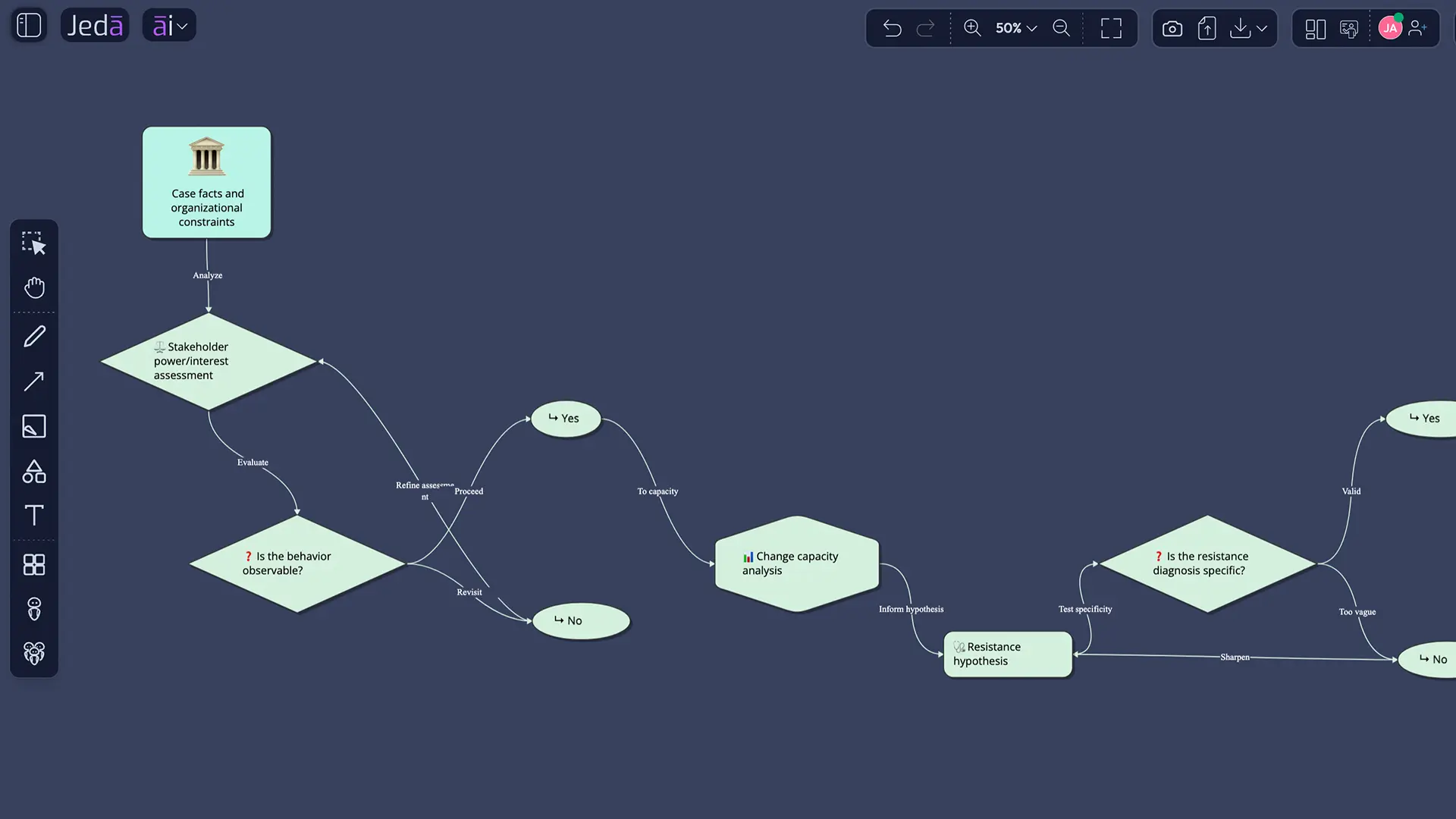
Jeda.ai is a visual AI workspace with framework-based outputs, document and data analysis, a collaborative canvas, and multi-model comparison. In this course, teams can place stakeholder evidence, resistance hypotheses, adoption metrics, communication drafts, leadership commitments, and decision ownership together rather than spreading them across separate chats.
Start with case facts and organizational constraints. Compare how more than one model reads the resistance, then trace every proposed intervention back to evidence. Another model supplies a second interpretation; it does not prove that the organization will move.
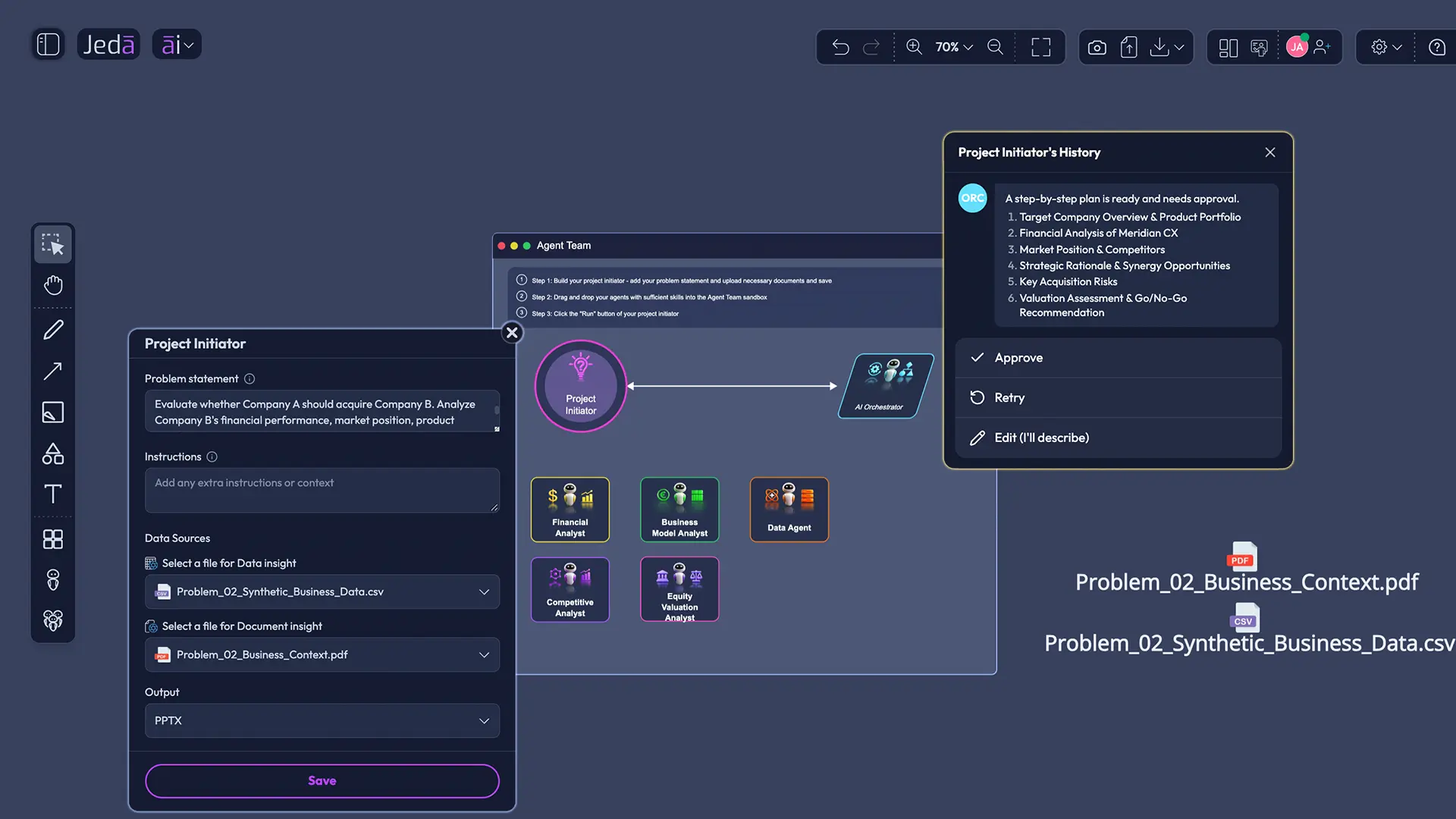
Jeda.ai also offers an agentic MBA case workspace. Students can create, upload, edit, or select a skill; assign it to a specialist agent; and build a small agent team in a sandbox. Before starting, the team reviews the Orchestrator's plan, adds the case question and shared files, keeps agent-specific files with the right agent, and resolves skill or team gaps. The review should also ask whether an agent has been allowed to erase dissent, incentives, or power.
The 45-minute resistance test
Build the rest of the course
Extend the exercise through the sample syllabus, exercises, quizzes, projects, and instructor guide.
The minimum for a useful leadership assignment is one visible behavior change, one honest resistance diagnosis, and a leader accountable after the announcement.
Explore Jeda.ai
Join over 150,000 professionals who trust Jeda.ai for their strategic analysis.
Explore Jeda.ai