Students can now generate issue trees, market scans, benchmark tables, interview guides, executive summaries, and deck outlines before they have tested the client's real question. That makes the consulting process look faster than it is. Start with a basic question: what would we advise the client to do, and which evidence would still hold up when the client pushes back?
What AI actually changes about consulting work
The familiar classroom risk is consulting-shaped performance. Students can learn the slides, frameworks, and executive tone before they understand the discipline underneath. AI makes that easier: a vague prompt can yield a plausible deck outline, a smooth storyline, and a recommendation that appears before the analysis is ready.
The course therefore needs to teach problem-structure discipline. The value of consulting comes from defining the decision, forming a testable hypothesis, selecting evidence that matters, and presenting a story that helps the client act.
Use these lenses across the work. They form a complete rubric, rather than a template for making the deck longer:
| Course lens | What students should answer |
|---|---|
| Problem structure | Is the issue tree decision-driven, clear, and narrow enough to analyze? |
| Hypothesis discipline | What does the team currently believe, and what evidence would prove it wrong? |
| Consulting logic | Can the team produce a recommendation that a client could act on and challenge? |
| Enterprise edge | Does the recommendation build a durable capability or only capture near-term savings? |
| Client context | What constraint, politics, budget, timing, or capability changes the answer? |
| Storyline logic | Does every slide support the answer, or is it just interesting work? |
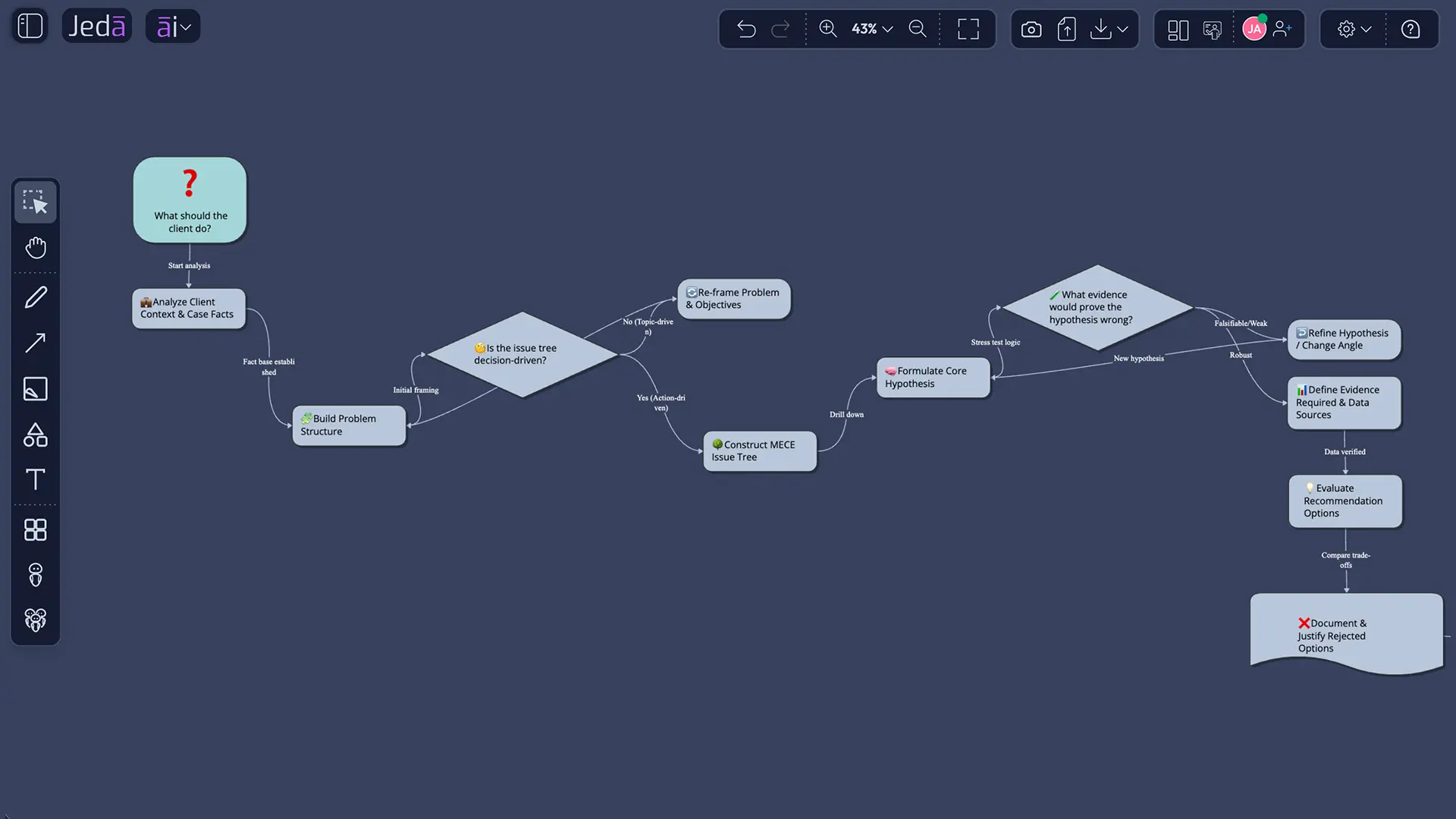
This is the course foundation. From there, students need three habits:
| Teach this | Why it matters if you skip it |
|---|---|
| Durable principles: problem structuring, hypothesis testing, client context, and recommendation logic | Without them, students produce consulting artifacts without consulting judgment |
| Judgment: the discipline to reject generic frameworks and premature answers | Without it, they graduate faster at making decks and no better at advising leaders |
| Practical tactics: using AI to draft, compare, challenge, and document consulting work | Without them, the course misses how junior consulting work is already changing |
When these habits are in place, students can treat AI output like a junior consultant's first draft: useful and quick, but always subject to partner-level questioning.
What AI reasoning gets wrong in consulting cases
The consulting model is changing
Source Global Research estimated the global consulting market would reach $275 billion in 2025, with technology and innovation as the largest service line and strategy consulting forecast to pass $60 billion. Harvard Business Review describes AI as reshaping consulting by automating work traditionally handled by junior consultants, including research, modeling, and analysis.
Consulting education should prepare students to use AI while raising the standard for work that still requires their judgment: problem framing, hypothesis choice, client usefulness, and accountability for the recommendation.
Text-only AI exercises will not close that gap. Students need practice defending advice when an AI draft sounds plausible, the evidence is partial, and client context changes the answer. Build the course around problem structure, hypothesis tests, storyline logic, implementation friction, and rejected options.
They also need to use AI for junior-draft work without allowing it to become the consultant.
Trade junior-draft work for advisory judgment
Put the case logic on one canvas
Jeda.ai is a visual AI workspace for consulting work that needs shared structure and traceable evidence. It supports framework-based outputs, document and data analysis, a collaborative canvas, and multi-model comparison. Use it to keep the client question, issue tree, hypothesis tests, evidence, storyline, risks, and final recommendation together.
Start with the case facts and client constraints. Then compare more than one model's issue tree or storyline, and take every recommendation back to the evidence. A second model can pressure-test the story, but it cannot know client context the team has not supplied.
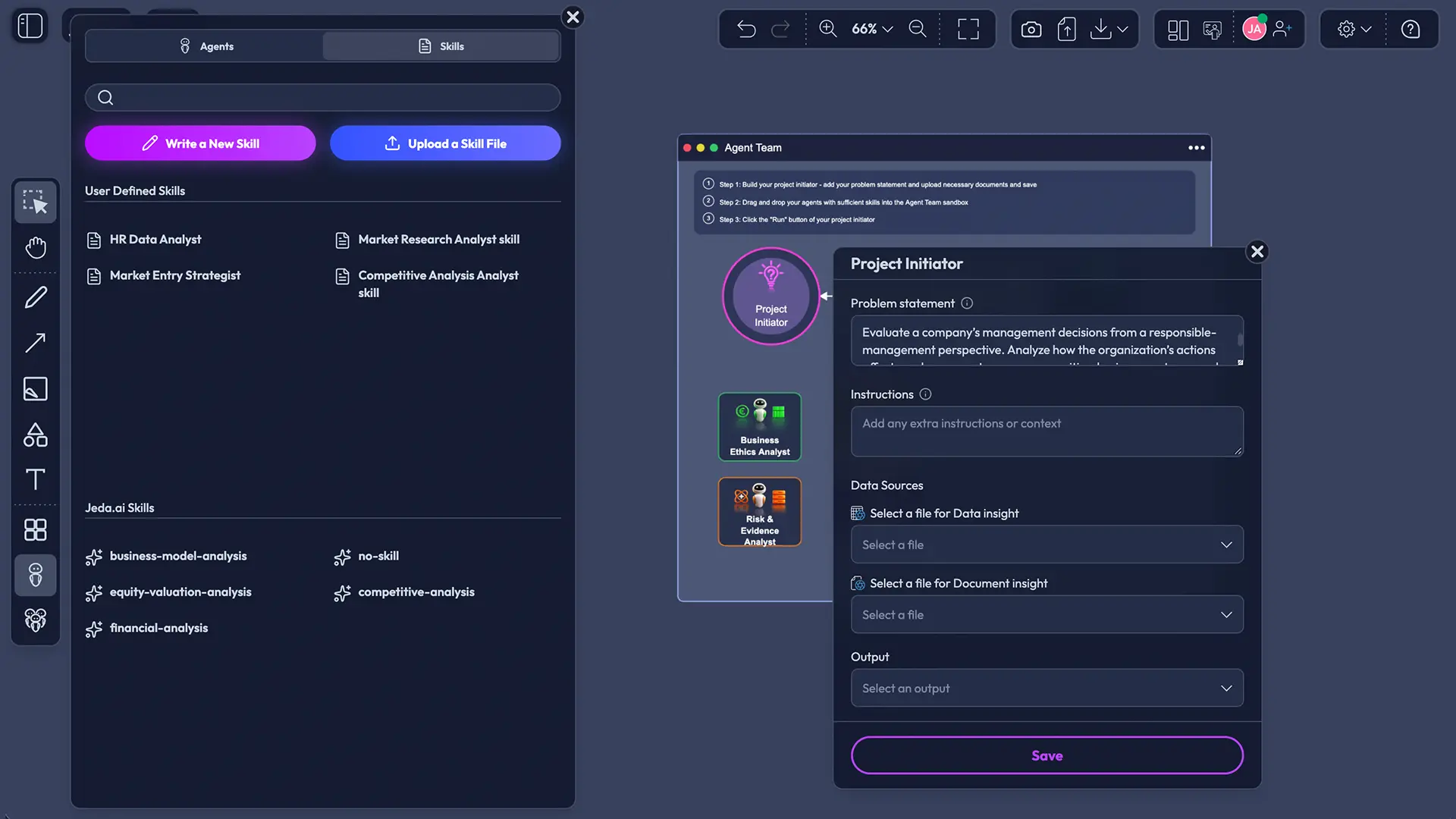
Jeda.ai also offers an agentic MBA case workspace. Students can create, upload, edit, or select a skill; assign it to a specialist agent; and build a small agent team in a sandbox. Before work begins, the team reviews the Orchestrator's plan, adds the case question and shared files, keeps agent-specific files with the right agent, and resolves any skill or team gaps. One agent can scan the market, another can pressure-test the issue tree, and another can draft the storyline. The student team still owns the advice.
The 45-minute red-team recommendation
Build the rest of the course
Extend this activity with the sample syllabus, exercises, quizzes, projects, and instructor guide.
A good consulting course should make students faster. More importantly, it should make them harder to fool with a polished answer.
Explore Jeda.ai
Join over 150,000 professionals who trust Jeda.ai for their strategic analysis.
Explore Jeda.ai