Marketing decisions now arrive with AI already involved. A student can generate personas, journey maps, value propositions, positioning lines, campaign ideas, and channel plans before examining a real customer signal. The course needs to make one distinction clear: which claims are observed, which are inferred, and which did the model invent?
What AI actually changes about customer strategy
Students have always been tempted to jump from a segment label to a campaign idea. AI makes that shortcut quick and polished. A vague customer group becomes a confident persona, a weak insight turns into a finished message, and a synthetic quote can look like research.
The course therefore needs as much evidence discipline as marketing creativity. Customer advantage depends on what the firm knows about customer behavior, which data it has permission to use, how it turns that evidence into a target and promise, and whether the recommendation can be measured after launch.
Use these lenses in case discussions. Together they form a rubric, but each case will call for only four or five. Students should defend the customer decision through the lenses that fit.
| Course lens | What students should answer |
|---|---|
| Customer evidence | Which claims come from observed behavior, interviews, transactions, or research, and which are generated hypotheses? |
| Enterprise edge | Does AI create a customer advantage competitors cannot quickly copy, or does it only make content cheaper to produce? |
| Positioning discipline | Can the team defend the target, promise, proof, and tradeoff behind the positioning choice? |
| Consent and trust | Would customers accept this level of personalization, data use, and automation if it were visible? |
| Consulting logic | Can the team turn customer evidence into a recommendation a client or marketing leader could defend? |
| Measurement logic | What metric will show whether the decision worked, and what result would force a change? |
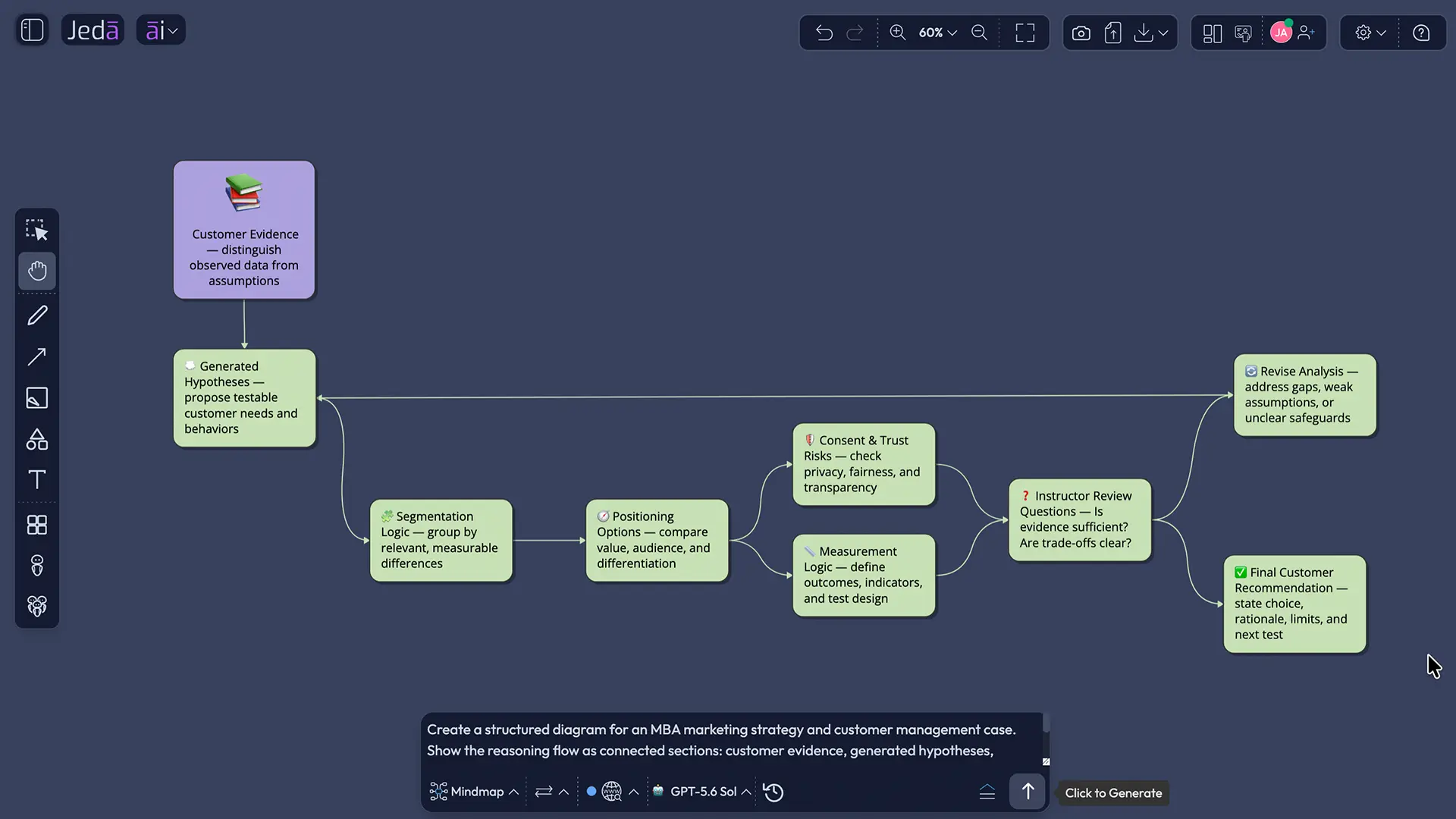
That gives the course a foundation. From there, students need three habits rather than a tour of campaign tools:
| Teach this | Why it matters if you skip it |
|---|---|
| Durable principles: segmentation, targeting, positioning, customer value, and measurement | Without them, students optimize prompts while losing the market logic |
| Judgment: the discipline to separate customer fact from generated hypothesis | Without it, they graduate able to produce marketing assets but unable to defend a customer decision |
| Practical tactics: using AI inside research, segmentation, positioning, and measurement work | Without them, the principles stay clean on paper and never touch a live marketing case |
The useful habit is to treat AI output as a draft from a fast junior marketer. It can suggest directions, but it cannot speak for the customer.
What AI reasoning gets wrong in marketing cases
Adoption is rising. Standards still have to catch up.
Gartner's 2025 CMO survey found that, among marketing organizations already using GenAI, 77% had adopted it for creative development and 48% for strategy development. Nielsen's 2025 Annual Marketing Report shows the measurement problem that sits beside that adoption: only 32% of global marketers said they measure media spending across both digital and traditional channels. Inside business schools, AACSB's 2025 GenAI adoption report found that 47% of responding deans said their school follows an AI or GenAI policy, while 45% said it does not.
AI use is already part of marketing education. Students will use it for creative development, message testing, customer synthesis, and strategy whether the course plans for it or not. The standard is whether they can recognize an output that should be ignored.
Text-only AI exercises will not close the gap. Students should defend a marketing decision when the output looks polished, customer evidence is incomplete, and the metric has not yet proved the claim. Put segmentation, positioning, privacy, attribution, and measurement in the same assignment, with the evidence trail counted in the grade.
They also need to use AI to speed up marketing work without letting it invent the customer.
Trade sorting work for customer decision work
Put the customer evidence on one canvas
Jeda.ai is a visual AI workspace with framework-based outputs, document and data analysis, a collaborative canvas, and multi-model comparison. For this course, it can hold research excerpts, segment maps, journey friction, positioning options, metric logic, and the final recommendation on one screen. The team can inspect its reasoning instead of reconstructing it from a private chat thread.
Start with approved sources and customer constraints. Compare outputs from more than one model, then check each useful claim against the original evidence. A second model can challenge the first model's answer, but it is not independent customer research. Students need that distinction early.
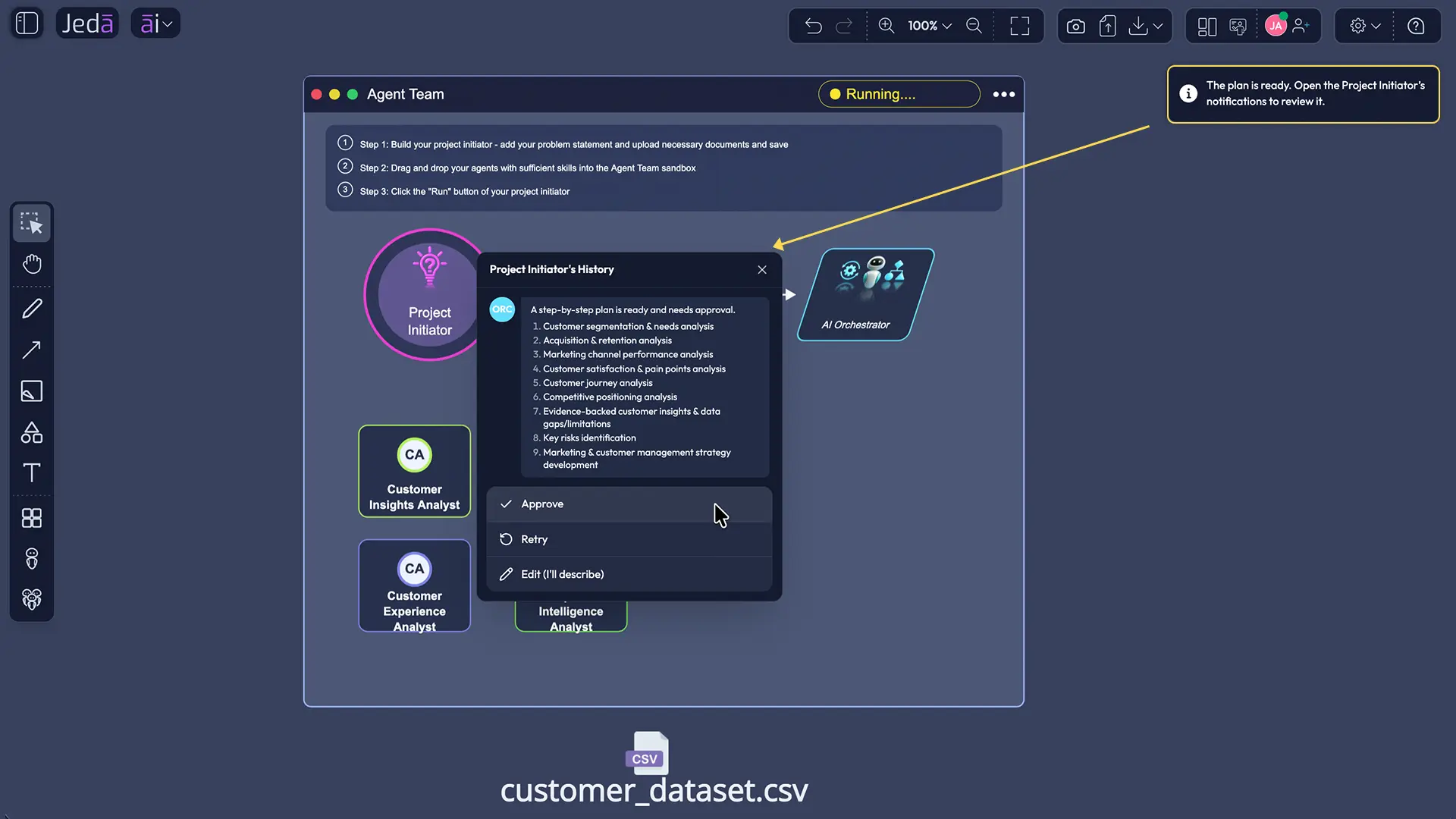
Jeda.ai also offers an agentic MBA case workspace. Students can create, upload, edit, or select a skill; assign it to a specialist agent; and build a small agent team in a sandbox. Before work begins, the team reviews the Orchestrator's plan, adds the case question and shared files, keeps agent-specific files with the right agent, and resolves skill or team gaps. In marketing, the review should ask whether an agent is being allowed to invent customers, claims, or evidence.
The 45-minute segment test
Build the rest of the course
Use the sample syllabus, exercises, quizzes, projects, and instructor guide to extend the activity.
A useful pilot does not need a perfect campaign. It needs one customer choice, one attractive AI recommendation the team rejected, and evidence for that rejection.
Explore Jeda.ai
Join over 150,000 professionals who trust Jeda.ai for their strategic analysis.
Explore Jeda.ai