Teaching business and corporate strategy with AI gives MBA faculty a practical playbook for AI-assisted case analysis, with classroom diagnostics, case rubrics, syllabus frameworks, and visual workspaces that turn faster student work into defensible strategic judgment.
AI has quietly moved ahead of the syllabus. Students can now generate a strategy memo before they understand the market boundary, the causal logic, or the risk behind the recommendation. Teaching business and corporate strategy with AI brings that gap into the open and gives instructors a practical way to grade judgment, evidence, and decision ownership.
What AI actually changes about enterprise advantage
Access to AI is not a moat. Competitors can use the same models. What differs is the data a firm brings to the model, how quickly it notices a change, and whether its governance makes an AI-supported decision reliable enough to use. Access is commoditized; disciplined use is not.
Use the following lenses in case discussions. The full set works as a rubric, but a case will usually need only three or four of them.
| Course lens | What students should answer |
|---|---|
| Enterprise edge | How does AI change industry structure, operating advantage, and the firm's ability to defend a position against rivals? |
| New moat | Does the advantage come from proprietary data, faster sensing, better scenario discipline, or governance that makes AI-supported strategy reliable? |
| Evidence and risk | Does the recommendation rest on traceable evidence, realistic assumptions, and risk controls leadership can defend, or does it rest on a confident-sounding output? |
| Corporate scope | Does AI change which businesses the firm should be in, where to expand, divest, integrate, or partner rather than build? |
| Execution capability | Can the firm actually implement this AI-enabled strategy, given its talent, change-management capacity, and workforce readiness? |
| Compliance and ethical exposure | Does the recommendation account for the data privacy, IP, bias, and compliance risk created by using AI at this scale? |
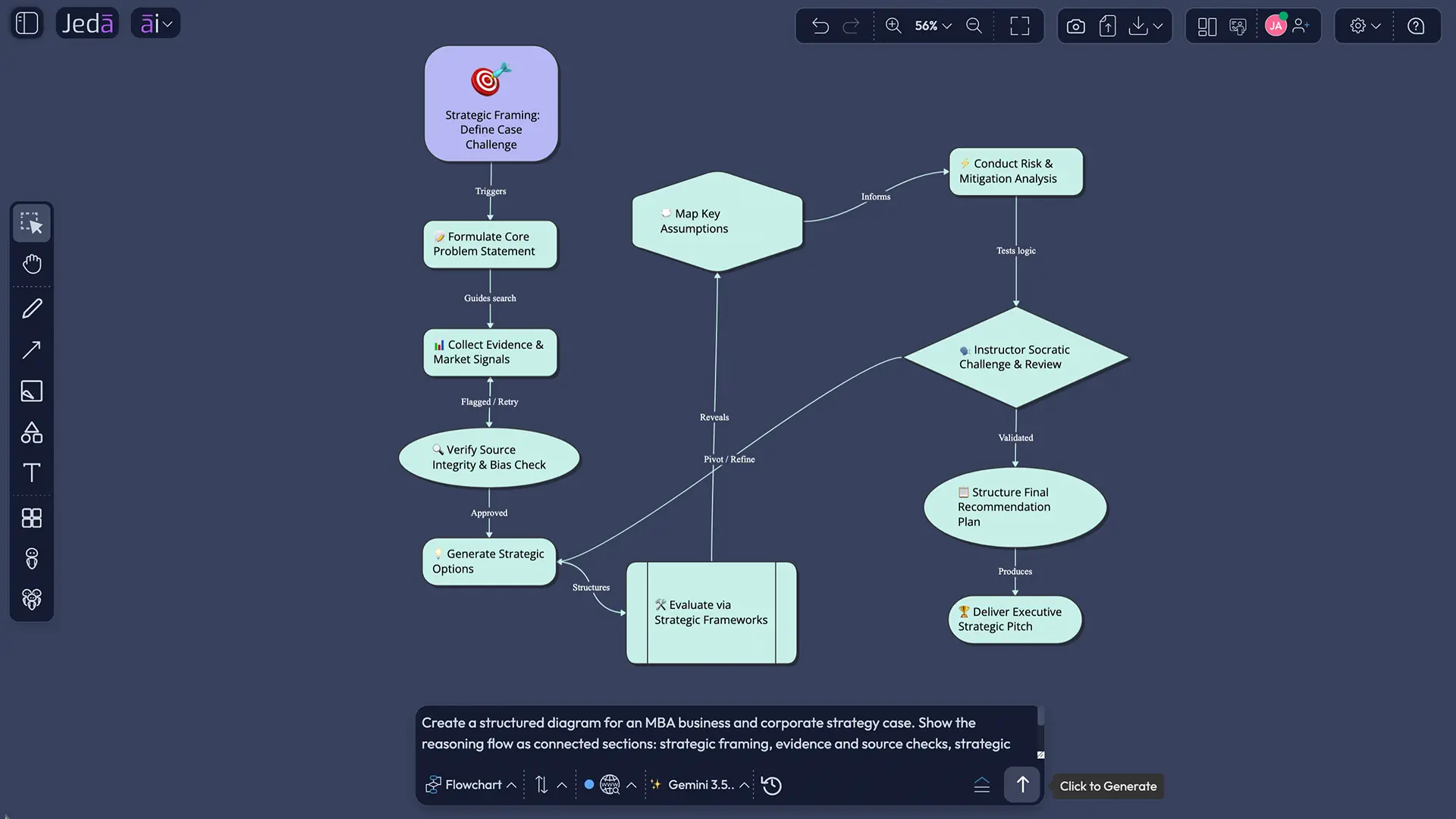
That framework gives the course its starting point. Students then need to learn how to work with AI, not just describe its effects. Three areas belong together:
| Teach this | Why it matters if you skip it |
|---|---|
| Durable principles - how these models reason, and where that reasoning breaks down | Without it, students memorize this year's tool and understand nothing about next year's |
| Judgment - the discipline to catch a confident output that's wrong | Without it, you graduate students who can prompt but cannot defend a decision in front of a board |
| Practical tactics - how to put AI to work inside a live case by Monday morning | Without it, the principles stay theoretical and never touch a real decision |
The intended habit is simple: treat an AI output as a useful junior-associate memo. It may help, but it still has to be checked by the person making the recommendation.
What AI reasoning gets structurally wrong
The adoption gap is small and closing very fast. The judgment gap isn't.
The syllabus problem is no longer whether students will adopt AI. They already have. The missing piece is verification: testing an output before treating it as evidence or advice.
Text-only AI exercises are not enough. Students should have to defend a management decision when evidence, assumptions, and model output point in different directions. Put AI operating logic, data advantage, model risk, scenario uncertainty, and human approval into graded cases instead of treating them as stand-alone topics.
Teaching business and corporate strategy with AI also asks business school faculty AI tools to serve pedagogy, not replace it. The goal is teaching strategic judgment in the AI era, with human oversight and a verifiable paper trail built into every case submission.
They also need practical routines for using AI without handing it the analysis.
Trade collection work for decision work
The course sequence can build that habit in stages:
- Strategy Foundations and Industry Analysis
Students define the market boundary, identify industry pressure, and connect claims to traceable evidence.
- Corporate Scope and Portfolio Choices
Students decide where to expand, divest, integrate, partner, or reject a tempting option.
- Scenario Planning and Strategic Uncertainty
Students compare possible futures, separate assumptions from evidence, and defend a choice under uncertainty.
The capstone is a board-ready recommendation. It should name its source evidence, flag AI-generated material, document the student's revisions, and identify the decision owner. A reader needs to be able to separate the model's contribution from the student's own reasoning.
Put the whole chain of reasoning on one canvas
Jeda.ai is a visual AI workspace with framework-based outputs, document and data analysis, a collaborative canvas, and multi-model comparison. In this course, a team can keep its industry map, scenario matrix, source notes, and final recommendation on one screen. That makes the reasoning chain easier to inspect than a set of disconnected chat threads.
Start with approved sources and constraints. Then compare outputs from more than one model and check each claim against the original evidence before submission. A second model supplies another output, not an independent source. Students need to learn that distinction early.
For teaching business and corporate strategy with AI, Jeda.ai works as the visual AI canvas for collaborative MBA case reasoning. It gives faculty a visual workspace for MBA students who need to show the collaborative reasoning chain, not just submit a polished answer.
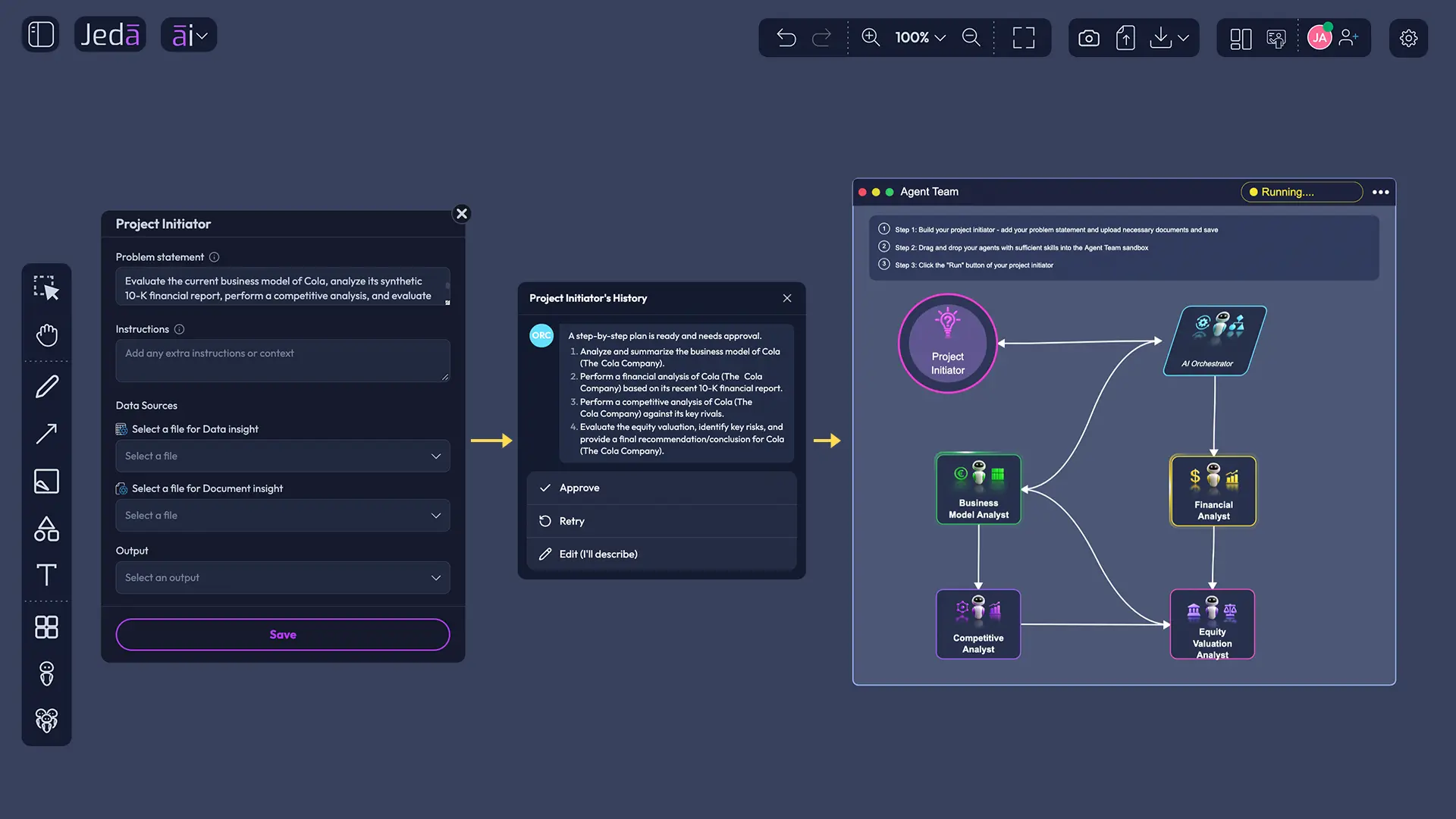
Jeda.ai also offers an agentic MBA case workspace. Students can create, upload, edit, or select a skill; assign it to a specialist agent; and build a small agent team in a sandbox. Before work starts, the team reviews the Orchestrator's plan, adds the case question and shared files, keeps agent-specific files with the right agent, and resolves skill or team gaps. Reviewing the plan means the team approves an approach rather than simply accepting what the agents return.
For a broader instructor hub, use the Jeda.ai MBA teaching resources.
The 45-minute test that reveals everything
Build the rest of the course
Use the sample syllabus, exercises, quizzes, projects, and instructor guide to extend the activity.
A useful pilot ends with one strategic choice, one rejected alternative, and the evidence that separated them.
FAQ
- What does teaching business and corporate strategy with AI require?
- It requires instructors to grade judgment, evidence quality, decision ownership, and the reasoning chain behind AI-assisted work.
- Why are text-only AI exercises not enough?
- Text-only exercises can hide weak reasoning. Students should show evidence, assumptions, model output, corrections, and the final decision in one package.
- How should instructors treat AI output in strategy cases?
- Treat AI output like a junior-associate memo. It may help, but students must verify it before using it as evidence or advice.
- Where does Jeda.ai fit in the course?
- Jeda.ai gives students a shared visual workspace where the industry map, scenario matrix, source notes, agent workflow, and final recommendation can stay connected.
- What should the 45-minute diagnostic test reveal?
- It should reveal whether students can define the industry, check evidence, compare AI outputs, defend tradeoffs, and own a decision under uncertainty.
Explore Jeda.ai
Join over 150,000 professionals who trust Jeda.ai for their strategic analysis.
Explore Jeda.ai