The fastest analyst in your MBA class may now be a chat window with suspicious confidence and zero accountability. Ignore it, and students outsource judgment. Teach it well, and every valuation becomes a defense of evidence. That is the real work of teaching corporate finance with AI.
Teaching Capital Allocation and AI-Era Valuation Evidence in MBA Corporate Finance
How do you evaluate AI in MBA corporate finance cases?
The familiar classroom risk is formula practice. Students can calculate value without taking ownership of the business judgment inside the assumptions. AI makes that risk more convincing. It can summarize filings, explain ratios, draft scenarios, and produce analyst-style prose before the revenue case, discount rate, peer set, or downside logic has been tested.
The course therefore needs assumption discipline. Corporate-finance advantage comes from deciding how capital should be allocated when forecasts are uncertain, incentives are imperfect, and the cost of being wrong is real.
Use these lenses across cases. They form a full rubric, but they do not replace the finance model:
| Course lens | What students should answer |
|---|---|
| Capital allocation | Which use of capital creates the strongest risk-adjusted value? |
| Valuation evidence | Which assumptions come from filings, market data, management guidance, or operating evidence? |
| Enterprise edge | Does the financing or investment choice strengthen a durable source of advantage? |
| Consulting logic | Can the team turn financial analysis into a recommendation a finance leader or review board could challenge? |
| Risk and downside | What breaks the recommendation, and how bad is the downside? |
| Incentives and governance | Who benefits from the decision, who approves it, and what agency problem could distort it? |
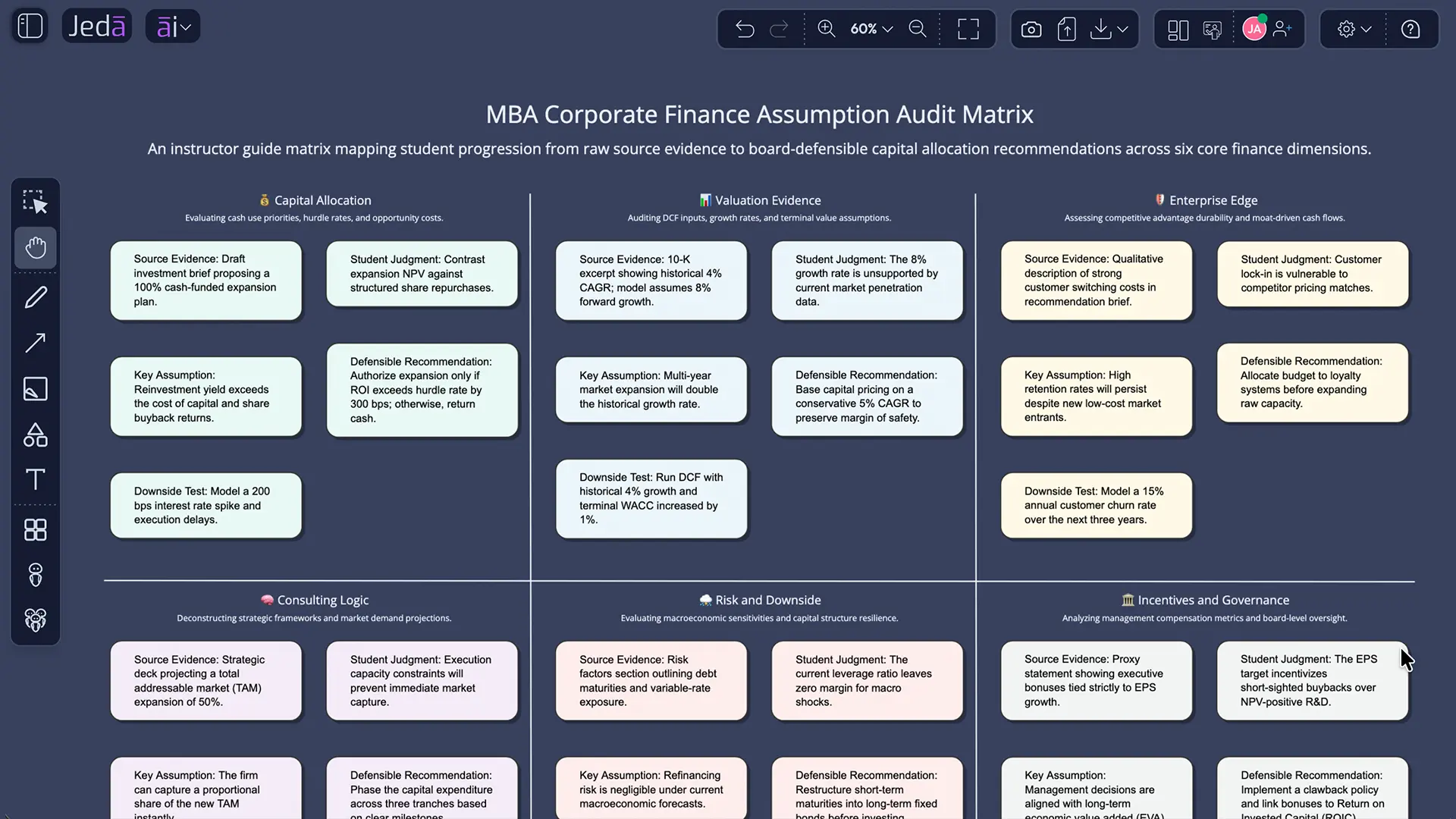
That is the course foundation. From there, students need three habits.
- Durable principles
Teach capital budgeting, valuation, capital structure, risk, and governance so students do not produce model-shaped answers without finance judgment.
- Judgment
Require students to defend, revise, or reject assumptions under uncertainty instead of merely explaining model mechanics.
- Practical tactics
Use AI to collect evidence, challenge assumptions, and document model logic without outsourcing the final decision.
With all three in place, students can treat AI output like a junior analyst's memo: useful for collecting evidence and challenging assumptions, but never allowed to approve a capital decision.
What AI Reasoning Gets Wrong in Finance Cases
Why the Classroom Standard Must Be Explainable
AI belongs in corporate finance when students can test valuation logic, inspect assumptions, explain uncertainty, and decide what a finance leader should approve. It cannot substitute for financial reasoning. That is the responsible-use standard for finance classrooms: students may use AI to accelerate evidence review, but they still own the judgment gap.
Text-only AI exercises will not close that gap. Students need practice defending capital decisions when an AI recommendation sounds like an analyst memo, the spreadsheet is fragile, and the downside case changes the decision. Build the course around valuation evidence, capital-structure tradeoffs, risk, incentives, governance, and explainability.
They also need to use AI to collect and challenge finance work without letting it launder assumptions.
Teaching Financial Reasoning vs. Raw AI Output in MBA Finance
Use the modules in this order to build that discipline across an MBA corporate finance syllabus framework:
- Valuation and Capital Budgeting
Require students to connect valuation inputs to source evidence and explain which assumptions drive the decision.
- Capital Structure and Payout Policy
Make students test financing choices against risk, flexibility, incentives, and governance constraints.
- Working Capital and Risk Decisions
Use operating scenarios and downside cases to show how short-term choices can alter enterprise value and resilience.
- Submit the evidence trail
Require the prompt record, source list, raw AI output, student corrections, model assumptions, and final decision in one submission.
A spreadsheet counts as evidence only when students can explain what changed and why.
Put the Valuation Logic on One Canvas
Jeda.ai is a visual AI workspace for finance work that should not stay buried in a private chat thread. It supports framework-based outputs, document and data analysis, a collaborative canvas, and multi-model comparison. For this course, use the canvas to keep source excerpts, assumption drivers, valuation outputs, sensitivity tables, financing tradeoffs, risk flags, and the final recommendation in an inspectable workspace.
For teaching corporate finance with AI, the canvas turns a private prompt exchange into an AI-enabled finance classroom where MBA finance students can review evidence together.
Start with approved source documents and model constraints. Then compare more than one model's interpretation, and check each useful claim against the source evidence and finance logic. A second model can challenge an assumption, but it is not an independent source. Students need that distinction early.
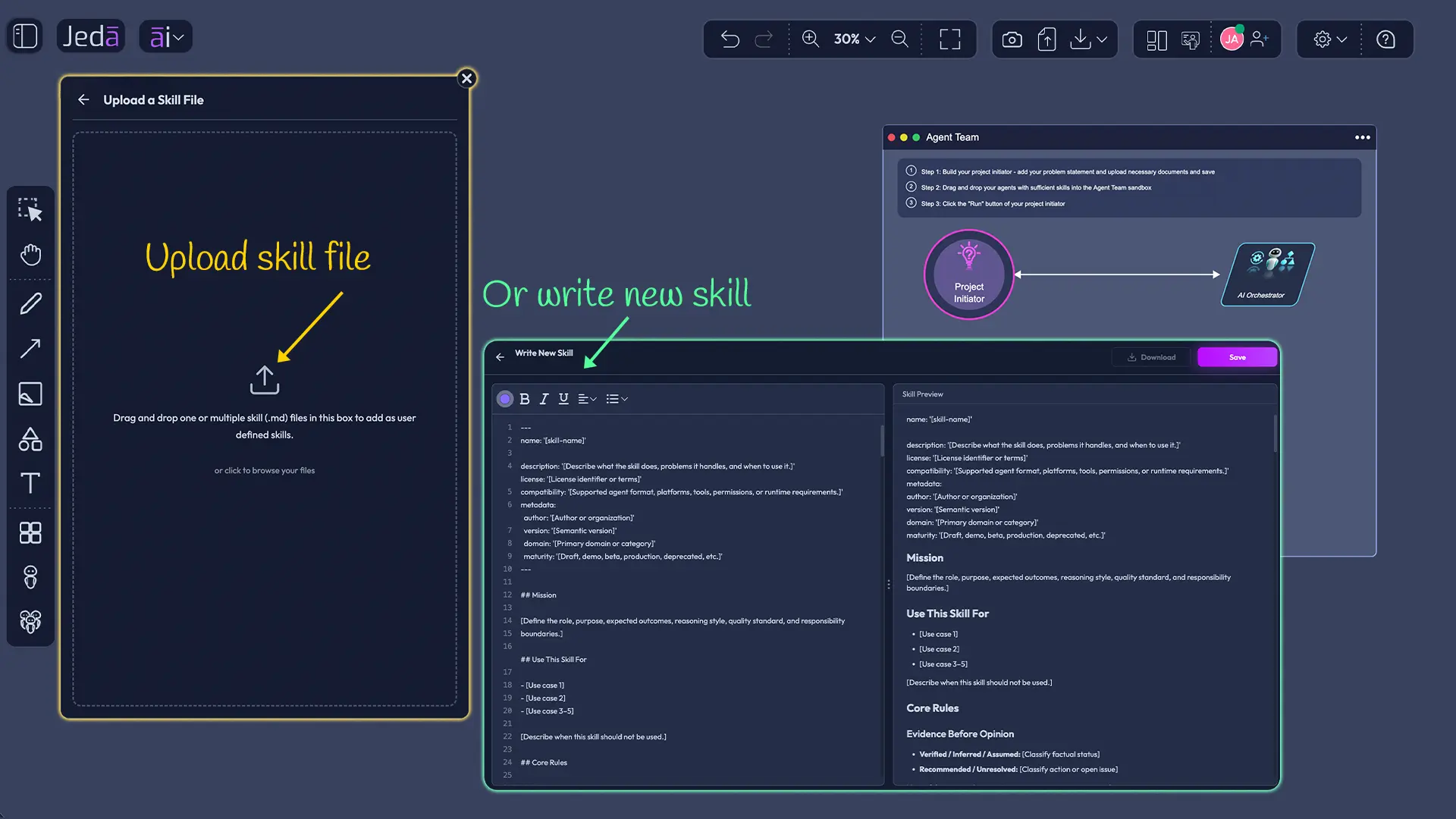
Jeda.ai also offers an agentic MBA case workspace. Students can create, upload, edit, or select a Skill; assign it to a specialist Agent; and build a small Agent Team in a sandbox. Before execution, the team reviews the Orchestrator's plan, adds the case question and shared files, keeps agent-specific files with the right Agent, and resolves any Skill or team gaps. One Agent can review source documents, another can challenge assumptions, and another can test downside cases. The student team still approves the recommendation.
Classroom Diagnostic: The 45-Minute AI Valuation Case Audit
Use this diagnostic with a short company pack, a simple discounted cash flow model, and an AI-generated investment recommendation. Give teams 45 to 60 minutes.
Assess five things: evidence quality, assumption logic, valuation discipline, risk treatment, and governance awareness. Require the final submission to include the prompt, source list, raw AI output, team corrections, rejected assumption, and final recommendation. The verifiable paper trail belongs with the work being assessed.
Do not reward a polished valuation when the assumptions are unsupported. In corporate finance, fluency is cheap and capital is not.
Frequently Asked Questions
- How should instructors evaluate AI use in MBA corporate finance cases?
- Evaluate the quality of evidence, assumption logic, valuation discipline, downside analysis, and governance awareness. Students should show their prompt, source trail, raw AI output, corrections, rejected assumptions, and final recommendation so the instructor can assess both the model and the judgment applied to it.
- Should students be allowed to use AI for DCF analysis?
- Yes, if AI supports analysis rather than replaces judgment. Students can use it to review source documents, explain model mechanics, draft scenarios, or challenge assumptions, but they should still defend revenue drivers, discount-rate logic, terminal assumptions, and the recommendation that follows from the model.
- What is the biggest risk of AI-generated finance analysis?
- The biggest risk is unsupported confidence. AI can produce polished language and internally consistent calculations while relying on weak, missing, or invented assumptions. The classroom response is to require an evidence trail and explicit assumption labels before students are allowed to defend the final valuation.
- How can an instructor make AI reasoning visible to the class?
- Keep source excerpts, assumptions, model outputs, sensitivity results, risk flags, and the final recommendation in one shared visual workspace. Students can then compare what the AI proposed with the evidence used to support or reject it, making the reasoning path inspectable rather than hidden in private chat threads.
- Why compare more than one AI model in a finance case?
- Different models can surface different assumptions, interpretations, or weaknesses. The value is not that a second model becomes a second source; it is that disagreement gives students something to investigate. They still need to verify every material claim against the approved evidence and finance logic.
- What should students submit after an AI-assisted valuation exercise?
- A strong submission includes the original prompt, approved source list, raw AI output, corrected assumptions, model inputs, sensitivity analysis, rejected claims, and the final recommendation. This creates a verifiable paper trail and makes it possible to grade judgment rather than presentation polish alone.
- How long should an AI valuation case diagnostic take?
- A focused classroom diagnostic can run in about 45 to 60 minutes when students receive a short source pack, a simple valuation model, and an AI-generated recommendation. The goal is not to rebuild the entire model but to find the assumptions and sensitivities that actually change the decision.
- What habit should students leave an AI-assisted corporate finance course with?
- They should learn that every valuation is only as good as the assumptions they are willing to defend. AI can accelerate evidence review and challenge reasoning, but the student remains responsible for linking claims to evidence, explaining uncertainty, and owning the final capital-allocation judgment.
Build the Rest of the Course
Extend this activity with a sample syllabus, exercises, quizzes, projects, and an instructor guide. This gives business school faculty a practical path for MBA corporate finance curriculum AI integration without replacing financial judgment with unverified AI output.
A useful corporate-finance assignment should leave students with one habit: every valuation is only as good as the assumptions a finance leader is willing to defend.
Explore Jeda.ai
Build visible, collaborative AI workflows for analysis, evidence review, and decision-ready classroom work.
Explore Jeda.ai