If your students can generate a campaign before finding a customer signal, the course has a judgment problem hiding inside a productivity win. The faculty who catch this early will teach better marketing decisions, not prettier guesses. Welcome to teaching marketing strategy and customer management with AI.
Teaching Customer Evidence & AI-Era Segmentation in MBA Marketing
Students have always been tempted to jump from a segment label to a campaign idea. AI makes that shortcut quick and polished. A vague customer group becomes a confident persona, a weak insight turns into a finished message, and a synthetic persona or synthetic quote can look like research.
The course therefore needs as much evidence discipline as marketing creativity. Customer advantage depends on what the firm knows about customer behavior, which data it has permission to use, how it turns that evidence into a target and promise, and whether the recommendation can be measured after launch.
How do you evaluate AI in MBA marketing strategy cases?
Use six course lenses in case discussions. Together they form a rubric, but each case will call for only four or five. Students should defend the customer decision through the lenses that fit.
| Course lens | What students should answer |
|---|---|
| Customer evidence | Which claims come from observed behavior, interviews, transactions, or research, and which are generated hypotheses? |
| Enterprise edge | Does AI create a customer advantage competitors cannot quickly copy, or does it only make content cheaper to produce? |
| Positioning discipline | Can the team defend the target, promise, proof, and tradeoff behind the positioning choice? |
| Consent and trust | Would customers accept this level of personalization, data use, and automation if it were visible? |
| Consulting logic | Can the team turn customer evidence into a recommendation a client or marketing leader could defend? |
| Measurement logic | What metric will show whether the decision worked, and what result would force a change? |
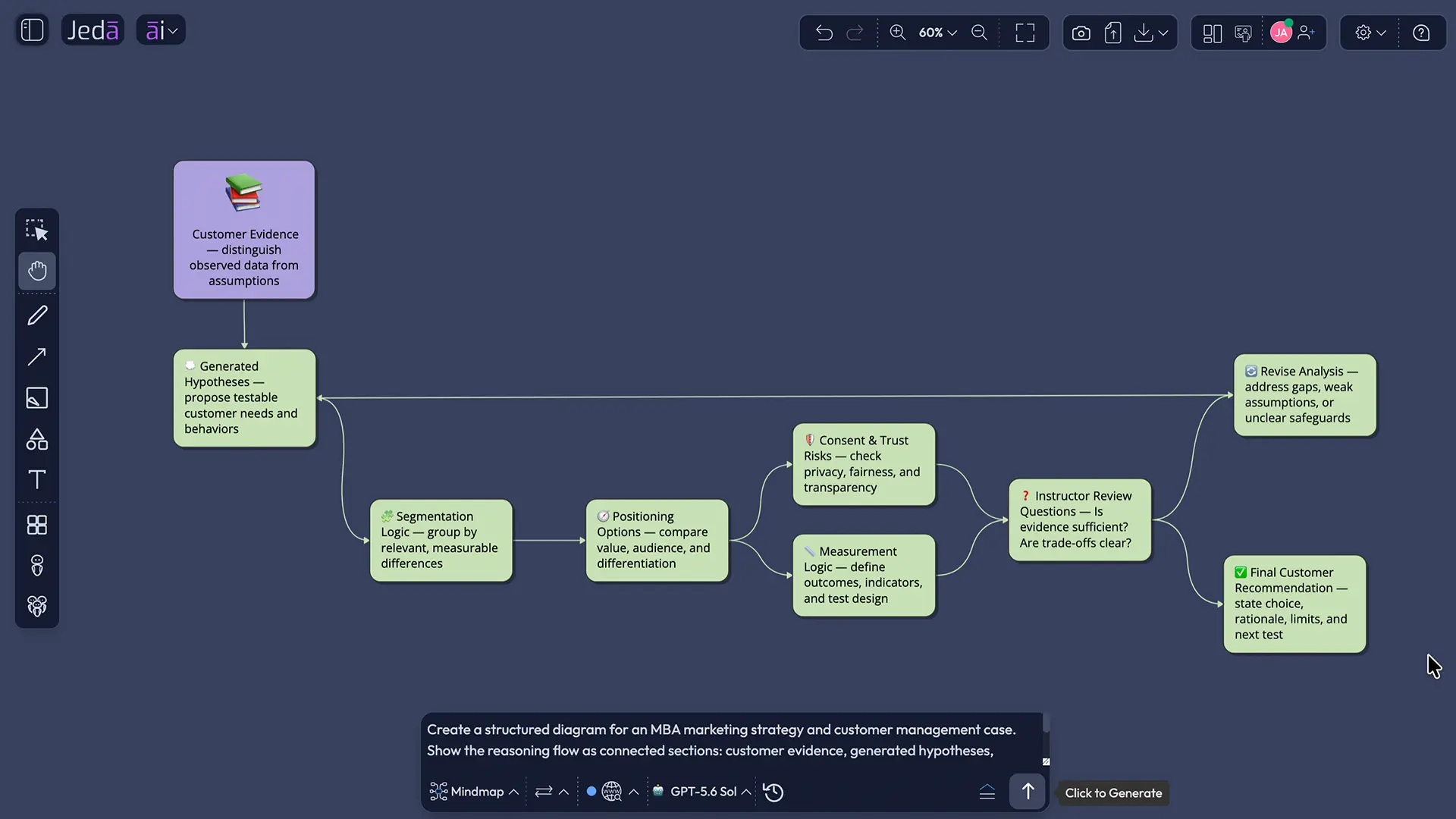
That gives the course a foundation. From there, students need three habits rather than a tour of campaign tools:
| Teach this | Why it matters if you skip it |
|---|---|
| Durable principles: segmentation, targeting, positioning, customer value, and measurement | Without them, students optimize prompts while losing the market logic. |
| Judgment: the discipline to separate customer fact from generated hypothesis | Without it, they graduate able to produce marketing assets but unable to defend a customer decision. |
| Practical tactics: using AI inside research, segmentation, positioning, and measurement work | Without them, the principles stay clean on paper and never touch a live marketing case. |
- Durable Principles
Keep segmentation, targeting, positioning, customer value, and measurement at the center of the work.
- Evidence Judgment
Separate observed customer facts from generated hypotheses before accepting a recommendation.
- Applied Tactics
Use AI inside research and strategy work without allowing output speed to replace market logic.
The useful habit is to treat AI output as a draft from a fast junior marketer. It can suggest directions, but it cannot speak for the customer.
What AI reasoning gets wrong in marketing cases
Adoption is rising. Standards still have to catch up.
Recent 2025 industry surveys show how quickly practice is moving: among marketing organizations already using generative AI, 77% reported adoption for creative development and 48% for strategy development. A separate marketing measurement survey found only 32% of global marketers measured spending across both digital and traditional channels. A business-school adoption survey also found a split in institutional policy adoption, with 47% of responding deans reporting an AI or generative AI policy and 45% reporting none.
AI use is already part of marketing education. Students will use it for creative development, message testing, customer synthesis, and strategy whether the course plans for it or not. The standard is whether they can recognize an output that should be ignored.
Text-only AI exercises will not close the gap. Students should defend a marketing decision when the output looks polished, customer evidence is incomplete, and the metric has not yet proved the claim. Put segmentation, positioning, privacy, attribution, and measurement in the same assignment, with the evidence trail counted in the grade.
They also need to use AI to speed up marketing work without letting it invent the customer.
Trade sorting work for customer decision work
Put the customer evidence on one canvas
Jeda.ai is a visual AI workspace with framework-based outputs, document and data analysis, a collaborative canvas, and multi-model comparison. For this course, it can hold research excerpts, segment maps, journey friction, positioning options, metric logic, and the final recommendation on one screen.
For teaching marketing strategy and customer management with AI, the workspace becomes a visual AI workspace for MBA customer management cases: the team can inspect its reasoning instead of reconstructing it from a private chat thread.
Start with approved sources and customer constraints. Compare outputs from more than one model, then check each useful claim against the original evidence. A second model can challenge the first model's answer, but it is not independent customer research. Students need that distinction early.
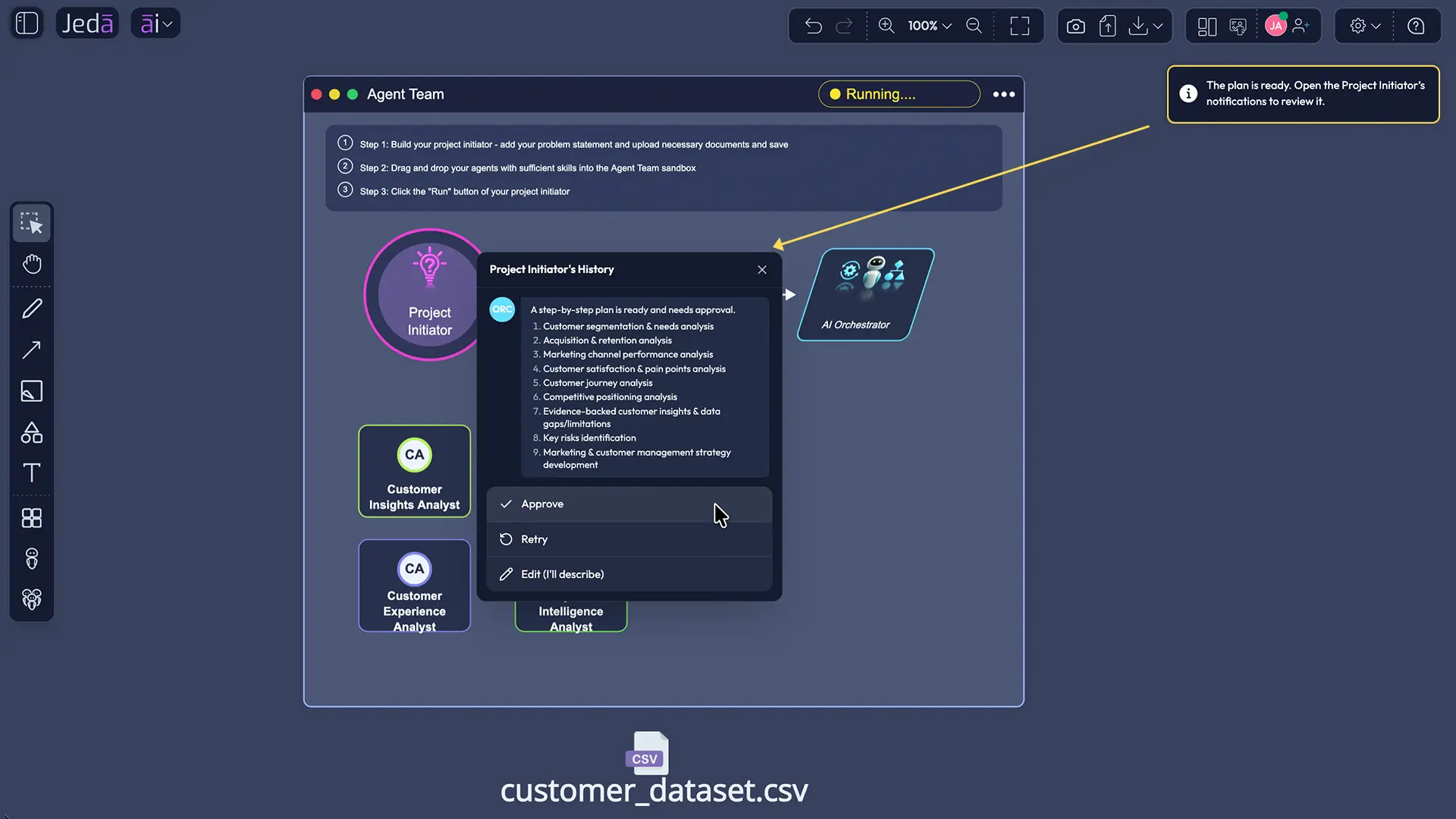
Use the agentic case workspace as a controlled classroom workflow, not as an autopilot. The teaching move is to make students justify why each specialist role exists: a research agent may summarize customer evidence, a positioning agent may generate alternatives, and a skeptical reviewer may challenge segment logic, consent risk, or measurement assumptions.
Before execution, the team reviews the plan and decides what evidence each role is allowed to use. The assessment question is not whether the agents produced a polished answer; it is whether the class can see where each customer claim came from, what was rejected, and who approved the final recommendation.
Classroom Diagnostic: The 45-Minute AI Marketing Case Test
Run this AI marketing strategy classroom diagnostic test to show where customer judgment breaks down. Give teams a customer dataset, a short market brief, and one AI-generated segmentation. Give them 45 to 60 minutes.
- Build the evidence-backed segment view
Separate observed customer signals from generated assumptions and show the source trail behind each meaningful claim.
- Compare two AI interpretations
Run the same customer problem through two reasoning paths and identify where their segment logic, assumptions, or recommendations diverge.
- Defend one positioning recommendation
Choose one direction and explain the target, promise, proof, tradeoff, and evidence supporting the decision.
- Submit the verification trail
Include the prompt, source list, raw AI output, team corrections, rejected segment or message, and final decision.
Grade with a marketing case study verification rubric: customer evidence, segment logic, positioning clarity, metric choice, and privacy judgment. Do not grade the result apart from its verifiable paper trail.
The exercise also makes policy practical. A 2025 business-school adoption survey reported that only 13% of responding schools required AI or generative AI training for students. Marketing makes the risks visible: invented customers, weak consent, poor targeting, and recommendations that no one can defend.
Build the rest of the course
Use the sample syllabus, exercises, quizzes, projects, and instructor guide to extend the activity. This gives business school faculty a practical path for MBA marketing curriculum AI integration without replacing human judgment in AI-supported marketing.
A useful pilot for teaching marketing strategy and customer management with AI does not need a perfect campaign. It needs one customer choice, one attractive AI recommendation the team rejected, and evidence for that rejection.
Frequently Asked Questions
- How should MBA instructors evaluate AI-generated marketing recommendations?
- Evaluate the evidence trail behind the recommendation, not just the polish of the output. Students should distinguish observed customer facts from generated hypotheses, defend segment logic and positioning choices, identify the success metric, and explain what evidence would make them change the decision.
- How can AI be used in customer segmentation assignments?
- Use AI to organize evidence, suggest segment hypotheses, compare alternative interpretations, and surface patterns. Students should still prove that segments differ in needs, behavior, access, or willingness to pay before treating an AI-generated label as a meaningful customer segment.
- What should students submit with an AI-supported marketing case?
- Require the prompt, source list, relevant raw AI output, student corrections, rejected alternatives, final recommendation, and a short explanation of why the team accepted or rejected key claims. This makes reasoning visible and gives instructors a defensible basis for assessment.
- Why compare more than one AI interpretation?
- Comparing interpretations helps students see that a fluent answer is not automatically authoritative. Differences in assumptions, segmentation logic, and positioning recommendations create useful material for critique, but a second AI answer still does not count as independent customer evidence.
- What is the role of human approval in an agentic classroom workflow?
- Human approval keeps the workflow accountable. Students review the proposed plan, decide what evidence each specialist role may use, and approve execution only after the workflow makes sense. That turns orchestration itself into part of the learning exercise.
- How can a visual AI workspace improve marketing strategy teaching?
- A visual AI workspace can keep customer evidence, segment maps, journey friction, positioning alternatives, metrics, rejected ideas, and final recommendations visible together. This makes it easier for instructors and students to inspect how the decision developed instead of relying on an isolated chat transcript.
- What is the main risk of AI-generated personas in marketing education?
- The main risk is treating a coherent synthetic persona as verified research. Generated personas often appear internally consistent even when the underlying market evidence is weak. Instructors should require source-backed claims and clearly mark unsupported persona details as hypotheses.
- What makes a strong AI marketing classroom diagnostic?
- A strong diagnostic gives students imperfect customer evidence, an AI-generated interpretation, a time limit, and a requirement to defend one decision. The grading rubric should reward evidence quality, reasoning, correction of AI output, and the team's ability to explain what it rejected.
Explore Jeda.ai for Visual AI Marketing Strategy Work
Build evidence-backed marketing cases, compare reasoning, and keep student decisions visible in one collaborative AI workspace.
Explore Jeda.ai