A 30-60-90 day sales plan gives a new rep, sales manager, or territory owner a phased roadmap for the first three months of execution. The format is popular because it breaks an otherwise fuzzy ramp period into concrete objectives, actions, and measurable checkpoints. And when you build it inside Jeda.ai, you’re not just drafting another document. You’re using an AI Workspace and AI Whiteboard that can structure the plan, refine the logic, and turn the final output into a reusable operating artifact for your team.
That matters. Most first-draft sales plans are too vague, too optimistic, or too generic. They list activity, but not capability-building. They name KPIs, but not review cadence. They sound busy. Not useful. Jeda.ai fixes that by giving you a structured Writer Recipe, Prompt Bar refinement, and the option to extend or convert the plan visually after generation. For teams that want clarity without the formatting slog, that’s the real win.
With 150,000+ users, 300+ strategic frameworks, and a flexible Visual AI workflow, Jeda.ai gives sales teams a practical way to move from rough intent to a plan that can actually be reviewed, edited, and used.
What is a 30-60-90 day sales plan?
A 30-60-90 day sales plan is a phased action plan for the first ninety days in a sales role, a new territory, or a changed go-to-market motion. Recent business guidance consistently describes it as a three-stage roadmap that helps salespeople learn the business, begin execution, and then optimize performance over time. In practice, the phases usually move from learning, to activation, to performance optimization.
Unlike some classic management frameworks, this format does not have one universally agreed original creator in the literature. It is better understood as an operational planning convention used in onboarding, role transition, and territory ramping. That distinction matters. You should not treat it like a named theory from a single author. You should treat it like a practical structure that becomes stronger when paired with sound goal design, onboarding discipline, and measurable feedback loops.
That’s where the academic logic enters. Goal-setting research shows that specific, challenging, and feedback-supported goals improve performance more reliably than vague intentions. Structured onboarding research also shows that formal onboarding programs, especially those extending over weeks or months, improve adjustment and readiness. So the 30-60-90 format works best when it is not just a checklist. It should be a staged learning-and-performance system.
Why generate a 30-60-90 day sales plan with AI?
Because blank pages waste time. And sales ramp plans often fail for a very predictable reason: the writer knows the destination but not the structure.
AI helps in three ways.
First, it removes the first-draft friction. You can give Jeda.ai your role, territory, ICP, motion, quota expectations, internal stakeholders, and review rhythm, and the platform can turn that into a structured first version quickly.
Second, it improves specificity. A good plan should separate learning goals, pipeline goals, relationship goals, and output metrics. Most people blend them together. Jeda.ai helps you keep those categories distinct, which makes manager review dramatically easier.
Third, it keeps the work editable. This is not a dead-end text generator. Jeda.ai is an AI Workspace and AI Whiteboard, so once the draft exists, you can revise sections, extend them with the AI+ button, or transform the material into a different format for presentations, coaching, or team discussion.
- Sharper Goals
Turn vague intentions into specific milestones, KPIs, and weekly actions across each 30-day phase.
- Faster First Draft
Generate a usable version in minutes instead of building structure from scratch in a doc editor.
- Better Phase Logic
Separate learning, execution, and optimization so the plan reads like an operating sequence, not a wish list.
- Manager Alignment
Make check-ins easier by linking every phase to review points, dependencies, and measurable expectations.
- Reusable Workflow
Adapt one strong prompt or Writer Recipe into versions for SDRs, AEs, sales managers, or new territories.
- Visual Follow-Through
Use Vision Transform to turn the final plan into a matrix, mind map, or flow-based coaching view.
How to create a 30-60-90 day sales plan in Jeda.ai
Jeda.ai supports two practical methods for this page’s use case.
Method 1 uses the AI Menu and the Writer Recipe. This is the recommended path when you want a guided structure and faster consistency.
Method 2 uses the Prompt Bar. This is better when you already know the exact context, role assumptions, and desired output format.
And there is a third layer worth understanding: AI+. AI+ is excellent for extending an existing section once the draft is on the canvas. It is not the ideal place to dump a totally new, highly detailed brief from scratch. Think of it as controlled expansion, not a replacement for the initial planning prompt.
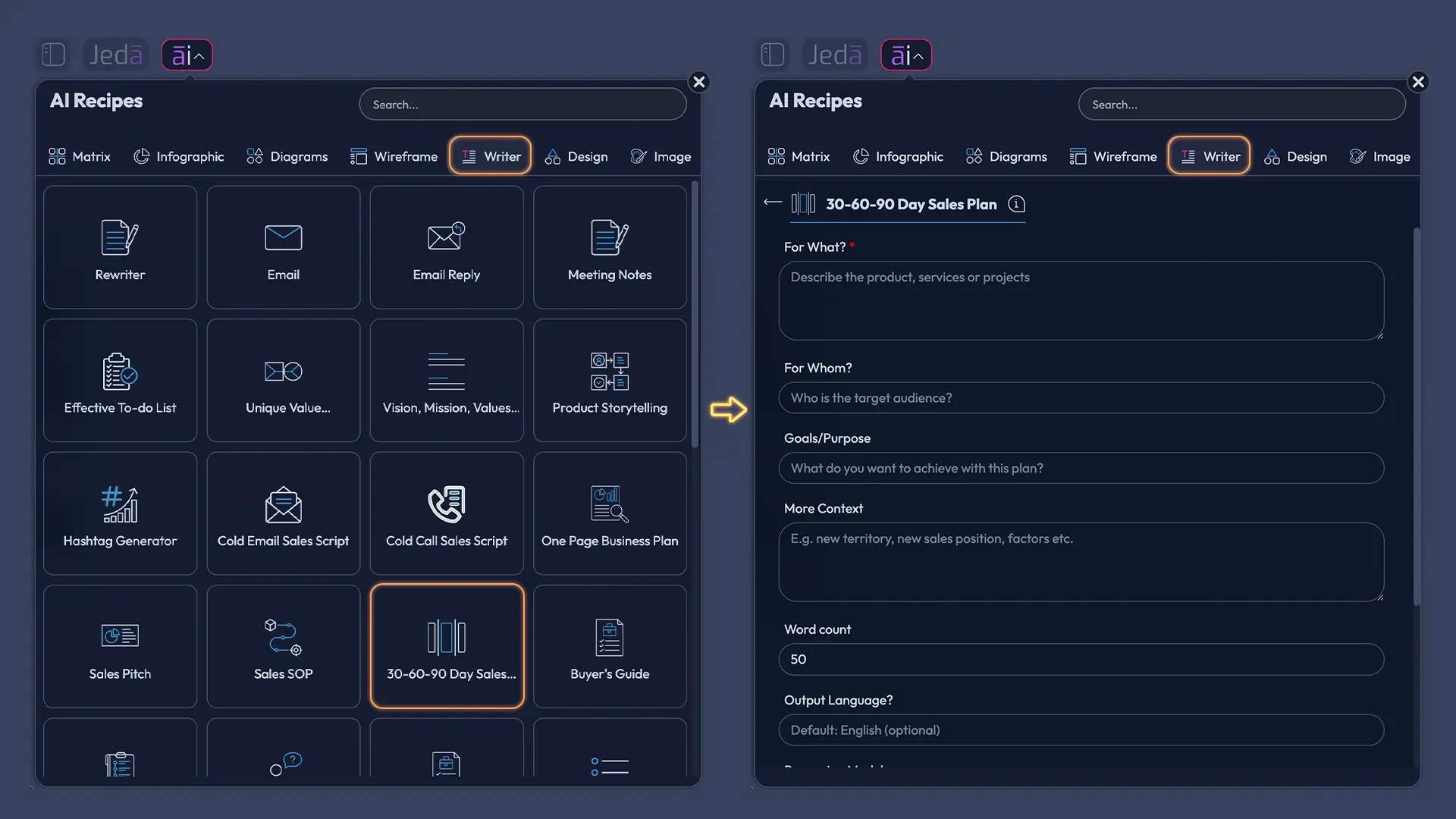
Method 1: Writer Recipe
Open the AI Menu from the top-left corner, choose Writer, and select the 30-60-90 Day Sales Plan recipe. Then fill in the planning brief. The best inputs are concrete: sales role, market or territory, target segment, expected pipeline sources, success metrics, onboarding constraints, and manager expectations.
The advantage here is structure. Jeda.ai’s recipe flow guides the output so your first draft already looks like a staged plan rather than a loose memo. Inside an AI Workspace, that saves time. Inside an AI Whiteboard, it also keeps the result easy to review alongside related notes, screenshots, or supporting strategy content.
Method 2: Prompt Bar
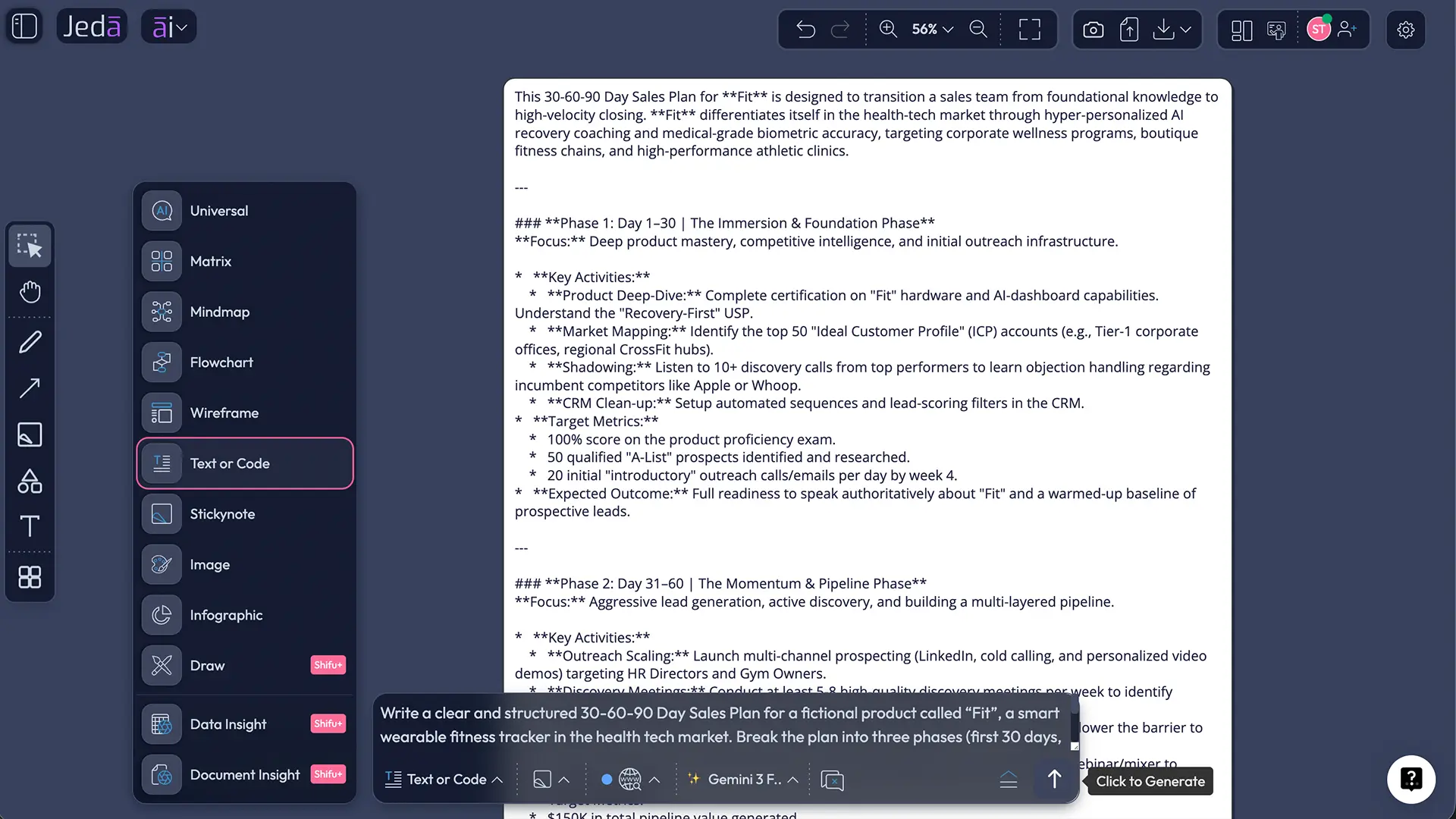
Open the Prompt Bar, select Text or Code, and switch the rendering option to Document. Then enter a direct prompt such as:
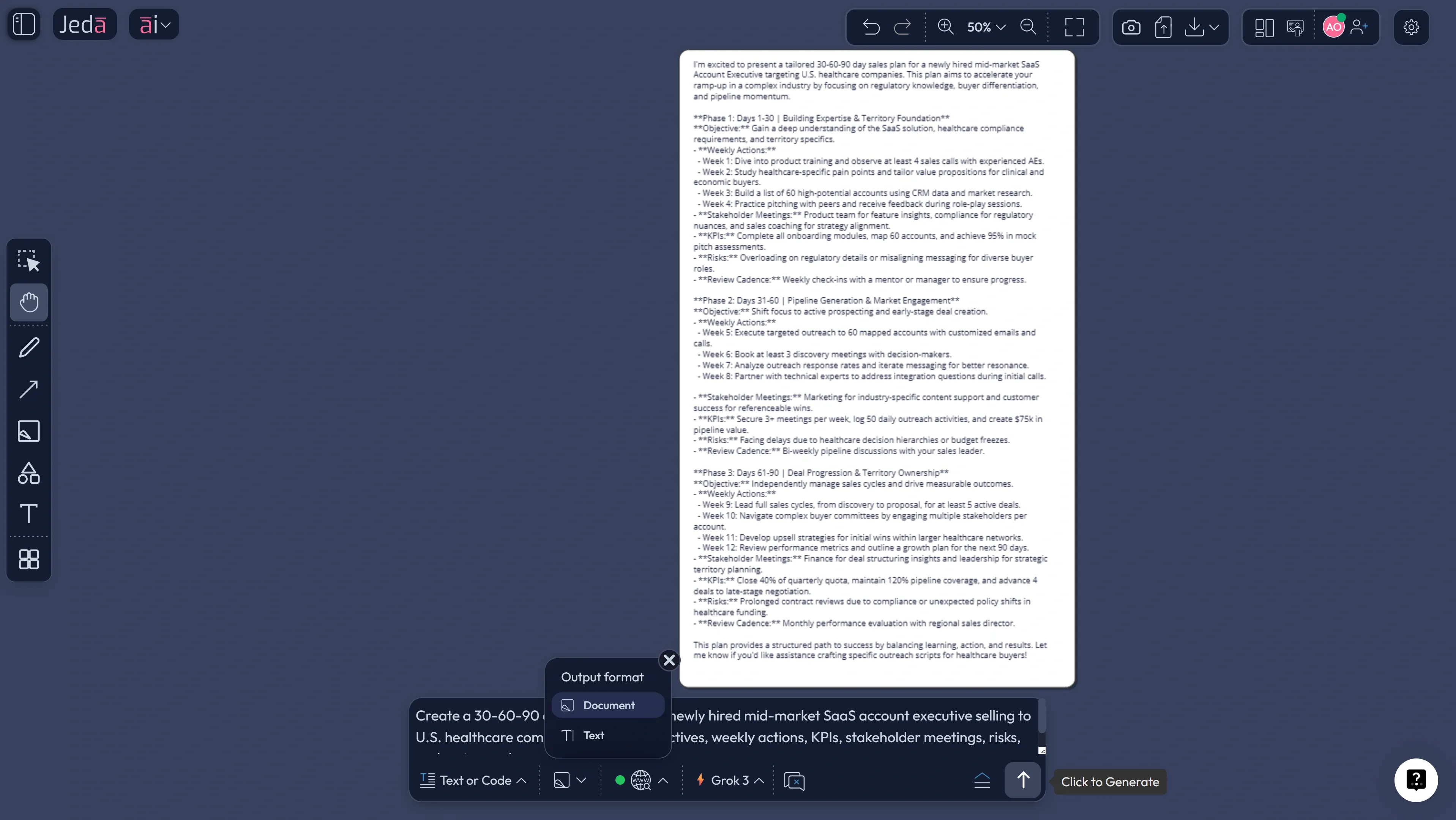
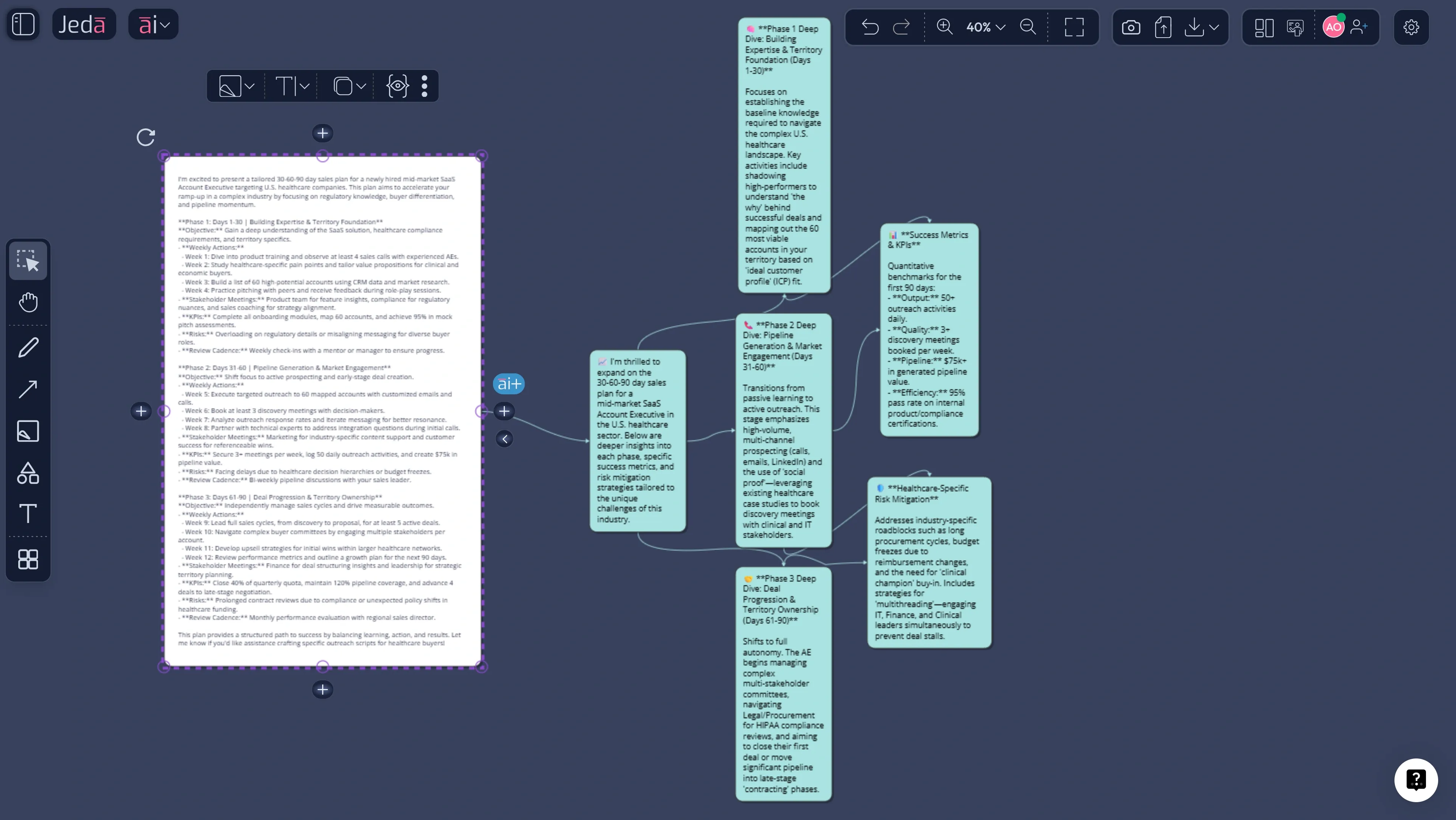
Create a 30-60-90 day sales plan for a newly hired mid-market SaaS account executive selling to U.S. healthcare companies. Include learning goals, pipeline-building actions, stakeholder meetings, KPIs, risks, review cadence, and success criteria for each phase.
This method gives you tighter control. It is especially useful when you want to specify sales motion, region, quota pressure, CRM stack, or internal dependencies in a single pass.
Deep dive with AI+
After the draft is generated, select a section on the canvas and use the AI+ button to extend it. Good uses include:
- adding more detailed KPIs for days 31-60
- deepening objection-handling actions
- expanding stakeholder alignment tasks
- extending risk mitigation or territory research
Bad use? Asking AI+ to invent a totally new planning structure unrelated to what is already selected. That is what the initial recipe or Prompt Bar prompt is for.
Convert it visually with Vision Transform
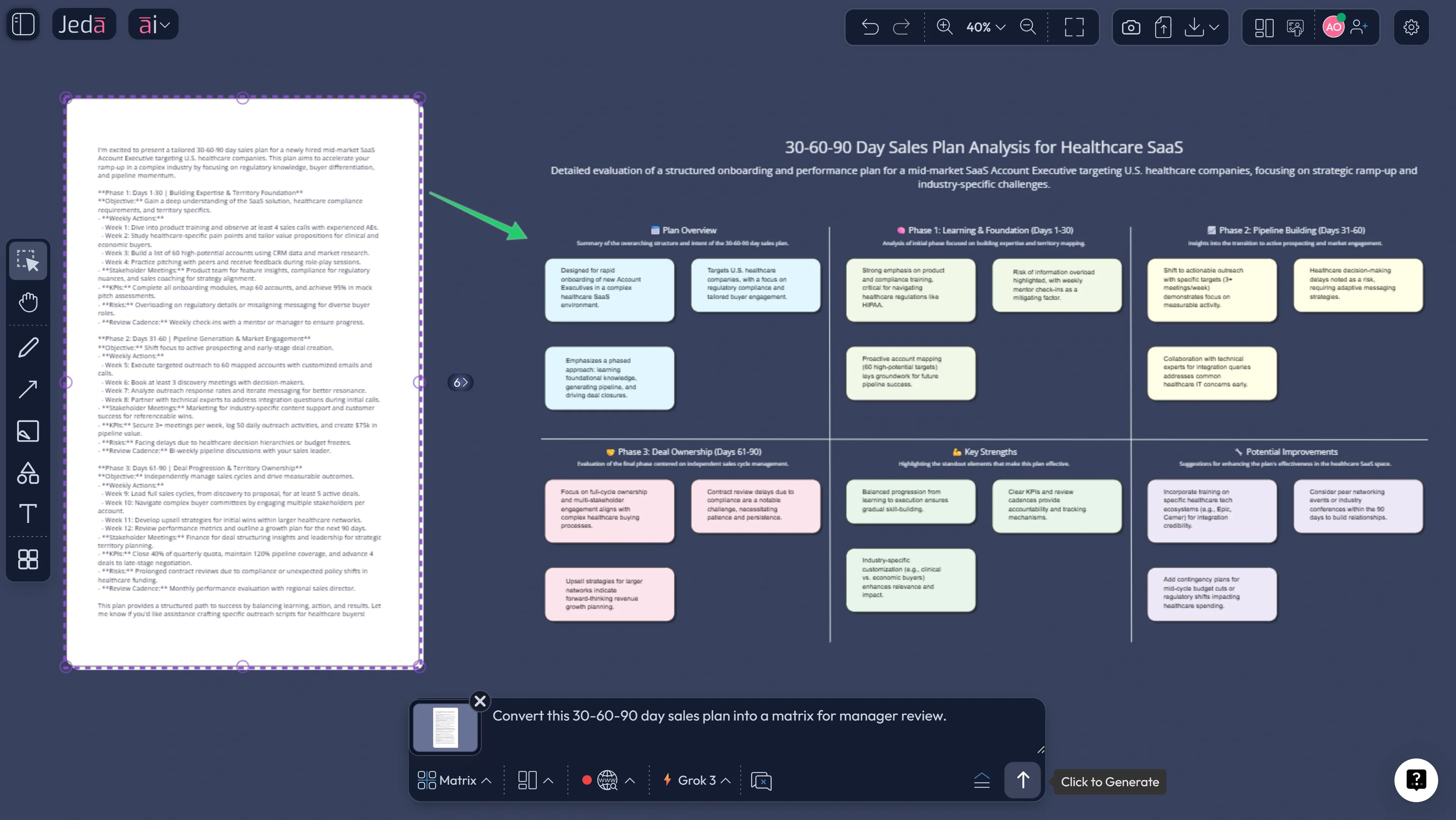
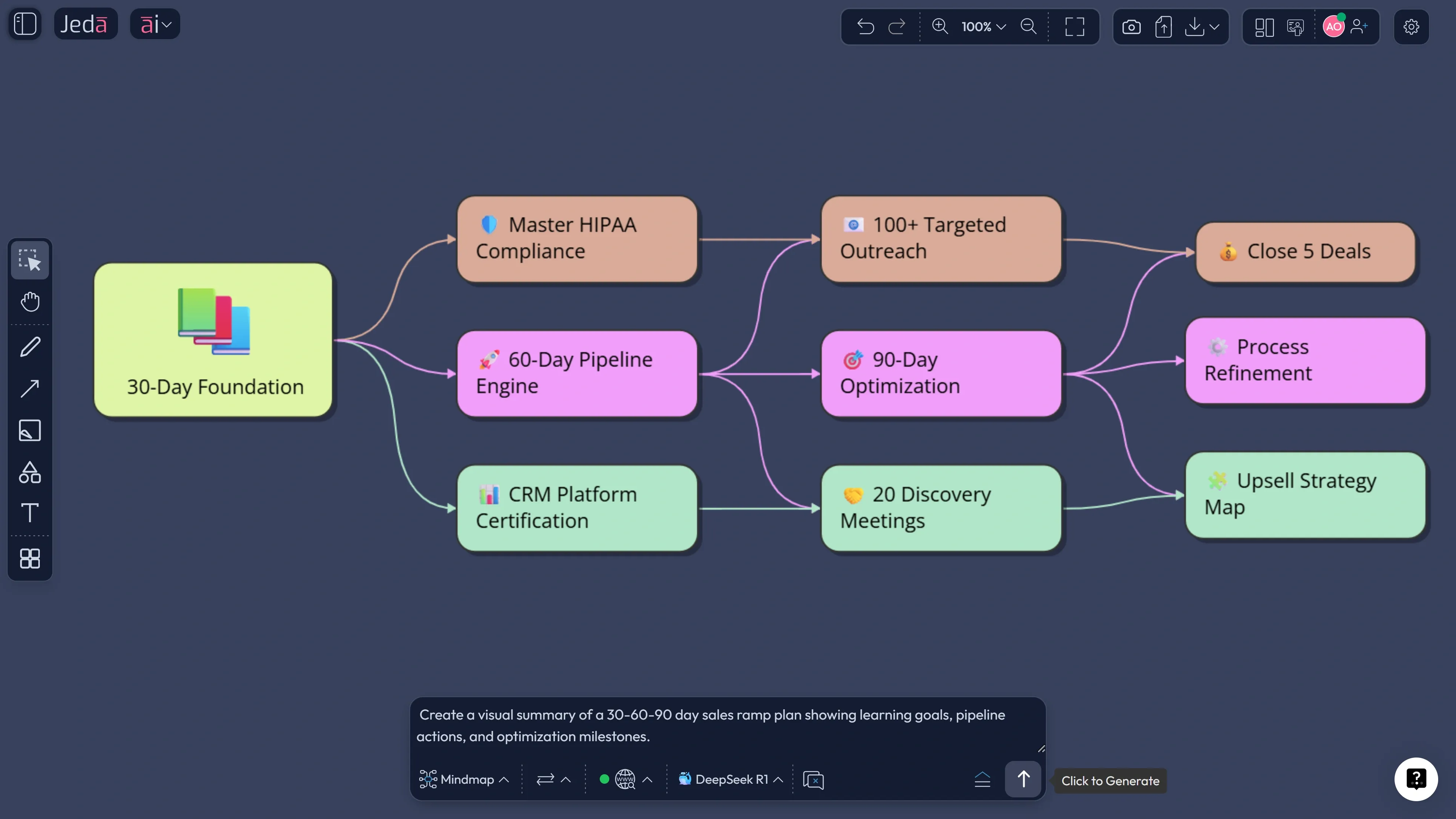
Once the document is done, use Vision Transform to convert the plan into another format. That is useful when a manager wants:
- a matrix version for phase-by-phase review
- a mind map for coaching sessions
- a flowchart for onboarding handoff
- sticky-note clusters for workshop discussion
- Method 1 — Open the AI Menu and choose Writer
From the top-left AI Menu, open the Writer category and select the 30-60-90 Day Sales Plan recipe.
- Add the operating brief
Enter the sales role, market, ICP, territory context, expected KPIs, sales motion, onboarding constraints, and manager expectations.
- Generate the first draft
Choose your reasoning model, keep the output focused, and generate a staged document covering days 1-30, 31-60, and 61-90.
- Method 2 — Refine in the Prompt Bar
Switch to the Prompt Bar, select Text or Code, choose Document format, and prompt Jeda.ai to tighten wording, metrics, or role-specific assumptions.
- Use AI+ to deepen a section
Select a specific section on the canvas and use the AI+ button to extend it with more detail, such as KPIs, stakeholder tasks, or risk controls.
- Convert the plan for review
Use Vision Transform to convert the final plan into a matrix, mind map, or another visual format for coaching, presentations, or team planning.
30-60-90 day sales plan template and example
A strong plan usually covers five things in each phase:
- phase objective
- actions
- measurable outputs
- stakeholder touchpoints
- risks or blockers
Here is a practical template structure.
| Phase | Strategic Objective | Core Actions | KPIs / Evidence | Manager Review Questions |
|---|---|---|---|---|
| Days 1-30 | Learn the market, product, process, and internal rhythm | Complete onboarding, review ICP and messaging, shadow calls, audit CRM, map internal stakeholders | certifications completed, call shadow count, account research completed, territory notes | Does the rep understand the offer, buyer, motion, and internal systems? |
| Days 31-60 | Activate pipeline and begin independent execution | Launch outreach, run discovery calls, build target-account list, test messaging, log activity in CRM | meetings booked, reply rate, pipeline created, call quality score | Is activity translating into qualified pipeline and better execution habits? |
| Days 61-90 | Improve conversion and establish repeatable performance | Refine sequences, improve objections, prioritize opportunities, tighten forecast discipline, document lessons learned | qualified pipeline, stage progression, forecast accuracy, early closed-won or close-plan quality | Is the rep operating with enough consistency to scale performance? |
That template works for more than new reps. You can adapt it for:
- a sales manager taking over a team
- a rep entering a new territory
- a new product launch motion
- an enablement-led onboarding program
- an interview case where a candidate must present their first-quarter plan
Best practices for a stronger plan
The first best practice is simple: tie each phase to a different question.
Days 1-30 asks, What must this person understand?
Days 31-60 asks, What must this person start doing independently?
Days 61-90 asks, What must this person improve, stabilize, or prove?
That sequencing keeps the plan honest.
The second best practice is to use SMART-style milestones. Not every line needs a hard number, but the plan should make progress visible. “Build product knowledge” is weak. “Complete certification, shadow eight discovery calls, and produce a territory summary” is useful.
Third, include manager review cadence. A plan without review points becomes decorative. Weekly check-ins, milestone reviews at day 30 and day 60, and a formal day-90 assessment usually create better accountability.
Fourth, define what counts as success for the role. For one team, success at day 90 might be a healthy pipeline. For another, it might be accurate forecasting, multi-threaded discovery, or process adherence. Context matters. A lot.
Common mistakes to avoid
The most common mistake is pretending the first thirty days should already look like full production. That usually creates performative activity, not real ramping.
Another mistake is writing one plan that could fit any sales job on Earth. It should not. A SaaS AE, channel manager, SDR, and enterprise sales director do not need the same first ninety days.
A third problem is overloading the plan with activity metrics while ignoring capability-building. Calls made and emails sent matter, sure. But so do discovery quality, account research depth, process discipline, and manager feedback loops.
And one more. People often forget risk. A credible plan names blockers early: missing enablement assets, unclear territory ownership, product complexity, poor CRM hygiene, or unrealistic pipeline assumptions.
Frequently asked questions
- What is a 30-60-90 day sales plan?
- A 30-60-90 day sales plan is a phased roadmap for the first ninety days in a sales role, territory, or transition. It typically separates learning, execution, and optimization so goals become measurable and easier for both the seller and manager to review.
- Who should use a 30-60-90 day sales plan?
- New sales reps, sales managers, territory owners, and internal candidates moving into a new commercial role can all use one. The structure is especially useful when expectations are changing quickly and manager alignment matters early.
- How long should a 30-60-90 day sales plan be?
- Usually one to three pages is enough for a working version, though more detail can be added for enterprise or complex sales roles. The better rule is clarity: each phase should have objectives, actions, KPIs, and review criteria without becoming bloated.
- What should be included in each phase?
- Each phase should include a primary objective, a short list of actions, measurable evidence of progress, stakeholder touchpoints, and review questions. That structure prevents the plan from collapsing into a generic task list.
- Can AI create a good 30-60-90 day sales plan?
- Yes, if the prompt includes enough context. AI works best when you provide role type, segment, territory, quota logic, sales motion, and manager expectations. It should generate the draft, but a human should still validate assumptions and priorities.
- Which Jeda.ai method is better for this task?
- The Writer Recipe is usually better for the first draft because it gives structure fast. The Prompt Bar is better for tighter revisions, role-specific prompts, and output control. In practice, the strongest workflow uses both.
- What is AI+ useful for in this workflow?
- AI+ is best for extending an existing section after the first draft exists on the canvas. It works well for deeper KPI detail, stakeholder actions, and risk expansion. It is less effective when used as a replacement for the original brief.
- Can I turn the plan into a visual format after writing it?
- Yes. In Jeda.ai, Vision Transform lets you convert the drafted plan into a matrix, mind map, flowchart, or other visual format. That is useful for coaching reviews, onboarding sessions, and team presentations.
- Is a 30-60-90 day sales plan only for onboarding?
- No. It is commonly used for onboarding, but it also works for territory transitions, promotions, role resets, new product launches, and interview presentations where a company wants to see structured thinking about the first quarter.
- What makes a 30-60-90 day sales plan credible?
- A credible plan aligns phase goals with role reality, names measurable milestones, includes manager review cadence, and acknowledges risk. It should read like an operating plan that can be executed and reviewed, not a motivational speech in business clothing.
Sources & further reading
- [1]
Zendesk (2026) . “30-60-90 day sales plan: how to build one that wins” Zendesk.
View Source ↗ - [2]
Indeed Editorial Team (2026) . “30-60-90 Day Plan (With Template and Example)” Indeed Career Guide.
View Source ↗ - [3]
Ellen Frögéli et al. (2023) . “Effectiveness of formal onboarding for facilitating organizational socialization” Systematic Review / PMC.
View Source ↗
Start Your 30-60-90 Day Sales Plan in Jeda.ai
Join over 150,000+ users who use Jeda.ai to turn rough sales goals into structured plans, editable documents, and presentation-ready outputs inside one AI Workspace.
Try Free Template