Most teams still talk about products like a spec sheet with a pulse. Feature. Feature. Feature. Then they wonder why the landing page gets skimmed, why the pitch sounds flat, and why the demo opener dies on contact.
Product Storytelling with AI gives you a better route. In Jeda.ai, you can turn messy raw material - product notes, customer interviews, launch briefs, review themes, competitor context, and internal positioning - into a narrative people can follow, remember, and repeat. That matters because storytelling in product marketing is not fluff. Product Marketing Alliance defines it as the combination of fact and narrative used to communicate a message, while recent Harvard Business Review guidance makes the same point from a different door: strong stories work when they start from the customer's point of view, not the seller's internal talking points.
And that is where Jeda.ai gets interesting. This is not just a blank doc with a blinking cursor. It is a Visual AI AI Workspace and AI Whiteboard where your story can begin as a Writer recipe, pull in supporting evidence from documents, evolve into a buyer-message map, and then get reviewed by the whole team in one place. That is why 150,000+ users come to Jeda.ai when they need ideas to turn into decision-ready output, not just another polite paragraph. Jeda.ai is known for 300+ strategic frameworks, but the same workspace also helps teams build sharper product narratives without tool-hopping.
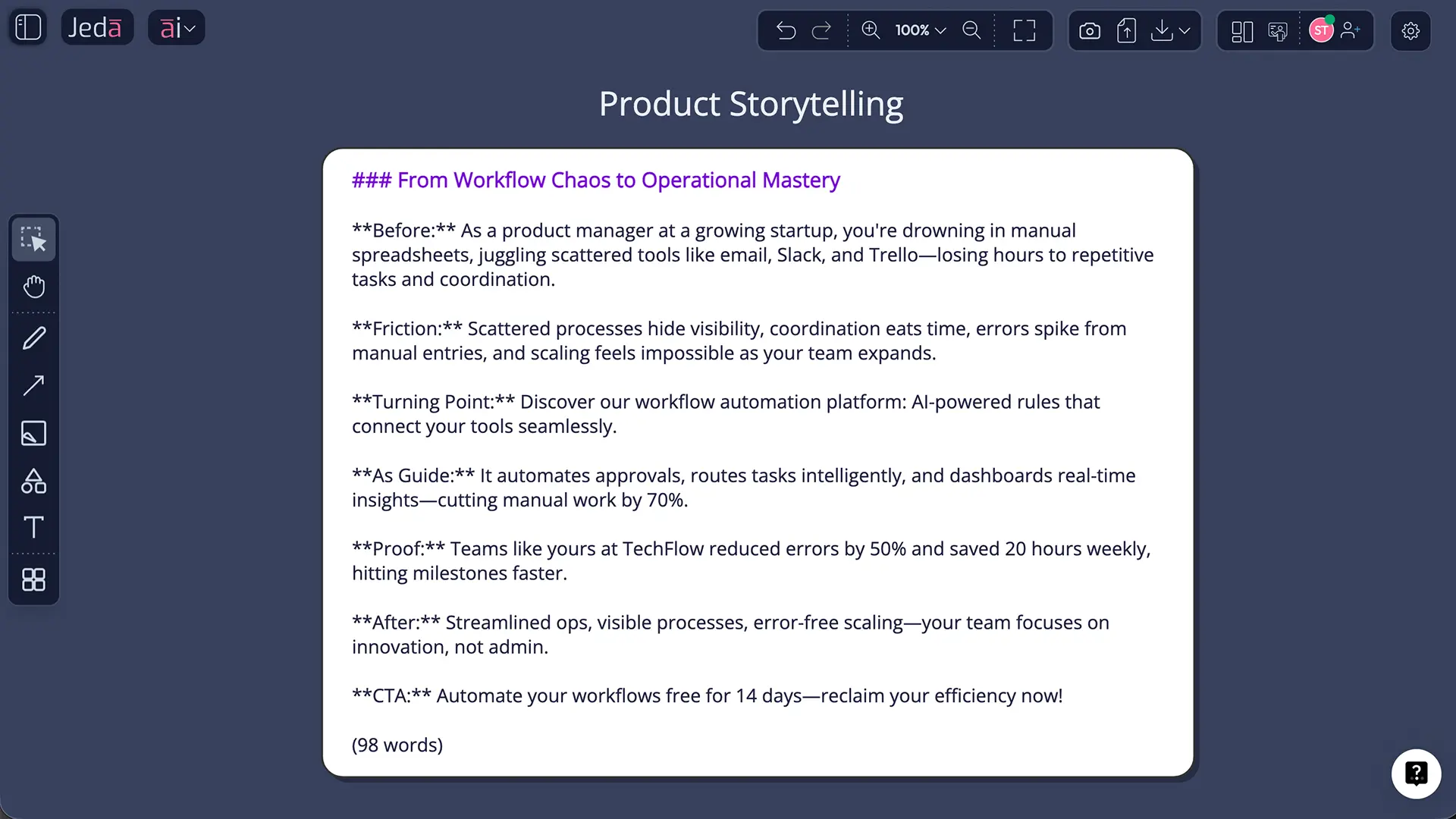
What is Product Storytelling with AI?
Product Storytelling with AI is the practice of using AI to shape product facts into a narrative that helps buyers understand change, risk, proof, and payoff faster.
That sounds simple. It is not. Good product stories do four jobs at once. They explain the customer's world before the product shows up. They make the tension visible. They show the product as the guide, not the hero. And they end with a believable after-state. ProductPlan, Product School, and Product Marketing Alliance all converge on the same hard truth here: the customer should be the protagonist, the story should be adapted to the audience, and the message should connect product value to a problem people actually feel.
There is also real research behind why this works. Jennifer Escalas' work on mental simulation and later meta-analysis from Tom van Laer and colleagues help explain the mechanism: stories increase immersion, help people picture themselves in the scenario, and make persuasion feel less like an argument and more like a lived possibility. Put plainly, a list tells. A story lets the buyer mentally rehearse the outcome.
AI does not replace that craft. It speeds up the ugly middle. It helps you find structure, pull voice-of-customer language, generate variants for different audiences, compress long briefs into cleaner narrative arcs, and keep your proof points attached to the message. Used badly, it creates beige nonsense. Used well, it becomes a story engine.
Why use Product Storytelling with AI instead of feature dumping?
If your product category is noisy, your story needs to do more than sound nice. It needs to create clarity fast.
- Turn customer language into narrative
Bring in reviews, interviews, tickets, and research notes so your story sounds like the market, not your internal jargon.
- Adapt by audience
Rewrite the same core product truth for founders, buyers, sales teams, executives, or skeptical users without rebuilding the whole message.
- Create short, medium, and long versions
Generate a homepage version, demo opener, launch email angle, and sales narrative from one core story spine.
- Keep proof close to the claim
Use Document Insight, uploaded briefs, or current web context to anchor the story in evidence instead of empty adjectives.
- Map the message visually
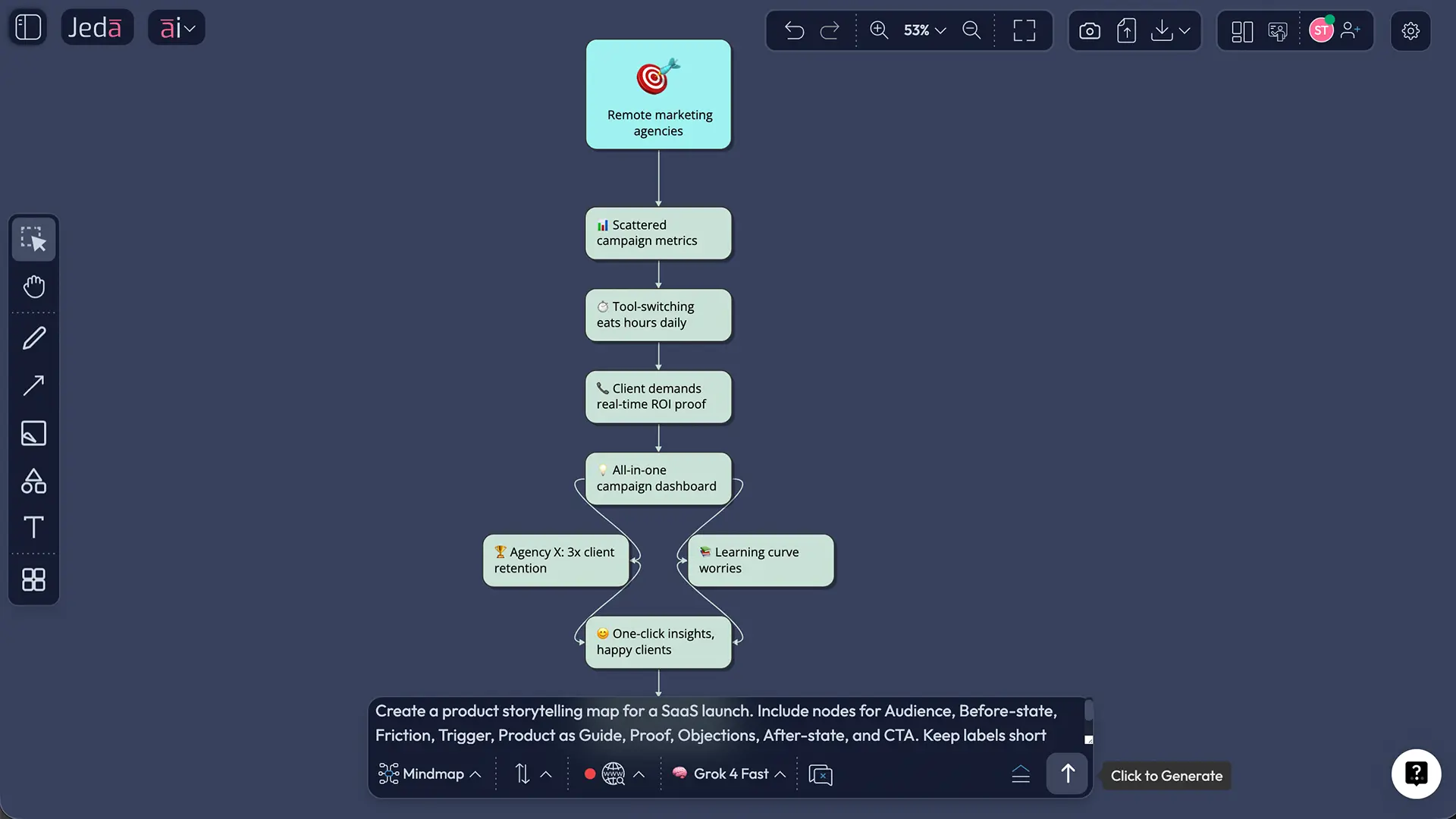
Turn one written story into a diagram, mind map, or objection-proof map on the AI Whiteboard so teams can refine it together.
- Deepen weak spots fast
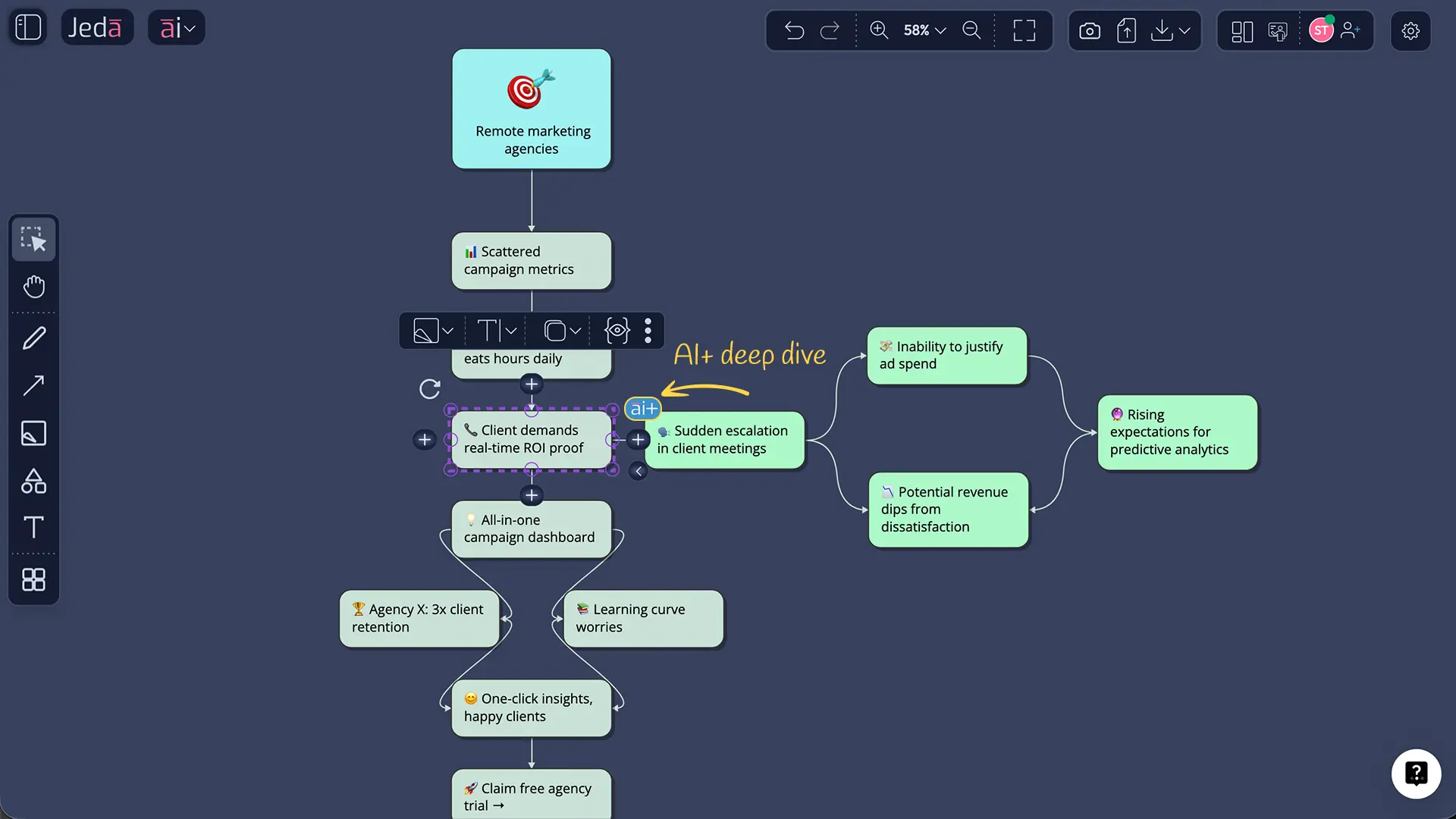
Use the AI+ button after you map the story visually to expand thin areas like proof, objections, or persona-specific language.
The bigger shift is strategic. AI lets you move from "write some copy" to "build a message system." In Jeda.ai, a product story can start in the Writer recipe, continue in the AI Workspace, branch into a visual objection map on the AI Whiteboard, and end as a reviewable narrative your team can edit together.
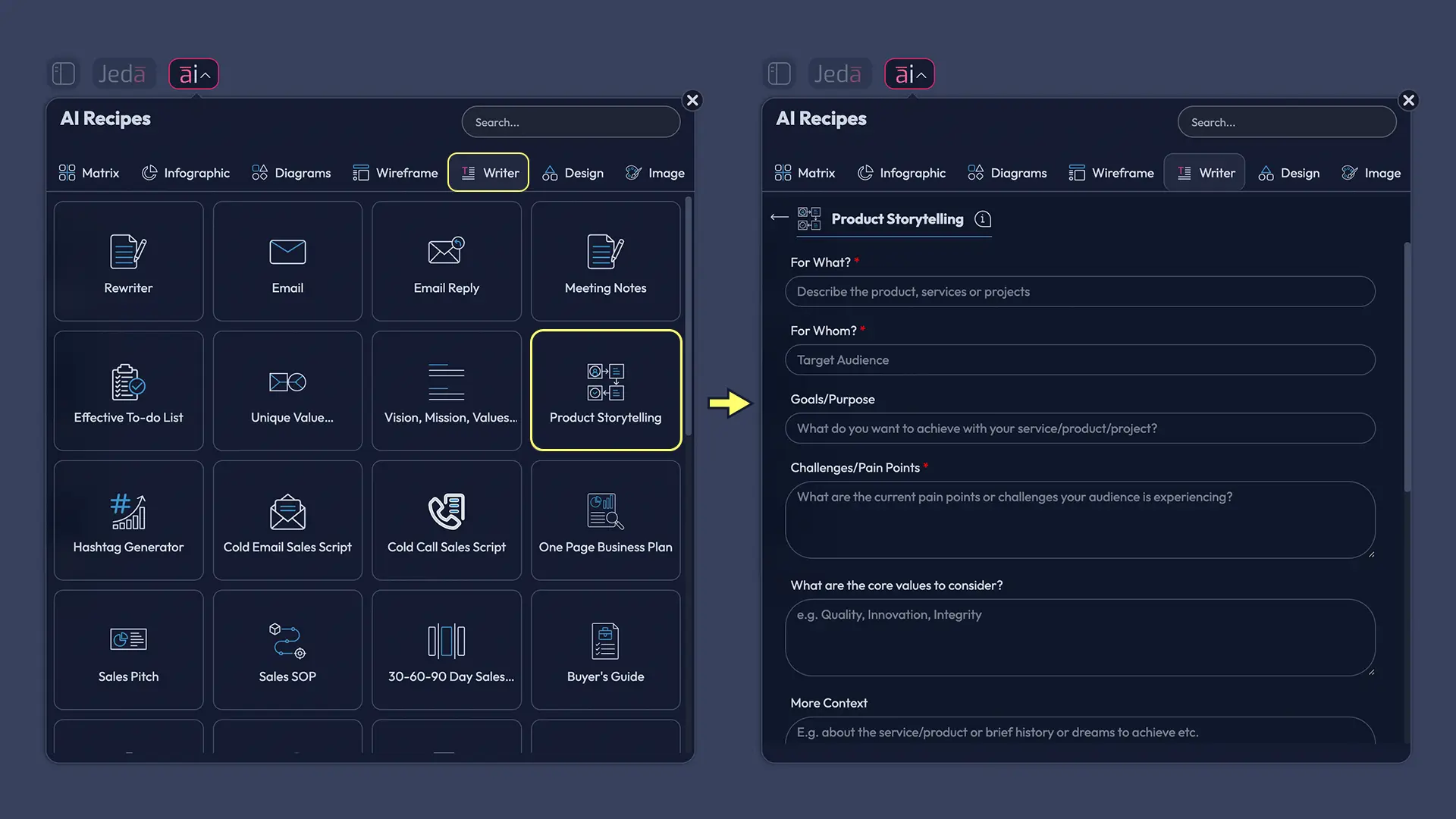
How to create Product Storytelling with AI in Jeda.ai
This topic fits Jeda.ai's Writer recipe flow. Use the AI Menu when you want the guided version. Use the Prompt Bar when you want total control over structure, tone, and output.
- Open a board in your AI Workspace
Create or open a canvas in Jeda.ai. This becomes the shared working area for narrative drafts, proof points, and message maps.
- Method 1 (recommended): Use the AI Menu Writer recipe
Click ai∨ at the top-left, switch to Writer, choose the Product Storytelling recipe, then fill in the guided form fields like For What, For Whom, Goals/Purpose, More Context, and Output Language.
- Method 2: Use the Prompt Bar with Text or Code
Open the Prompt Bar at the bottom, select Text or Code, switch the output format to Document, paste your storytelling prompt, and press Enter to generate the first narrative draft.
- Ground the story in evidence
Add customer interviews, review summaries, PRDs, launch notes, or positioning docs. Use Document Insight to extract strong proof signals, customer language, and objections before you finalize the story.
- Deepen and reframe with AI+
After you convert the story into a visual map using Vision Transform, select a key node such as proof, audience tension, or objections and use the AI+ button to deepen that section.
- Review, collaborate, and export
Refine the document with collaborators in real time, then export the finished board as PNG, SVG, or PDF for launch planning, reviews, or stakeholder sharing.
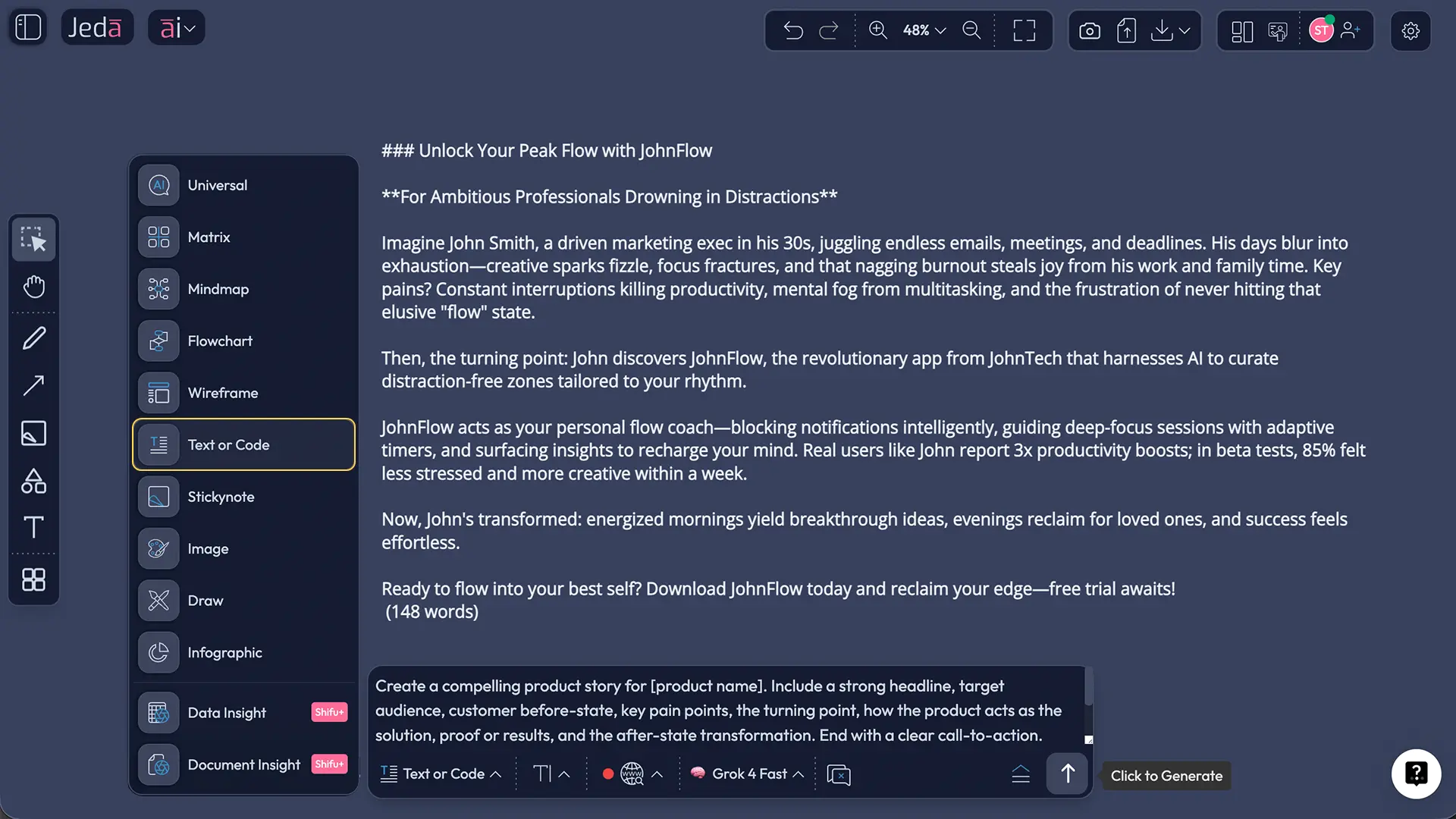
Copy-paste prompt (Prompt Bar -> Text or Code -> Document)
Prompt:
Create a product story for [product name] aimed at [audience].
Use this structure: customer before-state, friction or trigger, what changed in the market or workflow, product as guide, specific proof, after-state, and clear CTA.
Keep the customer as the hero and the product as the enabler.
Include:
- a landing-page opener,
- a 90-second demo intro,
- a short sales narrative,
- three proof bullets,
- three likely objections with responses, and
- one version for executives and one version for practitioners.
Use sharp, specific language. Avoid generic hype.
You can also switch on Web Search when the story depends on current market context, trend language, or category framing. And when you want multiple narrative angles, turn on Multi-LLM Agent so different models can produce different takes before the Aggregator helps you settle on the strongest version.
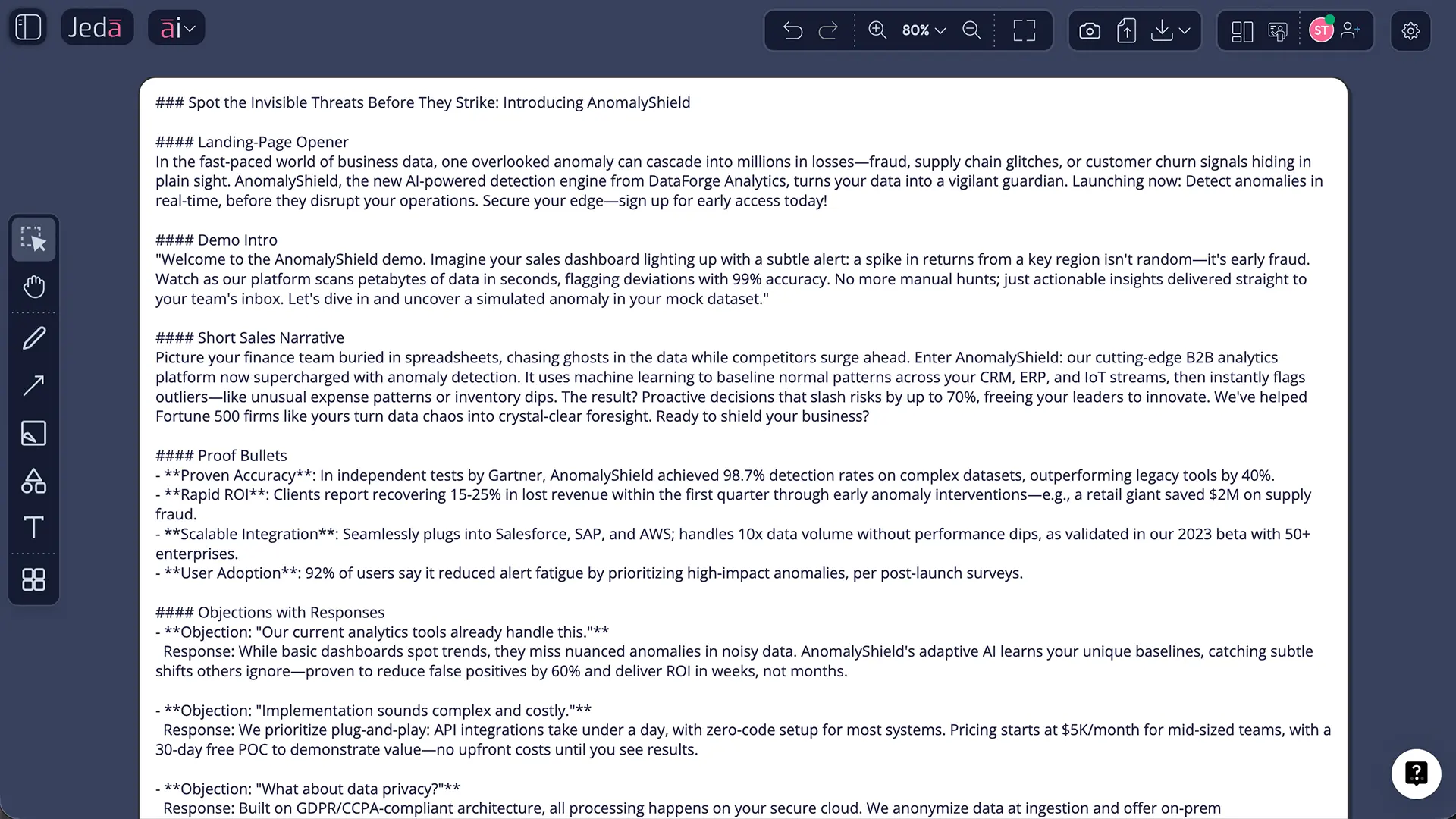
Product Storytelling with AI template and examples
Most product stories get lost because they skip the tension. They start with the product. Wrong move.
Here is a useful template you can reuse across launches, pitch decks, demos, product pages, and enablement docs:
- Before-state - What the customer's world looks like now.
- Tension - What is broken, slow, risky, expensive, or annoying.
- Trigger - Why this matters now. New complexity? New buyer expectation? New regulation?
- Guide - How the product helps the customer move.
- Proof - Evidence, not adjectives. Time saved, steps removed, adoption data, win stories, quotes.
- After-state - What becomes possible.
- CTA - What the audience should do next.
Example 1: B2B SaaS feature launch
A weak version says: We launched anomaly detection powered by advanced machine learning.
A better story says: Ops teams used to find revenue leaks after customers complained. By then, the damage was already done. Our new anomaly detection feature flags risky shifts before they spread, so teams can act earlier, reduce rework, and protect the numbers they are responsible for.
Same feature. Different gravity.
Example 2: Ecommerce product page
A weak version says: Our backpack is durable, lightweight, and waterproof.
A better story says: You leave early, change locations twice, and end the day carrying more than you planned. This backpack was built for that exact kind of day - light enough to forget, structured enough to organize, and tough enough not to fail halfway through it.
Now the product lives inside a situation instead of floating above one.
Example 3: Internal product pitch
A weak internal narrative says: Customers want this feature and competitors already have it.
A stronger one says: Our best-fit customers are trying to solve this job with workarounds that cost time every week. Competitors have fragments of the workflow, but not the full loop. If we close this gap now, we improve retention, increase product depth, and strengthen our position in the accounts that matter most.
That is not prettier copy. It is better strategic framing.
Best practices for better product storytelling
The fastest path to a strong story is not more adjectives. It is better inputs.
And one more thing. Cut the fake drama. Buyers are not looking for a Netflix pilot. They are looking for evidence, clarity, and an outcome they can picture. The story just makes the reasoning stick.
Common mistakes to avoid
1) Making the product the hero
This is the classic trap. The audience does not wake up wanting to admire your architecture. They want their problem to feel understood. Start there.
2) Writing one story for every audience
The same product truth can travel through several angles. Sales needs momentum. Product needs clarity. Executives need stakes. Practitioners need usefulness. One size fits no one.
3) Confusing features with meaning
A feature matters only when it changes a lived workflow, a felt pain, or a visible result. If your story does not connect the feature to change, the audience has to do the work. They usually will not.
4) Letting AI invent proof
Never let the story drift into made-up metrics or vague claims. Bring the inputs. Validate the evidence. Keep the narrative tethered to reality.
5) Over-polishing the voice
In the age of AI, perfectly smooth copy can feel weirdly forgettable. Keep the language clear, human, and slightly alive. A little texture beats corporate vanilla every time.
The win with Jeda.ai is not just speed. It is continuity. You can move from idea to document to shared message map inside one AI Workspace, then refine the output on the AI Whiteboard without rebuilding the whole thing somewhere else.
Frequently Asked Questions
- What is Product Storytelling with AI?
- Product Storytelling with AI is the process of using AI to turn product facts, customer pain points, and proof into a narrative that helps buyers understand why the product matters. The goal is not decoration. It is clarity, memorability, and stronger persuasion.
- Is product storytelling the same as brand storytelling?
- Not exactly. Brand storytelling explains the broader identity, values, and meaning of the company. Product storytelling focuses on a specific product, feature, or launch moment and connects that offer to a customer problem, proof, and outcome.
- Who should be the hero in a product story?
- The customer should be the hero. Your product should act as the guide, tool, or turning point that helps the customer resolve tension. That framing is more persuasive because buyers naturally scan for themselves inside the story.
- Can Jeda.ai create multiple versions of the same product story?
- Yes. You can generate a core narrative and then spin it into a landing-page opener, demo intro, executive summary, sales angle, objection handling, or shorter campaign variants. Multi-LLM mode helps when you want contrasting takes before choosing one.
- What inputs make AI product stories better?
- Customer interviews, win-loss notes, objection logs, reviews, PRDs, launch briefs, analyst notes, and positioning documents all improve the result. The better the inputs, the less generic the output. Customer language is especially valuable because it sharpens tone and stakes.
- How does AI+ help with Product Storytelling with AI?
- Use AI+ after you turn the story into a visual map. Select a node like proof, objections, or audience tension and extend it. This works well when the first draft is good but one part still feels thin, vague, or under-supported.
- Can I turn a written story into a visual message map?
- Yes. Generate the story as a document first, then use Vision Transform to convert it into a diagram, mind map, or other visual format. That makes it easier for cross-functional teams to review structure, objections, and proof together.
- Can I export the final story from Jeda.ai?
- Yes. Export the finished board or workspace output as PNG, SVG, or PDF. Those formats work well for launch planning, internal reviews, sales enablement, and stakeholder presentations.
- Is product storytelling useful only for external marketing?
- No. It also helps internal alignment. Product teams use narrative to explain priorities, clarify the problem a feature solves, align sales and marketing, and make launch decisions easier to defend across the company.
Sources & further reading
- [1]
Jennifer Edson Escalas (2004) . “Imagine Yourself in the Product: Mental Simulation, Narrative Transportation, and Persuasion” Journal of Advertising.
View Source ↗ - [2]
Tom van Laer, Ko de Ruyter, Luca M. Visconti, and Martin Wetzels (2014) . “The Extended Transportation-Imagery Model: A Meta-Analysis of the Antecedents and Consequences of Consumers' Narrative Transportation” Journal of Consumer Research.
View Source ↗ - [3]
Donato Cutolo and Simone Ferriani (2023) . “To Sell an Unconventional Product, Tell a Compelling Story” Harvard Business Review.
View Source ↗ - [4]
Matthew Abrahams and Sarah Glova (2024) . “A Great Sales Pitch Hinges on the Right Story” Harvard Business Review.
View Source ↗ - [5]
Charley Gale and Lawrence Chapman (2026) . “How to use storytelling and product narrative in marketing” Product Marketing Alliance.
View Source ↗ - [6]
Amplitude (2024) . “The Complete Product Marketing Guide” Amplitude.
View Source ↗ - [7]
ProductPlan (n.d.) . “6 Steps for Creating a Compelling and Well-Crafted Product Story” ProductPlan.
View Source ↗
Build your next product narrative in Jeda.ai
Join over 150,000+ users building sharper launch stories, message maps, and decision-ready content in Jeda.ai's AI Workspace.
Try Free Template