Most value propositions fail for one boring reason. They sound like recycled feature lists.
An AI Value Proposition Generator helps you move faster, but speed alone is not the win. The real win is clarity. When you use Jeda.ai as your AI Workspace and AI Whiteboard, you can turn messy notes, product claims, customer pain points, and team opinions into sharper positioning that people actually understand. That matters when your homepage gets one shot, your pitch deck gets one slide, and your ad gets maybe three seconds.
Jeda.ai gives you that process inside a Visual AI workspace built for thinking, not just typing. And yes, that difference shows up fast for teams who are tired of vague copy and internal debates that go nowhere.
What is an AI value proposition generator?
An AI value proposition generator is a writing workflow that helps you turn product details, audience pain points, and differentiators into a concise message that answers three questions: what you do, who it is for, and why someone should pick you over the alternative.
The idea itself is not new. Michael Lanning and Edward Michaels are widely credited with early formal work on the value proposition concept, and later frameworks such as the Value Proposition Canvas and Jobs to Be Done pushed the practice toward customer jobs, pains, gains, and proof. In plain English, a strong value proposition should not sound impressive only to your internal team. It should feel obvious to the buyer.
That is where AI helps. Instead of staring at a blank page, you can generate options, compare angles, and tighten the language around one real customer problem.
Why use AI to generate unique value propositions?
Because most teams already have the raw material. They just do not have a clean way to shape it.
Customer interview notes live in one doc. Sales objections sit in Slack. Feature lists sit in Jira. The homepage draft sits in Figma. Then someone tries to squeeze all of that into one sentence and calls it strategy. Rough.
Jeda.ai helps because it is not just a text box. It is an AI Workspace where you can generate copy, compare alternatives on the canvas, pull in broader business context, and refine the strongest option without leaving the board. That matters if you want message alignment, not just a one-off sentence.
- Sharper positioning
Turn broad claims into a focused statement built around a real customer problem, a real audience, and a real differentiator.
- Faster team alignment
Generate multiple angles at once, review them visually, and stop the endless loop of copy edits with no strategic direction.
- More than one sentence
Use the winning proposition as the base for homepage copy, ad hooks, sales enablement lines, and pitch messaging.
Another reason this works: good value propositions are usually concise. HBR has argued for years that weak propositions overclaim and underprove, while modern writing guides still push the same core rule: keep the message clear, specific, and tied to customer value.
How do you generate unique value propositions in Jeda.ai?
You have two solid paths inside Jeda.ai. The first is the guided Writer recipe. The second is the Prompt Bar if you want more control from scratch.
Method 1: Recipe Matrix
For this page, “Recipe Matrix” means using the structured recipe workflow from the AI Menu, even though the actual recipe lives under Writer.
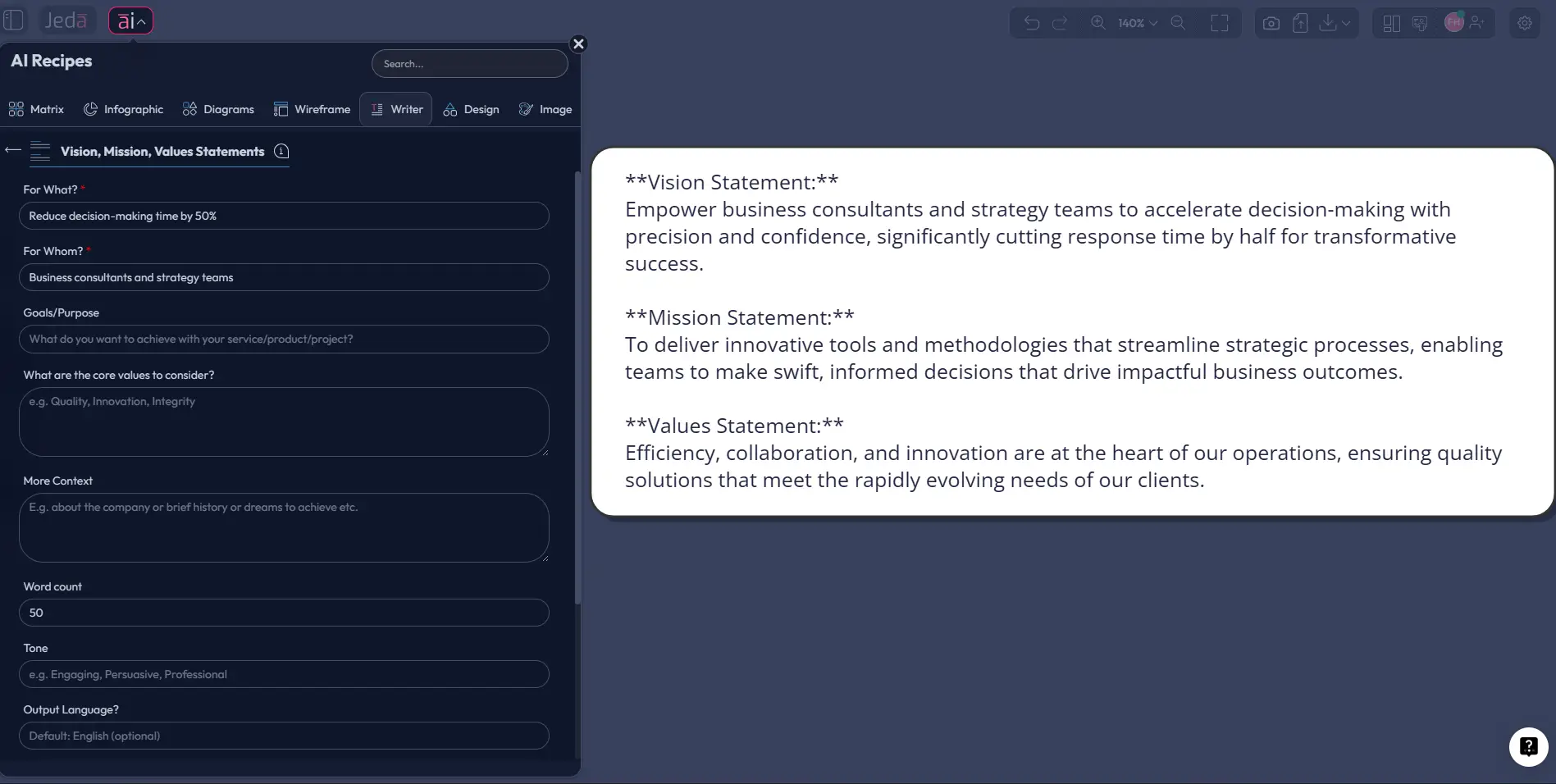
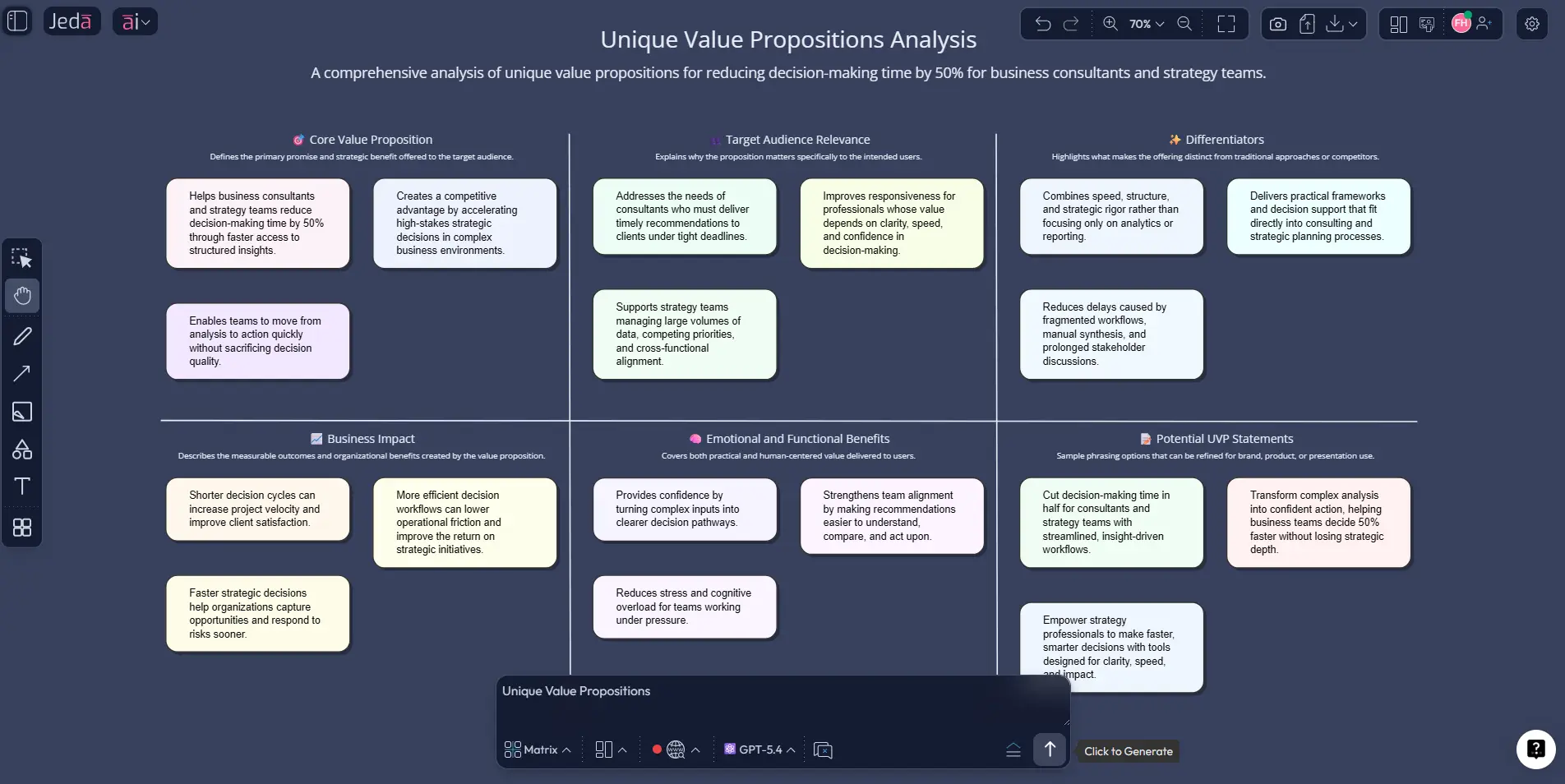
Open the AI Menu in the top-left corner, go to Writer, then choose Unique Value Propositions. Add your product, target audience, core pain point, main outcome, differentiators, and any extra context that sharpens the result. Generate a few options, compare them, and keep only the ones that are specific enough to survive contact with a skeptical buyer.
Method 2: Prompt Bar
Open the Prompt Bar at the bottom of the canvas and choose Text. Then describe your offer in plain language:
- who the product is for
- what painful problem it solves
- what outcome the customer gets
- what makes you different from common alternatives
- what tone or length you want
This route is great when you already know your angle and want faster iteration.
AI+ button generated deep dive
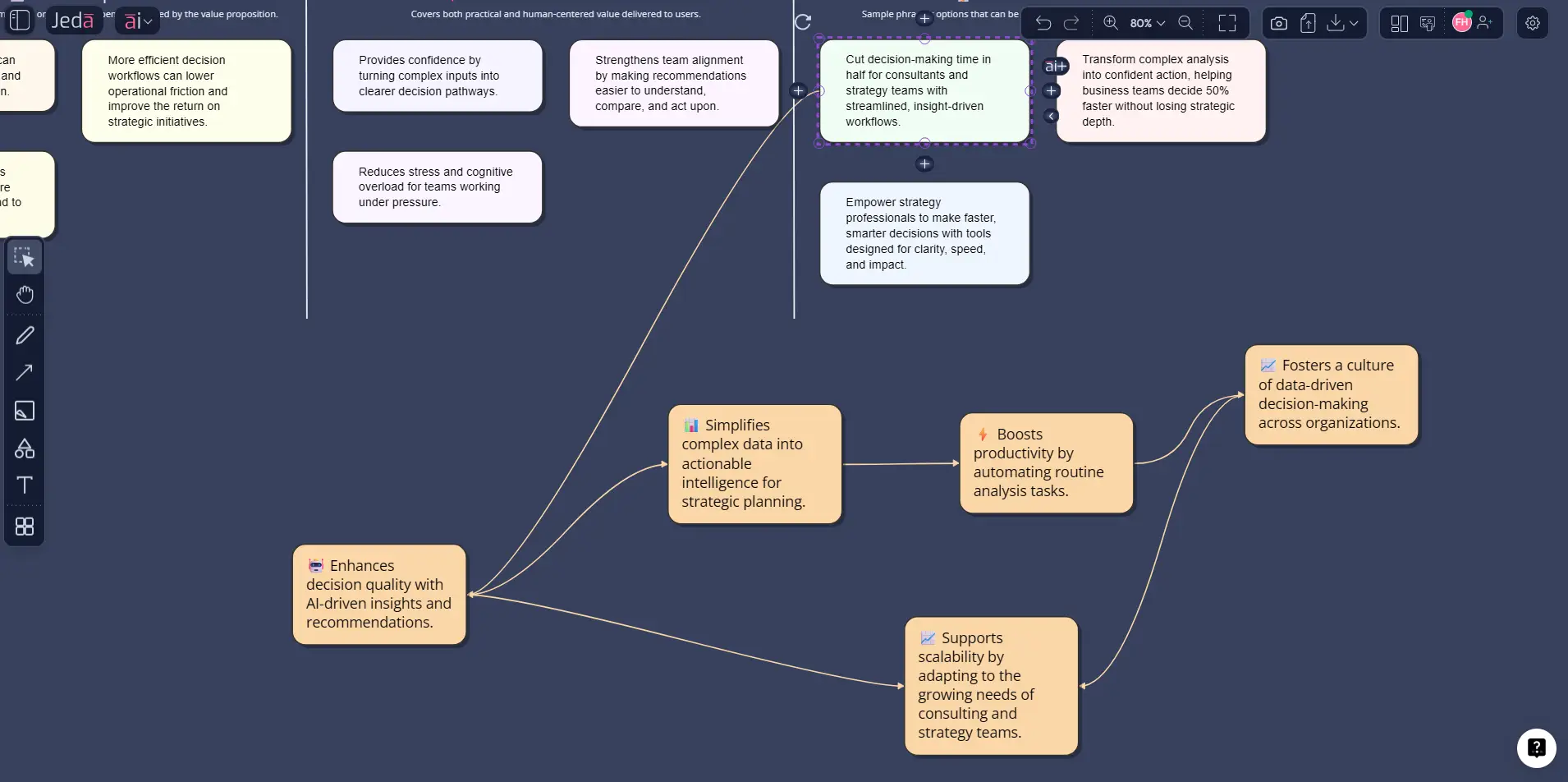
Once Jeda.ai gives you a strong first draft, select the text object and use the AI+ button to deepen the strongest direction. AI+ is best when you want expansion, richer variations, or supporting message layers. It is not the place for ultra-granular instructions. Think “take this promising draft further,” not “write exactly fourteen words and mention three features.”
And if you want to turn the winning draft into a messaging workshop board, select it and use Vision Transform to convert the content into a visual format for review inside the AI Whiteboard.
- Open the Recipe Matrix path
Click the AI Menu in Jeda.ai, choose Writer, and open the Unique Value Propositions recipe.
- Add the raw inputs
Enter your audience, offer, core pain point, desired outcome, differentiators, and any context that changes the message.
- Generate several options
Create multiple value proposition drafts instead of stopping at the first decent sentence. Comparison is where the clarity starts.
- Refine in the Prompt Bar
Switch to the Prompt Bar and the Text command when you want to steer length, tone, angle, or structure more directly.
- Use AI+ for a deeper pass
Select the strongest draft and use the AI+ button to expand the idea, add stronger benefits, or generate sharper variations.
- Turn the winner into campaign-ready messaging
Use the final proposition as the base for homepage copy, sales copy, ads, email messaging, or a broader positioning review on the canvas.
What makes a strong unique value proposition?
A strong UVP does not try to say everything. It earns attention by saying the right thing.
At minimum, it should name the audience, connect to a painful or urgent job, promise an outcome, and make the difference believable. That logic lines up closely with customer value research from HBR, Strategyzer’s Value Proposition Canvas, and Jobs to Be Done thinking. The message needs fit, not fluff.
Here is a practical formula you can use while reviewing AI output:
For [specific audience], Jeda.ai helps you [valuable outcome] without [friction or common failure], because [differentiator or proof].
That is not the only format. It is just a good filter. If the AI draft cannot pass that test, keep pushing.
Unique value proposition examples generated with AI
Here is what the workflow looks like when the inputs are specific.
Example 1: B2B onboarding software
For fast-growing SaaS teams, AcceleOn cuts new-customer onboarding from weeks to days by turning scattered setup tasks into one guided launch flow, without forcing CSMs to manage updates manually.
Example 2: AI note-taking app for consultants
For consultants who lose insight across meetings, BriefStack turns raw call notes into decision-ready summaries and next steps, so teams can move from conversation to client action faster.
Example 3: Sustainable skincare brand
For people with sensitive skin who want fewer ingredients and fewer surprises, BareRoot delivers clinically informed daily care with short formulas that are easy to trust and easy to keep using.
What changed across those examples? The audience is concrete. The outcome is visible. The wording avoids inflated buzzwords. And the promise is narrow enough to remember.
Best practices for getting better AI-generated value propositions
You will get better output when your inputs stop sounding like a brochure.
One more thing. Jeda.ai is especially strong here because the Writer workflow lives inside the same AI Workspace you can use for related positioning work. That means you can move from value proposition draft to messaging hierarchy, launch plan, campaign hooks, or even one of Jeda.ai’s 300+ strategic frameworks without starting over in another tool.
Common mistakes to avoid
The first mistake is writing for yourself. Buyers do not care that your platform is innovative, transformative, seamless, or next-generation. They care whether it solves a painful problem now.
The second mistake is piling three different audiences into one sentence. When a draft tries to speak to founders, enterprises, agencies, and students all at once, it becomes wallpaper.
The third mistake is confusing features with outcomes. “Uses AI” is not a value proposition. “Cuts first-draft messaging time from two days to twenty minutes” is getting warmer.
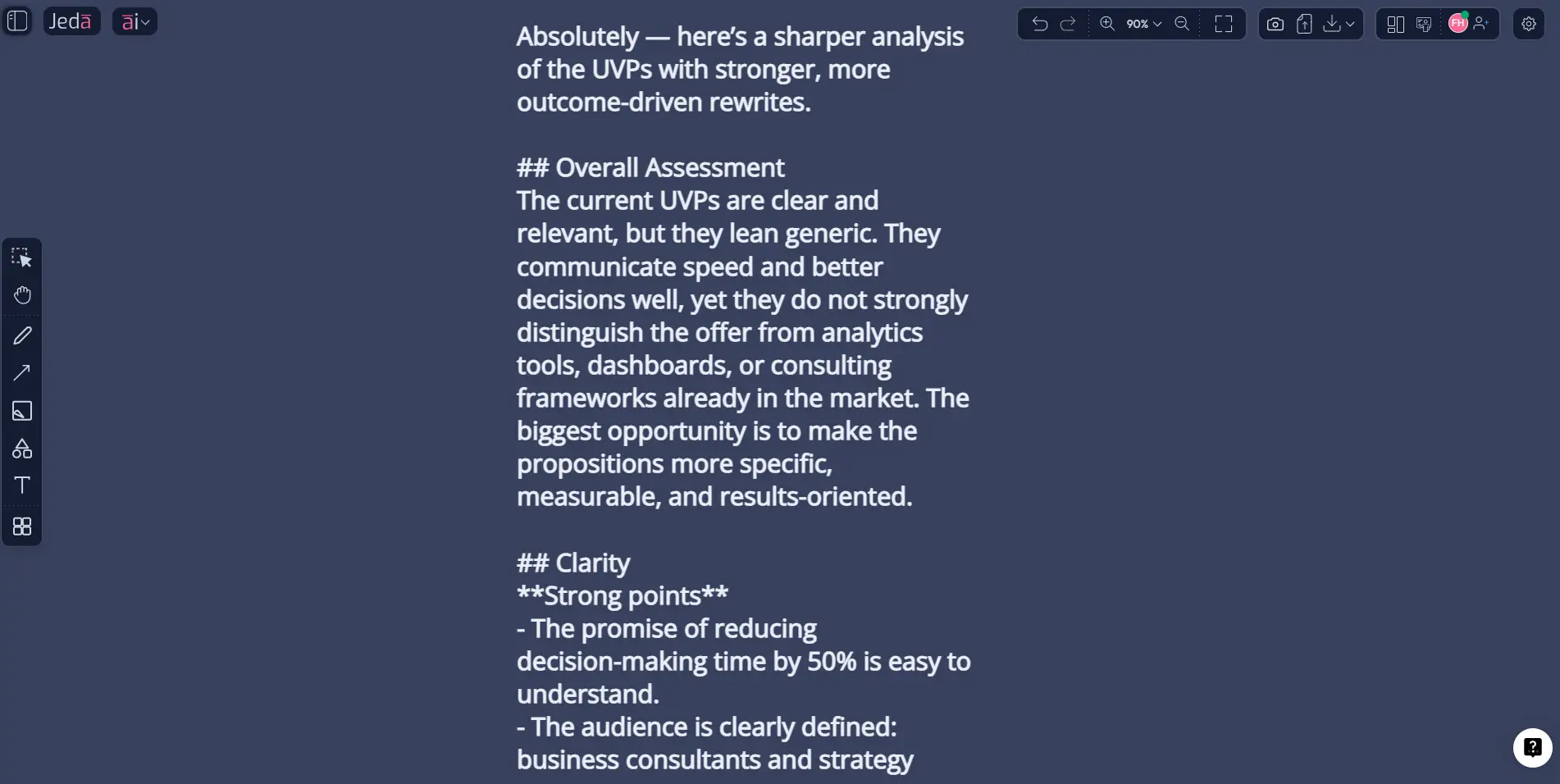
The fourth mistake is treating the first AI draft like the final answer. Good AI writing is iterative. Jeda.ai helps because you can generate, compare, extend with AI+, and pressure-test the message on the canvas.
The fifth mistake is stopping at the headline. A real value proposition should flow into your subheadline, landing page copy, sales talk track, and campaign messaging. Otherwise it just sits there looking important.
Frequently asked questions
- What is the difference between a value proposition and a slogan?
- A value proposition explains who the offer is for, what problem it solves, and why it is a better choice. A slogan is a short branding line built for memorability. One clarifies value. The other supports recall. They can work together, but they do different jobs.
- Can AI really create a unique value proposition?
- AI can generate strong first drafts and sharp variations, but uniqueness still depends on the quality of your inputs and your review. If your product details sound generic, the output will too. AI speeds the thinking. It does not replace strategic judgment.
- How many value proposition options should I generate?
- Start with at least five. That gives you enough variation to compare angles such as speed, cost, simplicity, proof, audience fit, or emotional payoff. One draft is usually too narrow. Ten is often noisy. Five to seven is a practical sweet spot.
- Should a value proposition mention competitors directly?
- Usually no. It is better to imply the alternative by naming the friction you remove or the outcome you improve. Direct competitor naming can be useful in internal strategy work, but public-facing homepage copy usually works better when it stays customer-centered.
- How long should a unique value proposition be?
- Most strong value propositions stay concise. One sentence is ideal for a hero line, while two or three sentences can work when you need more context. The rule is simple: every word should sharpen the value, the audience, or the differentiator.
- What inputs give Jeda.ai the best results?
- The best inputs include your audience segment, the painful problem, the desired outcome, product differentiators, and real customer language from interviews, reviews, or sales calls. Jeda.ai performs better when you give it specific context instead of polished but vague brand copy.
- Can I use Jeda.ai for more than just the value proposition?
- Yes. Once you have the winning proposition, you can keep working inside Jeda.ai to develop supporting messaging, campaign hooks, pitch copy, or broader strategy work on the same canvas. That is where an AI Workspace beats a single-purpose generator.
- Why use Jeda.ai instead of a basic value proposition generator?
- Basic generators are fine for quick lines. Jeda.ai is better when you need a repeatable workflow. You can generate options, compare them visually, extend a promising draft with AI+, and turn the result into broader messaging or strategy assets without bouncing between tools.
Sources & Further Reading
- [1]
James C. Anderson, James A. Narus, and Wouter van Rossum (2006) . “Customer Value Propositions in Business Markets” Harvard Business Review.
View Source ↗ - [2]
Strategyzer (2025) . “Value Proposition Canvas” Strategyzer Library.
View Source ↗ - [3]
Clayton M. Christensen, Taddy Hall, Karen Dillon, and David S. Duncan (2016) . “Know Your Customers’ Jobs to Be Done” Harvard Business Review.
View Source ↗ - [4]
Harvard Business School Online (2020) . “How to Create an Effective Value Proposition” HBS Online.
View Source ↗
Generate Your Unique Value Proposition in Jeda.ai
Join over 150,000+ users who use Jeda.ai as an AI Workspace and AI Whiteboard for sharper strategy, messaging, and decision-ready work.
Try Jeda.ai Free