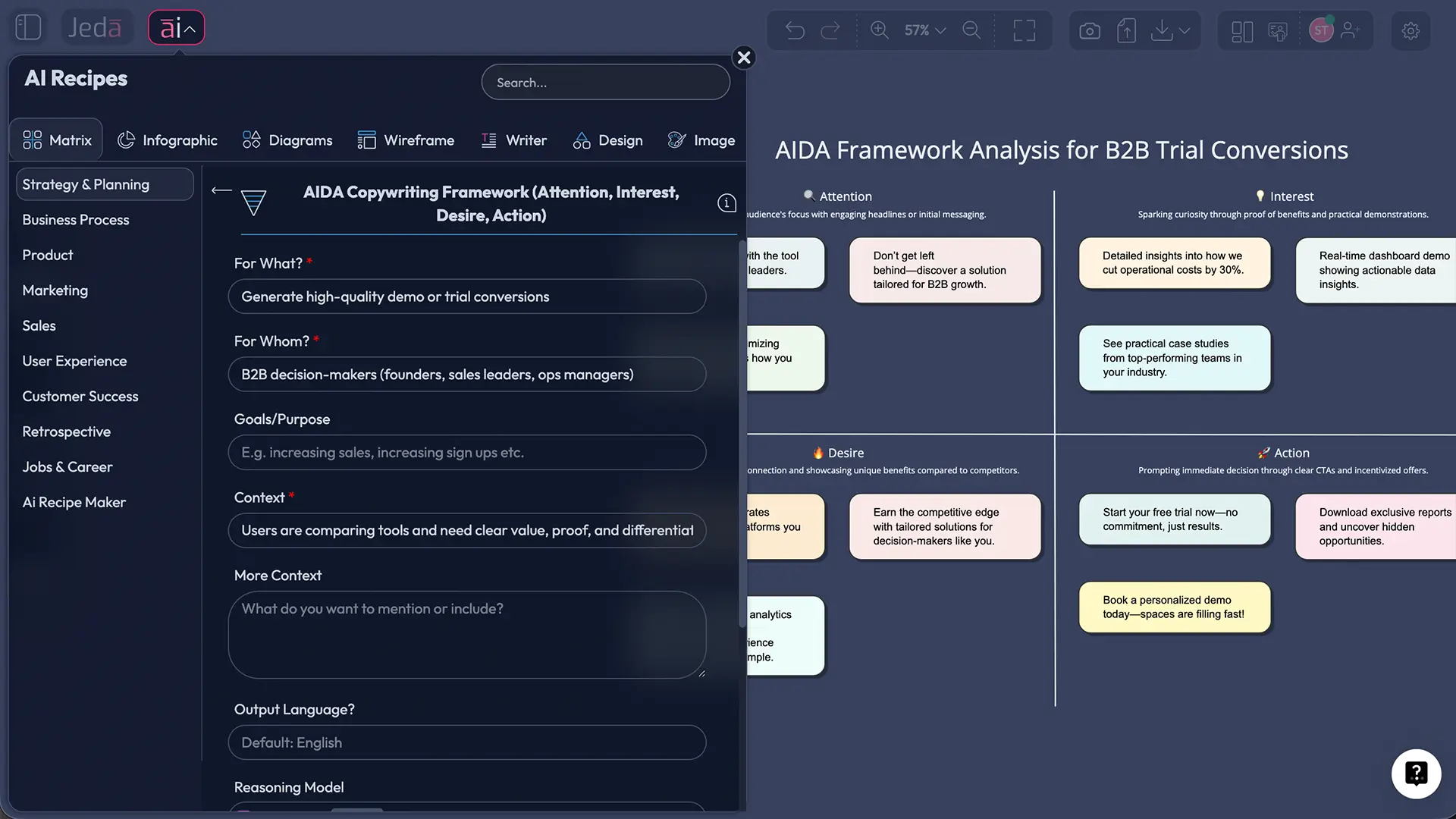
AIDA Copywriting Framework with AI gives you something most teams quietly need and rarely admit: a way to stop guessing your way through persuasive messaging. The structure is old. The pressure is new. You need copy that works across landing pages, ads, nurture emails, product launches, and social campaigns without sounding like it was stitched together during a caffeine emergency. In Jeda.ai’s AI Workspace, you can build the full AIDA flow visually, refine it collaboratively, and turn it into campaign-ready messaging faster than a scattered doc-and-chat workflow ever will. It is a practical system for serious teams, and it sits inside a platform trusted by 150,000+ users.
And that matters. Search results around AIDA are crowded with explainers and one-shot text generators, while teams still need a more practical workflow: generate the framework, stress-test the message, expand weak sections, and align stakeholders in one editable AI Whiteboard. That’s the real gap this page closes.
What is the AIDA Copywriting Framework?
AIDA stands for Attention, Interest, Desire, Action. It is one of the oldest and most widely used persuasion frameworks in advertising and copywriting. In plain English, it helps you move a reader from “Wait, what’s this?” to “Fine, where do I click?” HubSpot, Smart Insights, and Crazy Egg still teach the model because it remains useful across landing pages, email, social ads, and sales copy. The idea is simple enough to remember and flexible enough to reuse.
The history is messier than the neat textbook version. Many marketing guides still credit Elias St. Elmo Lewis with developing AIDA in the late 1890s, but newer historical research argues that the final formulation was shaped more decisively by Arthur Frederick Sheldon and Frank H. Dukesmith than most summaries admit. So yes, the framework is old. But the origin story is not as tidy as marketing blogs usually make it sound.
What keeps AIDA alive is not nostalgia. It is utility. The framework mirrors a familiar persuasion arc: first you earn attention, then build relevance, then intensify want, then point to a clear next step. Even critics of hierarchy-of-effects models admit the sequence remains influential in communications planning, despite the fact that real customer journeys are more nonlinear than AIDA suggests.
Why use AIDA Copywriting Framework with AI?
Here’s the blunt truth: AIDA is easy to understand and strangely easy to do badly. Plenty of teams nail the headline, drag through a generic body section, then slap on a CTA like they remembered it in the elevator. AI helps when it is used for structure, iteration, and pattern-spotting instead of lazy autopilot.
In Jeda.ai, the advantage is not just that AI can draft copy. It is that the AI Workspace lets you see the persuasive logic. You can map each stage, compare angles, add objections, pull in product context, and keep the whole decision trail on one AI Whiteboard. That is different from dumping a prompt into a text box and hoping the machine had a good day.
- See the persuasion flow
Map Attention, Interest, Desire, and Action as an editable visual instead of burying structure inside a long paragraph.
- Generate faster first drafts
Use AI to create multiple AIDA angles for ads, landing pages, sales emails, and social copy without starting from zero.
- Refine weak sections
Spot where the message loses momentum, then use AI+ to extend or deepen the framework without rewriting everything.
- Collaborate in context
Writers, marketers, founders, and product teams can review the same board inside Jeda.ai instead of chasing comments across tools.
- Use better model judgment
Shifu users can use Multi-LLM + Aggregator for stronger draft quality when the offer, audience, or channel is complex.
- Convert the output visually
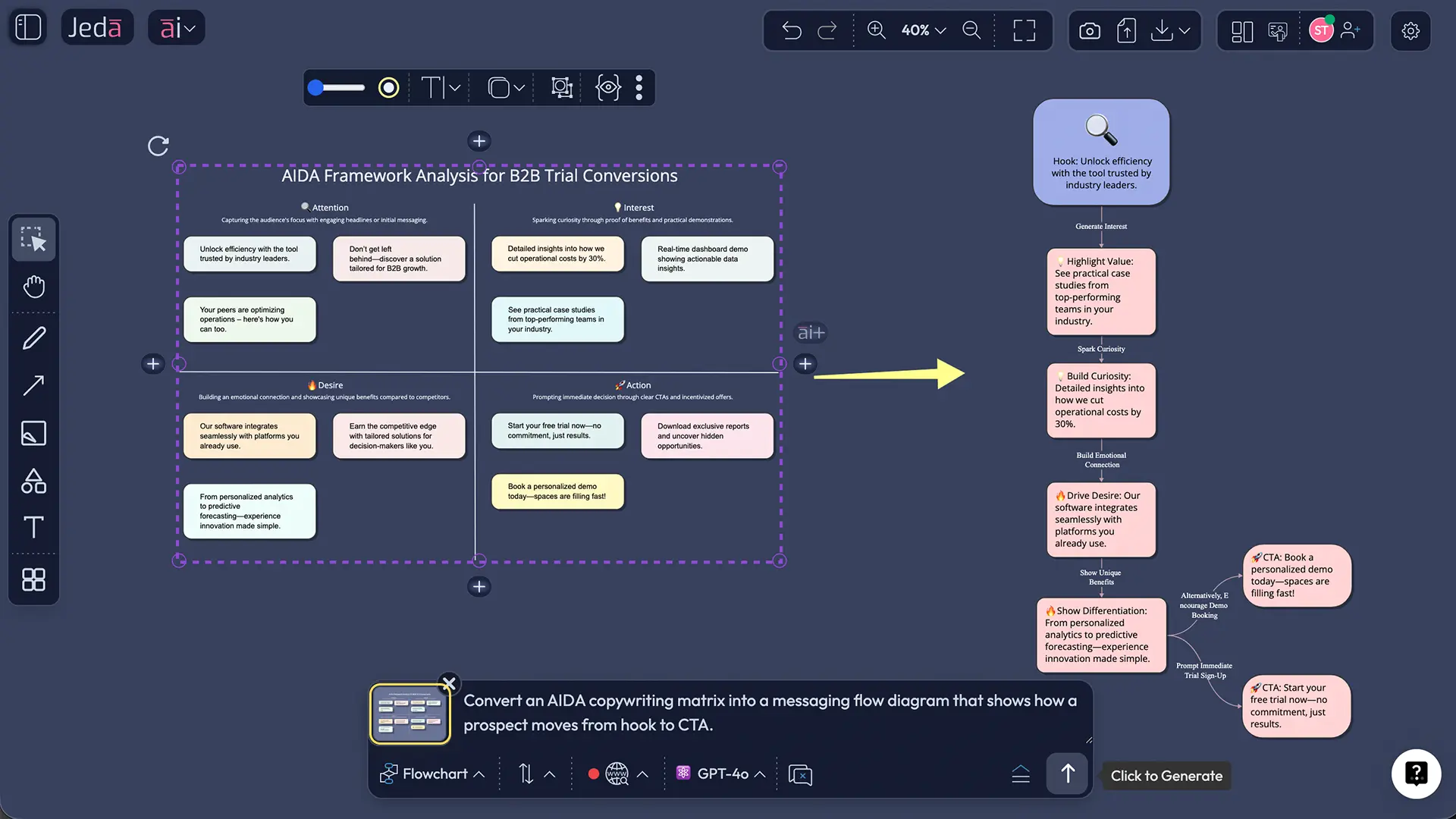
Use Vision Transform to reshape your AIDA board into another visual, such as a Diagram for messaging flow or a Mindmap for campaign expansion.
Most live AIDA-related results today fall into two camps: educational articles or AI generators that return a single text output. Tools like Rytr, GravityWrite, SwipeWell, and HoppyCopy all show that there is real demand for AI-assisted AIDA generation. But the bigger workflow problem is still post-generation refinement. Jeda.ai’s Visual AI approach is stronger there because the framework stays editable, reviewable, and extendable in one place.
Why AIDA still works — and where it breaks
AIDA still works because it respects a basic communication reality: people rarely care in the order brands want them to. You need to earn the first second, then the next ten, then the emotional case, then the click. That logic is still visible in modern examples from product pages, ad copy, and email sequences. Copyhackers’ breakdown is especially useful here because it shows how brands like Apple repeat mini AIDA loops across a single page rather than treating the framework as one rigid block.
But AIDA has limits. It is linear. Real journeys are not. Smart Insights notes that modern buyers move back and forth, especially when social proof, reviews, communities, and comparison research enter the picture. Vakratsas and Ambler also found limited empirical support for strict hierarchy models as universal explanations of advertising response. So no, AIDA is not sacred. It is a practical persuasion scaffold, not the Ten Commandments of copywriting.
That is exactly why AI improves it. You can keep the useful skeleton while adapting the message to channel, audience sophistication, objections, and awareness level. In other words: structure without stiffness. Because stiff copy reads like it was approved by a committee.
How to create an AIDA Copywriting Framework with AI in Jeda.ai
Jeda.ai supports two practical ways to build this framework.
Method 1: Recipe Matrix
This is the recommended route when you want speed, structure, and fewer blank-page headaches. Since this topic is a matrix-style framework, the Recipe path gives you the cleanest starting point. It also fits how Jeda.ai organizes 300+ strategic frameworks and templates for faster setup.
- Open the AI Menu
Start in your Jeda.ai workspace and open the AI Menu from the top-left corner of the canvas.
- Choose the Matrix recipe category
Select the Matrix recipe path, then choose the AIDA copywriting framework template.
- Add campaign context
Enter the product or offer, target audience, channel, desired action, and key differentiators.
- Generate the AIDA matrix
Let Jeda.ai build the first structured version across Attention, Interest, Desire, and Action.
- Edit each quadrant
Tighten hooks, sharpen proof, clarify benefits, and remove any generic filler before you move forward.
- Use AI+ to extend
Tap the AI+ button to deepen weak areas, expand message angles, or continue the framework with more detail.
- Transform if needed
Use Vision Transform when you want to convert the matrix into another visual for presentation, workflow mapping, or team discussion.
- Export or share
Finalize the board, collaborate with your team, then export as PNG, SVG, or PDF when you are ready.
Method 2: Prompt Bar
Use this when you already know what you want and do not need training wheels.
- Open the Prompt Bar at the bottom of the canvas.
- Select the Matrix command.
- Type a prompt that includes the audience, offer, channel, promise, and CTA.
- Press Enter to generate the first AIDA board.
- Review the structure, edit the weak sections, and use AI+ to extend the board where needed.
A strong starter prompt looks like this:
Build an AIDA copywriting framework for a landing page promoting an AI CRM for small B2B sales teams. Audience: founders and heads of sales. Pain points: missed follow-ups, messy pipelines, poor forecasting. Tone: confident, clear, practical. CTA: book a demo.
That prompt is already better than “write me some marketing copy.”
What to do after generation
This is where teams usually either win or ruin the draft.
Use the AI Whiteboard view to ask tougher questions:
- Does the Attention line stop the right reader, or just any reader?
- Is Interest built on actual relevance, or just product noise?
- Does Desire show a transformation people want, or only features the brand likes?
- Is Action singular and obvious, or vague and crowded?
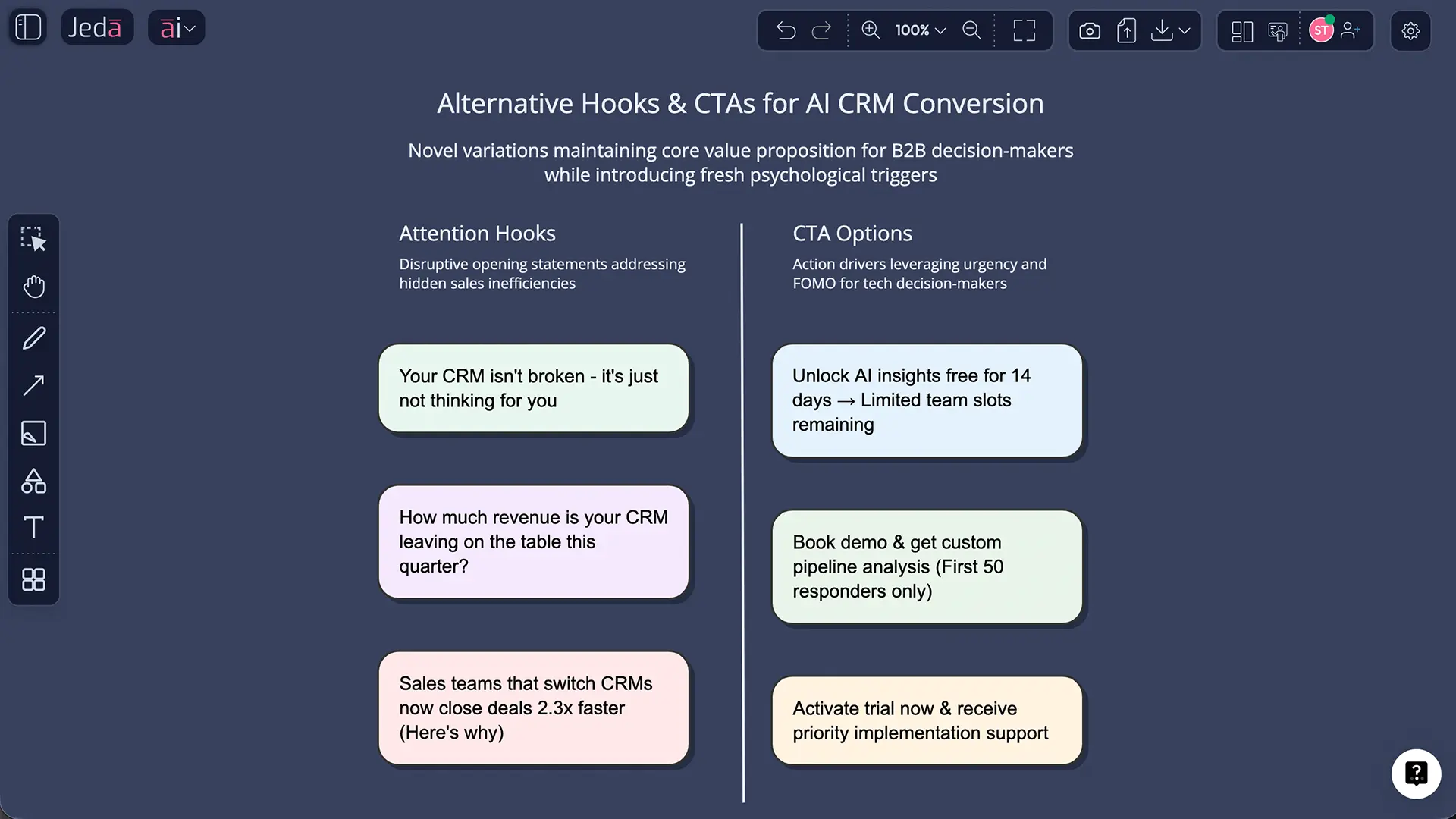
Then use AI+ to extend the draft. Keep that instruction broad. The goal is to deepen the framework, not micromanage the button like it owes you rent.
AIDA copywriting template and example
Let’s make this concrete.
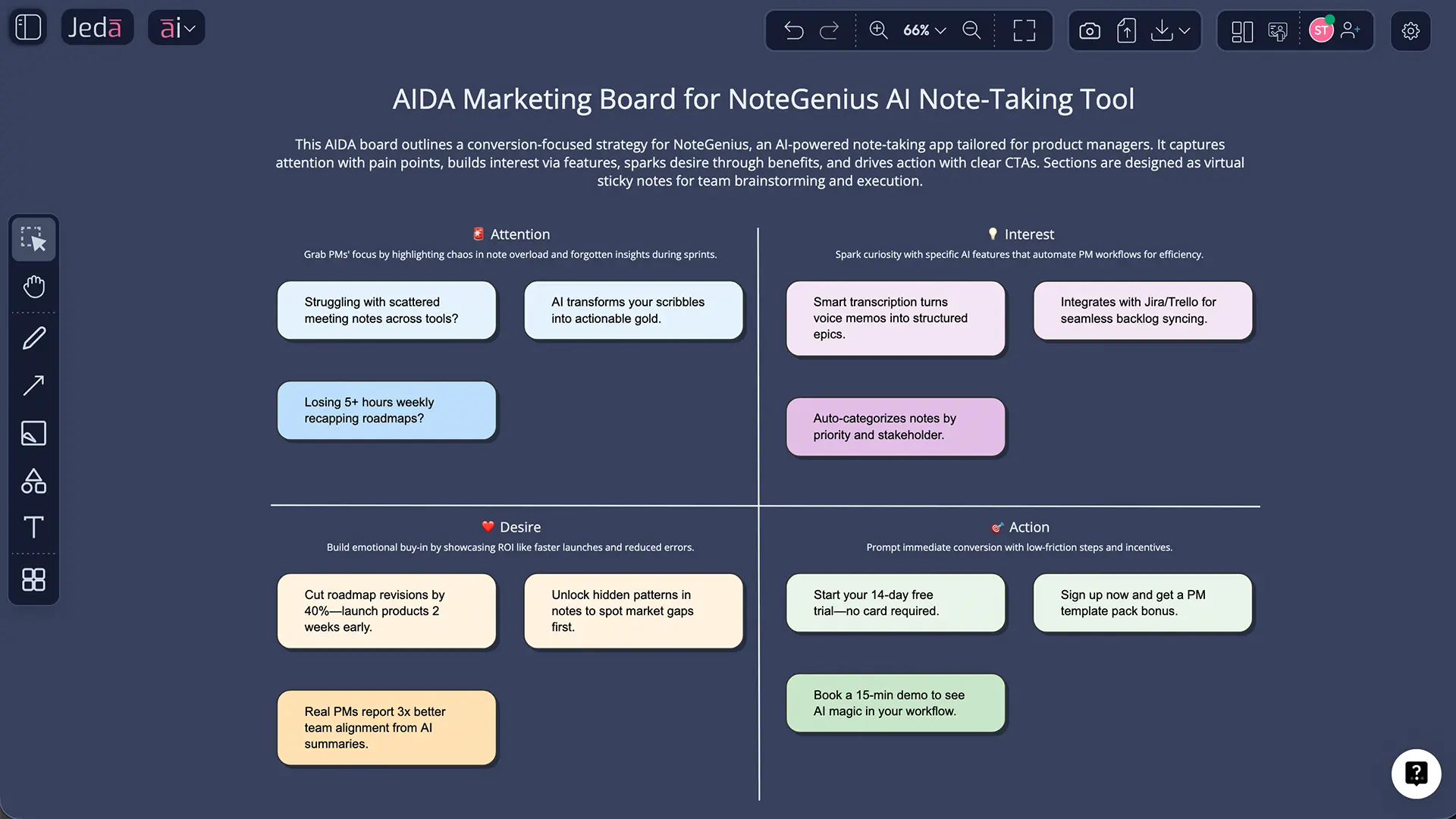
Imagine you are writing a landing page for an AI note-taking tool for product managers.
Now the useful part: you would not stop there.
In Jeda.ai, you can turn that first pass into a richer board by adding supporting proof under each stage. Under Attention, you might test three different hooks for different audience awareness levels. Under Interest, you could add feature-to-benefit links and objection notes. Under Desire, you could map before-and-after outcomes for PMs, designers, and engineers. Under Action, you might compare “Start free” versus “Book a demo” by funnel stage.
That is the difference between writing copy and designing persuasion.
AIDA vs other copywriting frameworks
AIDA is not the only game in town. And pretending otherwise is how marketers end up forcing the wrong structure onto the wrong message.
| Framework | Best use case | Main strength | Main weakness |
|---|---|---|---|
| AIDA | Landing pages, ads, sales emails, product pages | Clear persuasion flow from hook to CTA | Can feel too linear for complex or research-heavy journeys |
| PAS | Pain-led offers, direct response ads, problem-aware audiences | Faster emotional punch | Less useful when the audience needs education first |
| BAB | Simple before/after transformations | Easy to understand quickly | Often too light for nuanced offers |
| 4Ps | Short-form persuasive copy | Punchy and memorable | Less diagnostic than a full AIDA board |
AIDA tends to work best when the offer is understandable and the desired action is clear. PAS can outperform it when pain is the strongest entry point. Smart operators use more than one framework. Better operators know when to stop forcing one.
Best practices when using AIDA with AI
Another smart move is using the same AIDA matrix across channels. Build the core board once in Jeda.ai, then derive variations for a landing page hero, LinkedIn ad, nurture email, webinar blurb, or product launch post. You are not reinventing persuasion each time. You are adapting one message architecture.
Common mistakes to avoid
Treating AIDA like a fill-in-the-blanks toy
The framework is simple. That does not mean the thinking should be.
Confusing Interest with Desire
Interest explains. Desire intensifies. When teams blur the two, the copy starts sounding informative but not persuasive.
Listing features without consequence
Features belong in the copy only when the reader understands what changes because of them.
Using a weak action step
“Learn more” is not always wrong. It is just lazy a shocking amount of the time.
Leaving the AI draft untouched
First drafts are scaffolding. Not destiny.
Frequently asked questions
- What does AIDA stand for in copywriting?
- AIDA stands for Attention, Interest, Desire, and Action. It is a persuasion framework used to move a reader from first awareness to a specific next step, such as clicking, signing up, booking, or buying.
- Is AIDA still relevant in 2026?
- Yes. AIDA is still widely taught and used because it gives marketers a practical structure for persuasive messaging. The catch is that modern journeys are less linear, so the framework works best when adapted to channel, awareness level, and context.
- What is the difference between AIDA and PAS?
- AIDA starts by capturing attention, then builds interest, desire, and action. PAS begins with a problem, agitates it, and then offers a solution. AIDA is broader; PAS is usually sharper for pain-led direct response copy.
- Can AI write AIDA copy well?
- Yes, especially for first drafts, angle generation, and structure. AI is strongest when you provide clear audience, offer, and channel context. Human editing still matters for specificity, voice, credibility, and sharper calls to action.
- Which Jeda.ai command should I use for AIDA?
- Use the Matrix command when building an AIDA framework from the Prompt Bar. For a more guided setup, start with the Recipe Matrix path in the AI Menu and choose the AIDA template.
- Can I collaborate on an AIDA framework in Jeda.ai?
- Yes. Jeda.ai is built for collaborative editing, so marketers, copywriters, founders, and product teams can review the same AIDA board together on the AI Whiteboard instead of bouncing between separate tools.
- What should I do after the first AIDA draft is generated?
- Review each section for relevance and clarity, edit weak messaging, and use AI+ to extend the framework. After that, you can repurpose the board into channel-specific assets or use Vision Transform to reshape the visual output.
- Is there an AI recipe for AIDA in Jeda.ai?
- Yes. This page treats AIDA as a matrix-style framework, so the recommended workflow is the Recipe Matrix method first, followed by the Matrix command in the Prompt Bar when you want more control.
- Can I turn an AIDA board into another visual?
- Yes. Jeda.ai supports Vision Transform, which lets you convert an existing visual into another format. That is useful when you want to turn a messaging board into a Diagram, Mindmap, or other planning view.
- What can I export after building an AIDA framework in Jeda.ai?
- You can export your final work from Jeda.ai as PNG, SVG, or PDF. That makes it easy to share the framework with stakeholders or reuse it in planning and campaign review workflows.
Sources and further reading
For a broader view of Jeda.ai’s platform context, see AI Workspace, AI Whiteboard, and AI for Marketing Consultants. For related analysis workflows, you can also explore generate porters five forces with ai, pestel analysis with ai using jeda ai, and gap analysis templates with jeda ai.
- [1]
Iwamoto, Akinori (2023) . “The Origin of AIDA: Who Invented and Formulated the AIDA Model?” Persuasion and Communication.
View Source ↗ - [2]
Barry, Thomas E. (1987) . “The Development of the Hierarchy of Effects: An Historical Perspective” Current Issues & Research in Advertising.
View Source ↗ - [3]
Vakratsas, Demetrios; Ambler, Tim (1999) . “How Advertising Works: What Do We Really Know?” Journal of Marketing.
View Source ↗ - [4]
Lavidge, Robert J.; Steiner, Gary A. (1961) . “A Model for Predictive Measurements of Advertising Effectiveness” Journal of Marketing.
View Source ↗ - [5]
HubSpot (2025) . “The AIDA Model: A Proven Framework for Converting Strangers Into Customers” HubSpot Blog.
View Source ↗ - [6]
Smart Insights (2025) . “The AIDA model and how to apply it in the real world” Smart Insights.
View Source ↗ - [7]
Crazy Egg (2025) . “AIDA Copywriting Formula: How to Apply it + Real Examples” Crazy Egg Blog.
View Source ↗ - [8]
Copyhackers (2023) . “Attention Interest Desire Action: Use this to get, and keep, people reading” Copyhackers.
View Source ↗ - [9]
Rytr (2026) . “AIDA Copywriting Generator | Use Cases” Rytr.
View Source ↗ - [10]
GravityWrite (2026) . “Free AI AIDA Framework Generator” GravityWrite.
View Source ↗
Build your AIDA Copywriting Framework with AI
Join 150,000+ users on Jeda.ai to turn rough ideas into editable campaign logic inside one Visual AI workspace.
Try Free Template