Porter’s Five Forces with AI is still one of the cleanest ways to test whether an industry is attractive, crowded, fragile, or quietly profitable. And yes, it still matters. The problem is not the framework. The problem is how teams use it. They fill five boxes, toss in a few lazy labels like “high supplier power,” and call it strategy. Inside Jeda.ai, you can build the analysis inside one AI Workspace, keep the reasoning visible on an editable AI Whiteboard, and push beyond a static classroom exercise into something a product team, consultant, or founder can actually use.
That is where Jeda.ai becomes more than a pretty canvas. You can start with a Recipe Matrix, generate a structured first pass, refine each force with evidence, then use the AI+ button to deepen one force after the matrix exists. If you need a different view, you can convert the matrix with Vision Transform and keep the logic connected. No tool hopping. No screenshot graveyard. With 150,000+ users, 300+ strategic frameworks, and a genuinely Visual AI workflow, Jeda.ai gives Porter’s Five Forces the one thing most teams forget to build: context.
If you want the wider cluster around this page, this article belongs beside Jeda.ai’s AI Workspace, AI Whiteboard, and related Porter pages such as Porter’s analysis, Porter’s Four Corners Analysis, and Porter’s Generic Strategies.
What is Porter's Five Forces?
Porter’s Five Forces is an industry-structure framework developed by Michael E. Porter to explain the competitive pressures that shape profitability. Porter introduced the logic in his 1979 Harvard Business Review article and later revisited it in 2008 to remind managers that competition is broader than rivalry among current players. The framework asks you to examine five pressures: competitive rivalry, threat of new entrants, bargaining power of suppliers, bargaining power of buyers, and threat of substitutes.
That sounds simple because it is simple. But simple is not the same as shallow.
Five Forces does not tell you whether your company is good or bad. It tells you whether the industry structure makes sustained profits easier or harder to earn. That distinction matters. A strong company can still operate in a brutal industry. A weak company can still coast in a forgiving one for a while. Porter’s real point was that performance depends on both industry structure and your relative position inside it.
So what does each force really ask?
- Rivalry among existing competitors: How intense is direct competition on price, features, capacity, marketing, and customer switching?
- Threat of new entrants: How hard is it for a new player to enter and scale with credibility?
- Supplier power: How much control do key inputs, platforms, talent pools, or data providers have over cost and availability?
- Buyer power: How much pressure can customers exert on price, service, customization, or contract terms?
- Threat of substitutes: What other products, services, or workarounds could solve the same job differently?
That last point trips people up. A substitute is not just a direct competitor. It is an alternative way for the customer to get the job done. Spreadsheet software can substitute for analytics tools. In-house teams can substitute for agencies. A napkin sketch can substitute for expensive early design software, at least temporarily. Strategy gets more honest when substitutes enter the room.
Why use Porter's Five Forces with AI?
Five Forces is a reasoning framework, which means it benefits from structured synthesis more than from decoration. AI helps because it accelerates evidence gathering, sharpens assumptions, and makes it easier to compare forces without flattening them into clichés. You still need judgment. You still need market knowledge. But you do not need to waste an hour formatting columns before the real conversation starts.
- Cleaner industry framing
Jeda.ai gives each force its own space, so your team stops mixing rivalry, substitutes, and buyer pressure into one noisy paragraph.
- Faster evidence synthesis
You can draft the structure quickly, then enrich each force with product launches, pricing behavior, regulation, switching costs, and customer signals.
- Cross-functional analysis
Product, strategy, finance, and marketing can challenge the same board together inside one AI Whiteboard instead of debating from separate docs.
- AI+ for deeper pressure testing
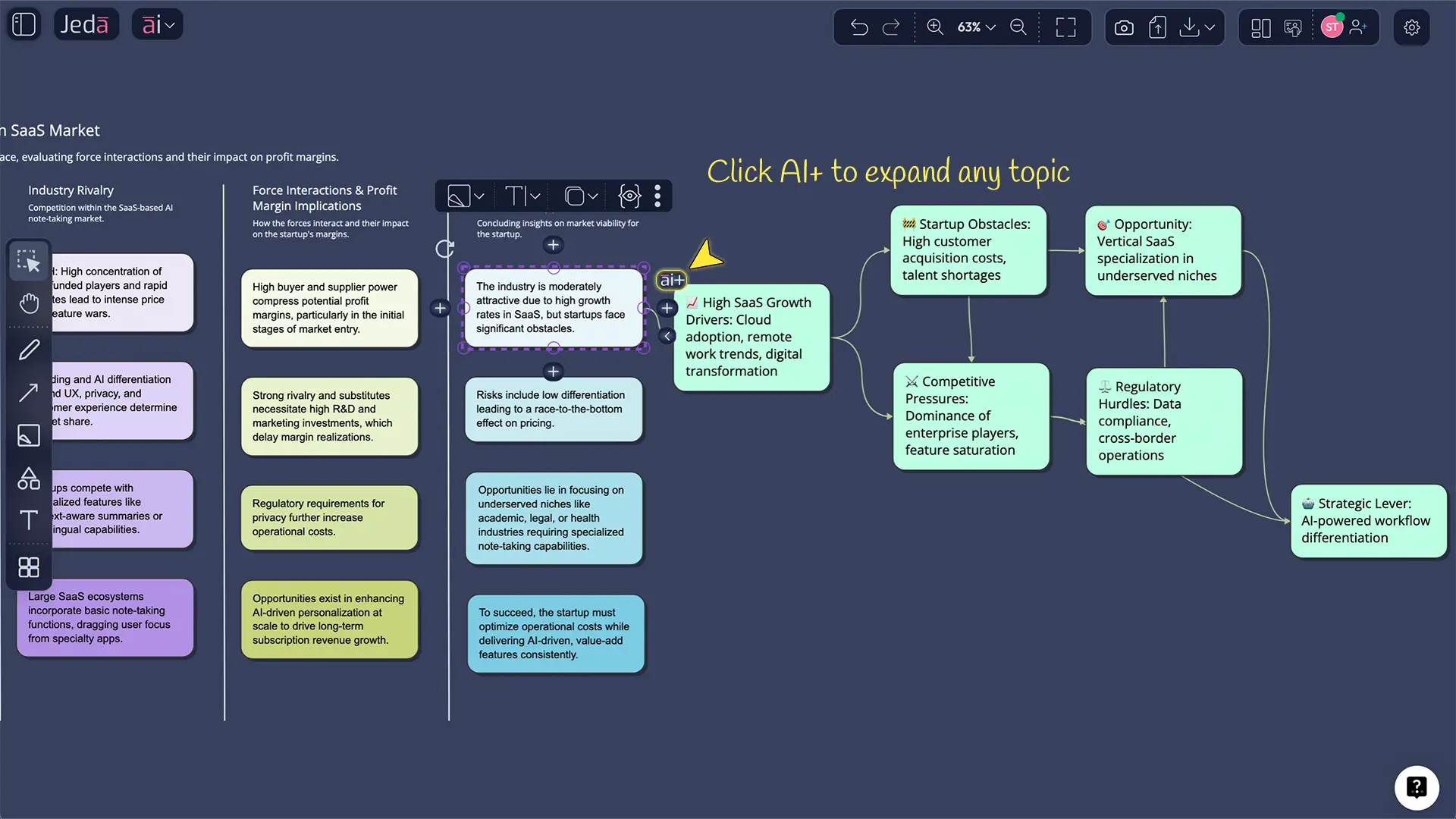
Use AI+ after the matrix exists to deepen one force, compare two scenarios, or extend the implications for margins, entry, or differentiation.
- Multiple visual outputs
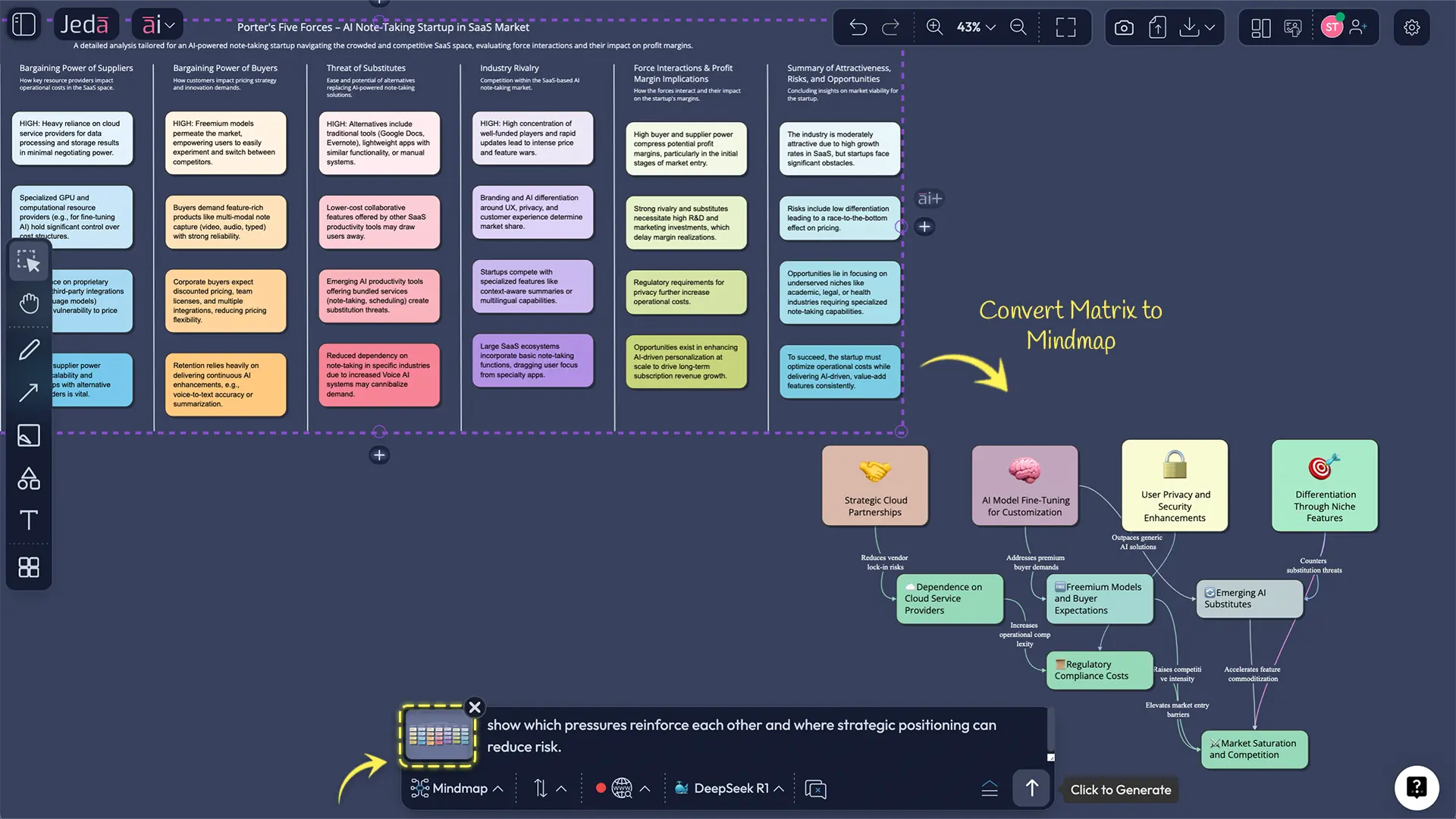
Start with Matrix, then convert the result into a Diagram or Mindmap if you want a force map, board summary, or workshop explainer.
- Editable from first draft
The output stays editable in Jeda.ai, which matters because Five Forces is almost always revised once real evidence and objections show up.
There is another reason, too. Most Five Forces writeups are static. Markets are not. New distribution channels emerge, a platform owner changes its terms, regulation shifts, a supplier consolidates, or a substitute suddenly becomes viable because AI cuts costs. In Jeda.ai, you can update the board as the market moves. That makes the framework useful again.
How to create Porter's Five Forces in Jeda.ai
Method 1: Recipe Matrix
Use the recipe-led matrix when you want a workshop-friendly board with labeled forces and room for evidence. It is the cleanest way to move from blank canvas to real analysis.
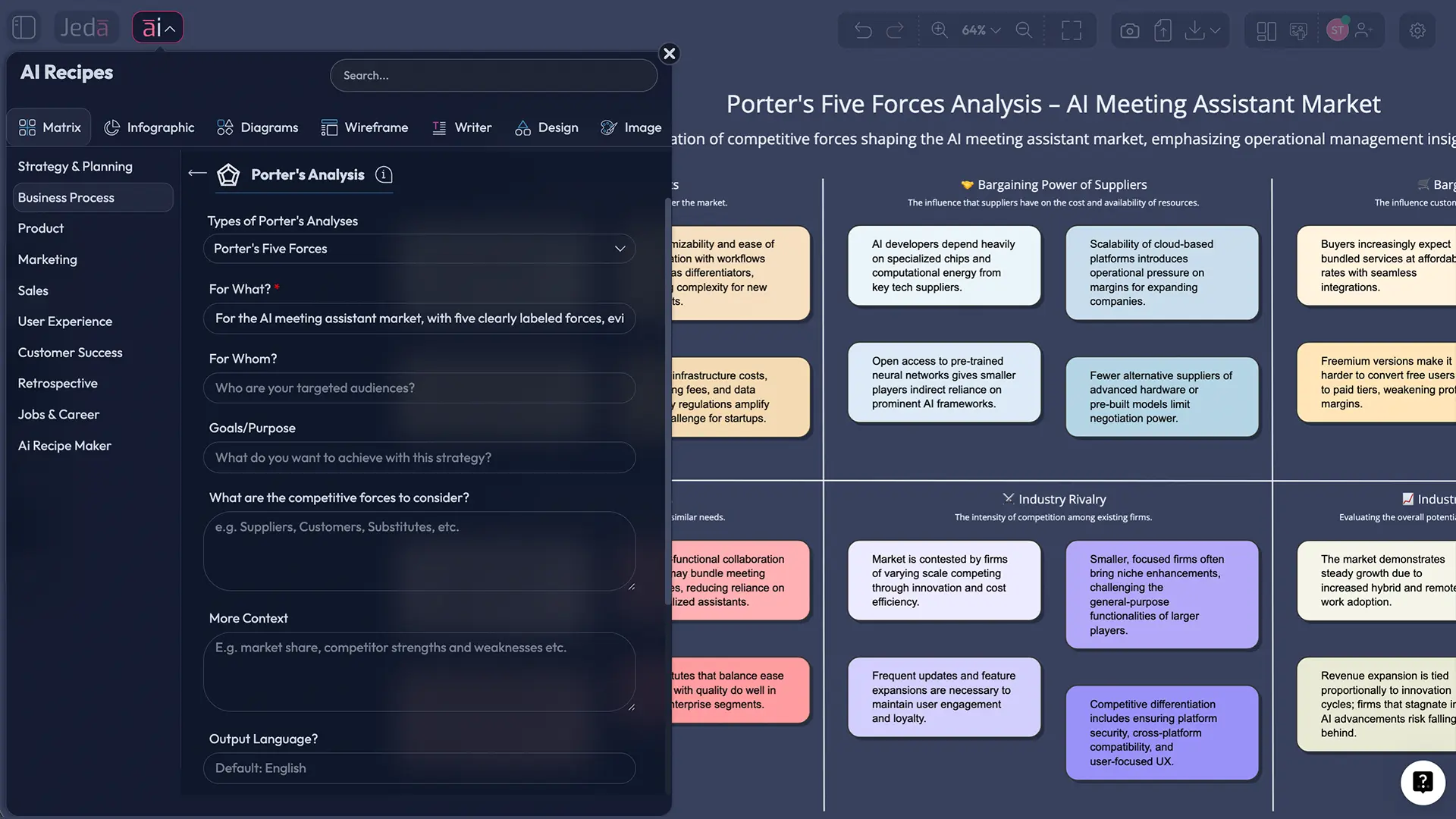
- Open the AI Menu and choose the Matrix recipe
From the canvas, open the AI Menu, go to Matrix Recipes, and select the Porter’s Five Forces recipe.
- Define the industry precisely
Name the market, customer segment, geography, and time horizon. A Five Forces board for global telecom is not the same thing as a board for AI note-taking tools in North America.
- Generate the five-force structure
Ask Jeda.ai to create five labeled sections for rivalry, entrants, suppliers, buyers, and substitutes, with room for evidence and an industry-attractiveness summary.
- Replace generic labels with proof
Edit each force using actual signals such as switching costs, concentration, customer behavior, capital requirements, regulation, channel access, and substitute usage.
- Add force interactions
Show where forces reinforce each other. Strong buyer power and heavy rivalry often create a very different margin picture than either force alone.
- Use AI+ for a deeper scenario
Once the matrix is on canvas, select one force and use the AI+ button to extend it. AI+ is best for continuing or deepening existing content, not for asking for a brand-new unrelated framework.
Method 2: Prompt Bar
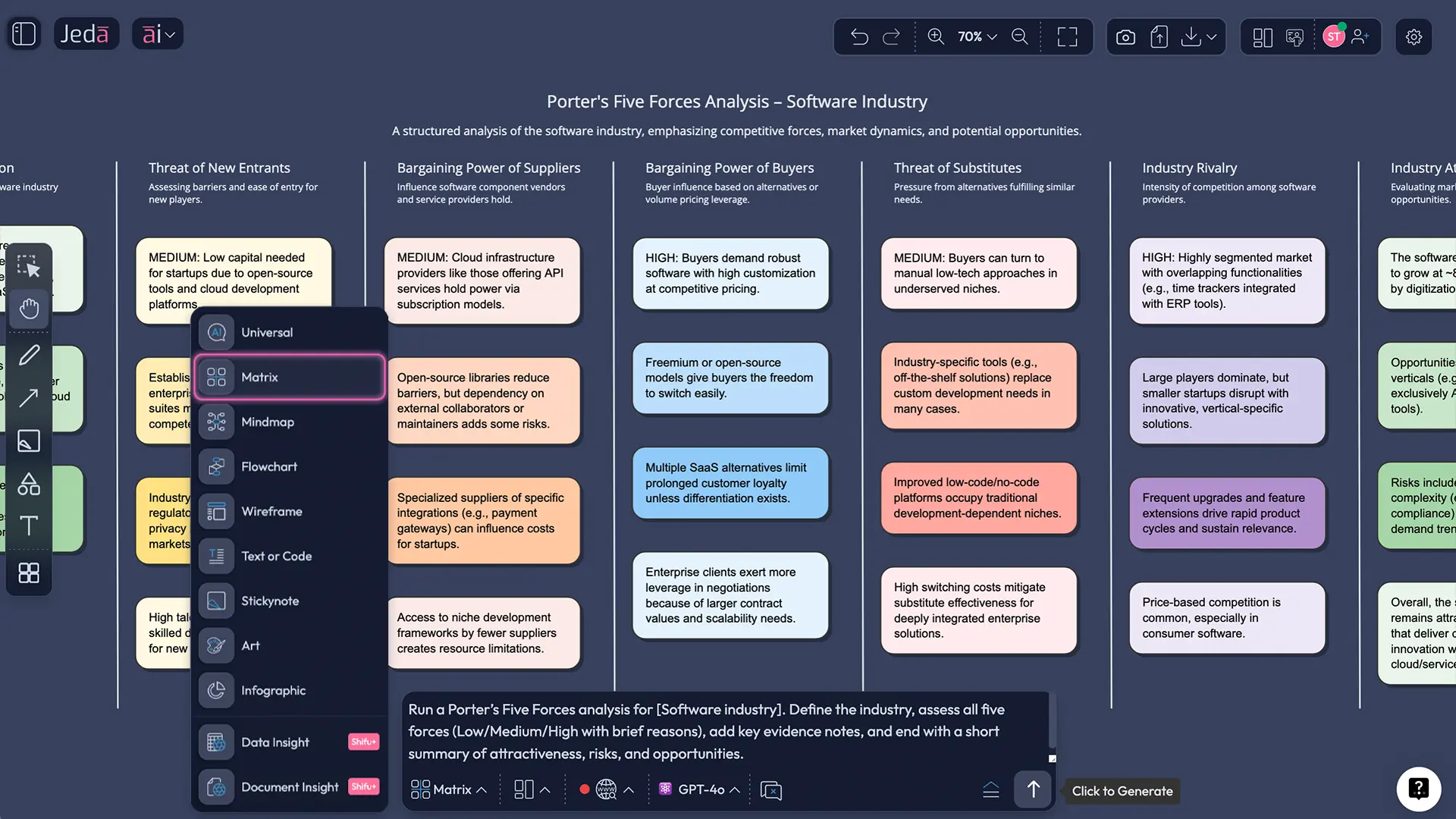
The Prompt Bar is the better option when the industry definition is unusual or the board needs a more tailored angle.
Open the Prompt Bar at the bottom of the canvas. Select the Matrix command. Then use a prompt like this:
Create a Porter’s Five Forces analysis for the AI meeting assistant market in North America. Evaluate rivalry, threat of new entrants, supplier power, buyer power, and substitute threats. Include short evidence notes and end with an overall view of industry attractiveness for a new entrant targeting mid-market teams.
Then edit. Always edit.
A decent first draft from AI is helpful. A blind first draft from AI is how you end up with the same three adjectives every competitor page uses.
After the matrix is built, you can do two high-value follow-ups in Jeda.ai:
- Tap AI+ on one force to extend it into a deeper explanation or scenario comparison.
- Use Vision Transform if leadership wants a different visual, such as a cause-effect map or a force interaction diagram.
What does a strong Five Forces analysis actually look like?
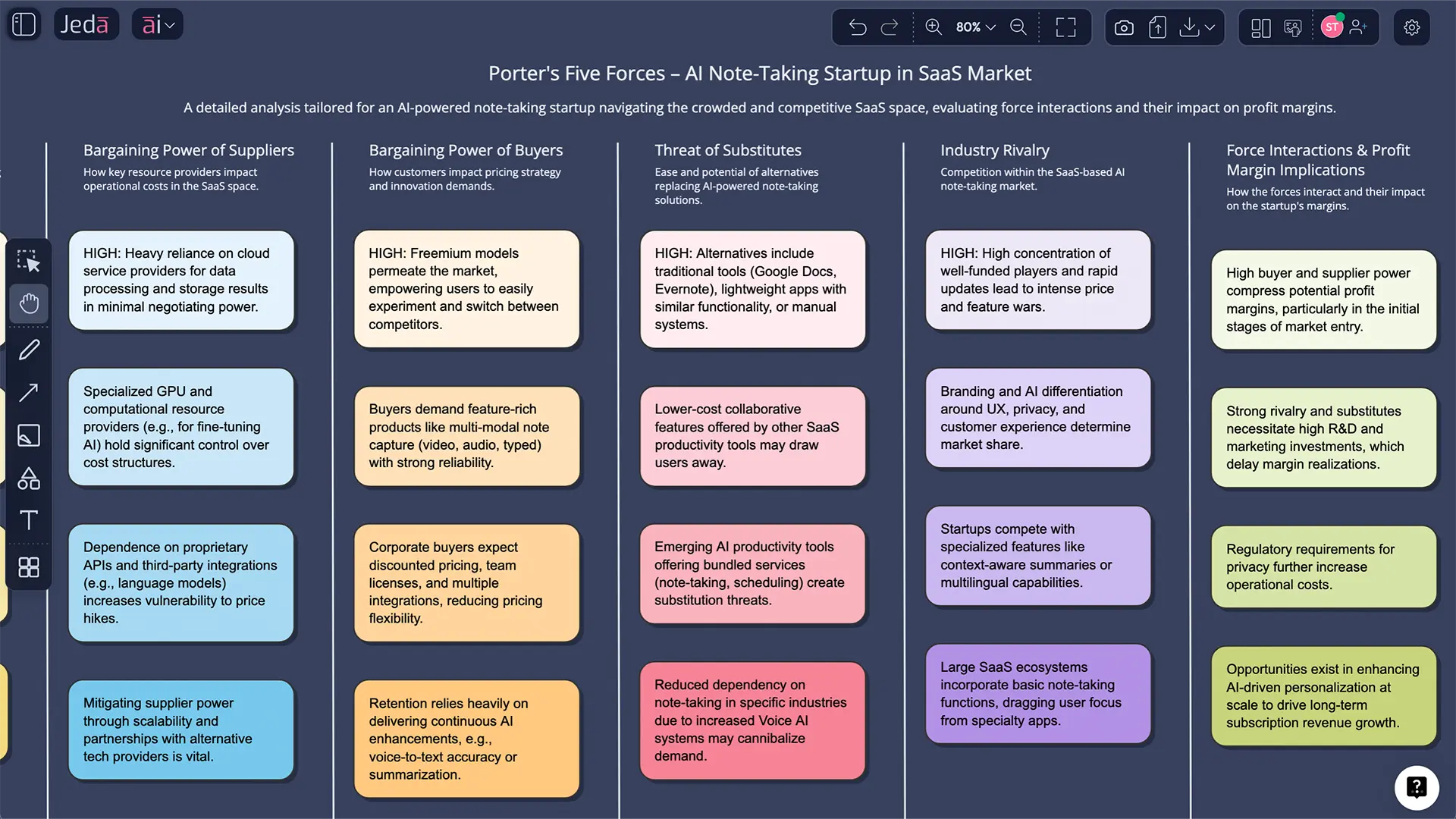
A good board does not stop at “high” or “low.” That is kindergarten strategy. A strong Five Forces analysis explains why the pressure exists, how it affects margins, and which force matters most right now.
Take the market for AI meeting assistants.
- Rivalry: high, because many tools overlap on transcription, summaries, action items, and integrations.
- Threat of new entrants: moderate, because the technical barriers have fallen, but distribution, trust, and workflow adoption remain hard.
- Supplier power: moderate to high, depending on dependence on upstream LLMs, cloud providers, or meeting-platform APIs.
- Buyer power: high in many segments, because switching costs can be modest and buyers compare on price, compliance, and integration depth.
- Threat of substitutes: high, because teams can use manual notes, built-in platform features, or general-purpose AI tools instead of a dedicated assistant.
Now the useful question: what does that combination imply?
It suggests a market where feature parity appears quickly, margins are pressured, and generic entry is dangerous. So a new entrant probably should not compete on commodity transcription alone. It may need a sharper wedge: regulated industries, meeting governance, CRM-linked workflows, multilingual compliance, or a distinctive service layer. That is strategy. The framework did not give the answer by magic, but it forced the right conversation.
Best practices and tips
A strong Five Forces board is specific, comparative, and alive.
And one more thing. Avoid false precision. Strategy is not chemistry class. You do not need a fake score of 7.3 out of 10 for supplier power to look intelligent.
Common mistakes to avoid
The first mistake is defining the industry too broadly. “Software” is not an industry for Five Forces. It is a continent.
Second, teams confuse competitors with substitutes. A substitute does not have to look like you. It only has to solve the same customer problem.
Third, analysts treat all five forces as equally important at all times. They are not. In some markets, substitutes dominate. In others, entry barriers and supplier concentration matter far more.
Fourth, they ignore complementors, regulation, or platform dependence when these factors materially reshape one or more forces. Porter’s core model still works, but you need to show where adjacent pressures change the structure.
And finally, they stop at diagnosis. A Five Forces board is not the destination. It is the setup for positioning, differentiation, value chain design, or a no-entry decision.
Frequently Asked Questions
- What is Porter’s Five Forces used for?
- Porter’s Five Forces is used to analyze industry structure and the competitive pressures that shape profitability. It helps teams assess whether a market is attractive, where pressure comes from, and how a company might position itself more effectively.
- Who created Porter’s Five Forces?
- Michael E. Porter introduced the framework in his 1979 Harvard Business Review article “How Competitive Forces Shape Strategy” and later revisited it in a 2008 Harvard Business Review article.
- What are the five forces in Porter’s model?
- The five forces are rivalry among existing competitors, threat of new entrants, bargaining power of suppliers, bargaining power of buyers, and threat of substitutes. Together they explain the pressure on prices, costs, and long-run profitability.
- Is Porter’s Five Forces about my company or the whole industry?
- Primarily, it is about industry structure. The framework helps you understand the economic pressure built into a market. Your company’s specific strategy matters too, but Five Forces starts with the external structure first.
- What is the difference between rivals and substitutes?
- Rivals compete directly within the same industry definition. Substitutes solve the same customer problem through a different product, service, or method. Mixing those two ideas weakens the analysis.
- How does AI improve a Five Forces analysis?
- AI improves the workflow by helping teams structure the matrix faster, compare evidence across forces, extend one force with AI+, and keep the analysis editable as market conditions change inside Jeda.ai.
- Which Jeda.ai command should I use for Five Forces?
- Start with the Matrix command or a Matrix recipe because Five Forces is easiest to read as a structured five-part board. After that, you can convert it to a Diagram or Mindmap if needed.
- Can I use AI+ to create a whole Five Forces board from scratch?
- AI+ works best after a visual already exists on canvas. Build the first matrix first, then select a force or summary area and use AI+ to deepen or continue the analysis.
- How often should a Five Forces analysis be updated?
- Update it when a major structural signal changes, such as a merger, regulation shift, channel disruption, new platform rules, or a substitute becoming significantly cheaper or more credible.
- What should come after Five Forces?
- Usually a positioning decision, a value chain review, a competitor-response analysis, or a go/no-go market decision. Five Forces is diagnostic; the next framework should turn diagnosis into action.
Sources & Further Reading
- [1]
Porter, Michael E. (1979) . “How Competitive Forces Shape Strategy” Harvard Business Review.
View Source ↗ - [2]
Porter, Michael E. (2008) . “The Five Competitive Forces That Shape Strategy” Harvard Business Review.
View Source ↗ - [3]
Institute for Strategy and Competitiveness (n.d.) . “The Five Forces” Harvard Business School.
View Source ↗ - [4]
Dobbs, Michael E. (2014) . “Guidelines for Applying Porter’s Five Forces Framework: A Set of Industry Analysis Templates” Competitiveness Review.
View Source ↗ - [5]
Shi, Chunxiao, et al. (2021) . “How Do Upper Echelons Perceive Porter’s Five Forces? Evidence From Strategic Entrepreneurship in China” Frontiers in Psychology.
View Source ↗
Start Your Porter's Five Forces Analysis Today
Join 150,000+ users who use Jeda.ai to turn industry pressure into editable strategy boards inside one AI Workspace.
Try Free Template