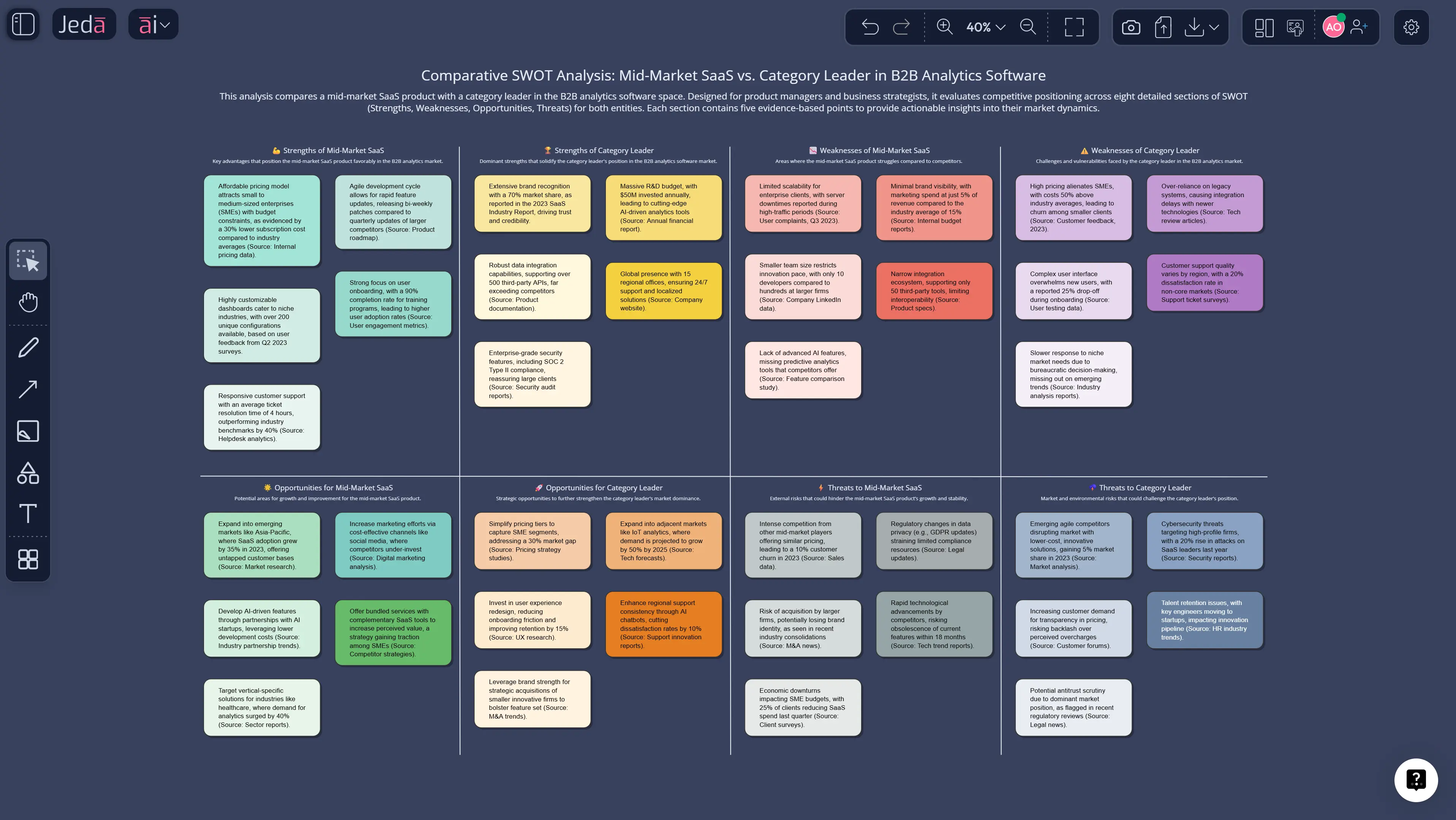
Comparative SWOT Analysis is what you use when a normal SWOT feels too “about us” and not enough “about the market.” It splits the classic SWOT into 8 sections—your Strengths/Weaknesses/Opportunities/Threats and your competitor’s Strengths/Weaknesses/Opportunities/Threats—so you can see the gap, not just your self-image.
In a Jeda.ai AI Workspace and AI Whiteboard, Comparative SWOT Analysis becomes a fast, visual competitive briefing: generate the first draft with AI, attach evidence, argue with your team in real time, then export a clean PNG/SVG/PDF when it’s time to decide. Jeda.ai is already used by 150,000+ users, and this is exactly the kind of “quick clarity, real action” workflow they come for.
What is Comparative SWOT Analysis?
Comparative SWOT Analysis is a competitive twist on SWOT. Instead of one 2×2 grid, you build an 8-cell view:
- Your Strengths
- Your Weaknesses
- Your Opportunities
- Your Threats
- Competitor Strengths
- Competitor Weaknesses
- Competitor Opportunities
- Competitor Threats
The goal isn’t to “score points.” It’s to expose where the market is tilting and where your assumptions are soft. SWOT is widely used because it’s simple, but researchers have also pointed out that it becomes vague when items aren’t prioritized or backed by evidence. Comparative SWOT Analysis forces a higher standard, because every claim sits next to a rival claim and begs the question: so what?
Comparative SWOT vs. competitor SWOT vs. “competitive matrix”
People mix these up.
- Competitor SWOT usually means “a SWOT about a competitor.”
- Comparative SWOT Analysis means “two SWOTs, side-by-side, designed for comparison.”
- Competitive matrices can be anything (features, pricing, positioning, perception maps). They’re useful, but often miss the internal vs external split that SWOT gives you.
If you’re choosing one, pick Comparative SWOT Analysis when you need strategy, not just a spreadsheet of features.
Why use Comparative SWOT Analysis with AI?
Comparative SWOT Analysis works best when you can iterate fast. That’s the whole point: you’re comparing, testing, revising. AI helps because it removes the blank-page drag, and it pushes you to consider angles you’d skip on a busy day.
Here’s what changes when you run Comparative SWOT Analysis inside Jeda.ai:
- Faster first draft
Generate an 8-section Comparative SWOT Analysis in under a minute, then refine it instead of starting from scratch.
- Evidence-first thinking
Use Jeda.ai Web Search (a platform feature) to ground claims, then paste sources into the canvas as notes.
- Real-time alignment
Build and debate the matrix live with your team in one AI Workspace, with cursor-based collaboration.
- Multi-model perspectives
Run 1–3 LLMs and use the Aggregator to pick the best draft when the stakes are high.
- AI+ expansion
Tap the AI+ button to expand a single cell, tighten wording, or generate counterarguments.
- Slide-ready export
Export the final Comparative SWOT Analysis as PNG, SVG, or PDF from your AI Whiteboard.
And yes, “AI” can hallucinate. That’s not a reason to avoid it; it’s a reason to use it correctly.
How to create Comparative SWOT Analysis in Jeda.ai
You said Jeda.ai supports Comparative SWOT Analysis as a SWOT sub-recipe. Great—then HAS_AI_RECIPE = Yes and you should use the recipe first (it’s cleaner), then use the Prompt Bar when you want more control.
Method 1: AI Menu recipe (recommended)
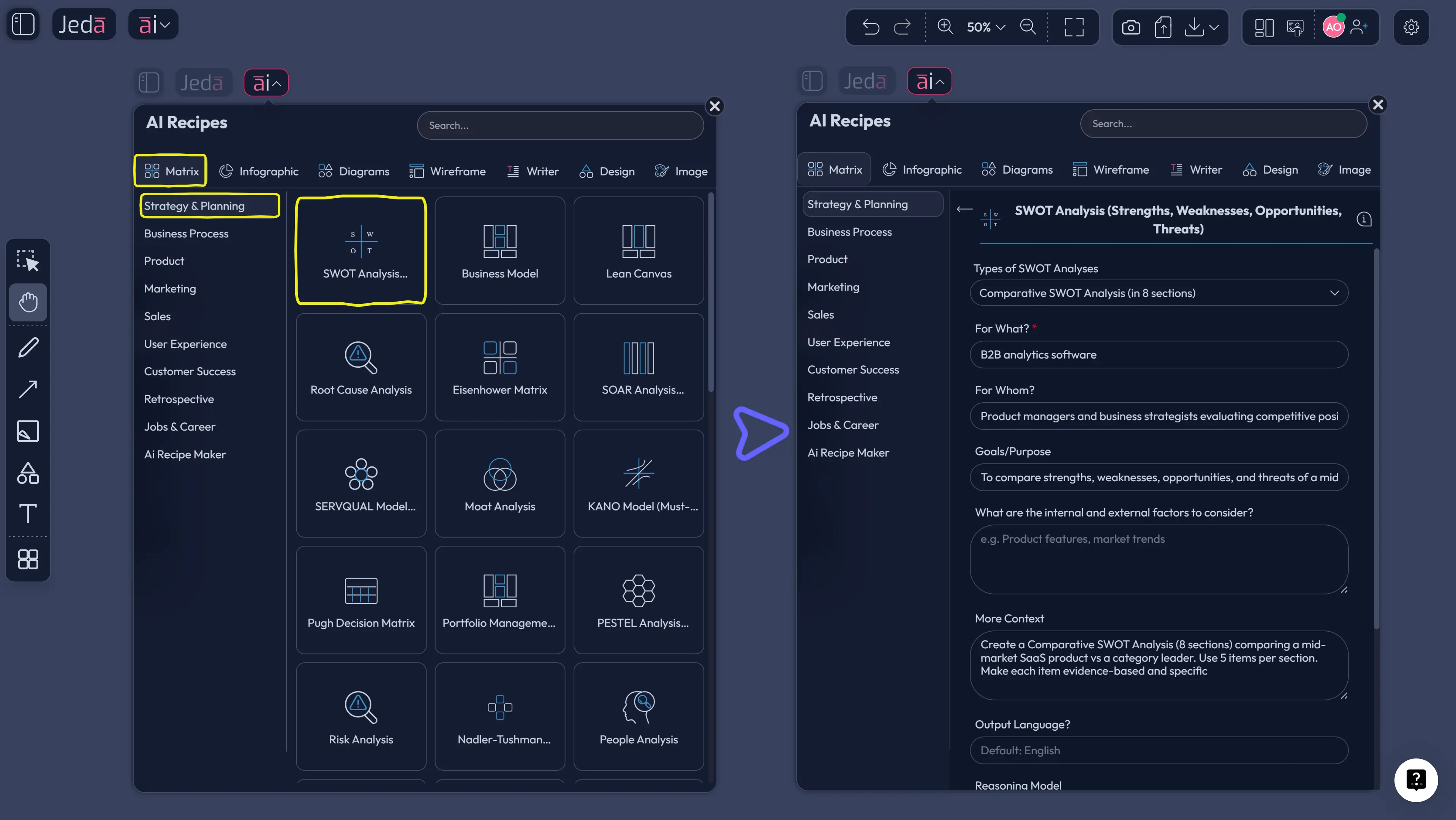
- Open the AI Menu
In your AI Whiteboard, click the AI Menu to browse 300+ strategic frameworks.
- Choose the SWOT recipe set
Go to Matrix Recipes → SWOT, then select Comparative SWOT Analysis (8 sections).
- Define the comparison
Enter your company/product, the competitor, the market segment, and the time horizon (e.g., next 12 months).
- Generate the matrix
Click Generate. You’ll get an 8-section Comparative SWOT Analysis you can edit immediately.
- Tighten with AI+
Select any cell and tap the AI+ button to add specifics, rewrite as evidence statements, or generate counterpoints.
- Convert if needed
Use Vision Transform to convert the matrix into a flowchart of actions or a mind map of themes.
Method 2: Prompt Bar (more flexible)
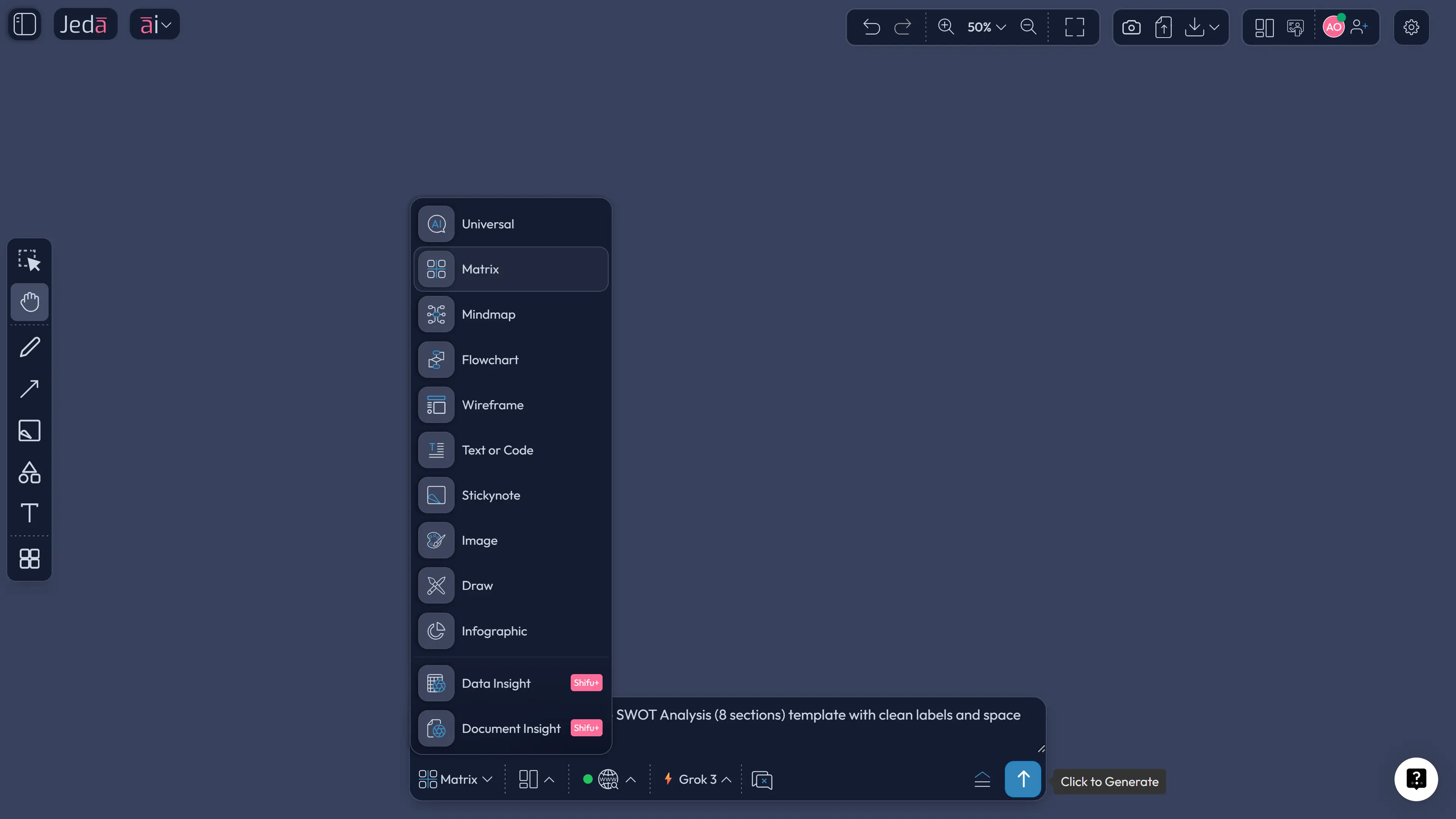
- Open the Prompt Bar at the bottom of your AI Workspace
- Select the Matrix command
- Paste your prompt
- Press Enter to generate
- Use AI+ to expand cells, and Vision Transform if you want a different visual
Prompt you can copy:
“Create a Comparative SWOT Analysis (8 sections). Compare [My Product] vs [Competitor] in [Market] for the next [Time Window]. Use 5 items per section. Write each item as an evidence-based statement, not a generic adjective. Add one ‘watch item’ per Threat.”
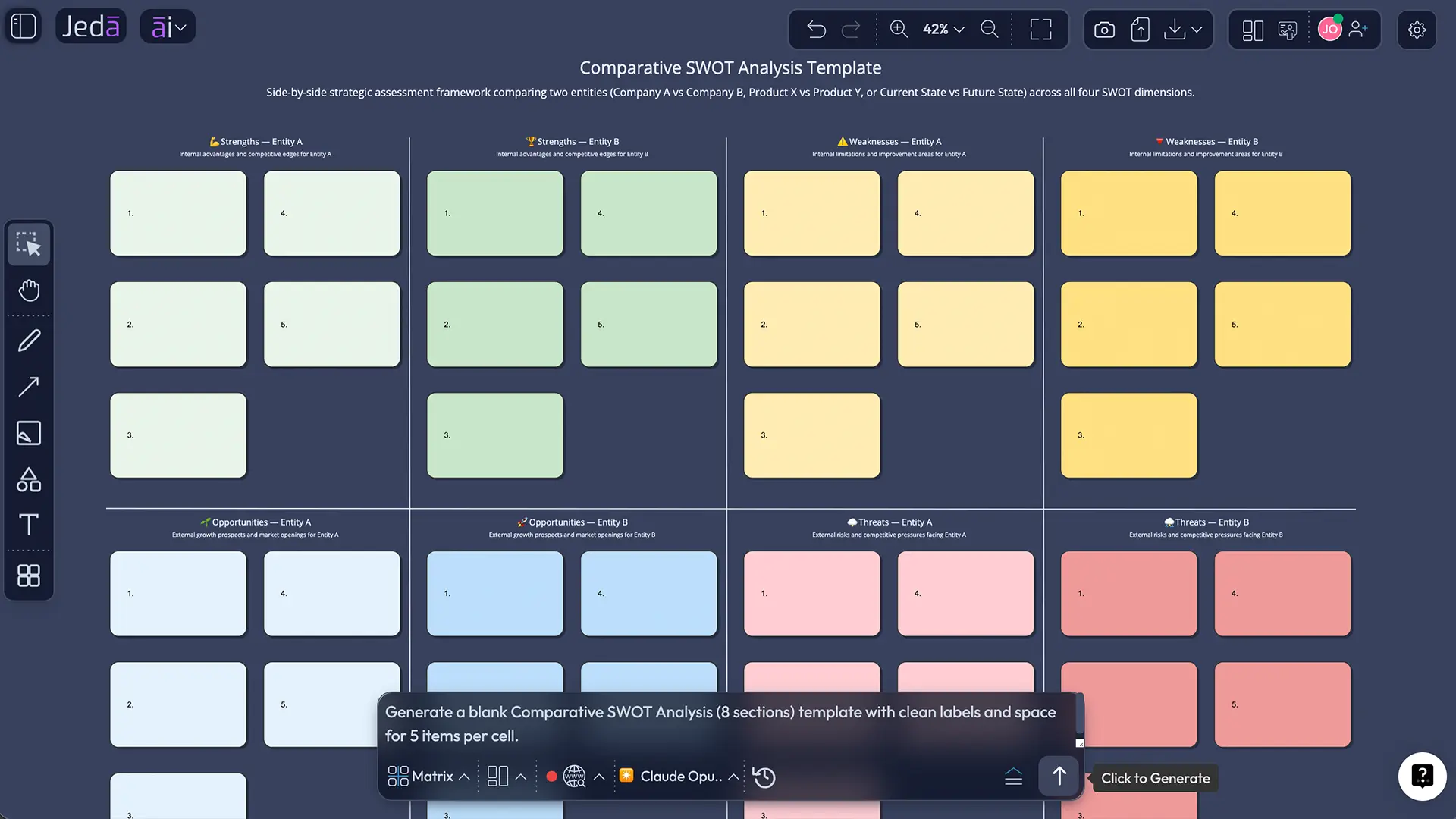
Comparative SWOT Analysis template (8 sections)
Here’s the structure that keeps the analysis usable. Keep each cell tight. If it turns into a diary, you’ve lost.
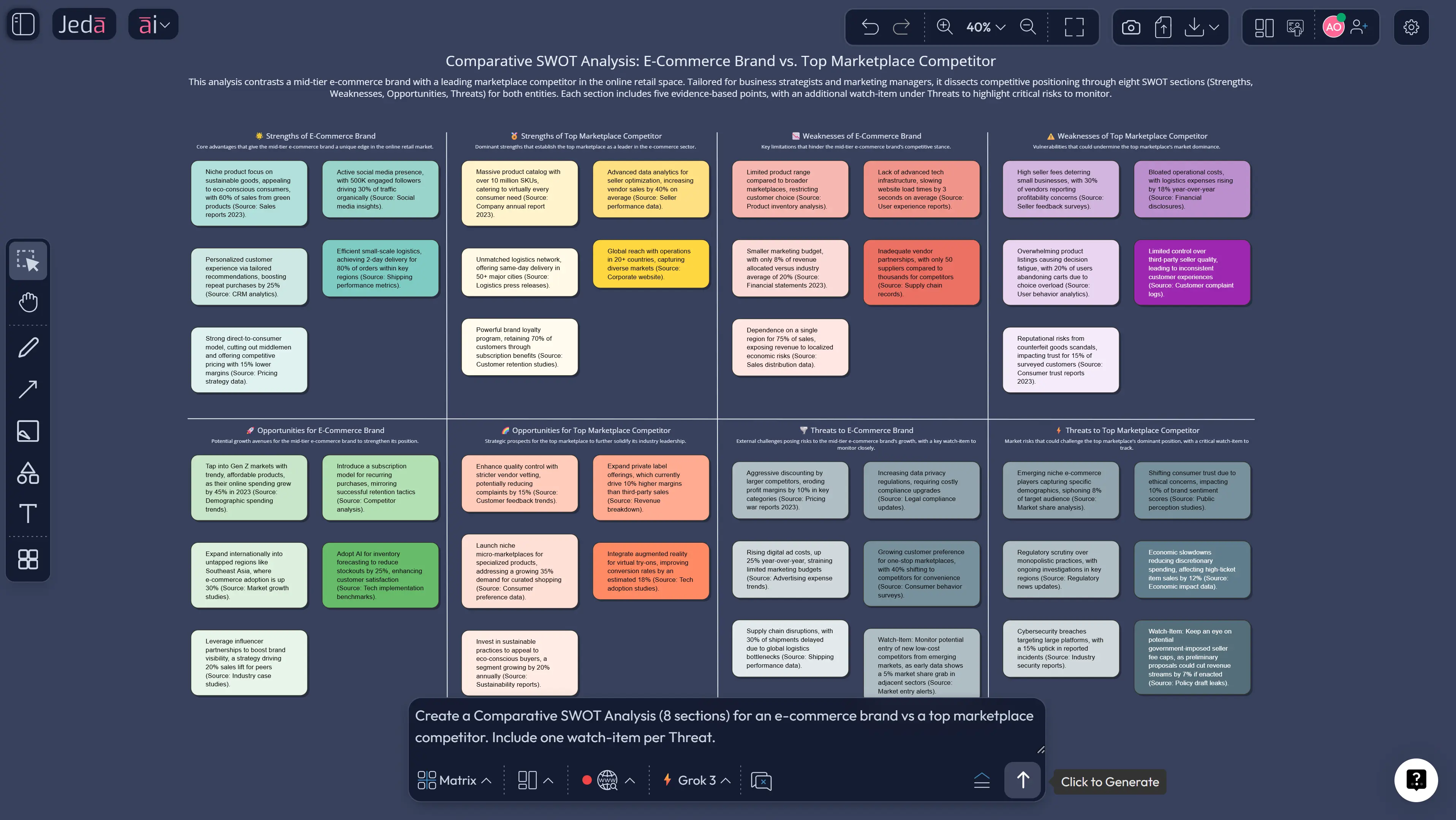
Worked example: B2B analytics tool vs a category leader
Let’s make it concrete. Imagine you sell a B2B analytics tool for mid-market teams. You’re up against a category leader with brand power and deeper integrations.
Now the point: Comparative SWOT Analysis isn’t the deliverable. The next move is.
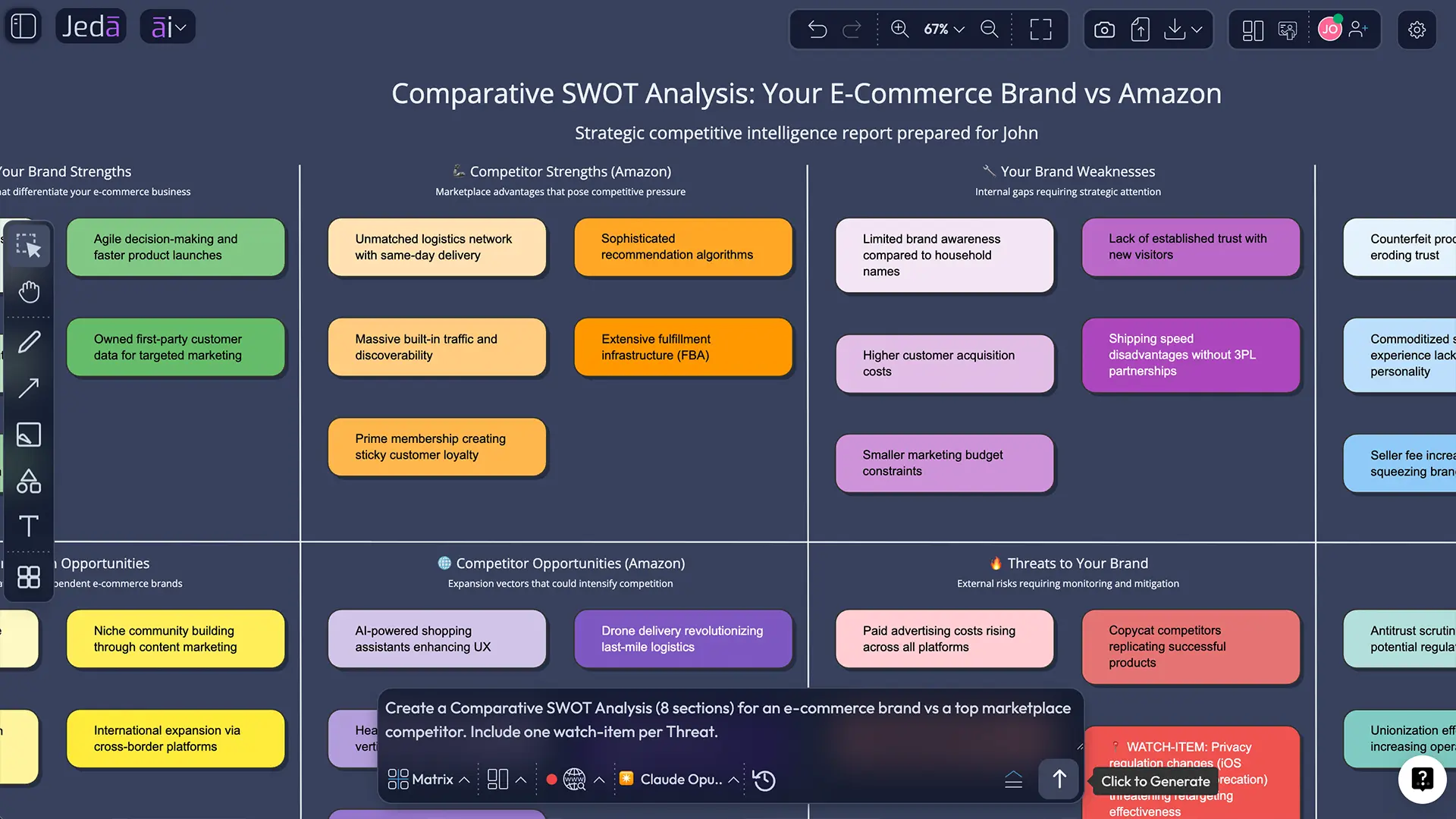
Turn the comparison into strategy (SO/WO/ST/WT)
SWOT became more actionable when strategy scholars introduced structured matching like the TOWS matrix—explicitly connecting internal/external factors into choices.
Use this quick translation:
- Exploit a competitor weakness with a strength (your “fast setup” vs their “slow onboarding”)
- Shield a weakness against a competitor strength (your “few integrations” vs their “deep catalog”)
- Prioritize 2–3 bets, not 12
If you want more discipline, add lightweight weighting. Researchers have shown AHP-SWOT methods can help prioritize factors instead of treating everything as equal.
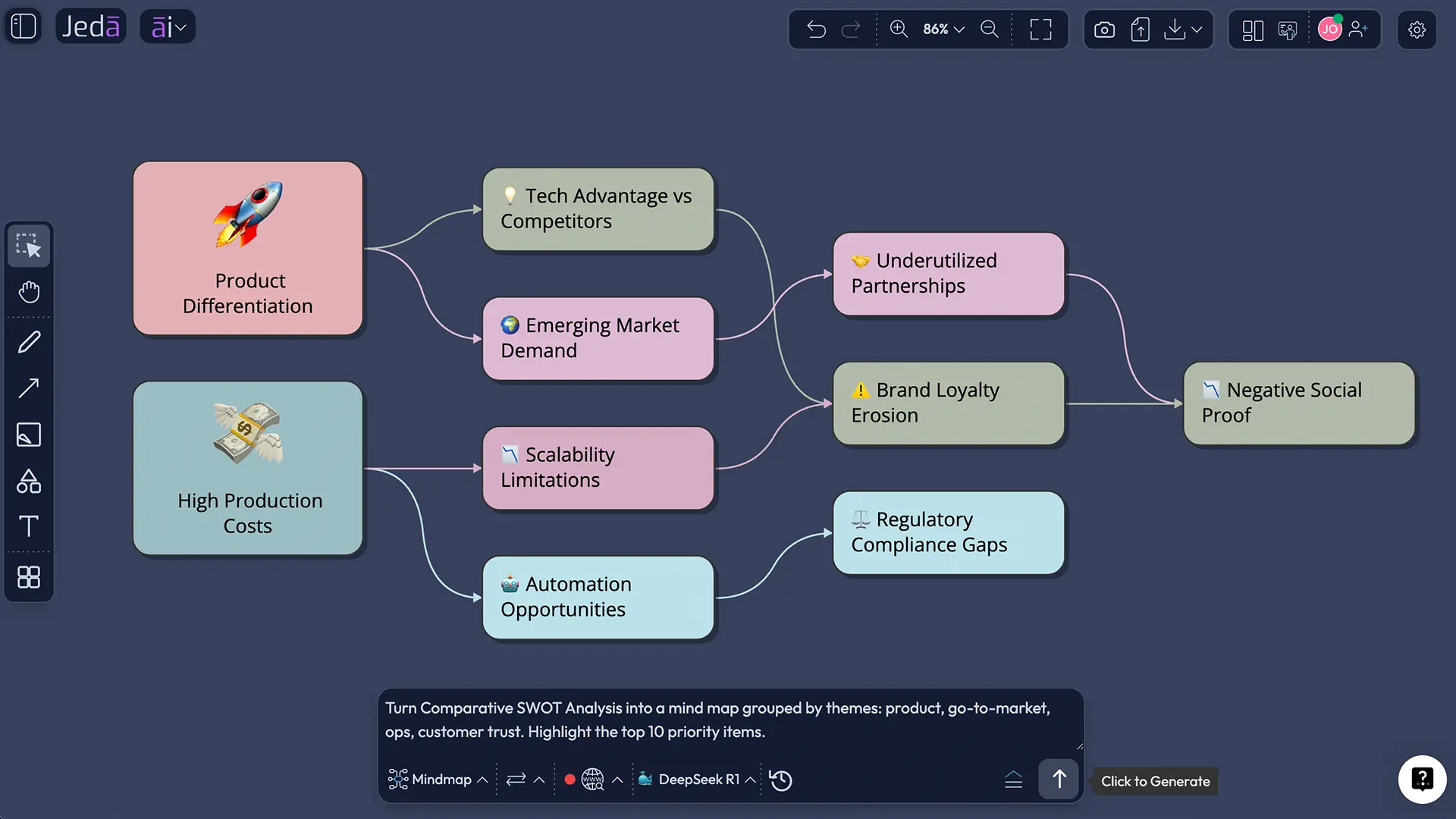
Best practices for Comparative SWOT Analysis that doesn’t waste your time
And in Jeda.ai, keep the workflow inside one place: your Comparative SWOT Analysis matrix next to notes, links, a PESTEL scan, and a Five Forces view—same AI Workspace, same AI Whiteboard.
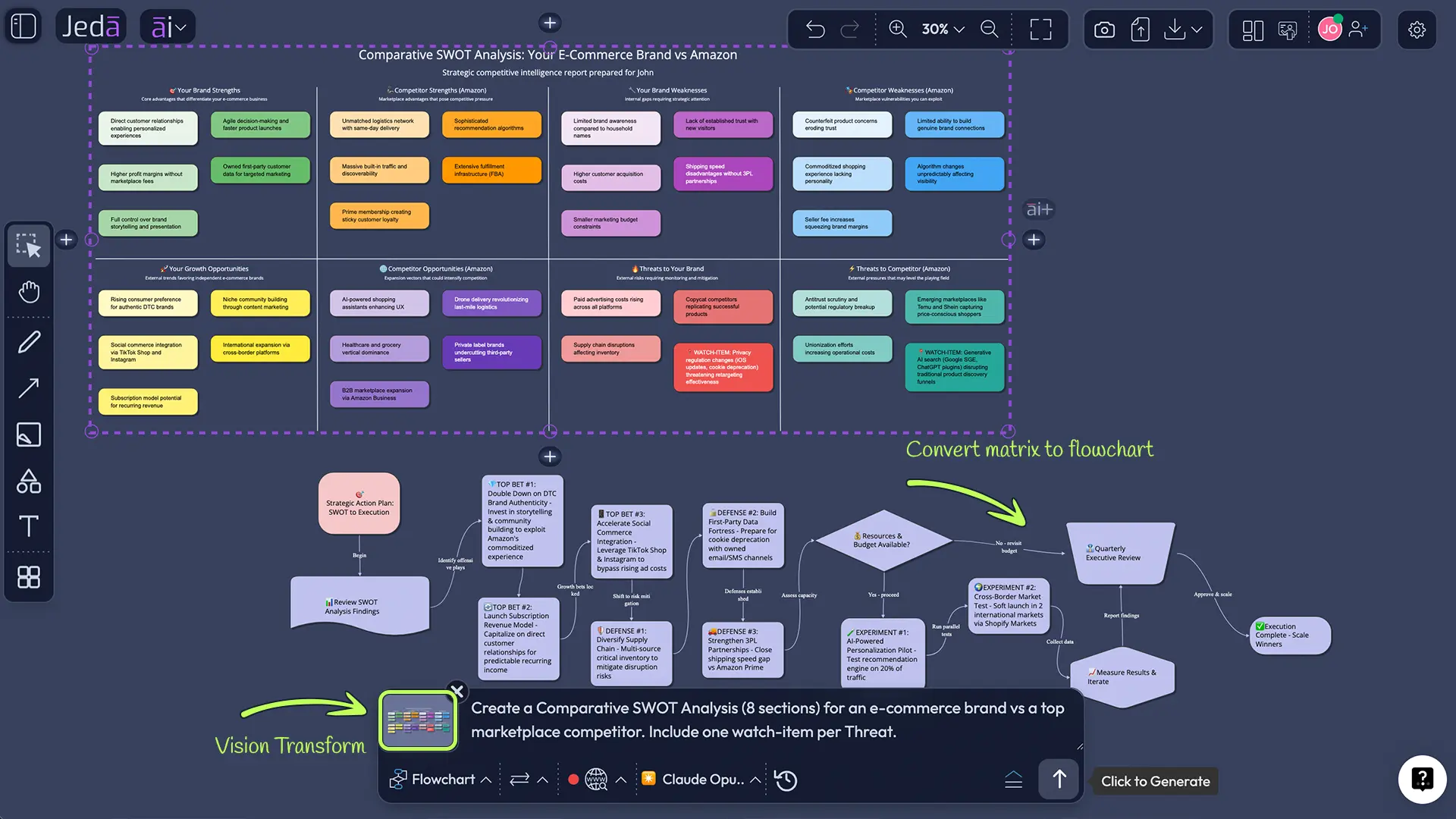
Common mistakes to avoid
- Comparing the wrong competitor. Pick the rival your buyer actually evaluates, not the one that annoys you on Twitter.
- Turning strengths into compliments. “Great team” means nothing. “Shipped X with Y outcome” does.
- Listing threats you can’t act on. If it’s not actionable, demote it to “watch list.”
- Ignoring time horizon. A 90-day threat and a 3-year threat belong in different conversations.
- Treating all items as equal. If you don’t prioritize, you don’t decide. That’s why weighting exists.
Frequently asked questions about Comparative SWOT Analysis
- What is Comparative SWOT Analysis?
- Comparative SWOT Analysis is a side-by-side SWOT that expands into 8 sections: your strengths, weaknesses, opportunities, threats plus the competitor’s strengths, weaknesses, opportunities, threats. It is used to spot real gaps and make competitive decisions faster.
- How is Comparative SWOT Analysis different from a normal SWOT?
- Comparative SWOT Analysis adds competitor context. A normal SWOT can stay internal and vague, while an 8-section comparison forces you to test claims against a rival’s position and identify where you are meaningfully better or meaningfully exposed.
- How many competitors should I include in one Comparative SWOT Analysis?
- One is ideal. Two is workable. More than two usually becomes messy unless you create separate matrices. If you need multi-competitor coverage, build one Comparative SWOT Analysis per major rival and then summarize the patterns.
- Can AI generate a Comparative SWOT Analysis accurately?
- AI can generate a strong first draft, but accuracy depends on your inputs and evidence. Treat AI output as a hypothesis, then validate it with data, customer feedback, public sources, and internal metrics before you use it for strategy.
- What inputs produce a better Comparative SWOT Analysis with AI?
- Provide the market segment, buyer persona, time horizon, and 3–5 evidence bullets for both you and the competitor. Add constraints like pricing tier, distribution channel, and geography. Specific context reduces generic output.
- Should I weight factors in Comparative SWOT Analysis?
- Yes if you need decisions, not just discussion. Weighting methods like SWOT-AHP help prioritize factors so the team doesn’t treat every bullet as equally important. Even simple 1–5 scoring can improve clarity.
- What should I do after I finish Comparative SWOT Analysis?
- Turn it into strategy matching. Use a TOWS-style approach to connect strengths to opportunities, weaknesses to fixes, and threats to defenses. Then commit to 2–3 bets with owners and timelines.
- How do I validate competitor strengths and weaknesses?
- Use a mix of sources: public docs, reviews, customer interviews, win/loss notes, demos, and partner feedback. In Jeda.ai, you can keep these notes alongside the Comparative SWOT Analysis on the same canvas for traceability.
- Is Comparative SWOT Analysis useful for non-business decisions?
- It can be, but it’s built for competitive contexts. For personal planning, a Personal SWOT works better. For market structure questions, pair Comparative SWOT Analysis with frameworks like PESTEL and Porter’s Five Forces.
- Can I export a Comparative SWOT Analysis from Jeda.ai?
- Yes. Jeda.ai exports visuals as PNG, SVG, or PDF. That makes it easy to drop your Comparative SWOT Analysis into a deck, a memo, or a client deliverable without rebuilding the layout.
Sources and further reading
- [1]
Puyt, R. W., Lie, F. B., & Wilderom, C. P. M. (2023) . “The origins of SWOT analysis” Long Range Planning.
View Source ↗ - [2]
Pickton, D. W., & Wright, S. (1998) . “What’s SWOT in strategic analysis?” Strategic Change.
View Source ↗ - [3]
Helms, M. M., & Nixon, J. (2010) . “Exploring SWOT analysis – where are we now? A review of academic research from the last decade” Journal of Strategy and Management.
View Source ↗ - [4]
Weihrich, H. (1982) . “The TOWS matrix—A tool for situational analysis” Long Range Planning.
View Source ↗ - [5]
Kurttila, M., Pesonen, M., Kangas, J., & Kajanus, M. (2000) . “Utilizing the analytic hierarchy process (AHP) in SWOT analysis — a hybrid method and its application to a forest-certification case” Forest Policy and Economics.
View Source ↗ - [6]
Journal of Retailing and Consumer Services (authors vary by paper) (2025) . “Dynamic prediction of product competitive position: A multisource data-driven competitive analysis framework from a multi-competitor perspective” Journal of Retailing and Consumer Services.
View Source ↗
Generate a Comparative SWOT Analysis in minutes
Join 150,000+ users who build competitive strategy visuals in Jeda.ai. Start with the 8-section Comparative SWOT Analysis, extend it with AI+, and export a decision-ready PDF.
Try Jeda.ai FreeRelated frameworks
Closing thought
Comparative SWOT Analysis isn’t a “who’s better” chart. It’s a pressure test.
Use Comparative SWOT Analysis with AI to surface the real gaps, kill the comforting stories, and earn the right to pick one competitive move you can defend.