SWOT Analysis with AI is the fastest way to turn scattered ideas into a clear Strengths-Weaknesses-Opportunities-Threats view — but only if it forces a decision. A pretty 2×2 is not strategy. It’s a mirror. Strategy is what you do after you look.
Jeda.ai is a Visual AI Workspace and AI Whiteboard where you can generate multiple SWOT formats, challenge weak assumptions, prioritize what matters, and convert the matrix into action paths you can present and execute.
What SWOT actually does (when it’s done right)
A SWOT analysis separates:
- Strengths (internal advantages you can leverage)
- Weaknesses (internal constraints you must address)
- Opportunities (external openings you can exploit)
- Threats (external risks you must mitigate)
The point is not to fill boxes. The point is to make trade-offs visible. Practical guides also recommend involving the right stakeholders and updating SWOT when conditions change, because the tool is only useful when it reflects real constraints and real market forces.
If your SWOT does not change what you prioritize, what you stop doing, or what you bet on next, it’s a worksheet — not a tool.
Why AI changes SWOT (and how it can mess it up)
SWOT Analysis with AI helps when you need speed and breadth:
- You get a structured first pass in minutes.
- You surface angles your team might miss.
- You can generate multiple variants (competitor, scenario, sector) without starting from zero.
But AI also introduces new failure modes:
- Confident nonsense: clean wording, weak truth.
- Generic answers: “strong brand,” “market growth,” “competition” — thanks, Captain Obvious.
- Category blur: internal factors drifting into external quadrants and vice versa.
The fix is simple: treat AI as a draft engine, then push it through a decision filter: validate → prioritize → convert to action.
How to generate SWOT Analysis with AI in Jeda.ai
You can create SWOT in two practical ways.
Option 1: Use the SWOT recipe (best for consistency)
Open the AI Menu → choose SWOT → pick the sub-recipe format → generate a clean matrix.
Option 2: Use the Prompt Bar (best for customization)
Use the Prompt Bar → choose Matrix → prompt the exact SWOT style you want.
Then refine on-canvas:
- tighten vague bullets into testable claims
- remove duplicates
- add evidence links or supporting notes
- convert the result into a strategy follow-through (TOWS, weighting, cross-impact)
- Pick the SWOT format that matches the decision
Traditional for alignment, Weighted for prioritization, TOWS for actions, Scenario-based for uncertainty.
- Add context AI cannot guess
Market, customer segment, business model, time horizon, constraints, and the decision you need to make.
- Generate and compare
Run one output fast, or use multiple models for alternative perspectives when stakes are high.
- Tighten the matrix
Rewrite vague bullets into specific claims. If it’s not measurable or defensible, it’s not done.
- Prioritize, then convert to action
Weight factors, map cross-impacts, and generate a TOWS matrix to produce strategy options.
- Present or export
Present live on the canvas or export PNG/SVG/PDF for decks and documents.
The 10 SWOT sub-recipes in Jeda.ai
SWOT Analysis with AI becomes a real strategy tool when you stop treating SWOT like a one-size-fits-all template.
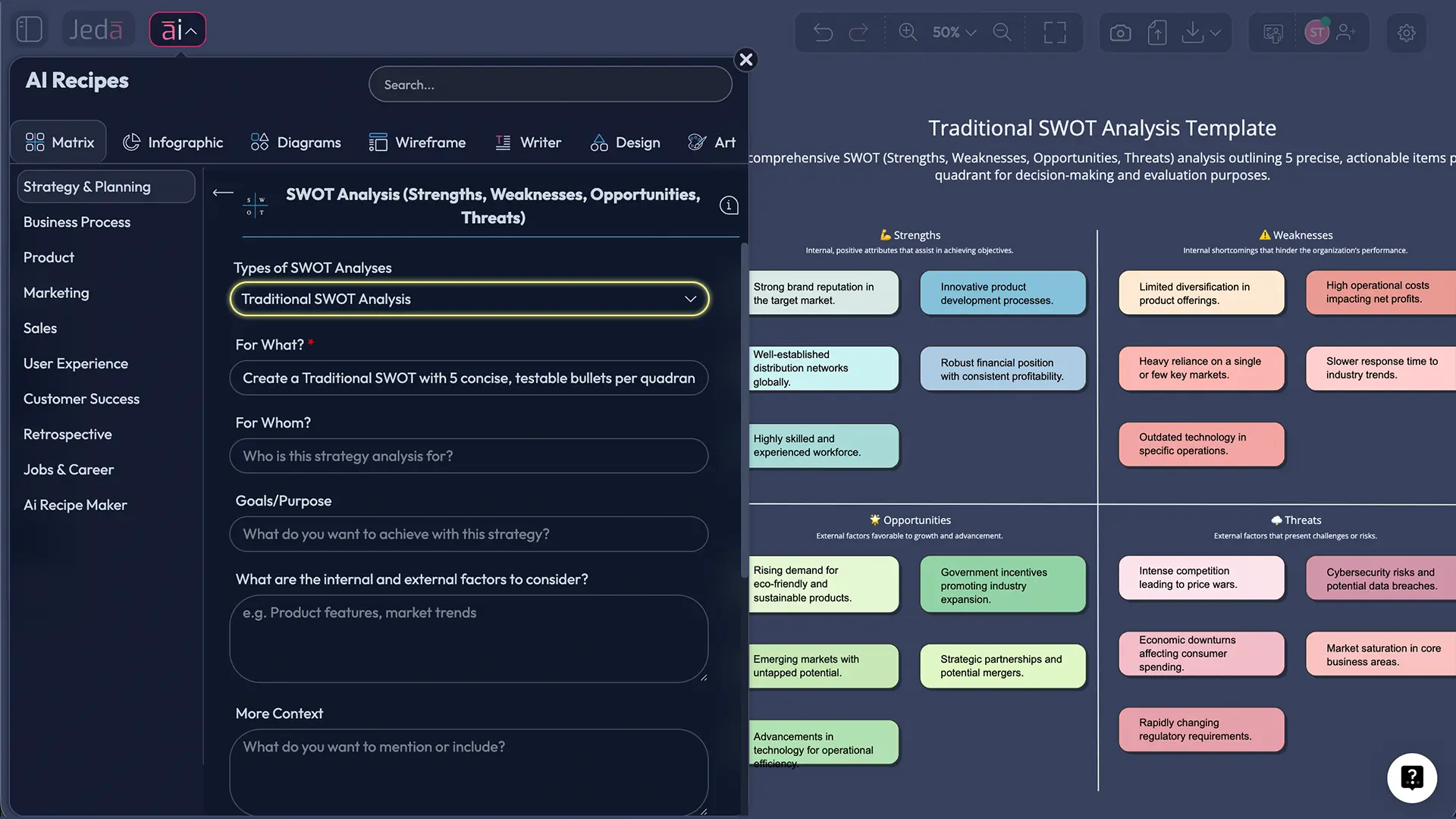
1) Traditional SWOT Analysis
Use it for quick alignment and a shared baseline.
Prompt starter: “Create a Traditional SWOT with 5 concise, testable bullets per quadrant.”
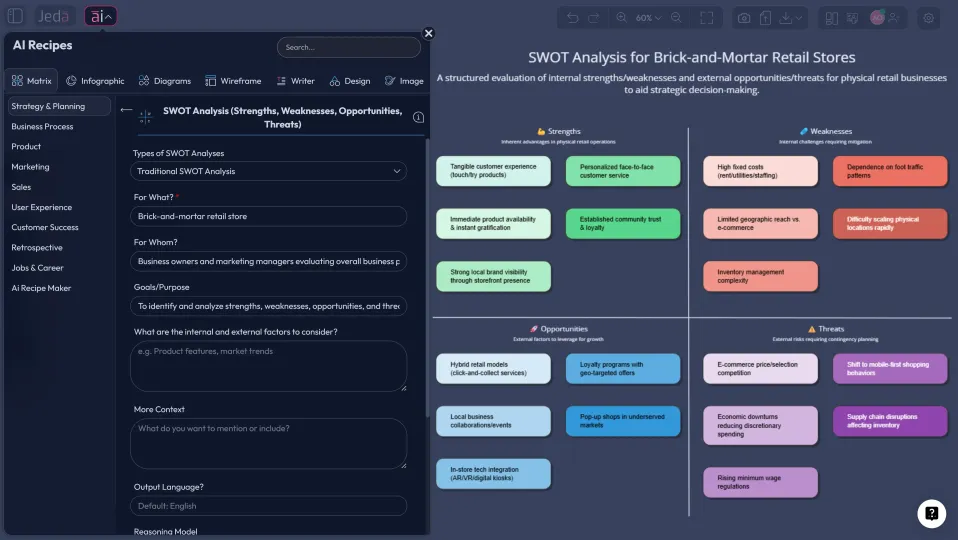
2) Personal SWOT Analysis (P-SWOT)
Use it for career planning, leadership growth, or role transitions.
Prompt starter: “Create a Personal SWOT for a growth marketer moving into product strategy. Keep it realistic and specific.”
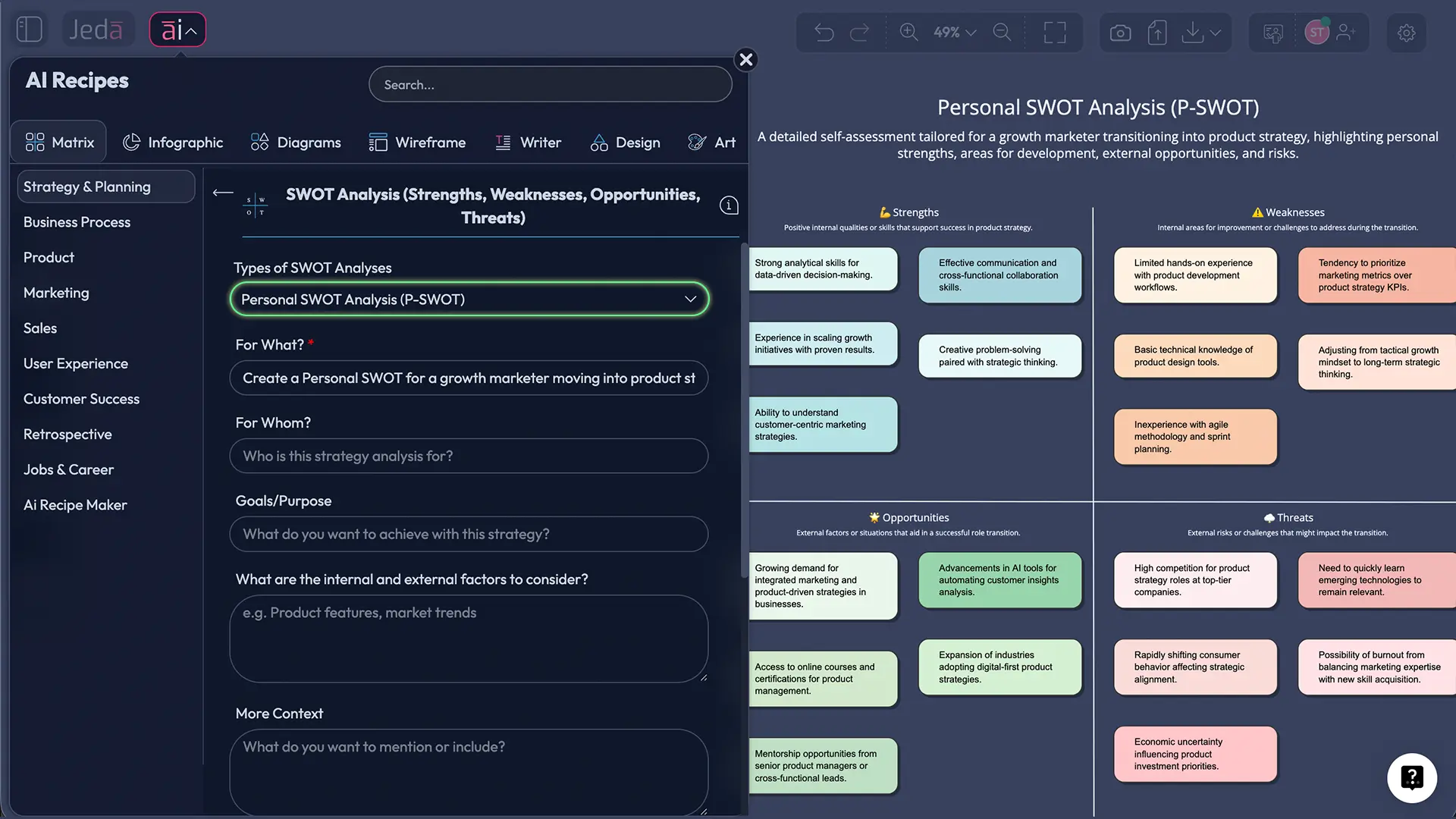
3) Comparative SWOT Analysis (8-sections)
Use it when your position only makes sense relative to a competitor.
Prompt starter: “Create a comparative SWOT with 8 sections: our S/W vs their S/W + shared O/T.”
### 4) TOWS Matrix Use it when you need actions, not observations. TOWS is a well-known extension that matches internal and external factors to produce strategy options.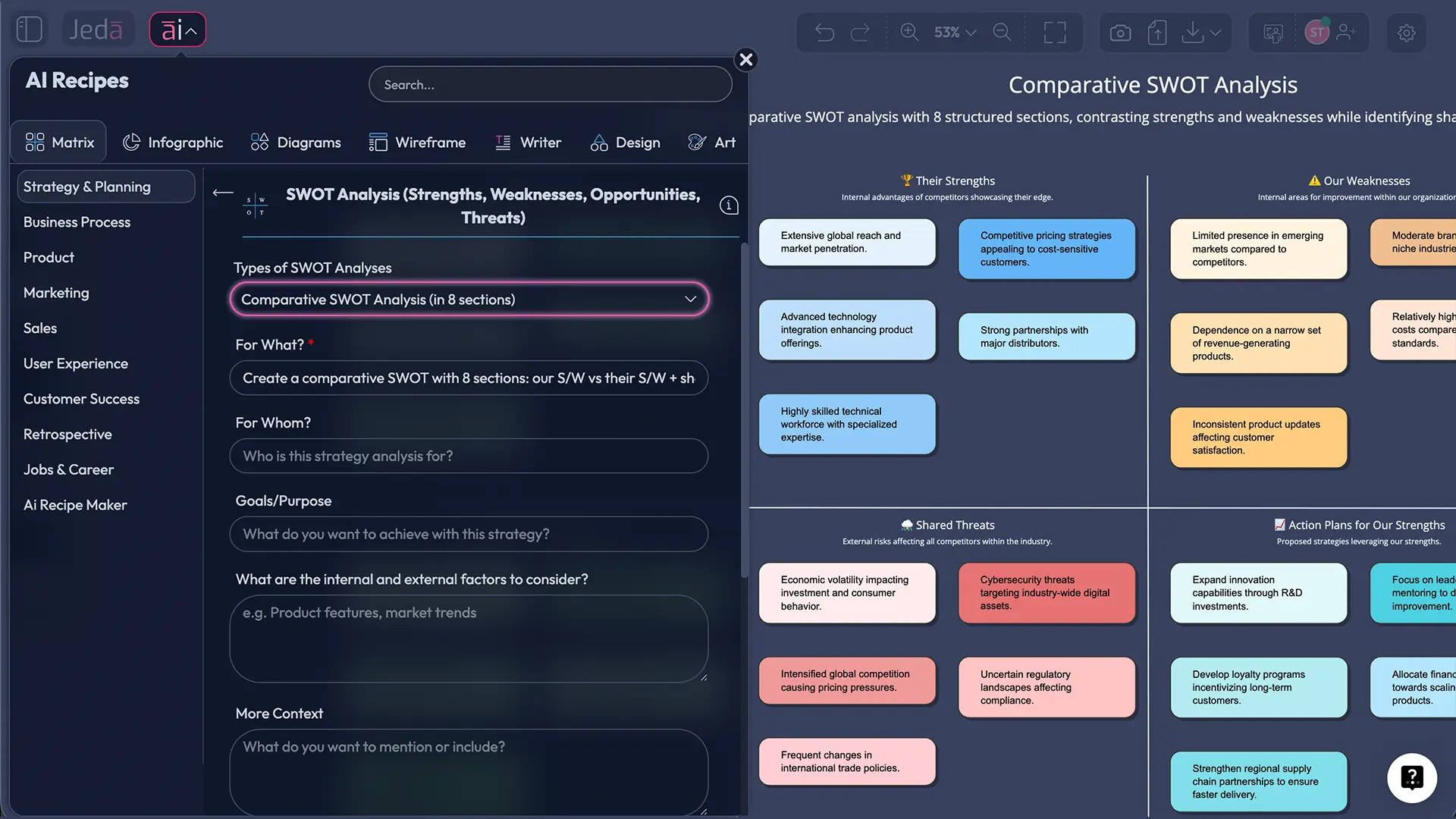
Prompt starter: “Convert the SWOT into a TOWS matrix with 3 SO, 3 ST, 3 WO, 3 WT strategies phrased as actions.”
### 5) SWOT Analysis with Weighting Use it when leadership needs prioritization and trade-offs. Weighted approaches are often paired with structured prioritization methods to rank factors rather than treating every bullet as equal.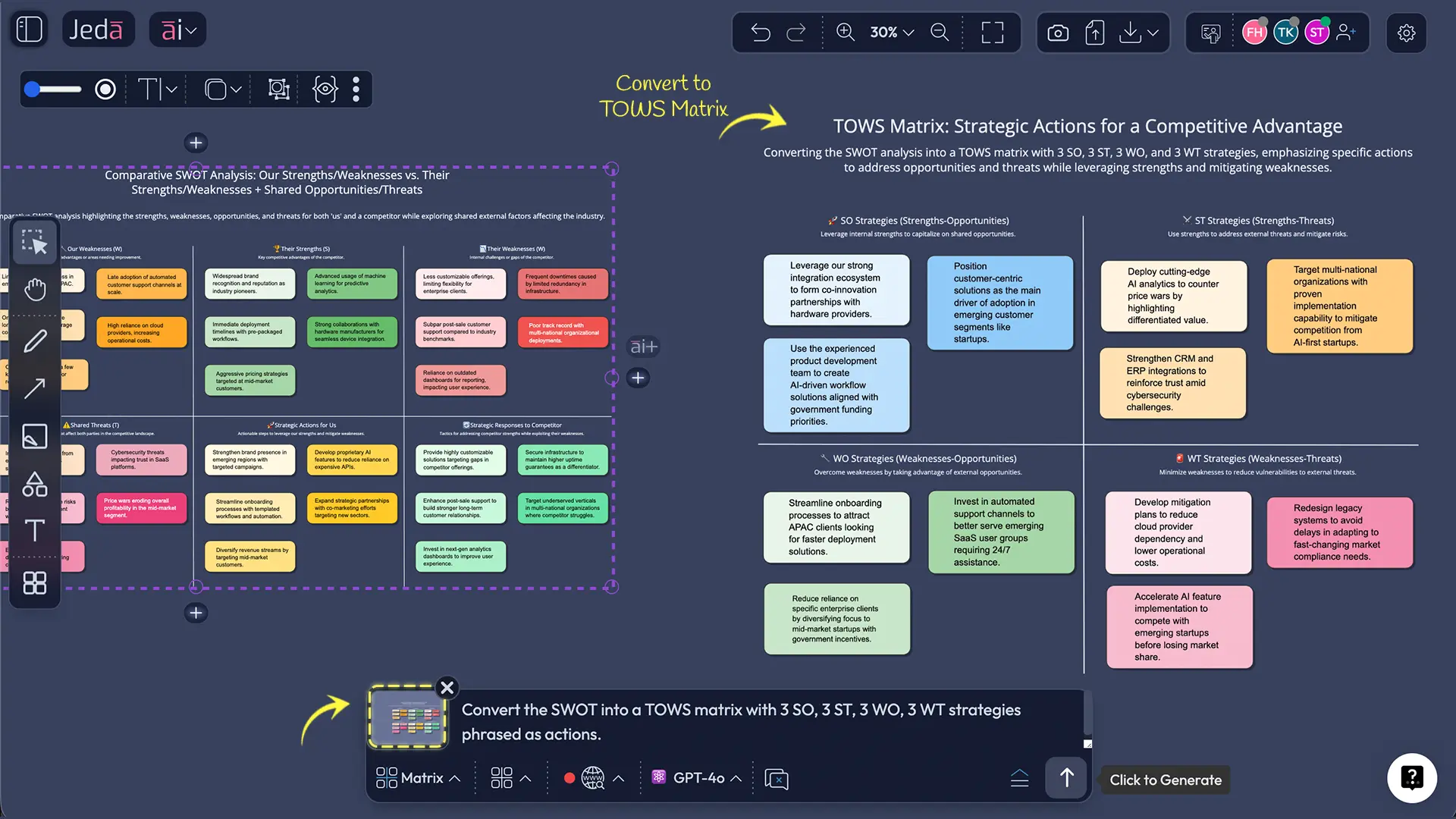
Prompt starter: “Score each factor by Impact (1–5) and Confidence (1–5). Output the top 5 priorities.”
### 6) Cross-Impact Matrix SWOT Analysis Use it when factors influence each other and second-order effects matter.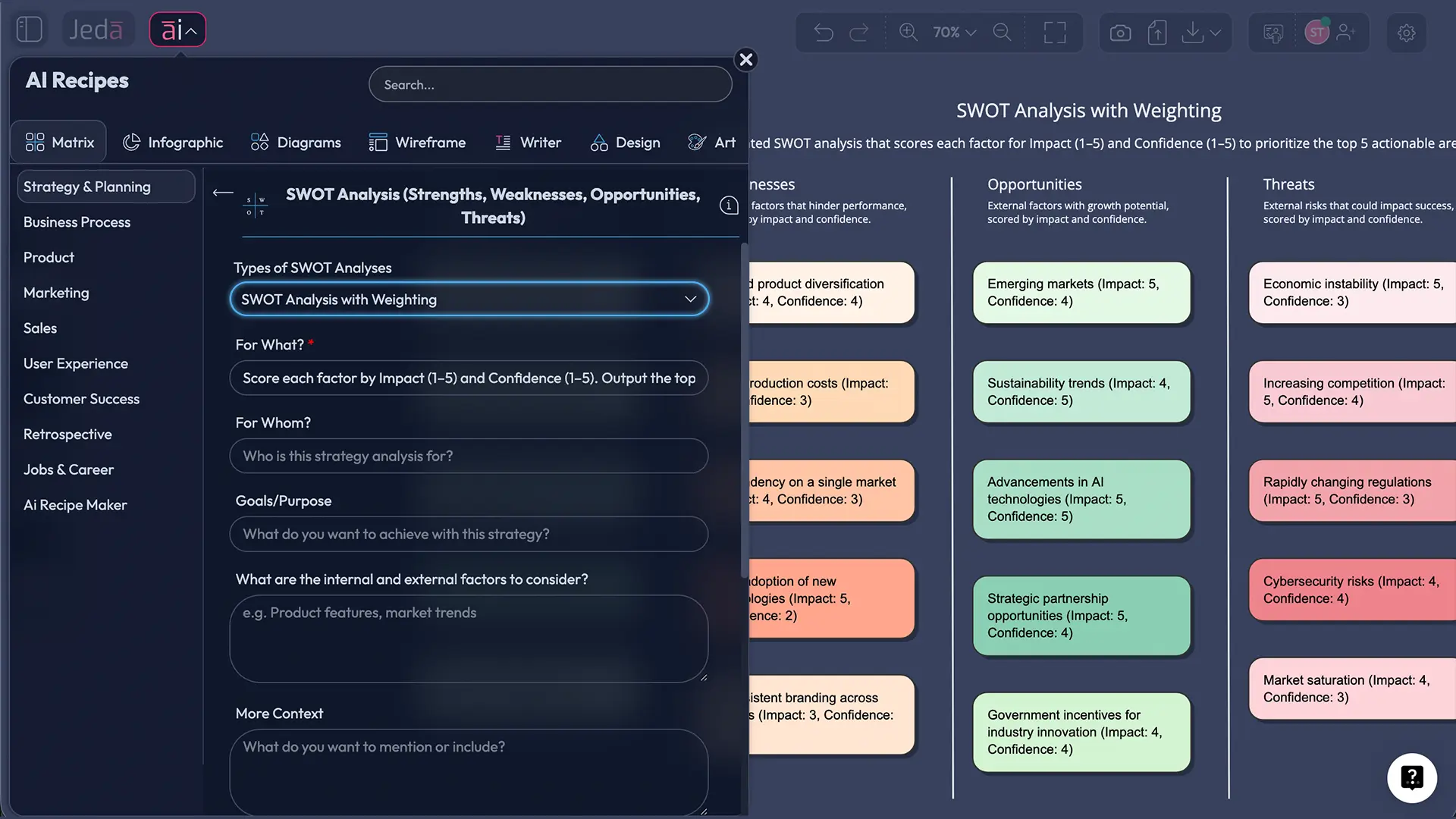
Prompt starter: “Map interactions between Opportunities and Threats and show which internal factors amplify or reduce them.”
### 7) Sector Specific SWOT Analysis Use it when industry forces require domain vocabulary (fintech, healthcare, logistics, education).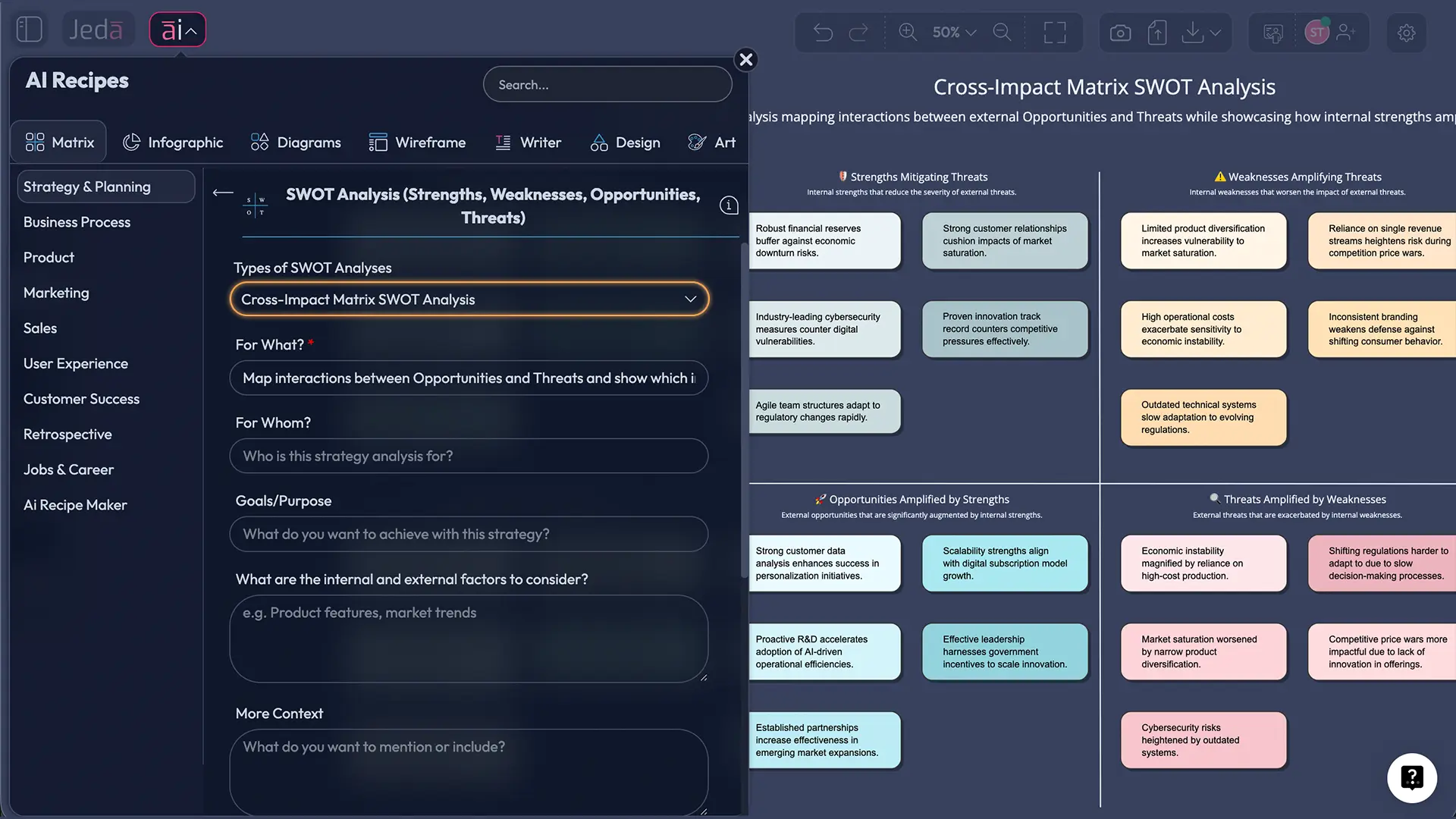
Prompt starter: “Create a sector-specific SWOT for [industry] with relevant regulatory and operational constraints.”
### 8) Cultural SWOT Analysis Use it when culture is a strategic constraint or advantage (scaling, mergers, leadership change).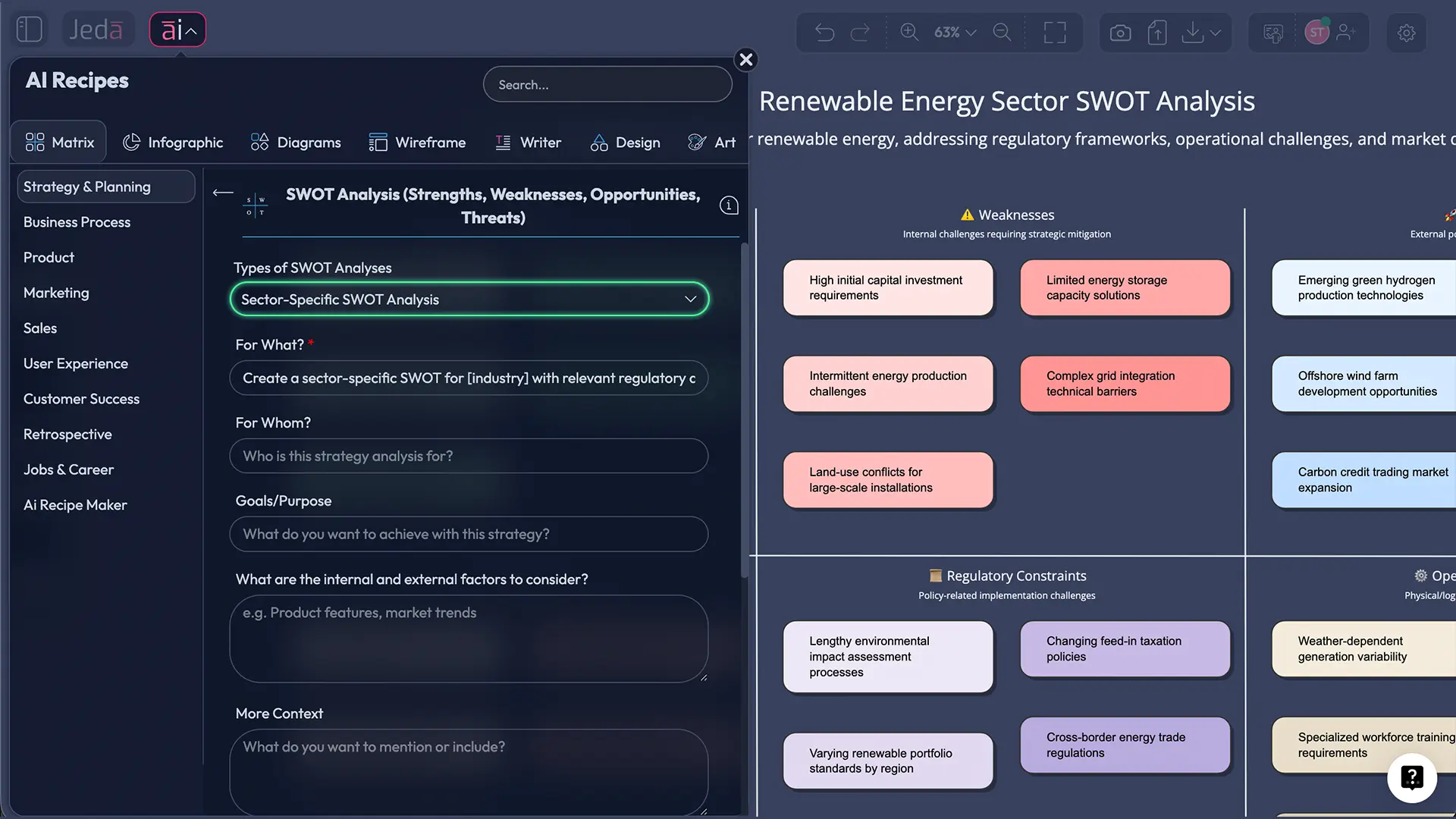
Prompt starter: “Create a cultural SWOT focused on decision speed, accountability, and collaboration quality.”
### 9) Scenario-based SWOT Analysis Use it when the future has multiple plausible outcomes.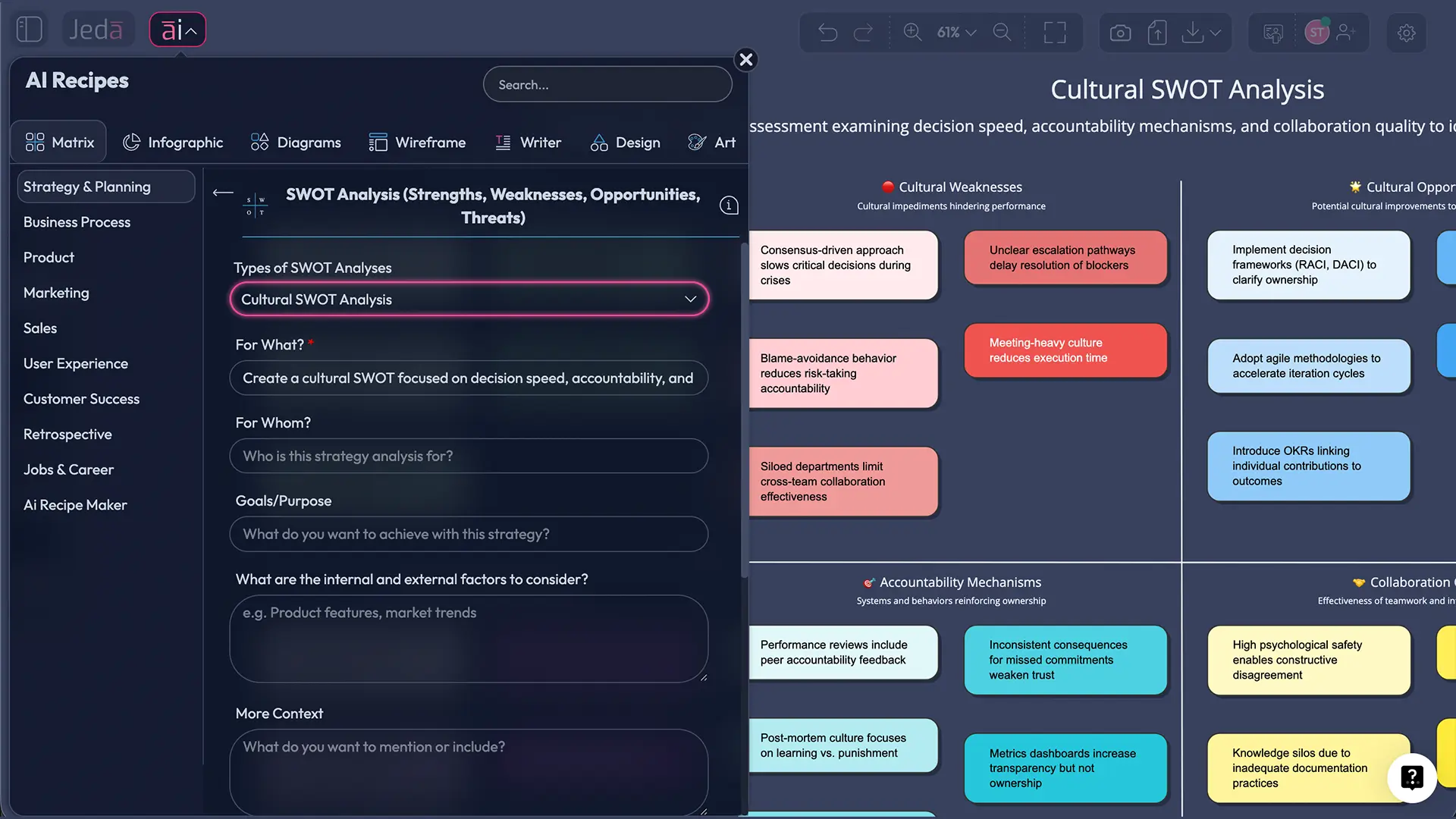
Prompt starter: “Create Base/Upside/Downside SWOTs and show what changes across scenarios.”
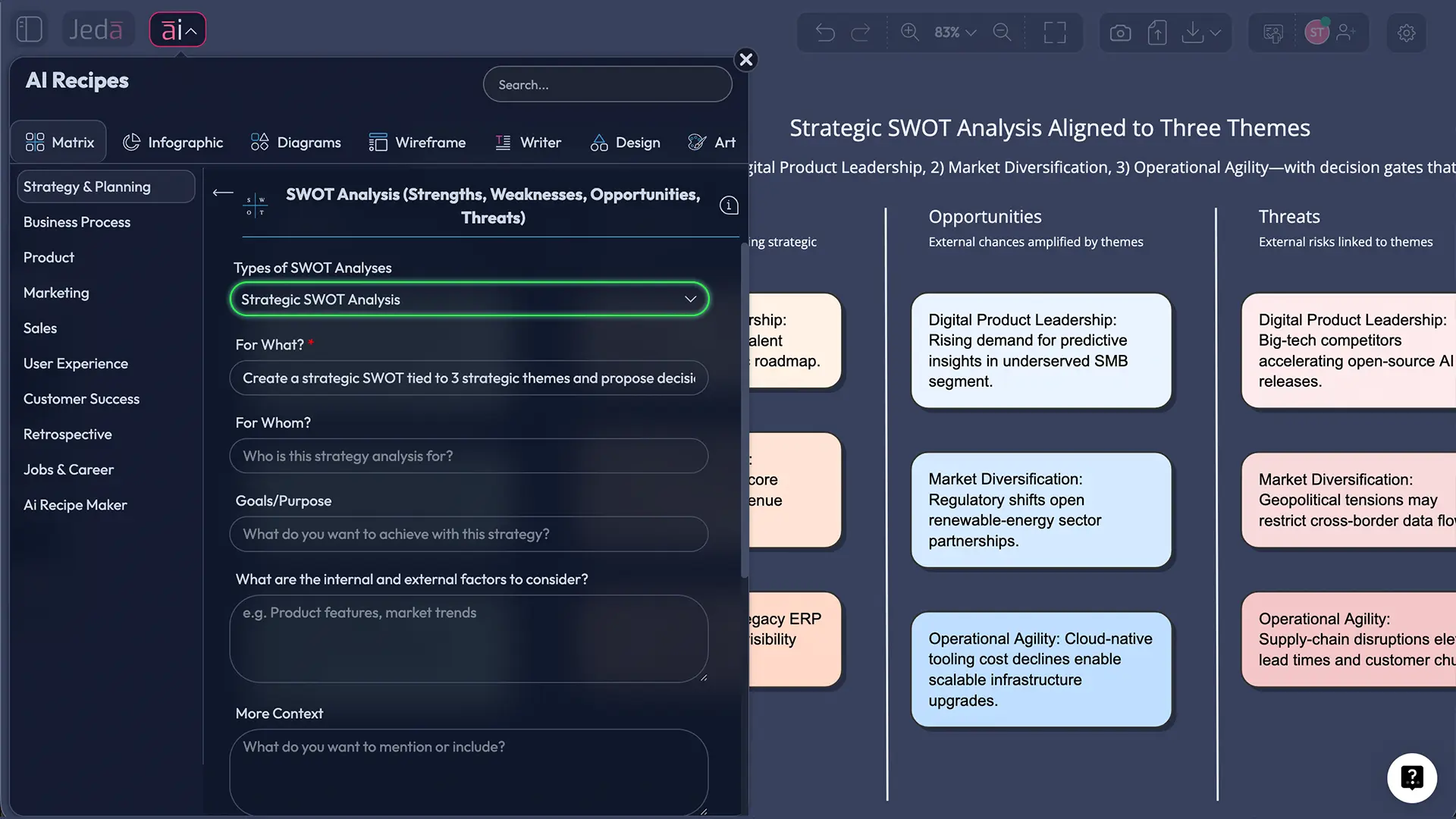
### 10) Strategic SWOT Analysis Use it when you need a board-level narrative tied to strategic themes and decision gates.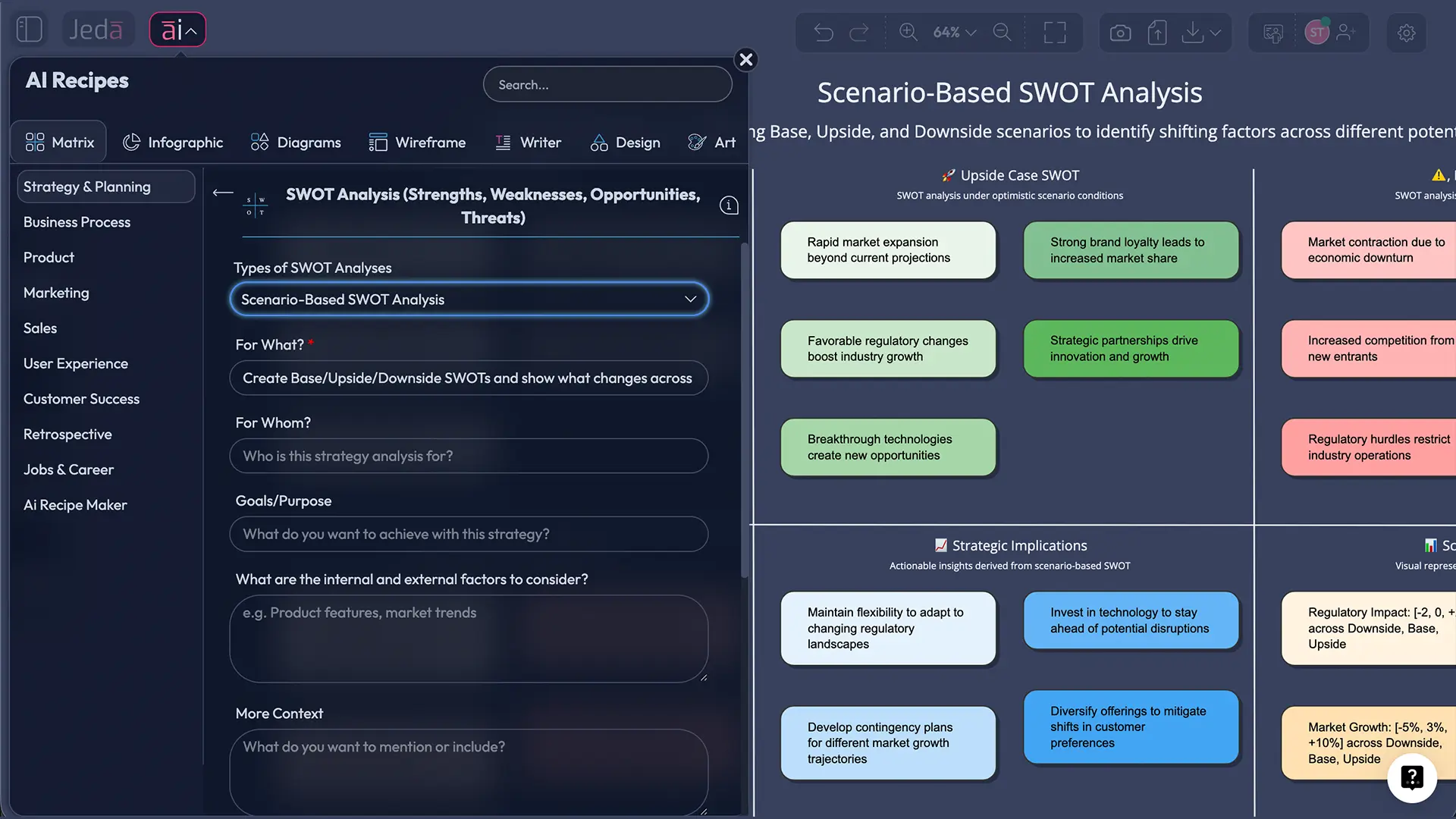
Prompt starter: “Create a strategic SWOT tied to 3 strategic themes and propose decision gates for each.”
The action bridge: Weighted SWOT → TOWS → initiatives
Most SWOTs fail because they stop at categorization. The fix is a simple pipeline:
- Weighted SWOT (so not every bullet pretends it’s equally important)
- TOWS (so the matrix turns into strategy options)
- Initiatives (so options become execution)
A practical flow that works in real teams
- Generate a Weighted SWOT (Impact + Confidence).
- Keep the top priorities (high impact, reasonable confidence).
- Convert to TOWS (SO / ST / WO / WT).
- Turn the best strategies into initiatives with owners and timelines.
Best practices that make SWOT Analysis with AI credible
- Make bullets testable: replace “strong brand” with measurable signals.
- Keep categories clean: internal stays internal; external stays external.
- Add a time horizon: now/next/later changes the meaning of every factor.
- Compare perspectives: when stakes are high, challenge the first draft with another model or another run.
- Never present a draft: tighten first, then export.
Jeda.ai vs. other ways to build a SWOT
| Feature | Jeda.ai | Venngage AI SWOT Generator | Static SWOT Templates | |
|---|---|---|---|---|
| AI-generated first draft from your context | — | ✓ | ✓ | ✗ |
| Weighted scoring (Impact x Confidence) | — | ✓ | ✗ | ✗ |
| Auto-converts to a TOWS strategy matrix | — | ✓ | ✗ | ✗ |
| 10 SWOT variants (Comparative, Scenario, Cultural, Sector-specific, and more) | — | ✓ | ✗ | ✗ |
| Live, editable AI Whiteboard canvas (not a static export) | — | ✓ | Design canvas | ✗ |
| Free to start | — | ✓ | ✓ | ✓ |
FAQ
- What is SWOT Analysis with AI?
- SWOT Analysis with AI uses AI to draft and structure strengths, weaknesses, opportunities, and threats faster. The best workflow validates claims, prioritizes factors, and converts the matrix into actions such as a TOWS strategy set.
- How do I generate SWOT Analysis with AI in Jeda.ai?
- Use the AI Menu SWOT recipe for structured outputs, or use the Prompt Bar with the Matrix command for a custom format. Then refine bullets, prioritize key factors, and generate TOWS to convert SWOT into strategy options.
- What is the difference between SWOT and TOWS?
- SWOT identifies factors. TOWS converts those factors into strategy options by matching internal strengths and weaknesses with external opportunities and threats to produce SO, ST, WO, and WT actions.
- What is a Weighted SWOT analysis?
- Weighted SWOT adds scoring to prioritize factors. Common scoring uses impact and confidence so leadership can focus on what actually changes decisions.
- What is Comparative SWOT analysis?
- Comparative SWOT evaluates you and a competitor side by side. It is useful when strategy depends on relative advantage rather than generic strengths.
- What should come after SWOT?
- A conversion step. The simplest is a TOWS matrix, then a short initiative list with owners and timelines. If SWOT stops at the 2×2, it usually dies there.
Related resources inside Jeda.ai
- Explore the AI Templates library: AI Templates
- See how the AI Workspace works end-to-end: AI Workspace
- Learn the AI Whiteboard workflow: AI Whiteboard
Related frameworks
Closing thought
SWOT isn’t a strategy oracle. It’s a forcing function.
Use SWOT Analysis with AI to generate options, argue with yourself faster, and earn the right to pick a move.