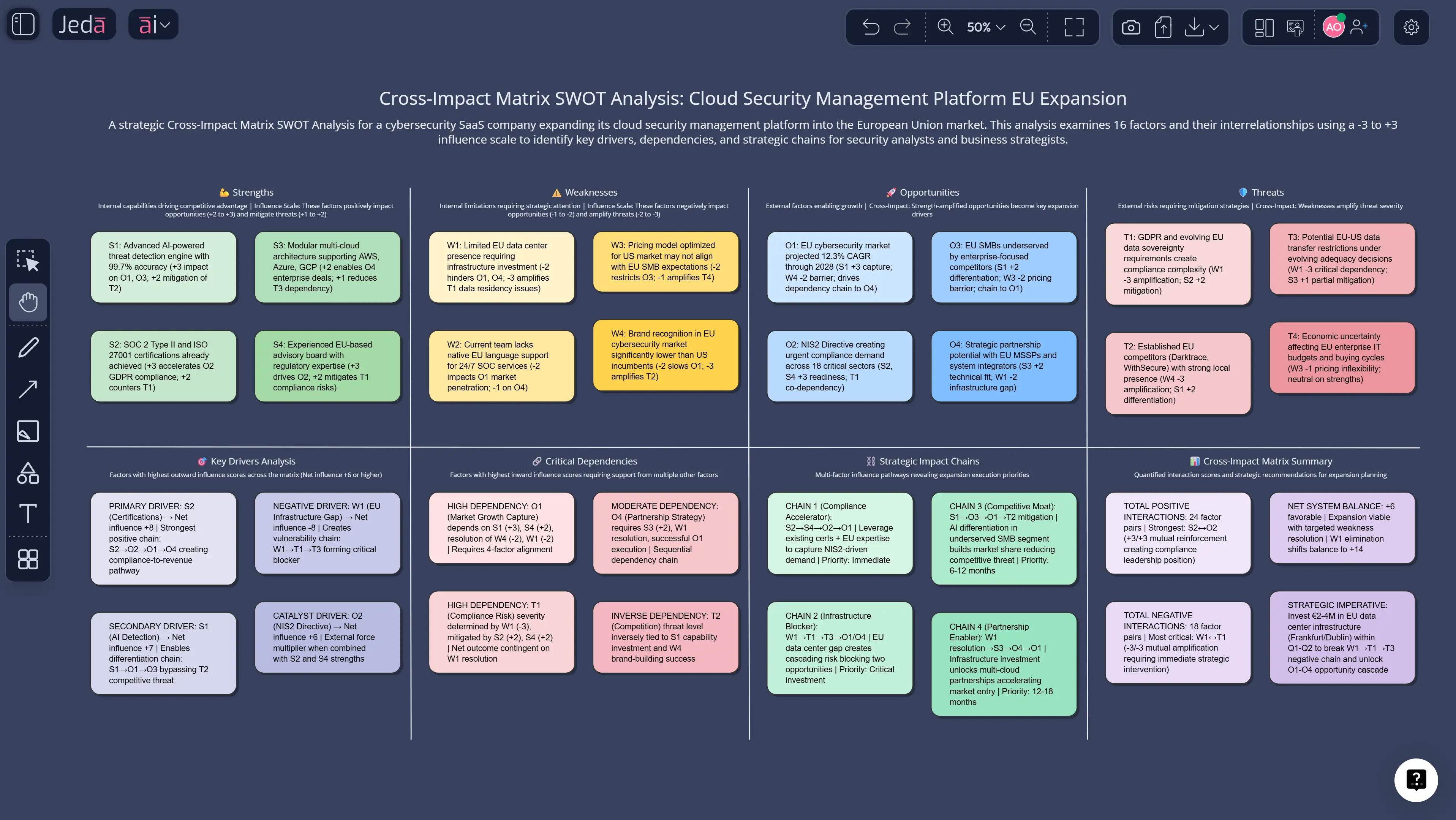
Cross Impact SWOT Analysis with AI is what you use when a plain four-box SWOT feels too polite for the mess you are actually dealing with. A normal SWOT lists factors. This version maps how those factors push, block, amplify, or weaken one another, then turns that into strategy inside Jeda.ai’s AI Workspace and AI Whiteboard. If your team is planning a launch, entering a new market, or staring at a nasty mix of risk and upside, this is where the conversation gets smarter fast.
Look, this matters because strategy rarely fails from lack of ideas. It fails because teams treat factors as isolated bullets when they are really part of a system. Cross Impact SWOT Analysis with AI helps you see that system sooner, argue about it less, and move toward action with more confidence.
What is Cross Impact SWOT Analysis?
Cross Impact SWOT Analysis builds on two ideas. First, classic SWOT gives you the internal and external picture: strengths, weaknesses, opportunities, and threats. Second, later strategy work such as the TOWS matrix pushed SWOT beyond description by matching internal and external factors to generate strategic options. Cross-impact thinking adds another useful layer: it asks what happens when one factor changes the force of another.
That sounds academic. It is. But it is also practical.
A normal SWOT might say you have a strong brand, weak onboarding, rising demand, and new competitors. Helpful, sure. A cross-impact version asks harder questions:
- Does the strong brand reduce the threat of new entrants, or only in one segment?
- Does weak onboarding cancel part of the opportunity created by rising demand?
- Could new competitors turn your premium pricing strength into a future weakness?
- Which single weakness damages the most opportunities if left unresolved?
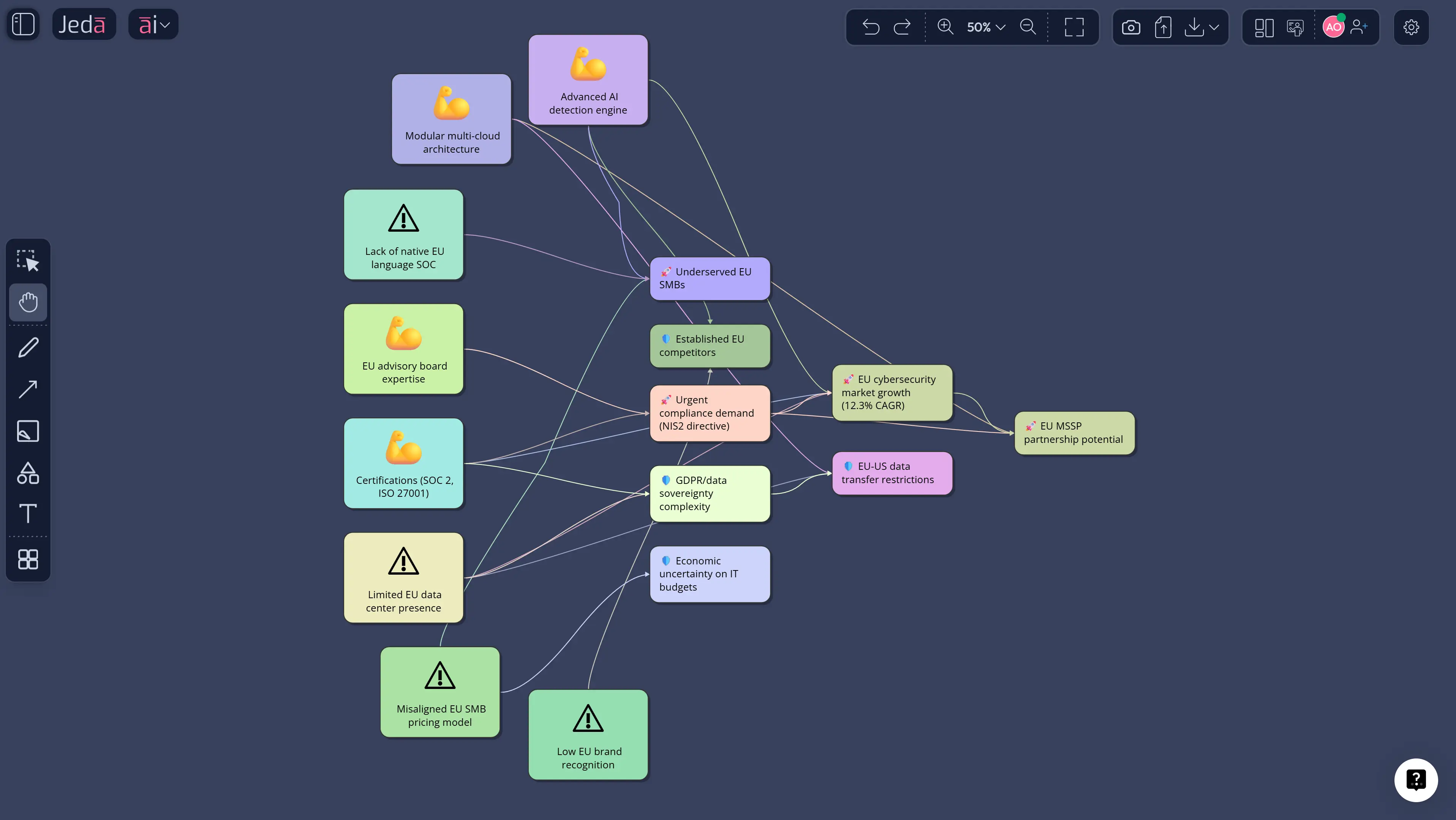
That shift is the whole game. You stop collecting boxes and start reading interactions.
Historically, SWOT traces back to the SOFT/SWOT planning tradition linked to SRI work in the 1960s, while TOWS formalized the matching of strengths and weaknesses with opportunities and threats. Cross-impact analysis, developed in futures and scenario work, studies how variables influence each other instead of assuming they sit quietly in separate lanes. Put those together and you get a more dynamic strategy lens. That is why Cross Impact SWOT Analysis with AI is especially useful for scenario planning, market entry, transformation work, and any decision where second-order effects can bite you later.
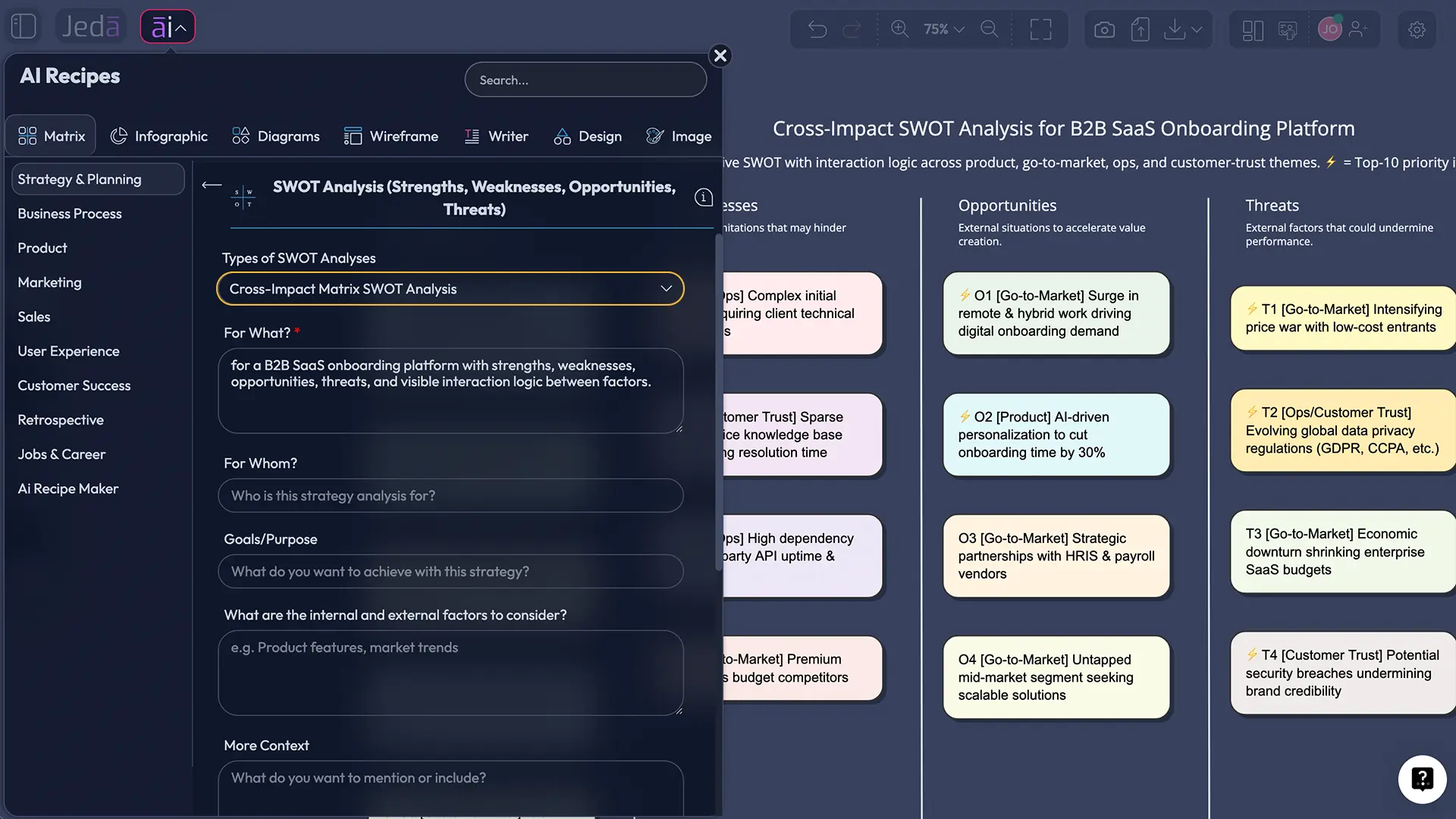
Why Cross Impact SWOT Analysis with AI beats a static four-box SWOT
Doing this manually is possible. It is also slow, inconsistent, and strangely easy to derail. One person adds too many factors. Another rates everything as “high impact.” Somebody else turns the workshop into theater. The board looks busy, but nobody can tell what matters most.
AI helps because it can structure the first pass, surface relationships, cluster related signals, and give your team a visible draft to challenge. In Jeda.ai, that draft lands on the canvas as an editable visual, not a dead paragraph hiding in chat. And that changes the quality of the meeting.
- See interaction, not just inventory
Map how one strength amplifies an opportunity, how a weakness worsens a threat, and where trade-offs deserve real discussion.
- Get to first draft fast
Use the Matrix recipe or the Prompt Bar to generate a working strategic map in minutes, then spend your energy refining judgment.
- Reduce noise
AI helps group repeated ideas, clean vague inputs, and keep the matrix from turning into a junk drawer of half-finished thoughts.
- Move from analysis to options
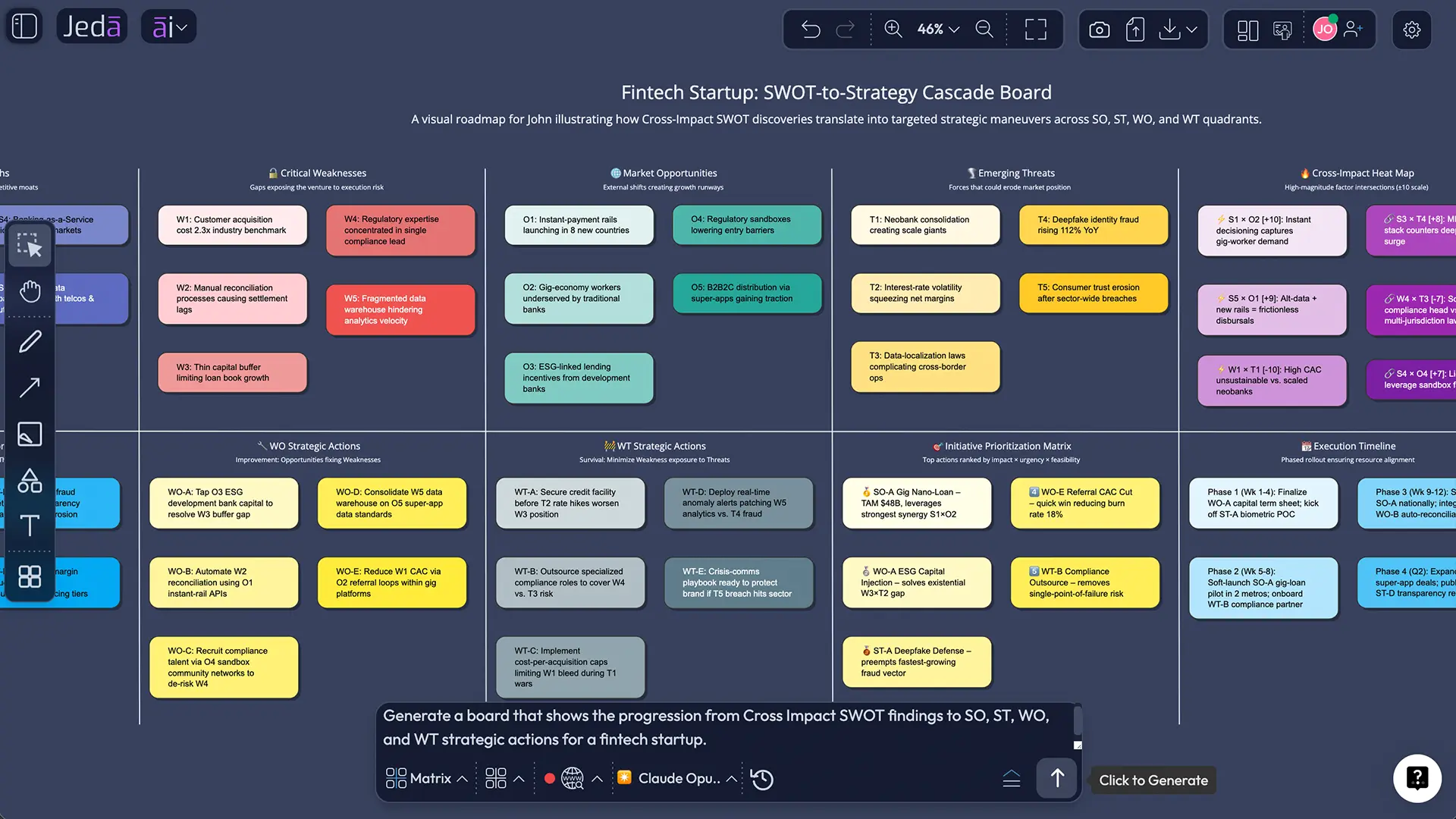
Translate interactions into SO, ST, WO, and WT strategic moves instead of ending the session with a pretty but passive canvas.
- Work together in context
Because the output lives on an AI Whiteboard, teams can annotate, challenge, extend, and reshape the same visual in real time.
- Deepen the map with AI+
Once the first version exists, use the AI+ button to extend a node, sharpen a quadrant, or explore ripple effects without rebuilding everything.
Here is the bigger point. The best strategy teams are not winning because they have more frameworks. They are winning because they can move from framework to decision without losing the thread. Jeda.ai is built for that move. The AI Workspace gives you structured visuals, editable outputs, and access to 300+ strategic frameworks so the work does not splinter across slides, docs, and sticky notes that never talk to each other.
If you want the broader platform context, see AI Workspace and AI Whiteboard. If you want related strategy pages, start with SWOT Analysis with AI, PESTEL Analysis with AI, and Porter’s Five Forces with AI.
How to create Cross Impact SWOT Analysis with AI in Jeda.ai
You have two good paths. Use the recipe when you want guided structure. Use the Prompt Bar when you already know the context and want speed.
Method 1: Recipe Matrix
This is the recommended route because Cross Impact SWOT Analysis with AI is a Matrix recipe under Strategy & Planning, nested inside the SWOT family. In plain English, Jeda.ai already knows the structure, so you do not need to reinvent it every time.
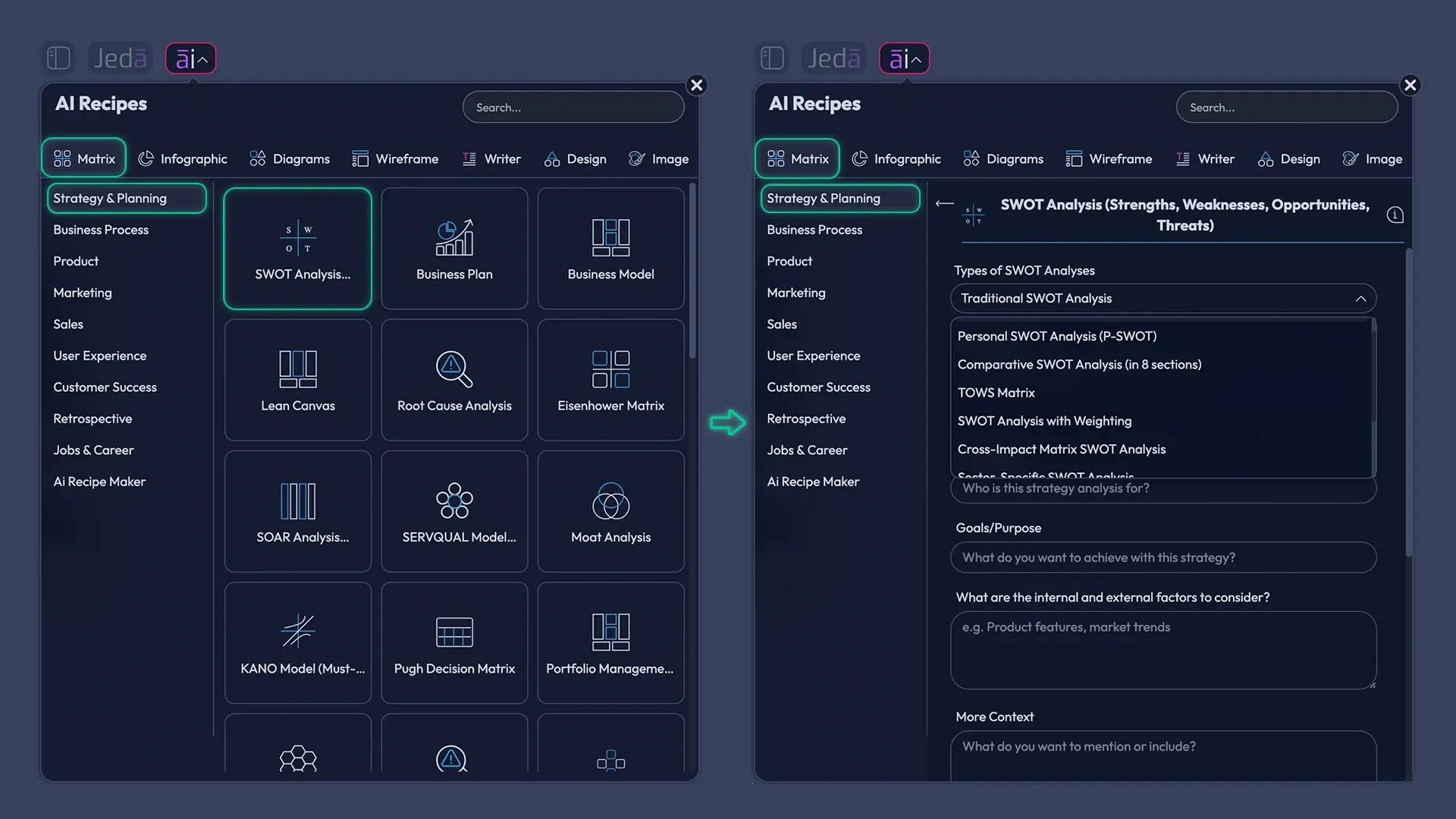
- Open the AI Menu
Click the AI Menu at the top-left of the canvas to open Jeda.ai’s recipe library.
- Choose Matrix Recipes
Select the Matrix category, then go to Strategy & Planning and open the SWOT Analysis family.
- Pick the Cross Impact SWOT recipe
Choose the Cross Impact SWOT Analysis recipe so the framework, layout, and prompting logic are pre-structured for you.
- Fill in the brief
Add the business, project, market, objective, and any critical context such as competitors, customer shift, regulation, or operational constraints.
- Generate the matrix
Select your preferred layout and reasoning model, then generate the first draft on the canvas.
- Refine with AI+ and edits
Click any relevant object and use the AI+ button to deepen a branch, then edit wording, reorder factors, and tighten the final strategic takeaways.
A small but important note: AI+ is best after the first matrix exists. Use it to deepen the board you already have. Ask it to extend a relationship, reveal second-order effects, or add missing risks. Do not treat AI+ like a wish-granting button for a brand-new custom method. It is an extension tool, and a very good one.
Method 2: Prompt Bar
Some people do not want a guided form. Fair. They want to type a sharp brief, hit generate, and get on with it. This is that route.
- Open the Prompt Bar
Use the Prompt Bar at the bottom of the canvas, which is Jeda.ai’s primary input area.
- Select the Matrix command
Choose Matrix from the command selector so the output renders as a structured visual instead of plain text.
- Write a specific prompt
Describe the company or project, the decision context, and ask Jeda.ai to map interactions between strengths, weaknesses, opportunities, and threats.
- Choose layout and generate
Pick Auto, Column, or Grid layout, then generate the board.
- Stress-test the result
Edit weak factors, merge duplicates, and ask follow-up prompts to check which interactions matter most.
- Transform if needed
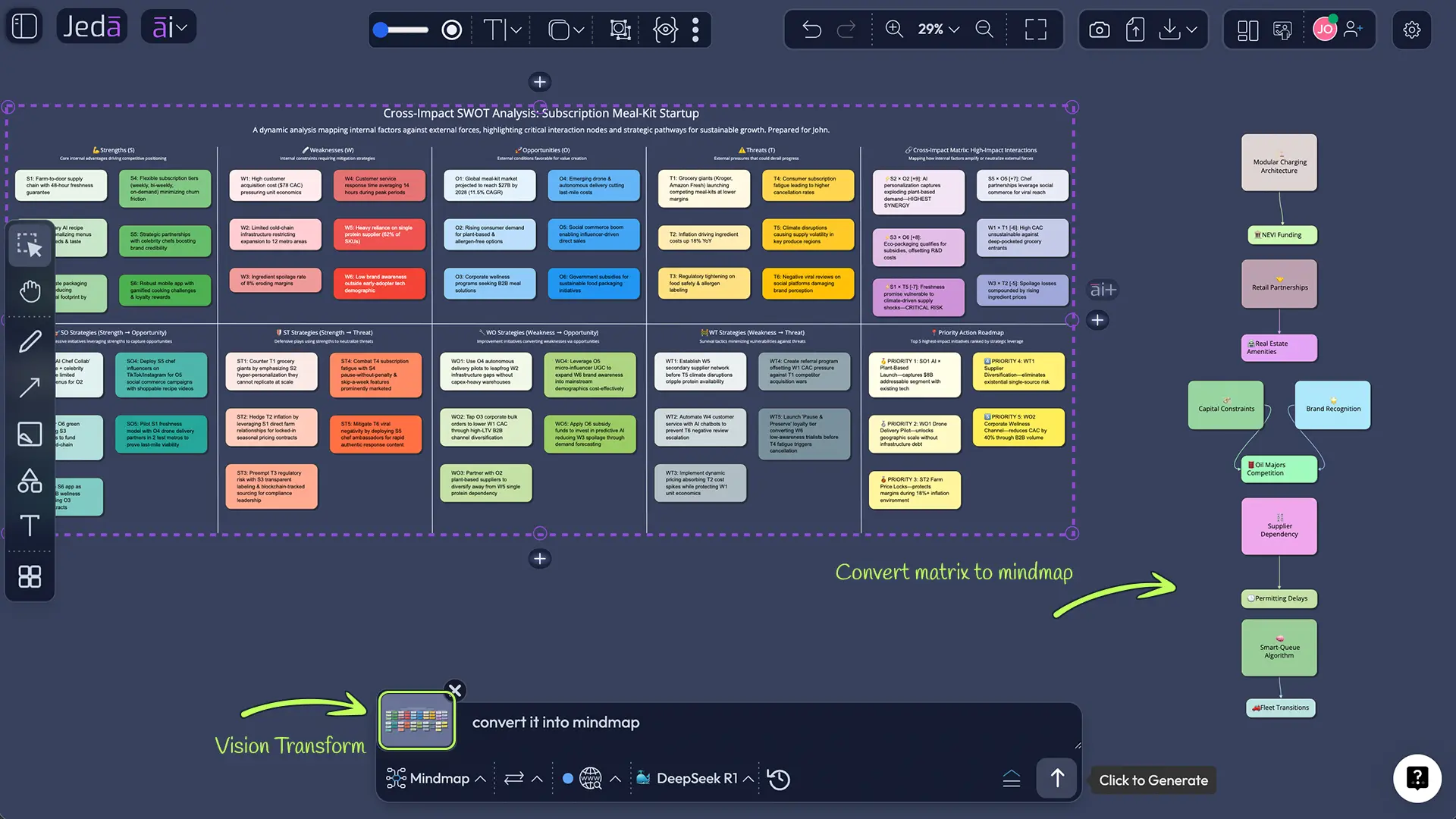
Use Vision Transform if you want to convert the matrix into a flowchart, mind map, or another visual for presentation.
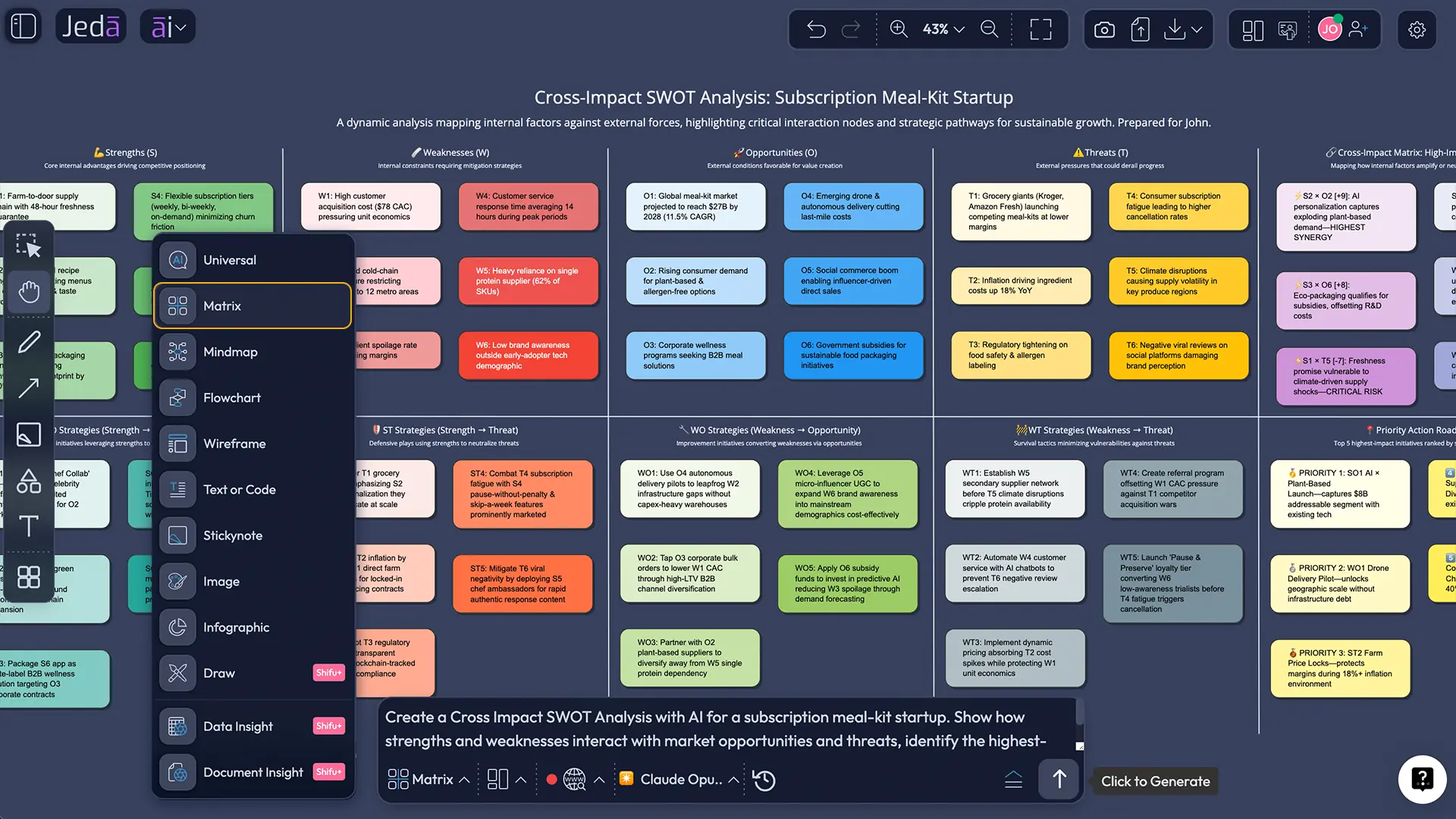
A useful prompt looks like this:
Create a Cross Impact SWOT Analysis with AI for a subscription meal-kit startup. Show how strengths and weaknesses interact with market opportunities and threats, identify the highest-impact relationships, and suggest SO, ST, WO, and WT strategic actions.
And if you want better outputs, feed it real context. Upload a report with Document Insight, upload a spreadsheet with Data Insight, or switch on web-grounded inputs when current market changes matter. The Visual AI advantage is not just generation. It is generation with context, on a canvas you can still shape.
Cross Impact SWOT Analysis with AI template and example
A good template has four layers, not one.
Core factors
Your strengths, weaknesses, opportunities, and threats.Interaction logic
Which factors intensify, reduce, trigger, or cancel other factors.Strategic interpretation
The SO, ST, WO, and WT moves that follow from the interaction map.Decision output
Owners, timing, risk flags, and what to monitor next.
That last layer is where many teams quietly fail. They finish the analysis and stop one minute too early.
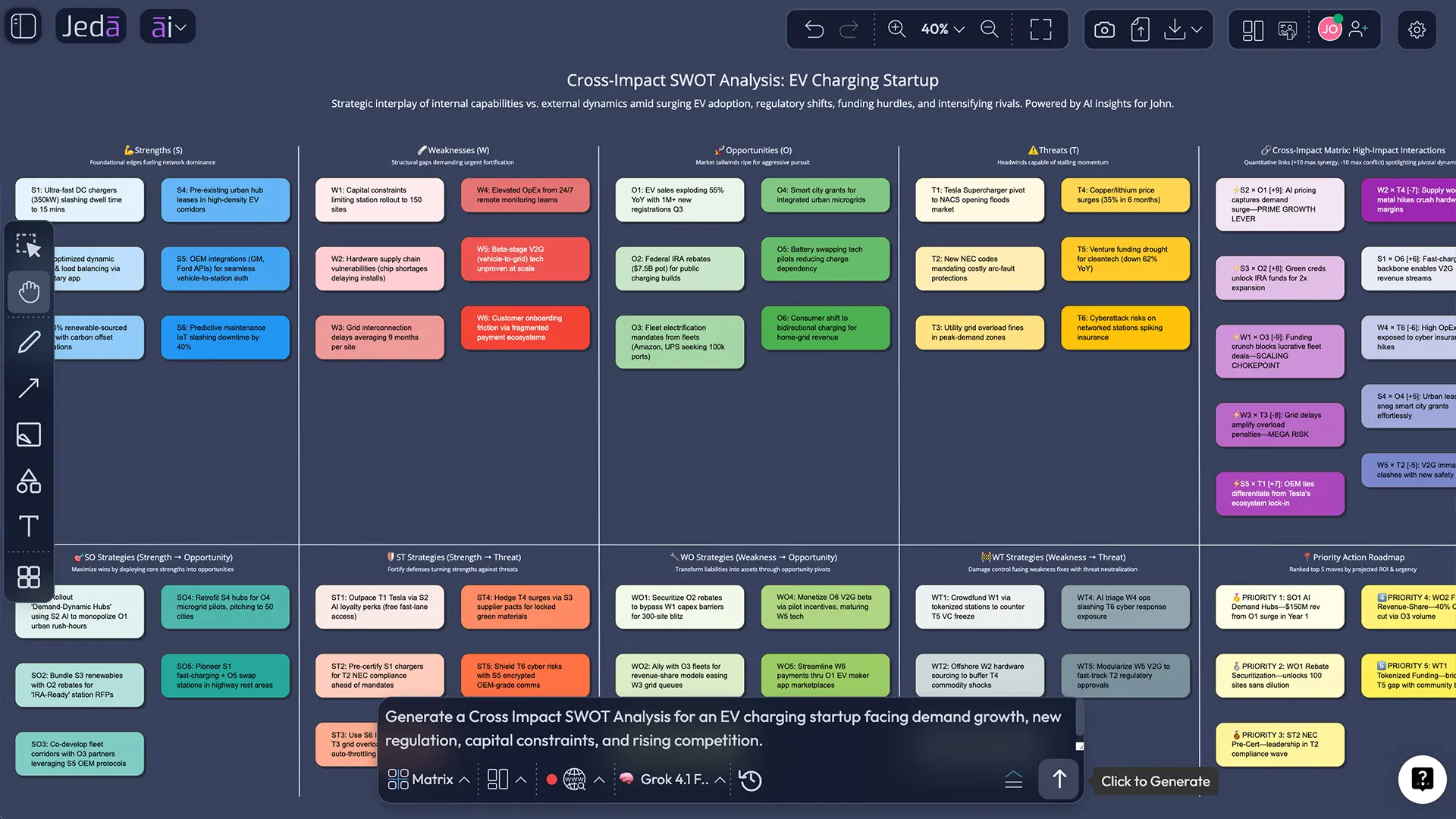
In practice, the best sequence is simple. Generate the cross-impact matrix first. Then isolate the few relationships that truly move the strategy. Then turn those into TOWS-style options. Jeda.ai handles that progression well because the same canvas can hold the diagnosis, the argument, and the final strategic move.
Best practices for a matrix that is actually useful
Jeda.ai also works well when you split the board into two passes. Pass one is discovery. Pass two is discipline. In the first pass, let the AI surface the landscape. In the second, prune, rename, rank, and tighten. That rhythm tends to produce better boards than pretending the first output is sacred.
Common mistakes to avoid
Mistake 1: Treating it like a prettier SWOT.
If the board only restates the four quadrants, you have not done cross-impact work yet. You have just redecorated the original method.
Mistake 2: Mixing factors with actions.
“Hire two sales reps” is not a factor. It is a response. Keep the diagnosis separate from the move.
Mistake 3: Using vague phrases that cannot be challenged.
Words like “strong market presence” sound strategic and say almost nothing. Name the actual source of strength or weakness.
Mistake 4: Letting the matrix become exhaustive.
Not everything deserves equal attention. The job is not to document the universe. The job is to find the interactions that change the decision.
Mistake 5: Skipping the handoff to strategy.
A matrix without SO, ST, WO, or WT actions is a smart-looking pause screen.
Frequently Asked Questions
- What is Cross Impact SWOT Analysis with AI?
- Cross Impact SWOT Analysis with AI is a structured way to map how strengths, weaknesses, opportunities, and threats influence one another, not just how they exist on separate lists. AI speeds up the first draft, helps expose patterns, and makes the matrix easier to refine into strategic action.
- How is Cross Impact SWOT different from a classic SWOT?
- Classic SWOT is mainly descriptive. Cross Impact SWOT is relational. It asks how one factor amplifies, weakens, blocks, or reshapes another factor, which makes it more useful for scenario planning, trade-off analysis, and difficult strategy choices.
- Is Cross Impact SWOT the same as a TOWS matrix?
- No. They are related, but not identical. Cross Impact SWOT analyzes the interaction patterns among SWOT factors, while TOWS is usually the next move that translates those patterns into SO, ST, WO, and WT strategic options.
- When should I use Cross Impact SWOT Analysis with AI?
- Use it when the environment is changing fast, when internal weaknesses can distort external opportunities, or when second-order effects matter. It is especially useful for launches, market entry, transformation programs, pricing shifts, and competitive response planning.
- Can AI replace expert judgment in a Cross Impact SWOT?
- No. AI should accelerate structure, not replace judgment. The strongest use of AI is to produce a draft, surface interactions, and help teams test alternatives. Final prioritization still needs domain knowledge, evidence, and human debate.
- How many factors should I include?
- Most teams do better with six to ten sharp factors than with a giant catalog of half-defined points. Too many factors make the matrix noisy and lower the quality of the discussion because everything starts looking equally important.
- What kind of input makes the output better?
- Specific input wins. Include the business model, market context, timeframe, major competitors, customer shifts, known operational weaknesses, and any hard evidence from documents or data. The tighter the brief, the stronger the interaction map.
- Can I turn the result into another visual?
- Yes. In Jeda.ai, you can generate the matrix first and then use Vision Transform to convert the board into another visual such as a flowchart or mind map. That is handy when different stakeholders prefer different formats.
- Is this useful only for large companies?
- No. Smaller teams often get even more value from it because they feel strategic trade-offs faster. Startups, product teams, consultants, and business leaders can all use it when the wrong move would waste scarce time, budget, or market momentum.
Sources & Further Reading
- [1]
Puyt, Richard Willem; Lie, Finn Birger; Wilderom, Celeste Pauline Martine (2023) . “The origins of SWOT analysis” Journal of Business Research.
View Source ↗ - [2]
Ghazinoory, Sepehr; Abdi, Mansoureh; Azadegan-Mehr, Mandana (2011) . “SWOT methodology: a state-of-the-art review for the past, a framework for the future” Journal of Business Economics and Management.
View Source ↗ - [3]
Weihrich, Heinz (1982) . “The TOWS matrix—A tool for situational analysis” Long Range Planning.
View Source ↗ - [4]
Asan, Seyda Serdar; Asan, Umut (2007) . “Qualitative cross-impact analysis with time consideration” Technological Forecasting and Social Change.
View Source ↗ - [5]
Weimer-Jehle, Wolfgang (2006) . “Cross-Impact Balances: A system-theoretical approach to cross-impact analysis” Technological Forecasting and Social Change.
View Source ↗ - [6]
Miura, Shin-ichiro; Nose, Daisuke; Kanamori, Katsutoshi; Imaizumi, Satoshi; Shimura, Hideo; Saku, Keijiro (2021) . “Sustainable Hospital Management by a Cross SWOT Analysis in a Medium-Sized Hospital” Sustainability.
View Source ↗
Start Your Cross Impact SWOT Analysis Today
Join over 150,000+ users who use Jeda.ai to turn strategy discussions into editable visual decisions inside one AI Workspace.
Try Free Template