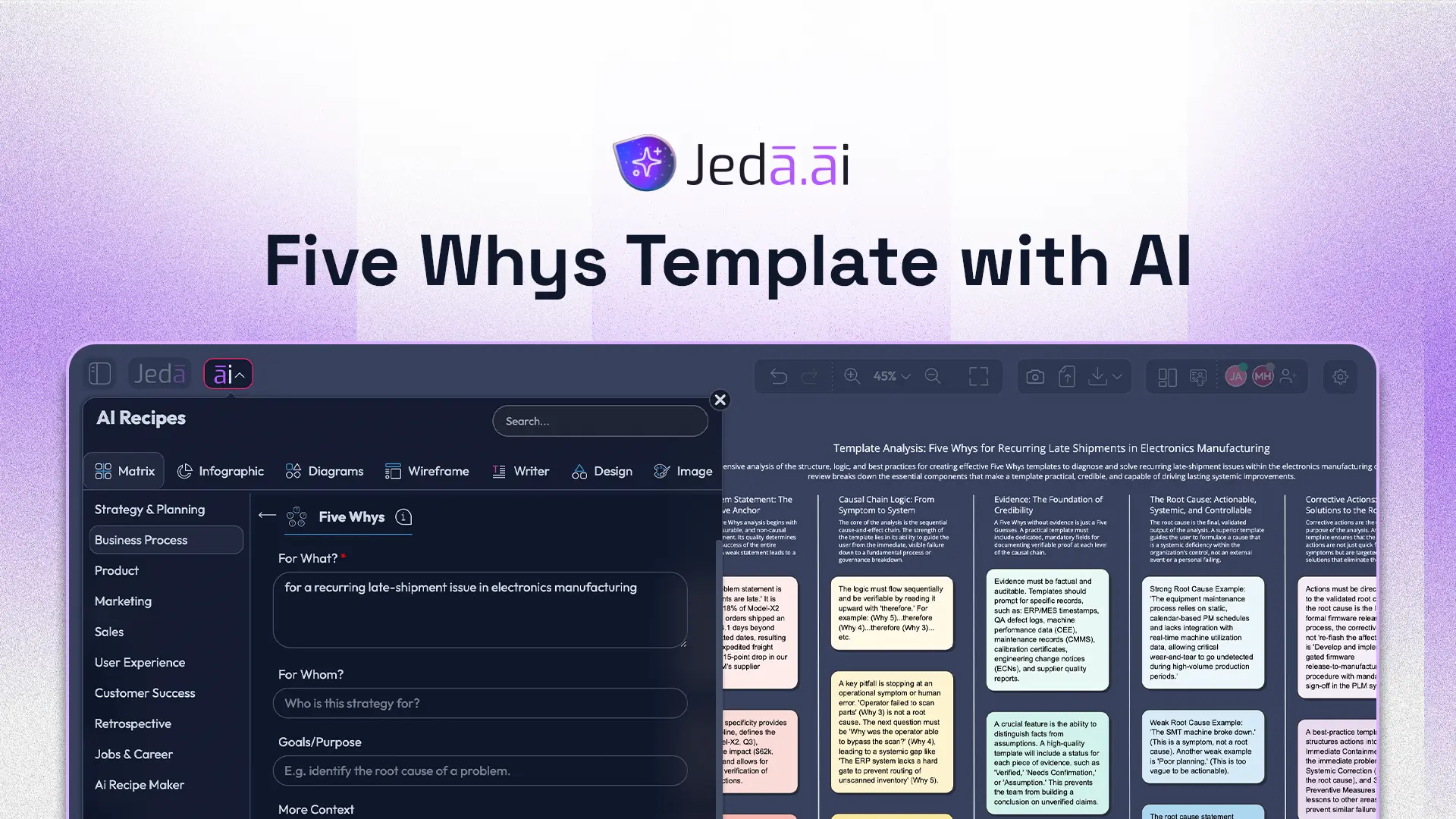
A Five Whys template gives you a practical way to stop circling around symptoms and start tracing a problem back to its real cause. Sounds simple. In a real meeting, it usually is not. Jeda.ai turns that messy discussion into an editable visual inside an AI Workspace and AI Whiteboard, so your team can move from blame and guesswork to actual root cause faster.
The Five Whys method became popular through Toyota problem solving, and lean practitioners still use it because it forces a cause-and-effect chain instead of opinion swapping (Lean Enterprise Institute; Toyota; IHI). On Jeda.ai, you can build the template through the Recipe Matrix when you want structure fast, or through the Prompt Bar when you want more control, then use the AI+ button to deepen the board. Not a blank page. Not a dead worksheet. A Visual AI workflow with editable output, built on the same language Jeda.ai uses across 300+ strategic frameworks and 150,000+ users.
What is a Five Whys template?
A Five Whys template is a structured root cause analysis tool. You write a clear problem statement, ask "why?" repeatedly, and document each answer as the next link in the chain until you reach a cause your team can actually address.
The method is closely associated with Toyota problem solving. Lean Enterprise Institute defines 5 Whys as the practice of asking why repeatedly to move beyond symptoms and discover root cause. IHI attributes the technique to Taiichi Ohno, while Tulip's glossary traces its development to Sakichi Toyoda in the Toyota tradition (Lean Enterprise Institute; IHI; Tulip; Toyota).
You do not always stop at exactly five. ASQ and UC Irvine both note that some problems need fewer rounds and some need more; the real target is an actionable cause, not a tidy number (ASQ; UC Irvine DFA). In practice, Five Whys works best for simple to moderately complex process, quality, service, and handoff issues. If the problem is broad or multi-causal, teams often pair it with a fishbone diagram first.
Why use a Five Whys template with AI?
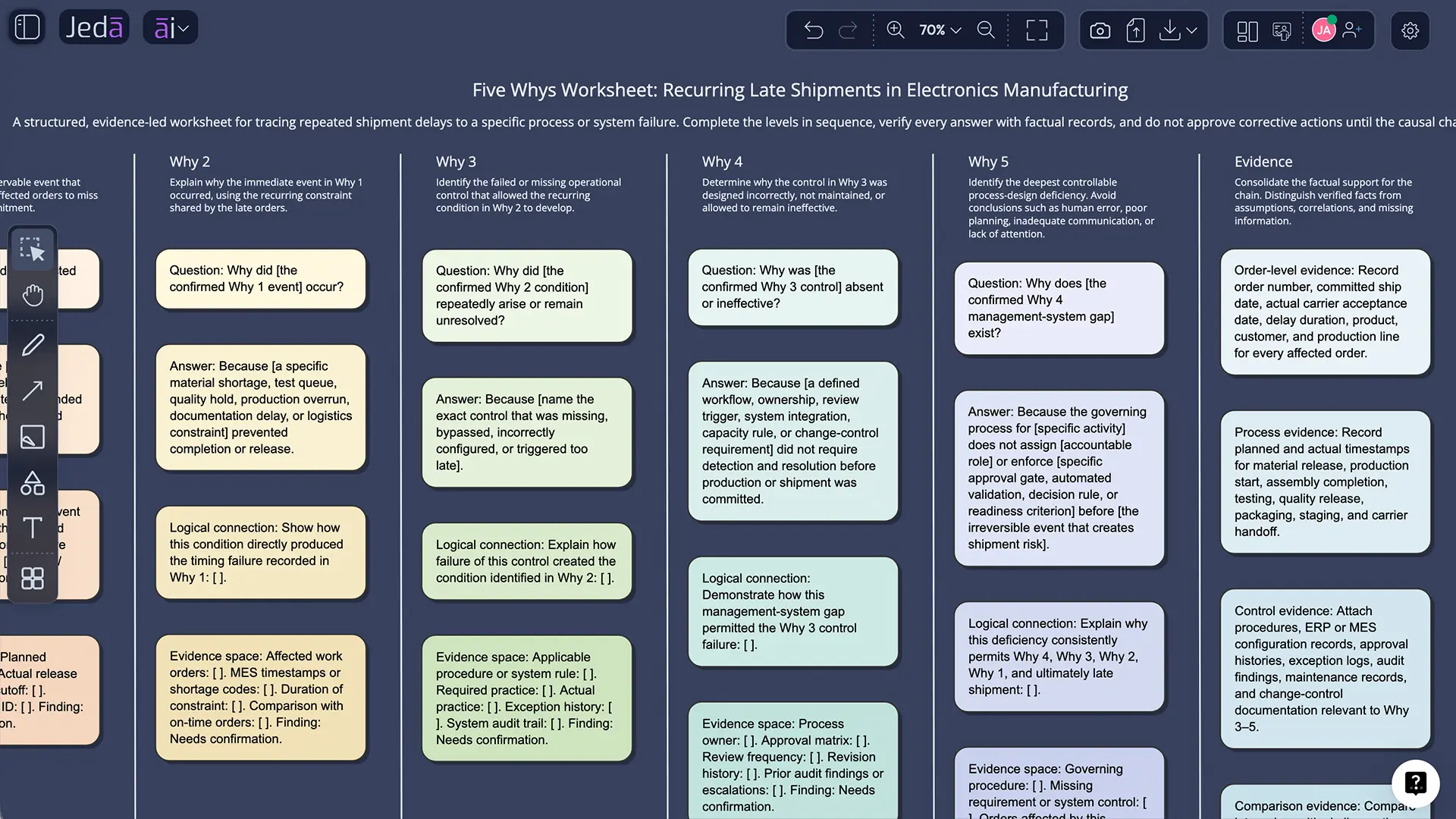
AI does not replace the Five Whys method. It makes the method less clunky. Instead of drafting a chain by hand and losing the thread in meeting notes, you can generate a clean first version, refine the language, and keep the whole analysis editable inside Jeda.ai's AI Workspace.
Most Five Whys pages ranking today still center on static worksheets, simple whiteboard templates, or manual collaborative boards. Miro, Lucid, Mural, Atlassian, and Iowa's government lean tools all help users start, but they still rely heavily on manual setup and manual branching (Miro; Lucid; Mural; Atlassian; Iowa Department of Management). Jeda.ai changes the starting point: describe the problem, generate the structure, then iterate visually with AI assistance.
- Faster root-cause framing
Start with a clear problem statement, likely causal chain, and editable matrix instead of burning ten minutes deciding where the first sticky note goes.
- Better branch quality
AI helps you test whether each answer is a cause, a symptom, or just vague wording. That alone saves a lot of fake certainty.
- Shared team reasoning
Your Five Whys stays visible, collaborative, and revisable in one AI Whiteboard so operations, product, quality, and leadership can work from the same chain.
A good AI-assisted Five Whys template solves three real headaches. It keeps the language specific, makes it easier to compare multiple plausible branches, and keeps the work reusable. You can return to the same board, extend it, annotate evidence, and convert it into another visual if you need to brief a wider group.
The goal is not to accept every generated answer. The goal is to think better, with less friction.
How to create a Five Whys template in Jeda.ai
Jeda.ai gives you two practical routes. For this page, Method 1 uses the Recipe Matrix because it is the fastest way to get a structured Five Whys template on the canvas. Method 2 uses the Prompt Bar for more custom wording and broader problem context. After either method, use the AI+ button to deepen what is already there.
Method 1: Recipe Matrix
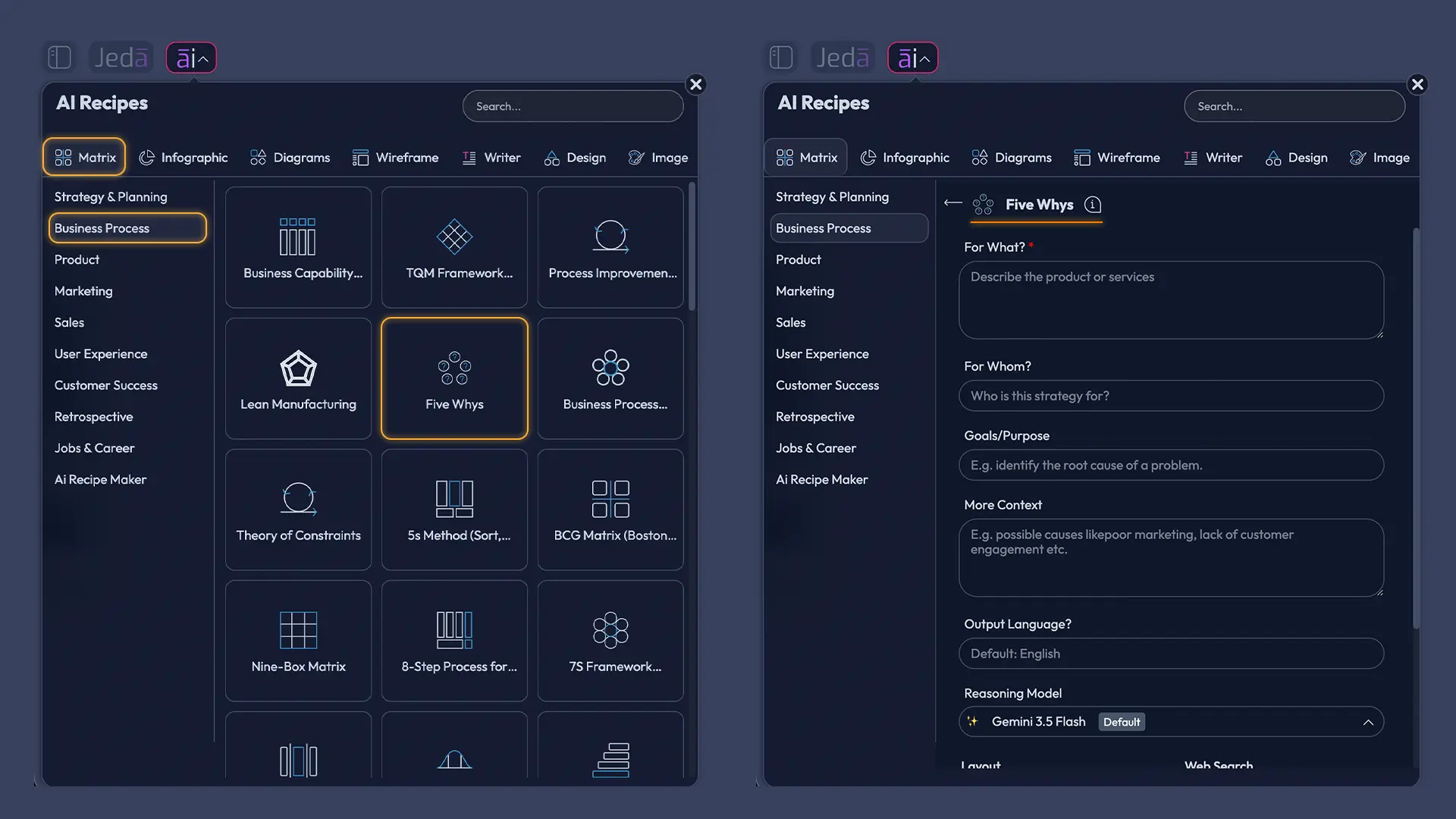
This is the recommended starting path when you want a ready-made structure. You open the AI Menu, choose the Five Whys recipe, enter the problem context, and let Jeda.ai create the first pass. Then you refine, validate, and extend.
- Open the AI Menu
Inside your Jeda.ai workspace, open the AI Menu from the top-left corner and go to the Matrix recipe category.
- Select the Five Whys template
Choose the Five Whys recipe.
- Define the problem clearly
Enter a concrete issue, not a vague frustration. Include who is affected, what failed, and where it shows up.
- Add context before generating
Include process notes, incident details, shift information, customer complaints, quality defects, or any evidence that sharpens the chain.
- Generate and review the first matrix
Let Jeda.ai build the initial Five Whys template, then check whether each answer points to a true cause rather than a symptom.
- Refine and validate with your team
Edit wording, branch alternatives, attach evidence, and make sure the chain leads to an actionable root cause.
- Use AI+ to deepen the board
Tap the AI+ button on the generated visual to extend branches, suggest actions, or expand the analysis already on the canvas.
Method 2: Prompt Bar
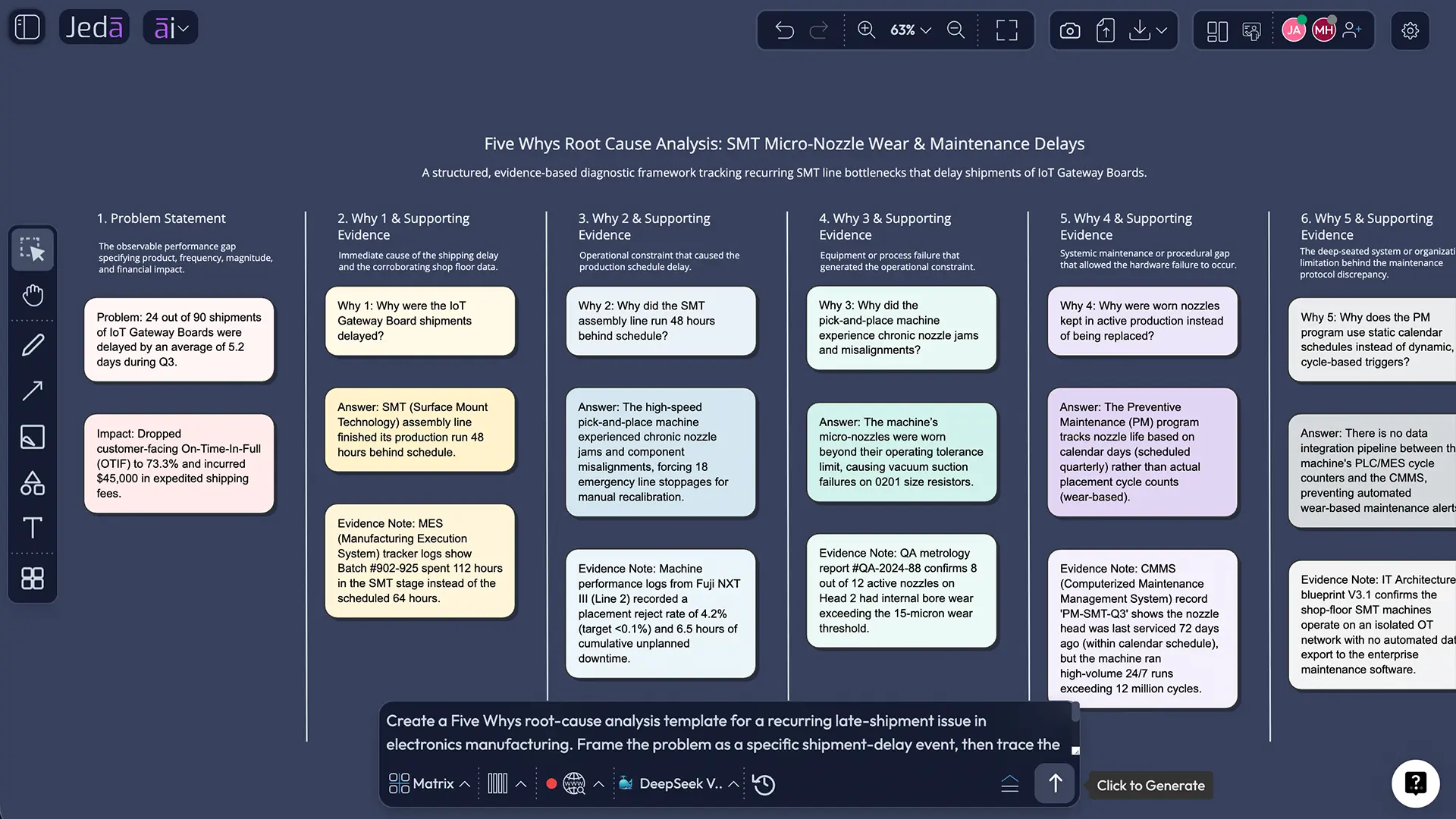
Use the Prompt Bar when the issue is unusual, cross-functional, or messy enough that you want to frame the output yourself.
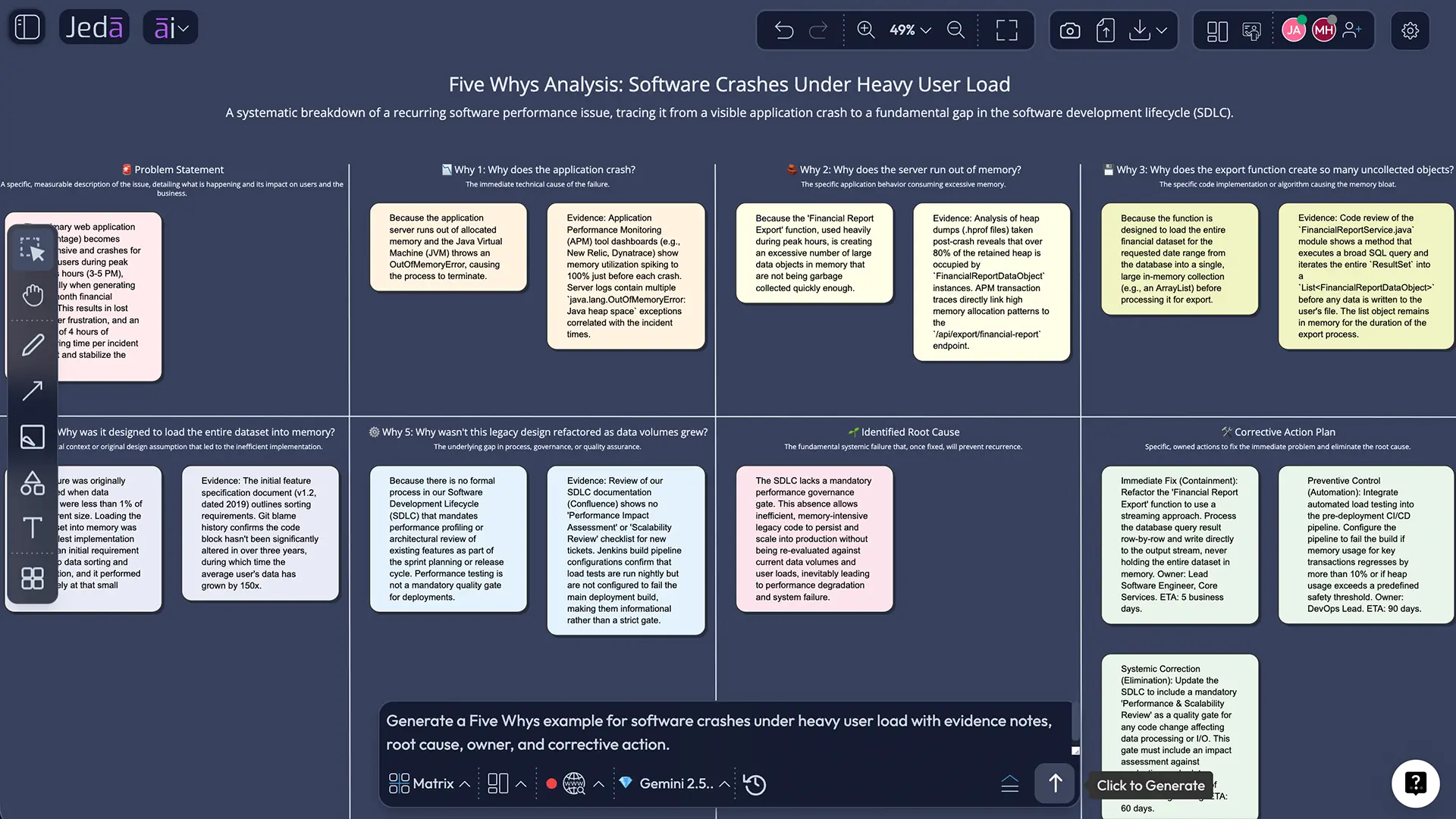
- Open the Prompt Bar at the bottom of the Jeda.ai canvas.
- Select the Matrix command.
- Type a prompt that states the issue, the business context, and the kind of output you want.
- Generate the matrix.
- Edit the answers, add evidence, and invite collaborators to challenge weak links.
A prompt that actually works:
Create a Five Whys template for rising late shipments in an electronics assembly process. Show one main problem statement, five sequential why levels, evidence notes, root cause, corrective action, owner, and follow-up checks.
That prompt gives the AI real business context and tells Jeda.ai what fields belong in the matrix. Less cleanup. Better first draft.
AI+ button generated deep dive
Once the first Five Whys template exists, select the visual and tap the AI+ button. Jeda.ai will extend the analysis from the structure already on the board. That means AI+ is best used for a generated deep dive, not for throwing a brand-new, hyper-specific instruction at empty air. Think of it as "go deeper from here," not "start an unrelated task."
Use AI+ to:
- expand a weak branch into sub-causes
- generate evidence prompts your team should verify
- suggest corrective actions for the final root cause
- add owners, deadlines, and follow-up checks
- compare one causal chain against another
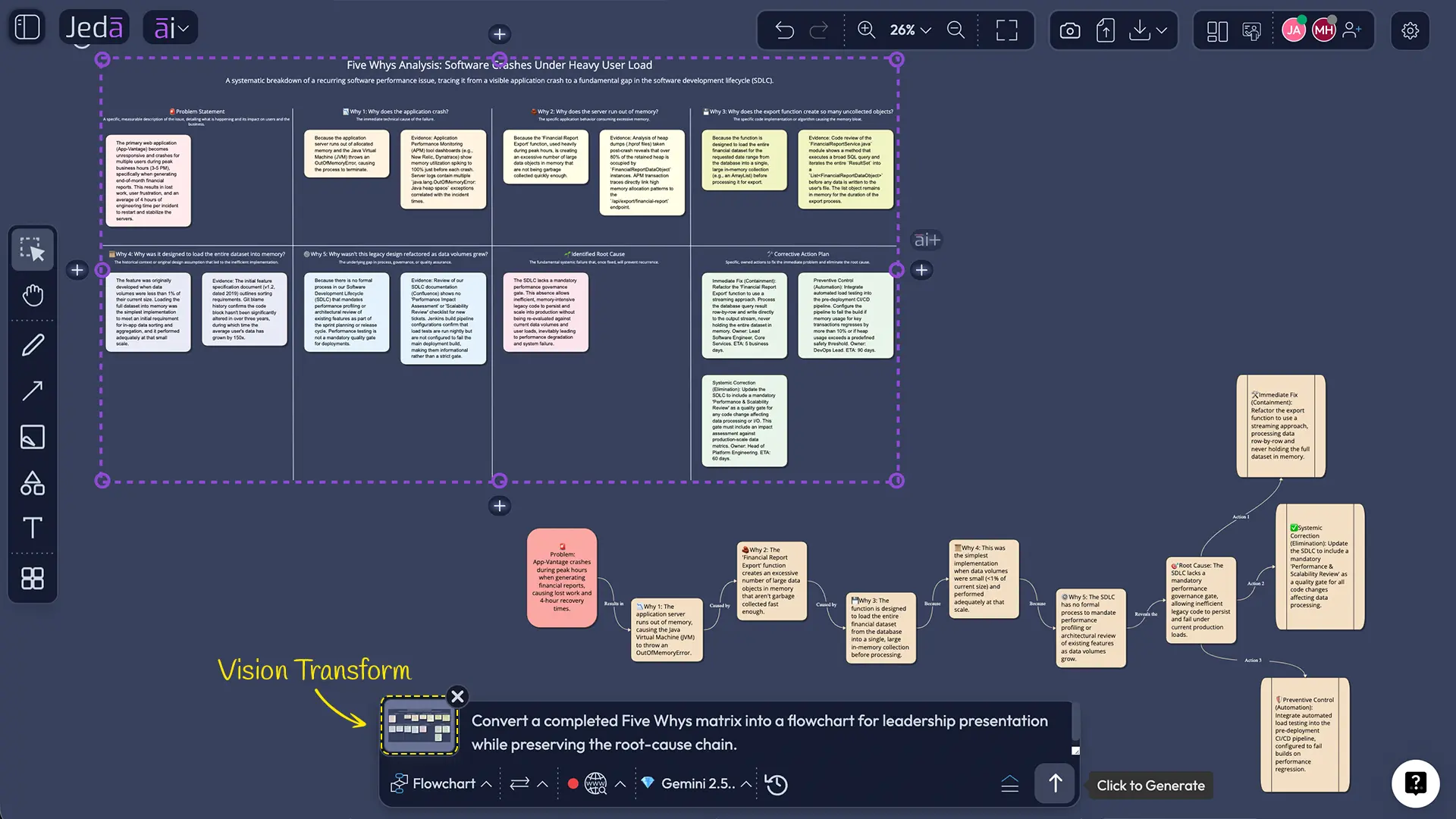
And if you need to present the same thinking in another format, use Vision Transform to convert the matrix into a flowchart or diagram for a wider audience.
Five Whys template example
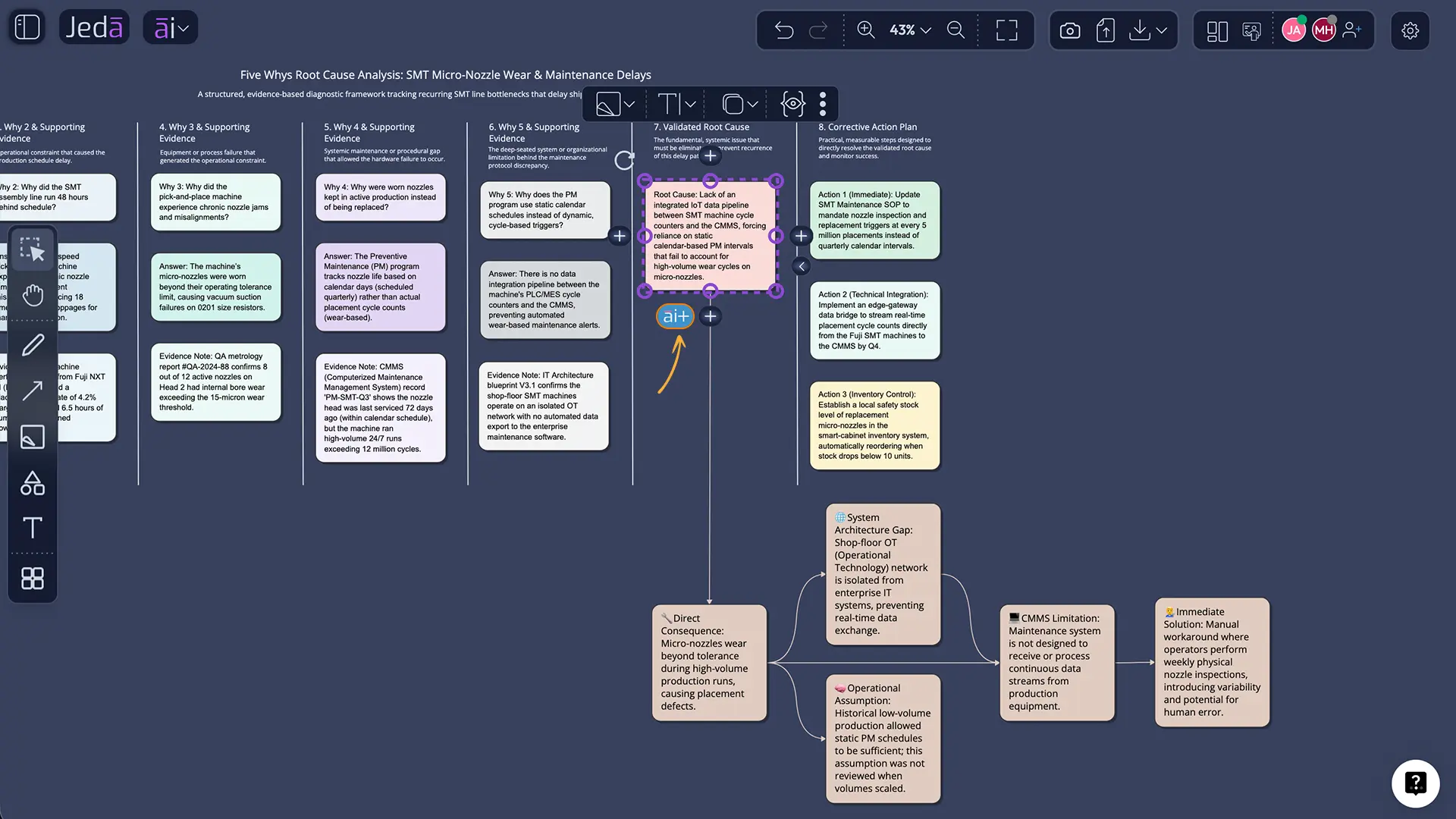
Let’s make this real. Say a manufacturer sees a spike in late shipments.
This is where a Five Whys template with AI earns its keep. A manual session often stops at "night shift missed defects." AI helps you push beyond blame language, compare other branches, and document the real systems problem. In the example above, the corrective action is not "tell staff to be more careful." It is "fix the revision-control and handoff mechanism."
You can also attach inspection notes, screenshots, or a quality report so the final board becomes more than diagnosis. It becomes a decision artifact.
Best practices and tips
The best Five Whys sessions feel slower at the start and faster at the end. That is a good sign. It means your team is defining the problem clearly instead of chasing the wrong cause.
If an answer sounds like blame, rewrite it as a process condition. If it sounds vague, add context. If it feels absolute, test it against evidence.
For teams doing process improvement, quality management, lean manufacturing, support operations, or product incident reviews, Five Whys fits nicely beside related methods like Fishbone Diagram, Gap Analysis, Porter's Five Forces, and Improvement Kata.
Common mistakes to avoid
The first mistake is using Five Whys for a problem that is still undefined. If the statement is mushy, every answer after it will be mush.
The second mistake is stopping at blame language. "The operator forgot" may describe what happened, but it rarely explains the system that allowed it.
The third mistake is treating five like a sacred number. The target is an actionable root cause, not a perfect staircase.
The fourth mistake is forcing a single branch when the evidence suggests multiple causes. The fifth is ending without corrective action, owner, and follow-up. A Five Whys template without next steps is just an attractive autopsy.
Frequently asked questions
- What is a Five Whys template used for?
- A Five Whys template is used to uncover the root cause of a recurring problem by documenting a chain of why-questions and answers. Teams use it for process issues, service breakdowns, quality defects, delays, and incident reviews where surface explanations are not enough.
- Do you always need exactly five whys?
- No. Five is a guideline, not a fixed rule. Authoritative lean and quality sources note that some problems reach an actionable cause in fewer rounds, while others need more. Stop when the team reaches a cause it can verify and address.
- When should I use Five Whys instead of a fishbone diagram?
- Use Five Whys when the problem is specific and you want one clear causal chain. Use a fishbone diagram first when the issue is broad, multi-causal, or cross-functional. Many teams pair the two: fishbone to explore, Five Whys to drill down.
- Is Five Whys good for complex enterprise problems?
- It can help, but not by itself. Five Whys is strongest for simple to moderately complex issues. For large systems problems, it works better as one layer inside a broader root cause process that also includes evidence gathering, branching, and validation.
- Can Jeda.ai generate a Five Whys template from a prompt?
- Yes. In Jeda.ai, you can create a Five Whys template through the Matrix recipe flow or by using the Prompt Bar with the Matrix command. The output stays editable, collaborative, and ready for extension with the AI+ button.
- What does the AI+ button do after the template is generated?
- AI+ deepens the visual that already exists on the canvas. It can expand branches, suggest evidence to check, propose actions, and add more detail to the current analysis. It is best for extending an existing board, not replacing the initial setup step.
- Can I turn a Five Whys matrix into another format?
- Yes. After generating the matrix, you can use Vision Transform to convert the output into another visual form, such as a flowchart or diagram, when you need a different presentation style for leadership, training, or handoff.
- Is the generated Five Whys output editable?
- Yes. Jeda.ai's matrix outputs are editable, so you can revise wording, add evidence, move branches, and collaborate with teammates in real time. That is a big advantage over static worksheets and one-off exports that freeze the thinking too early.
- Can I try this in Jeda.ai without committing to a paid plan?
- Yes. According to the Jeda.ai platform reference provided for this workflow, the Whitebelt plan is free, while Blackbelt and Shifu offer broader usage and advanced capabilities. That makes it easy to test the method before scaling it across a team.
- How should I know whether the root cause is good enough?
- A good root cause is specific, evidence-based, and actionable. If your team can assign an owner, change a process, and verify that the problem is less likely to recur, you are probably close. If the answer still sounds vague, keep digging.
Sources & further reading
The Five Whys method is old-school in the best way. It is simple, practical, and still useful because it forces teams to think in causal chains rather than slogans. The sources below informed the historical framing, usage notes, and template recommendations in this page.
- [1]
Lean Enterprise Institute (2026) . “5 Whys” Lean Lexicon.
View Source ↗ - [2]
Institute for Healthcare Improvement (2026) . “5 Whys: Finding the Root Cause” IHI Tools.
View Source ↗ - [3]
American Society for Quality (2026) . “Five Whys and Five Hows” ASQ Quality Resources.
View Source ↗ - [4]
Toyota Motor Corporation (2026) . “Toyota Production System” Official Global Website.
View Source ↗ - [5]
Tulip (2026) . “What are the Five Whys? A Tool for Root Cause Analysis” Tulip Glossary.
View Source ↗ - [6]
Iowa Department of Management (2026) . “5 Whys Template” Lean Enterprise Tools.
View Source ↗
Start Your Five Whys Template in Jeda.ai
Join 150,000+ users using Jeda.ai's AI Workspace and AI Whiteboard to turn recurring problems into visible, editable root-cause decisions.
Try Free Template