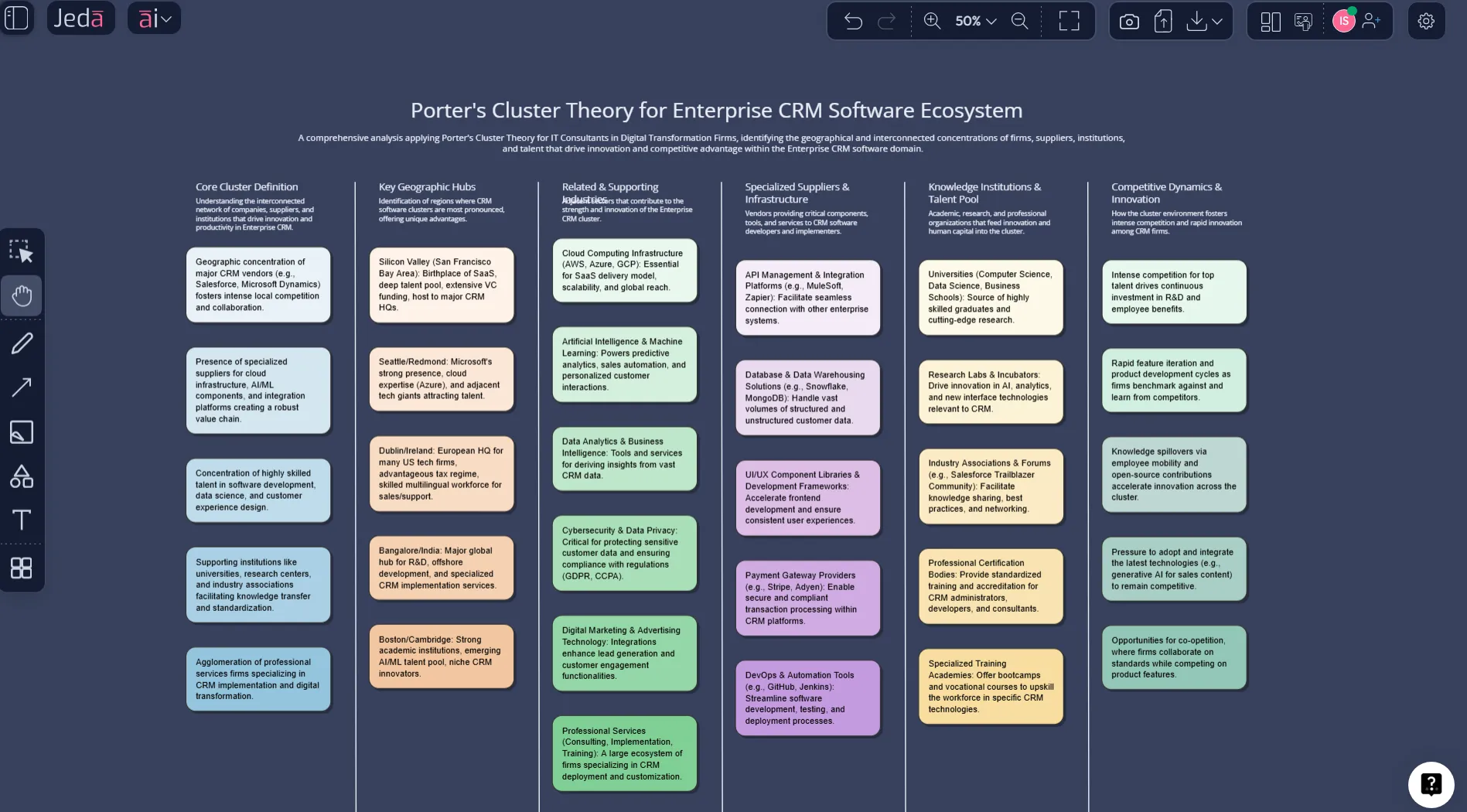
Porter’s Cluster Theory with AI is useful when you need to understand why certain places become unusually strong in a specific field and what that means for strategy, policy, investment, or ecosystem design. In Jeda.ai, you can turn that question into a live, editable matrix inside one AI Workspace, connect firms with suppliers and institutions inside the same AI Whiteboard, and then extend the analysis without rebuilding the board from scratch every time a stakeholder adds new evidence.
That matters because cluster thinking is messy by nature. You are dealing with firms, talent, infrastructure, universities, public agencies, demand conditions, spillovers, and bottlenecks all at once. Traditional slide decks flatten those relationships. Jeda.ai does not. It gives teams a collaborative Visual AI canvas where a cluster can be structured, challenged, and refined in real time. That is one reason more than 150,000+ users use Jeda.ai across 300+ strategic frameworks for analysis that is visual, editable, and decision-ready rather than locked in static files. If you want the broader platform context, the work sits naturally beside Jeda.ai’s AI Workspace and AI Whiteboard pages.
What is Porter's Cluster Theory?
Porter’s Cluster Theory explains how geographic concentrations of interconnected companies and institutions can increase productivity, innovation, and new business formation. Porter’s work on clusters developed from The Competitive Advantage of Nations and was later sharpened in his cluster articles and policy work. The basic claim is simple, but not simplistic: even in a global economy, location still matters because proximity can improve learning, coordination, specialization, and competitive intensity.
Porter later described clusters as geographic concentrations of interconnected companies, specialized suppliers, service providers, firms in related industries, and associated institutions in a particular field. So a cluster is not just “a lot of companies in one sector.” It includes the surrounding ecosystem that makes those companies stronger or weaker. That ecosystem might include universities, training pipelines, labs, trade bodies, logistics infrastructure, finance, anchor firms, demanding customers, and public institutions.
This is where teams often confuse cluster theory with other Porter ideas. It is related to the Diamond Model, but not identical. The Diamond helps explain national or regional competitive advantage through interacting conditions. Cluster theory zooms in on the localized ecosystem itself: the firms, linkages, spillovers, and institutions that shape competitiveness on the ground.
The theory also matters beyond corporate strategy. It shows up in regional development, innovation policy, industrial strategy, venture ecosystems, and location decisions. That broader relevance is a strength. It is also where sloppy usage creeps in. Not every co-located industry is a real cluster. Not every cluster can be willed into existence with subsidies and a press release. Harsh, yes. Accurate too.
It also helps to place cluster theory in the wider Porter family. If a team is still deciding whether it is analyzing market pressure or regional advantage, it can start with Porter’s analysis, pair the cluster view with Porter’s Five Forces, or bring in a macro lens like PESTEL analysis. That sequence usually prevents one of the most common mistakes: using cluster language when the real question is simply industry attractiveness.
Why use Porter's Cluster Theory with AI?
Cluster analysis involves too many moving pieces for a static worksheet to carry it well. AI helps by accelerating structure, exposing missing actors, and making the relationships between cluster elements easier to test.
- Faster ecosystem mapping
Jeda.ai helps you organize the cluster into core firms, suppliers, institutions, talent pools, infrastructure, and demand conditions without spending the first hour drawing boxes.
- Better relationship visibility
Cluster strength depends on linkages, not just presence. AI makes it easier to map who connects to whom and where spillovers are strong or weak.
- Useful for business and policy teams
The same board can support strategy teams, economic development groups, investors, universities, and public agencies because everyone can work from one structured ecosystem view.
- AI+ for deeper bottleneck analysis
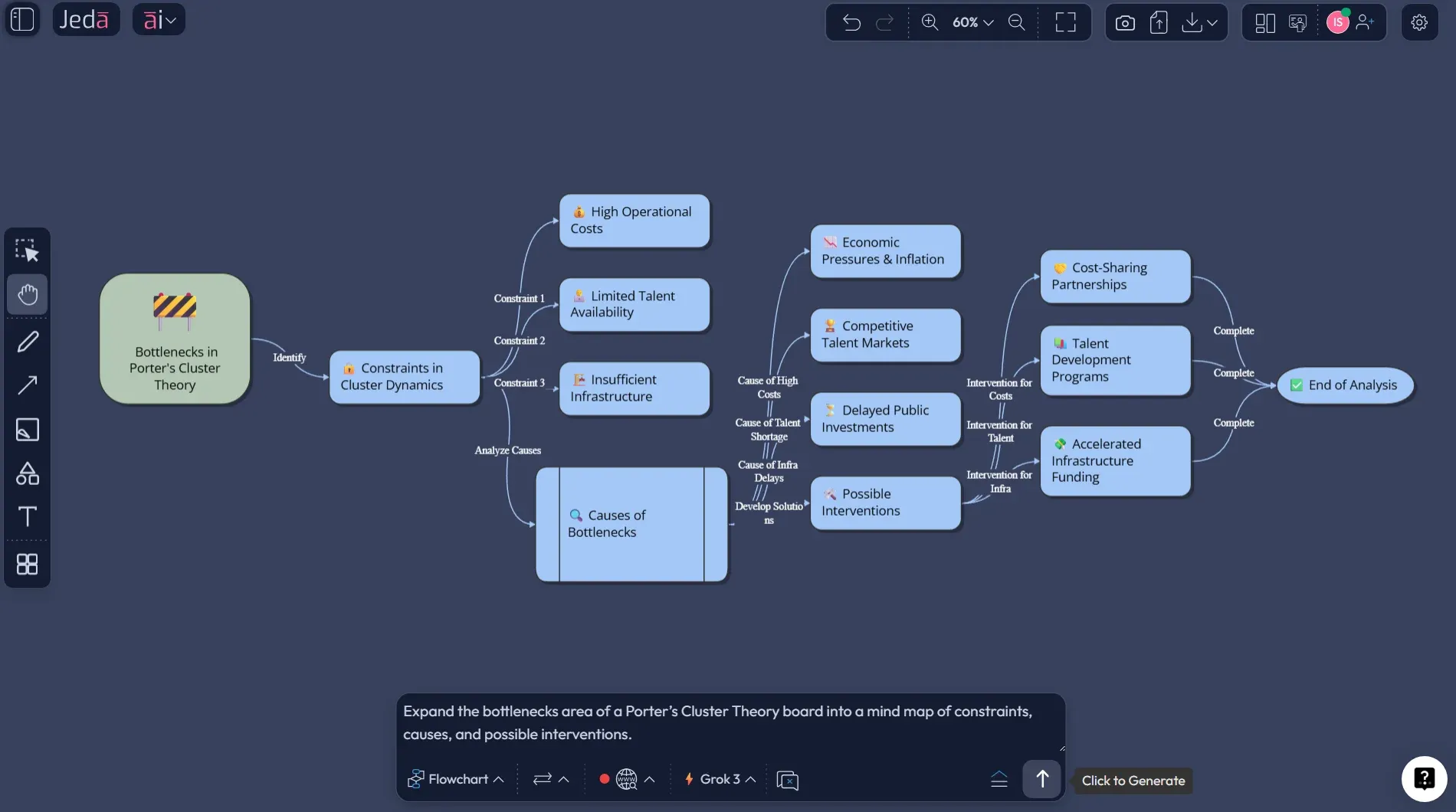
Once the matrix exists, AI+ can extend a bottleneck or opportunity area with more detail, implications, and possible interventions.
- Cross-functional collaboration
Cluster work usually involves multiple stakeholders. Jeda.ai makes it practical to review and refine one shared board rather than trading version-controlled misery over email.
- Easy visual conversion
Start with a matrix for clarity, then convert to a diagram when you need to show ecosystem flows, institutional links, or development pathways.
And there is a strategic bonus. In Jeda.ai, the analysis stays editable. That is not a small detail. Cluster conditions change: talent pipelines shift, anchor firms move, research funding changes, infrastructure improves, adjacent industries appear, demand gets more sophisticated. A cluster board should evolve with those shifts.
How to create Porter's Cluster Theory in Jeda.ai
Method 1: Recipe Matrix
Use the recipe-led matrix when you want a structured cluster assessment that a team can discuss quickly. This is the recommended path for ecosystem mapping, regional competitiveness reviews, and strategy workshops.
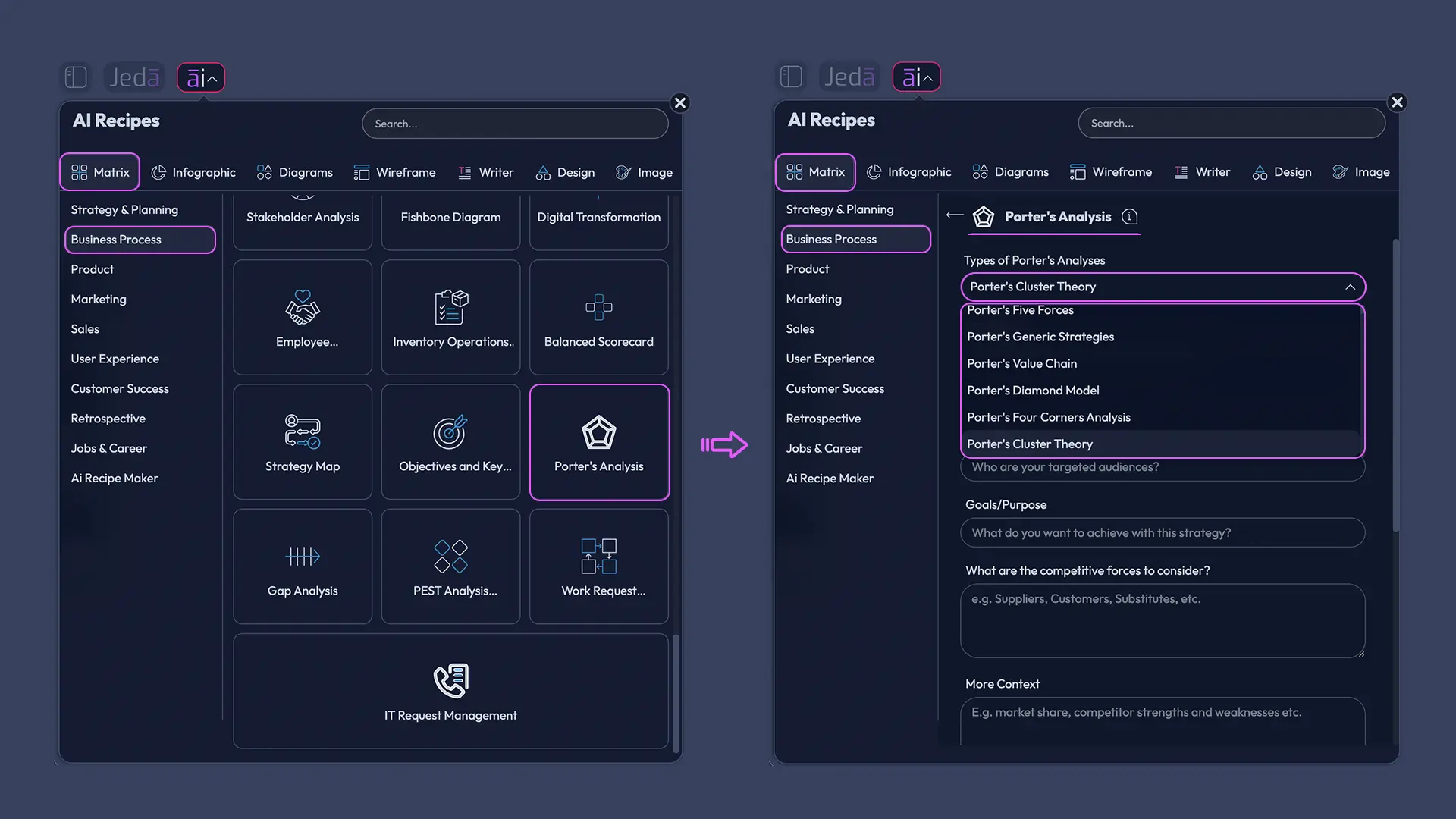
- Open the AI Menu and choose the Matrix recipe
From the canvas, open the AI Menu, go to Matrix Recipes, and select the Porter’s Cluster Theory recipe.
- Define the place, field, and objective
Specify the region, the cluster field, and the reason for analysis. For example: medical devices in Minneapolis–Saint Paul, or EV battery production in the U.S. Midwest.
- Generate the cluster matrix
Ask Jeda.ai to organize the board into core firms, specialized suppliers, service providers, institutions, talent and infrastructure, demand conditions, spillovers, and bottlenecks.
- Validate each cell with evidence
Replace any generic content with observed facts: anchor companies, university programs, logistics assets, regulatory support, customer sophistication, and missing links.
- Add strategic priorities
Turn the matrix from description into action by adding what strengthens the cluster, what weakens it, and which interventions or strategic moves matter most.
- Use the AI+ button to deepen one bottleneck
After the matrix is on canvas, select a weak or high-potential area and use AI+ to extend that section with deeper diagnosis or next-step options. AI+ should extend the existing analysis, not replace the original build.
Method 2: Prompt Bar
The Prompt Bar is better when the cluster question is more specific than a preset recipe can capture.
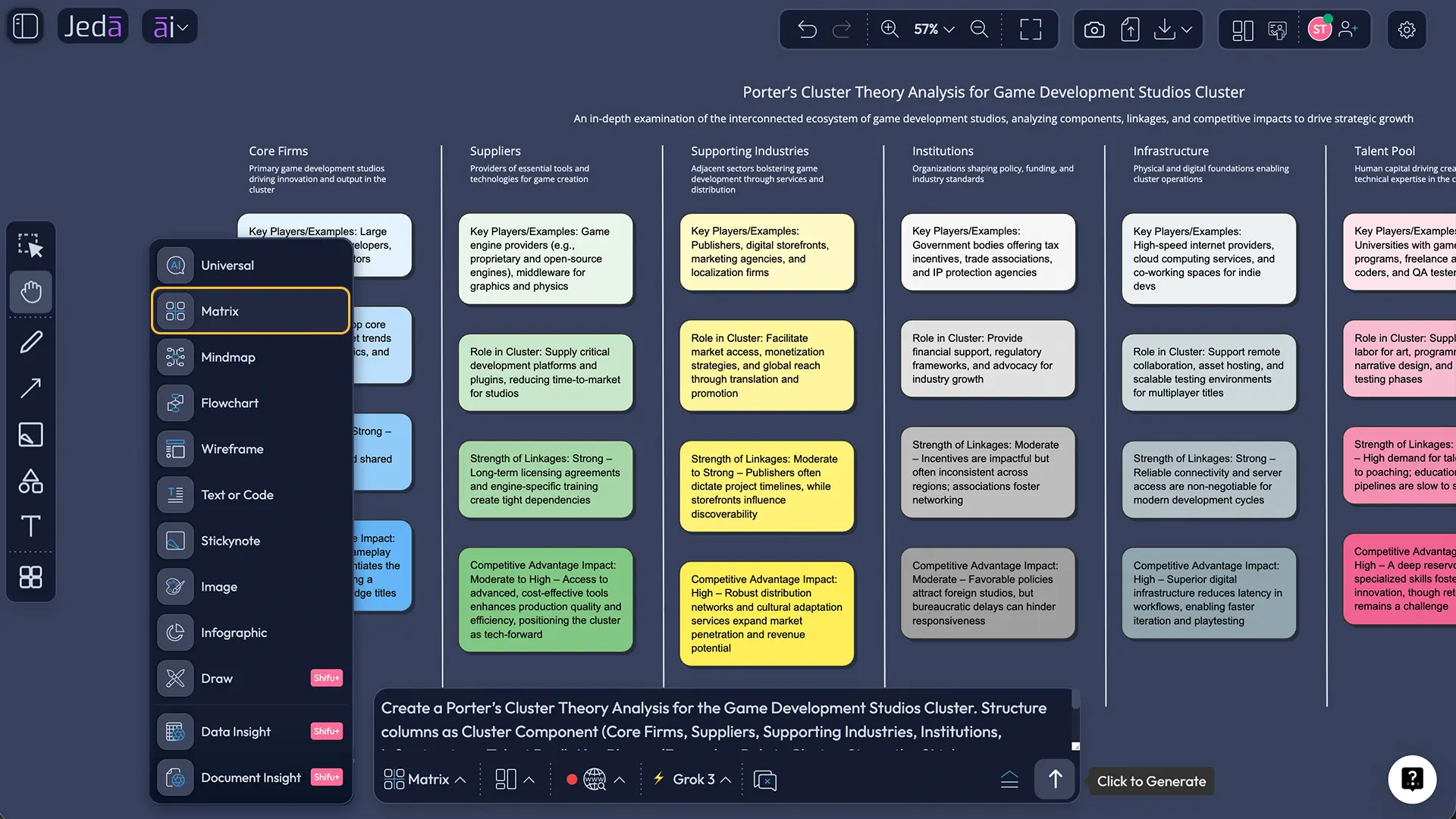
Open the Prompt Bar, select the Matrix command, and try a prompt like this:
Create a Porter’s Cluster Theory analysis for the biotech ecosystem in San Diego. Organize the output into core firms, suppliers, institutions, talent pipeline, infrastructure, demand conditions, spillovers, cluster bottlenecks, and strategic actions.
Then tighten the results. Cluster analysis gets better when you ask whether the ecosystem merely has participants or actually has productive interdependence. Big difference.
After that, you can:
- Use AI+ to extend one bottleneck or opportunity area.
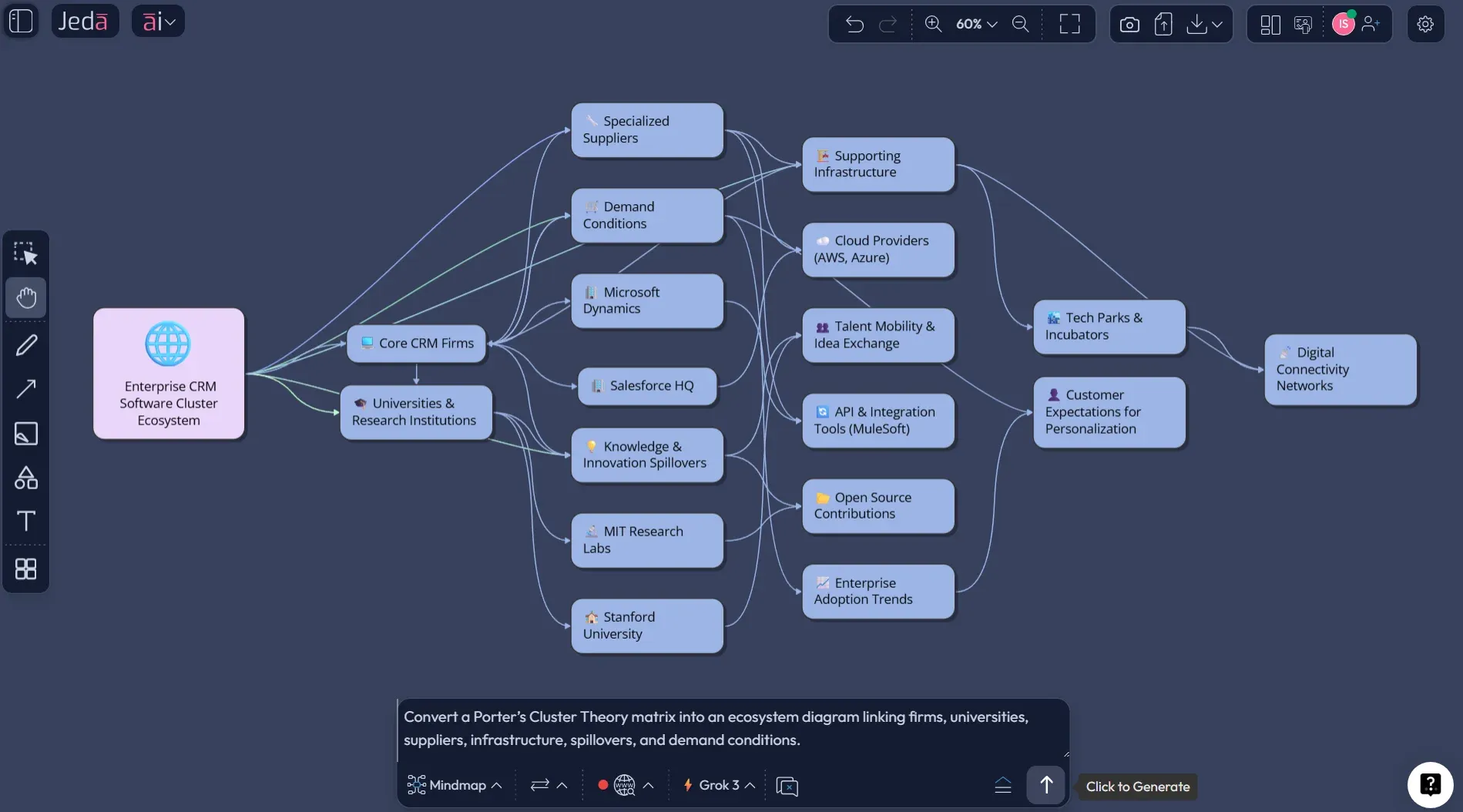
- Use Vision Transform to convert the matrix into a network-style diagram for executive or policy presentation.
What makes a cluster strong?
This is the core strategic question. A strong cluster is not just a concentration of companies. It is a concentration of productive relationships.
A mature cluster tends to show several characteristics at once:
Interconnected firms
Not simply competitors, but related firms that also learn from shared context, specialized services, talent flows, and demand conditions.
Specialized suppliers and services
Clusters get stronger when suppliers, legal specialists, logistics partners, tooling providers, researchers, and technical service firms are present and responsive.
Institutions that matter
Universities, labs, training centers, associations, standards bodies, accelerators, testing facilities, and public agencies can all strengthen cluster performance when they are relevant and aligned.
Skilled labor and infrastructure
Specialized talent pools, transport access, digital infrastructure, lab space, manufacturing capacity, and regulatory support often determine whether the cluster compounds or stalls.
Sophisticated demand and knowledge spillovers
Demanding customers push firms to improve. Proximity also helps ideas spread faster, whether through labor movement, supplier interaction, shared forums, or informal networks.
Porter's Cluster Theory template and worked example
Let’s use a concrete case. Suppose a team is assessing the San Diego biotech cluster.
A useful matrix in Jeda.ai might include:
- Core firms: biotech startups, platform companies, diagnostics firms, and scaled life-science players
- Suppliers and services: lab equipment vendors, CROs, legal specialists, clinical support, data infrastructure
- Institutions: UC San Diego, research institutes, incubators, hospitals, public-private development organizations
- Talent and infrastructure: research talent, lab space availability, translational funding, transport access, regulatory expertise
- Demand conditions: strong healthcare and research demand, sophisticated buyers, commercialization pressure
- Spillovers: scientific collaboration, founder networks, labor mobility, informal knowledge exchange
- Bottlenecks: wet-lab scarcity, funding gaps for scale-up, long commercialization cycles, regulatory friction
- Strategic actions: expand lab capacity, strengthen translational partnerships, improve later-stage financing access, deepen clinical-commercial linkages
Now the board becomes actionable.
A strategy consultant might use the matrix to advise an entrant on where to plug into the cluster. A business leader might use it to assess location attractiveness. A regional development team might use it to identify weak links rather than throwing generic incentives at the whole ecosystem. Same theory. Different decision contexts.
And because this is inside Jeda.ai, you can go one step further. Select the bottlenecks area and use AI+ to deepen it. Then convert the board into a Diagram to show how missing lab space, talent competition, or limited growth capital affects the ecosystem over time. That is much more persuasive than a flat list of “pros and cons.”
There is also a sequencing benefit here. A matrix makes weak links visible before the team jumps into storytelling. That means stakeholders can argue about evidence first, then argue about recommendations. It sounds mundane. It is not. That order alone prevents a lot of ecosystem strategy work from sliding into vague optimism.
Best practices and tips
Cluster analysis gets stronger when the unit of analysis is clear and the ecosystem boundaries are honest. Do not inflate a region into a cluster just because the branding sounds nice.
Also, bring a little skepticism. Cluster language is popular because it sounds strategic. That does not mean every regional ambition deserves the label.
Common mistakes to avoid
The first mistake is treating a cluster as a simple industry inventory. A list of firms is not a cluster analysis.
Second, teams focus only on firms and ignore institutions. That misses a huge part of Porter’s logic. Universities, research centers, training systems, public agencies, and specialized intermediaries often shape the cluster’s performance as much as the firms themselves.
Third, the analysis becomes descriptive and static. That is one of the main criticisms in the literature. If the board explains what the cluster looks like but not how it emerged, where it is weakening, or how it might evolve, it remains incomplete.
Fourth, policy or strategy teams jump too fast to intervention. They decide the solution before diagnosing the actual bottleneck. More funding, more branding, or more incentives may not solve the real issue.
And finally, people confuse any dense urban economy with a cluster. Proximity helps. But without meaningful linkages and specialization, it is just proximity.
Frequently Asked Questions
- What is Porter's Cluster Theory?
- Porter’s Cluster Theory explains how geographic concentrations of interconnected firms and institutions can raise productivity, stimulate innovation, and support new business formation in a specific field.
- How is cluster theory different from the Porter Diamond?
- The Diamond explains broader conditions behind competitive advantage. Cluster theory focuses more specifically on the localized ecosystem itself: the firms, institutions, suppliers, linkages, and spillovers inside a field.
- What counts as a cluster?
- A cluster is more than a group of firms in the same sector. It includes interconnected companies, suppliers, service providers, institutions, talent pipelines, and supporting infrastructure that create real competitive benefits through proximity.
- Why does geography still matter in a global economy?
- Geography still matters because proximity can improve knowledge exchange, labor matching, supplier specialization, trust, collaboration, and innovation speed. Those local advantages can remain powerful even when markets are global.
- Can Porter's Cluster Theory be used for business strategy?
- Yes. Firms use cluster theory for location decisions, partnership strategy, market-entry analysis, innovation sourcing, and ecosystem positioning. It is also widely used in regional development and industrial policy work.
- How does AI help with cluster analysis?
- AI helps structure the ecosystem quickly, surface missing actors, organize bottlenecks, and test relationships across firms, institutions, demand, and infrastructure. In Jeda.ai, the result remains visual and editable.
- Which Jeda.ai command should I use for Porter's Cluster Theory?
- Start with the Matrix command or the Matrix recipe because it creates a clear ecosystem structure. If you want to show relationships and flows afterward, convert the result into a Diagram using Vision Transform.
- Can AI+ build the whole cluster analysis from scratch?
- AI+ is best used after the first analysis is already on canvas. Build the initial matrix first, then select a section and use the AI+ button to extend that part of the board.
- What are common weaknesses in a cluster?
- Common weaknesses include thin supplier depth, weak university-industry links, lack of specialized talent, infrastructure limits, weak commercialization support, shallow funding, and poor coordination among key institutions.
- Is Porter's Cluster Theory ever criticized?
- Yes. Critics have argued that cluster theory can be descriptive, static, and difficult to operationalize. That criticism is useful because it reminds teams to analyze evolution, relationships, and measurable bottlenecks rather than rely on loose branding.
Sources & Further Reading
- [1]
Porter, Michael E. (1990) . “The Competitive Advantage of Nations” Harvard Business Review.
View Source ↗ - [2]
Porter, Michael E. (1998) . “Clusters and the New Economics of Competition” Harvard Business Review / Harvard Business School Faculty & Research.
View Source ↗ - [3]
Porter, Michael E. (2000) . “Location, Competition, and Economic Development: Local Clusters in a Global Economy” Economic Development Quarterly / Harvard Business School Faculty & Research.
View Source ↗ - [4]
Delgado, Mercedes, Michael E. Porter, and Scott Stern (2012) . “Clusters, Convergence, and Economic Performance” NBER Working Paper 18250.
View Source ↗ - [5]
Motoyama, Yasuyuki (2008) . “What Was New About the Cluster Theory?” Economic Development Quarterly.
View Source ↗ - [6]
Porter, Michael E. (2007) . “Clusters and Economic Policy: Aligning Public Policy with the New Economics of Competition” Institute for Strategy and Competitiveness, Harvard Business School.
View Source ↗ - [7]
GIZ (2021) . “Cluster Development Guide: A Practitioners Guide for Cluster Policy, Strategy and Implementation” Deutsche Gesellschaft für Internationale Zusammenarbeit.
View Source ↗
Start Your Porter's Cluster Theory Analysis Today
Join 150,000+ users who use Jeda.ai to map regional advantage, innovation bottlenecks, and ecosystem strategy inside one AI Workspace.
Try Free Template