Agentic AI for MBA Instructors gives business faculty a cleaner way to teach messy case work: build the team, assign the skills, approve the plan, and let specialist agents work through the case inside Jeda.ai. This release turns the Jeda.ai AI Workspace into a more structured teaching environment for strategy, finance, competitive analysis, valuation, and class-ready business output OS. Not one chatbot trying to sound like the whole consulting team. An actual workflow.
Jeda.ai already supports 150,000+ users working across an Interactive AI Whiteboard, Visual AI Workspace, file intelligence, and 300+ strategic frameworks. Agentic AI adds a new operating layer on top of that: expert roles, reusable skills, team sandboxing, task delegation, Orchestrator planning, human approval, and final outputs students can critique instead of blindly accepting.
- Specialist AI teams
Create or select worker agents for business model analysis, finance, competition, research, data interpretation, and review.
- Instructor-approved plans
The Orchestrator proposes a step-by-step execution plan before agents begin, so the workflow can be discussed, revised, or approved.
- Class-ready outputs
Turn MBA case work into structured text, presentation-style outputs, recommendations, and visual analysis that students can debate.
What Is New in Jeda AI Agentic AI?
Jeda AI Agentic AI introduces a workflow where instructors and teams can create skills, build worker agents, assemble an agent team, delegate a business objective, review the Orchestrator's execution plan, and generate final outputs. The workflow shown in the product demo uses a fictional Dummy-Cola business analysis example, with agents evaluating the business model, synthetic 10-K style financials, competition, and equity valuation.
That example is fictional. The workflow is the point.
For MBA instructors, Agentic AI for MBA Instructors turns a case into a live operating system for business reasoning. For consultants, it divides client analysis into specialist workstreams. For decision makers, it creates a visible path from evidence to recommendation. The best part is not the answer at the end; it is the structured work students can inspect along the way.
Why One AI Is Not Enough for MBA Case Work
MBA case work is not a clean Q&A exercise. A good case discussion asks students to test business model logic, question assumptions, read financial signals, evaluate competitors, consider strategic options, and defend a recommendation under uncertainty.
One broad AI response can sound polished. That is the trap. Polished is not the same as rigorous.
Agentic AI gives business education instructors a better structure inside the Jeda.ai AI Workspace. For example - A Business Model Analyst can inspect value creation. A Financial Analyst can review financial signals. A Competitive Analyst can look at market pressure. A Research Analyst can expand context. A Data Agent can support evidence-based interpretation. Then the Orchestrator coordinates the path toward a final output.
| Work style | Instructor control | Teaching value | Output quality | |
|---|---|---|---|---|
| Single AI chat | One broad response | Limited | Hard to inspect | Often polished but shallow |
| Jeda.ai Agentic AI | Specialist agents plus Orchestrator | Plan review and approval | Visible reasoning path | Structured, role-based, and easier to critique |
The goal is not to replace the business studies instructors. Please, no. The goal is to give the instructor a stronger Agentic AI Whiteboard for guided business reasoning, where students see how expert roles and analytical methods shape the answer.
Start With Skills: Define How Each Agent Thinks
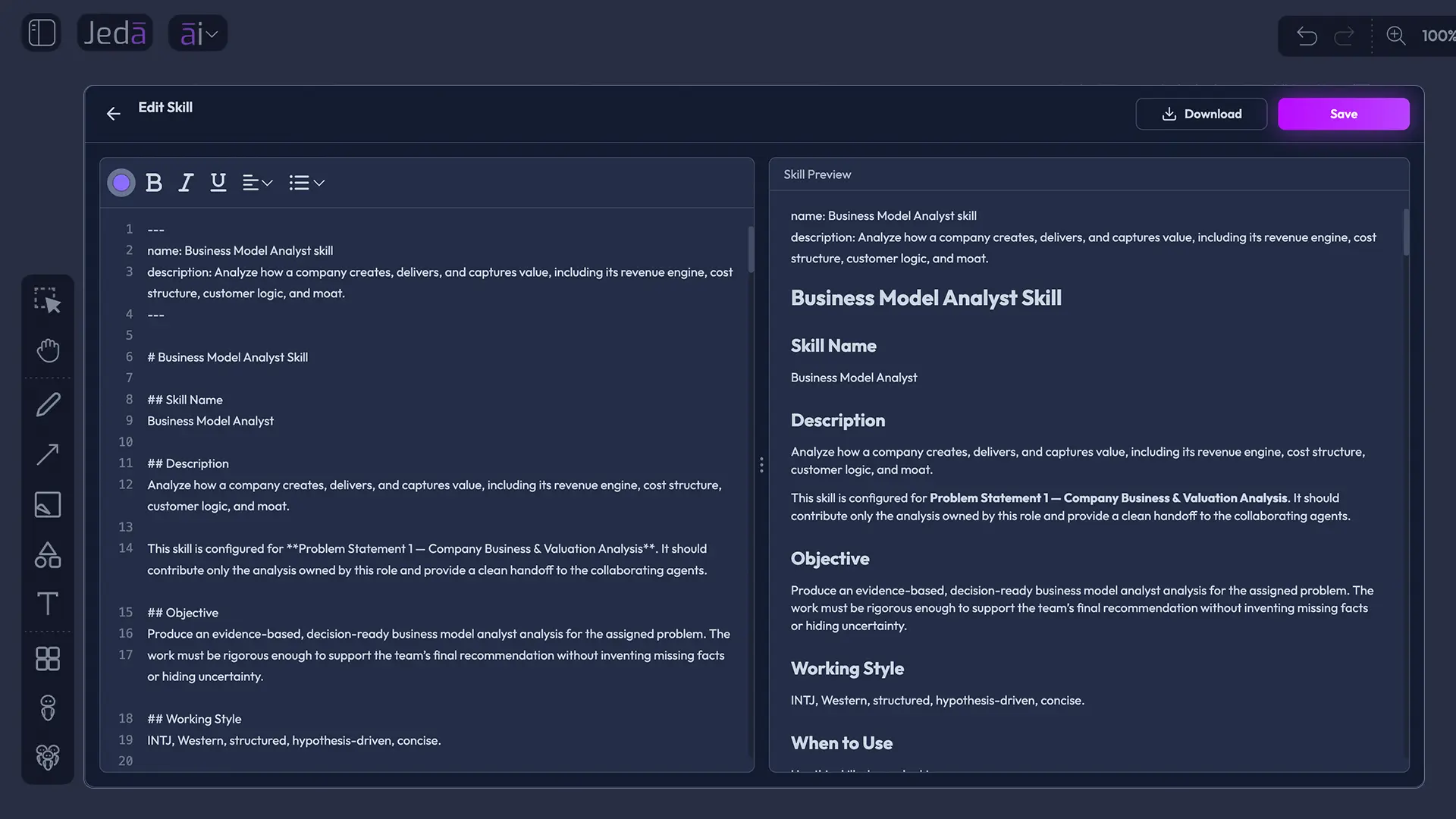
Skills are the starting point. In Jeda.ai, a skill defines how an agent approaches a task, what method it follows, what evidence it should consider, and what kind of output it should produce. In a business classroom, that is where the learning design gets interesting.
An instructor can write a new skill, upload an existing skill, edit and save a skill, or browse built-in skills. That means the method can be encoded once, reused across cases, and refined over the semester. Business model analysis, MOAT review, valuation review, stakeholder mapping, go-to-market evaluation, strategic risk analysis — each can become a reusable skill instead of a prompt students keep reinventing badly at midnight.
Create Worker Agents for Specialist Business Roles
After skills are ready, users create worker agents. In the demo, Jeda.ai creates a Business Model Analyst, adds a role description, configures the essentials, and attaches the business-model-analysis skill. That turns a generic AI interaction into a specialist role.
For MBA teaching, this is a big shift. Instead of telling one AI to analyze the entire case, the instructor can assign work to a small analytical team. Let the Business Model Analyst inspect value logic. Let the Financial Analyst evaluate the numbers. Let the Competitive Analyst examine external pressure. Let the Orchestrator coordinate the final recommendation.
That is closer to how real strategy teams operate. It also creates better classroom questions: Were the right roles selected? Did the agents use the right evidence? Did the team miss a lens? Should there have been a skeptical reviewer? Suddenly the AI workflow itself becomes part of the discussion.
Use Built-In Agents When You Need Speed
Not every instructor wants to create a full agent library before class. Fair. Course prep already has enough tabs open to qualify as a fire hazard.
Jeda.ai also includes built-in agents for common business workflows. The demo references ready-to-use specialists such as Financial, Competitive, Data, and Research Analysts. These reduce setup time while still giving users a structured workflow instead of a blank prompt box.
Built-in agents are useful for faculty workshops, MBA cohorts, consulting prep, and internal decision sessions where speed matters. A strategy professor may start with built-in agents for the first case, then create custom skills as the course deepens. A consultant may use the built-in team for discovery analysis, then customize roles for a client-specific project.
Assemble the Agent Team in the Team Sandbox
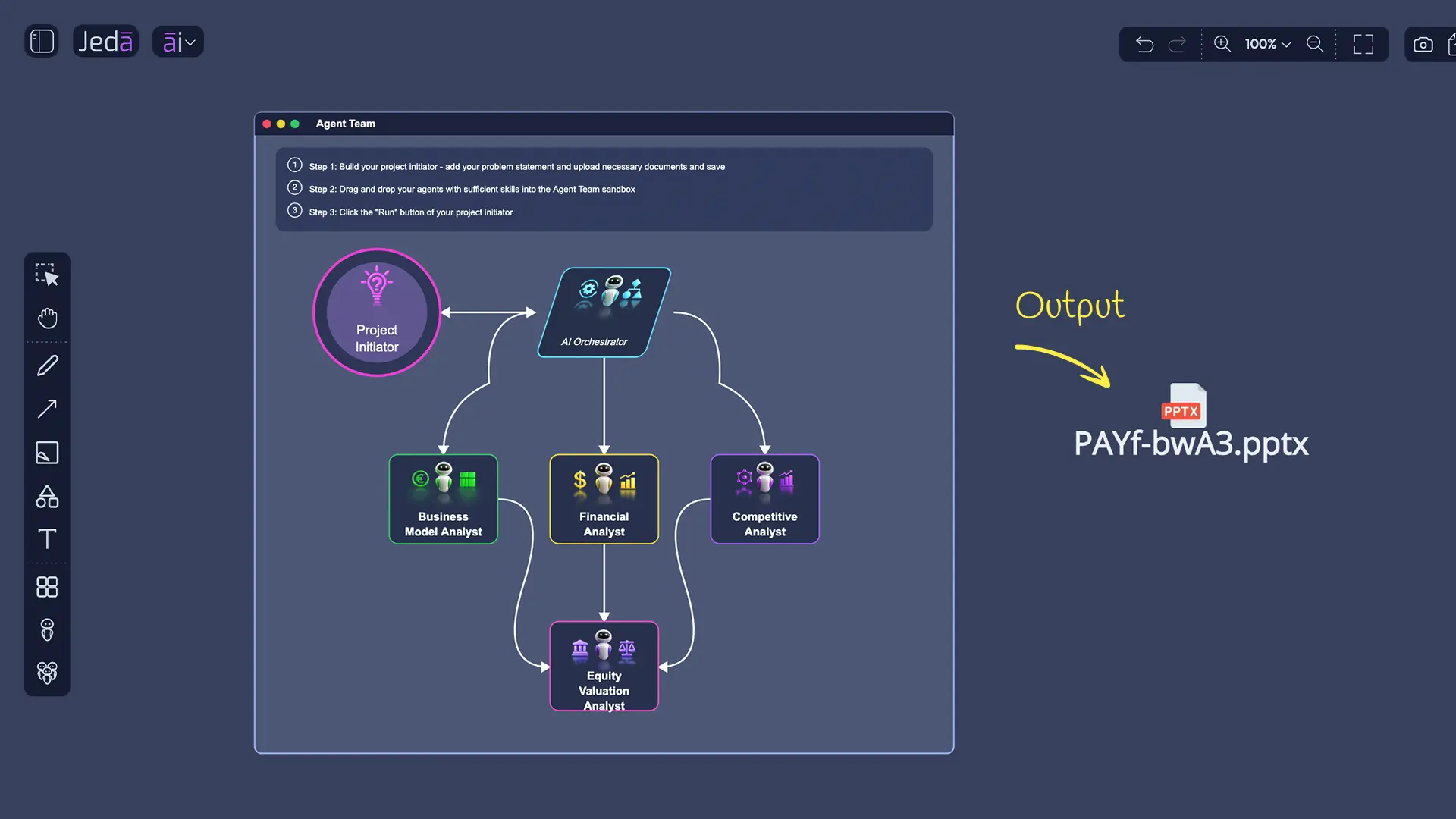
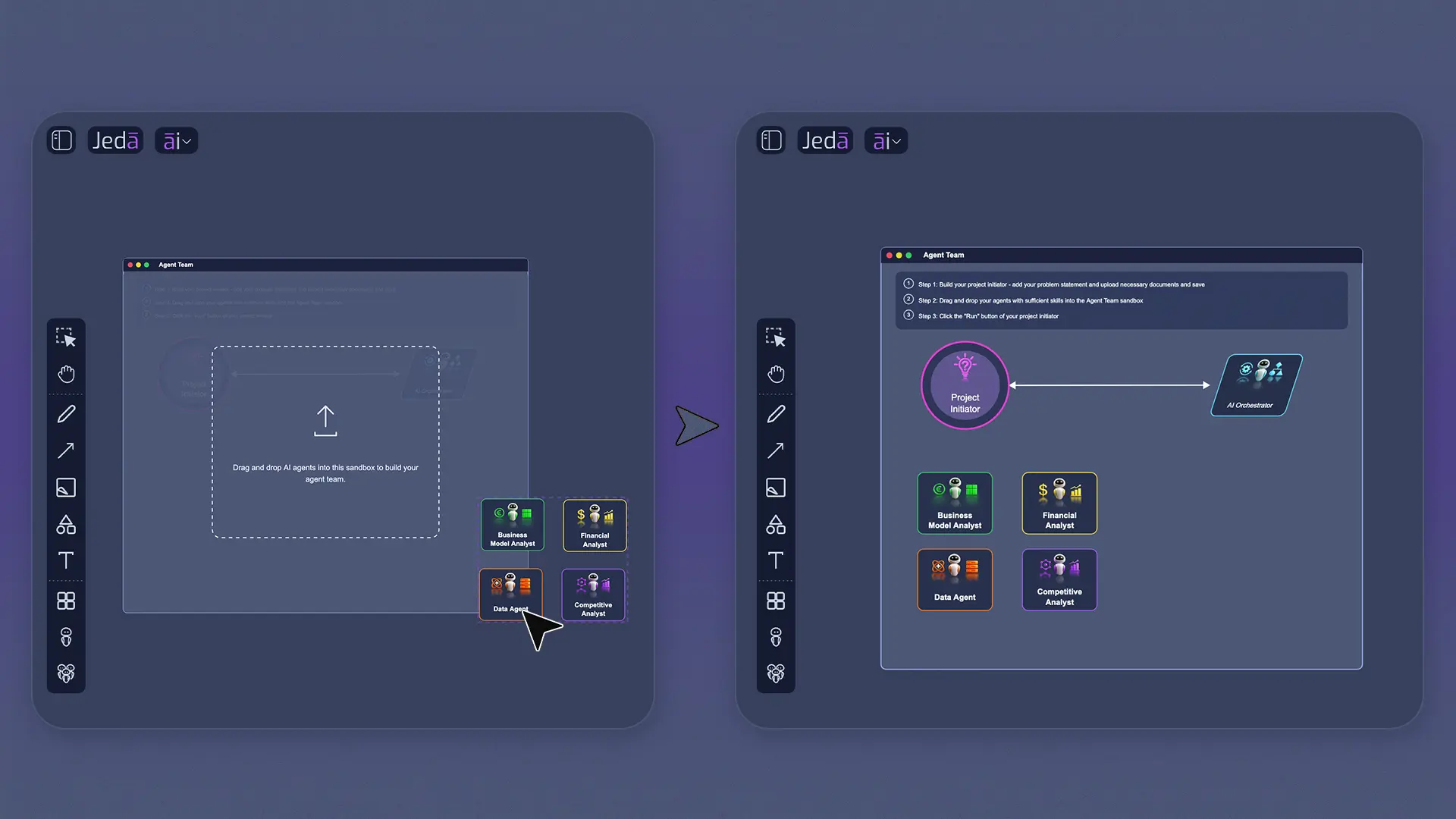
Once agents are selected, users create an Agent Team and drag agents into the Team Sandbox. Only agents inside that sandbox participate in the workflow. That small constraint does real teaching work.
A finance-heavy case may need valuation, accounting, and risk agents. A strategy case may need business model, competition, and market research agents. A product case may need user research, UX, go-to-market, and prioritization roles. In Jeda.ai, the team composition is visible, so students can critique it before the workflow begins.
Classroom Prompt "Before running the task, ask students which expert is missing. A risk reviewer? A customer analyst? A skeptical CFO? This turns agent selection into a quick but useful strategy discussion."
Delegate the Case Objective and Attach Evidence
After the team is assembled, the user gives the Project Initiator the problem. In the Dummy-Cola demo, the task is to evaluate the current business model, review a synthetic 10-K style financial report, run competitive analysis, and assess equity valuation.
Users can add instructions, context, and supporting files. That matters for MBA teaching because a case can include PDFs, financial notes, research briefs, spreadsheet data, or instructor-provided assumptions. Jeda.ai also separates file scope: task-level files are shared across the team, while files attached directly to an individual agent remain within that agent's scope.
This gives instructors more control over the evidence environment. A finance agent can receive the synthetic financial report. A competitive analyst can receive market notes. The whole team can receive the case prompt. The AI Workspace becomes a structured case room rather than a single chat thread with everything dumped into it.
- Case files
Upload PDFs, notes, reports, or supporting documents so the agent team works from shared evidence.
- Data context
Add spreadsheets or synthetic financial data when the case requires evidence-backed interpretation.
- Scoped access
Keep some files available to the whole task and others attached only to specific agents when needed.
Choose the Output Format and AI Model
Before running the workflow, users choose the final output format and select the AI model. For MBA instructors, that means a case can become a discussion brief, a strategy recommendation, a valuation summary, a competitive analysis output, or a class-ready presentation structure.
Jeda.ai already supports an AI Whiteboard where generated outputs can become editable visual structures. Agentic AI adds the team logic that gets the work there. Instead of leaving analysis trapped in one long chat response, the workflow can produce something students can review, challenge, and refine.
Review the Orchestrator Plan Before Work Begins
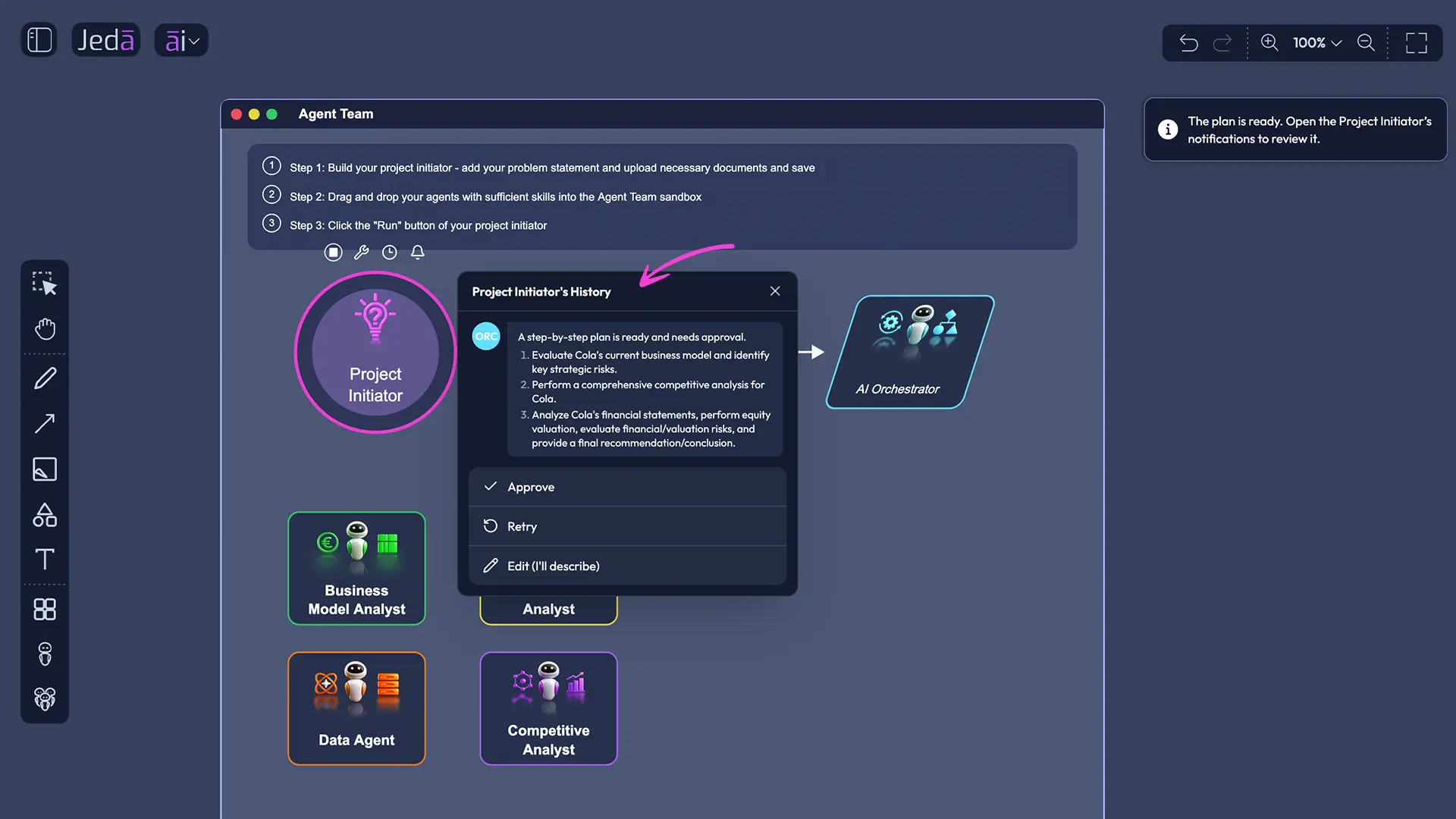
The Orchestrator is the control layer. Before the agents begin work, it inspects the team and creates a multi-step execution plan. Users can review that plan, then approve, reject, or recreate it.
This is where the workflow gets serious.
Nothing in a business education or consulting context should run blindly. The instructor, consultant, or decision maker needs to see the plan first. Is the sequence logical? Are the right agents assigned? Is the task too broad? Are there missing skills? Would a real consulting team structure the work this way?
- Create or choose the skills
Use the Skills area to write, upload, edit, save, or select built-in skills for the methods you want agents to follow.
- Create specialist worker agents
Build agents such as Business Model Analyst, Financial Analyst, Competitive Analyst, Research Analyst, or Data Agent, then attach the right skills.
- Assemble the Agent Team
Create an Agent Team and drag only the selected agents into the Team Sandbox so the scope of participation is clear.
- Delegate the business objective
Use the Project Initiator to enter the case objective, add instructions, and attach relevant files or context.
- Choose the output format and model
Select the desired final output style, choose the AI model, and prepare the workflow for execution.
- Review the Orchestrator plan
Inspect the proposed execution steps, agent assignments, and sequencing before any agent begins work.
- Approve, reject, or recreate
Approve the plan when it fits the case, reject it when the workflow is wrong, or recreate it when the team needs a better path.
- Use the result as a teaching artifact
Bring the final output into class discussion, ask students to critique the assumptions, and use AI+ to extend weak sections when needed.
Agentic Execution: Handoffs, Coordination, and Gap Detection
Once the plan is approved, the Orchestrator sets the pathway, delegates tasks, manages handoffs, reviews work, and coordinates the workflow toward the final objective. If the team lacks the required skills or agents, the Orchestrator can flag the gap instead of pretending everything is fine.
That matters. A lot.
Weak AI systems fake confidence. Better systems expose missing context, weak team design, and unsupported conclusions. For consultants, that protects client work. For decision makers, it reduces false certainty. For MBA cohorts, it teaches a practical lesson: knowing what the system cannot do is part of good judgment.
What MBA Instructors Gain
Agentic AI for MBA Instructors gives faculty a way to turn cases into visible workflows. Students can see expert roles, task decomposition, plan approval, evidence scope, specialist analysis, handoffs, and final synthesis. That is far more useful than showing them one polished AI answer.
Instructors can use the workflow to teach business model analysis, finance interpretation, strategic positioning, valuation, market entry, competitive strategy, and board-style recommendations. The Jeda.ai AI Workspace also keeps the work visual, so a class can discuss not only the conclusion but the operating structure behind the conclusion.
What Consultants and Decision Makers Gain
This release is framed for MBA instructors, but the workflow has obvious value beyond the classroom. Consultants can use agent teams to break client problems into workstreams, assign specialist perspectives, review execution plans, detect gaps, and generate structured outputs. Decision makers get a clearer view of how a recommendation was formed before it reaches the room.
That is the real value of an agentic AI Workspace. It does not just make content faster. It makes the work more inspectable.
Jeda.ai becomes the place where the question, evidence, team design, plan, execution, and output live together. Not scattered across chat logs, slides, spreadsheets, and someone's “final_v7_really_final” document. We have all been there. Nobody came out stronger.
How This Fits the Jeda.ai AI Workspace
Jeda.ai is already designed as a framework-native, visual-first workspace for strategy, design, innovation, and collaboration. Agentic AI extends that direction by letting users build teams of AI specialists instead of relying on one response from one model.
The AI Whiteboard gives instructors and teams a canvas for visual thinking. Document and data workflows bring evidence into the process. Matrix, Mindmap, Flowchart, Diagram, and other visual outputs help structure the work. Agentic AI now adds role-based collaboration between AI agents, with the Orchestrator keeping the work aligned to the objective.
- Role-based reasoning
Move from one generic prompt to specialist agents with defined responsibilities and reusable skills.
- Visible orchestration
Review the plan before execution so the workflow can be approved, rejected, or recreated.
- Editable visual outputs
Use the AI Whiteboard to inspect, revise, extend, and transform outputs after the agent team completes the work.
Practical Classroom Use Cases
Agentic AI for MBA Instructors works especially well when the case requires more than summary. Use it when students need to compare viewpoints, defend assumptions, work from files, or prepare a final recommendation.
Good classroom fits include business model review, competitive strategy, valuation debate, financial health assessment, market entry, M&A logic, product portfolio review, go-to-market strategy, and strategy presentation prep. For each case, the instructor can decide which agents belong in the team and which skills define their analytical behavior.
Final Take: Agentic AI Belongs in the MBA Classroom
Agentic AI for MBA Instructors gives Jeda.ai users a more realistic way to teach, analyze, and present complex business work. Build the team. Set the goal. Review the plan. Approve the workflow. Study the result.
This is not AI chaos. It is orchestrated AI work with instructor control.
For MBA instructors, it creates a deeper classroom experience. For consultants, it creates a faster path to structured client analysis. For decision makers, it creates more visible reasoning before action. And for students, it shows that AI-supported work is not about getting the quickest answer. It is about building a better reasoning process.
Jeda.ai brings that process onto one AI Workspace: specialist agents, structured plans, evidence-aware execution, and editable Visual AI outputs on the AI Whiteboard. That is a smarter way to teach business with AI. And yes, it is much less chaotic than asking one chatbot to cosplay as a full strategy team.
Frequently Asked Questions
- What is Agentic AI for MBA Instructors?
- Agentic AI for MBA Instructors is a Jeda.ai workflow that lets faculty create specialist AI agents, assign skills, assemble an agent team, review an Orchestrator plan, and generate structured outputs for MBA case teaching and discussion.
- How is Agentic AI different from using one AI chatbot?
- A single chatbot gives one broad response. Agentic AI divides the work across specialist agents, lets the Orchestrator coordinate the workflow, and gives instructors a plan to review before execution. That makes the reasoning process easier to inspect.
- Can instructors use Agentic AI with MBA case materials?
- Yes. Instructors can add context and supporting files to the task. Files uploaded to the task can be shared with the team, while files attached to a specific agent can remain scoped to that agent's work.
- What kinds of agents can be used for MBA case analysis?
- Common agents include Business Model Analyst, Financial Analyst, Competitive Analyst, Research Analyst, Data Agent, risk reviewer, and strategy synthesizer. Instructors can use built-in agents or create custom worker agents with their own role descriptions and skills.
- What does the Orchestrator do in Jeda.ai Agentic AI?
- The Orchestrator reviews the selected team, creates a multi-step execution plan, assigns work to agents, manages handoffs, detects gaps, and coordinates the workflow toward the final objective. Users can approve, reject, or recreate the plan before execution.
- Why is the Team Sandbox important?
- The Team Sandbox defines which agents participate in the workflow. Only agents placed inside the team are active, giving instructors clear control over analytical scope and making team design visible for classroom critique.
- Can this workflow generate presentation-style outputs?
- Yes. The demo shows users choosing final output formats such as text or presentation-style results. The key benefit is that agentic work can become a structured teaching artifact, not just a long answer hidden in a chat thread.
- How does this fit with the Jeda.ai AI Whiteboard?
- The AI Whiteboard gives teams a visual canvas for analyzing, editing, extending, and transforming outputs. Agentic AI adds specialist roles and orchestration, while the workspace keeps the reasoning process visible and easier to discuss.
- Is Agentic AI only for MBA instructors?
- No. MBA instructors are a strong use case because case teaching depends on structured reasoning. Consultants, strategy teams, business analysts, decision makers, and innovation teams can also use agent teams for complex business analysis.
- How many users use Jeda.ai?
- Jeda.ai supports 150,000+ users across visual AI workflows, including AI Workspace, AI Whiteboard, framework generation, file intelligence, collaboration, and structured business analysis use cases.
Sources and Further Reading
- [1]
Harvard Business School Christensen Center (n.d.) . “Teaching by the Case Method” Harvard Business School.
View Source ↗ - [2]
Porter, Michael E. (1979) . “How Competitive Forces Shape Strategy” Harvard Business Review.
View Source ↗ - [3]
AACSB International (2026) . “A Framework for Artificial Intelligence in Business Education” AACSB Insights.
View Source ↗ - [4]
McKinsey Global Institute (2023) . “The Economic Potential of Generative AI: The Next Productivity Frontier” McKinsey & Company.
View Source ↗
Teach MBA Cases With Agentic AI
Join 150,000+ users building strategy workflows, visual analysis, and AI Workspace outputs in Jeda.ai.
Try Jeda.ai Free