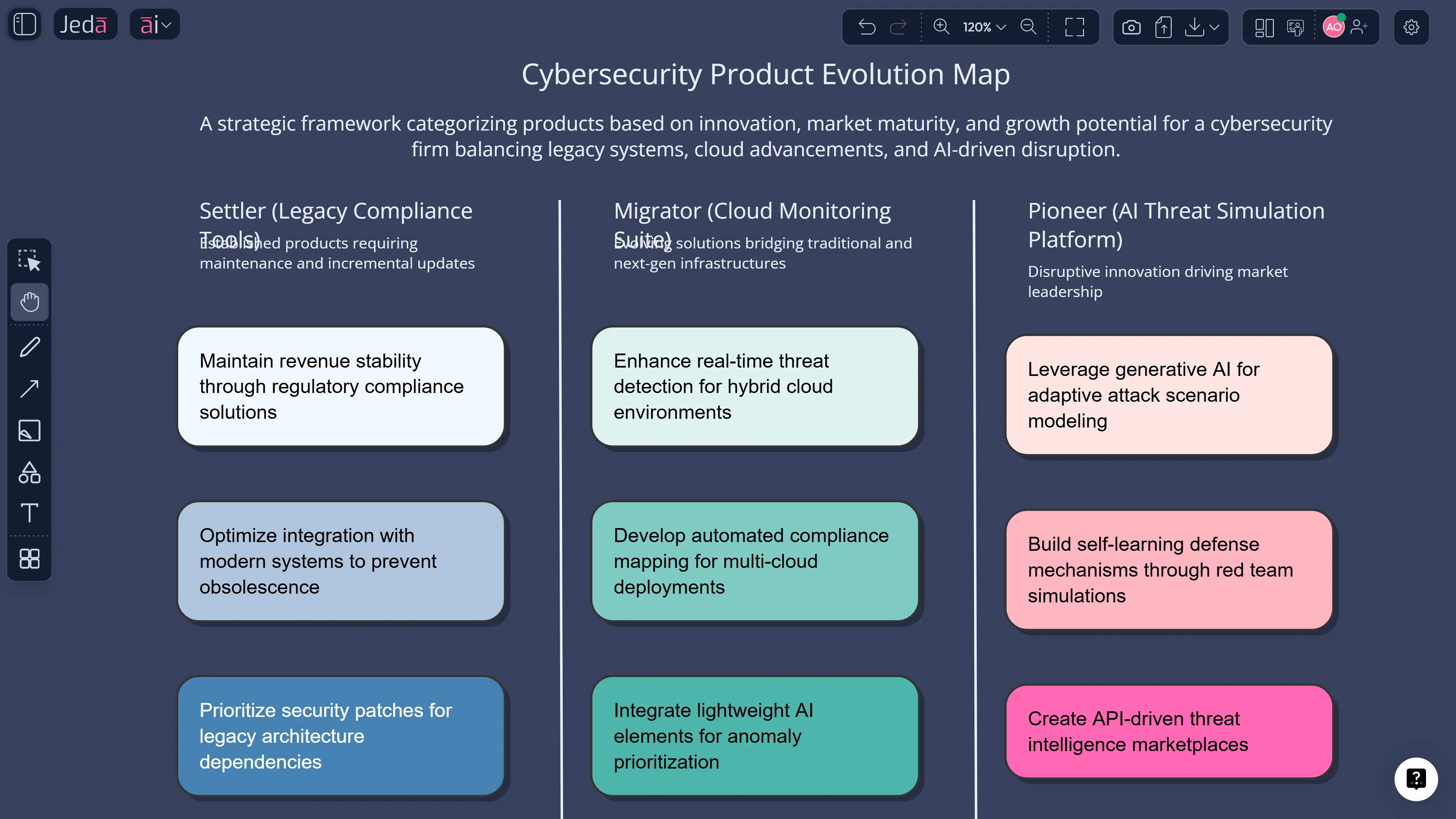
Growth portfolios get romanticized. Leaders talk about innovation, adjacency, and reinvention, but the actual portfolio usually tells a less flattering story. A few solid legacy offers. A handful of better-but-familiar upgrades. One or two bets that might genuinely change the company’s future. The pioneer-migrator-settler map is useful because it cuts through the theater. It shows, in one view, whether your growth story is mostly habit wearing a strategy costume.
Chan Kim and Renée Mauborgne created the Pioneer-Migrator-Settler Map as a Blue Ocean portfolio tool for plotting current and planned offerings according to the innovative value they create for buyers. Their premise is blunt: settlers are me-too businesses, migrators are better-than-average offerings, and pioneers offer unprecedented value and become the strongest engines of profitable growth. In Jeda.ai, an AI Workspace and AI Whiteboard built for structured strategic thinking, that logic becomes much easier to map, challenge, and update.
Because Jeda.ai brings 300+ strategic frameworks into one Visual AI environment and is used by 150,000+ users, the map does not have to live as a dead slide. It can sit beside your Strategy Canvas, Four Actions Framework, and noncustomer analysis on the same board, which is where the real strategic work usually begins.
What is a Pioneer-Migrator-Settler Map?
A Pioneer-Migrator-Settler Map is a portfolio view that sorts offerings into three buckets based on the degree of buyer value they create. Kim and Mauborgne describe settlers as me-too businesses, migrators as offerings better than most in the market, and pioneers as offerings with unprecedented value. That sounds tidy. It is also revealing.
The point is not to insult your settled business. Settlers often fund the rest of the portfolio. The point is to stop pretending that incremental product upgrades and category-leading growth engines are the same thing. They are not. A portfolio heavy with settlers can still produce revenue. It is just strategically exposed.
That is why the map matters. It gives executives, founders, product leaders, and strategy consultants a quick way to test whether the organization’s future growth is being built or merely narrated. In Jeda.ai, you can turn that portfolio discussion into an editable matrix inside an AI Workspace, annotate each offering, compare current and planned initiatives, and use the same AI Whiteboard to debate where new blue ocean moves should come from.
Why use a Pioneer-Migrator-Settler Map with AI?
Because portfolio discussions are often too verbal and too polite.
A leadership team says it has an innovation pipeline. Product says the roadmap contains bold bets. Finance says the core business still carries the numbers. Everyone is partly right, which means the conversation can drift for hours without landing anywhere useful. AI helps because it can turn a messy product list into a categorized first draft that the team can argue with instead of building from scratch.
In Jeda.ai, AI can help classify offerings by buyer value, spot where the company is overweight on settlers, and propose a cleaner portfolio view for planning. Then the human team does the strategic part: challenge the assumptions, re-sort borderline cases, and decide where to focus blue ocean effort.
- See the portfolio honestly
Turn a vague innovation story into a visible portfolio map showing which offerings are settlers, migrators, and pioneers.
- Draft faster with AI
Use AI to group offerings, summarize buyer value, and create a first-pass map before the workshop burns half its energy on formatting.
- Compare current and planned moves
Build an as-is portfolio and a future portfolio on the same AI Whiteboard so the strategic gap becomes obvious.
- Keep strategy collaborative
Work in a shared Jeda.ai AI Workspace where consultants, leaders, founders, and analysts can refine the board together.
And there is a subtler advantage. AI makes it easier to run several portfolio versions. One by revenue. One by growth potential. One by strategic vulnerability. That matters because the first map is often emotionally defensive. The second one tends to get honest.
How to create a Pioneer-Migrator-Settler Map in Jeda.ai
Because this topic belongs to the Blue Ocean Framework set in Jeda.ai, the best starting point is the AI Menu recipe. Use the Prompt Bar when you want a faster custom pass or when your business lines need more context than a standard recipe prompt can capture.
Method 1: Recipe Matrix
Open Jeda.ai, enter the AI Workspace where you want to work, and click the AI Menu. Under Strategy & Planning, choose Blue Ocean Framework, then select Pioneer-Migrator-Settler Map. Add the list of current and planned offerings, the buyer segments involved, and a brief description of what makes each offer established, improved, or truly different. Then choose your layout and AI model.
This route is strong when you want a structured, repeatable output for a portfolio workshop or board-prep session.
Method 2: Prompt Bar
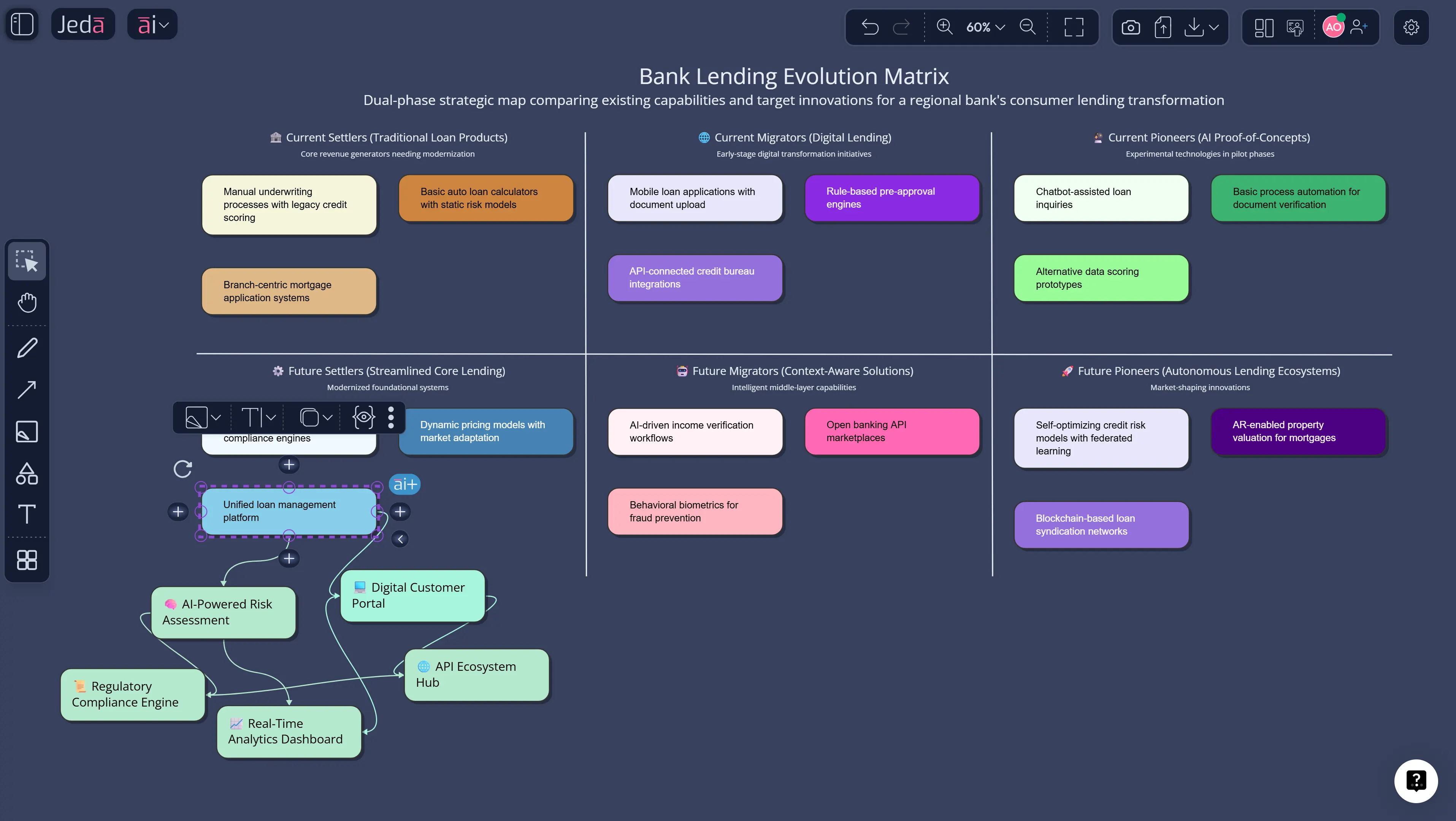
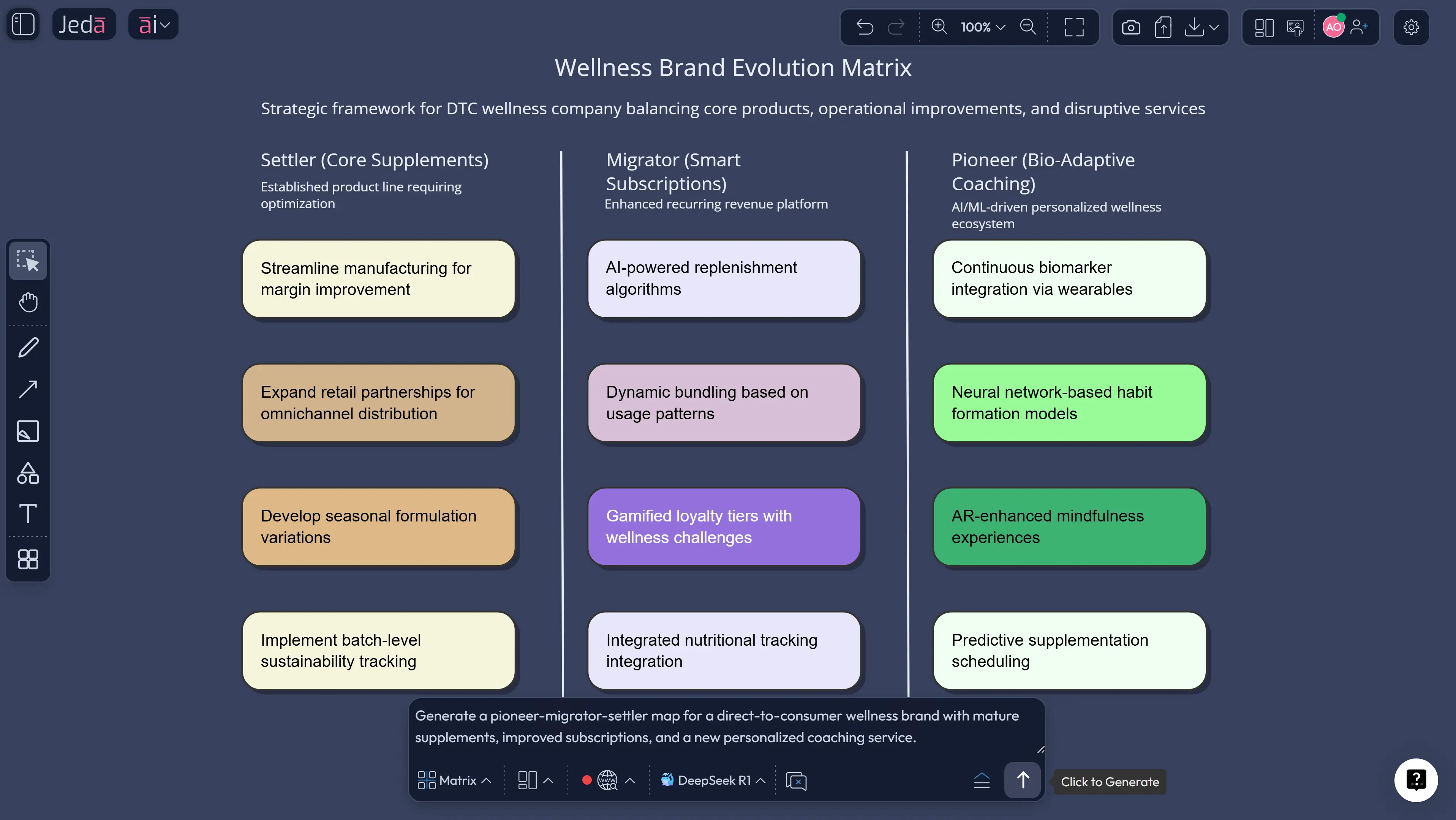
Open the Prompt Bar at the bottom of the canvas and select the Matrix command. Then enter a prompt that names the company, its portfolio, and the lens you want used for classification. For example: “Create a pioneer-migrator-settler map for a cloud security company with legacy endpoint products, improved compliance automation tools, and a new AI-native threat simulation platform.”
After the board is generated, edit labels directly, move borderline offerings between categories, use AI+ to extend the reasoning for each classification, and use Vision Transform if you want to reframe the same discussion as a roadmap, diagram, or prioritization board. When you are ready to share, export from Jeda.ai in PNG, SVG, or PDF.
- Open your AI Workspace
Log in to Jeda.ai and enter the workspace where you want to build the pioneer-migrator-settler map.
- Choose the Blue Ocean recipe
Click AI Menu, open Strategy & Planning, choose Blue Ocean Framework, and select Pioneer-Migrator-Settler Map.
- List your offerings
Enter current and planned products, services, business lines, or initiatives that belong on the portfolio view.
- Generate the first draft
Pick a layout and AI model, then generate an editable matrix that groups offerings into settlers, migrators, and pioneers.
- Challenge the classifications
Review whether each item is truly me-too, better-than-average, or unprecedented in buyer value, then adjust the map.
- Run a custom Prompt Bar version
Select the Matrix command and create a second portfolio view using a stricter growth, buyer-value, or market-creation lens.
- Use AI+ to extend the map
Tap the AI+ button to deepen reasoning, surface portfolio gaps, or suggest where new pioneer bets should come from.
- Export and keep editing
Export the board as PNG, SVG, or PDF, while keeping the live version in Jeda.ai for future planning cycles.
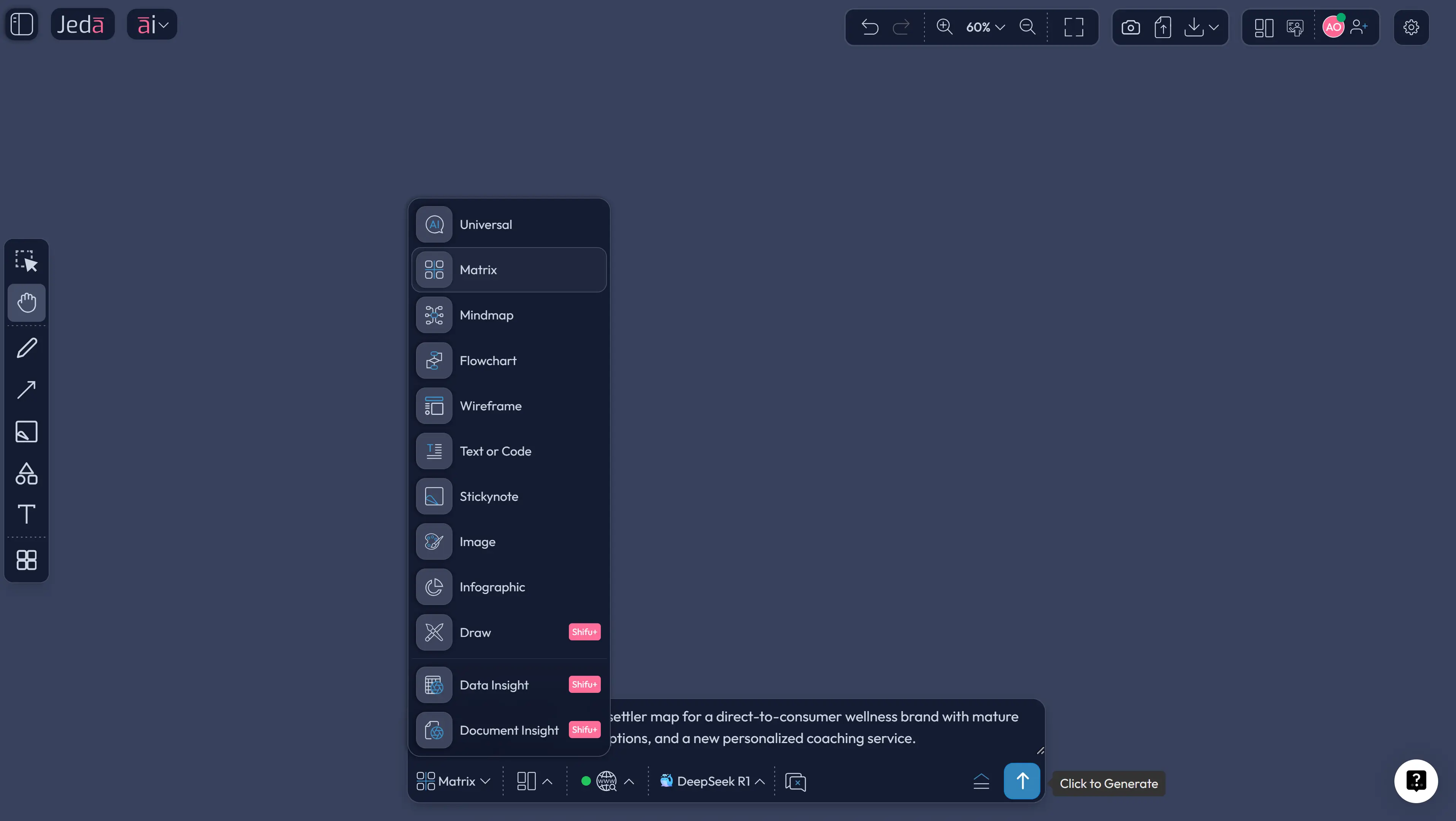
Pioneer-Migrator-Settler Map template and example
Take a software company with three product families.
The first is a legacy enterprise platform that still sells well but looks increasingly indistinguishable from the rest of the category. That is probably a settler. The second is a modernized workflow product with better implementation speed, cleaner onboarding, and more useful analytics than most competitors. That sounds like a migrator. The third is a new AI-native product that changes how buyers solve the problem and attracts users who would not have considered the category before. That is where the pioneer case begins.
Now the map becomes useful.
Instead of treating all three businesses as “growth bets,” the team can see the portfolio tension clearly. The settler pays bills but adds little strategic surprise. The migrator improves competitive position but still plays on familiar terrain. The pioneer could create new demand, but it also needs protection, investment, and sharper execution discipline.
In Jeda.ai, you can keep those three layers visible on one AI Whiteboard, attach notes about buyer value and risk, and use AI+ to ask tougher portfolio questions. Which settlers should be maintained, not glamorized? Which migrators deserve more investment because they could become pioneers? Which planned projects claim to be innovative but are really polished settlers with a nicer demo?
Best practices for using the map well
Common mistakes to avoid
The first mistake is classifying offerings by internal novelty instead of buyer value. A feature feels new to the team; buyers shrug. That is not a pioneer.
The second mistake is assuming settlers are bad and pioneers are always good. Settlers can fund the business. Pioneers can burn capital badly. The point is portfolio clarity, not moral judgment.
Third, teams often confuse migrators with pioneers. Better execution and better UX matter, but they do not automatically create a new market space.
A fourth mistake is mapping only the current portfolio. That gives you diagnosis without direction.
And finally, some organizations build the map once, then never revisit it. Markets move, buyers learn, and pioneers can become settlers faster than leadership decks admit.
Frequently asked questions
- What is a pioneer-migrator-settler map?
- A pioneer-migrator-settler map is a Blue Ocean portfolio tool that groups offerings into settlers, migrators, and pioneers based on the innovative value they create for buyers. It helps teams judge how healthy or vulnerable their future growth mix really is.
- Who created the pioneer-migrator-settler map?
- Chan Kim and Renée Mauborgne created the Pioneer-Migrator-Settler Map as part of the Blue Ocean Strategy toolkit for portfolio planning and growth selection.
- What is the difference between settlers, migrators, and pioneers?
- Settlers are me-too offerings, migrators are better-than-average offerings, and pioneers create unprecedented buyer value. The categories are meant to show how much strategic growth potential exists across the portfolio.
- Can I build a pioneer-migrator-settler map with AI?
- Yes. In Jeda.ai, you can generate the map through the Blue Ocean Framework recipe or by selecting the Matrix command in the Prompt Bar. AI helps organize offerings, classify a first draft, and extend the portfolio analysis.
- Why use an AI Workspace for portfolio mapping?
- An AI Workspace keeps the portfolio map editable, collaborative, and connected to notes, prompts, and related frameworks. That is much more useful than a static slide that gets reviewed once and forgotten.
- What should go on a pioneer-migrator-settler map?
- Current and planned products, services, business lines, or strategic initiatives can go on the map. The key is to classify them by buyer value and growth potential, not by internal political importance.
- What comes after the pioneer-migrator-settler map?
- Teams usually move from the map into Strategy Canvas work, Four Actions thinking, or investment prioritization. The map tells you where future growth is likely to come from and where the portfolio is exposed.
- Does Jeda.ai support sharing and exporting the map?
- Yes. Jeda.ai lets teams collaborate on the map in the AI Whiteboard and export the finished board as PNG, SVG, or PDF while keeping the working version editable.
Sources & further reading
- [1]
Kim, W. Chan; Mauborgne, Renée (2004) . “Blue Ocean Strategy” Harvard Business Review.
View Source ↗ - [2]
Kim, W. Chan; Mauborgne, Renée (2025) . “Pioneer Migrator Settler Map” Blue Ocean Strategy Tools.
View Source ↗ - [3]
Blue Ocean Strategy (2021) . “Five Steps to Making a Blue Ocean Shift” Blue Ocean Strategy Blog.
View Source ↗ - [4]
Blue Ocean Strategy (2022) . “Select the Right Strategic Initiatives to Plan Your Company’s Future Growth” Blue Ocean Strategy Blog.
View Source ↗
For the wider cluster, continue with Blue Ocean Strategy with AI, Strategy Canvas with AI, and Four Actions Framework with AI. For the product context, see /ai-workspace and /ai-whiteboard.
Create your Pioneer-Migrator-Settler Map in Jeda.ai
Join over 150,000+ users who use Jeda.ai's AI Workspace and AI Whiteboard to turn portfolio planning into an editable strategic decision board.
Try Free Template