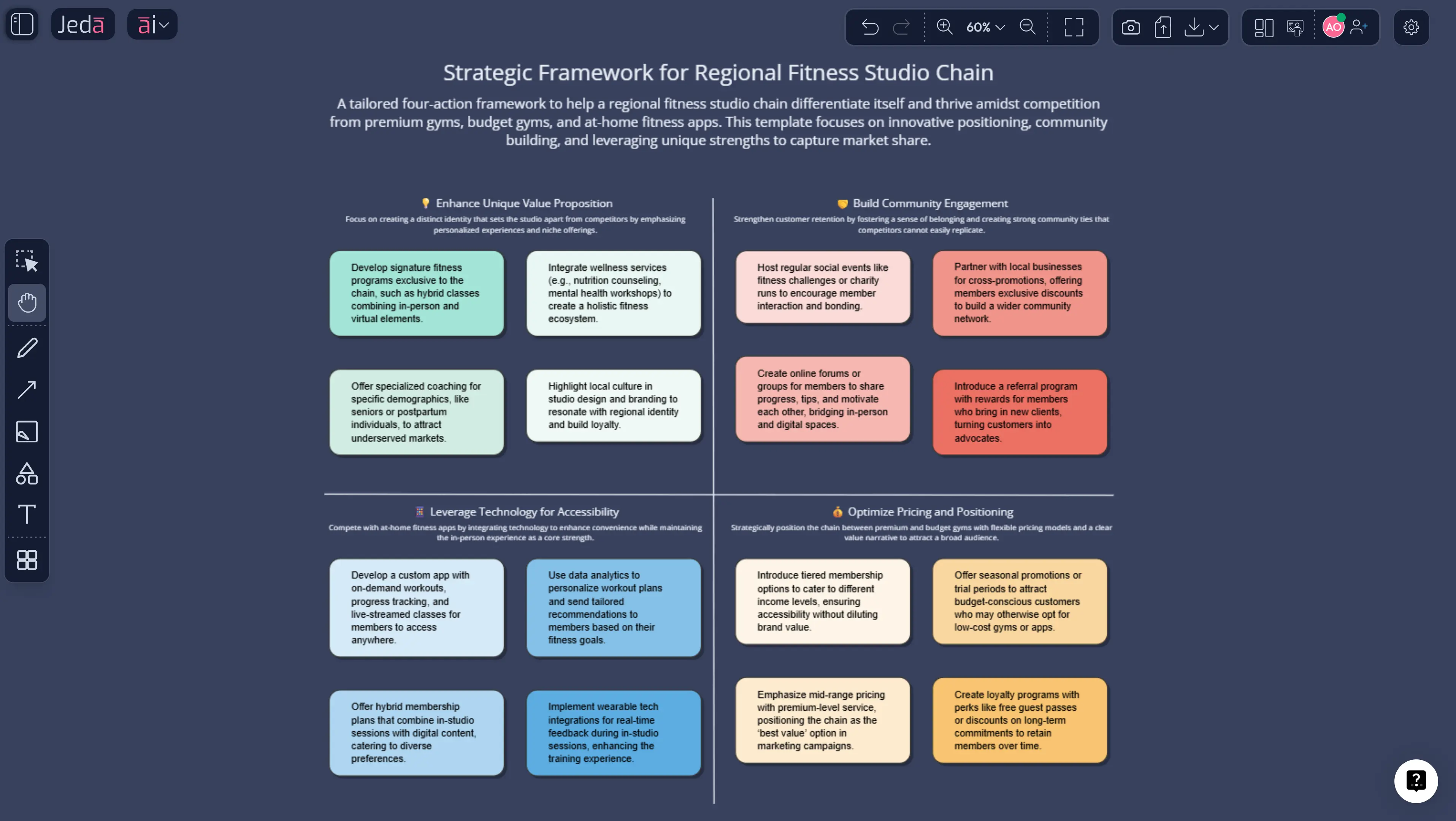
Every strategy team says it wants innovation. Far fewer are willing to remove anything. That is the real test. The four actions framework template remains one of the clearest tools for forcing strategic trade-offs because it asks four uncomfortable questions: what should be eliminated, reduced, raised, and created. Clean. Direct. Hard to dodge.
Inside Jeda.ai, the framework becomes more than a worksheet. It becomes a live decision board inside an AI Workspace and AI Whiteboard where you can generate the first pass, challenge assumptions, compare alternatives, and extend the work with AI+ instead of getting stuck in spreadsheet purgatory.
Because Jeda.ai brings 300+ strategic frameworks into one Visual AI workspace, you can connect this analysis to adjacent blue-ocean tools without leaving the board. It is also trusted by 150,000+ users who want strategy work to stay editable instead of turning into static deck debris.
What is the Four Actions Framework?
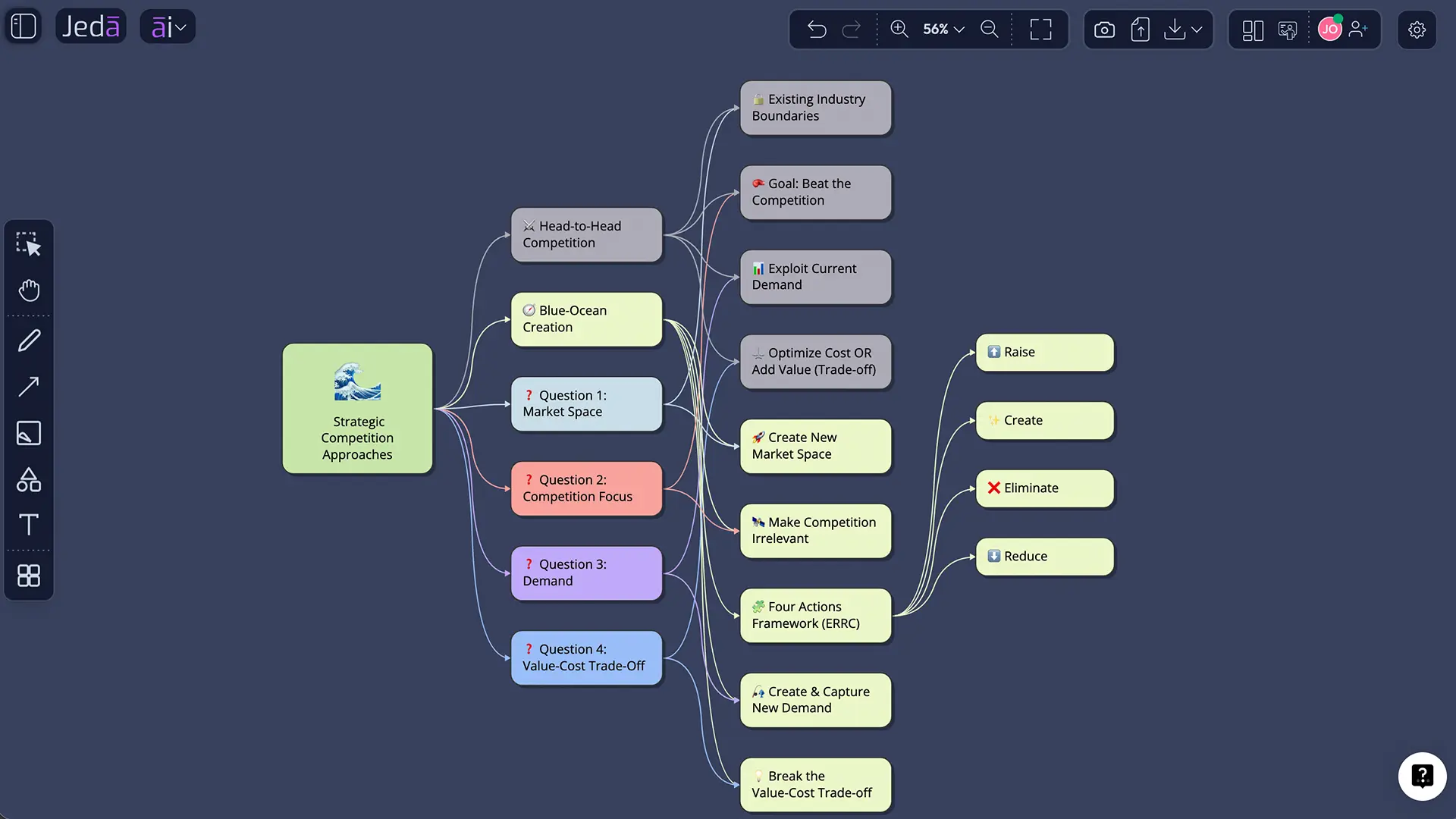
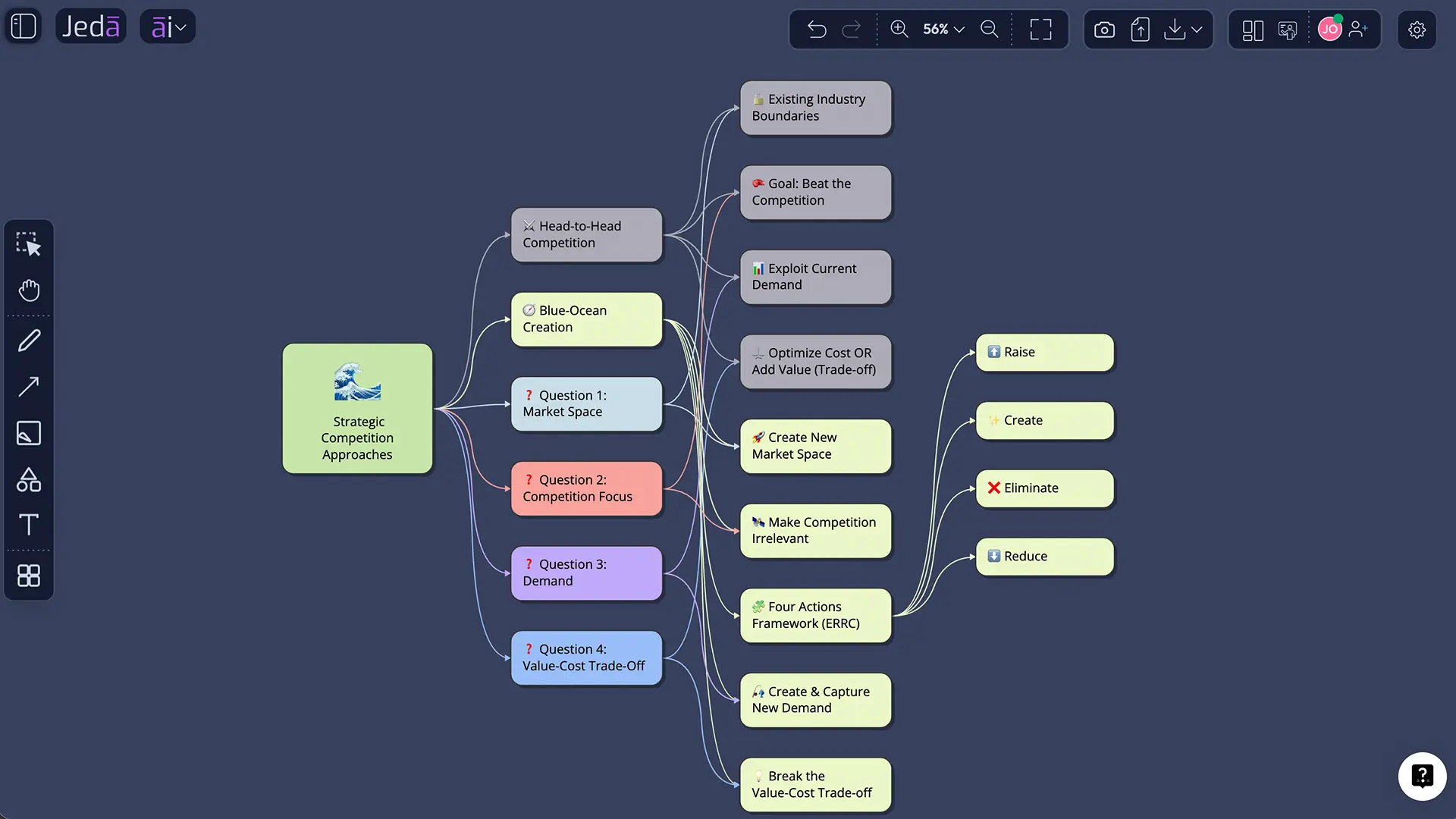
The Four Actions Framework was developed by W. Chan Kim and Renée Mauborgne as part of Blue Ocean Strategy. Its purpose is to reconstruct buyer value elements and help teams break the trade-off between differentiation and low cost. The framework does that by posing four questions:
- Which factors should be eliminated?
- Which factors should be reduced well below the industry standard?
- Which factors should be raised well above the industry standard?
- Which factors should be created that the industry has never offered?
That sequence matters. It prevents innovation from becoming a one-direction exercise where teams only add new things and call it strategy. In many markets, the biggest gains come from subtraction first.
Kim and Mauborgne’s logic is blunt and useful: if your offering only adds new features while preserving every legacy assumption in the category, you are probably decorating the red ocean, not escaping it.
Why use the Four Actions Framework with AI?
The traditional version of this framework is easy to understand and surprisingly hard to facilitate. Teams overfill the Create quadrant, avoid the Eliminate quadrant, and fill the Reduce quadrant with polite half-measures. That is not a framework problem. It is a human one.
AI helps because it can challenge category defaults without worrying about politics.
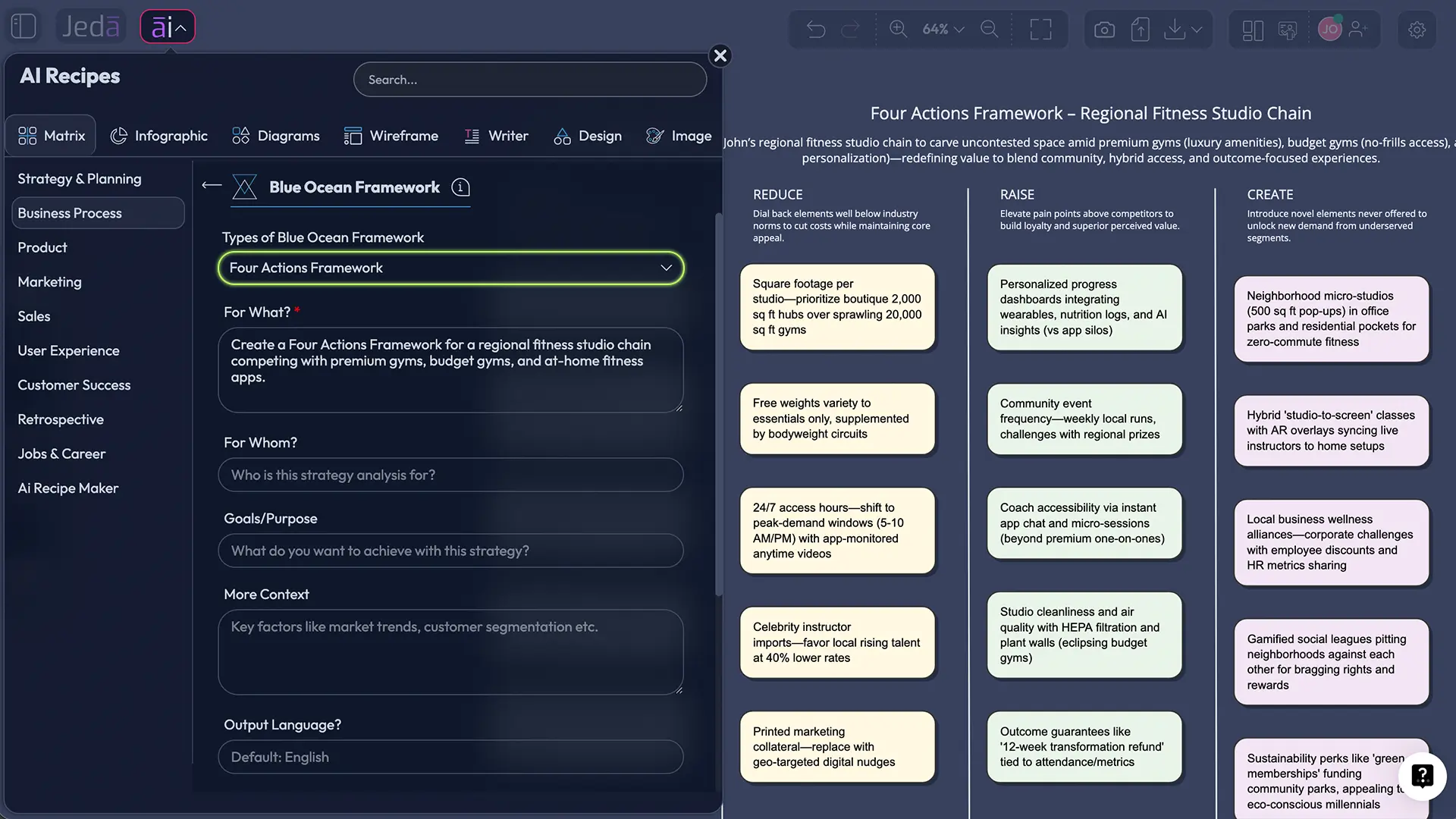
In Jeda.ai, you can ask AI to surface the factors the industry takes for granted, identify where cost is being carried without proportional buyer value, and draft multiple ERRC options for different strategic positions. A product team can create one version optimized for premium growth, another for mass adoption, and a third for channel expansion, all on the same AI Whiteboard.
- Sharper elimination logic
Use AI to expose legacy features, rituals, or service layers that everyone keeps because the category expects them, not because buyers value them.
- Better cost-value trade-offs
Generate structured options that reduce cost-heavy factors while raising the few elements buyers truly notice and remember.
- Multiple strategy options
Draft several ERRC versions on one board so leadership can compare strategic bets instead of arguing around a single draft.
- Connected blue-ocean thinking
Move from the four actions template to a strategy canvas, noncustomer map, or follow-up matrix without leaving Jeda.ai.
There is another advantage. AI is good at finding symmetry. Good strategy is not always symmetrical. Inside Jeda.ai, your team can challenge the AI draft in real time and keep the reasoning visible. That makes the output stronger than a static template and a lot more honest than a deck polished after the fact.
How to create a Four Actions Framework in Jeda.ai
This framework sits naturally inside the Blue Ocean Framework recipe flow, so the AI Menu route is the recommended starting point. Use the Prompt Bar when you already know the market context and want a more tailored draft.
Method 1: Recipe Matrix
Open Jeda.ai, enter your AI Workspace, and click AI Menu in the top-left corner. Under Strategy & Planning, select Blue Ocean Framework, then choose Four Actions Framework. Add the business context, the category you want to challenge, the customer segment, and any relevant rivals or substitutes. Pick your preferred layout and AI model, then generate the matrix.
This route works especially well when you need a fast starting structure for a workshop or client session.
Method 2: Prompt Bar
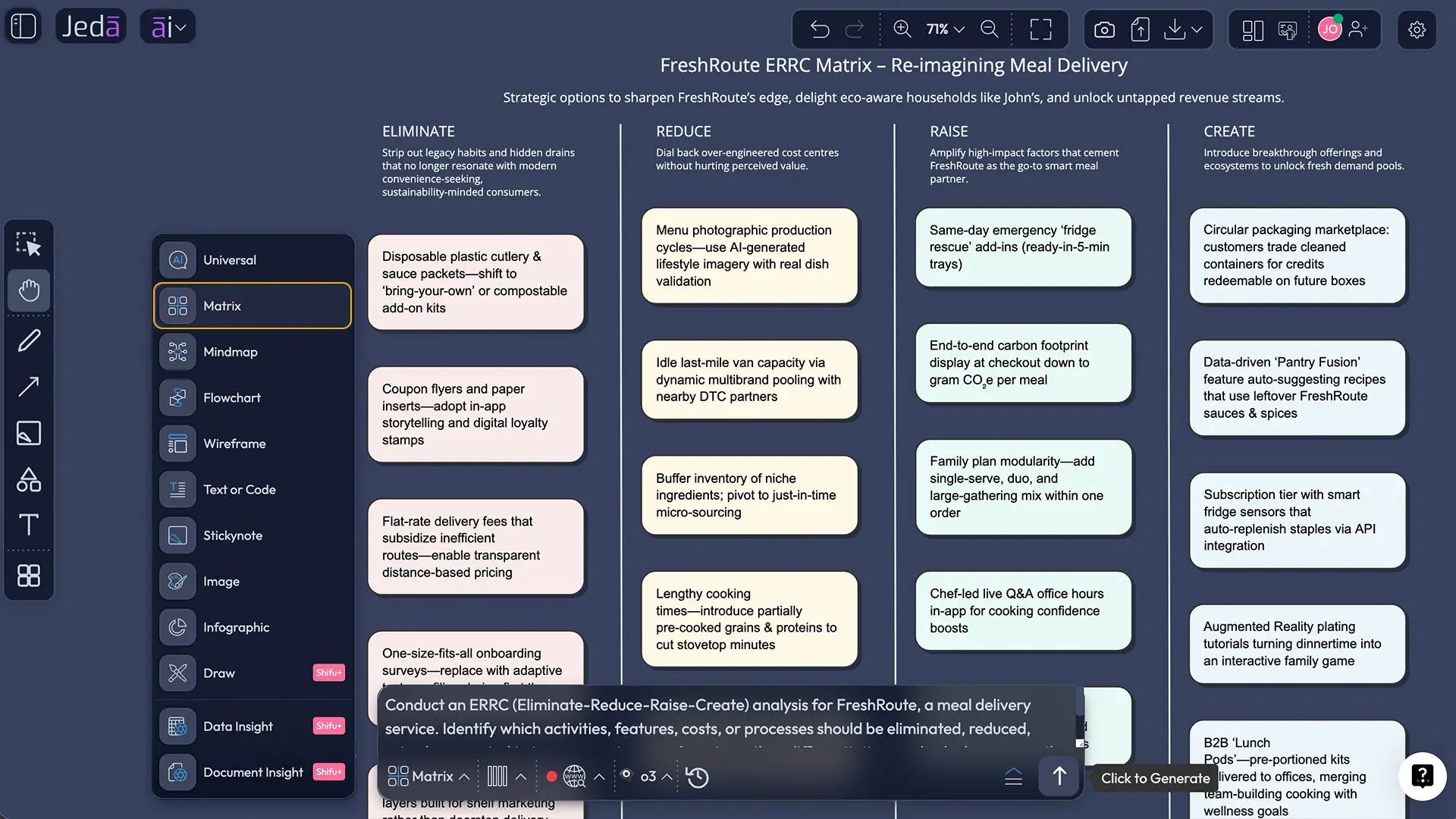
Open the Prompt Bar and select the Matrix command. Then write a detailed prompt that names the market, the current category norms, and the result you want. For example: “Create a Four Actions Framework for a regional meal-kit company competing with grocery delivery, local prepared-food subscriptions, and traditional supermarkets. Focus on waste reduction, convenience, personalization, delivery reliability, menu flexibility, and price transparency.”
Once the matrix appears, edit the notes, merge overlaps, and use the AI+ button to extend each quadrant into implications, messaging, cost impact, or roadmap ideas. If you want to translate the same logic into another visual, use Vision Transform. When the board is ready, export it from Jeda.ai in PNG, SVG, or PDF.
- Enter Jeda.ai
Open Jeda.ai and create or enter the AI Workspace where the framework will live.
- Select the recipe
Use AI Menu, open Strategy & Planning, choose Blue Ocean Framework, and click Four Actions Framework.
- Describe the category
Add the market context, target segment, current norms, and the rivals or substitutes shaping buyer expectations.
- Generate the first ERRC matrix
Choose layout and model, then generate a draft covering Eliminate, Reduce, Raise, and Create.
- Tighten the quadrants
Remove weak ideas, combine duplicates, and challenge any Create items that do not support a real trade-off.
- Run a custom Prompt Bar version
Open the Prompt Bar, select Matrix, and generate a second version optimized for a different segment, price point, or channel.
- Use AI+ for implications
Select the finished framework and use the AI+ button to expand it into messaging, operational impact, or a follow-on strategy canvas.
- Finalize and export
Keep the framework in the AI Whiteboard for collaboration, then export it as PNG, SVG, or PDF when you need to share it.
Four Actions Framework template and example
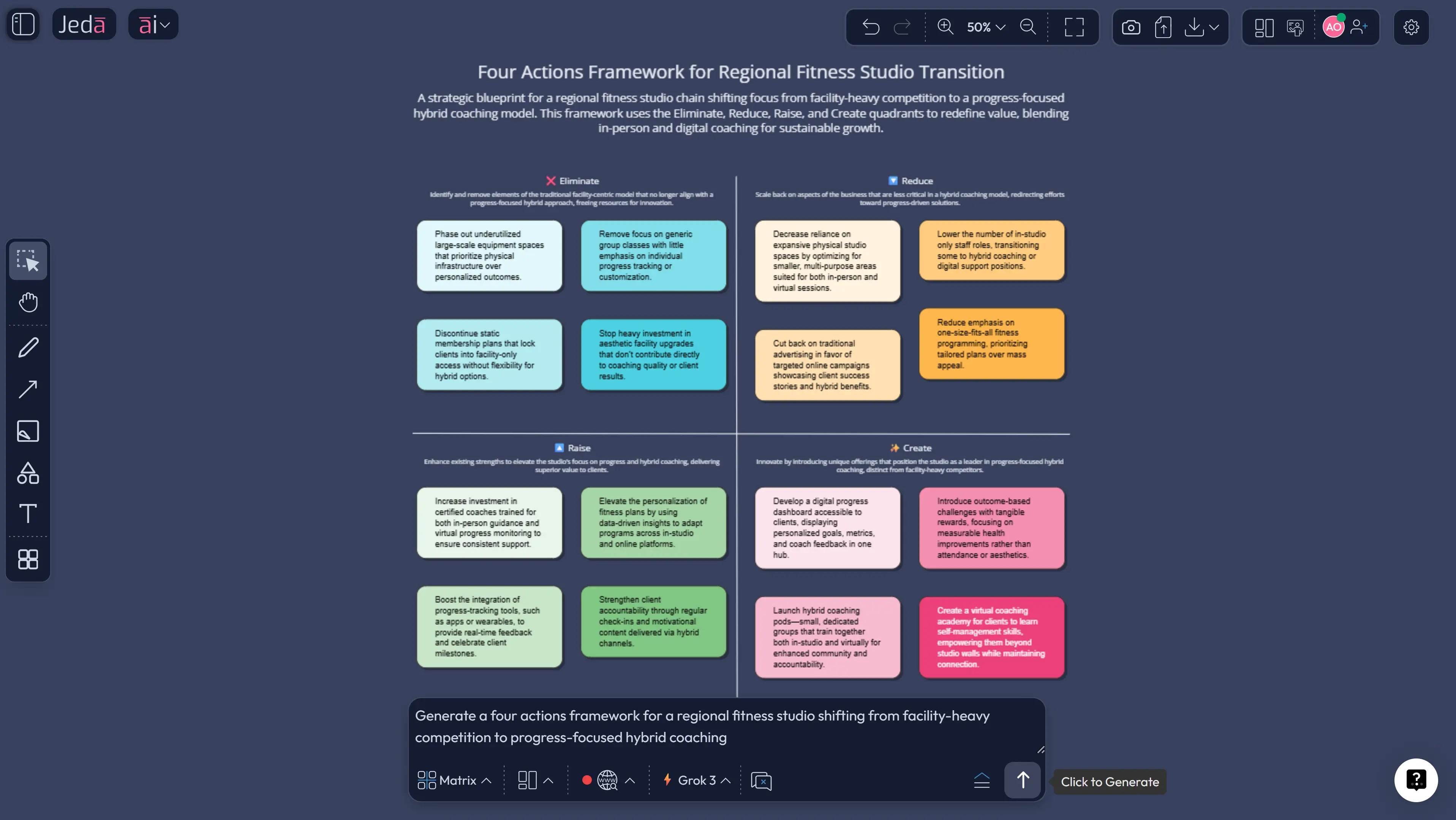
Consider a regional fitness studio chain caught between premium boutique gyms, low-cost memberships, and at-home fitness apps. Leadership says the answer is better advertising. The market says otherwise.
A Four Actions Framework reveals the deeper issue. The chain is carrying too many expensive category expectations while failing to create a reason people would switch.
Eliminate: long annual contracts, oversized reception areas, and underused premium amenities that sound impressive in brochures but add little daily value.
Reduce: class complexity, schedule fragmentation, and equipment variety that creates overhead without improving adherence.
Raise: coaching consistency, progress visibility, community accountability, and booking simplicity.
Create: hybrid membership plans that combine studio sessions with intelligent at-home guidance, short-form habit programs, and team accountability circles.
Now the strategy looks different. It is not “be a better gym.” It is “build a lower-friction habit system around visible progress.” That is a real move.
Inside Jeda.ai, that example becomes easier to work through because you can keep the ERRC matrix beside a strategy canvas, notes from interviews, and alternate versions for different segments on one board. That is the quiet superpower of an AI Workspace: you do not lose the path from idea to reasoning.
Best practices for a Four Actions Framework that creates real strategic movement
The framework is simple enough to fit on one page. That does not mean it should be handled casually.
Use these working rules:
A final suggestion: run two versions. One for your current target customers. Another for the adjacent segment you think you could unlock. The contrast is often more revealing than the framework itself.
Common mistakes to avoid
The biggest mistake is treating the framework like an ideation board. It is not there to collect ideas. It is there to force choices.
Another common error is loading every attractive possibility into Create while leaving Eliminate nearly empty. That usually signals the team wants growth without sacrifice. Strategy rarely works that way.
A third mistake is using vague labels such as “better experience” or “more innovation.” Those are not actions. They are aspirations wearing fake glasses.
Teams also get into trouble when they skip market evidence. If the framework reflects only internal belief, it may look decisive while quietly preserving the category’s blind spots.
And sometimes the board is fine but execution drifts. The company writes a bold Create statement, then sells and distributes the result through the exact same channels, narratives, and incentives that locked it into the red ocean in the first place. That part stings. Because it happens a lot.
Frequently asked questions
- What is the Four Actions Framework?
- The Four Actions Framework is a Blue Ocean Strategy tool developed by W. Chan Kim and Renée Mauborgne. It asks what should be eliminated, reduced, raised, and created so a company can break the value-cost trade-off and design a different strategic profile.
- Is the Four Actions Framework the same as the ERRC grid?
- They are closely related. ERRC stands for Eliminate, Reduce, Raise, and Create. The Four Actions Framework provides the core logic, while the ERRC grid is often used as the practical matrix format teams fill in during workshops and analysis sessions.
- When should I use a Four Actions Framework?
- Use it when your market feels crowded, your offer is becoming too similar to rivals, or your team needs a disciplined way to redesign value rather than just add more features. It is especially useful before repositioning, relaunching, or entering an adjacent segment.
- Can I create a Four Actions Framework with AI?
- Yes. In Jeda.ai, you can use the Blue Ocean Framework recipe or the Matrix command in the Prompt Bar to generate a first-pass ERRC matrix, refine the quadrants, and expand the work with the AI+ button.
- What makes a strong Create quadrant?
- A strong Create quadrant introduces new value that buyers actually care about and that the category has not meaningfully offered before. It should not be random novelty. Ideally, it is supported by clear reductions or eliminations elsewhere in the model.
- Should the framework focus only on competitors?
- No. Blue Ocean logic pushes you to consider alternatives and noncustomers too. Some of the best inputs for the framework come from what buyers use instead of the industry’s standard offering, not only from direct rival features.
- What comes after a Four Actions Framework?
- Teams usually translate the decisions into a strategy canvas, an offer design, a go-to-market shift, or a pilot plan. In Jeda.ai, you can keep those next steps on the same AI Workspace so the framework leads directly into execution thinking.
- Why build this in an AI Whiteboard?
- Because the framework is easier to challenge when it stays editable and visible. An AI Whiteboard lets the team compare versions, annotate trade-offs, collaborate live, and extend the analysis without rebuilding the work from scratch.
Sources & further reading
- [1]
Kim, W. Chan; Mauborgne, Renée (2004) . “Blue Ocean Strategy” Harvard Business Review.
View Source ↗ - [2]
Kim, W. Chan; Mauborgne, Renée (2004) . “Value Innovation: The Strategic Logic of High Growth” Harvard Business Review.
View Source ↗ - [3]
Kim, W. Chan; Mauborgne, Renée (2026) . “Four Actions Framework” Blue Ocean Strategy Tools and Frameworks.
View Source ↗ - [4]
The Blue Ocean Team (2022) . “Four Actions Framework and ERRC Grid (Examples and Template)” Blue Ocean Strategy Blog.
View Source ↗ - [5]
IMD (2026) . “What is Blue Ocean Strategy and How To Implement It” IMD Blog.
View Source ↗
This page fits best when linked with Strategy Canvas with AI, Six Paths Framework with AI, and Three Tiers of Noncustomers with AI. For product context, visit /ai-workspace and /ai-whiteboard.
Build your Four Actions Framework in Jeda.ai
Join over 150,000+ users who use Jeda.ai's AI Workspace and AI Whiteboard to redesign value, compare trade-offs, and turn blue-ocean thinking into editable strategy boards.
Try Free Template