Here is the trap. Most teams search for growth in the same places their rivals already watch: the same competitors, the same buyer group, the same feature checklist, the same trend deck. Then they act surprised when the output feels familiar. The Six Paths Framework exists to break that habit.
It is one of the most useful parts of Blue Ocean thinking because it does not begin with the question, “How do we win this market?” It begins with a better one: “What if we are looking at the market through the wrong lens?” Build that framework in Jeda.ai, and you can explore the six paths inside one editable AI Workspace and AI Whiteboard, instead of scattering the thinking across whiteboards, notes, and orphaned slides.
Because Jeda.ai brings 300+ strategic frameworks into one Visual AI workspace, you can connect this analysis to adjacent blue-ocean tools without leaving the board. It is also trusted by 150,000+ users who want strategy work to stay editable instead of turning into static deck debris.
What is the Six Paths Framework?
The Six Paths Framework was developed by W. Chan Kim and Renée Mauborgne to help managers reconstruct market boundaries and reduce what they call search risk. In other words, it helps teams identify commercially plausible blue oceans instead of brainstorming random “innovations” that sound bold and die young.
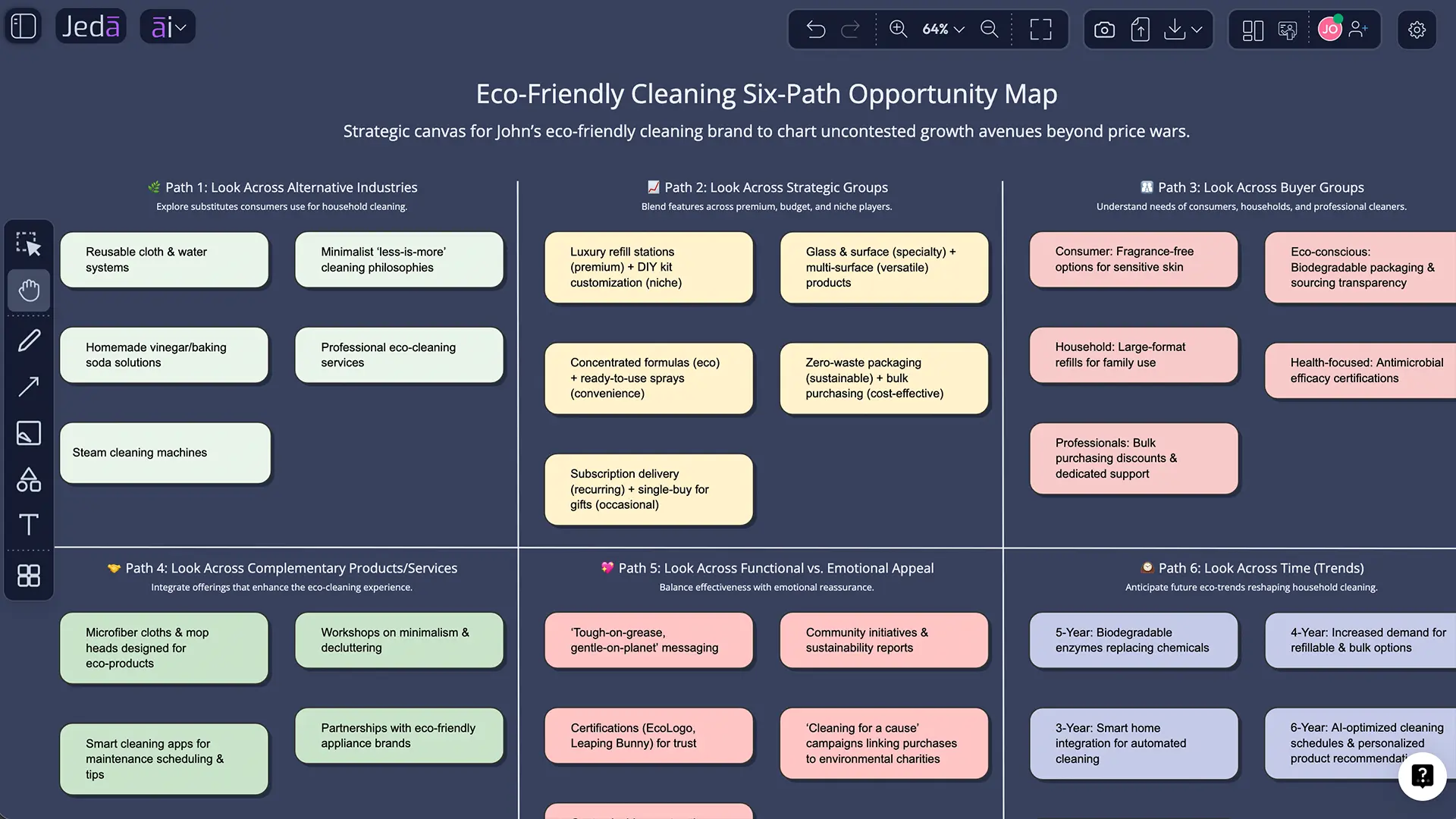
The framework asks you to look across six paths:
- Alternative industries
- Strategic groups within an industry
- Buyer groups
- Complementary product and service offerings
- Functional-emotional orientation
- Time
That list looks tidy on paper. In practice, it is a very effective way to stop copying the industry’s mental model.
The official Blue Ocean framing contrasts conventional head-to-head competition with blue-ocean creation. Instead of looking only within your industry, the framework pushes you to look across alternatives, across strategic groups, across buyer groups, across complements, across emotional versus functional assumptions, and across external trends over time.
Why use the Six Paths Framework with AI?
Because six paths create a lot of possibility. And a lot of possibility can become noise if the team is doing all the sorting manually.
Inside Jeda.ai, AI can help generate structured hypotheses for each path, cluster adjacent opportunities, and keep the exploration readable. That means you can test more directions without turning the workshop into a chaos festival.
- Broader search without losing structure
Use AI to expand adjacent-market options for each path while keeping them organized by lens instead of dumping them into one generic idea board.
- Better reframing
Prompt the board to rethink the market through buyers, substitutes, complements, and trend shifts so you are not trapped by the category’s default logic.
- Connected follow-through
Move from six paths into a strategy canvas, noncustomer map, or prioritization matrix without leaving the same Jeda.ai workspace.
- Live collaboration
Keep consultants, founders, product leaders, and analysts on the same AI Whiteboard with visible assumptions and editable hypotheses.
And that last point matters more than it sounds. The Six Paths Framework is not useful because it generates ideas. Plenty of workshops generate ideas. It is useful because it generates disciplined reframing. AI helps the team do more of that, faster, while Jeda.ai keeps the logic visible instead of hidden inside someone’s summary deck.
How to create a Six Paths Framework in Jeda.ai
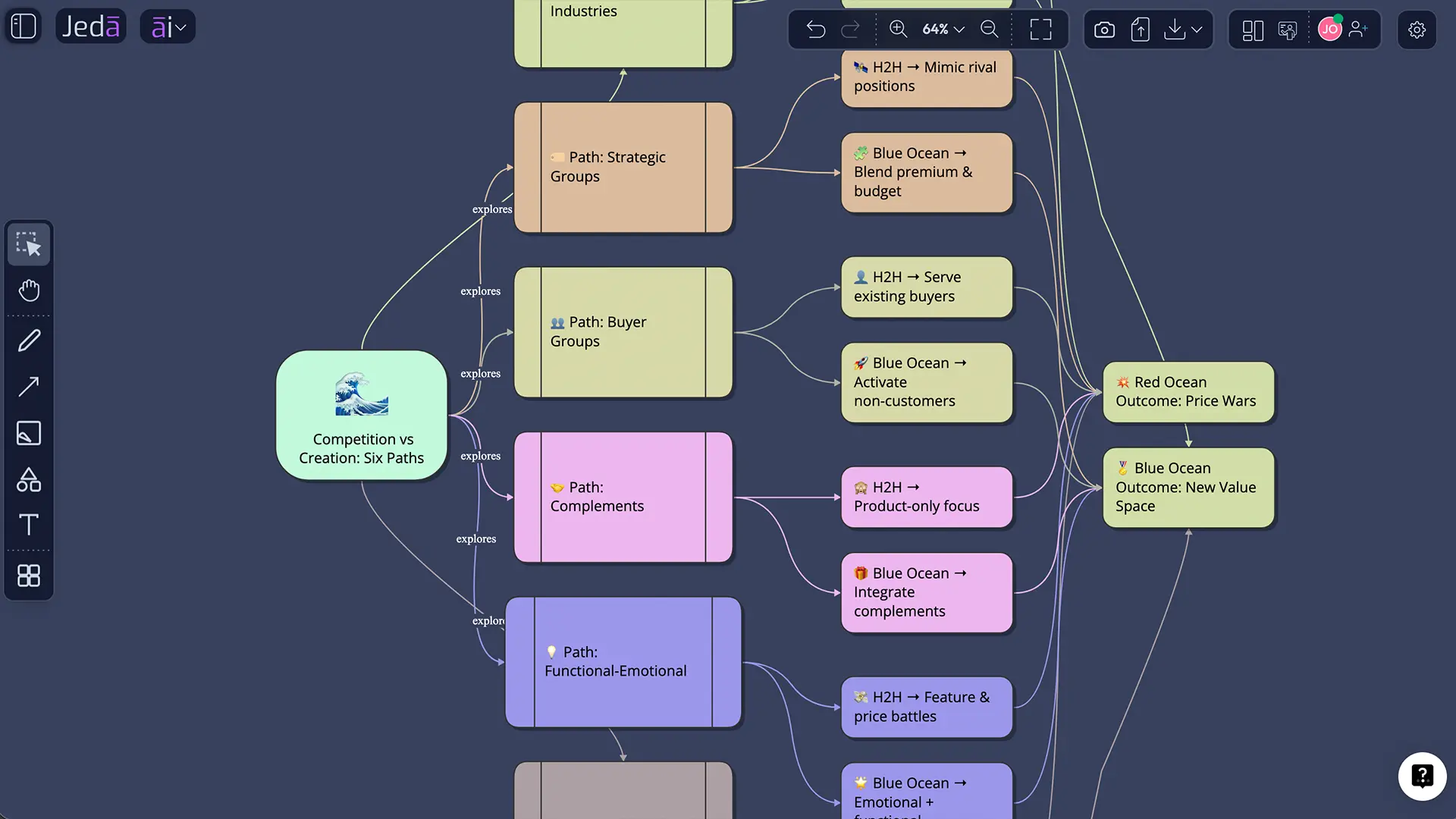
For Blue Ocean work, the most reliable route is the AI Menu recipe flow. Then, when you want a more customized or more experimental version, use the Prompt Bar with the Matrix command.
Method 1: Recipe Matrix
Open Jeda.ai, enter your AI Workspace, and click the AI Menu in the top-left corner. Under Strategy & Planning, choose Blue Ocean Framework, then select Six Paths Framework. Add the business context, the market being challenged, and the segment or growth problem you want to examine. Choose your layout and AI model, then generate.
This is the better route when the team needs a clean scaffold. It keeps the exploration organized path by path instead of letting stronger personalities dominate the room.
Method 2: Prompt Bar
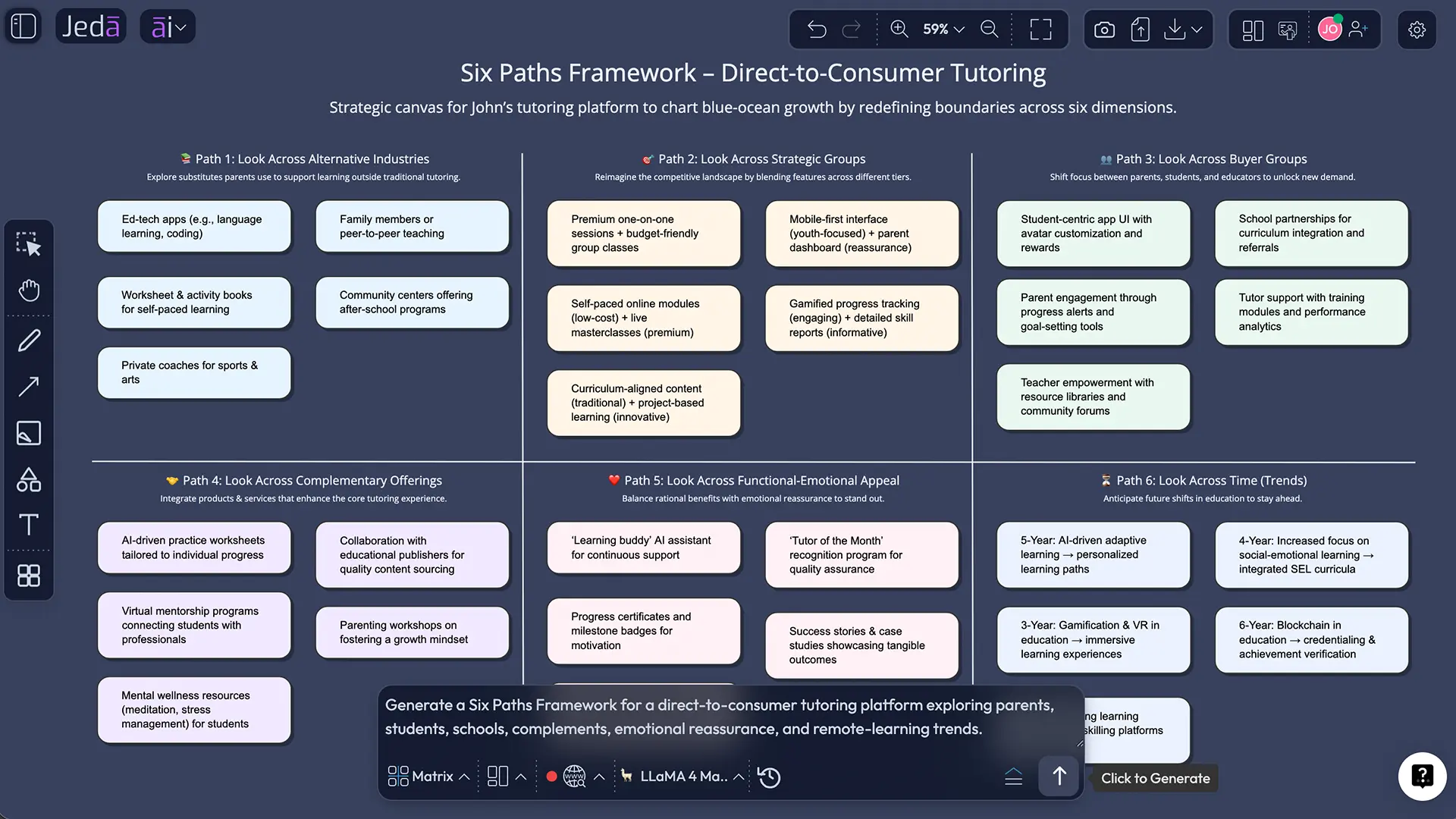
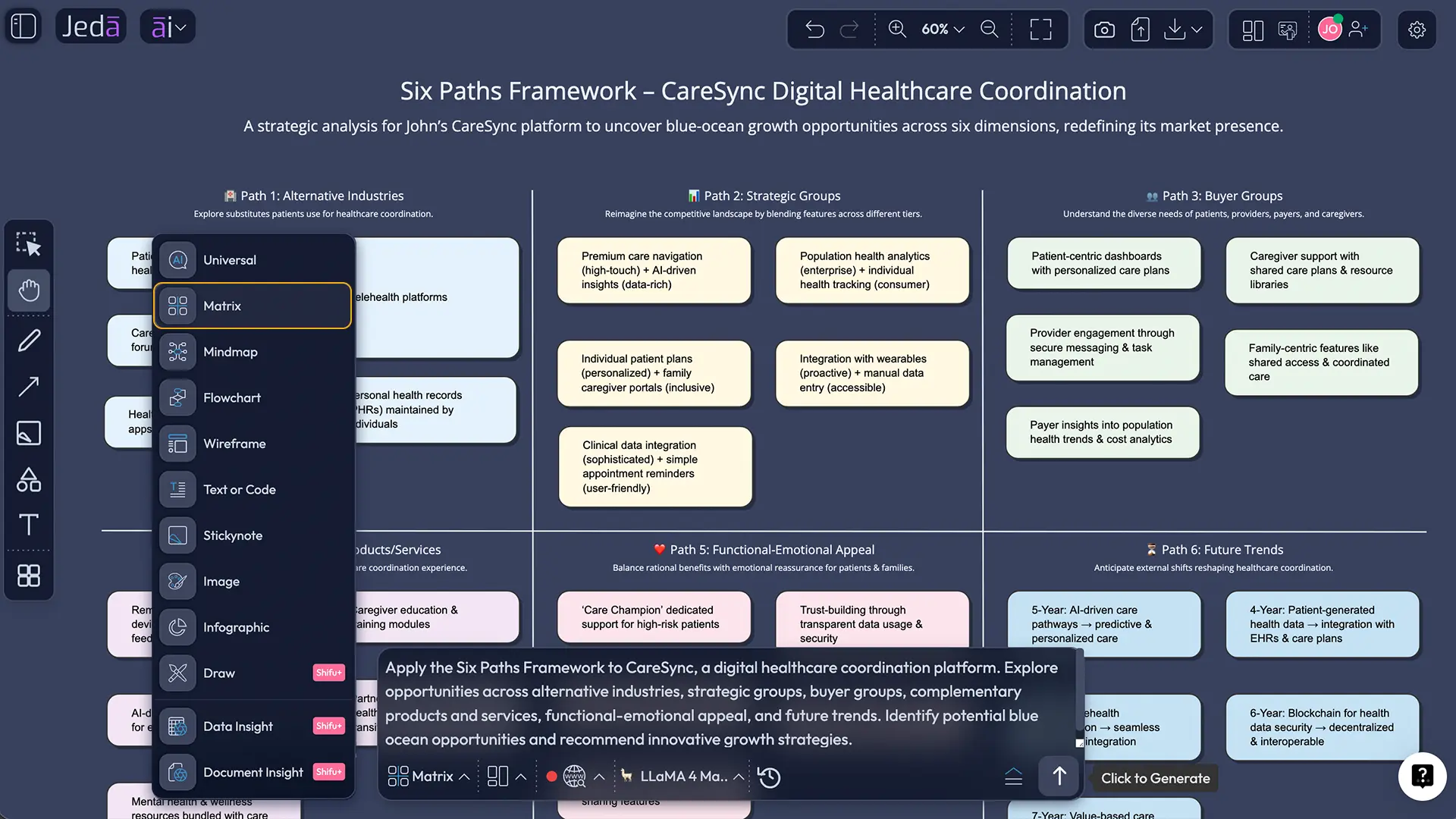
Open the Prompt Bar, choose the Matrix command, and write a prompt that names the market and explicitly asks for the six paths. For example: “Create a Six Paths Framework for a direct-to-consumer tutoring platform seeking blue-ocean growth. Explore alternative industries, strategic groups, buyer groups, complementary services, functional versus emotional shifts, and trends over time.”
After the first version is generated, refine it. Add evidence. Delete weak paths. Then use AI+ to extend the promising ideas into deeper opportunity statements, and use Vision Transform if you want to convert the output into another visual. The finished board stays collaborative inside Jeda.ai and can be exported in PNG, SVG, or PDF.
- Start in Jeda.ai
Open Jeda.ai and enter the AI Workspace where your blue-ocean exploration will happen.
- Open the Blue Ocean Framework recipe
Use AI Menu, open Strategy & Planning, and choose Six Paths Framework under Blue Ocean Framework.
- Set the strategic context
Describe the market, the growth challenge, and the customer or segment assumptions you want to challenge.
- Generate the six-path matrix
Choose your layout and model, then generate a structured board covering all six reframing paths.
- Review path by path
Tighten each section, remove generic ideas, and add notes on where the strongest strategic openings appear.
- Create a custom version in the Prompt Bar
Select the Matrix command and generate a second pass with more specific instructions for your market.
- Use AI+ to deepen the best opportunities
Extend the most promising path into concrete value propositions, target segments, or follow-on blue-ocean moves.
- Transform or export the board
Use Vision Transform if needed, then share the finished board from Jeda.ai in PNG, SVG, or PDF.
Six Paths Framework template and example
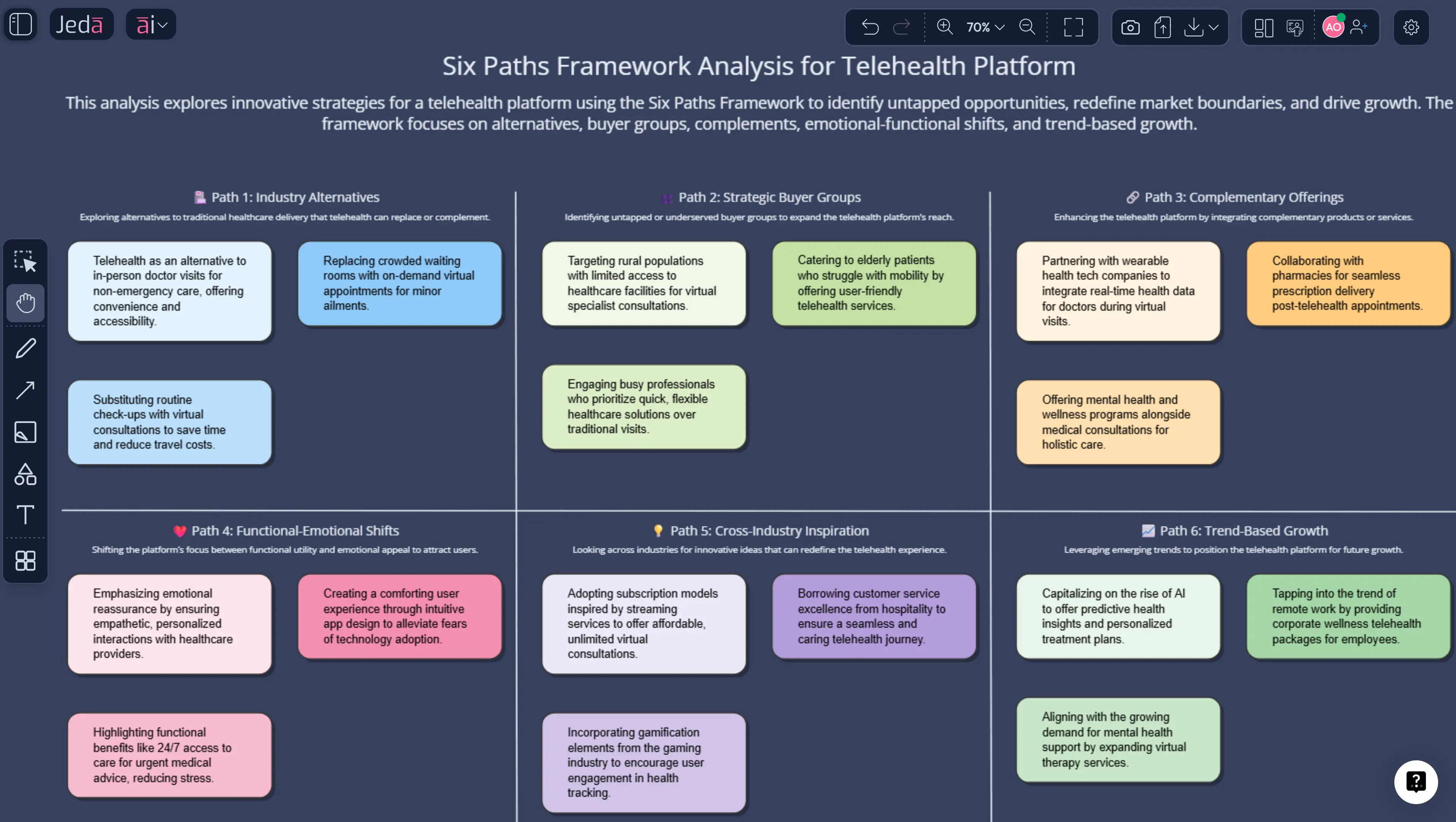
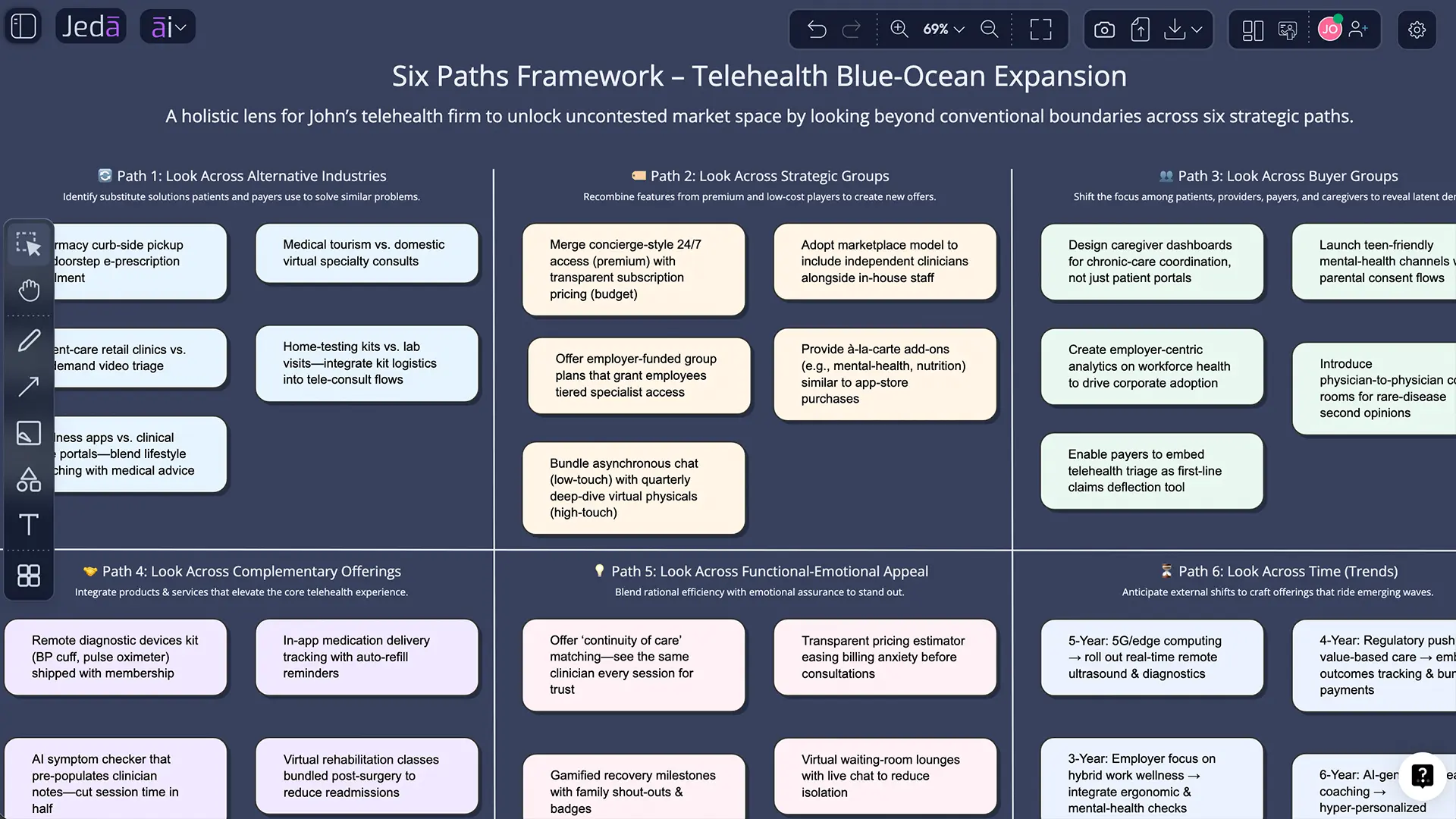
Let’s use a practical example: a telehealth company that thinks its competition is other telehealth companies.
That assumption is already limiting the frame.
Path 1: Alternative industries. The real alternative may be urgent care, pharmacies, employer clinics, or even symptom-checking apps.
Path 2: Strategic groups. The market may split between premium continuous-care providers and quick-access, low-friction services.
Path 3: Buyer groups. The current offer may be aimed at patients, while the actual value driver sits with employers, caregivers, or insurers.
Path 4: Complementary offerings. The friction may not be in the consultation at all. It may be in lab access, prescription fulfillment, or follow-up coordination.
Path 5: Functional-emotional orientation. The category may over-index on convenience while underplaying reassurance, trust, and continuity.
Path 6: Time. Regulatory shifts, workforce shortages, and remote-care normalization may reshape what buyers will accept over the next few years.
Now the company has a richer search field. It may discover that the bigger move is not another video-visit improvement. It may be a coordinated “diagnosis-to-treatment-to-follow-up” service designed around complements and continuity.
This is why Jeda.ai is useful here. You can keep each path visible, attach assumptions beside it, and move directly from exploration to a follow-on strategy canvas in the same AI Workspace. In a normal slide flow, that reasoning chain gets flattened. On an AI Whiteboard, it stays intact.
Best practices for using the Six Paths Framework well
The framework works best when the team respects the discipline of the paths. If every section turns into “what features should we add,” the exercise collapses back into product brainstorming.
A few habits help:
And yes, you should narrow the output afterward. But not too early. Early narrowing is one of the main ways teams quietly rebuild the same strategy they started with.
Common mistakes to avoid
One classic mistake is confusing alternatives with competitors. They are related, but not identical. If you only map direct rivals, Path 1 loses most of its power.
Another is skipping buyer-group reframing because the company thinks it already knows the customer. That confidence is often the problem.
Teams also misuse Path 5 by treating “emotional” as a soft branding layer rather than a serious strategic orientation. In many categories, the emotional shift is the move.
A fourth problem is trend theater. Path 6 is not a license to paste AI, sustainability, or Gen Z onto the board and call it foresight. The trends must be relevant, durable, and tied to value creation.
And finally, people sometimes stop at the idea list. The Six Paths Framework is an exploration tool, not the final answer. Its job is to produce stronger opportunities that then get tested through tools like the Strategy Canvas, the Four Actions Framework, and noncustomer analysis.
Frequently asked questions
- What is the Six Paths Framework?
- The Six Paths Framework is a Blue Ocean Strategy tool created by W. Chan Kim and Renée Mauborgne. It helps teams reconstruct market boundaries by looking across alternative industries, strategic groups, buyer groups, complements, functional-emotional orientation, and time.
- Why is the Six Paths Framework useful?
- It reduces search risk. Instead of brainstorming growth ideas inside the same category logic as everyone else, the framework gives teams six disciplined ways to reframe the market and uncover more plausible blue-ocean opportunities.
- Can I create a Six Paths Framework with AI?
- Yes. In Jeda.ai, you can generate a Six Paths Framework through the Blue Ocean Framework recipe or by using the Matrix command in the Prompt Bar. AI can help expand hypotheses, cluster ideas, and extend promising paths with AI+.
- What comes after the Six Paths Framework?
- The next step is usually to test the strongest openings using a strategy canvas, a Four Actions Framework, or a noncustomer map. The six paths help you widen the search field; the next tools help you narrow and shape the strategic move.
- How is the Six Paths Framework different from brainstorming?
- Brainstorming often generates unstructured ideas. The Six Paths Framework forces a structured search through six specific reframing lenses. That makes the output easier to evaluate and more likely to reveal non-obvious strategic directions.
- How many opportunities should I keep from a six paths exercise?
- Usually only a few survive serious scrutiny. That is fine. The goal is not to keep everything. The goal is to scan broadly, spot the strongest openings, and then move into deeper evaluation with follow-on frameworks.
- Who should use the Six Paths Framework?
- It is useful for consultants, founders, product leaders, business analysts, innovation teams, and executives facing crowded markets. It works especially well when a team feels trapped by category assumptions but cannot yet see where to go next.
- Why use an AI Workspace for this framework?
- Because the framework creates many strategic branches. An AI Workspace helps you organize them, compare them, annotate the logic, and keep the board collaborative and editable. That is much more useful than trying to stitch the work together afterward in slides.
Sources & further reading
- [1]
Kim, W. Chan; Mauborgne, Renée (2004) . “Blue Ocean Strategy” Harvard Business Review.
View Source ↗ - [2]
Kim, W. Chan; Mauborgne, Renée (2017) . “Blue Ocean Shift” Hachette Book Group.
View Source ↗ - [3]
Kim, W. Chan; Mauborgne, Renée (2026) . “Six Paths Framework” Blue Ocean Strategy Tools and Frameworks.
View Source ↗ - [4]
IMD (2026) . “What is Blue Ocean Strategy and How To Implement It” IMD Blog.
View Source ↗
For the rest of the cluster, read Blue Ocean Strategy with AI, Strategy Canvas with AI, Four Actions Framework with AI, and Three Tiers of Noncustomers with AI. For product context, see /ai-workspace and /ai-whiteboard.
Explore new market space with Jeda.ai
Join over 150,000+ users who use Jeda.ai's AI Workspace and AI Whiteboard to search beyond obvious competitors and turn opportunity discovery into editable, visual strategy boards.
Try Free Template