A lot of growth work starts in the wrong place. Teams interview current customers, segment them more finely, optimize for retention, and wonder why the market still feels small. That approach can improve a business. It rarely creates a blue ocean.
The three tiers of noncustomers framework flips the lens. Instead of asking only how to serve current customers better, it asks where latent demand sits outside the industry’s existing demand pool. That sounds like a subtle shift. It is not. It can change the entire search field. Built inside Jeda.ai, the framework becomes a living board in an AI Workspace and AI Whiteboard where you can map refusal patterns, adjacent demand, and new-market hypotheses without losing the trail of reasoning.
Because Jeda.ai brings 300+ strategic frameworks into one Visual AI workspace, you can connect this analysis to adjacent blue-ocean tools without leaving the board. It is also trusted by 150,000+ users who want strategy work to stay editable instead of turning into static deck debris.
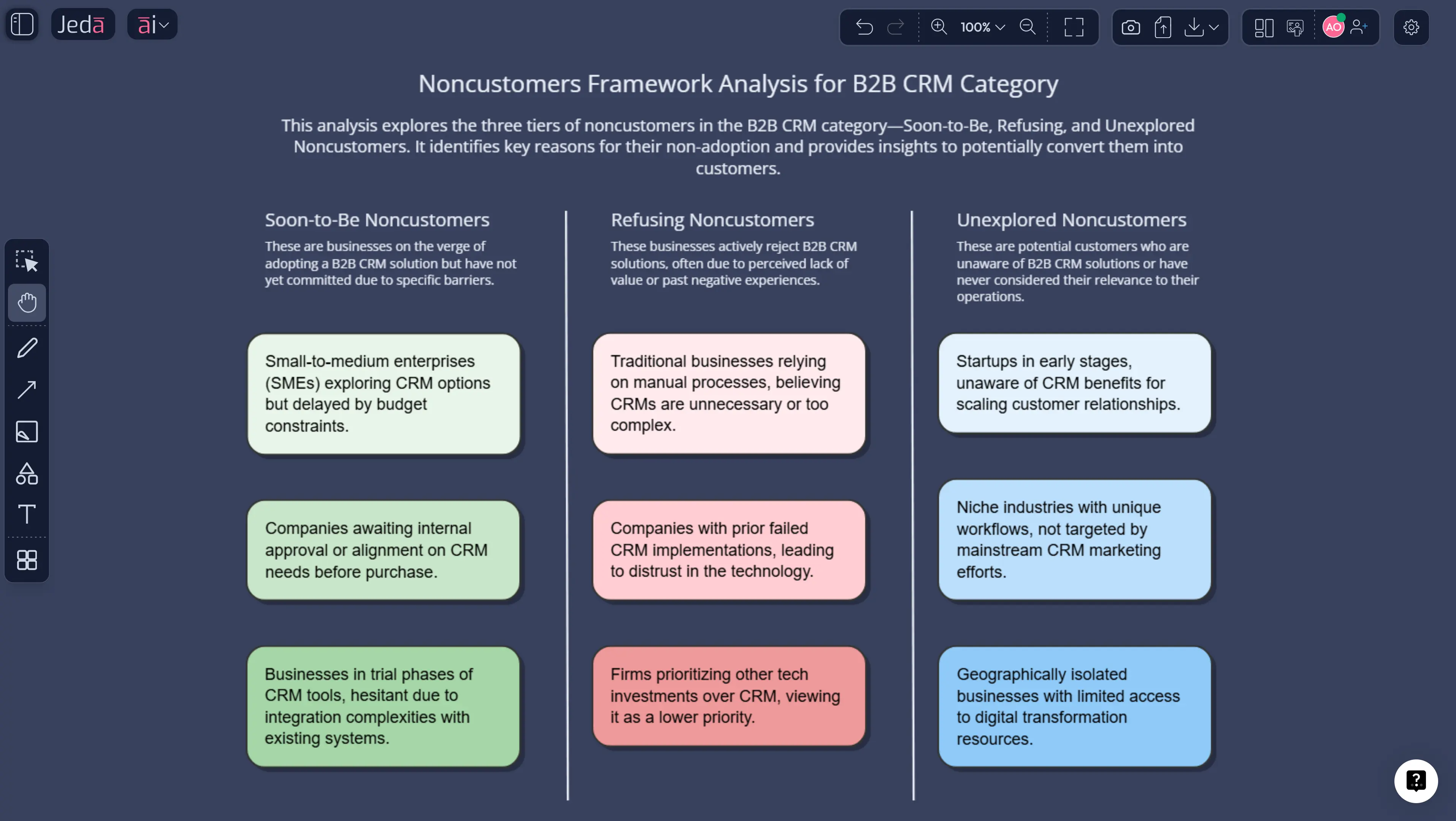
What are the Three Tiers of Noncustomers?
The Three Tiers of Noncustomers framework was developed by W. Chan Kim and Renée Mauborgne to help organizations identify the latent demand beyond their existing customer base. Rather than focusing only on current users, the framework pushes teams to understand who does not buy from the industry and why.
The three tiers are:
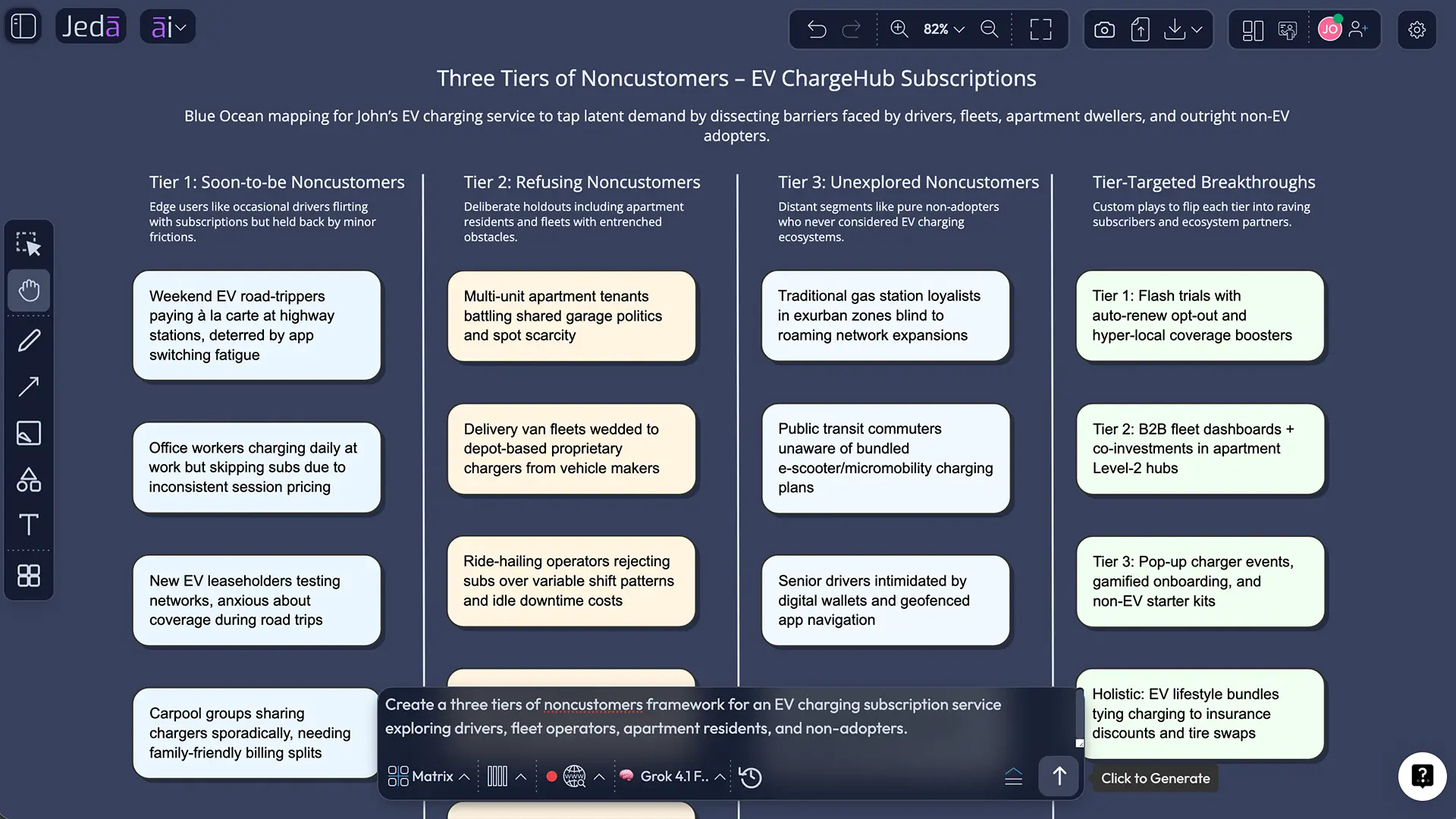
- First tier: soon-to-be noncustomers who sit on the edge of the market and buy minimally out of necessity
- Second tier: refusing noncustomers who have considered the industry’s offer and deliberately chosen against it
- Third tier: unexplored noncustomers who have never seen the industry’s offer as a relevant option at all
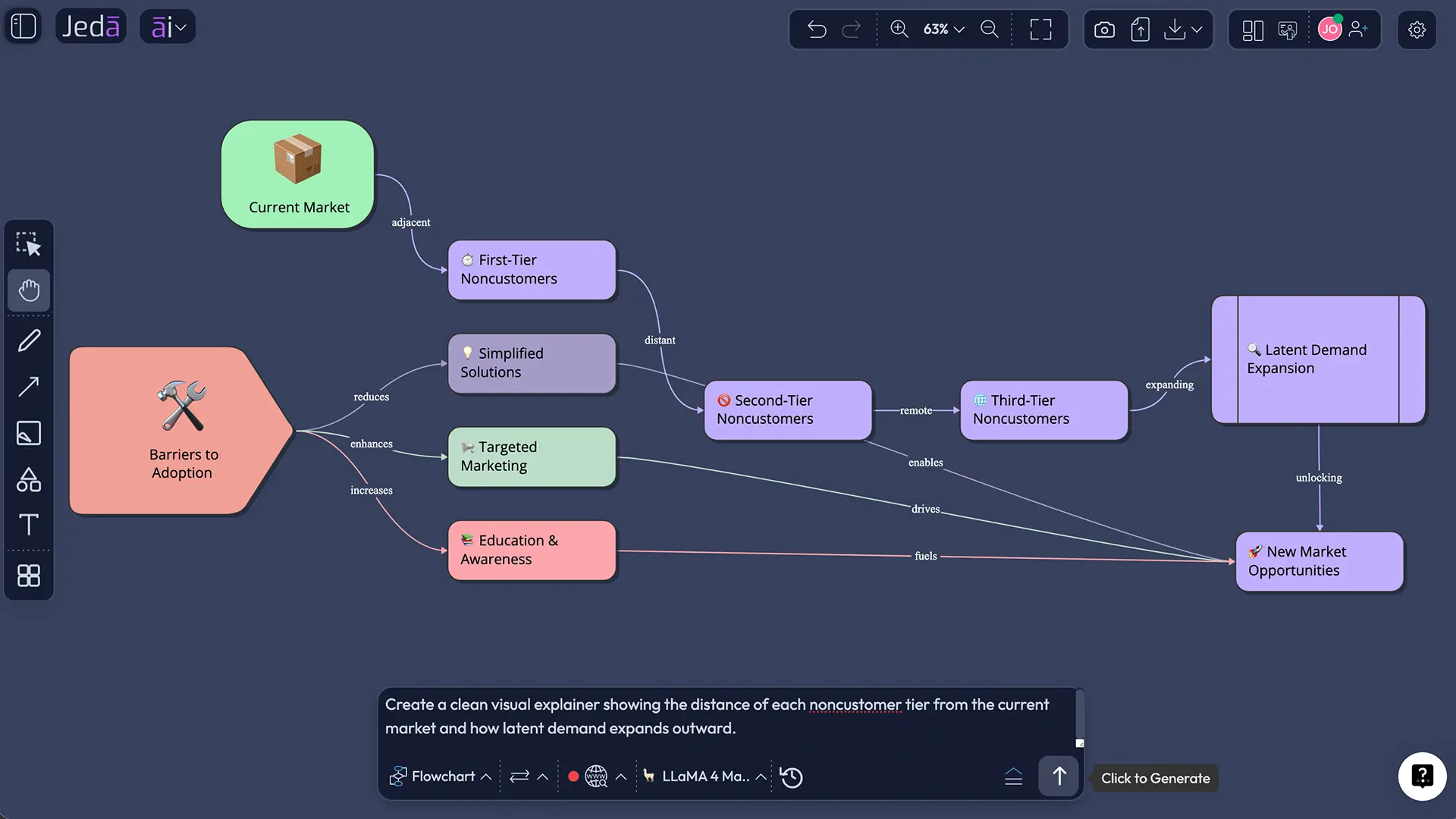
That structure matters because not all noncustomers are equally distant. The first tier sits closest to conversion. The third tier often points to the most surprising expansion possibilities.
Kim and Mauborgne argue that companies often know very little about these groups even though they can represent a larger pool than the current customer base. Their advice is straightforward and slightly heretical if you grew up on customer-centric slogans: noncustomers first.
Why use the Three Tiers of Noncustomers with AI?
Because noncustomer analysis is messy. People refuse categories for different reasons. Some are trapped by cost. Others by complexity, status signals, timing, trust, or plain indifference. AI helps sort that mess into patterns without oversimplifying it too early.
Inside Jeda.ai, you can generate the first version of the three tiers, cluster reasons for nonconsumption, compare adjacent segments, and use the AI+ button to extend each tier into opportunities, risks, and new value propositions. That makes the framework much more useful than a static diagram pasted into a presentation.
- Clearer latent-demand mapping
Use AI to group noncustomers by proximity, refusal logic, and unmet value instead of treating everyone outside the category as one vague opportunity pool.
- Faster pattern recognition
Turn messy interview notes, market observations, or segment lists into structured first-tier, second-tier, and third-tier insights.
- Stronger expansion hypotheses
Use AI+ to turn each tier into a practical move: what to redesign, what to simplify, what to bundle, and what new market to test.
- One connected board
Keep noncustomer analysis beside your strategy canvas, Four Actions Framework, and positioning notes in the same Jeda.ai AI Whiteboard.
This is where Jeda.ai fits well. The framework is not just descriptive. It is generative. Once you see why people remain outside the category, you can start designing for what they value in common. The key phrase is “in common.” Blue-ocean growth does not usually come from hyper-segmentation. It comes from identifying common value across overlooked groups.
How to create the Three Tiers of Noncustomers in Jeda.ai
This framework is part of the Blue Ocean Framework recipe flow in Jeda.ai, so the AI Menu path is the recommended method. The Prompt Bar version is excellent when you already know the market and want a more custom, more pointed draft.
Method 1: Recipe Matrix
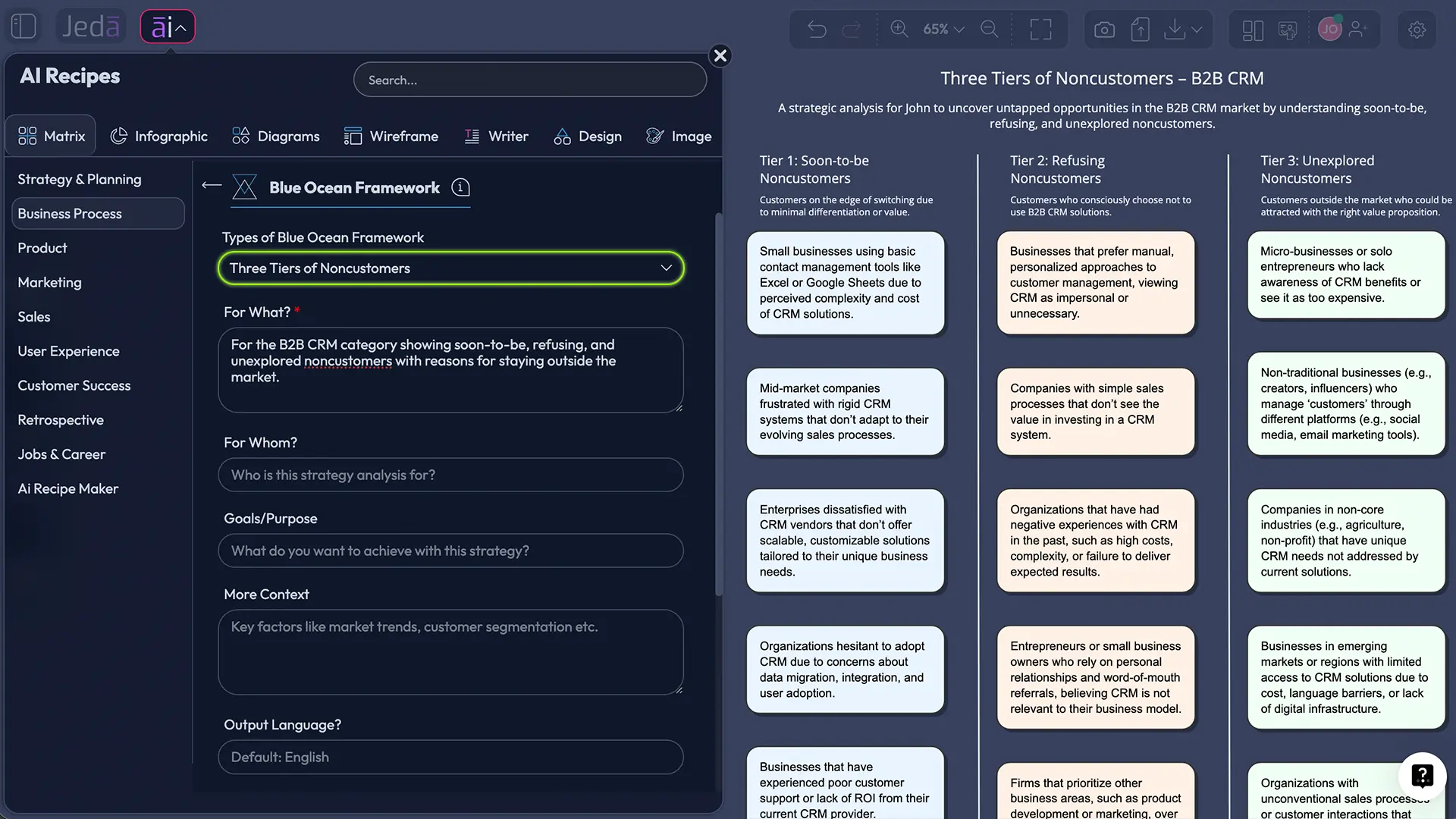
Open Jeda.ai, enter your AI Workspace, and click AI Menu in the top-left corner. Under Strategy & Planning, choose Blue Ocean Framework, then select Three Tiers of Noncustomers. Add your market context, target industry, and the growth question you are trying to answer. Choose your layout and AI model, then generate the matrix.
This method works well when you want a structured view of who is outside the market and why.
Method 2: Prompt Bar
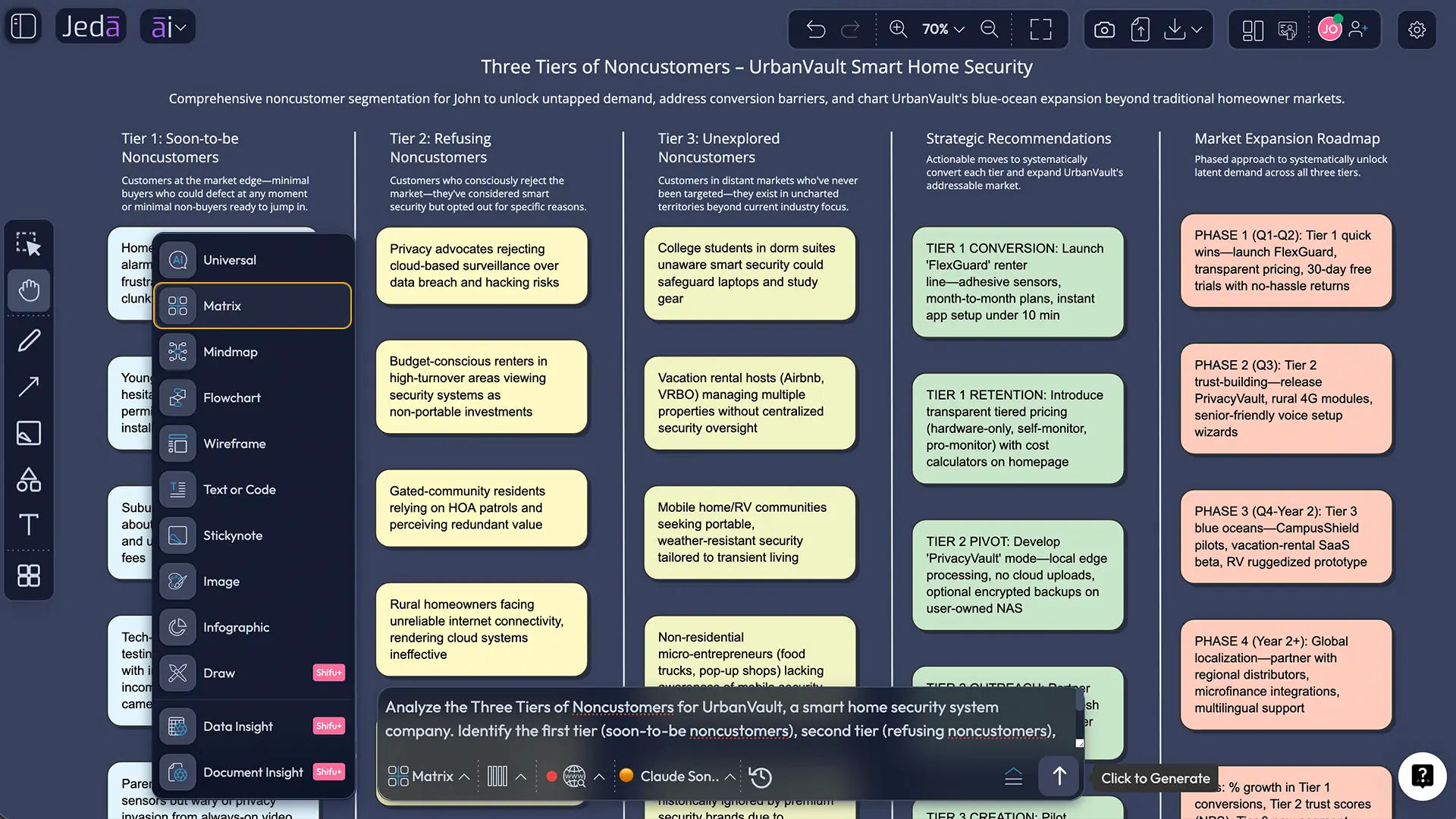
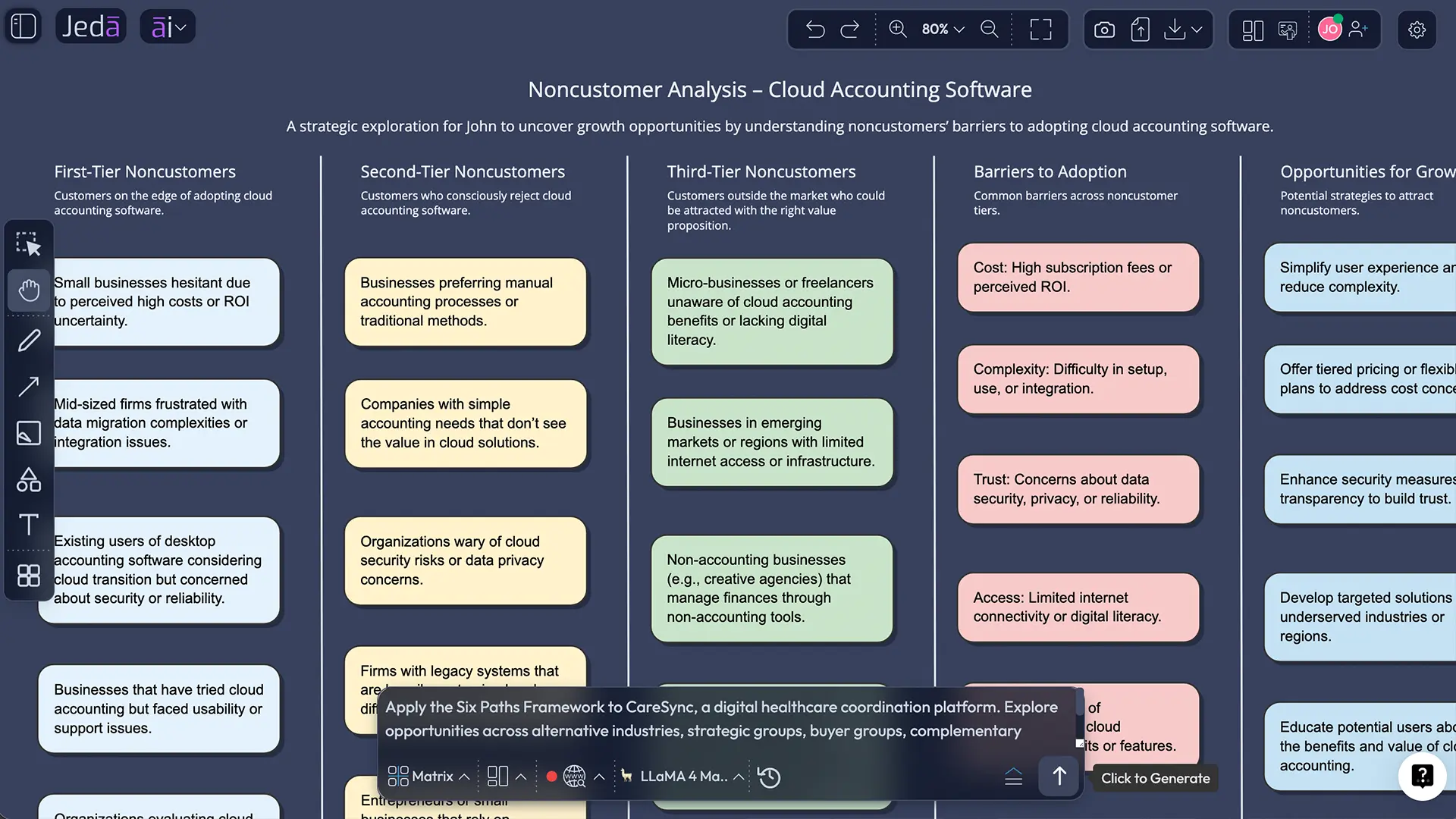
Open the Prompt Bar, select the Matrix command, and write a prompt that names the category and asks for tiered noncustomer analysis. For example: “Create a Three Tiers of Noncustomers framework for cloud accounting software, identifying soon-to-be, refusing, and unexplored noncustomers and the major reasons each group stays outside the category.”
Then refine the output. Merge redundant groups. Clarify why each tier is outside the market. Use AI+ to extend the strongest tier into offer ideas, messaging changes, or new distribution models. If you want a different visual structure afterward, use Vision Transform. The board remains editable inside Jeda.ai and can be exported as PNG, SVG, or PDF.
- Open your AI Workspace
Log in to Jeda.ai and enter the workspace where you want to map noncustomers.
- Select the Blue Ocean recipe
Use AI Menu, open Strategy & Planning, choose Blue Ocean Framework, and select Three Tiers of Noncustomers.
- Define the market
Describe the industry, target segment, and the growth question or adoption challenge your team wants to solve.
- Generate the first tiered map
Pick the layout and AI model, then generate a board showing soon-to-be, refusing, and unexplored noncustomers.
- Clarify reasons for nonconsumption
Edit each tier so the barriers are explicit, concrete, and based on actual buyer logic rather than generic labels.
- Run a custom Prompt Bar version
Select the Matrix command and generate a second draft with tighter prompts, sharper segments, or new market evidence.
- Use AI+ to extend the opportunity
Select the strongest tier and use the AI+ button to turn it into offer ideas, GTM changes, or adjacent-market hypotheses.
- Keep, transform, or export
Keep the framework live in Jeda.ai, use Vision Transform if needed, and export the board as PNG, SVG, or PDF when ready.
Three Tiers of Noncustomers template and example
The CRM software case is a classic one for a reason. It shows how noncustomer logic can reveal a market that incumbents barely noticed.
For years, CRM vendors focused on large business clients that could afford complex on-premise systems, long implementation cycles, and heavy customization. According to Kim and Mauborgne’s later noncustomer analysis, the first tier included buyers who used these systems minimally and grudgingly. They were in the market, but only just.
The second tier included organizations that had considered CRM but refused it because cost, complexity, implementation burden, and poor usability pushed them away.
The third tier included small businesses and entrepreneurs who never saw enterprise CRM as a realistic option at all. Their workaround tools lived elsewhere: spreadsheets, manual notes, and lightweight databases.
That reframing matters because it changes the growth question. The issue is no longer “How do we sell more to the existing CRM buyer?” It becomes “How do we design an offering that removes the barriers keeping adjacent buyers outside the category?”
Salesforce is often cited as a blue-ocean example because it helped transform CRM from a heavy, high-friction software category into an accessible cloud-based service. The point is not to copy Salesforce’s product. The point is to notice the move: it rethought what noncustomers valued and redesigned the offer accordingly.
Inside Jeda.ai, you can run that same logic on your own market, keep the tiers visible beside the reasons for refusal, and connect the findings directly to a strategy canvas or Four Actions Framework in the same AI Workspace.
Best practices for using the Three Tiers of Noncustomers well
The framework is simple to draw and easy to misuse. A few practices help keep it sharp.
Work these habits into the board:
And be careful not to force every outside group into the three tiers just because it looks tidy. The goal is clarity, not false neatness.
Common mistakes to avoid
One mistake is treating competitors’ customers as your only noncustomers. That is much too narrow. Noncustomers are people or organizations outside the industry’s current demand pool, not just buyers who chose a rival.
Another is creating tiers without explaining the barrier that keeps each tier out. Without that barrier logic, the framework turns into a weak segmentation chart.
A third problem is focusing only on the first tier because it feels safer. First-tier conversion can matter. But the bigger blue-ocean play often lives in the second and third tiers.
Teams also stumble when they identify the noncustomers correctly but fail to redesign the delivery, distribution, or status logic needed to bring them in. The Tata Nano story is a warning here: a market insight can be right and the execution still fail badly.
And sometimes companies over-segment too fast. They start with a useful noncustomer map and then slice it into tiny micro-personas until the strategic opening disappears. That is the corporate version of overthinking yourself out of a good idea.
Frequently asked questions
- What are the Three Tiers of Noncustomers?
- The Three Tiers of Noncustomers is a Blue Ocean Strategy framework developed by W. Chan Kim and Renée Mauborgne. It groups noncustomers into soon-to-be, refusing, and unexplored tiers so teams can understand latent demand beyond the current market.
- Why focus on noncustomers instead of current customers?
- Because current customers often keep teams inside the market’s existing logic. Noncustomer analysis helps reveal overlooked demand, hidden barriers, and shared value drivers that can support a genuine market-creating move rather than an incremental improvement.
- Can I create a Three Tiers of Noncustomers framework with AI?
- Yes. In Jeda.ai, you can generate the framework through the Blue Ocean Framework recipe or by using the Matrix command in the Prompt Bar. AI can help structure tiers, cluster refusal reasons, and extend the analysis with AI+.
- What is the first tier of noncustomers?
- The first tier includes soon-to-be noncustomers who sit on the edge of the market. They buy only minimally, often out of necessity, and are usually waiting for something better or easier.
- What is the second tier of noncustomers?
- The second tier includes refusing noncustomers. These buyers have considered the industry’s offering but decided against it, often because of cost, complexity, poor fit, bad user experience, or better alternatives elsewhere.
- What is the third tier of noncustomers?
- The third tier includes unexplored noncustomers who have never viewed the industry’s offer as a relevant option. They often use other categories, improvised workarounds, or no formal solution at all.
- What comes after identifying noncustomers?
- The next step is to identify the common value these groups want and redesign the offer, distribution, or business model around that insight. In practice, teams often connect this framework to a strategy canvas or Four Actions Framework.
- Why build this in an AI Whiteboard?
- Because noncustomer analysis gets stronger when the tiers, barriers, evidence, and resulting strategy ideas stay visible together. An AI Whiteboard keeps that chain of reasoning editable and collaborative rather than flattening it into a summary slide.
Sources & further reading
- [1]
Kim, W. Chan; Mauborgne, Renée (2004) . “Blue Ocean Strategy” Harvard Business Review.
View Source ↗ - [2]
Kim, W. Chan; Mauborgne, Renée (2026) . “Three Tiers of Noncustomers” Blue Ocean Strategy Tools and Frameworks.
View Source ↗ - [3]
Kim, W. Chan; Mauborgne, Renée; Ji, Mi (2022) . “How to Create Your Blue Ocean Through Noncustomer Analysis” Blue Ocean Strategy Blog / INSEAD Knowledge.
View Source ↗ - [4]
Kim, W. Chan; Mauborgne, Renée (2004) . “Value Innovation: The Strategic Logic of High Growth” Harvard Business Review.
View Source ↗
This page works best when linked with Blue Ocean Strategy with AI, Strategy Canvas with AI, Four Actions Framework with AI, and Six Paths Framework with AI. For product context, see /ai-workspace and /ai-whiteboard.
Map noncustomers in Jeda.ai
Join over 150,000+ users who use Jeda.ai's AI Workspace and AI Whiteboard to uncover latent demand, rethink market boundaries, and turn outside demand into editable strategy boards.
Try Free Template