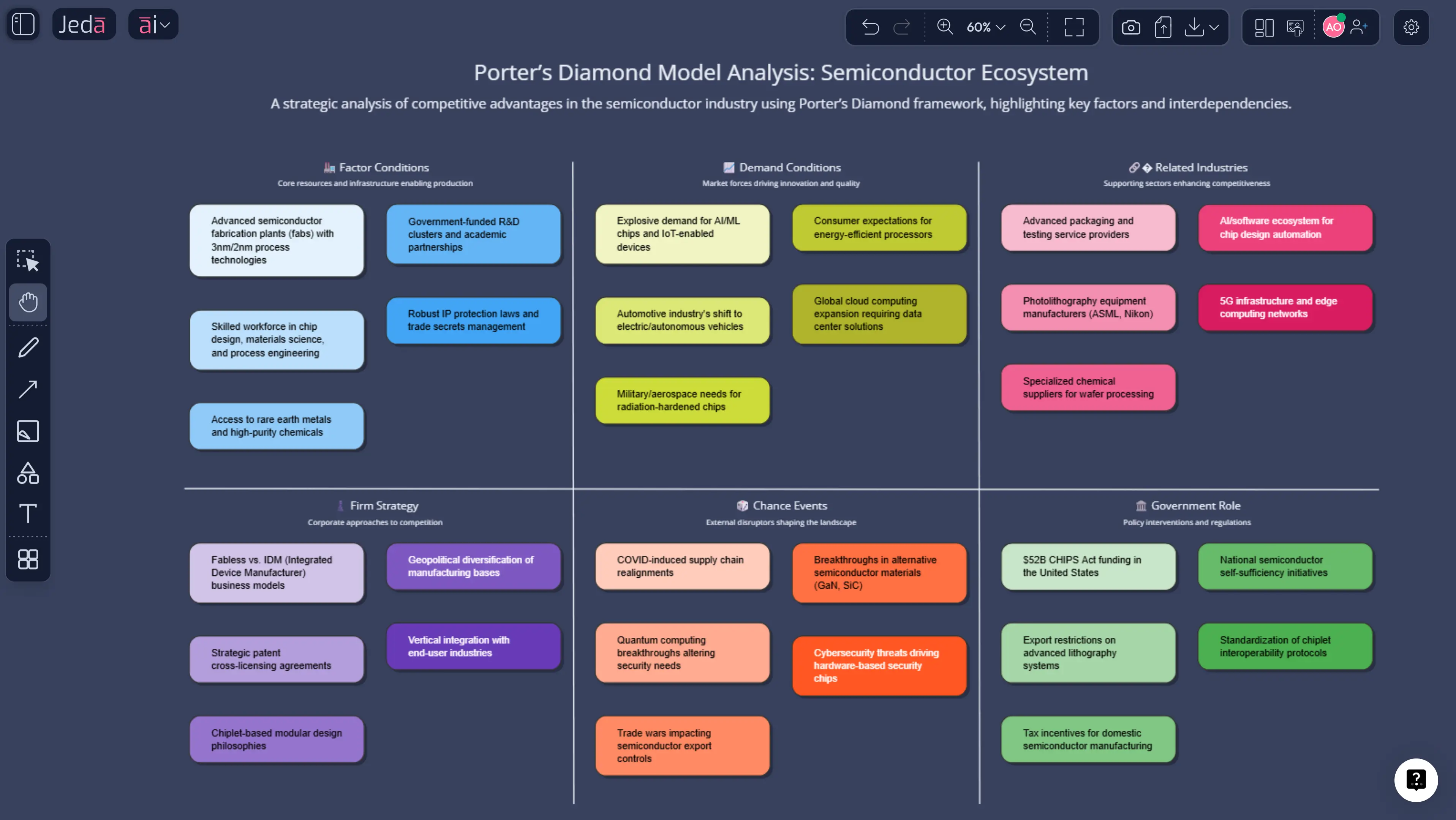
Porter’s Diamond Model with AI is one of those frameworks people quote when they want to sound strategic about regions, nations, and industrial strength. But when you actually use it well, it does something more practical: it helps you see competitiveness as a system of conditions, pressures, and reinforcing relationships rather than a single headline like “cheap labor” or “strong innovation.” In Jeda.ai, you can build that system inside one AI Workspace, keep the interconnections visible on an editable AI Whiteboard, and turn a messy competitiveness discussion into a board your team can actually reason with.
That matters because the Diamond Model is often flattened into a diagram with four labels and zero insight. Porter’s point was never that one factor explains national or regional advantage. He argued that advantage is created, not inherited, and that it emerges from a set of mutually reinforcing conditions. Inside Jeda.ai, you can start with a Recipe Matrix, map the determinants cleanly, extend one part using the AI+ button, and convert the board into a richer diagram when the story needs to show feedback loops. With 150,000+ users, 300+ strategic frameworks, and a practical Visual AI workflow, Jeda.ai gives the Diamond Model something it badly needs in most workshops: structure with enough flexibility to think.
This article also belongs beside Jeda.ai’s AI Workspace, AI Whiteboard, Porter’s Cluster Theory, Porter’s Five Forces, and Porter’s Value Chain pages, because national or regional competitiveness rarely makes sense in isolation.
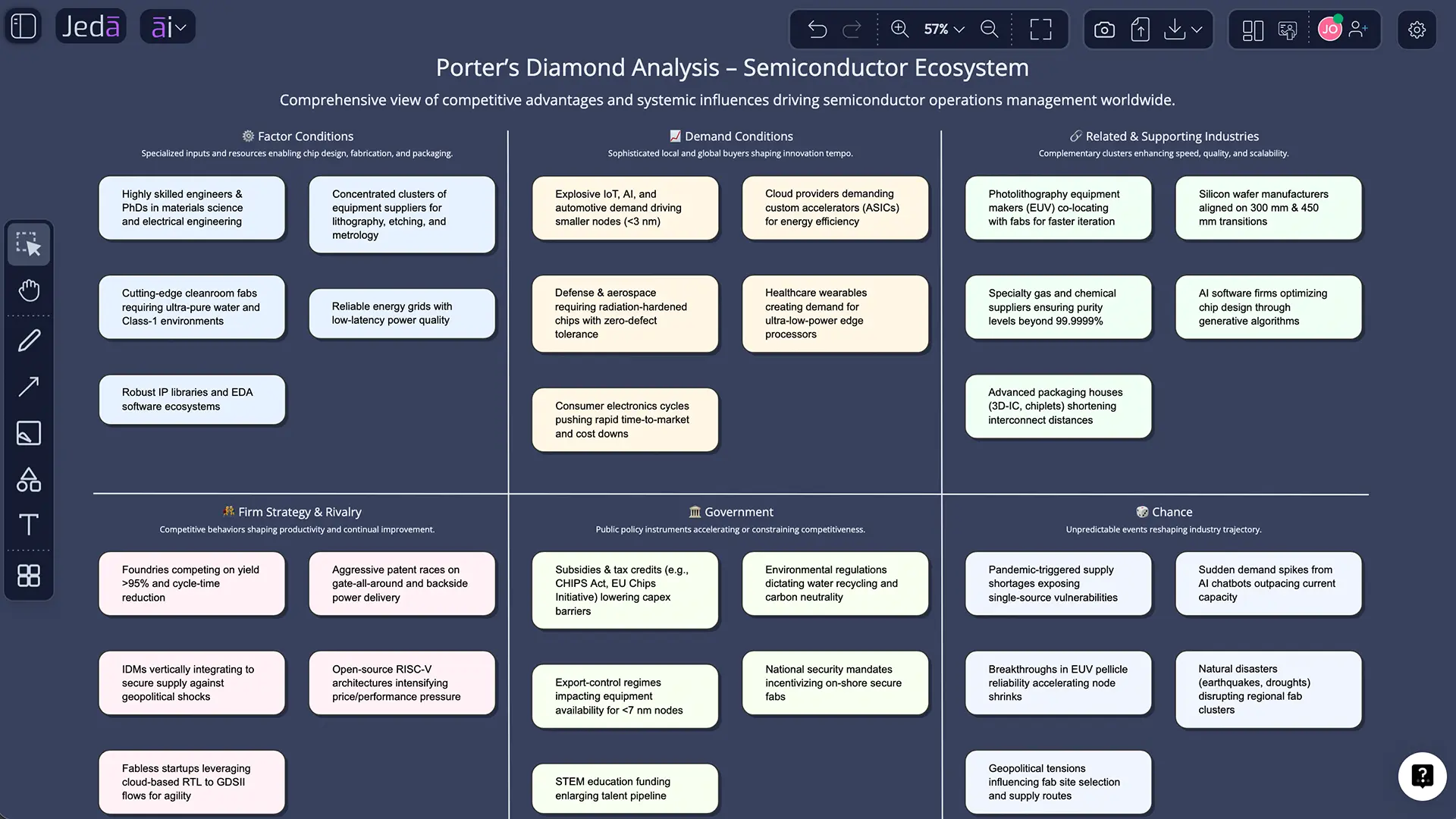
What is Porter's Diamond Model?
Porter’s Diamond Model is a framework for explaining why certain industries within certain nations or regions become internationally competitive. Michael Porter introduced it in The Competitive Advantage of Nations in 1990 after a multi-country study of how industry success is shaped. The framework centers on four core determinants:
- Factor conditions
- Demand conditions
- Related and supporting industries
- Firm strategy, structure, and rivalry
Porter also discussed the role of government and chance as important influences on how the system evolves.
What makes the model durable is not the labels. It is the logic of interaction.
Factor conditions
These are not just natural resources. Porter cared especially about created factors such as skilled labor, infrastructure, technical knowledge, specialized suppliers, research capacity, and institutional depth.
Demand conditions
Local demand can shape firm capability by forcing companies to satisfy sophisticated, demanding, or early-adopting customers. Tough home-market customers can be annoying. They can also be a gift.
Related and supporting industries
Clusters of capable suppliers, adjacent sectors, service providers, and knowledge institutions create spillovers, speed, and mutual reinforcement. Innovation rarely happens in a vacuum.
Firm strategy, structure, and rivalry
The local context of competition matters. Strong domestic rivalry can force firms to improve faster. Managerial norms, ownership structures, and organizational expectations also shape how firms compete.
Government and chance
Government policy can strengthen or weaken the system through education, infrastructure, regulation, trade policy, and innovation support. Chance events — wars, breakthroughs, shocks, major discoveries, geopolitical realignments — can also change the diamond dramatically.
Why use Porter's Diamond Model with AI?
Because the Diamond Model is a system framework. Systems get messy fast.
AI helps because it can structure the determinants, surface the interactions among them, and make it easier to test whether a cluster, region, or national industry really has reinforcing advantages or just one loud talking point. You still need judgment. You still need evidence. But you do not need to spend your energy arranging boxes while the real debate slips away.
- System-level visibility
Jeda.ai helps teams see competitiveness as an interconnected system instead of four isolated labels copied from a textbook slide.
- Better ecosystem analysis
You can map universities, suppliers, infrastructure, regulations, talent, and local rivalry on one board without losing the underlying Porter structure.
- AI+ for determinant deep dives
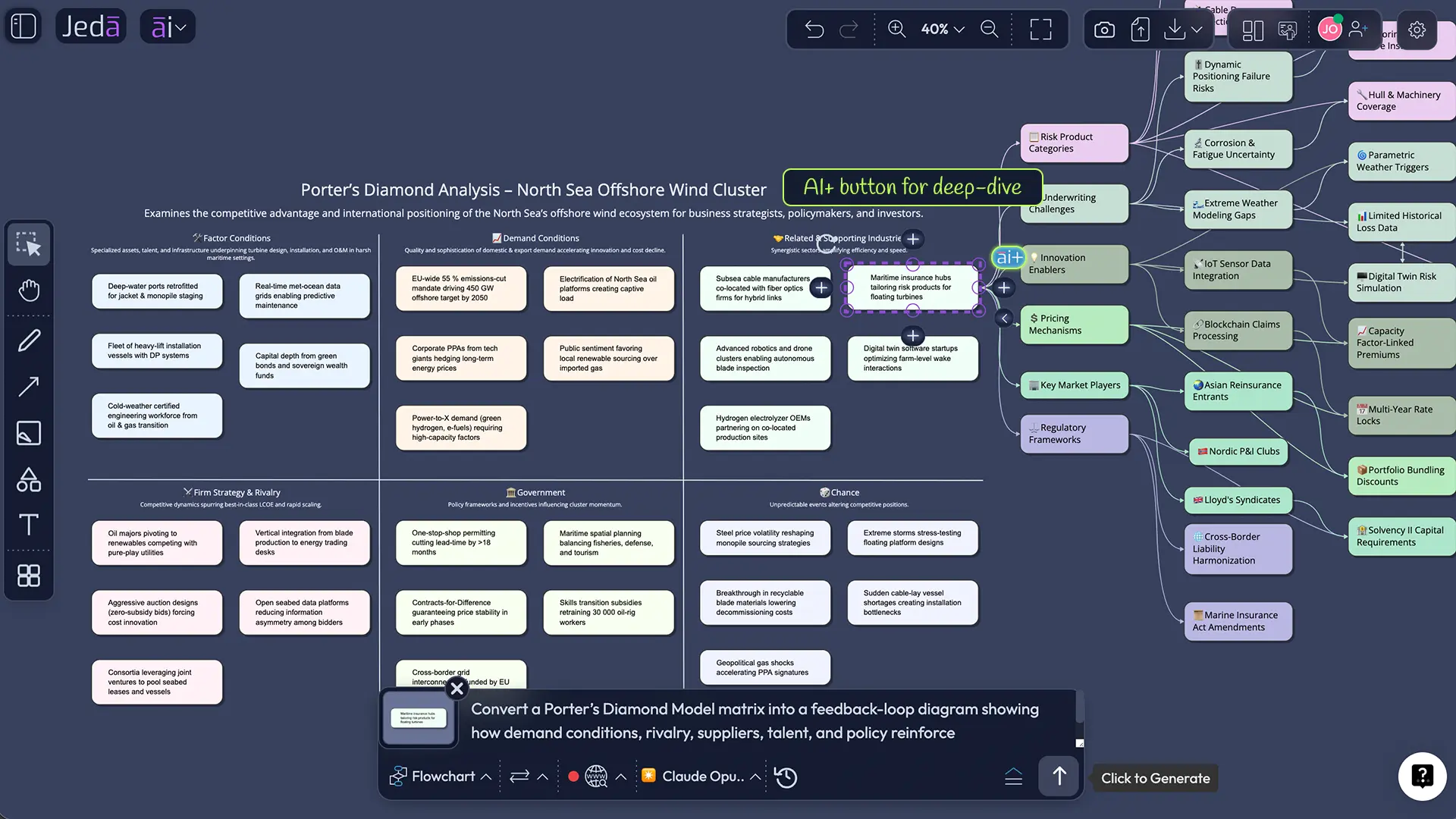
Use AI+ after the matrix exists to expand one determinant, stress-test a weak link, or explore how a policy change might shift the whole system.
- Feedback-loop thinking
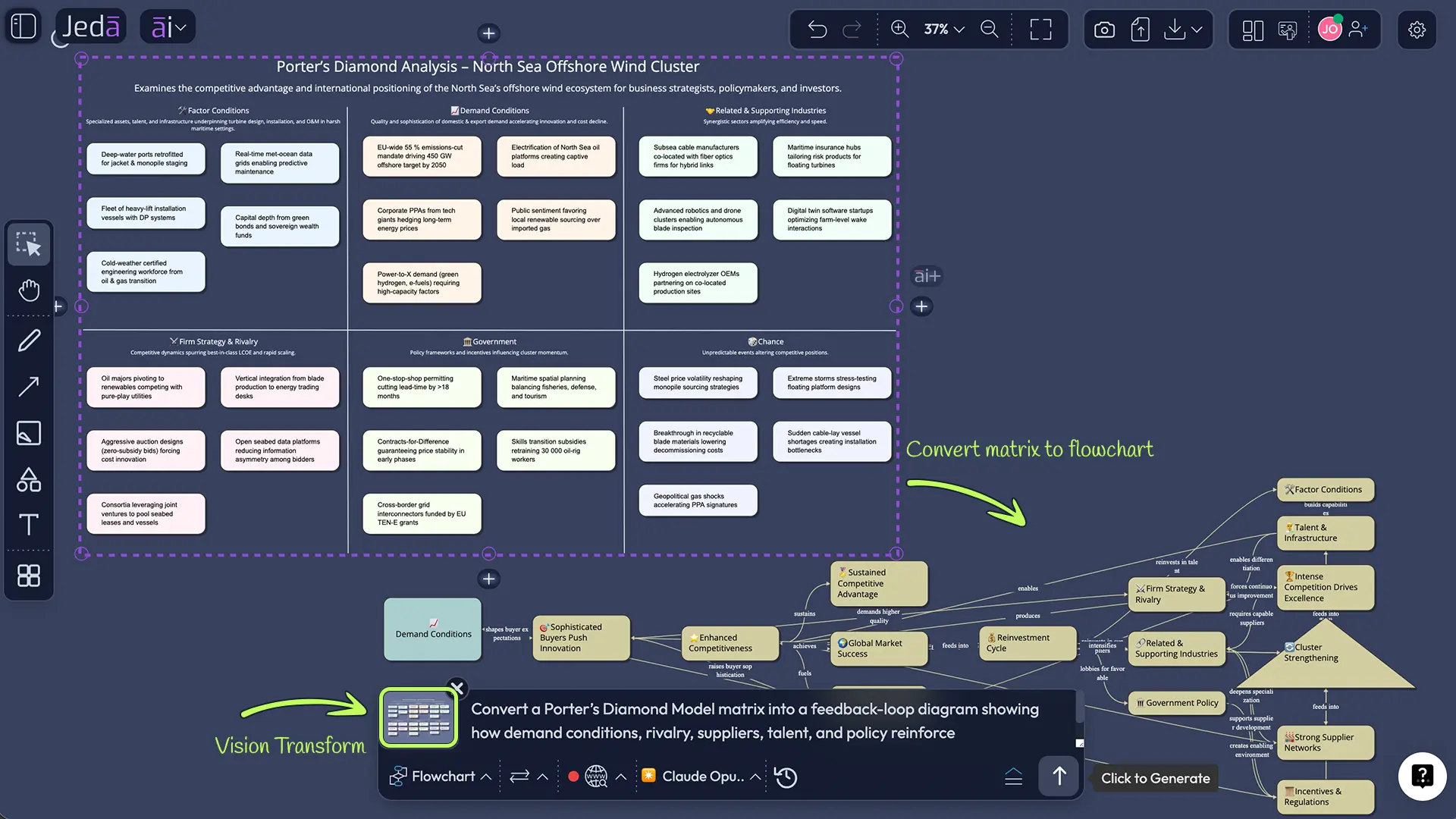
Start in Matrix, then convert to Diagram if you want to show reinforcement, bottlenecks, or how one determinant changes another over time.
- Shared reasoning on one board
Consultants, policy teams, founders, and analysts can challenge the same assumptions inside one AI Whiteboard instead of arguing from disconnected slides.
- Regional and national flexibility
The same workflow can be adapted for countries, regions, cities, or sector ecosystems as long as the scope is defined with discipline.
And here is the underappreciated benefit: the board helps you resist lazy explanations. “They win because labor is cheaper” sounds neat. So does “the government invested heavily.” Real competitiveness is usually more tangled, and therefore more interesting.
How to create Porter's Diamond Model in Jeda.ai
Method 1: Recipe Matrix
Use the recipe-led matrix when you want a clean competitiveness board with the determinants clearly labeled from the start.
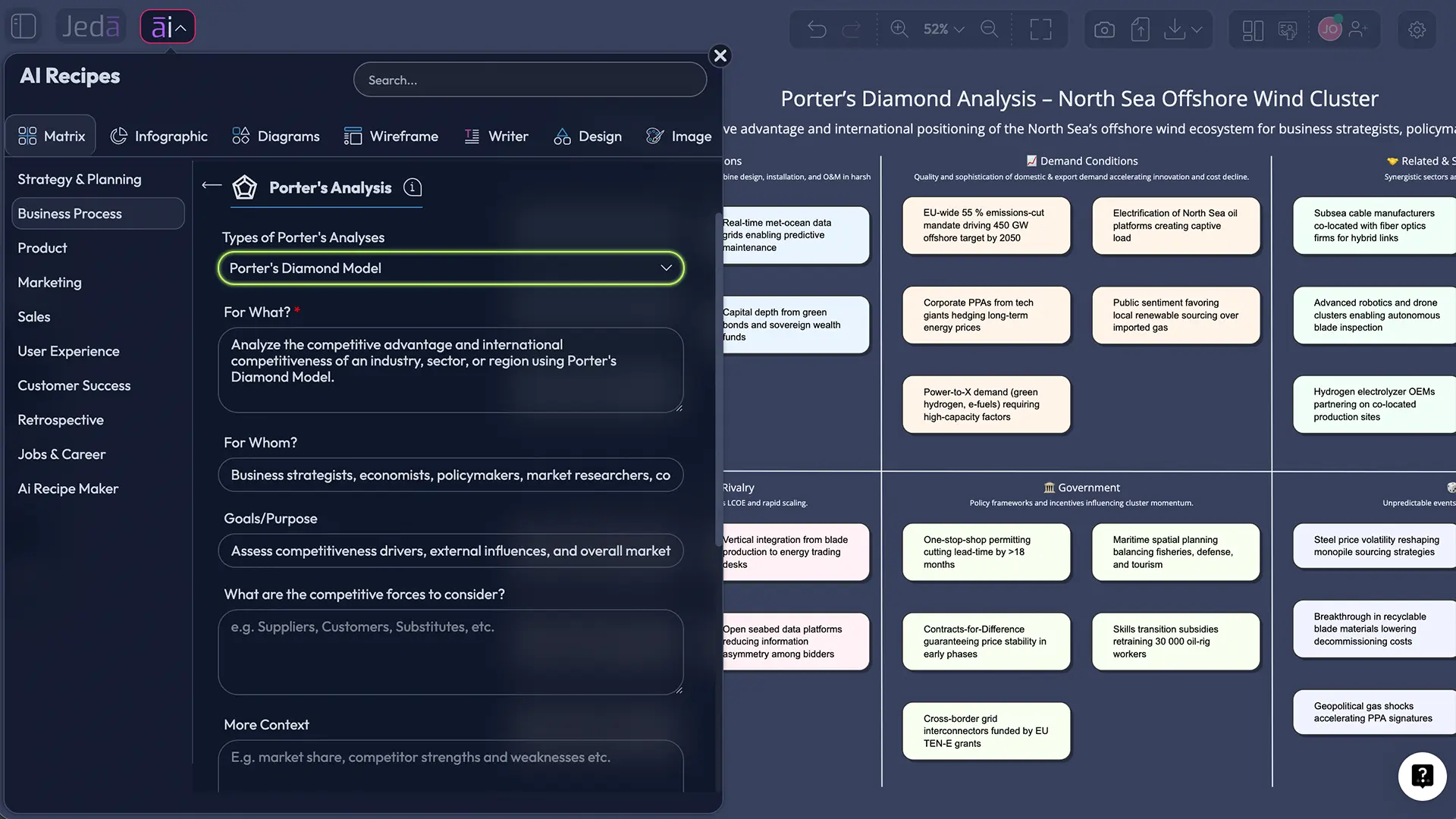
- Open the AI Menu and choose the Matrix recipe
Open the AI Menu on the canvas, go to Matrix Recipes, and select the Porter’s Diamond Model recipe.
- Define the scope tightly
Specify whether the board is about a nation, region, city, or industry ecosystem. Add the sector, time horizon, and the strategic question you want to answer.
- Generate the diamond structure
Ask Jeda.ai to organize the board around factor conditions, demand conditions, related and supporting industries, and firm strategy, structure, and rivalry, with notes for government and chance.
- Replace broad claims with evidence
Edit each determinant with real indicators such as talent depth, infrastructure, domestic sophistication, supplier quality, research intensity, rivalry, and policy conditions.
- Mark reinforcing loops
Show how one determinant strengthens or constrains another. Strong local demand may push firms to innovate, which then strengthens suppliers and regional talent attraction.
- Use AI+ to deepen a weak or contested determinant
Once the board exists, select one determinant and use AI+ to continue the analysis. AI+ works best after the structure is already on canvas rather than as a blank, unrelated request.
Method 2: Prompt Bar
The Prompt Bar is the better route when the ecosystem is unusual or when you want a more customized analytical angle.
Open the Prompt Bar. Select the Matrix command. Then use a prompt like this:
Create a Porter’s Diamond Model analysis for the semiconductor ecosystem in Taiwan. Organize the board around factor conditions, demand conditions, related and supporting industries, and firm strategy, structure, and rivalry. Also include the role of government and chance, and conclude with the main sources of sustained competitiveness.
Then refine the draft with evidence. Add institutions, supplier depth, technical workforce, infrastructure, local customer sophistication, domestic rivalry, and policy interventions. Then use AI+ to expand one determinant or Vision Transform to turn the board into a feedback-loop diagram.

What a strong diamond analysis actually shows
A strong diamond analysis does not say, “This country is competitive because it has engineers.” That is too thin.
It asks whether the determinants reinforce each other.
Take a semiconductor ecosystem.
- Factor conditions: deep engineering talent, advanced fabs, logistics infrastructure, research capacity
- Demand conditions: demanding customers in electronics and advanced manufacturing, early pressure for quality and speed
- Related and supporting industries: equipment suppliers, design houses, materials firms, testing services, universities, research institutes
- Firm strategy, structure, and rivalry: intense local competition, export orientation, fast iteration, aggressive capability development
- Government: industrial policy, education investment, infrastructure support, regulatory coordination
- Chance: geopolitical shifts, technology transitions, or supply-chain shocks that redirect global demand and investment
Now the real question: do those determinants merely coexist, or do they create reinforcing pressure?
If demanding buyers push firms to improve, improvement strengthens suppliers, stronger suppliers speed innovation, faster innovation attracts more talent, and that talent raises the quality of future factor conditions, the system becomes self-reinforcing. That is where Porter’s model becomes useful.
At the same time, later critics were right to point out that the model has limits. It can underplay multinational networks, cross-border value chains, and the firm-level capabilities inside clusters. Those critiques matter. But they do not destroy the framework. They tell you to use the Diamond Model as a disciplined starting point rather than a final doctrine.
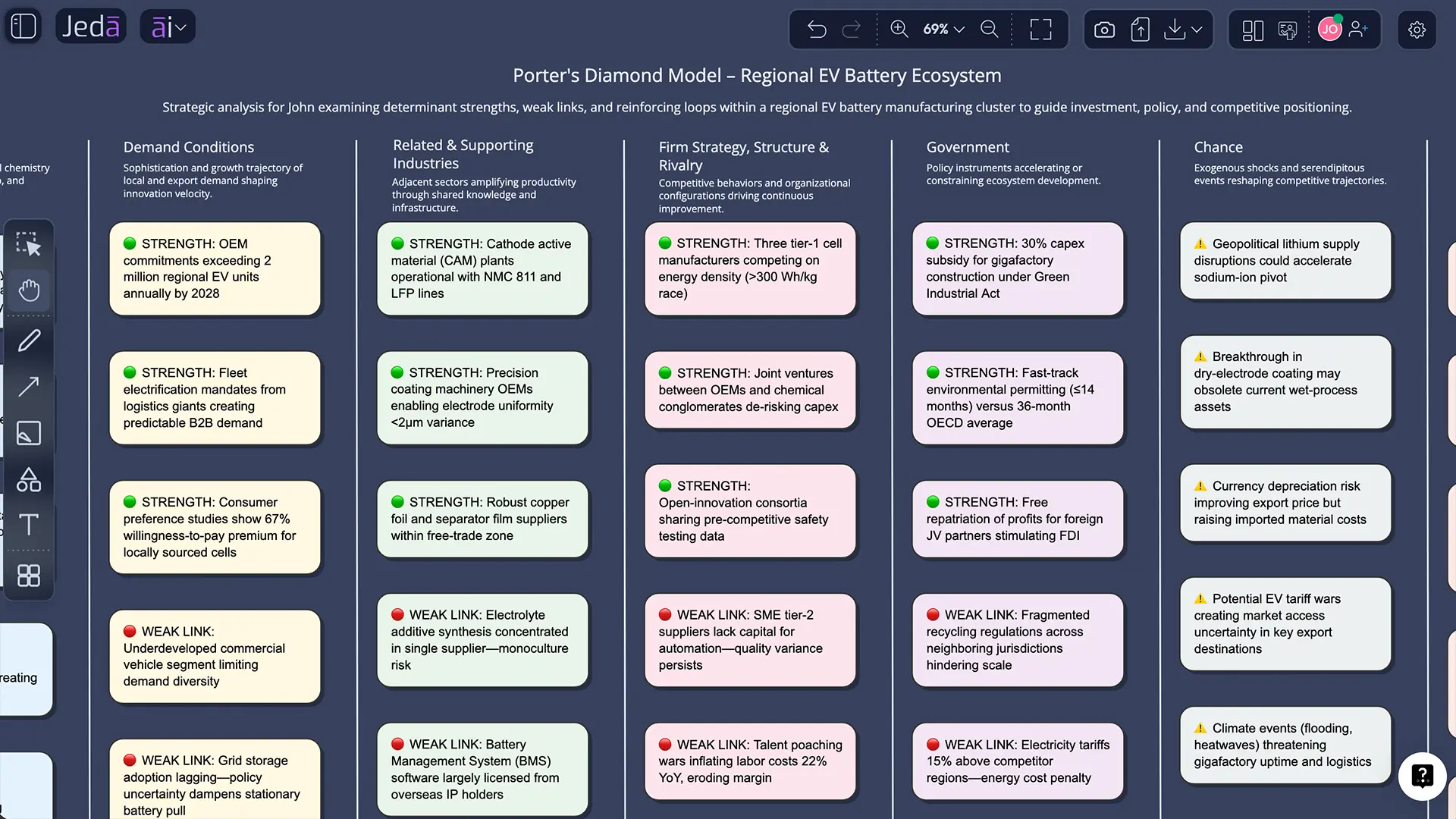
Best practices and tips
The best diamond work starts with scope discipline and ends with interaction logic.
One more thing. Domestic rivalry is easy to underestimate. Managers often see local competition as a nuisance. Porter saw it as a forcing function.
Common mistakes to avoid
The first mistake is using the model as a national brag sheet. That produces flattering noise, not analysis.
Second, teams reduce factor conditions to cheap labor or natural resources. Porter’s point was almost the opposite: advanced, created factors often matter more.
Third, they forget demand conditions. Sophisticated local demand can matter a great deal, especially in innovation-heavy industries.
Fourth, they describe the determinants without showing interaction. The model becomes much weaker when the system logic disappears.
And finally, they ignore the modern critiques. In globally networked industries, multinational firms, cross-border supply chains, and transnational capability systems can reshape the diamond. Pretending otherwise does not make the framework cleaner. It makes the analysis poorer.
Frequently Asked Questions
- What is Porter’s Diamond Model used for?
- Porter’s Diamond Model is used to analyze why certain industries within a nation or region become internationally competitive. It helps explain competitiveness through interacting ecosystem conditions rather than through a single factor.
- Who created Porter’s Diamond Model?
- Michael E. Porter introduced the model in The Competitive Advantage of Nations in 1990 as part of his broader work on strategy, competitiveness, and industrial advantage.
- What are the four determinants in Porter’s Diamond Model?
- The four core determinants are factor conditions, demand conditions, related and supporting industries, and firm strategy, structure, and rivalry. Government and chance are often included as important influences on the system.
- What is the role of government in the Diamond Model?
- Government is not one of the four core determinants, but it can shape them through education, infrastructure, regulation, trade policy, innovation support, and institutional design. It influences the system rather than replacing it.
- What does chance mean in Porter’s Diamond Model?
- Chance refers to unexpected events such as technological breakthroughs, shocks, wars, geopolitical changes, or sudden market shifts that can alter the trajectory of an industry or region in major ways.
- How is the Diamond Model different from cluster theory?
- They are closely related, but the Diamond Model is a broader competitiveness framework. Cluster theory zooms in more specifically on geographic concentrations of interconnected firms, suppliers, institutions, and spillovers.
- How does AI help with Porter’s Diamond Model?
- AI helps teams structure the determinants quickly, compare evidence across the ecosystem, map reinforcement among factors, and extend one determinant with AI+ inside Jeda.ai once the board already exists.
- Which Jeda.ai command works best for the Diamond Model?
- Start with the Matrix command or a Matrix recipe because the determinants are easiest to compare in a structured layout. Use Diagram afterward if you want to show reinforcement and feedback loops more clearly.
- Can I use AI+ to create a full Diamond Model board from scratch?
- AI+ is best used after an initial visual is already on the canvas. Create the first Diamond Model board first, then use the AI+ button to deepen one determinant or continue the analysis.
- What should come after a Diamond Model analysis?
- Often the next step is a cluster analysis, value-chain review, policy map, or industry strategy board that turns the competitiveness diagnosis into more concrete priorities and actions.
Sources & Further Reading
- [1]
Porter, Michael E. (1990) . “The Competitive Advantage of Nations” Harvard Business Review.
View Source ↗ - [2]
Porter, Michael E. (1990) . “The Competitive Advantage of Nations” Free Press / Harvard Business School.
View Source ↗ - [3]
Grant, Robert M. (1991) . “Porter’s ‘Competitive Advantage of Nations’: An Assessment” Strategic Management Journal.
View Source ↗ - [4]
Tsai, Pei-Hsuan, Chih-Jou Chen, and Ho-Chin Yang (2021) . “Using Porter’s Diamond Model to Assess the Competitiveness of Taiwan’s Solar Photovoltaic Industry” SAGE Open.
View Source ↗ - [5]
Rugman, Alan M., and Joseph R. D’Cruz (1993) . “An Extension and Correction of Porter’s Single Diamond Framework” Management International Review.
View Source ↗
Start Your Porter's Diamond Model Analysis Today
Join 150,000+ users who use Jeda.ai to map ecosystem competitiveness, test determinant interactions, and build clearer strategy boards inside one AI Workspace.
Try Free Template