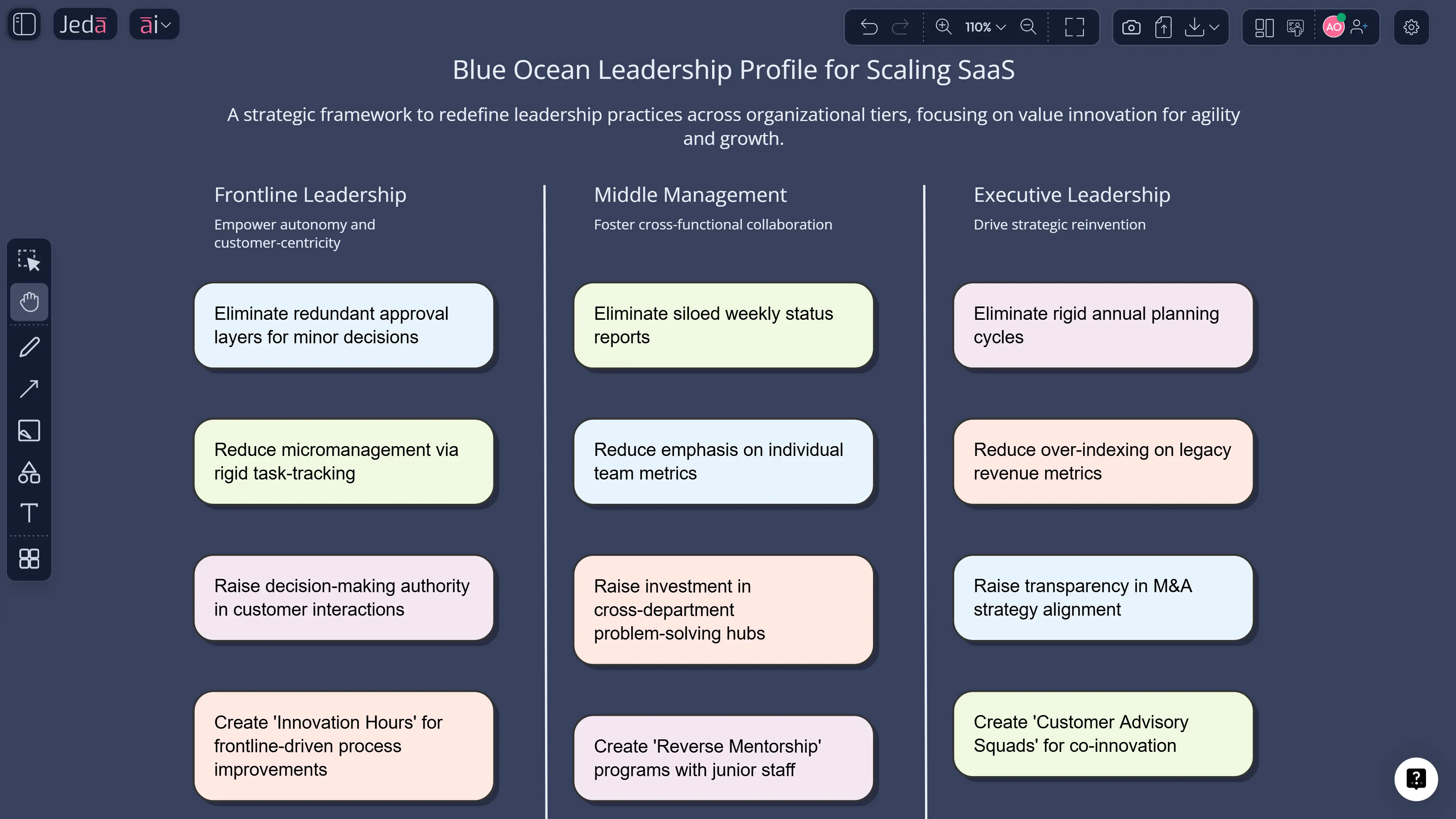
Most leadership frameworks sound better than they operate. They praise vision, values, and alignment, then leave people inside the organization to decode what any of that means in practice. Blue Ocean Leadership is different. It treats leadership as something people experience directly, almost like a service they either buy into or quietly reject. That single shift makes the framework more concrete than a lot of executive language deserves. In Jeda.ai, an AI Workspace and AI Whiteboard for editable strategy, Blue Ocean Leadership becomes much easier to map, compare, and improve.
W. Chan Kim and Renée Mauborgne introduced Blue Ocean Leadership as a practical way to unlock the unrealized talent and energy sitting inside organizations. Rather than focusing on abstract leadership traits, the framework looks at acts and activities across leadership levels. In other words, it asks what leaders do that people actually experience. That is a sharper question — and a harder one to dodge.
Inside Jeda.ai, teams can generate a Blue Ocean Leadership matrix, compare as-is and to-be leadership profiles, and use the AI+ button to extend specific changes into operating behaviors, meeting rhythms, or communication adjustments. Because Jeda.ai supports 300+ strategic frameworks in one Visual AI workspace and serves 150,000+ users, the framework can live next to other decision tools instead of floating as another disconnected leadership offsite artifact.
What is Blue Ocean Leadership?
Blue Ocean Leadership is a leadership framework that rethinks leadership from the perspective of those who are led. Kim and Mauborgne argue that leadership should be viewed as a set of acts and activities that can be observed, assessed, and improved, not as a vague bundle of personality traits.
That framing changes the conversation. A lot.
It means the question is not “Do we have inspiring leaders?” The question becomes “What do leaders at each level do that people experience as helpful, wasteful, energizing, or blocking?” Once leadership becomes observable, it becomes redesignable.
The framework is often operationalized through the Leadership Canvas and the Blue Ocean Leadership Grid, which help organizations map current and future leadership profiles. In Jeda.ai, you can turn that logic into a matrix-style board inside an AI Whiteboard, compare leadership acts across levels, and connect the work to broader strategic execution inside the same AI Workspace.
Why use Blue Ocean Leadership with AI?
Because leadership conversations are usually polluted by vagueness.
One group says the culture needs more empowerment. Another says accountability. Someone else says communication. Everyone leaves sounding sensible and nothing changes. AI helps because it can translate those fuzzy complaints into observable leadership acts that can actually be discussed, ranked, and redesigned.
In Jeda.ai, AI can help teams capture repeated leadership pain points, organize them by level, and identify patterns that cut across departments. More importantly, it can help generate as-is versus to-be views so the conversation moves away from complaint collection and toward redesign.
- Make leadership observable
Translate abstract complaints into visible acts and activities people experience every week.
- Compare leadership levels
Map frontline, middle-management, and executive leadership patterns on one board instead of mixing them into one vague diagnosis.
- Support practical dialogue
Keep leadership analysis in a shared AI Workspace where teams can refine language and compare evidence together.
- Extend with AI+
Use AI+ to convert leadership gaps into behaviors, routines, and experiments that teams can actually test.
That is the real win. Not another polished leadership diagram. A better operating conversation.
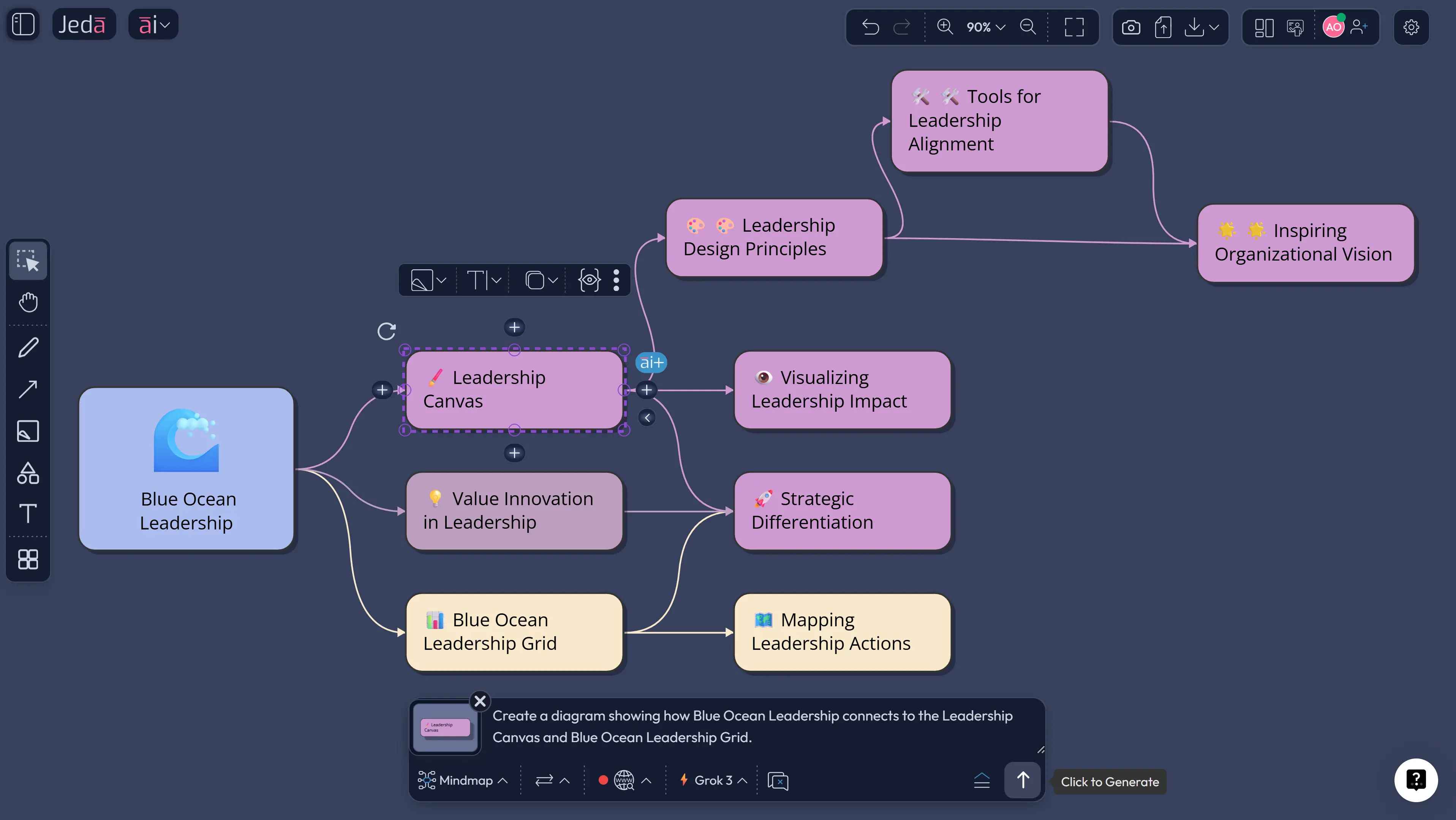
How to create Blue Ocean Leadership in Jeda.ai
Because Blue Ocean Leadership exists as a structured Jeda.ai recipe, the AI Menu is the recommended starting point. The Prompt Bar is useful when you want to tailor the matrix to a specific organization, function, or leadership layer.
Method 1: Recipe Matrix
Open Jeda.ai, enter the AI Workspace where you want to run the session, and click the AI Menu. Under Strategy & Planning, choose Blue Ocean Framework, then select Blue Ocean Leadership. Add the organization context, the leadership levels you want to analyze, and the behavioral concerns or goals you want considered. Then choose your layout and AI model.
This route is ideal for teams that want a structured first draft and a consistent visual format.
Method 2: Prompt Bar
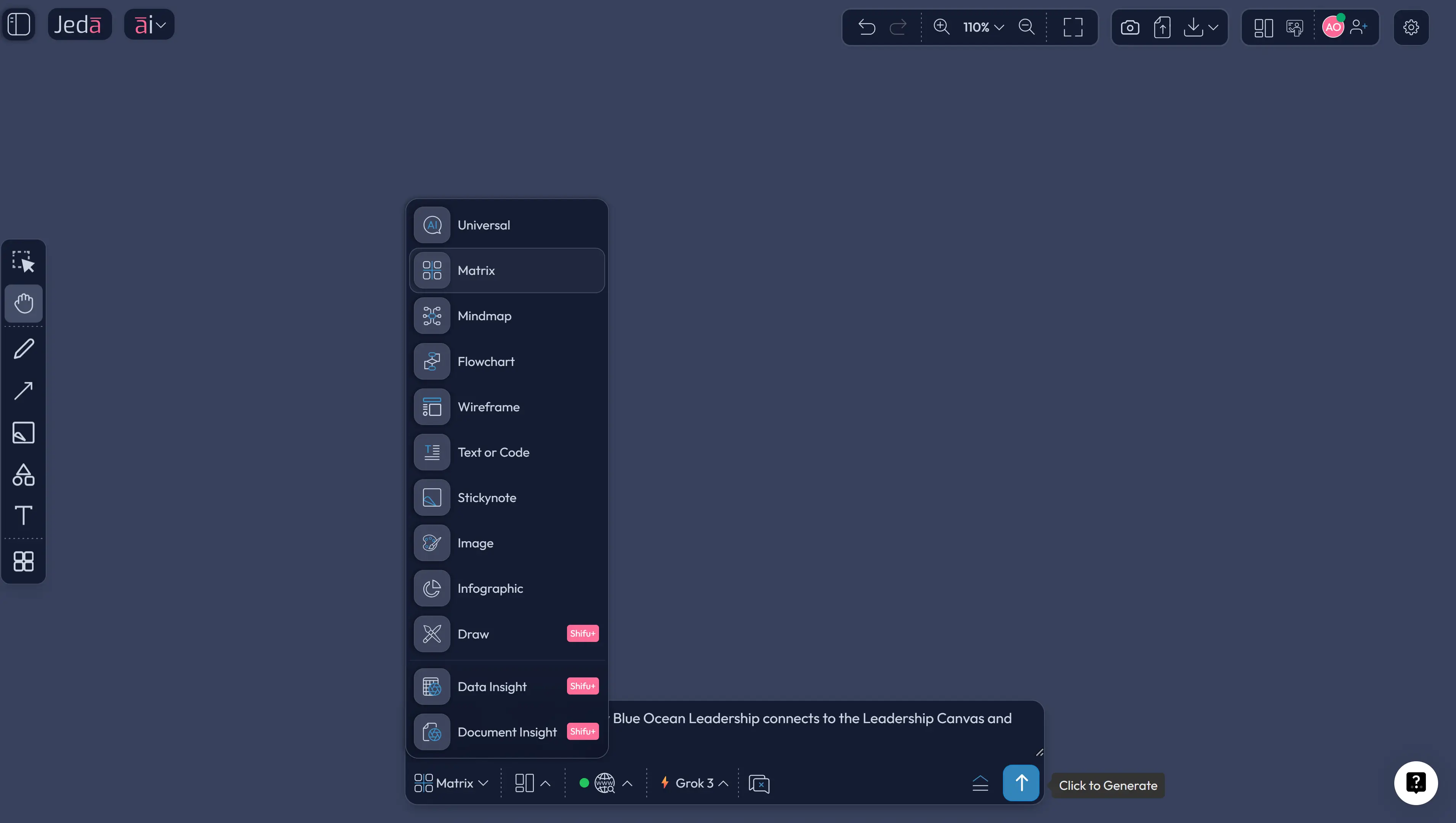
Open the Prompt Bar at the bottom of the canvas and select the Matrix command. Then write a prompt that names the organization context and the leadership levels to compare. For example: “Create a Blue Ocean Leadership matrix for a manufacturing company struggling with slow decisions, low frontline initiative, and communication gaps between plant managers and executives.”
After generation, edit the leadership acts directly on the board, use AI+ to deepen any leadership level or behavior cluster, and use Vision Transform if you want to convert the output into another visual type.
- Open your AI Workspace
Log in to Jeda.ai and enter the workspace where you want to build the Blue Ocean Leadership board.
- Choose the Blue Ocean recipe
Click AI Menu, open Strategy & Planning, choose Blue Ocean Framework, and select Blue Ocean Leadership.
- Define the organization context
Enter the company setting, the leadership levels to analyze, and the challenges or goals shaping the discussion.
- Generate the first leadership matrix
Pick a layout and model, then generate the current-state leadership view as an editable board.
- Separate as-is from to-be acts
Map what leaders currently do versus what they should do more, less, or differently.
- Run a custom pass in the Prompt Bar
Use the Matrix command to produce a second version for a different function, level, or turnaround scenario.
- Use AI+ to extend the redesign
Expand promising leadership changes into routines, communication practices, or execution experiments.
- Export the working board
When the framework is ready, export it as PNG, SVG, or PDF while keeping the editable version in Jeda.ai.
Blue Ocean Leadership template and example
Consider a pharmaceutical manufacturer where frontline supervisors feel trapped between compliance pressure and production targets, middle managers spend most of their time escalating issues, and executives believe they are communicating clearly even though plant teams hear only decisions, not reasoning.
A traditional leadership workshop would produce themes like trust, empowerment, and alignment. That sounds respectable. It also sounds dangerously generic.
A Blue Ocean Leadership analysis is more grounded. At the frontline level, leadership may need to reduce reactive firefighting and raise coaching acts. At middle-management level, it may need to eliminate redundant approval loops and create faster issue-escalation paths. At executive level, it may need to raise field visibility and create clearer explanations of trade-offs instead of top-down directives that arrive late and travel badly.
Inside Jeda.ai, that as-is view can sit next to the to-be version on the same AI Whiteboard. Teams can challenge the language, attach evidence, and use AI+ to turn leadership redesign into visible changes in meetings, reporting, and operating rhythm. That is where leadership stops being a poster and starts becoming a system.
Best practices for Blue Ocean Leadership work that does not drift into slogans
Blue Ocean Leadership becomes useful when it gets concrete. Until then, it is just another executive adjective generator.
Common mistakes to avoid
The first mistake is treating leadership as personality instead of practice. That makes the discussion subjective and difficult to redesign.
The second mistake is collapsing all leadership levels into one diagnosis. What helps a frontline leader is not always what helps an executive team.
Third, many organizations use broad labels like “be more empowering” without defining what that means in observable acts. That weakens the framework.
Fourth, some teams collect complaints but never convert them into as-is and to-be leadership profiles. Without that shift, the work stalls.
Finally, leadership redesign often fails because it is disconnected from operational cadence. If behavior changes do not touch meetings, reporting, escalation, and feedback loops, the framework remains aspirational.
Frequently asked questions
- What is Blue Ocean Leadership?
- Blue Ocean Leadership is a framework developed by W. Chan Kim and Renée Mauborgne that treats leadership as a set of observable acts and activities rather than abstract traits. It helps organizations redesign leadership from the perspective of those being led.
- How is Blue Ocean Leadership different from traditional leadership models?
- Traditional models often focus on personality traits or values. Blue Ocean Leadership focuses on what leaders actually do and how employees experience those acts, which makes the framework more concrete and easier to redesign.
- What are the Leadership Canvas and Leadership Grid?
- They are practical tools used within Blue Ocean Leadership. The Leadership Canvas helps visualize current leadership reality, while the Leadership Grid helps formulate a future leadership profile by clarifying which acts should be changed.
- Can I create a Blue Ocean Leadership board with AI?
- Yes. In Jeda.ai, you can generate a Blue Ocean Leadership board through the AI Menu recipe or by selecting the Matrix command in the Prompt Bar. AI helps organize behaviors, compare levels, and extend redesign options.
- Who should use Blue Ocean Leadership?
- It is especially useful for executive teams, HR and organizational-development leaders, business unit heads, and strategy consultants working on leadership effectiveness, execution gaps, or transformation efforts.
- Why use an AI Workspace for Blue Ocean Leadership?
- An AI Workspace keeps the framework editable, collaborative, and visible. Instead of isolated workshop notes, teams get a working board where leadership acts, evidence, prompts, and redesign ideas stay connected.
- What is the practical output of Blue Ocean Leadership?
- The useful output is an as-is and to-be leadership profile by level, along with specific acts to change. That can then feed into communication routines, decision processes, meeting structure, and leadership-development work.
- Does Jeda.ai support exporting the leadership board?
- Yes. You can export the board from Jeda.ai in PNG, SVG, or PDF while keeping the editable working version inside the AI Whiteboard.
Sources & further reading
- [1]
Kim, W. Chan; Mauborgne, Renée (2014) . “Blue Ocean Leadership” Harvard Business Review.
View Source ↗ - [2]
Kim, W. Chan; Mauborgne, Renée (2026) . “Leadership Canvas” Blue Ocean Strategy Tools and Frameworks.
View Source ↗ - [3]
Kim, W. Chan; Mauborgne, Renée (2026) . “Blue Ocean Leadership Grid” Blue Ocean Strategy Tools and Frameworks.
View Source ↗
Continue the cluster with Value Innovation Canvas with AI, ERRC Grid with AI, and Strategy Canvas with AI. For the product context, explore /ai-workspace and /ai-whiteboard.
Build a Blue Ocean Leadership board in Jeda.ai
Join over 150,000+ users who use Jeda.ai's AI Workspace and AI Whiteboard to turn leadership from vague aspiration into editable, visible operating change.
Try Free Template