Most strategy teams still treat differentiation and cost like a seesaw. Push one side up and the other side drops. Add more value, expect higher cost. Cut cost, expect weaker value. That logic is familiar. It is also exactly what value innovation was built to challenge. A value innovation canvas is useful because it turns that challenge into a visible working model. And when you build it in Jeda.ai, an AI Workspace and AI Whiteboard for editable strategy, the framework stops being a slogan and starts becoming a design surface.
Kim and Mauborgne describe value innovation as the simultaneous pursuit of differentiation and low cost, creating a leap in value for buyers and the company. That idea sits at the heart of Blue Ocean Strategy. In practical work, teams often need a way to visualize that logic — utility, price, cost, and the choices shaping the offering. That is where a value innovation canvas becomes helpful inside Jeda.ai's Blue Ocean cluster.
Inside Jeda.ai, you can generate the canvas, compare current and future value logic, and use the AI+ button to extend promising moves into utility hypotheses, pricing implications, or adjacent blue-ocean plays. Because Jeda.ai supports 300+ strategic frameworks inside one Visual AI workspace and is already used by 150,000+ people, the framework can sit next to strategy canvas work, ERRC grids, buyer utility analysis, and execution planning on one editable board.
What is a Value Innovation Canvas?
A value innovation canvas is a practical matrix for visualizing how an offering might increase buyer value while improving the economics behind it. The term extends the core idea of value innovation into a working canvas format that strategy teams can use to inspect utility, price, cost, and design choices together.
The underlying concept comes directly from Kim and Mauborgne's work. Their central point is simple and unsettling: high growth does not come from choosing between differentiation and low cost, but from aligning the whole system of activities to pursue both. That is easy to quote and harder to operationalize. A canvas helps because it gives the idea a visible shape.
In Jeda.ai, that shape becomes editable. Teams can map current value logic, identify where cost is being spent without enough buyer payoff, and test new combinations of utility, pricing, and delivery on the same AI Whiteboard. That matters because value innovation is not just a concept. It is a design discipline.
Why use a Value Innovation Canvas with AI?
Because strategy teams usually overestimate how original their current value logic is.
They think they are differentiated. Then they map the category and discover they are just a slightly rearranged version of the industry standard. AI helps because it can expose where offerings cluster, suggest underexplored combinations of utility and economics, and generate more than one plausible strategic path before the team narrows the field.
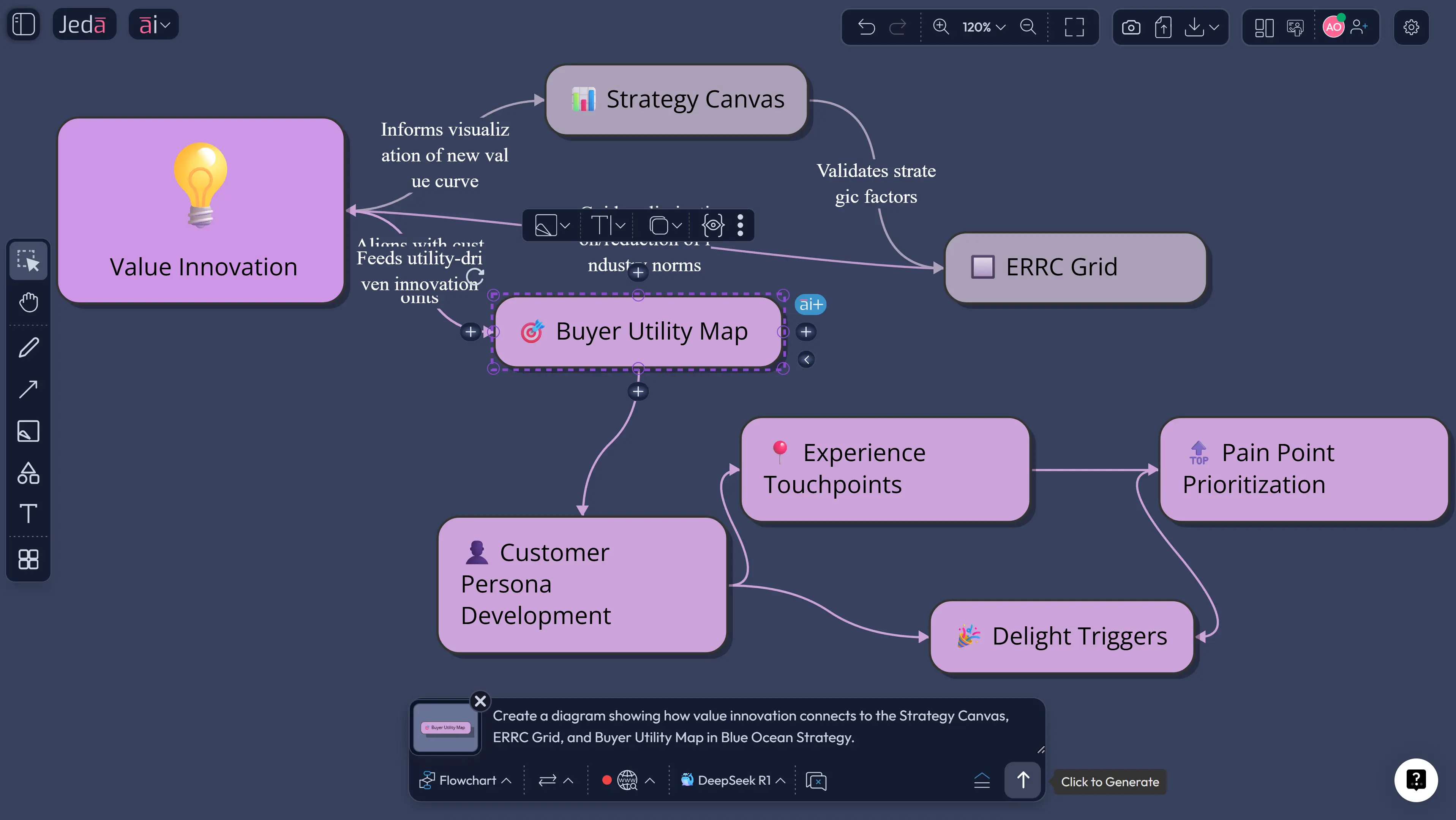
In Jeda.ai, AI can help identify where buyer value is weak, where cost is bloated, and where the category may be stuck inside old assumptions. It can also help connect value innovation work to adjacent Blue Ocean tools — especially the Strategy Canvas, ERRC Grid, and Buyer Utility Map.
- Link value to economics
Map buyer utility and cost implications on one board instead of treating value design and operating economics as separate conversations.
- Surface new combinations
Use AI to test plausible ways an offering could become more useful and more economically coherent at the same time.
- Keep strategy collaborative
Let founders, consultants, product leaders, and operators work from one editable AI Workspace instead of scattered files.
- Extend with AI+
Use AI+ to turn promising value-innovation moves into segment hypotheses, messaging directions, or execution questions.
The deeper advantage is intellectual discipline. A value innovation canvas forces teams to ask whether the whole system makes sense. Not whether one feature feels exciting.
How to create a Value Innovation Canvas in Jeda.ai
Because value innovation sits inside Jeda.ai's Blue Ocean framework cluster, the AI Menu is the recommended place to start when you want a structured first pass. The Prompt Bar is useful when you want a more customized canvas for a category, segment, or business model twist.
Method 1: Recipe Matrix
Open Jeda.ai, enter your AI Workspace, and click the AI Menu. Under Strategy & Planning, choose Blue Ocean Framework, then select Value Innovation Canvas. Add the market context, offering type, target buyer, and any cost or differentiation tensions you want the canvas to explore. Then choose your layout and AI model.
This route is best when you want a framework-native starting point instead of improvising the structure from scratch.
Method 2: Prompt Bar
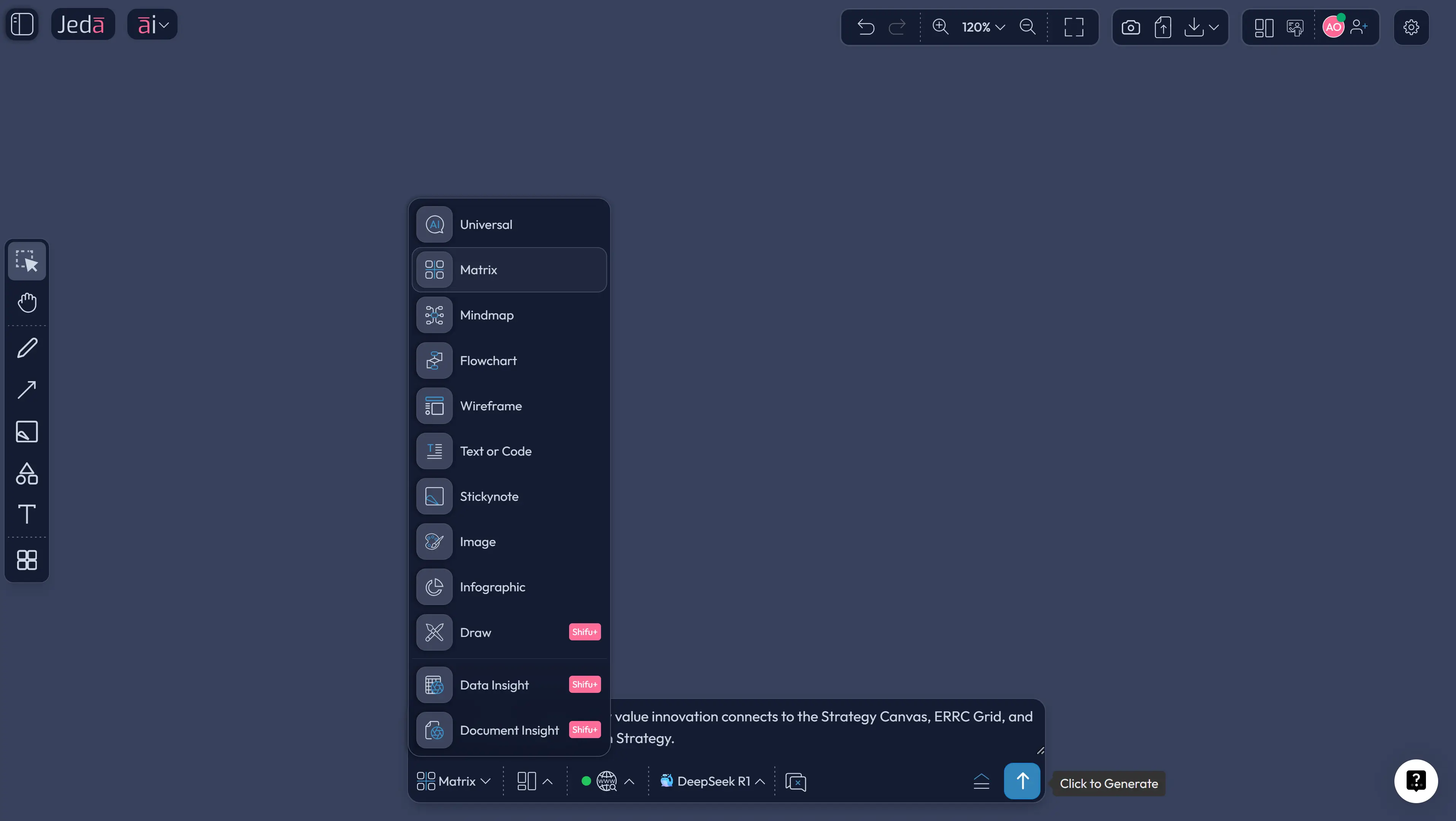
Open the Prompt Bar at the bottom of the canvas and select the Matrix command. Then type a prompt that names the category, buyer, and value-cost problem you want to explore. For example: “Create a value innovation canvas for a direct-to-consumer mattress brand that wants to reduce returns and logistics costs while increasing trust, trial confidence, and buying simplicity.”
After the board is generated, refine the notes directly on the canvas, use AI+ to deepen the most promising moves, and use Vision Transform if you want to convert the output into another visual representation.
- Open your AI Workspace
Log in to Jeda.ai and enter the workspace where you want to build the value innovation canvas.
- Choose the Blue Ocean recipe
Click AI Menu, open Strategy & Planning, choose Blue Ocean Framework, and select Value Innovation Canvas.
- Define the strategic tension
Enter the market, buyer, and the value-cost trade-off your team wants to challenge.
- Generate the first canvas
Pick a layout and AI model, then generate the value innovation canvas as an editable board.
- Inspect the whole system
Mark where utility is weak, where cost is overbuilt, and where new combinations could create a leap in value.
- Create an alternate version
Use the Matrix command in the Prompt Bar to generate a second canvas for another segment or strategic angle.
- Extend with AI+
Use AI+ to deepen the strongest ideas into pricing implications, buyer utility hypotheses, or adjacent Blue Ocean moves.
- Export the working board
When the canvas is ready, export it as PNG, SVG, or PDF while keeping the editable version in Jeda.ai.
Value Innovation Canvas template and example
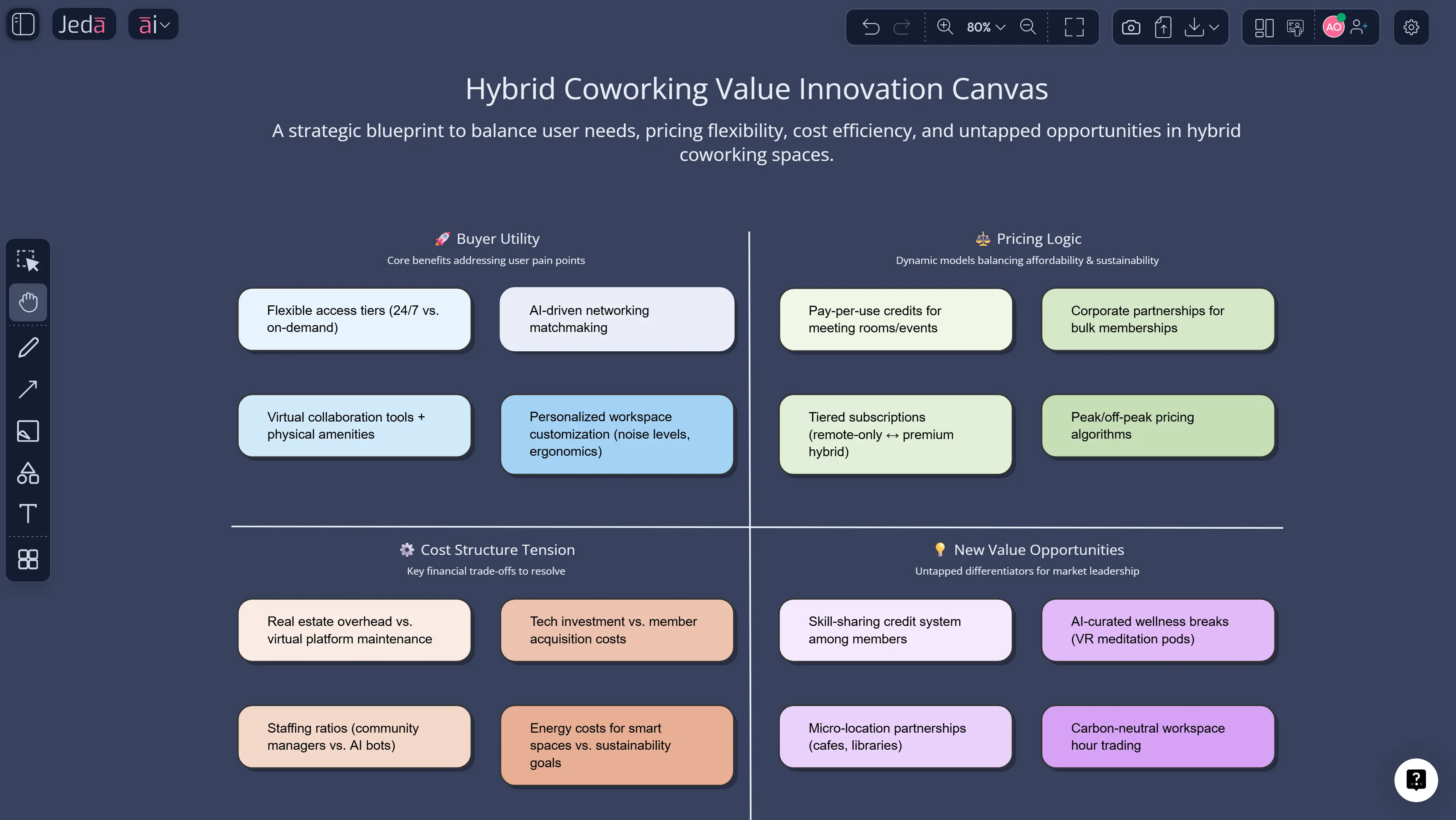
Picture a coworking company trying to grow in a market full of sameness. Everyone offers desks, Wi-Fi, meeting rooms, and aesthetic branding. The company keeps adding more perks, more room types, more packages. Costs rise. Differentiation barely moves.
A value innovation canvas gives the team a harder question to answer: what combination of utility, pricing logic, and delivery model would create a leap in value without bloating the system?
In one version, the company reduces underused premium add-ons, simplifies membership tiers, raises reliability and neighborhood relevance, and creates a hybrid membership built around guaranteed quiet zones, flexible local access, and on-demand professional hosts for small team sessions. That does not sound flashy. Good. It sounds coherent.
Inside Jeda.ai, the team can compare that future-state canvas against the current model on the same AI Whiteboard. They can challenge assumptions, use AI+ to extend the strongest ideas, and connect the output to an ERRC Grid or Strategy Canvas. That is where value innovation shifts from concept to operating choice.
Best practices for a Value Innovation Canvas that is more than a buzzword
The companies that move first are rarely the ones with the longest feature list. They are the ones that design a cleaner logic for value.Common mistakes to avoid
One mistake is treating value innovation like branding language instead of system design. That leads to attractive copy and weak economics.
Another is using the canvas only to justify adding more value. In many categories, the real move comes from simplification, reduction, or removal.
Third, some teams separate value and cost conversations. That defeats the point. The framework matters because it asks whether both can be improved together.
Fourth, people often skip buyer evidence and build the canvas from executive intuition alone. That is risky, especially in mature categories.
Finally, teams sometimes stop after one version. The better habit is to build at least two or three plausible canvases, then compare them against utility, feasibility, and strategic coherence.
Frequently asked questions
- What is value innovation?
- Value innovation is the simultaneous pursuit of differentiation and low cost. In Blue Ocean Strategy, Kim and Mauborgne describe it as the cornerstone of creating a leap in value for both buyers and the company.
- What is a value innovation canvas?
- A value innovation canvas is a practical way to visualize the core logic of value innovation. It helps teams map buyer utility, pricing logic, cost implications, and new strategic choices on one editable framework.
- How is a value innovation canvas related to Blue Ocean Strategy?
- It is rooted in the central Blue Ocean concept of value innovation. In practice, teams often use the canvas alongside the Strategy Canvas, ERRC Grid, and Buyer Utility Map to design more coherent blue-ocean moves.
- Can I create a value innovation canvas with AI?
- Yes. In Jeda.ai, you can generate a value innovation canvas through the AI Menu recipe or by selecting the Matrix command in the Prompt Bar. AI helps compare alternatives and deepen promising value-cost ideas.
- Is value innovation just about lowering prices?
- No. Lower price can be part of the logic, but the idea is broader. The goal is to increase buyer value while improving the economics of the offering, not simply to discount.
- What usually goes wrong in value innovation work?
- Teams often add features without redesigning the whole system, or they separate value and cost into different conversations. That weakens the strategic logic and keeps the business trapped in familiar trade-offs.
- Why use an AI Workspace for this framework?
- An AI Workspace keeps the canvas editable, collaborative, and connected to adjacent frameworks. Instead of a static diagram, you get a working board where prompts, revisions, notes, and follow-on strategy stay in one place.
- Does Jeda.ai support exporting the value innovation canvas?
- Yes. You can export the final board from Jeda.ai in PNG, SVG, or PDF while keeping the editable working version in the AI Whiteboard.
Sources & further reading
- [1]
Kim, W. Chan; Mauborgne, Renée (2026) . “Value Innovation” Blue Ocean Strategy Tools and Frameworks.
View Source ↗ - [2]
Kim, W. Chan; Mauborgne, Renée (2004) . “Value Innovation: The Strategic Logic of High Growth” Harvard Business Review.
View Source ↗ - [3]
Kim, W. Chan; Mauborgne, Renée (2004) . “Blue Ocean Strategy” Harvard Business Review.
View Source ↗
Continue the cluster with Strategy Canvas with AI, ERRC Grid with AI, and Buyer Experience Cycle with AI. For the broader product context, explore /ai-workspace and /ai-whiteboard.
Build a Value Innovation Canvas in Jeda.ai
Join over 150,000+ users who use Jeda.ai's AI Workspace and AI Whiteboard to turn value innovation from theory into editable strategic design.
Try Free Template