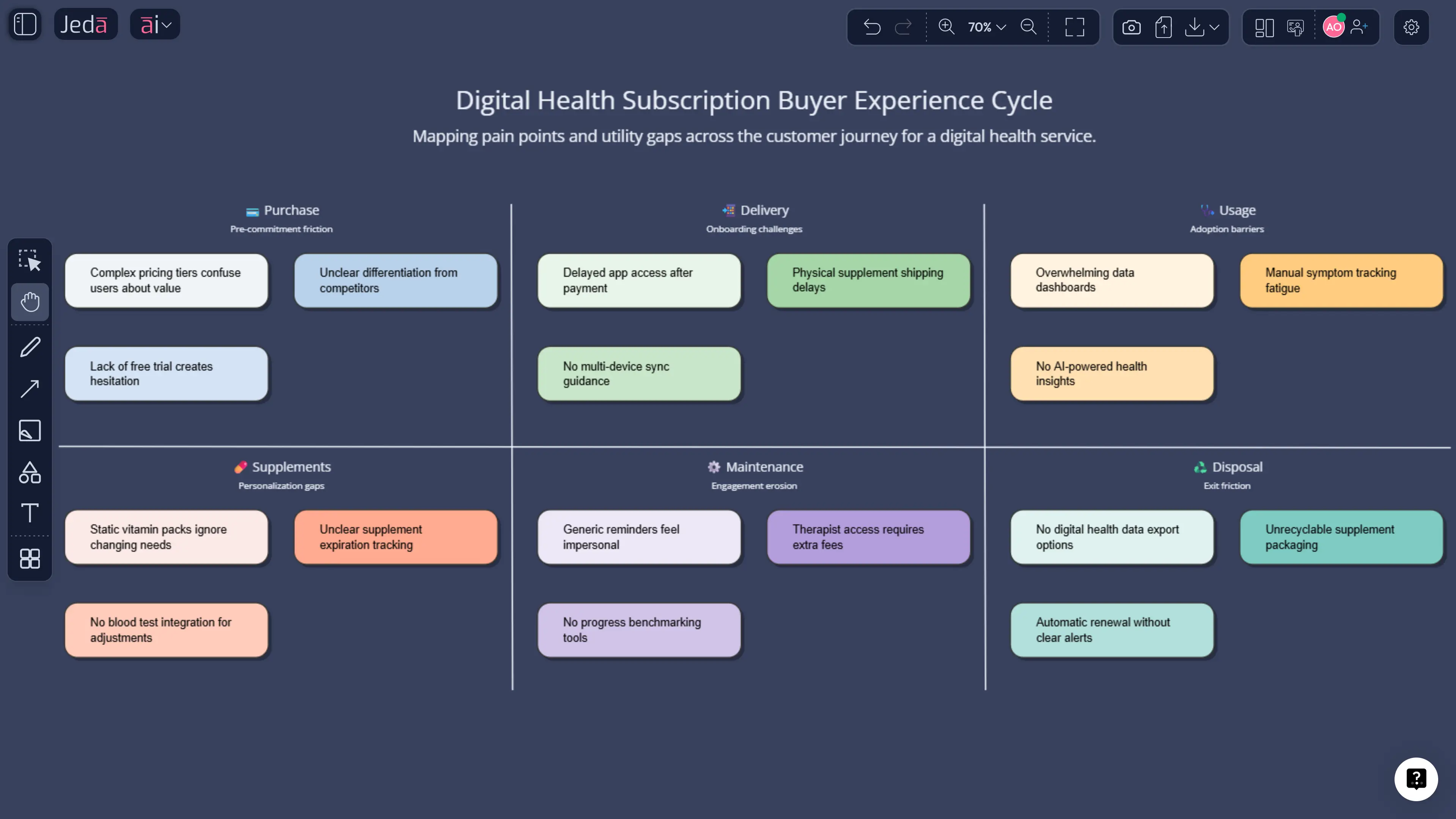
The buyer experience cycle looks deceptively simple. Six stages. One journey. A neat framework. But once you actually use it, the framework exposes something most strategy decks politely ignore: buyers do not judge your offering only at the moment of purchase. They judge it across the whole experience — from purchase to disposal. That is why the buyer experience cycle still matters inside modern strategy work, and why it becomes far more useful when built in Jeda.ai, an AI Workspace and AI Whiteboard designed for editable strategic thinking.
W. Chan Kim and Renée Mauborgne position the Buyer Experience Cycle, or BEC, as one dimension of the Buyer Utility Map. The six stages — purchase, delivery, use, supplements, maintenance, and disposal — help managers identify where buyer utility is blocked and where new demand could be unlocked. Put less formally, BEC forces you to look beyond what you sell and inspect what people actually go through. That is where strategy gets real.
Inside Jeda.ai, you can generate the matrix, annotate pain points, compare buyer segments, and use the AI+ button to extend any stage into deeper analysis. Because Jeda.ai supports 300+ strategic frameworks in one Visual AI workspace, BEC does not sit alone on the board. You can connect it to the Buyer Utility Map, ERRC Grid, Strategy Canvas, and Three Tiers of Noncustomers without losing context. The platform is already used by 150,000+ users who want strategic work to stay editable rather than fossilize inside static slides.
What is the Buyer Experience Cycle?
The buyer experience cycle is a framework that maps the sequence of experiences buyers move through when engaging with a product or service. In Blue Ocean Strategy, Kim and Mauborgne describe six broad stages: purchase, delivery, use, supplements, maintenance, and disposal. These stages form the horizontal dimension of the Buyer Utility Map.
That detail matters because strategy teams often overfocus on the sale. They optimize messaging, price, and channel — then stop. BEC does the opposite. It widens the lens. It asks where effort, delay, confusion, risk, or annoyance shows up across the whole experience.
A strong BEC exercise is not just a customer journey map with a new label. It is a diagnostic framework for identifying utility blocks that competitors overlook. When you build the cycle inside Jeda.ai, the framework becomes a working object in an AI Workspace. Your team can challenge assumptions, cluster pain points, and attach follow-up ideas on the same AI Whiteboard instead of scattering the thinking across workshop notes and cleanup decks.
Why use the Buyer Experience Cycle with AI?
The manual version of BEC tends to collapse for a boring reason: teams forget half the journey. Purchase gets overanalyzed. Delivery gets a few sticky notes. Disposal gets ignored like an awkward relative at a wedding. AI helps because it expands recall, suggests missing friction points, and makes it easier to compare how different buyer types experience the same stages.
In Jeda.ai, AI can help you generate the six-stage structure, identify likely pain points, and separate operational issues from buyer-visible issues. That last distinction is huge. A company may be obsessed with internal workflow efficiency while buyers are actually stuck at onboarding, replenishment, or disposal. One is an internal process problem. The other is where blue-ocean opportunity lives.
- Surface hidden pain points
AI helps teams identify friction that buyers actually feel across all six stages instead of clustering every issue around purchase.
- Build a true demand-side view
Keep the analysis grounded in buyer experience rather than internal org charts, team ownership, or feature wish lists.
- Compare segments on one board
Map how different buyer groups experience the same cycle and where their blocks to utility diverge.
- Extend with AI+
Use AI+ to turn stage-level pain points into hypotheses, redesign options, and adjacent blue-ocean ideas without leaving the board.
There is also a practical advantage. BEC is rarely the end of the analysis. It is the setup. Once you find the blocks, you usually want to map them against the six utility levers or move into ERRC decisions. Keeping the work inside Jeda.ai makes that transition clean.
How to create a Buyer Experience Cycle in Jeda.ai
Because this Blue Ocean subtype exists as a structured recipe in Jeda.ai, the recommended starting point is the AI Menu. The Prompt Bar is useful when you want a more customized first draft, an industry-specific stage interpretation, or a segment-specific variant.
Method 1: Recipe Matrix
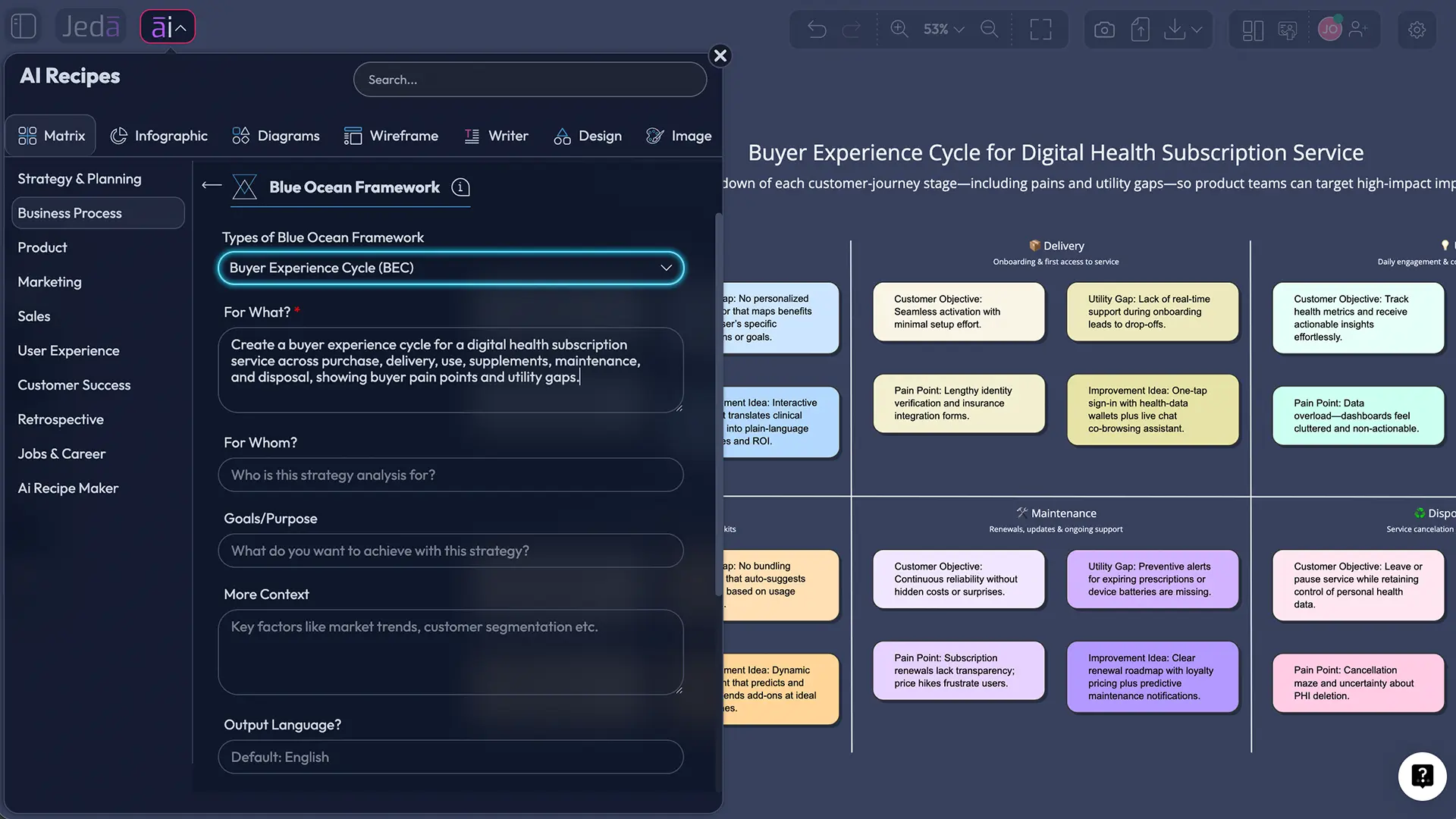
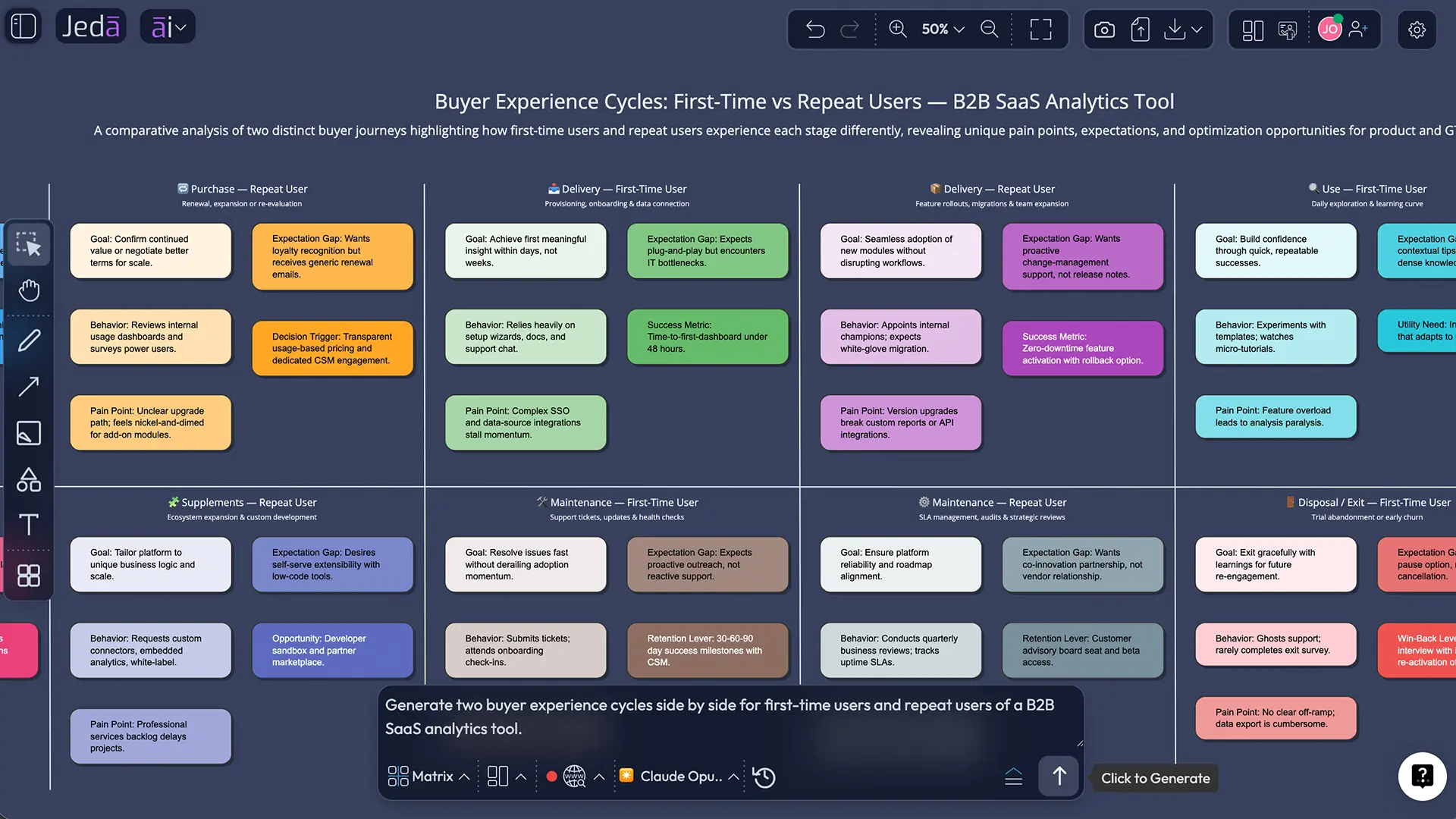
Open Jeda.ai, enter your preferred AI Workspace, and click the AI Menu in the top-left corner. Under Strategy & Planning, choose Blue Ocean Framework, then select Buyer Experience Cycle. Add the product or service context, the buyer type, the market conditions, and any known friction you want the framework to analyze. Then choose a layout and AI model.
This route is best when you want a clear, ready-made structure and a faster start.
Method 2: Prompt Bar
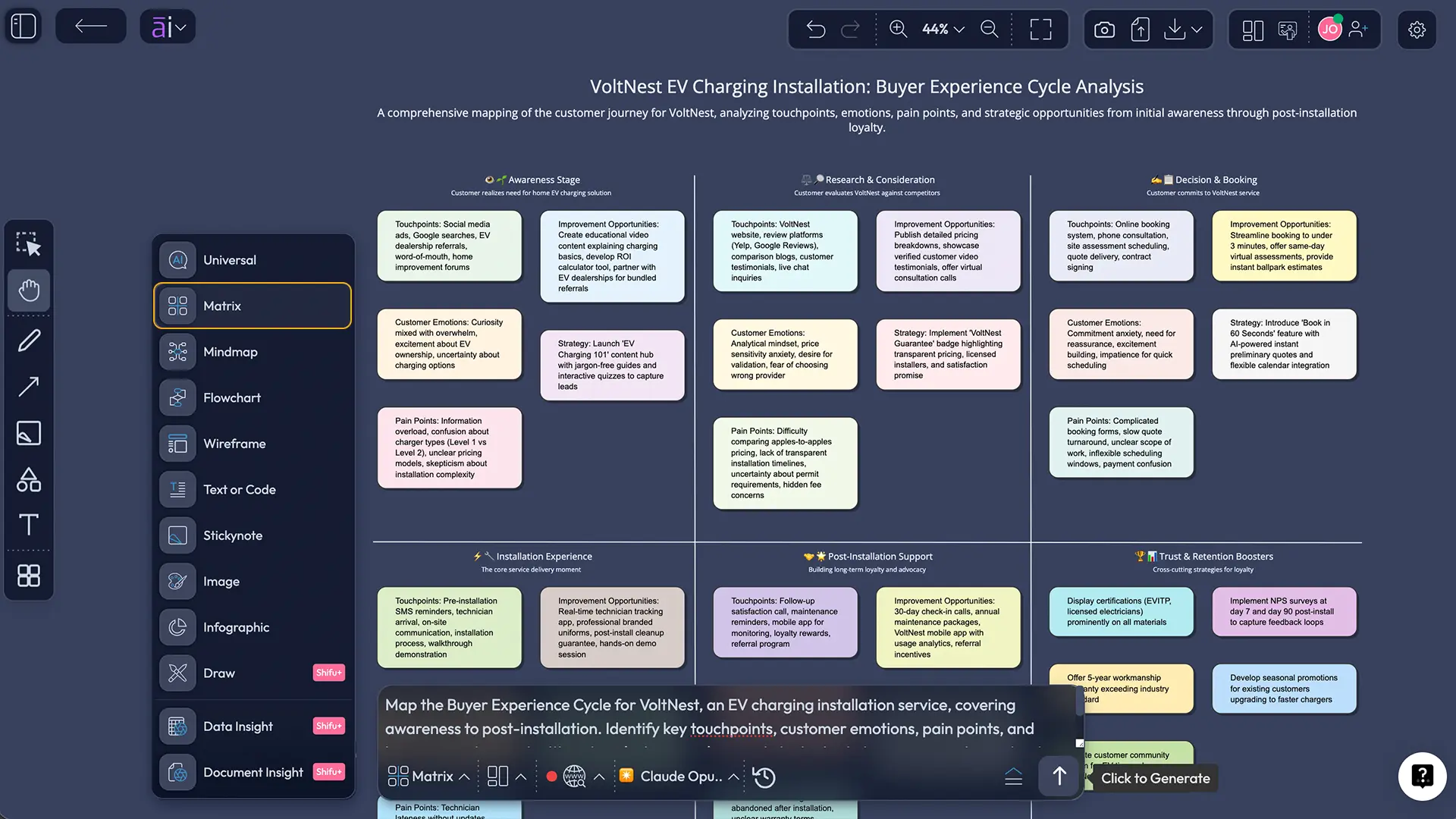
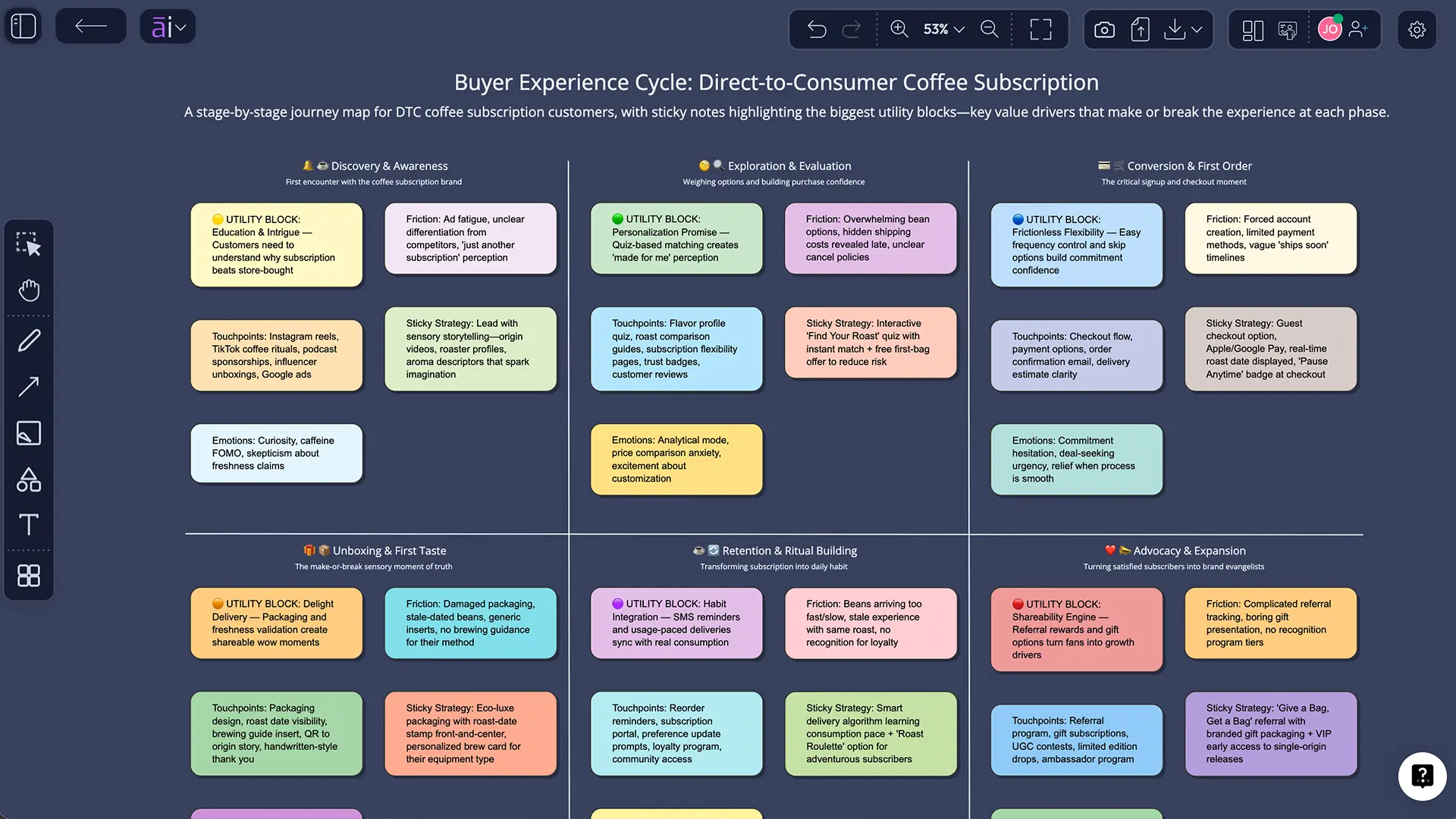
Open the Prompt Bar at the bottom of the canvas and select the Matrix command. Then write a prompt that names the offering, the target buyer, and the six stages you want examined. Be specific about the setting. “Create a BEC” is weak. “Create a buyer experience cycle for a home EV charger service for apartment dwellers, highlighting purchase, installation coordination, daily use, required supplements, maintenance, and disposal concerns” is much better.
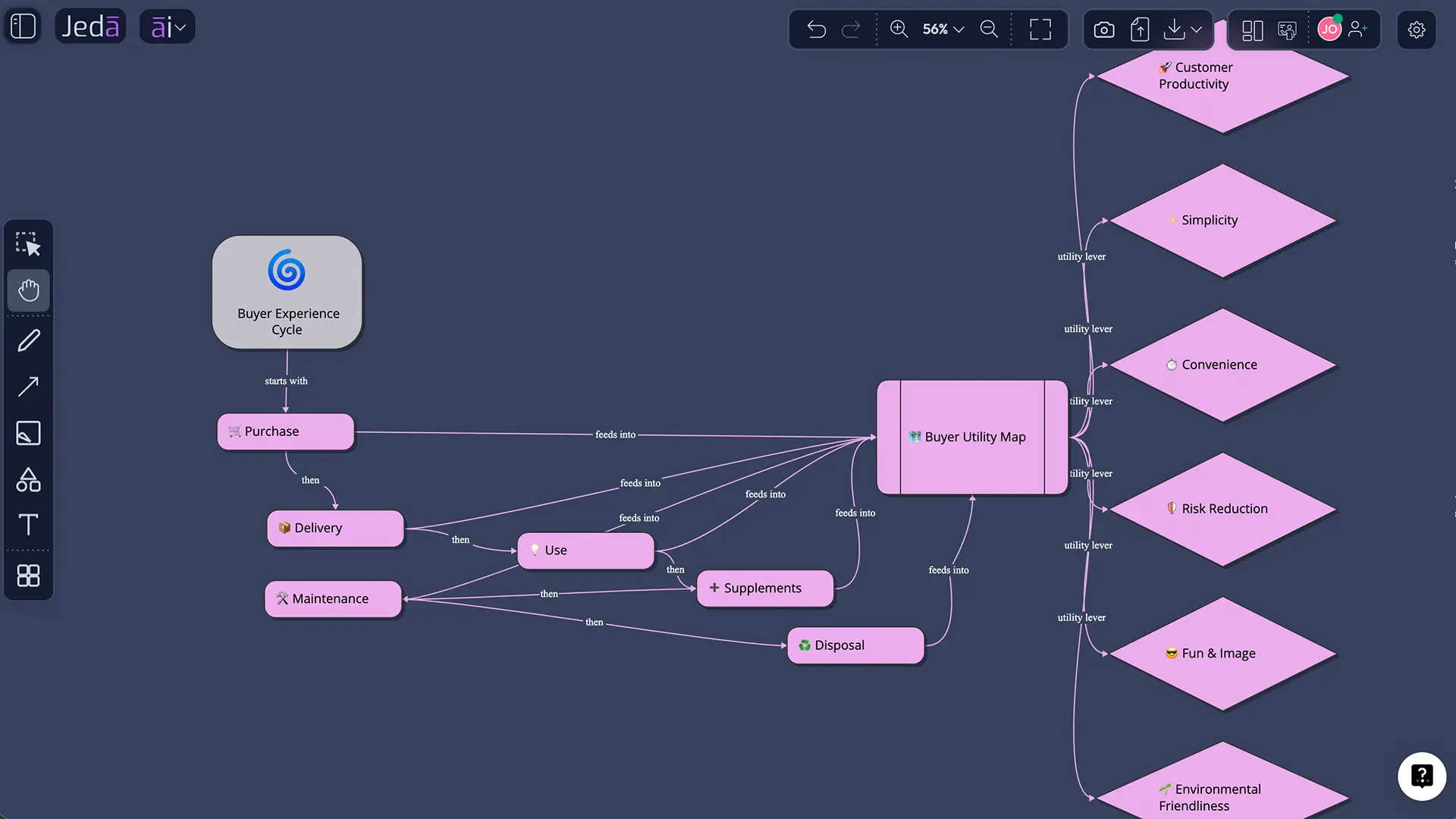
After generation, edit the notes directly on the board, use AI+ to extend any stage into deeper reasoning, and use Vision Transform if you want to convert the analysis into another visual structure such as a diagram or flowchart.
- Open your AI Workspace
Log in to Jeda.ai and enter the workspace where you want to build the buyer experience cycle.
- Choose the Blue Ocean recipe
Click AI Menu, open Strategy & Planning, choose Blue Ocean Framework, and select Buyer Experience Cycle.
- Define the buyer and context
Enter the product or service, the buyer group, and any market context or assumptions that should shape the matrix.
- Generate the first BEC draft
Pick your layout and model, then generate the six-stage matrix as an editable board.
- Refine the stage logic
Adjust stage labels if your industry needs slight tailoring, but keep the buyer experience central.
- Identify utility blocks
Add sticky notes for friction, delay, confusion, cost, inconvenience, or risk that buyers face at each stage.
- Run a second pass in the Prompt Bar
Use the Matrix command to create a tighter or segment-specific version for comparison.
- Extend with AI+ and export
Use AI+ to expand the most important stages, then export the board as PNG, SVG, or PDF.
Buyer Experience Cycle template and example
Consider a telemedicine platform that thinks its problem is customer acquisition cost. Marketing wants better ad performance. Finance wants lower CAC. Leadership wants more retention. Nobody is wrong, exactly. But they are all working from partial pictures.
A BEC view tells a different story.
At the purchase stage, buyers are uncertain about pricing and insurance compatibility. At delivery, they wait too long to get access credentials and intake paperwork. During use, the video experience is fine, but supplements are weak because diagnostics, referrals, and prescription coordination feel fragmented. Maintenance is clumsy because follow-up reminders are generic, and disposal is barely considered even though patients worry about cancelation, data portability, and continued prescription access.
That is a more useful strategic picture than “CAC is rising.” It shows where utility is blocked across the actual buyer experience. Inside Jeda.ai, that BEC can then be linked to the six utility levers to identify whether the biggest issue is convenience, risk reduction, simplicity, or customer productivity. That is where a framework begins to produce strategic movement instead of decorative analysis.
Best practices for a Buyer Experience Cycle that leads somewhere
Checklist
- Keep the unit of analysis at the buyer level. Internal departmental pain is not the same thing as buyer friction.
- Use the six canonical stages first, then adapt lightly if the industry genuinely requires it.
- Document specific moments of friction, not vague labels like 'poor experience' or 'needs improvement.
- Map different buyer segments separately when their experience cycles diverge in meaningful ways.
- Connect BEC outputs to the six utility levers so the analysis moves from journey observation to strategic action.
- Keep the matrix editable in Jeda.ai so your AI Whiteboard becomes a living demand-side reference.
The biggest win with BEC is not the diagram. It is the discipline. It forces teams to stop pretending the product begins at launch and ends at checkout.
Common mistakes to avoid
The first mistake is confusing BEC with a generic funnel. A funnel is about conversion movement. BEC is about the lived sequence of buyer experience.
The second mistake is focusing only on purchase and use. Those are visible, so teams overinvest there. Delivery, supplements, maintenance, and disposal often contain the more interesting blue-ocean openings.
Third, many teams document frustrations without ranking them. Not every irritation deserves strategic attention. The useful question is where the biggest block to utility sits.
Fourth, some teams fill the board with internal metrics instead of buyer experience evidence. That makes the matrix look busy and say very little.
Finally, teams often stop after diagnosis. The better move is to push the analysis forward into utility levers, ERRC choices, or a revised value curve.
Frequently asked questions
- What is the Buyer Experience Cycle in Blue Ocean Strategy?
- The Buyer Experience Cycle, or BEC, is a six-stage framework used in Blue Ocean Strategy to examine how buyers experience a product or service from purchase through disposal. It helps teams identify where buyer utility is blocked and where new demand might be unlocked.
- What are the six stages of the Buyer Experience Cycle?
- The six stages are purchase, delivery, use, supplements, maintenance, and disposal. Together they provide a broad structure for examining the total buyer experience rather than focusing only on the point of sale.
- How is BEC different from a customer journey map?
- A customer journey map can be very detailed and channel-specific. BEC is more strategic. It provides a standardized lens for identifying utility blocks across the whole buyer experience and is commonly used with the Buyer Utility Map in Blue Ocean Strategy.
- What comes after the Buyer Experience Cycle?
- Teams usually connect BEC to the six utility levers, then move into value innovation decisions. In practice, many people follow BEC with the Buyer Utility Map, ERRC Grid, or Four Actions Framework.
- Can I create a Buyer Experience Cycle with AI?
- Yes. In Jeda.ai, you can generate a Buyer Experience Cycle through the Blue Ocean Framework recipe or by selecting the Matrix command in the Prompt Bar. AI helps you draft the structure, surface likely friction points, and extend the analysis.
- What does BEC stand for?
- BEC stands for Buyer Experience Cycle. It is the short form commonly used when discussing the framework in workshops, planning sessions, and Blue Ocean Strategy analysis.
- Why build BEC in an AI Workspace instead of slides?
- Slides are fine for presenting a finished view, but not for building one. An AI Workspace keeps the matrix editable, collaborative, and connected to prompts, revisions, and follow-up framework work on the same board.
- Does Jeda.ai support exporting a BEC board?
- Yes. You can collaborate on the framework in Jeda.ai and export the board in PNG, SVG, or PDF while keeping the working version inside the AI Whiteboard.
Sources & further reading
- [1]
Kim, W. Chan; Mauborgne, Renée (2004) . “Blue Ocean Strategy” Harvard Business Review.
View Source ↗ - [2]
Kim, W. Chan; Mauborgne, Renée (2026) . “Buyer Utility Map” Blue Ocean Strategy Tools and Frameworks.
View Source ↗ - [3]
Kim, W. Chan; Mauborgne, Renée (2021) . “Blue Ocean Toolkit” Blue Ocean Strategy.
View Source ↗
Continue the Blue Ocean cluster with Strategy Canvas with AI, ERRC Grid with AI, and Three Tiers of Noncustomers with AI. For the product context, see /ai-workspace and /ai-whiteboard.
Build a Buyer Experience Cycle in Jeda.ai
Join over 150,000+ users who use Jeda.ai's AI Workspace and AI Whiteboard to turn customer friction into editable, visual strategic analysis.
Try Free Template