A surprising number of strategy teams treat innovation like a launch event. Big reveal. New deck. Fresh language. Temporary excitement. Then the market shifts, competitors copy the visible bits, and the once-brilliant move starts hardening into the very sameness it was meant to escape. That is why Dynamic Value Innovation is a useful idea. It treats value innovation not as a one-time act, but as a moving discipline.
In classic Blue Ocean thinking, value innovation means pursuing differentiation and low cost at the same time, creating a leap in value for both buyers and the company. In Jeda.ai, the Dynamic Value Innovation framework works as a practical Blue Ocean sub-framework built around that principle: keep reassessing what buyers value, where costs can be reshaped, and how the offering must evolve before the market catches up. Inside Jeda.ai, an AI Workspace and AI Whiteboard for editable strategic work, that becomes a living board instead of a static innovation story.
Because Jeda.ai includes 300+ strategic frameworks and is used by 150,000+ users, teams can connect dynamic value work to Strategy Canvas, ERRC, Buyer Experience, and portfolio decisions on the same Visual AI canvas. That is where it gets interesting.
What is Dynamic Value Innovation?
At its foundation, Dynamic Value Innovation builds on Kim and Mauborgne’s value innovation logic: create a leap in buyer value while aligning utility, price, and cost. The “dynamic” part matters because value does not stand still. Buyer expectations shift. Industry norms creep upward. Competitors imitate visible features. Cost structures change. Channels change. Sometimes the emotional meaning of the category changes too.
So a value innovation that worked brilliantly two years ago can become ordinary today.
That is the problem this framework tries to solve. In Jeda.ai, Dynamic Value Innovation is best understood as a recurring working board for scanning changes, challenging assumptions, and deciding where to refresh the offering before advantage fades. Rather than treating innovation as a single breakthrough moment, the framework helps teams keep buyer value, delivery, and cost logic in motion.
Inside an AI Workspace, that means you can map what buyers valued yesterday, what they value now, what is becoming table stakes, and where the next leap may come from. It is strategic maintenance, yes. But not the dull kind.
Why use Dynamic Value Innovation with AI?
Because drift is expensive.
A lot of companies do the hard work of creating a differentiated offer, then stop examining it with the same intensity. AI helps because it can surface market shifts, summarize evolving buyer preferences, and structure the conversation around where value is rising, flattening, or becoming costly to defend.
In Jeda.ai, AI can help teams compare earlier assumptions with current realities, identify which parts of the offer still feel distinctive, and propose ways to refresh the value equation. Better yet, the framework stays editable in an AI Whiteboard where teams can test several responses instead of committing too early to one interpretation.
- Keep value logic current
Revisit what buyers care about before your last innovation quietly turns into industry baseline.
- Track shifting buyer priorities
Use AI to summarize changes in buyer expectations, category norms, and emerging trade-offs that affect the value equation.
- Reconnect value and cost
Dynamic innovation is not only about new features. It also tests where cost, price, and delivery need to move with the market.
- Extend with AI+
Use AI+ to deepen scenarios, rewrite value propositions, and generate next-step experiments inside the same Jeda.ai board.
There is also a very practical reason to do this in Jeda.ai: your team can keep the last version and the next version side by side. That sounds small. It is not. Strategy gets better when people can see what changed and why.
How to create Dynamic Value Innovation in Jeda.ai
Because Dynamic Value Innovation belongs to the Blue Ocean framework set in Jeda.ai, the AI Menu recipe is the recommended entry point. Use the Prompt Bar when you need a sharper market-specific version or want to compare several refresh options quickly.
Method 1: Recipe Matrix
Open Jeda.ai, enter your AI Workspace, and click the AI Menu. Under Strategy & Planning, choose Blue Ocean Framework, then select Dynamic Value Innovation. Enter your current offer, what buyers valued previously, what seems to be changing now, and where cost or delivery pressures are emerging. Then choose your layout and AI model.
This method gives you a structured board for analyzing how value innovation should evolve instead of ossify.
Method 2: Prompt Bar
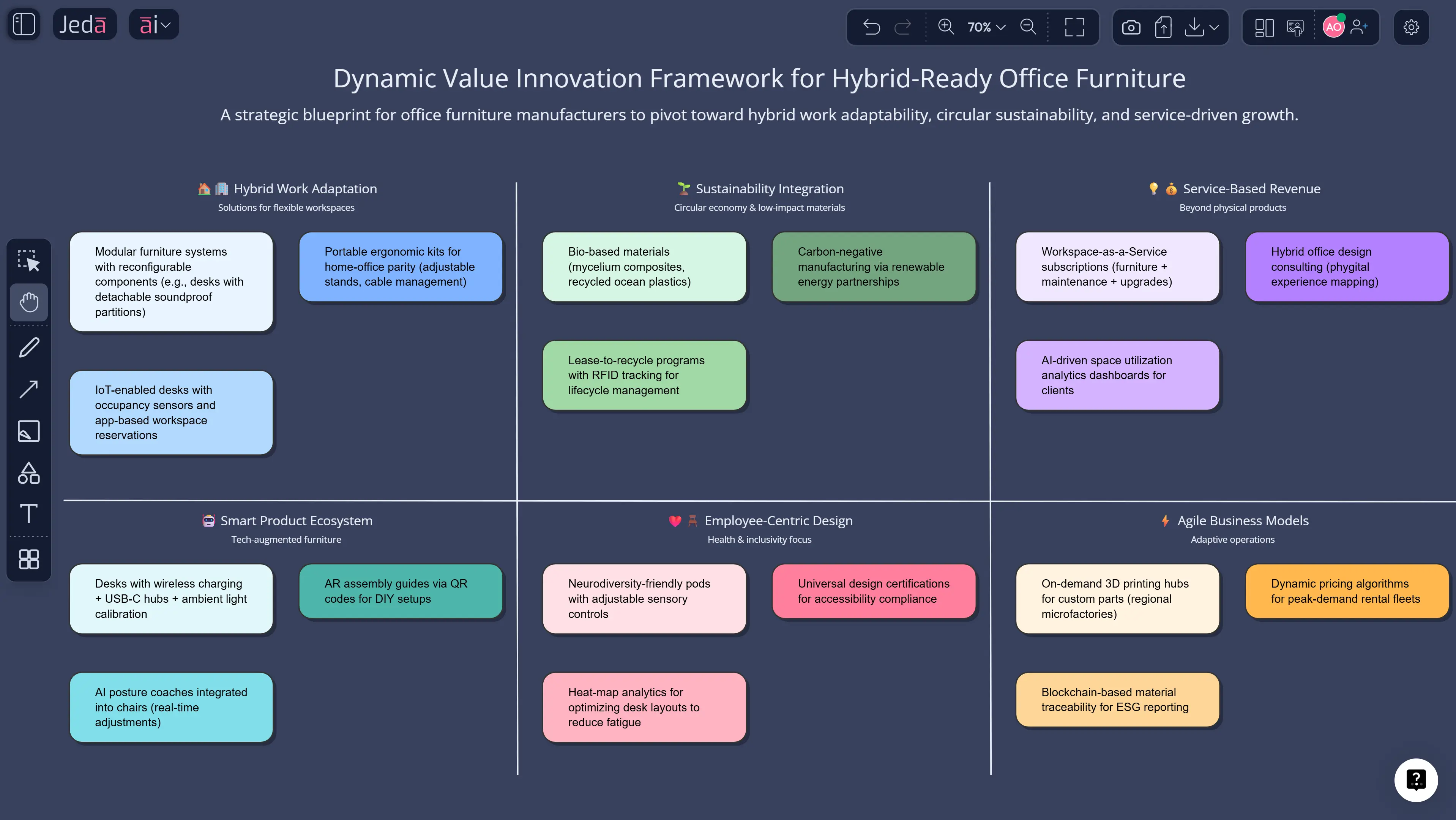
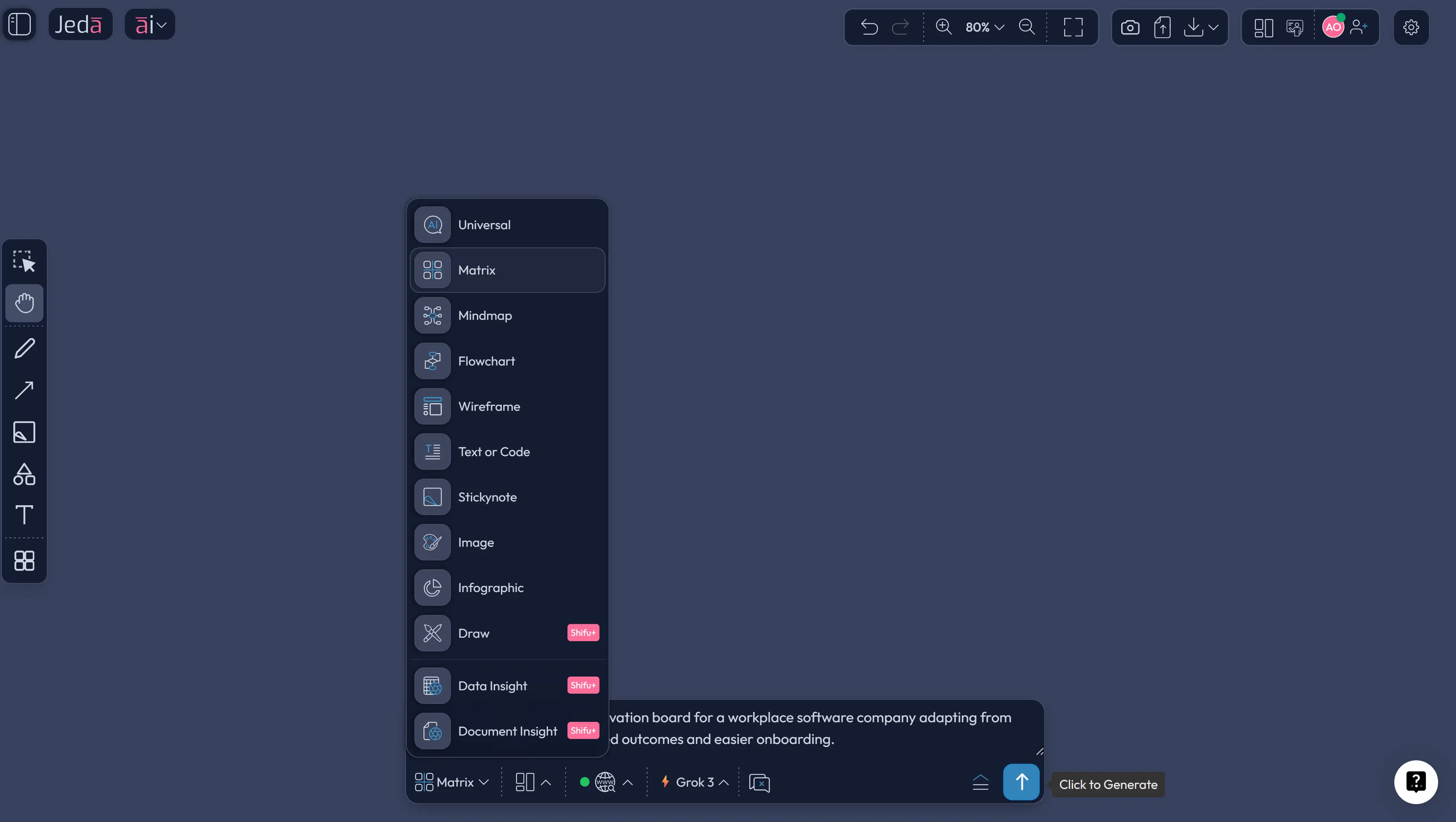
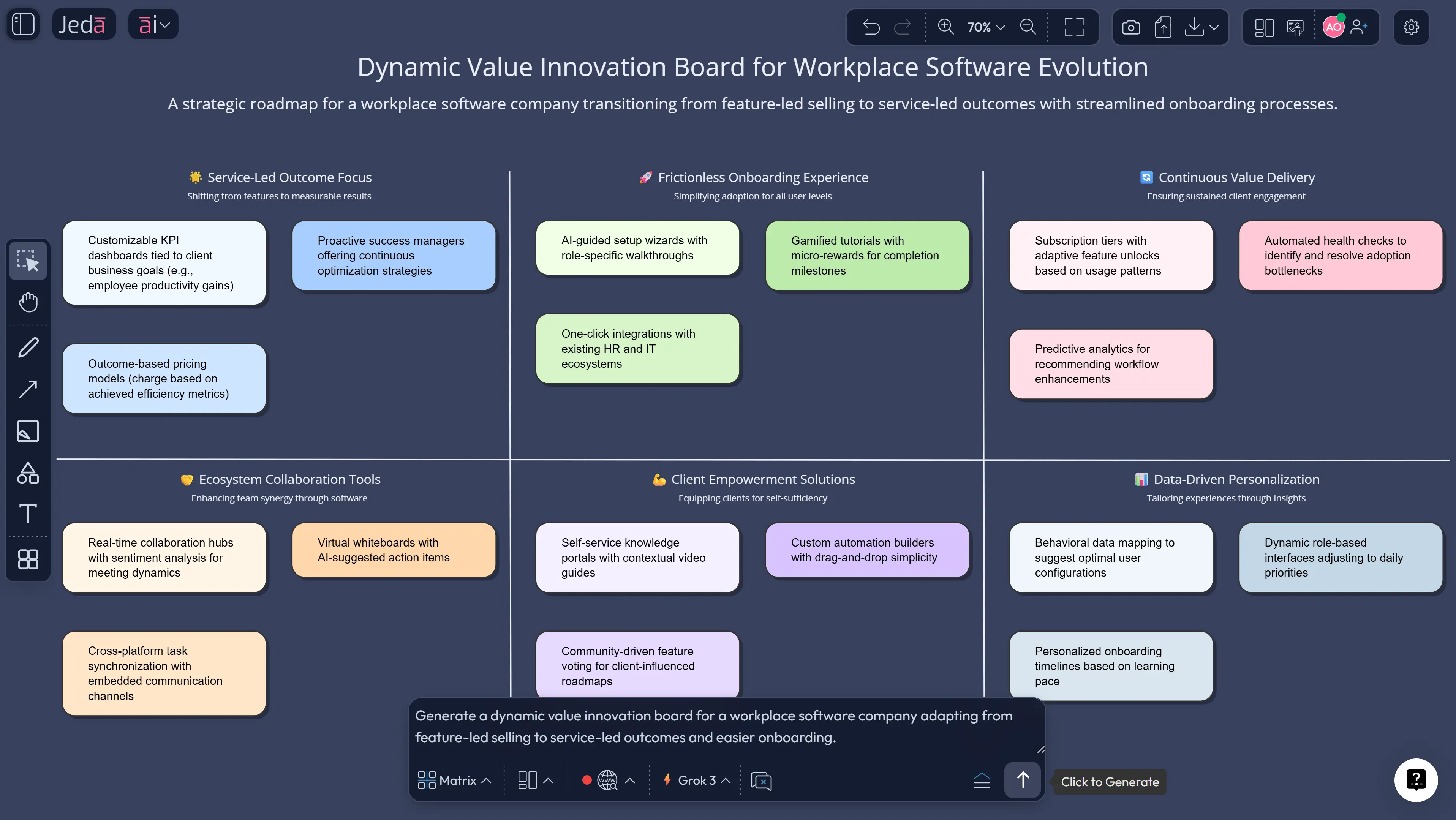
Open the Prompt Bar at the bottom of the canvas and select the Matrix command. Then write a prompt that names the offer, the market shift, and the tension you want examined. For example: “Create a dynamic value innovation board for an office furniture manufacturer adapting to hybrid work, sustainability expectations, shorter buying cycles, and the rise of subscription-style workplace services.”
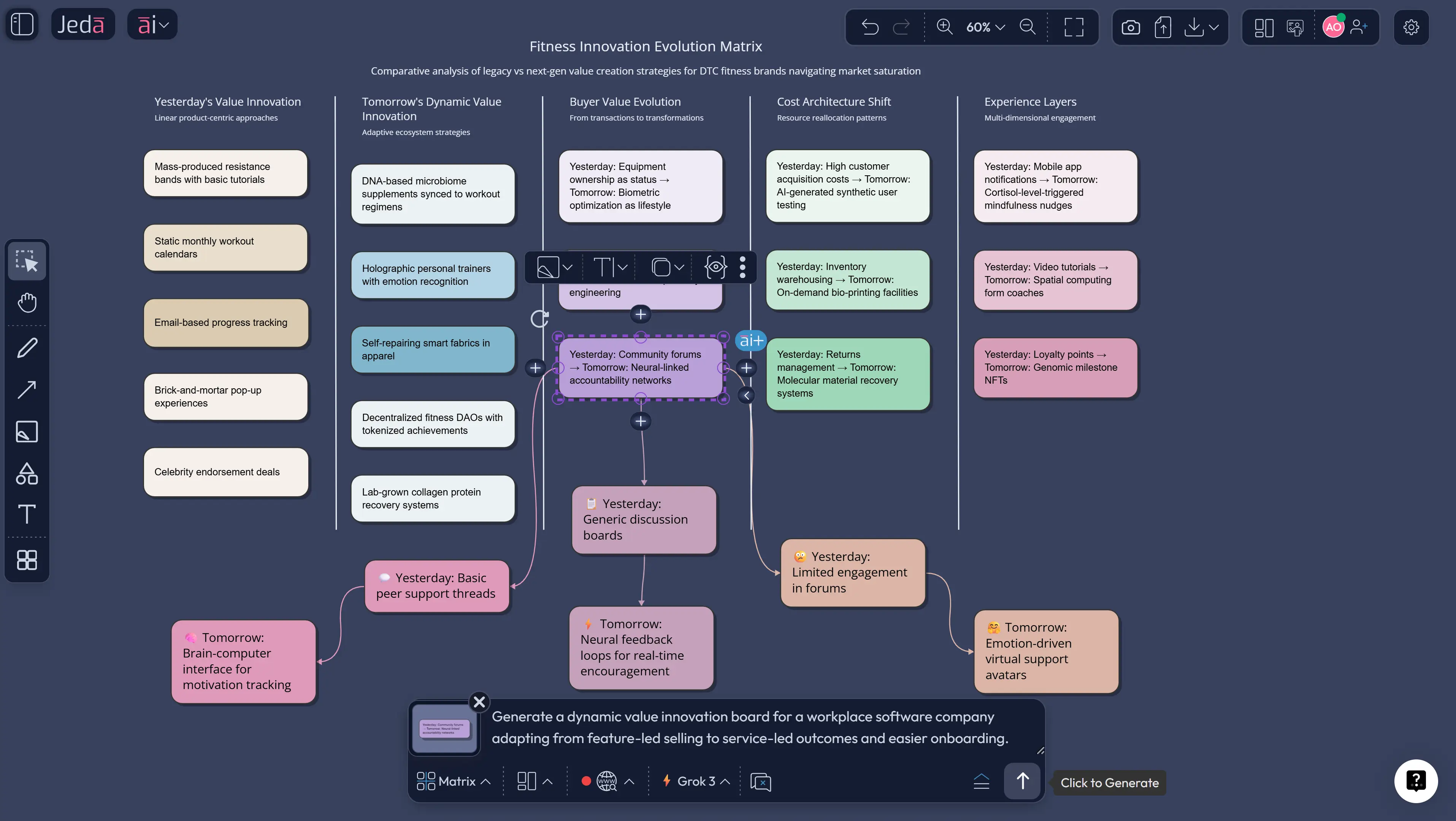
After generation, edit assumptions directly, use AI+ to deepen the next move, and use Vision Transform if you want to convert the board into a roadmap, flowchart, or prioritized action plan. Export from Jeda.ai in PNG, SVG, or PDF when you are ready to share.
- Open your AI Workspace
Log in to Jeda.ai and enter the workspace where you want to build the Dynamic Value Innovation board.
- Choose the Blue Ocean recipe
Click AI Menu, open Strategy & Planning, choose Blue Ocean Framework, and select Dynamic Value Innovation.
- Describe the current offer
Enter the product, service, or business model along with the buyer value it currently creates.
- Add the market shift
Describe what is changing in buyer expectations, industry standards, delivery models, or cost pressures.
- Generate the first dynamic board
Pick a layout and AI model, then generate an editable matrix showing where value should be refreshed.
- Run a custom Prompt Bar pass
Select the Matrix command and create a second version focused on a different segment, geography, or future scenario.
- Use AI+ to extend the next move
Tap the AI+ button to deepen experiments, rewrite the value proposition, or explore how costs and delivery should change.
- Export while keeping it live
Export the final board as PNG, SVG, or PDF and keep the editable version inside Jeda.ai for future refresh cycles.
Dynamic Value Innovation template and example
Consider an office furniture manufacturer that built its success around stylish, ergonomic products for centralized offices.
Then work changed.
Hybrid arrangements spread. Buyers cared more about flexibility, fast delivery, smaller-batch ordering, sustainability, and workspace-as-a-service options. The old offer did not become useless. It became incomplete.
A static strategy response might tweak the catalog and call it innovation. A Dynamic Value Innovation board is more demanding. It asks which parts of the value proposition are still distinctive, which have become table stakes, which cost structures are now working against the business, and what new mix of product, service, delivery, and pricing could create the next leap.
In Jeda.ai, that can live on one AI Whiteboard: the original value logic on the left, current market shifts in the middle, and potential refreshed value moves on the right. Teams can attach evidence, compare paths, and use AI+ to extend one promising option into a sharper business hypothesis. That is a better way to protect a blue ocean move from decaying into a familiar red one.
Best practices for keeping value innovation alive
Common mistakes to avoid
The first mistake is confusing continuous feature addition with dynamic value innovation. More stuff is not the same as a better value equation.
Second, teams often watch competitors too closely and buyers too little. That tends to produce reactive upgrades instead of meaningful shifts.
Third, some organizations treat cost as a back-office issue when the framework explicitly depends on aligning utility, price, and cost.
Fourth, there is a temptation to defend the original innovation story long after parts of it have become ordinary.
And finally, many teams try to refresh value without keeping a visible record of what changed. That makes learning sloppy and repeatability weak.
Frequently asked questions
- What is Dynamic Value Innovation?
- Dynamic Value Innovation is a practical Blue Ocean-style framework for revisiting and refreshing value innovation as market conditions change. It helps teams reassess what buyers value, what is becoming standard, and where the next leap in value should come from.
- How does it relate to classic value innovation?
- Classic value innovation is about pursuing differentiation and low cost at the same time. The dynamic version keeps that logic alive by revisiting the value equation as buyer expectations, costs, and category norms change over time.
- Can I create Dynamic Value Innovation boards with AI?
- Yes. In Jeda.ai, you can generate a Dynamic Value Innovation board through the Blue Ocean recipe or by selecting the Matrix command in the Prompt Bar. AI helps summarize market shifts and structure the next value move.
- Why use an AI Workspace for Dynamic Value Innovation?
- An AI Workspace keeps the framework editable and comparative. Teams can place previous and next value logic side by side, challenge assumptions, and keep the innovation discussion connected to related strategic frameworks.
- Who should use Dynamic Value Innovation?
- It is useful for strategy consultants, product leaders, innovation teams, founders, and business leaders who need to keep an offer relevant as the market evolves.
- What should go into the framework?
- The board should include the current offer, the existing buyer value logic, the market shifts affecting that logic, and the actions needed to refresh value, price, delivery, or cost alignment.
- What comes after Dynamic Value Innovation analysis?
- Teams often move from this framework into Strategy Canvas revisions, ERRC choices, service redesign, or roadmap prioritization. The board shows where the next value leap could be built.
- Does Jeda.ai support exporting the board?
- Yes. Jeda.ai lets teams export the framework in PNG, SVG, or PDF while keeping the editable source board inside the AI Whiteboard.
Sources & further reading
- [1]
Kim, W. Chan; Mauborgne, Renée (2004) . “Value Innovation: The Strategic Logic of High Growth” Harvard Business Review.
View Source ↗ - [2]
Kim, W. Chan; Mauborgne, Renée (2025) . “Value Innovation” Blue Ocean Strategy Tools.
View Source ↗ - [3]
Kim, W. Chan; Mauborgne, Renée (2004) . “Blue Ocean Strategy” Harvard Business Review.
View Source ↗ - [4]
Hajar, M. A.; others (2022) . “The Effect of Value Innovation in the Superior Performance and Sustainable Growth of Telecommunications Sector” Sustainability.
View Source ↗
Continue the Blue Ocean cluster with Value Innovation Canvas with AI, ERRC Grid with AI, and Six Utility Levers with AI. For the broader product pages, visit /ai-workspace and /ai-whiteboard.
Create your Dynamic Value Innovation board in Jeda.ai
Join over 150,000+ users who use Jeda.ai's AI Workspace and AI Whiteboard to keep value innovation editable, visible, and alive as markets change.
Try Free Template